
Strategy maps and cascading
Printable study notes to use alongside Part B.4.
Read the handout text
Accounting Ahead | Original study resource | accountingahead.com.au
Strategy maps and cascading
MODULE 5 | PART B.4 | STUDENT COMPANION
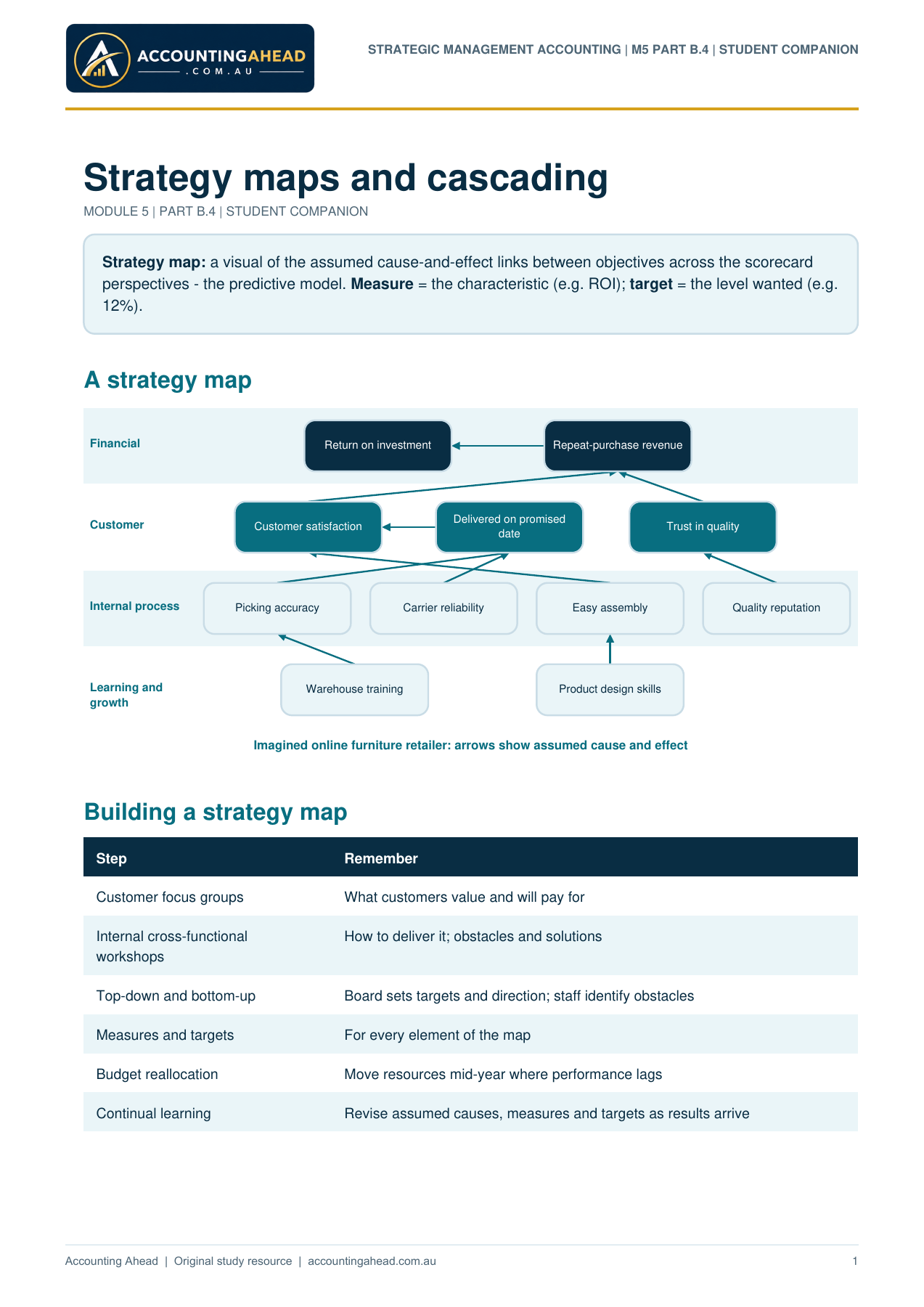
Strategy map: a visual of the assumed cause-and-effect links between objectives across the scorecard
perspectives - the predictive model. Measure = the characteristic (e.g. ROI); target = the level wanted (e.g.
12%).
A strategy map
Financial
Customer
Internal process
Learning and
growth
Return on investment Repeat-purchase revenue
Customer satisfaction Delivered on promised
date Trust in quality
Picking accuracy Carrier reliability Easy assembly Quality reputation
Warehouse training Product design skills
Imagined online furniture retailer: arrows show assumed cause and effect
Building a strategy map
Step Remember
Customer focus groups What customers value and will pay for
Internal cross-functional
workshops
How to deliver it; obstacles and solutions
Top-down and bottom-up Board sets targets and direction; staff identify obstacles
Measures and targets For every element of the map
Budget reallocation Move resources mid-year where performance lags
Continual learning Revise assumed causes, measures and targets as results arrive
STRATEGIC MANAGEMENT ACCOUNTING | M5 PART B.4 | STUDENT COMPANION
1
Accounting Ahead | Original study resource | accountingahead.com.au
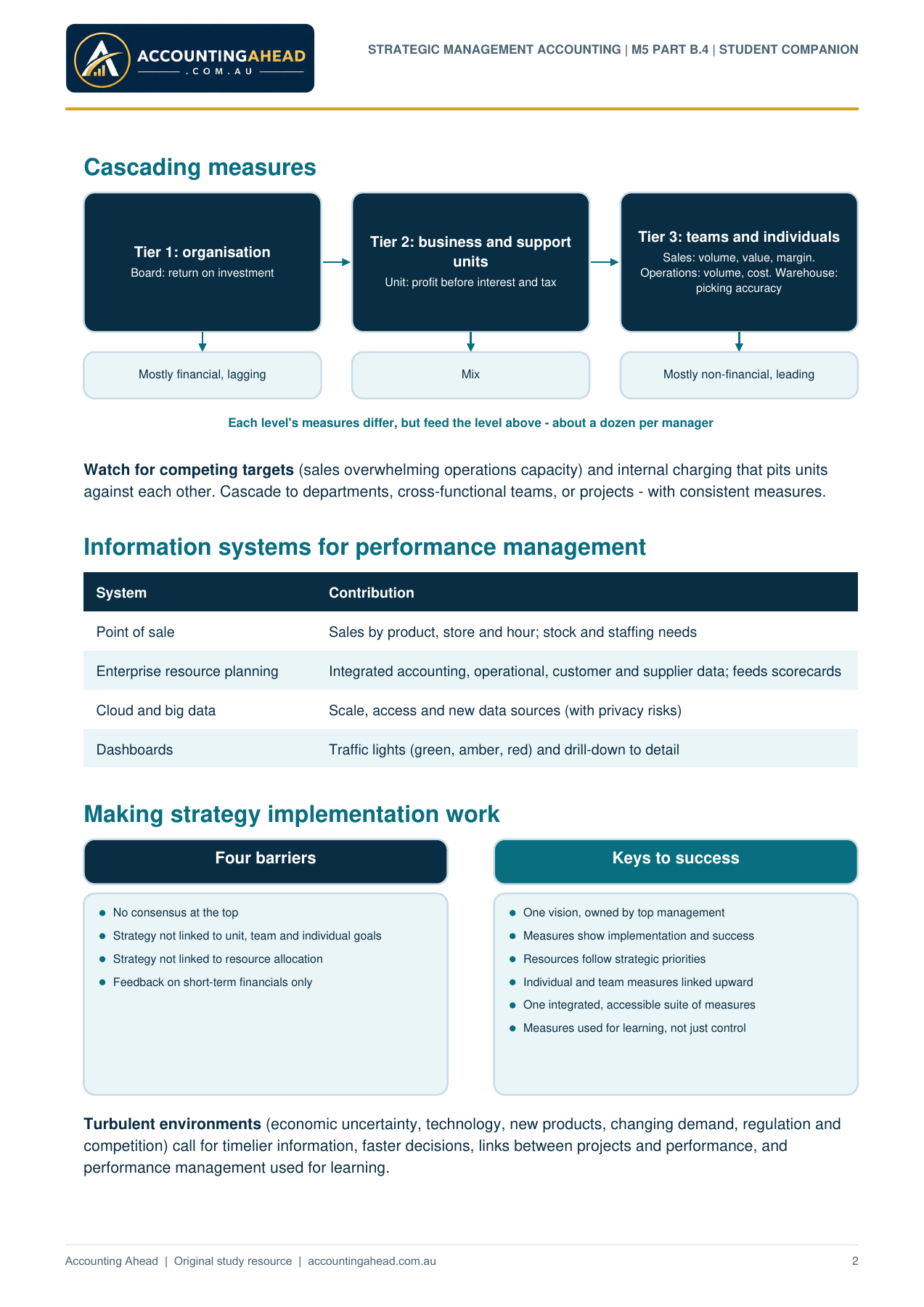
Cascading measures
Tier 1: organisation
Board: return on investment
Mostly financial, lagging
Tier 2: business and support
units
Unit: profit before interest and tax
Mix
Tier 3: teams and individuals
Sales: volume, value, margin.
Operations: volume, cost. Warehouse:
picking accuracy
Mostly non-financial, leading
Each level's measures differ, but feed the level above - about a dozen per manager
Watch for competing targets (sales overwhelming operations capacity) and internal charging that pits units
against each other. Cascade to departments, cross-functional teams, or projects - with consistent measures.
Information systems for performance management
System Contribution
Point of sale Sales by product, store and hour; stock and staffing needs
Enterprise resource planning Integrated accounting, operational, customer and supplier data; feeds scorecards
Cloud and big data Scale, access and new data sources (with privacy risks)
Dashboards Traffic lights (green, amber, red) and drill-down to detail
Making strategy implementation work
Four barriers
No consensus at the top
Strategy not linked to unit, team and individual goals
Strategy not linked to resource allocation
Feedback on short-term financials only
Keys to success
One vision, owned by top management
Measures show implementation and success
Resources follow strategic priorities
Individual and team measures linked upward
One integrated, accessible suite of measures
Measures used for learning, not just control
Turbulent environments (economic uncertainty, technology, new products, changing demand, regulation and
competition) call for timelier information, faster decisions, links between projects and performance, and
performance management used for learning.
STRATEGIC MANAGEMENT ACCOUNTING | M5 PART B.4 | STUDENT COMPANION
2
Accounting Ahead | Original study resource | accountingahead.com.au
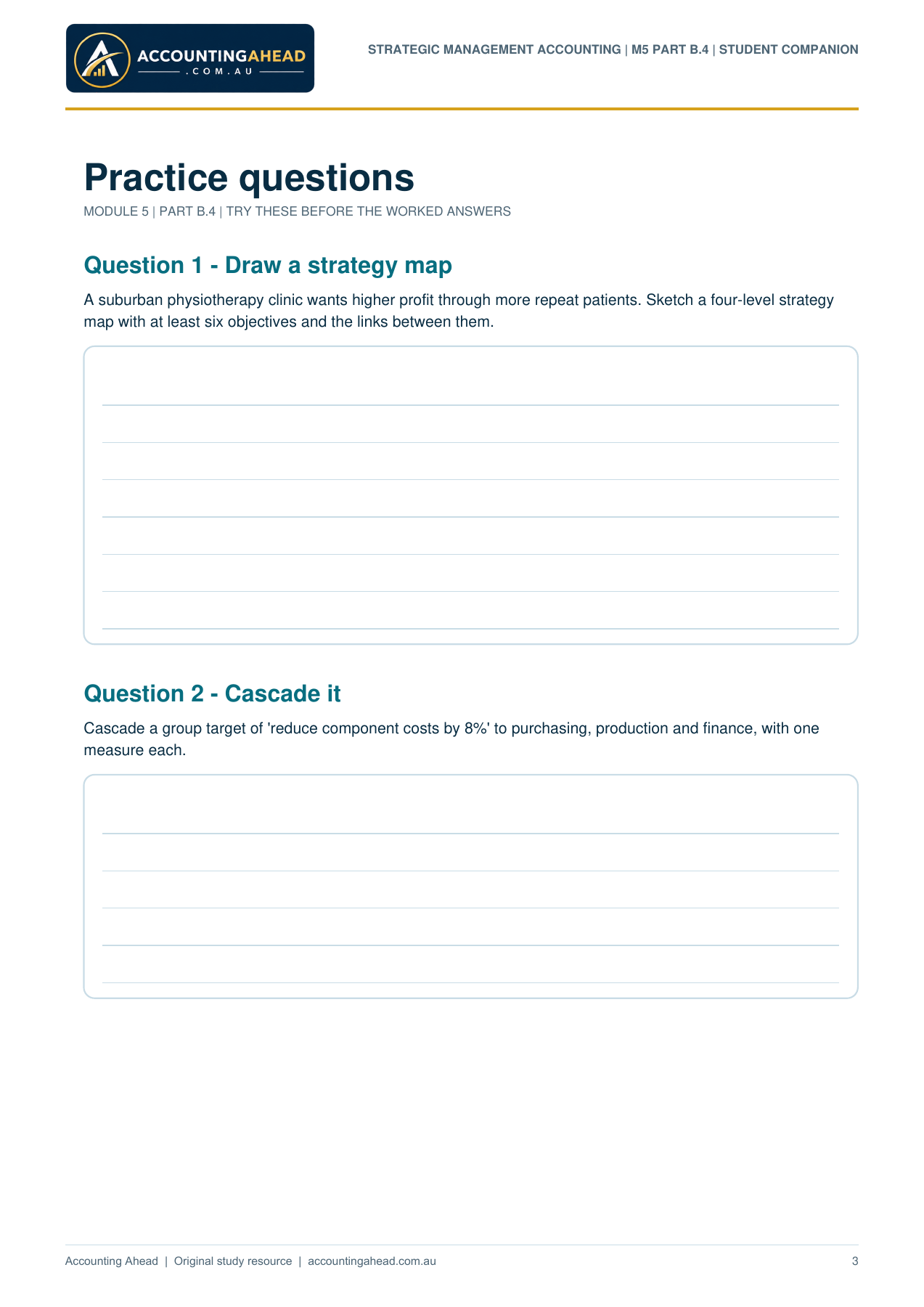
Practice questions
MODULE 5 | PART B.4 | TRY THESE BEFORE THE WORKED ANSWERS
Question 1 - Draw a strategy map
A suburban physiotherapy clinic wants higher profit through more repeat patients. Sketch a four-level strategy
map with at least six objectives and the links between them.
Question 2 - Cascade it
Cascade a group target of 'reduce component costs by 8%' to purchasing, production and finance, with one
measure each.
STRATEGIC MANAGEMENT ACCOUNTING | M5 PART B.4 | STUDENT COMPANION
3
Accounting Ahead | Original study resource | accountingahead.com.au
Question 3 - Barriers
Two directors disagree about strategy, and budgets are still set as last year plus 3%. Which barriers are present
and what would you recommend?
STRATEGIC MANAGEMENT ACCOUNTING | M5 PART B.4 | STUDENT COMPANION
4
Accounting Ahead | Original study resource | accountingahead.com.au
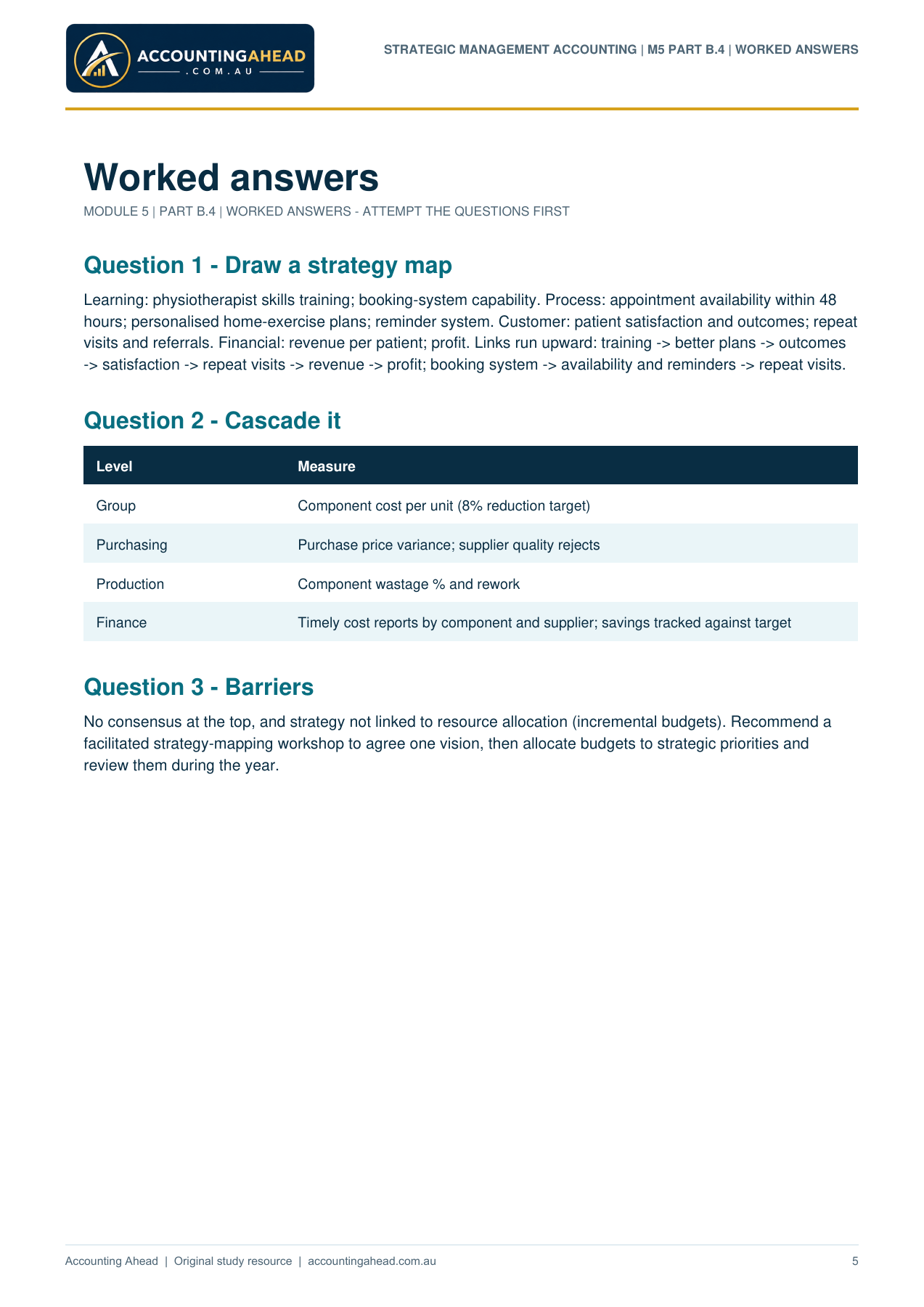
Worked answers
MODULE 5 | PART B.4 | WORKED ANSWERS - ATTEMPT THE QUESTIONS FIRST
Question 1 - Draw a strategy map
Learning: physiotherapist skills training; booking-system capability. Process: appointment availability within 48
hours; personalised home-exercise plans; reminder system. Customer: patient satisfaction and outcomes; repeat
visits and referrals. Financial: revenue per patient; profit. Links run upward: training -> better plans -> outcomes
-> satisfaction -> repeat visits -> revenue -> profit; booking system -> availability and reminders -> repeat visits.
Question 2 - Cascade it
Level Measure
Group Component cost per unit (8% reduction target)
Purchasing Purchase price variance; supplier quality rejects
Production Component wastage % and rework
Finance Timely cost reports by component and supplier; savings tracked against target
Question 3 - Barriers
No consensus at the top, and strategy not linked to resource allocation (incremental budgets). Recommend a
facilitated strategy-mapping workshop to agree one vision, then allocate budgets to strategic priorities and
review them during the year.
STRATEGIC MANAGEMENT ACCOUNTING | M5 PART B.4 | WORKED ANSWERS
5