
Behaviour, incentives and rewards
Printable study notes to use alongside Part C.3.
Read the handout text
Accounting Ahead | Original study resource | accountingahead.com.au
Behaviour, incentives and rewards
MODULE 5 | PART C.3 | STUDENT COMPANION
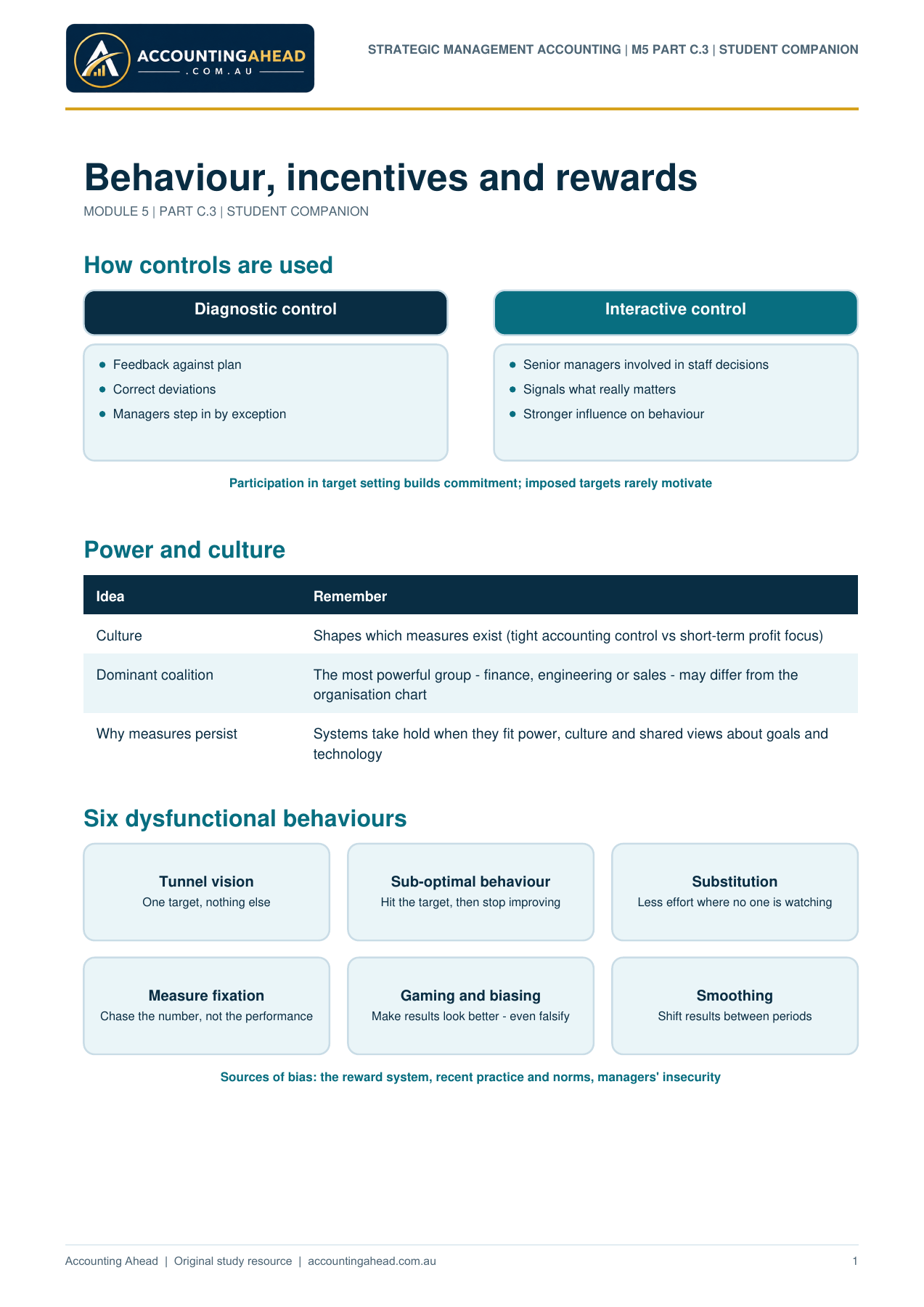
How controls are used
Diagnostic control
Feedback against plan
Correct deviations
Managers step in by exception
Interactive control
Senior managers involved in staff decisions
Signals what really matters
Stronger influence on behaviour
Participation in target setting builds commitment; imposed targets rarely motivate
Power and culture
Idea Remember
Culture Shapes which measures exist (tight accounting control vs short-term profit focus)
Dominant coalition The most powerful group - finance, engineering or sales - may differ from the
organisation chart
Why measures persist Systems take hold when they fit power, culture and shared views about goals and
technology
Six dysfunctional behaviours
Tunnel vision
One target, nothing else
Sub-optimal behaviour
Hit the target, then stop improving
Substitution
Less effort where no one is watching
Measure fixation
Chase the number, not the performance
Gaming and biasing
Make results look better - even falsify
Smoothing
Shift results between periods
Sources of bias: the reward system, recent practice and norms, managers' insecurity
STRATEGIC MANAGEMENT ACCOUNTING | M5 PART C.3 | STUDENT COMPANION
1
Accounting Ahead | Original study resource | accountingahead.com.au
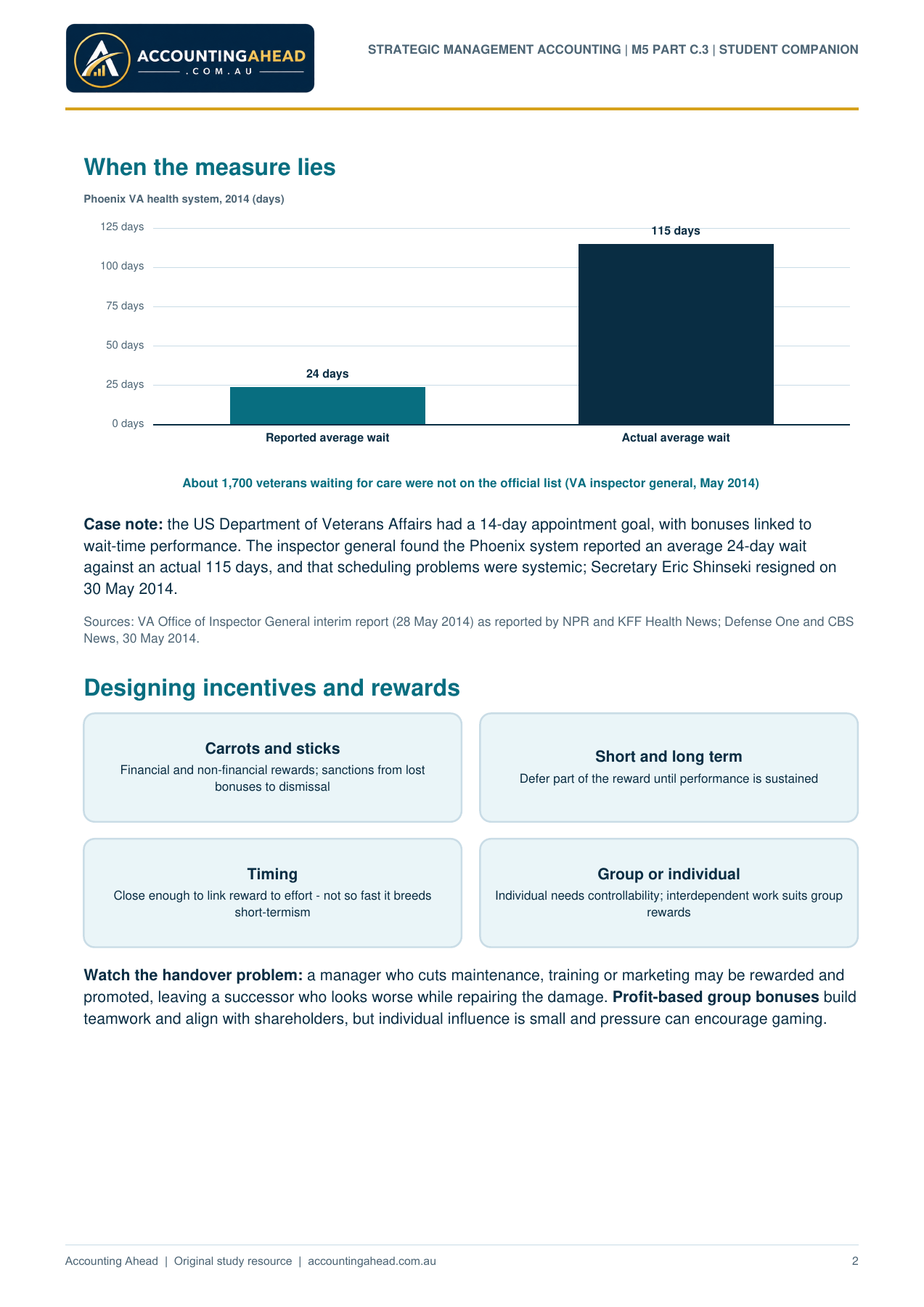
When the measure lies
0 days
25 days
50 days
75 days
100 days
125 days
24 days
Reported average wait
115 days
Actual average wait
Phoenix VA health system, 2014 (days)
About 1,700 veterans waiting for care were not on the official list (VA inspector general, May 2014)
Case note: the US Department of Veterans Affairs had a 14-day appointment goal, with bonuses linked to
wait-time performance. The inspector general found the Phoenix system reported an average 24-day wait
against an actual 115 days, and that scheduling problems were systemic; Secretary Eric Shinseki resigned on
30 May 2014.
Sources: VA Office of Inspector General interim report (28 May 2014) as reported by NPR and KFF Health News; Defense One and CBS
News, 30 May 2014.
Designing incentives and rewards
Carrots and sticks
Financial and non-financial rewards; sanctions from lost
bonuses to dismissal
Short and long term
Defer part of the reward until performance is sustained
Timing
Close enough to link reward to effort - not so fast it breeds
short-termism
Group or individual
Individual needs controllability; interdependent work suits group
rewards
Watch the handover problem: a manager who cuts maintenance, training or marketing may be rewarded and
promoted, leaving a successor who looks worse while repairing the damage. Profit-based group bonuses build
teamwork and align with shareholders, but individual influence is small and pressure can encourage gaming.
STRATEGIC MANAGEMENT ACCOUNTING | M5 PART C.3 | STUDENT COMPANION
2
Accounting Ahead | Original study resource | accountingahead.com.au
Practice questions
MODULE 5 | PART C.3 | TRY THESE BEFORE THE WORKED ANSWERS
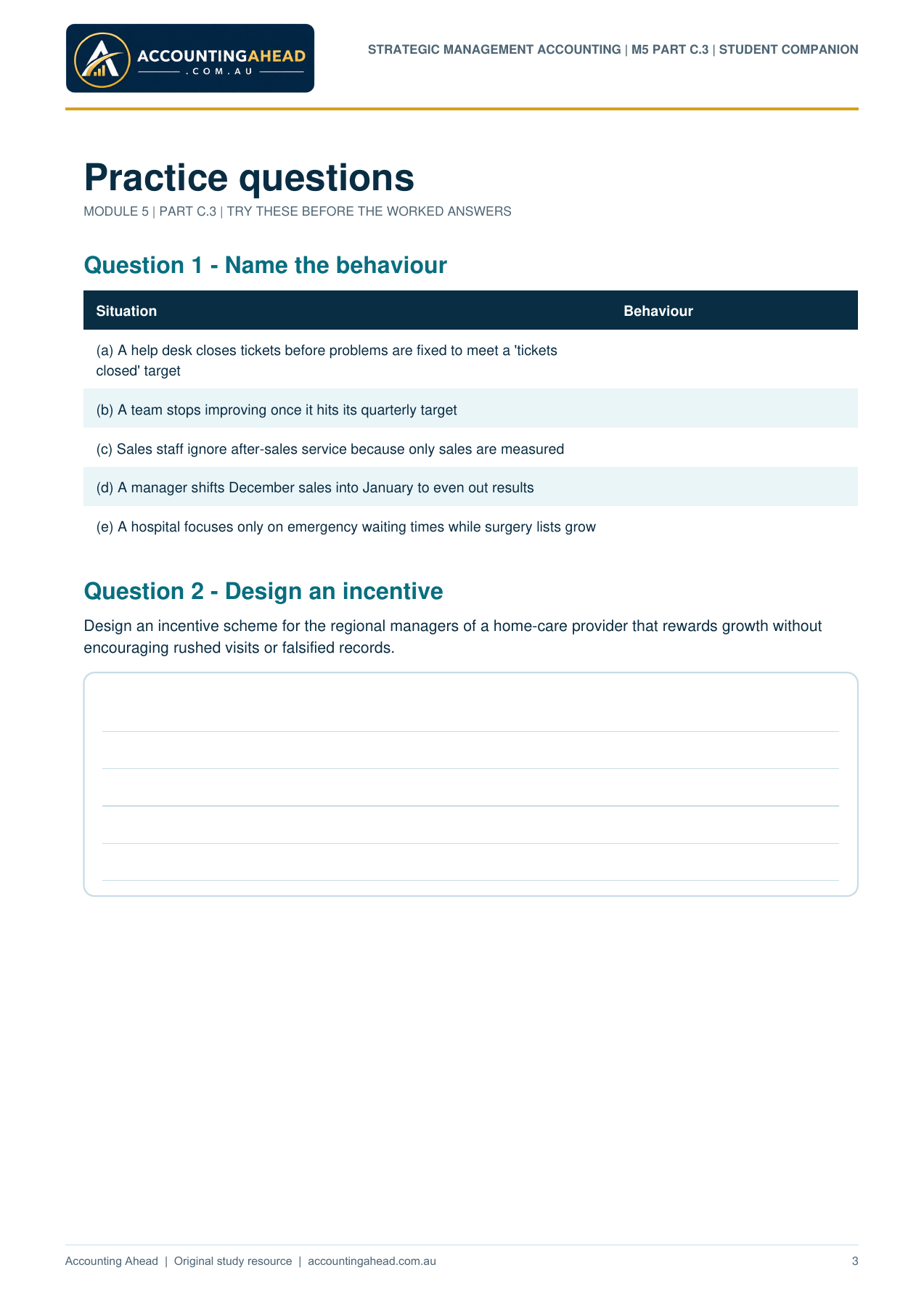
Question 1 - Name the behaviour
Situation Behaviour
(a) A help desk closes tickets before problems are fixed to meet a 'tickets
closed' target
(b) A team stops improving once it hits its quarterly target
(c) Sales staff ignore after-sales service because only sales are measured
(d) A manager shifts December sales into January to even out results
(e) A hospital focuses only on emergency waiting times while surgery lists grow
Question 2 - Design an incentive
Design an incentive scheme for the regional managers of a home-care provider that rewards growth without
encouraging rushed visits or falsified records.
STRATEGIC MANAGEMENT ACCOUNTING | M5 PART C.3 | STUDENT COMPANION
3
Accounting Ahead | Original study resource | accountingahead.com.au
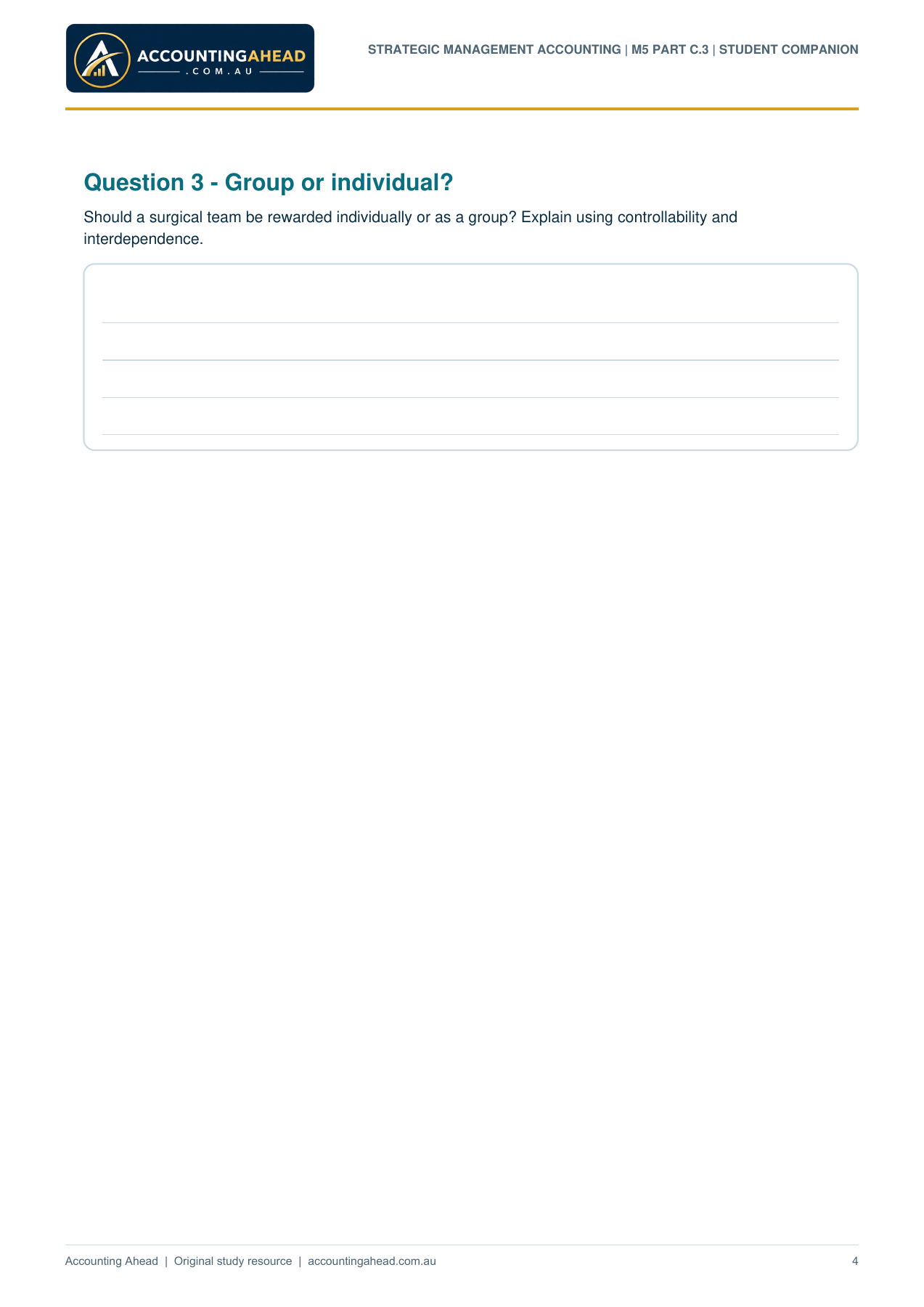
Question 3 - Group or individual?
Should a surgical team be rewarded individually or as a group? Explain using controllability and
interdependence.
STRATEGIC MANAGEMENT ACCOUNTING | M5 PART C.3 | STUDENT COMPANION
4
Accounting Ahead | Original study resource | accountingahead.com.au
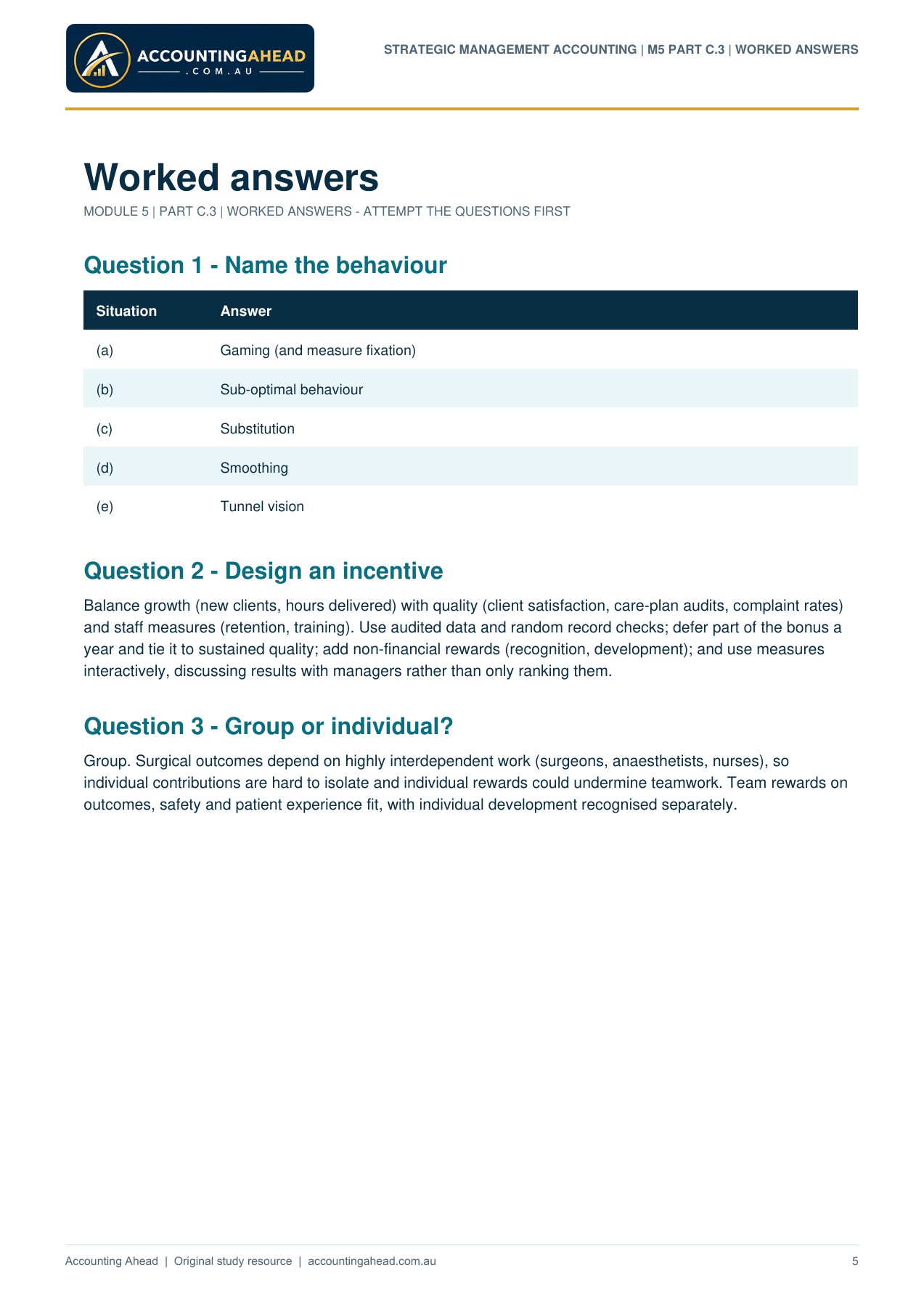
Worked answers
MODULE 5 | PART C.3 | WORKED ANSWERS - ATTEMPT THE QUESTIONS FIRST
Question 1 - Name the behaviour
Situation Answer
(a) Gaming (and measure fixation)
(b) Sub-optimal behaviour
(c) Substitution
(d) Smoothing
(e) Tunnel vision
Question 2 - Design an incentive
Balance growth (new clients, hours delivered) with quality (client satisfaction, care-plan audits, complaint rates)
and staff measures (retention, training). Use audited data and random record checks; defer part of the bonus a
year and tie it to sustained quality; add non-financial rewards (recognition, development); and use measures
interactively, discussing results with managers rather than only ranking them.
Question 3 - Group or individual?
Group. Surgical outcomes depend on highly interdependent work (surgeons, anaesthetists, nurses), so
individual contributions are hard to isolate and individual rewards could undermine teamwork. Team rewards on
outcomes, safety and patient experience fit, with individual development recognised separately.
STRATEGIC MANAGEMENT ACCOUNTING | M5 PART C.3 | WORKED ANSWERS
5