
ABC 2: time-driven activity-based costing
Printable study notes to use alongside Part B.2.2.
Read the handout text
Accounting Ahead | Original study resource | accountingahead.com.au
ABC 2: time-driven activity-based costing
MODULE 6 | PART B.2.2 | STUDENT COMPANION
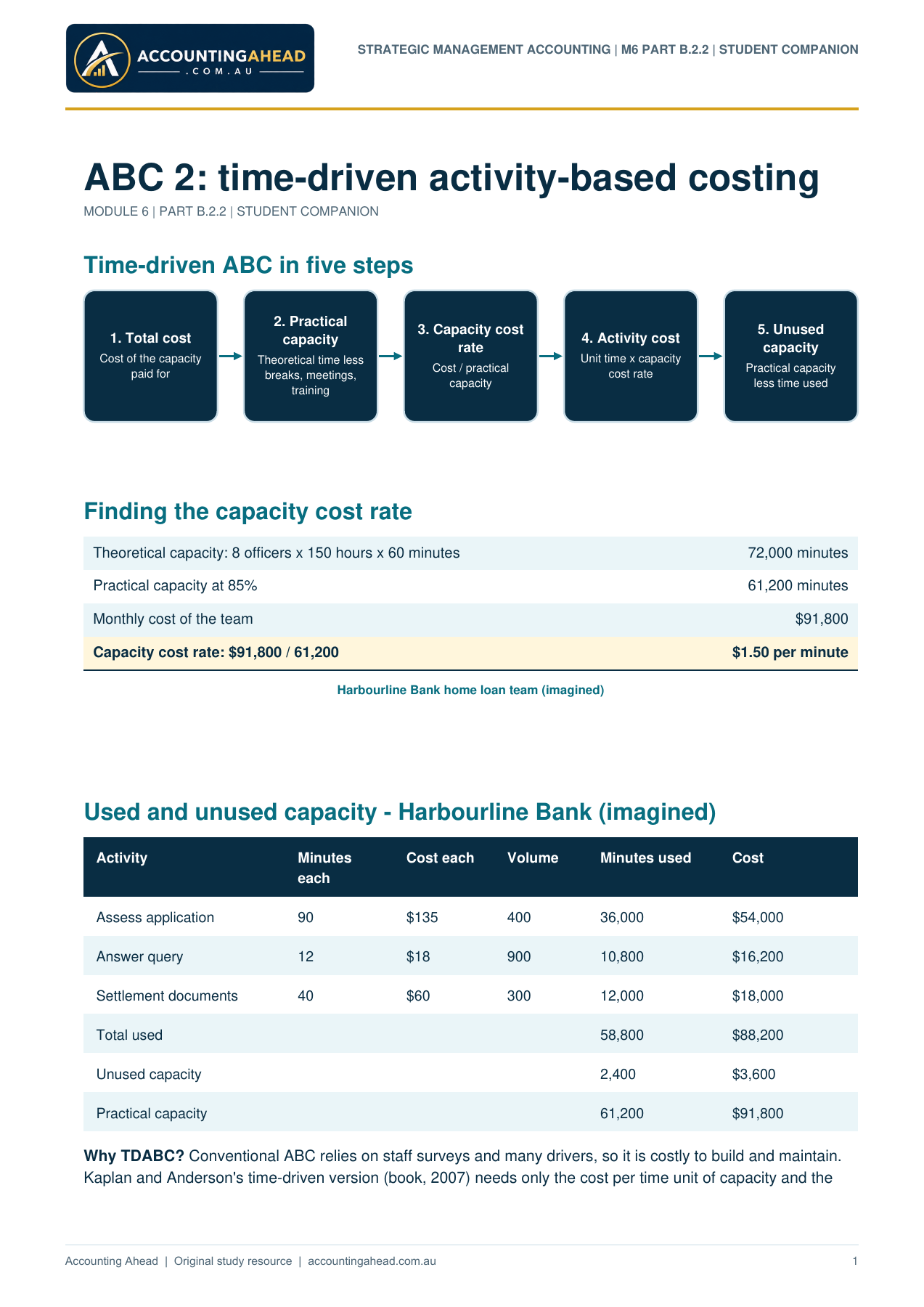
Time-driven ABC in five steps
1. Total cost
Cost of the capacity
paid for
2. Practical
capacity
Theoretical time less
breaks, meetings,
training
3. Capacity cost
rate
Cost / practical
capacity
4. Activity cost
Unit time x capacity
cost rate
5. Unused
capacity
Practical capacity
less time used
Finding the capacity cost rate
Theoretical capacity: 8 officers x 150 hours x 60 minutes 72,000 minutes
Practical capacity at 85% 61,200 minutes
Monthly cost of the team $91,800
Capacity cost rate: $91,800 / 61,200 $1.50 per minute
Harbourline Bank home loan team (imagined)
Used and unused capacity - Harbourline Bank (imagined)
Activity Minutes
each
Cost each Volume Minutes used Cost
Assess application 90 $135 400 36,000 $54,000
Answer query 12 $18 900 10,800 $16,200
Settlement documents 40 $60 300 12,000 $18,000
Total used 58,800 $88,200
Unused capacity 2,400 $3,600
Practical capacity 61,200 $91,800
Why TDABC? Conventional ABC relies on staff surveys and many drivers, so it is costly to build and maintain.
Kaplan and Anderson's time-driven version (book, 2007) needs only the cost per time unit of capacity and the
STRATEGIC MANAGEMENT ACCOUNTING | M6 PART B.2.2 | STUDENT COMPANION
1
Accounting Ahead | Original study resource | accountingahead.com.au
time each activity takes, is easy to update, and shows unused capacity. Kaplan and Porter (Harvard Business
Review, 2011) proposed it for costing patients' full cycle of care.
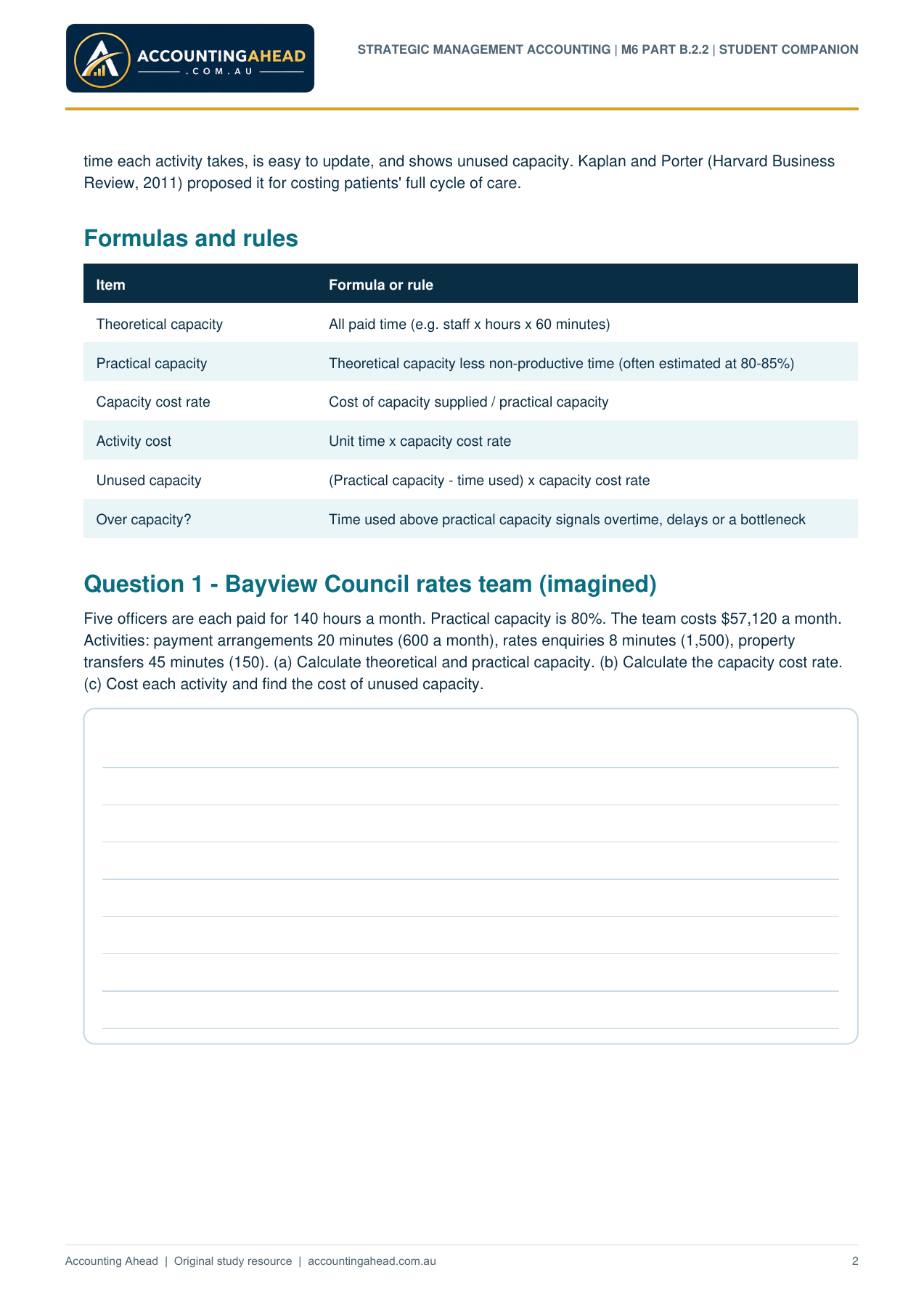
Formulas and rules
Item Formula or rule
Theoretical capacity All paid time (e.g. staff x hours x 60 minutes)
Practical capacity Theoretical capacity less non-productive time (often estimated at 80-85%)
Capacity cost rate Cost of capacity supplied / practical capacity
Activity cost Unit time x capacity cost rate
Unused capacity (Practical capacity - time used) x capacity cost rate
Over capacity? Time used above practical capacity signals overtime, delays or a bottleneck
Question 1 - Bayview Council rates team (imagined)
Five officers are each paid for 140 hours a month. Practical capacity is 80%. The team costs $57,120 a month.
Activities: payment arrangements 20 minutes (600 a month), rates enquiries 8 minutes (1,500), property
transfers 45 minutes (150). (a) Calculate theoretical and practical capacity. (b) Calculate the capacity cost rate.
(c) Cost each activity and find the cost of unused capacity.
STRATEGIC MANAGEMENT ACCOUNTING | M6 PART B.2.2 | STUDENT COMPANION
2
Accounting Ahead | Original study resource | accountingahead.com.au
Worked answers
MODULE 6 | PART B.2.2 | WORKED ANSWERS - ATTEMPT THE QUESTIONS FIRST
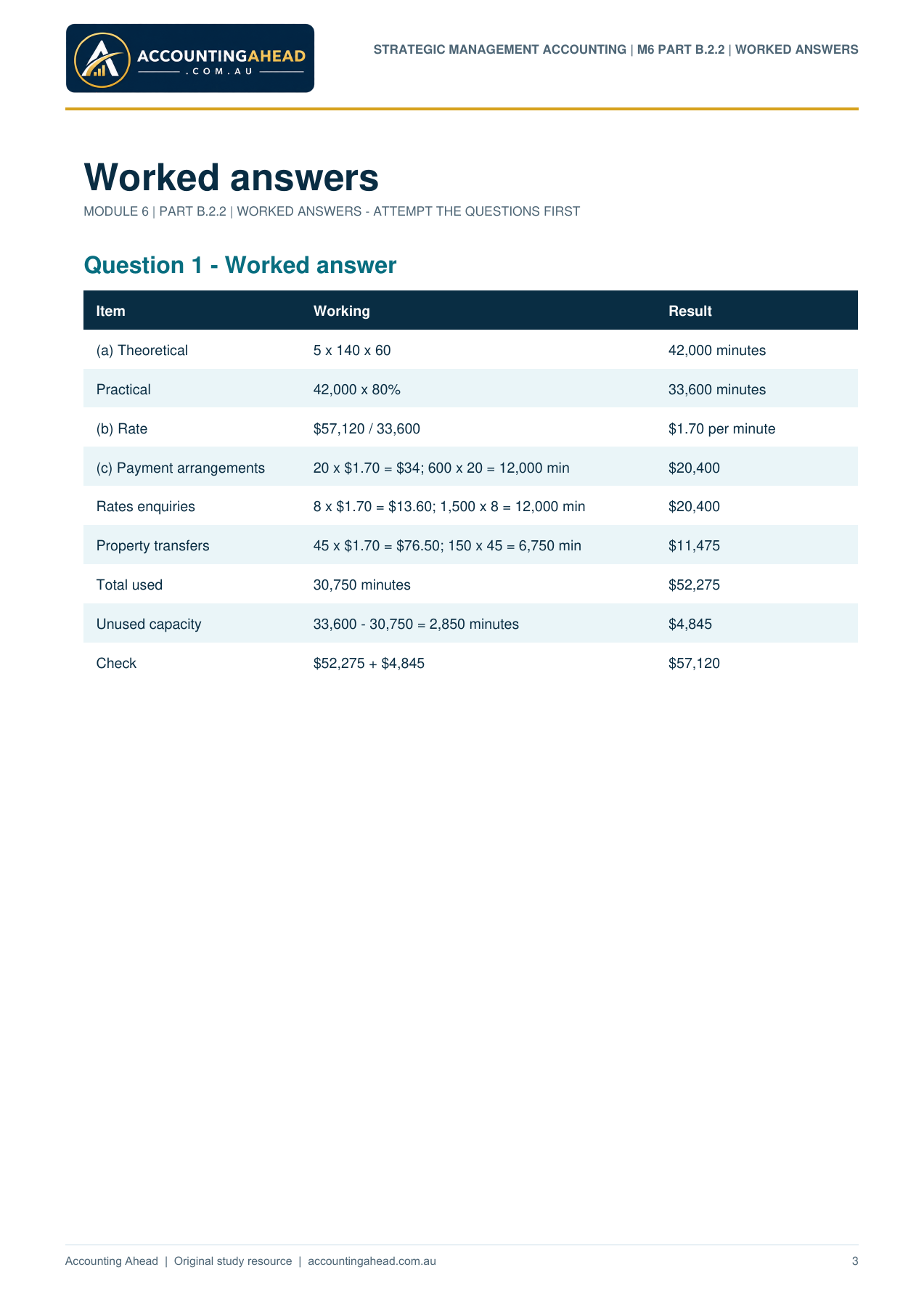
Question 1 - Worked answer
Item Working Result
(a) Theoretical 5 x 140 x 60 42,000 minutes
Practical 42,000 x 80% 33,600 minutes
(b) Rate $57,120 / 33,600 $1.70 per minute
(c) Payment arrangements 20 x $1.70 = $34; 600 x 20 = 12,000 min $20,400
Rates enquiries 8 x $1.70 = $13.60; 1,500 x 8 = 12,000 min $20,400
Property transfers 45 x $1.70 = $76.50; 150 x 45 = 6,750 min $11,475
Total used 30,750 minutes $52,275
Unused capacity 33,600 - 30,750 = 2,850 minutes $4,845
Check $52,275 + $4,845 $57,120
STRATEGIC MANAGEMENT ACCOUNTING | M6 PART B.2.2 | WORKED ANSWERS
3