
Costing 1: life cycle costing
Printable study notes to use alongside Part D.2.1.
Read the handout text
Accounting Ahead | Original study resource | accountingahead.com.au
Costing 1: life cycle costing
MODULE 6 | PART D.2.1 | STUDENT COMPANION
Life cycle costing treats each product as an investment: across introduction, growth, maturity and decline it
must recover all costs - research, design, production, marketing, distribution, service and disposal - and earn a
return that justifies the risk. A balanced portfolio uses mature products' cash to fund new ones.
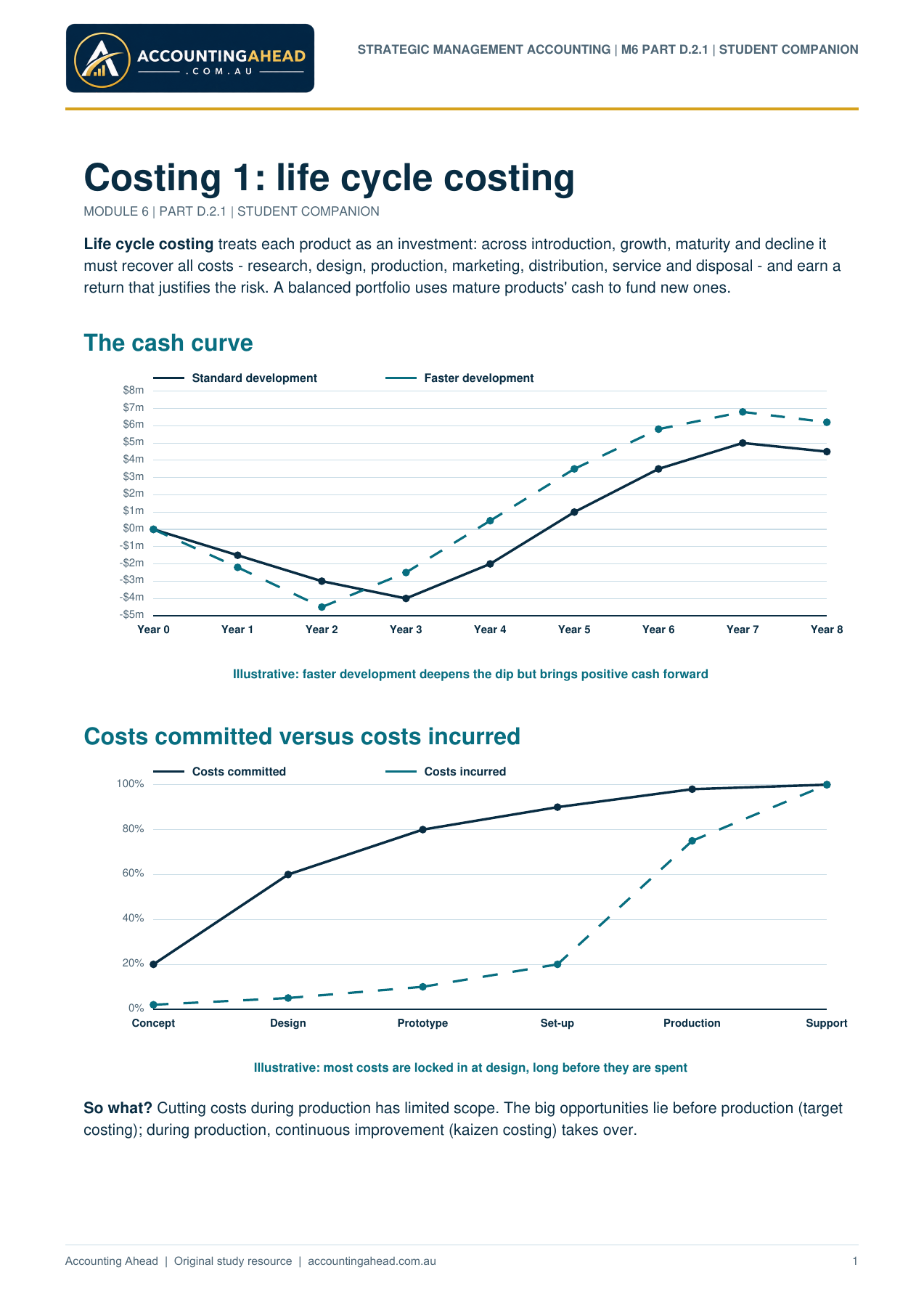
The cash curve
-$5m
-$4m
-$3m
-$2m
-$1m
$0m
$1m
$2m
$3m
$4m
$5m
$6m
$7m
$8m
Year 0 Year 1 Year 2 Year 3 Year 4 Year 5 Year 6 Year 7 Year 8
Standard development Faster development
Illustrative: faster development deepens the dip but brings positive cash forward
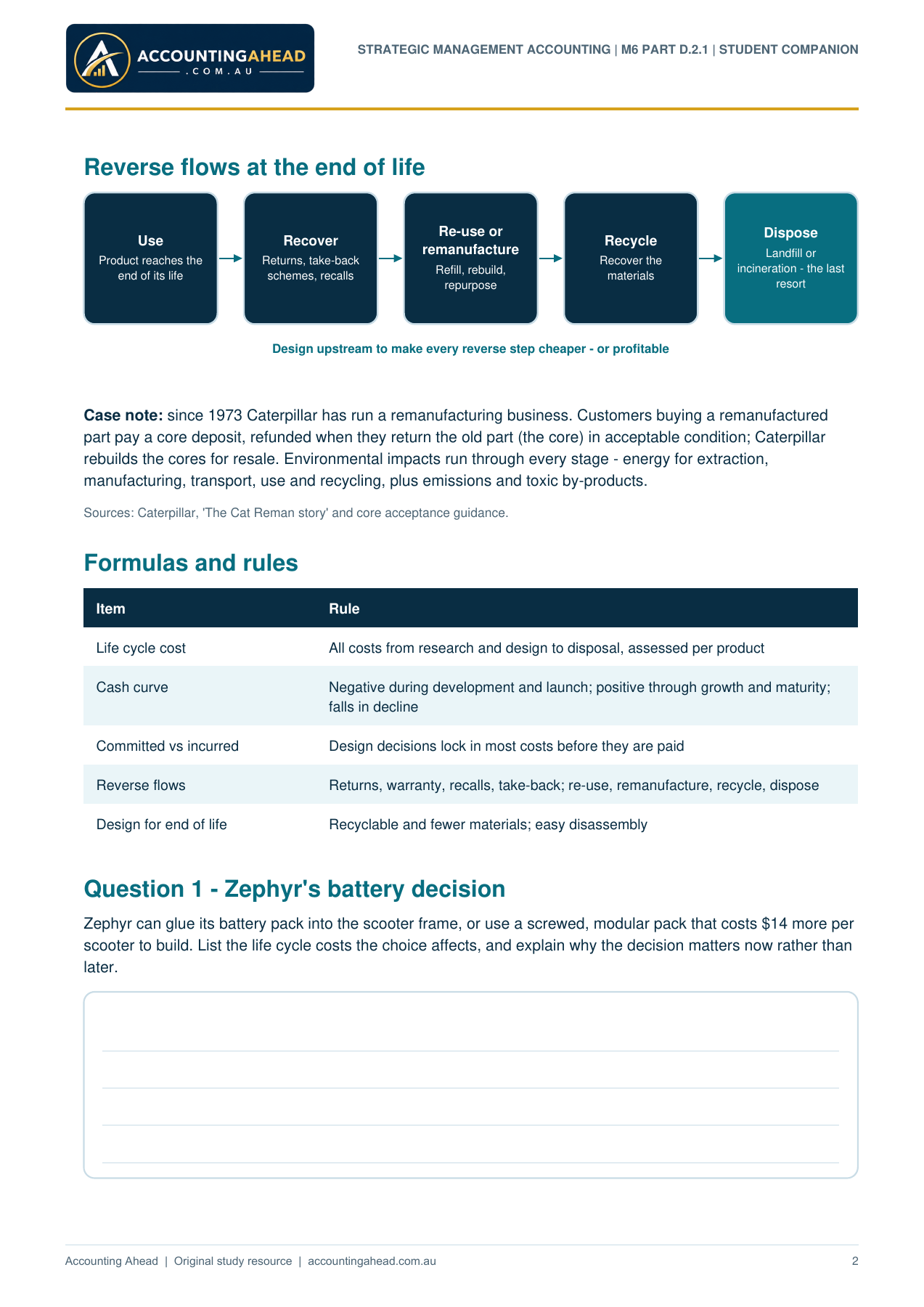
Costs committed versus costs incurred
0%
20%
40%
60%
80%
100%
Concept Design Prototype Set-up Production Support
Costs committed Costs incurred
Illustrative: most costs are locked in at design, long before they are spent
So what? Cutting costs during production has limited scope. The big opportunities lie before production (target
costing); during production, continuous improvement (kaizen costing) takes over.
STRATEGIC MANAGEMENT ACCOUNTING | M6 PART D.2.1 | STUDENT COMPANION
1
Accounting Ahead | Original study resource | accountingahead.com.au
Reverse flows at the end of life
Use
Product reaches the
end of its life
Recover
Returns, take-back
schemes, recalls
Re-use or
remanufacture
Refill, rebuild,
repurpose
Recycle
Recover the
materials
Dispose
Landfill or
incineration - the last
resort
Design upstream to make every reverse step cheaper - or profitable
Case note: since 1973 Caterpillar has run a remanufacturing business. Customers buying a remanufactured
part pay a core deposit, refunded when they return the old part (the core) in acceptable condition; Caterpillar
rebuilds the cores for resale. Environmental impacts run through every stage - energy for extraction,
manufacturing, transport, use and recycling, plus emissions and toxic by-products.
Sources: Caterpillar, 'The Cat Reman story' and core acceptance guidance.
Formulas and rules
Item Rule
Life cycle cost All costs from research and design to disposal, assessed per product
Cash curve Negative during development and launch; positive through growth and maturity;
falls in decline
Committed vs incurred Design decisions lock in most costs before they are paid
Reverse flows Returns, warranty, recalls, take-back; re-use, remanufacture, recycle, dispose
Design for end of life Recyclable and fewer materials; easy disassembly
Question 1 - Zephyr's battery decision
Zephyr can glue its battery pack into the scooter frame, or use a screwed, modular pack that costs $14 more per
scooter to build. List the life cycle costs the choice affects, and explain why the decision matters now rather than
later.
STRATEGIC MANAGEMENT ACCOUNTING | M6 PART D.2.1 | STUDENT COMPANION
2
Accounting Ahead | Original study resource | accountingahead.com.au
Worked answers
MODULE 6 | PART D.2.1 | WORKED ANSWERS - ATTEMPT THE QUESTIONS FIRST
Question 1 - Worked answer
The choice affects: assembly time and cost; warranty repairs (a modular pack can be swapped in minutes rather
than replacing the frame); spare parts and service revenue; customer satisfaction and resale value; product
take-back and recycling costs (easy separation of the battery, a hazardous component); and compliance with
any battery stewardship rules. The decision matters now because design commits these costs: once tooling is
built and production starts, changing the design is slow and expensive, even though most of the costs will be
paid years later. The extra $14 may well be repaid by lower warranty and end-of-life costs.
STRATEGIC MANAGEMENT ACCOUNTING | M6 PART D.2.1 | WORKED ANSWERS
3