
Costing 3: kaizen costing
Printable study notes to use alongside Part D.2.3.
Read the handout text
Accounting Ahead | Original study resource | accountingahead.com.au
Costing 3: kaizen costing
MODULE 6 | PART D.2.3 | STUDENT COMPANION
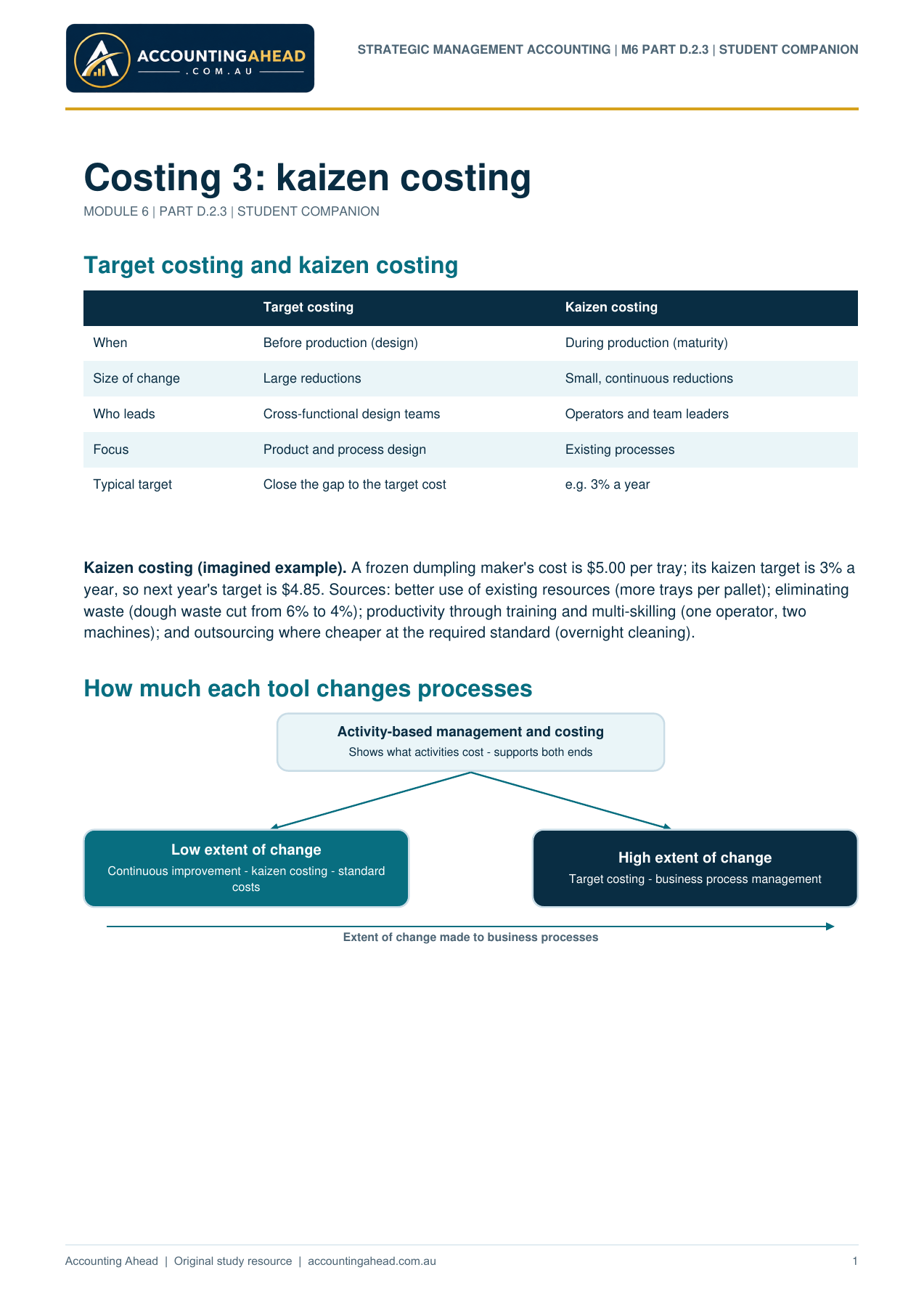
Target costing and kaizen costing
Target costing Kaizen costing
When Before production (design) During production (maturity)
Size of change Large reductions Small, continuous reductions
Who leads Cross-functional design teams Operators and team leaders
Focus Product and process design Existing processes
Typical target Close the gap to the target cost e.g. 3% a year
Kaizen costing (imagined example). A frozen dumpling maker's cost is $5.00 per tray; its kaizen target is 3% a
year, so next year's target is $4.85. Sources: better use of existing resources (more trays per pallet); eliminating
waste (dough waste cut from 6% to 4%); productivity through training and multi-skilling (one operator, two
machines); and outsourcing where cheaper at the required standard (overnight cleaning).
How much each tool changes processes
Activity-based management and costing
Shows what activities cost - supports both ends
Low extent of change
Continuous improvement - kaizen costing - standard
costs
High extent of change
Target costing - business process management
Extent of change made to business processes
STRATEGIC MANAGEMENT ACCOUNTING | M6 PART D.2.3 | STUDENT COMPANION
1
Accounting Ahead | Original study resource | accountingahead.com.au
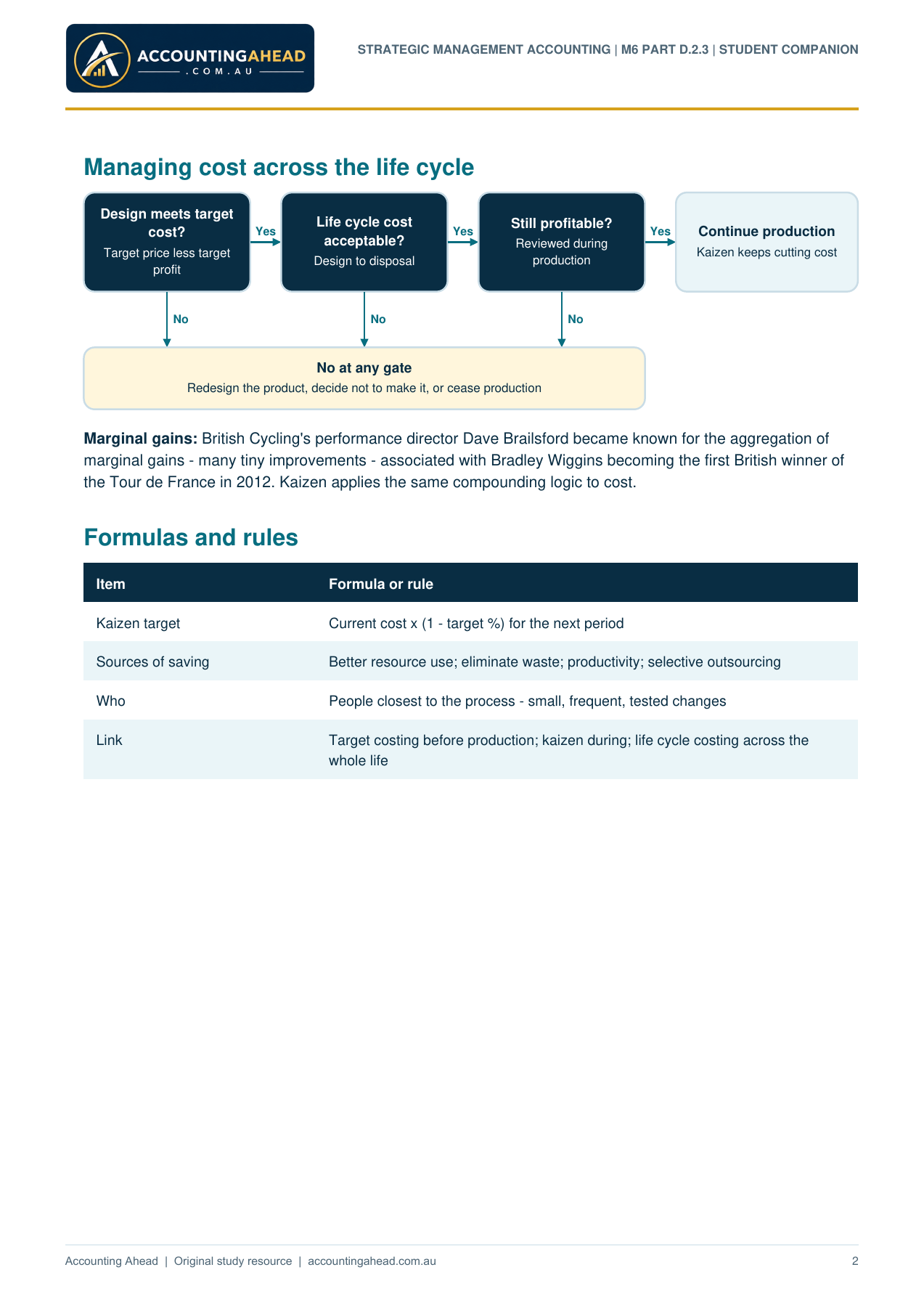
Managing cost across the life cycle
Design meets target
cost?
Target price less target
profit
Yes
No
Life cycle cost
acceptable?
Design to disposal
Yes
No
Still profitable?
Reviewed during
production
Yes
No
Continue production
Kaizen keeps cutting cost
No at any gate
Redesign the product, decide not to make it, or cease production
Marginal gains: British Cycling's performance director Dave Brailsford became known for the aggregation of
marginal gains - many tiny improvements - associated with Bradley Wiggins becoming the first British winner of
the Tour de France in 2012. Kaizen applies the same compounding logic to cost.
Formulas and rules
Item Formula or rule
Kaizen target Current cost x (1 - target %) for the next period
Sources of saving Better resource use; eliminate waste; productivity; selective outsourcing
Who People closest to the process - small, frequent, tested changes
Link Target costing before production; kaizen during; life cycle costing across the
whole life
STRATEGIC MANAGEMENT ACCOUNTING | M6 PART D.2.3 | STUDENT COMPANION
2
Accounting Ahead | Original study resource | accountingahead.com.au
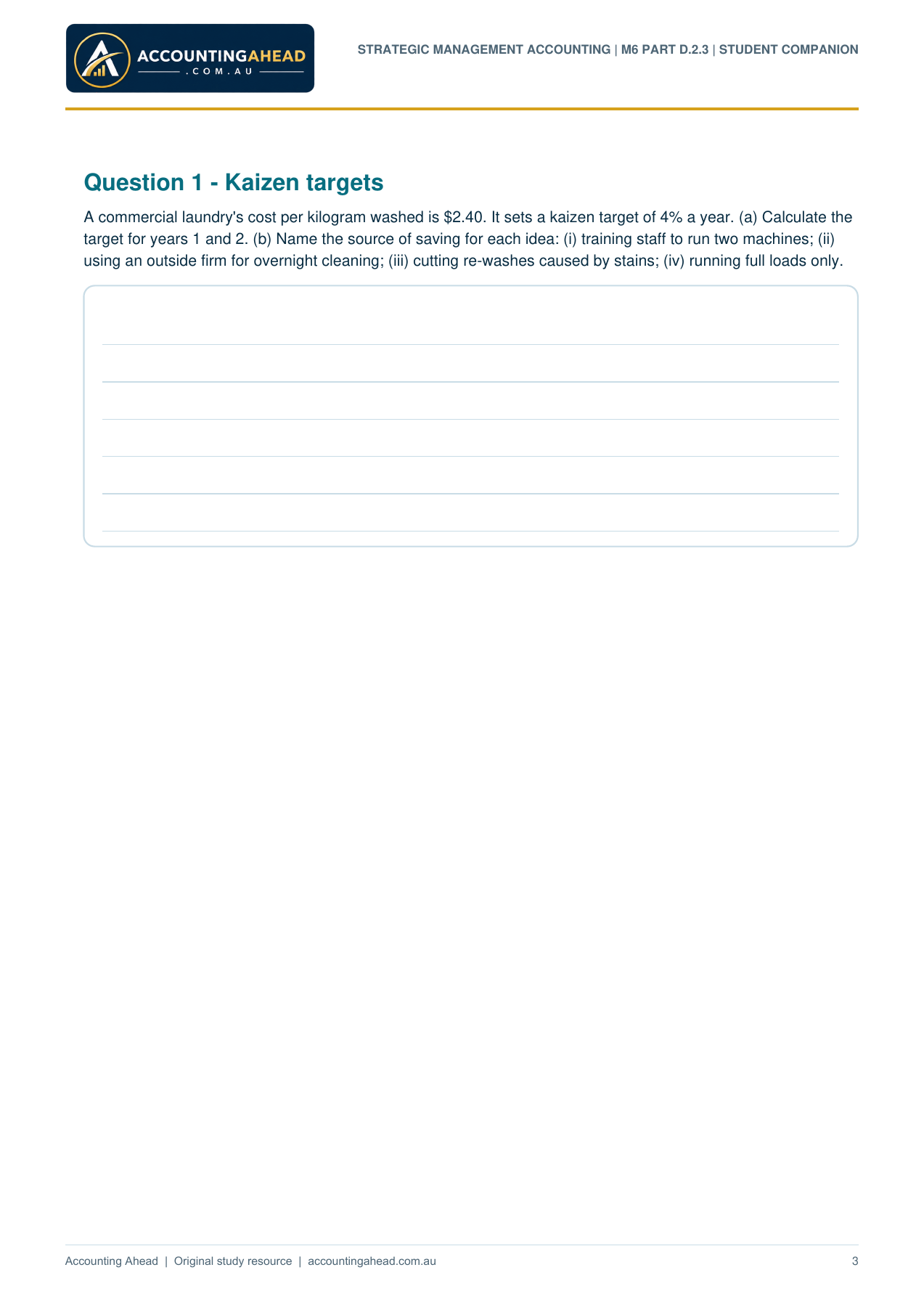
Question 1 - Kaizen targets
A commercial laundry's cost per kilogram washed is $2.40. It sets a kaizen target of 4% a year. (a) Calculate the
target for years 1 and 2. (b) Name the source of saving for each idea: (i) training staff to run two machines; (ii)
using an outside firm for overnight cleaning; (iii) cutting re-washes caused by stains; (iv) running full loads only.
STRATEGIC MANAGEMENT ACCOUNTING | M6 PART D.2.3 | STUDENT COMPANION
3
Accounting Ahead | Original study resource | accountingahead.com.au
Worked answers
MODULE 6 | PART D.2.3 | WORKED ANSWERS - ATTEMPT THE QUESTIONS FIRST
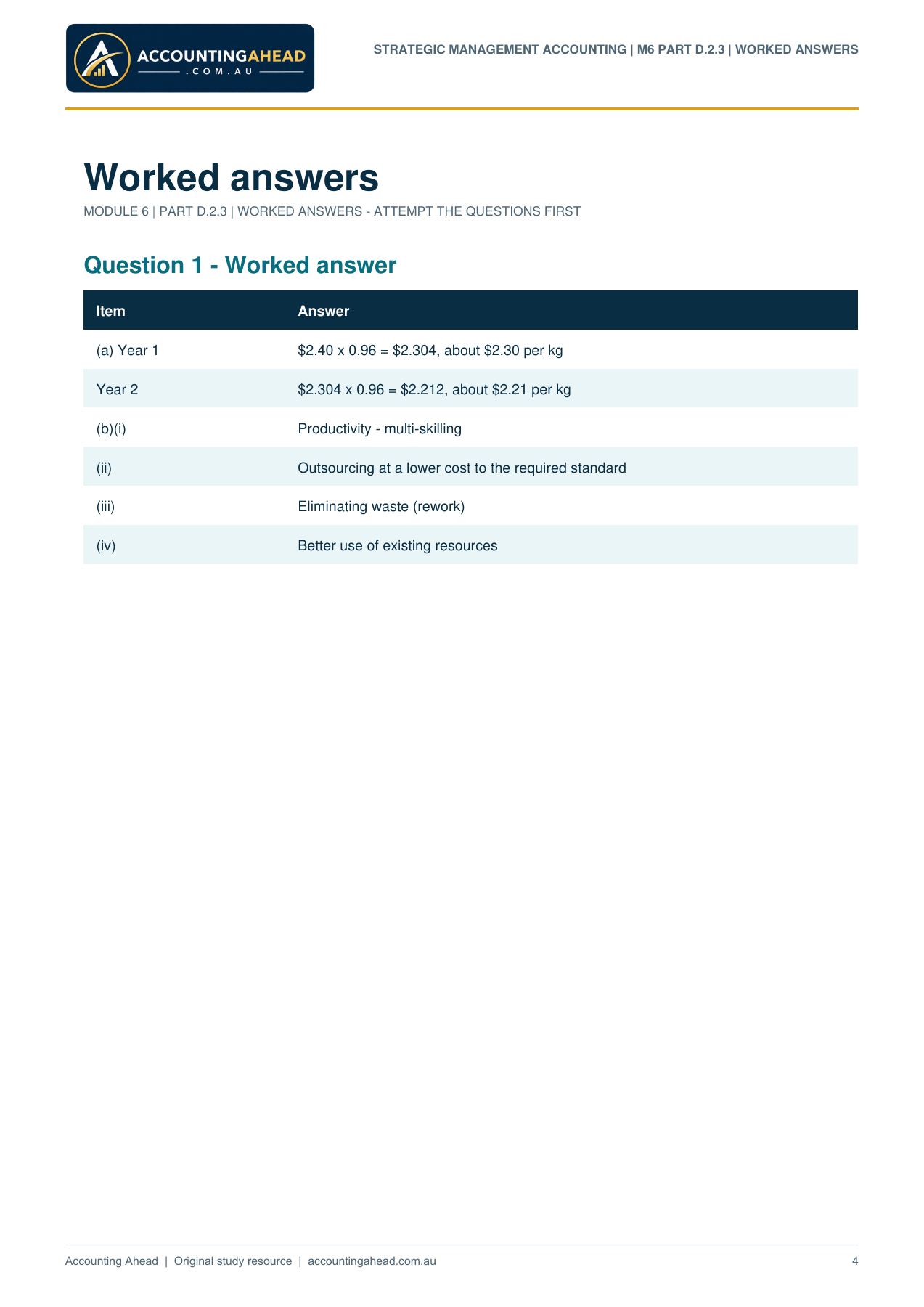
Question 1 - Worked answer
Item Answer
(a) Year 1 $2.40 x 0.96 = $2.304, about $2.30 per kg
Year 2 $2.304 x 0.96 = $2.212, about $2.21 per kg
(b)(i) Productivity - multi-skilling
(ii) Outsourcing at a lower cost to the required standard
(iii) Eliminating waste (rework)
(iv) Better use of existing resources
STRATEGIC MANAGEMENT ACCOUNTING | M6 PART D.2.3 | WORKED ANSWERS
4