
ABM, BPM and continuous improvement
Printable study notes to use alongside Part D.3.
Read the handout text
Accounting Ahead | Original study resource | accountingahead.com.au
ABM, BPM and continuous improvement
MODULE 6 | PART D.3 | STUDENT COMPANION
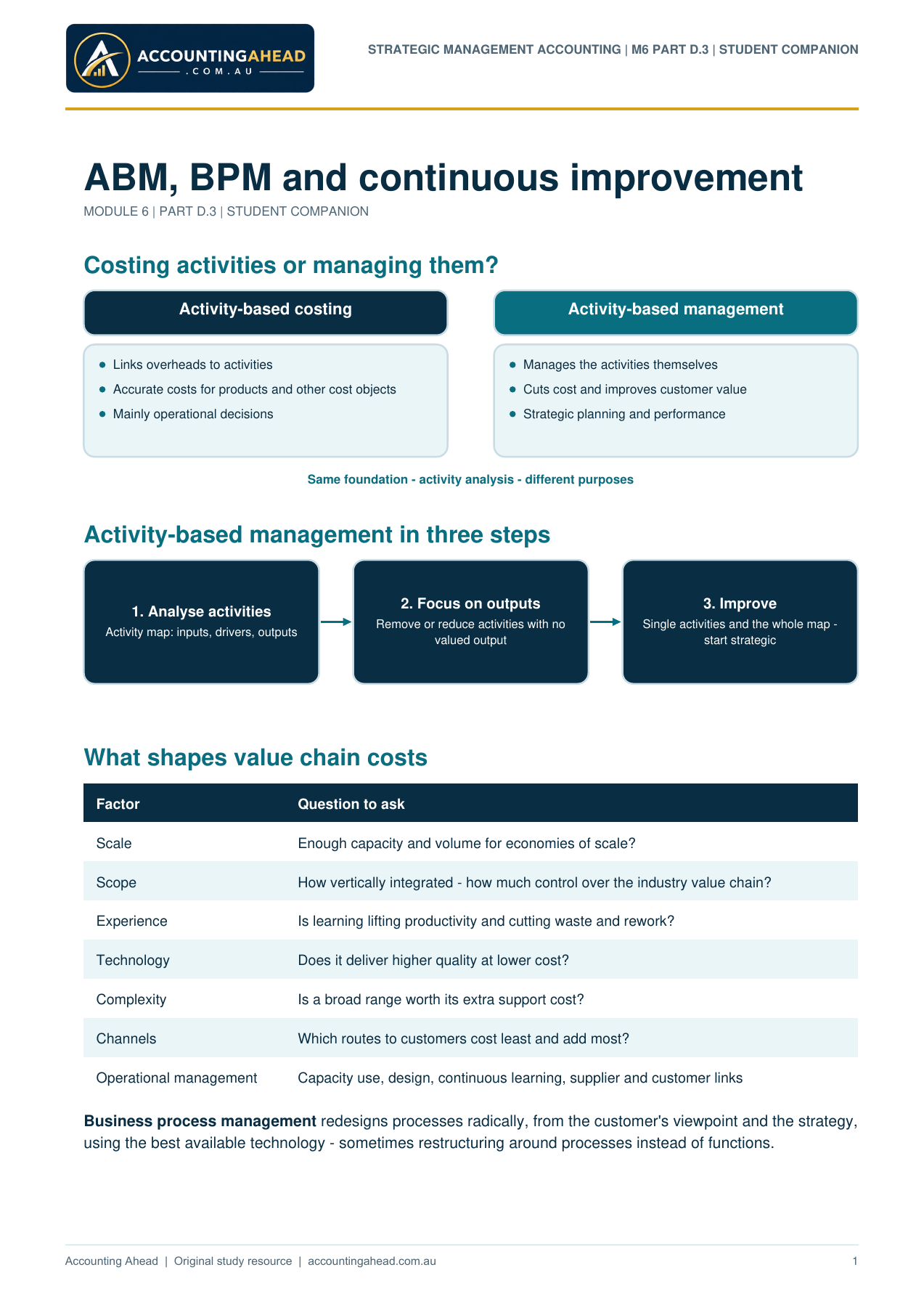
Costing activities or managing them?
Activity-based costing
Links overheads to activities
Accurate costs for products and other cost objects
Mainly operational decisions
Activity-based management
Manages the activities themselves
Cuts cost and improves customer value
Strategic planning and performance
Same foundation - activity analysis - different purposes
Activity-based management in three steps
1. Analyse activities
Activity map: inputs, drivers, outputs
2. Focus on outputs
Remove or reduce activities with no
valued output
3. Improve
Single activities and the whole map -
start strategic
What shapes value chain costs
Factor Question to ask
Scale Enough capacity and volume for economies of scale?
Scope How vertically integrated - how much control over the industry value chain?
Experience Is learning lifting productivity and cutting waste and rework?
Technology Does it deliver higher quality at lower cost?
Complexity Is a broad range worth its extra support cost?
Channels Which routes to customers cost least and add most?
Operational management Capacity use, design, continuous learning, supplier and customer links
Business process management redesigns processes radically, from the customer's viewpoint and the strategy,
using the best available technology - sometimes restructuring around processes instead of functions.
STRATEGIC MANAGEMENT ACCOUNTING | M6 PART D.3 | STUDENT COMPANION
1
Accounting Ahead | Original study resource | accountingahead.com.au
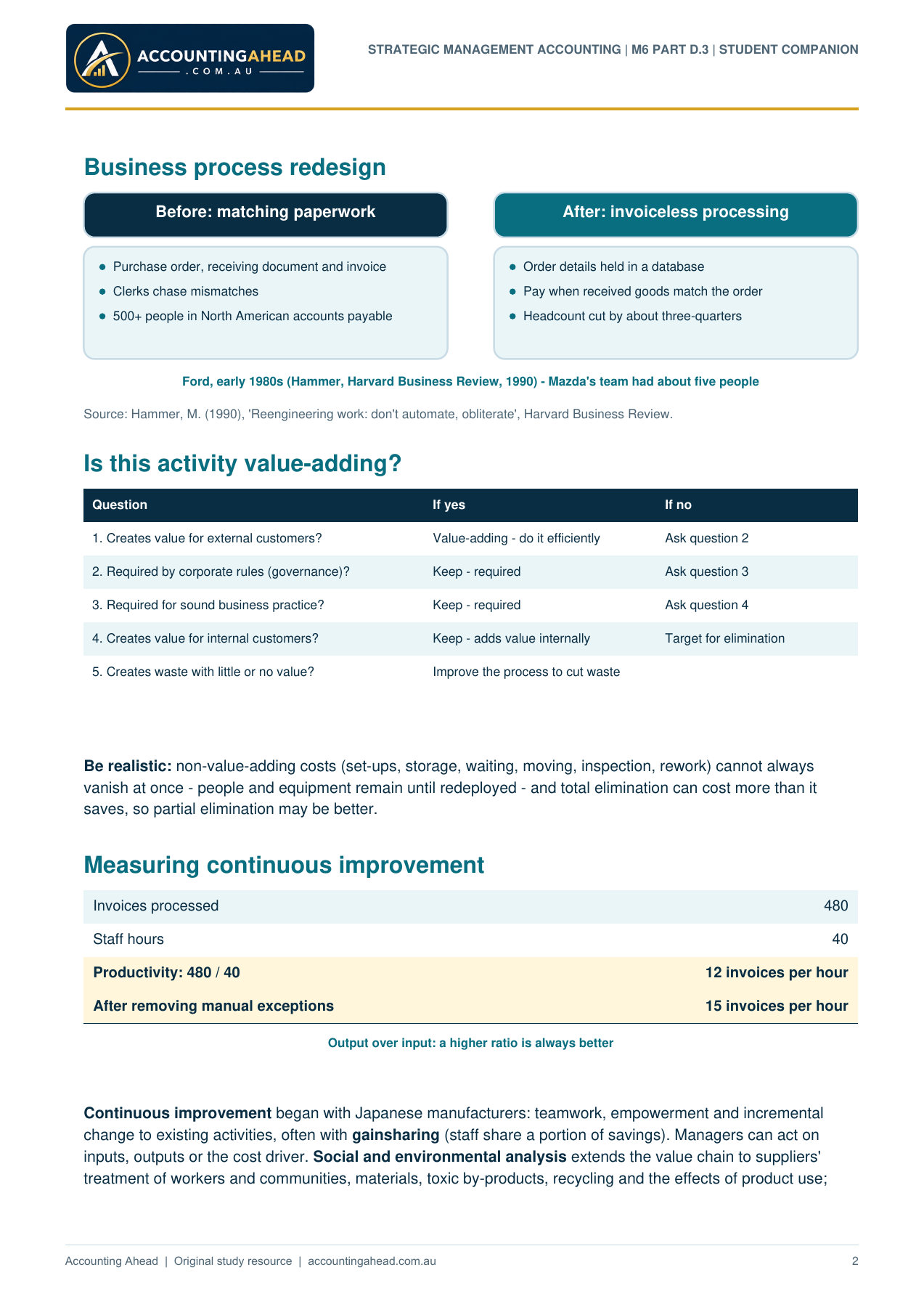
Business process redesign
Before: matching paperwork
Purchase order, receiving document and invoice
Clerks chase mismatches
500+ people in North American accounts payable
After: invoiceless processing
Order details held in a database
Pay when received goods match the order
Headcount cut by about three-quarters
Ford, early 1980s (Hammer, Harvard Business Review, 1990) - Mazda's team had about five people
Source: Hammer, M. (1990), 'Reengineering work: don't automate, obliterate', Harvard Business Review.
Is this activity value-adding?
Question If yes If no
1. Creates value for external customers? Value-adding - do it efficiently Ask question 2
2. Required by corporate rules (governance)? Keep - required Ask question 3
3. Required for sound business practice? Keep - required Ask question 4
4. Creates value for internal customers? Keep - adds value internally Target for elimination
5. Creates waste with little or no value? Improve the process to cut waste
Be realistic: non-value-adding costs (set-ups, storage, waiting, moving, inspection, rework) cannot always
vanish at once - people and equipment remain until redeployed - and total elimination can cost more than it
saves, so partial elimination may be better.
Measuring continuous improvement
Invoices processed 480
Staff hours 40
Productivity: 480 / 40 12 invoices per hour
After removing manual exceptions 15 invoices per hour
Output over input: a higher ratio is always better
Continuous improvement began with Japanese manufacturers: teamwork, empowerment and incremental
change to existing activities, often with gainsharing (staff share a portion of savings). Managers can act on
inputs, outputs or the cost driver. Social and environmental analysis extends the value chain to suppliers'
treatment of workers and communities, materials, toxic by-products, recycling and the effects of product use;
STRATEGIC MANAGEMENT ACCOUNTING | M6 PART D.3 | STUDENT COMPANION
2
Accounting Ahead | Original study resource | accountingahead.com.au
fines are lagging indicators.
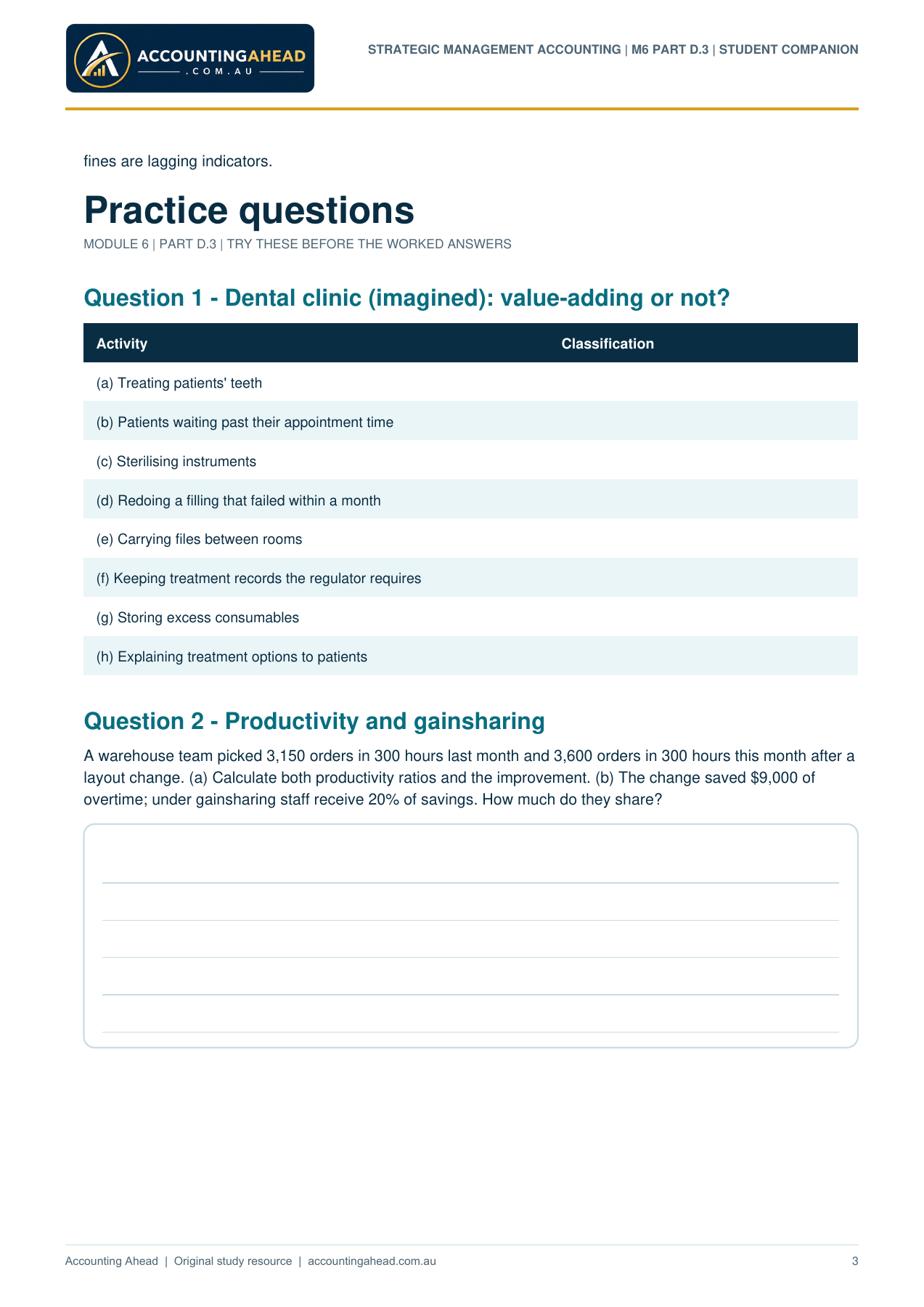
Practice questions
MODULE 6 | PART D.3 | TRY THESE BEFORE THE WORKED ANSWERS
Question 1 - Dental clinic (imagined): value-adding or not?
Activity Classification
(a) Treating patients' teeth
(b) Patients waiting past their appointment time
(c) Sterilising instruments
(d) Redoing a filling that failed within a month
(e) Carrying files between rooms
(f) Keeping treatment records the regulator requires
(g) Storing excess consumables
(h) Explaining treatment options to patients
Question 2 - Productivity and gainsharing
A warehouse team picked 3,150 orders in 300 hours last month and 3,600 orders in 300 hours this month after a
layout change. (a) Calculate both productivity ratios and the improvement. (b) The change saved $9,000 of
overtime; under gainsharing staff receive 20% of savings. How much do they share?
STRATEGIC MANAGEMENT ACCOUNTING | M6 PART D.3 | STUDENT COMPANION
3
Accounting Ahead | Original study resource | accountingahead.com.au
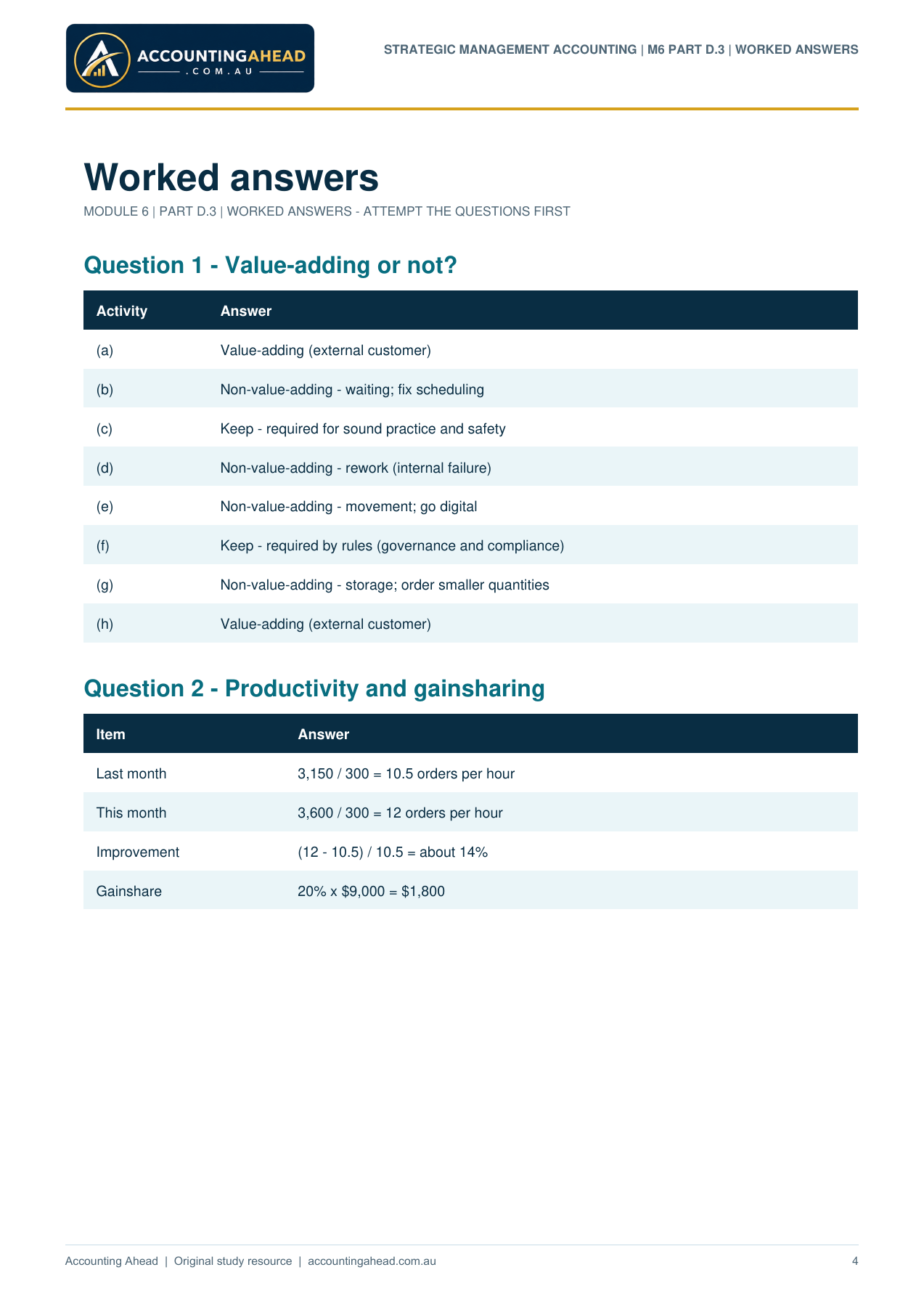
Worked answers
MODULE 6 | PART D.3 | WORKED ANSWERS - ATTEMPT THE QUESTIONS FIRST
Question 1 - Value-adding or not?
Activity Answer
(a) Value-adding (external customer)
(b) Non-value-adding - waiting; fix scheduling
(c) Keep - required for sound practice and safety
(d) Non-value-adding - rework (internal failure)
(e) Non-value-adding - movement; go digital
(f) Keep - required by rules (governance and compliance)
(g) Non-value-adding - storage; order smaller quantities
(h) Value-adding (external customer)
Question 2 - Productivity and gainsharing
Item Answer
Last month 3,150 / 300 = 10.5 orders per hour
This month 3,600 / 300 = 12 orders per hour
Improvement (12 - 10.5) / 10.5 = about 14%
Gainshare 20% x $9,000 = $1,800
STRATEGIC MANAGEMENT ACCOUNTING | M6 PART D.3 | WORKED ANSWERS
4