
Supplier management
Printable study notes to use alongside Part E.1.
Read the handout text
Accounting Ahead | Original study resource | accountingahead.com.au
Supplier management
MODULE 6 | PART E.1 | STUDENT COMPANION
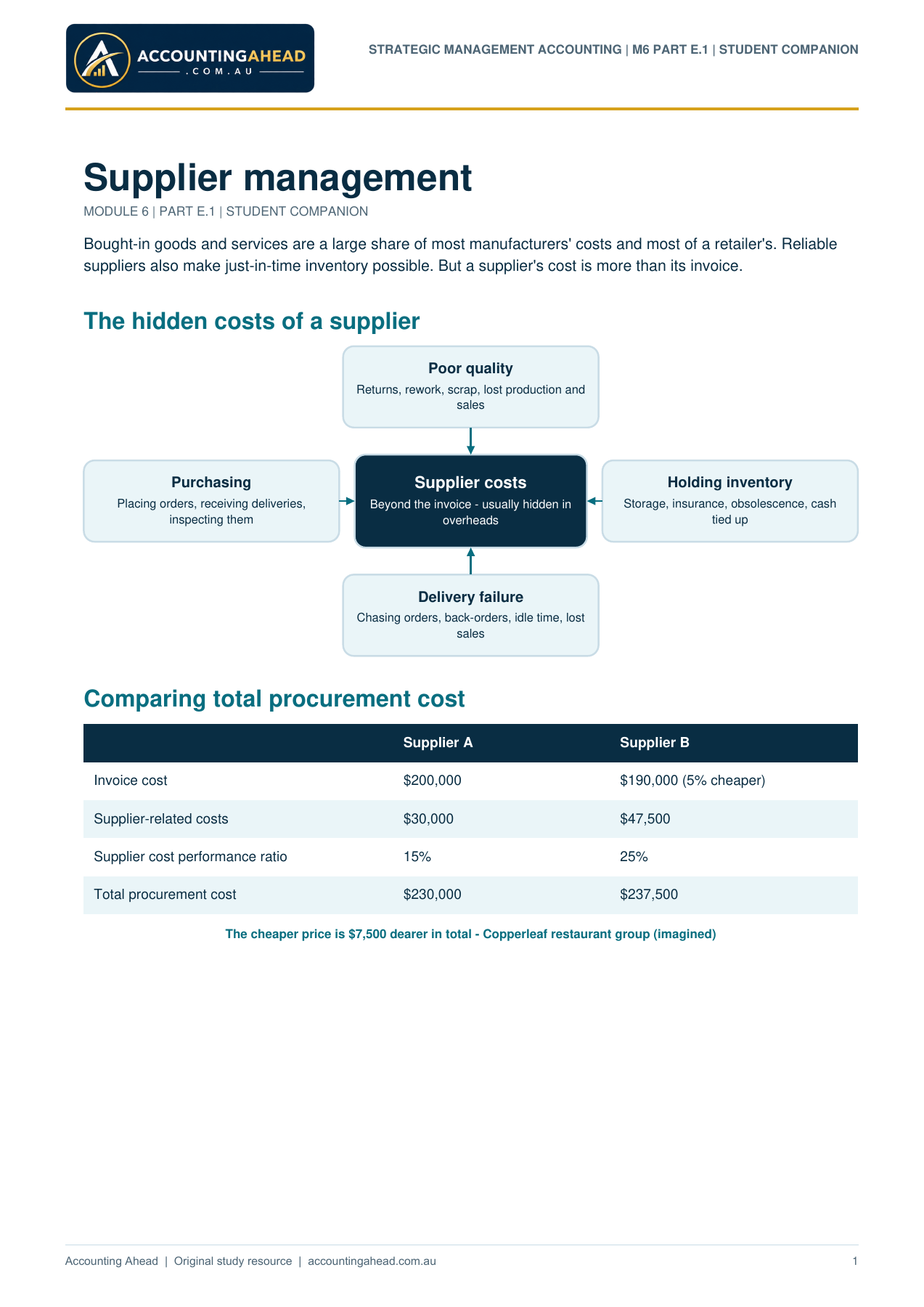
Bought-in goods and services are a large share of most manufacturers' costs and most of a retailer's. Reliable
suppliers also make just-in-time inventory possible. But a supplier's cost is more than its invoice.
The hidden costs of a supplier
Supplier costs
Beyond the invoice - usually hidden in
overheads
Purchasing
Placing orders, receiving deliveries,
inspecting them
Holding inventory
Storage, insurance, obsolescence, cash
tied up
Poor quality
Returns, rework, scrap, lost production and
sales
Delivery failure
Chasing orders, back-orders, idle time, lost
sales
Comparing total procurement cost
Supplier A Supplier B
Invoice cost $200,000 $190,000 (5% cheaper)
Supplier-related costs $30,000 $47,500
Supplier cost performance ratio 15% 25%
Total procurement cost $230,000 $237,500
The cheaper price is $7,500 dearer in total - Copperleaf restaurant group (imagined)
STRATEGIC MANAGEMENT ACCOUNTING | M6 PART E.1 | STUDENT COMPANION
1
Accounting Ahead | Original study resource | accountingahead.com.au
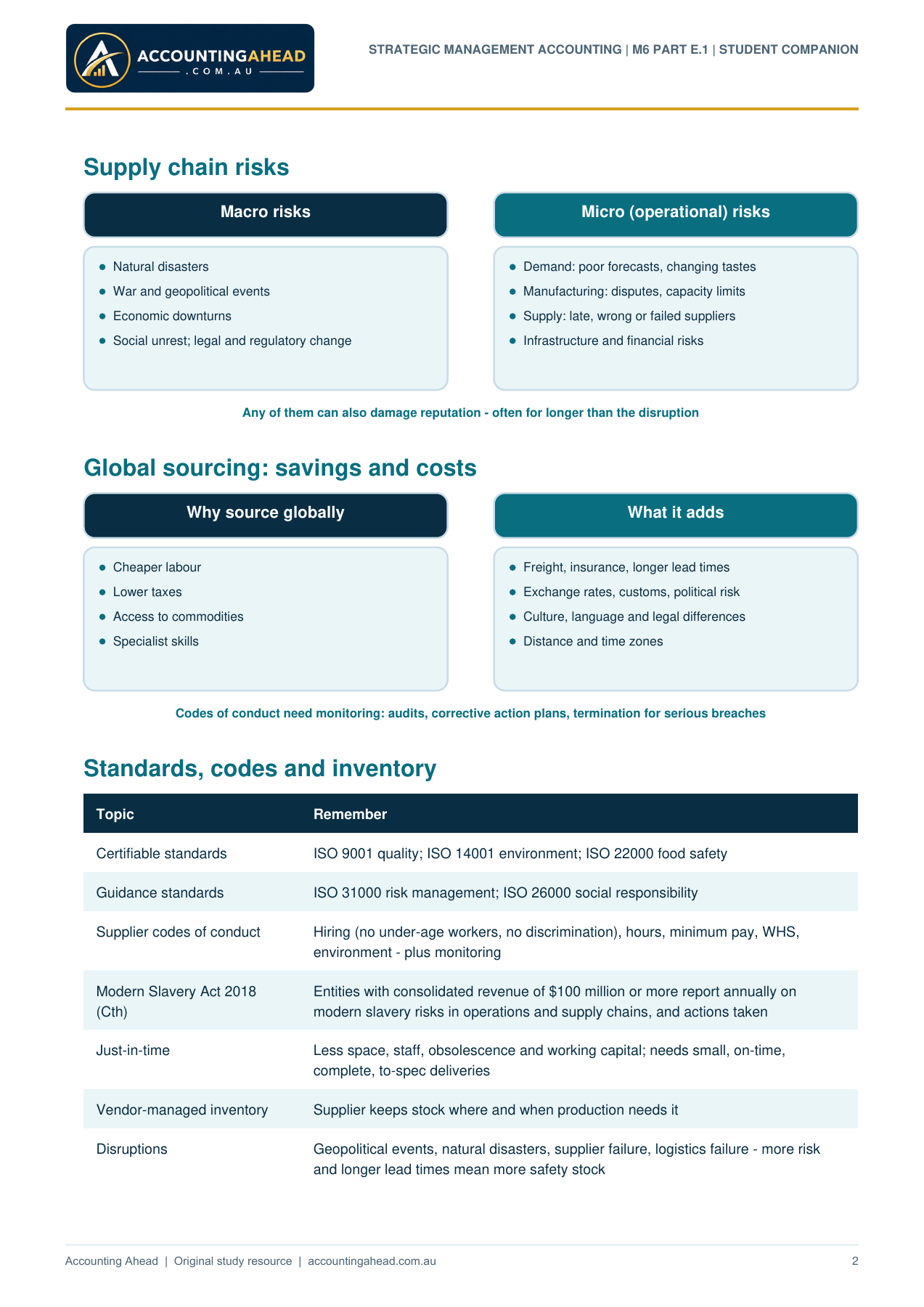
Supply chain risks
Macro risks
Natural disasters
War and geopolitical events
Economic downturns
Social unrest; legal and regulatory change
Micro (operational) risks
Demand: poor forecasts, changing tastes
Manufacturing: disputes, capacity limits
Supply: late, wrong or failed suppliers
Infrastructure and financial risks
Any of them can also damage reputation - often for longer than the disruption
Global sourcing: savings and costs
Why source globally
Cheaper labour
Lower taxes
Access to commodities
Specialist skills
What it adds
Freight, insurance, longer lead times
Exchange rates, customs, political risk
Culture, language and legal differences
Distance and time zones
Codes of conduct need monitoring: audits, corrective action plans, termination for serious breaches
Standards, codes and inventory
Topic Remember
Certifiable standards ISO 9001 quality; ISO 14001 environment; ISO 22000 food safety
Guidance standards ISO 31000 risk management; ISO 26000 social responsibility
Supplier codes of conduct Hiring (no under-age workers, no discrimination), hours, minimum pay, WHS,
environment - plus monitoring
Modern Slavery Act 2018
(Cth)
Entities with consolidated revenue of $100 million or more report annually on
modern slavery risks in operations and supply chains, and actions taken
Just-in-time Less space, staff, obsolescence and working capital; needs small, on-time,
complete, to-spec deliveries
Vendor-managed inventory Supplier keeps stock where and when production needs it
Disruptions Geopolitical events, natural disasters, supplier failure, logistics failure - more risk
and longer lead times mean more safety stock
STRATEGIC MANAGEMENT ACCOUNTING | M6 PART E.1 | STUDENT COMPANION
2
Accounting Ahead | Original study resource | accountingahead.com.au
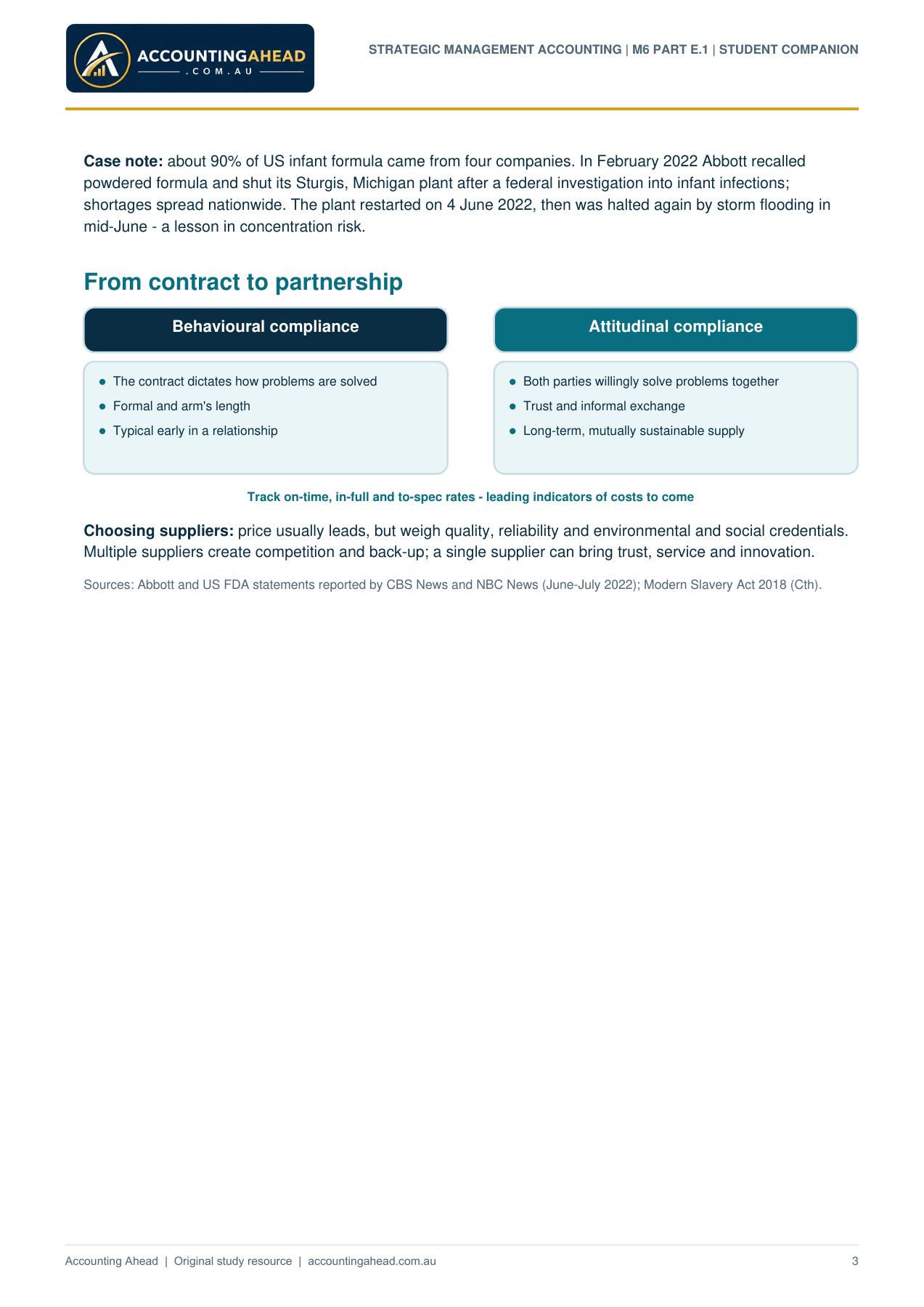
Case note: about 90% of US infant formula came from four companies. In February 2022 Abbott recalled
powdered formula and shut its Sturgis, Michigan plant after a federal investigation into infant infections;
shortages spread nationwide. The plant restarted on 4 June 2022, then was halted again by storm flooding in
mid-June - a lesson in concentration risk.
From contract to partnership
Behavioural compliance
The contract dictates how problems are solved
Formal and arm's length
Typical early in a relationship
Attitudinal compliance
Both parties willingly solve problems together
Trust and informal exchange
Long-term, mutually sustainable supply
Track on-time, in-full and to-spec rates - leading indicators of costs to come
Choosing suppliers: price usually leads, but weigh quality, reliability and environmental and social credentials.
Multiple suppliers create competition and back-up; a single supplier can bring trust, service and innovation.
Sources: Abbott and US FDA statements reported by CBS News and NBC News (June-July 2022); Modern Slavery Act 2018 (Cth).
STRATEGIC MANAGEMENT ACCOUNTING | M6 PART E.1 | STUDENT COMPANION
3
Accounting Ahead | Original study resource | accountingahead.com.au
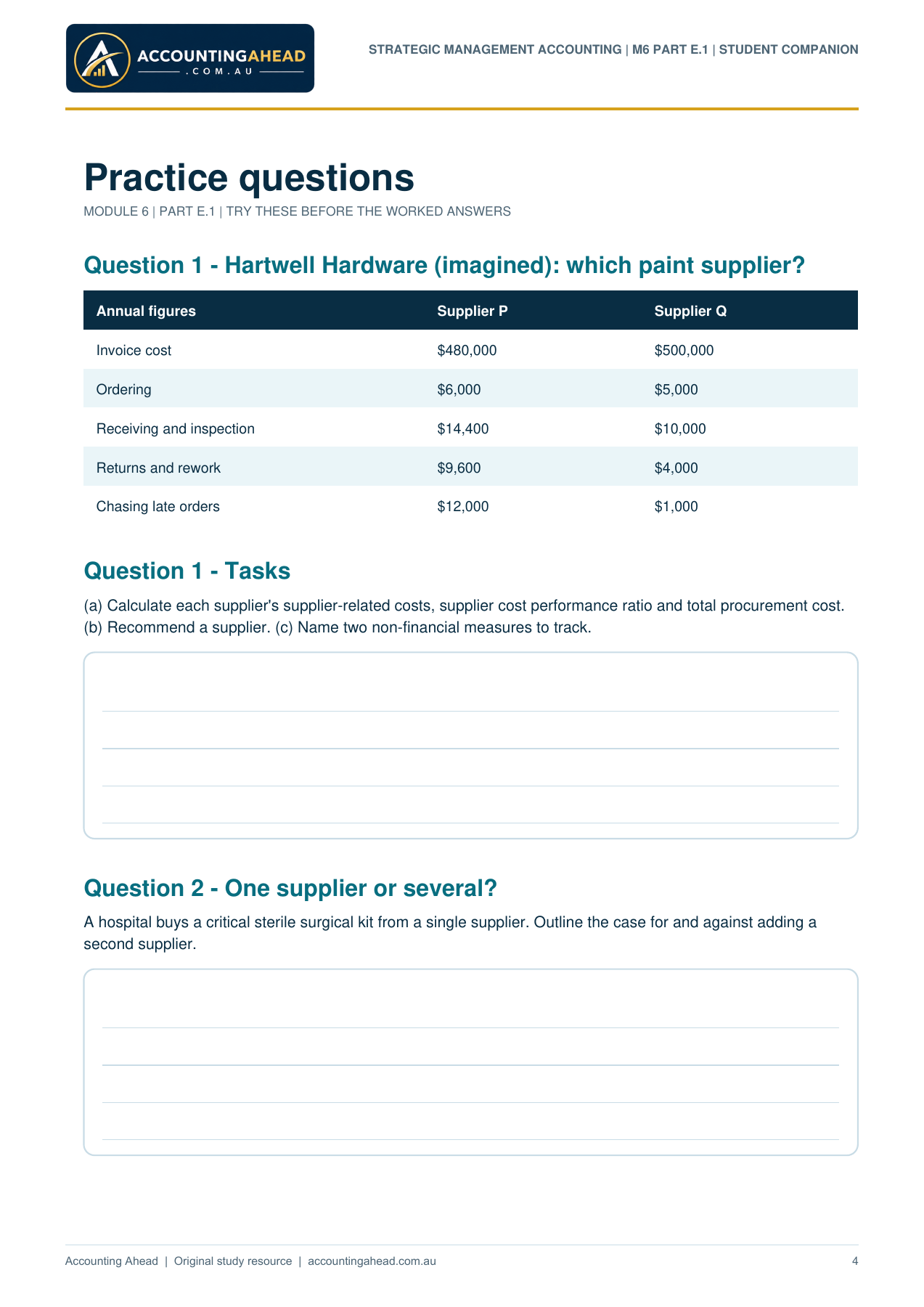
Practice questions
MODULE 6 | PART E.1 | TRY THESE BEFORE THE WORKED ANSWERS
Question 1 - Hartwell Hardware (imagined): which paint supplier?
Annual figures Supplier P Supplier Q
Invoice cost $480,000 $500,000
Ordering $6,000 $5,000
Receiving and inspection $14,400 $10,000
Returns and rework $9,600 $4,000
Chasing late orders $12,000 $1,000
Question 1 - Tasks
(a) Calculate each supplier's supplier-related costs, supplier cost performance ratio and total procurement cost.
(b) Recommend a supplier. (c) Name two non-financial measures to track.
Question 2 - One supplier or several?
A hospital buys a critical sterile surgical kit from a single supplier. Outline the case for and against adding a
second supplier.
STRATEGIC MANAGEMENT ACCOUNTING | M6 PART E.1 | STUDENT COMPANION
4
Accounting Ahead | Original study resource | accountingahead.com.au
Worked answers
MODULE 6 | PART E.1 | WORKED ANSWERS - ATTEMPT THE QUESTIONS FIRST
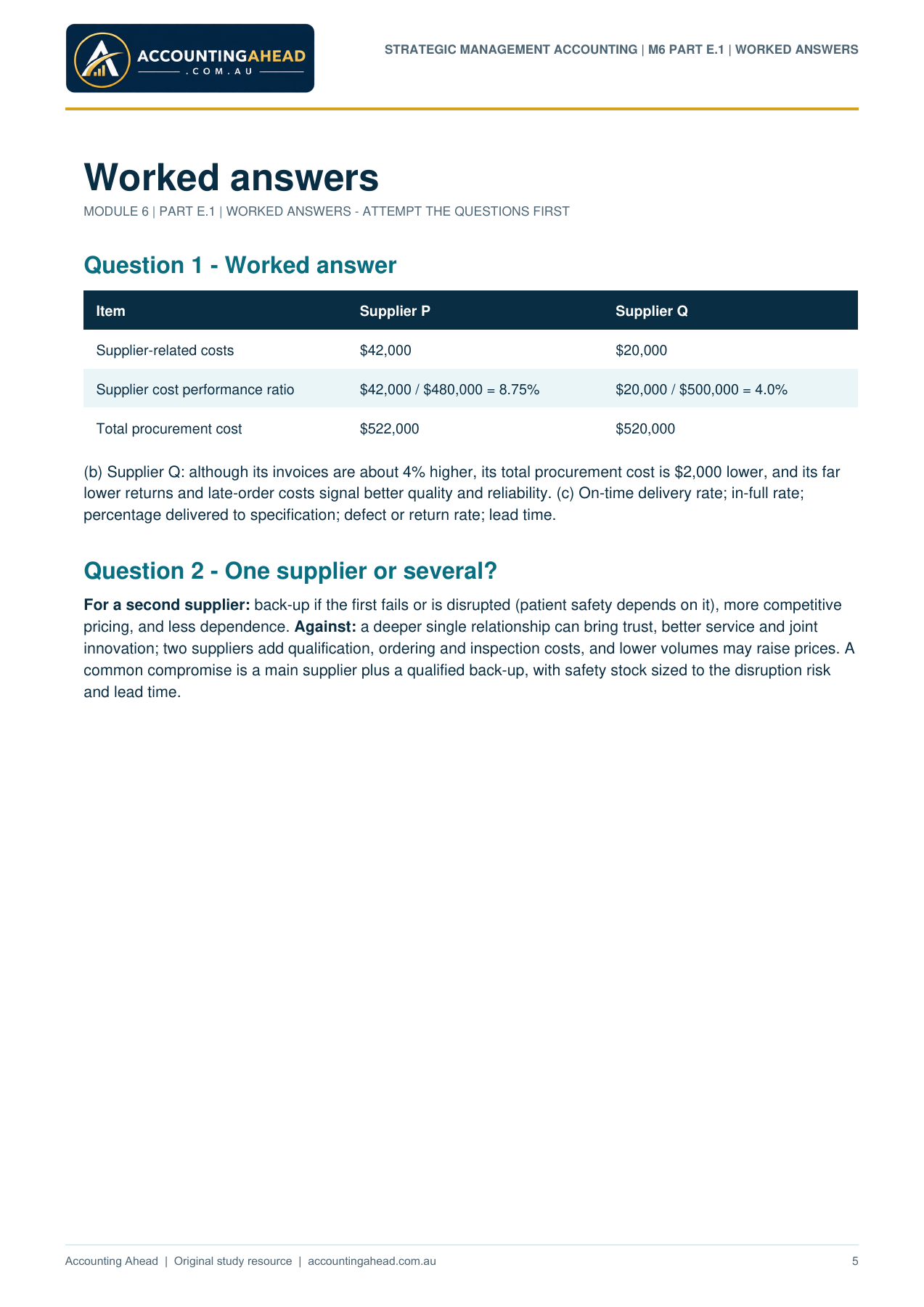
Question 1 - Worked answer
Item Supplier P Supplier Q
Supplier-related costs $42,000 $20,000
Supplier cost performance ratio $42,000 / $480,000 = 8.75% $20,000 / $500,000 = 4.0%
Total procurement cost $522,000 $520,000
(b) Supplier Q: although its invoices are about 4% higher, its total procurement cost is $2,000 lower, and its far
lower returns and late-order costs signal better quality and reliability. (c) On-time delivery rate; in-full rate;
percentage delivered to specification; defect or return rate; lead time.
Question 2 - One supplier or several?
For a second supplier: back-up if the first fails or is disrupted (patient safety depends on it), more competitive
pricing, and less dependence. Against: a deeper single relationship can bring trust, better service and joint
innovation; two suppliers add qualification, ordering and inspection costs, and lower volumes may raise prices. A
common compromise is a main supplier plus a qualified back-up, with safety stock sized to the disruption risk
and lead time.
STRATEGIC MANAGEMENT ACCOUNTING | M6 PART E.1 | WORKED ANSWERS
5