
AAA Exam Reference Pack
Subject-wide reference charts for Advanced Audit and Assurance exam revision.
Read the handout text
Accounting Ahead | Original study resource | accountingahead.com.au
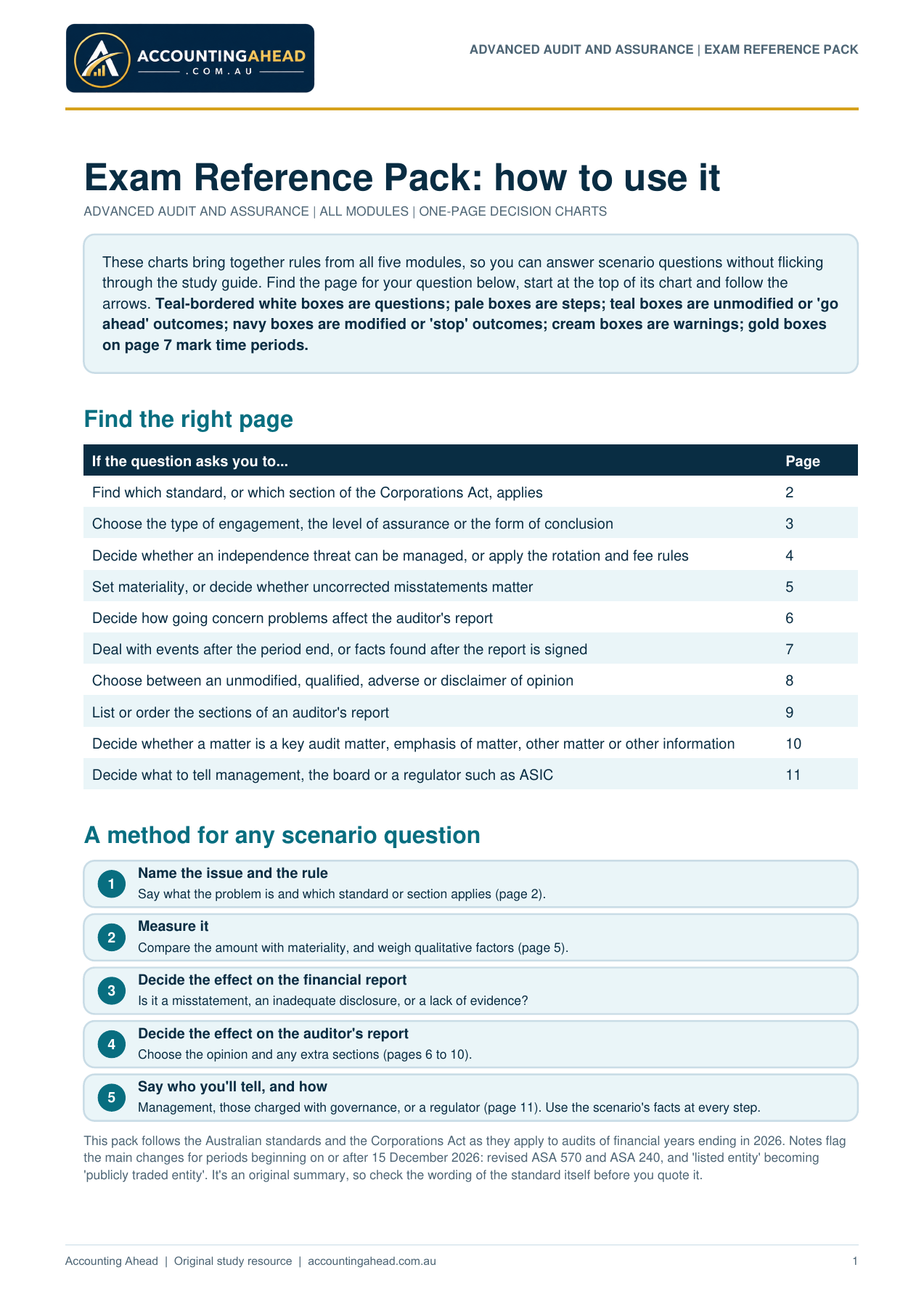
Exam Reference Pack: how to use it
ADVANCED AUDIT AND ASSURANCE | ALL MODULES | ONE-PAGE DECISION CHARTS
These charts bring together rules from all five modules, so you can answer scenario questions without flicking
through the study guide. Find the page for your question below, start at the top of its chart and follow the
arrows. Teal-bordered white boxes are questions; pale boxes are steps; teal boxes are unmodified or 'go
ahead' outcomes; navy boxes are modified or 'stop' outcomes; cream boxes are warnings; gold boxes
on page 7 mark time periods.
Find the right page
If the question asks you to... Page
Find which standard, or which section of the Corporations Act, applies 2
Choose the type of engagement, the level of assurance or the form of conclusion 3
Decide whether an independence threat can be managed, or apply the rotation and fee rules 4
Set materiality, or decide whether uncorrected misstatements matter 5
Decide how going concern problems affect the auditor's report 6
Deal with events after the period end, or facts found after the report is signed 7
Choose between an unmodified, qualified, adverse or disclaimer of opinion 8
List or order the sections of an auditor's report 9
Decide whether a matter is a key audit matter, emphasis of matter, other matter or other information 10
Decide what to tell management, the board or a regulator such as ASIC 11
A method for any scenario question
1 Name the issue and the rule
Say what the problem is and which standard or section applies (page 2).
2 Measure it
Compare the amount with materiality, and weigh qualitative factors (page 5).
3 Decide the effect on the financial report
Is it a misstatement, an inadequate disclosure, or a lack of evidence?
4 Decide the effect on the auditor's report
Choose the opinion and any extra sections (pages 6 to 10).
5 Say who you'll tell, and how
Management, those charged with governance, or a regulator (page 11). Use the scenario's facts at every step.
This pack follows the Australian standards and the Corporations Act as they apply to audits of financial years ending in 2026. Notes flag
the main changes for periods beginning on or after 15 December 2026: revised ASA 570 and ASA 240, and 'listed entity' becoming
'publicly traded entity'. It's an original summary, so check the wording of the standard itself before you quote it.
ADVANCED AUDIT AND ASSURANCE | EXAM REFERENCE PACK
1
Accounting Ahead | Original study resource | accountingahead.com.au
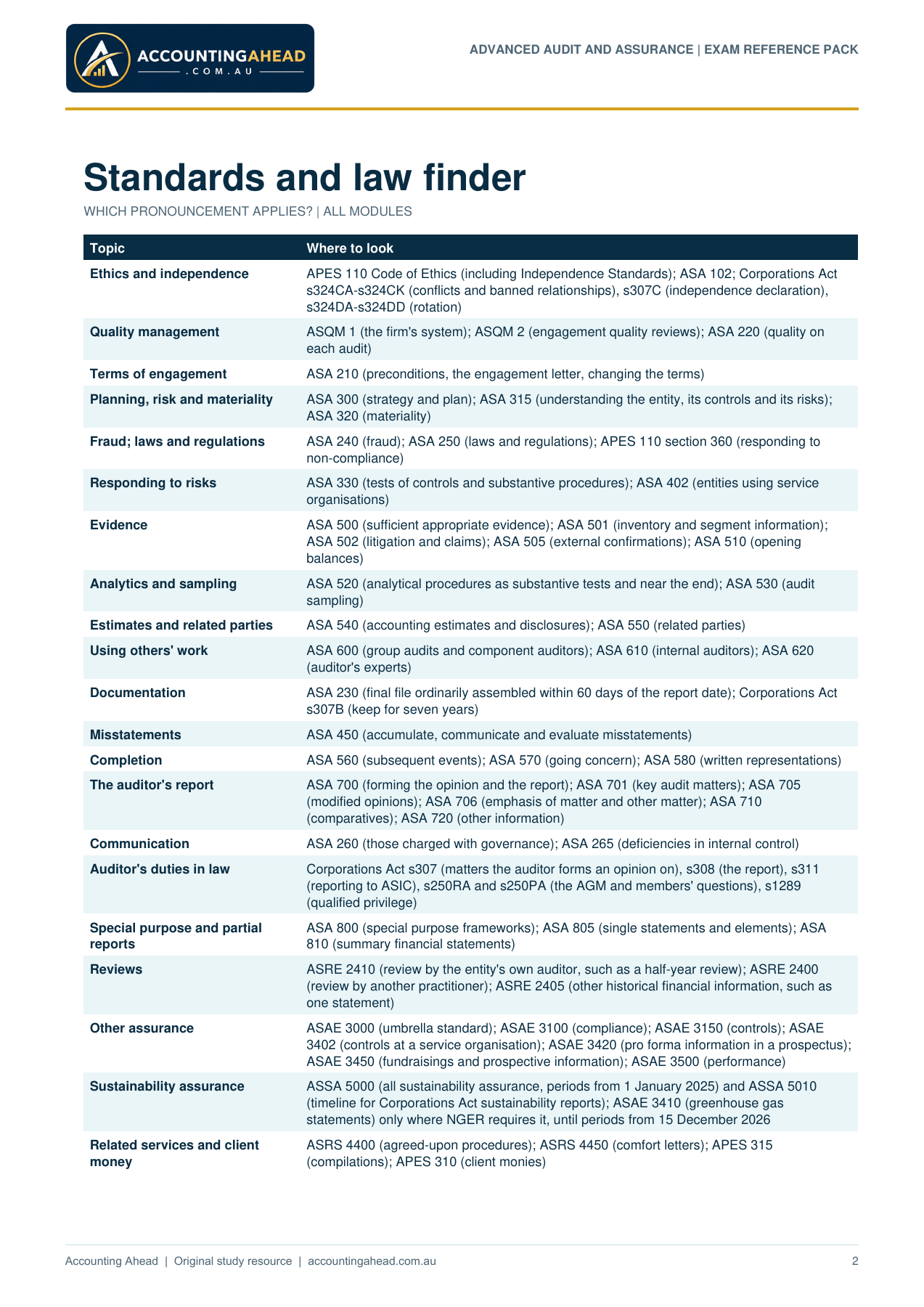
Standards and law finder
WHICH PRONOUNCEMENT APPLIES? | ALL MODULES
Topic Where to look
Ethics and independence APES 110 Code of Ethics (including Independence Standards); ASA 102; Corporations Act
s324CA-s324CK (conflicts and banned relationships), s307C (independence declaration),
s324DA-s324DD (rotation)
Quality management ASQM 1 (the firm's system); ASQM 2 (engagement quality reviews); ASA 220 (quality on
each audit)
Terms of engagement ASA 210 (preconditions, the engagement letter, changing the terms)
Planning, risk and materiality ASA 300 (strategy and plan); ASA 315 (understanding the entity, its controls and its risks);
ASA 320 (materiality)
Fraud; laws and regulations ASA 240 (fraud); ASA 250 (laws and regulations); APES 110 section 360 (responding to
non-compliance)
Responding to risks ASA 330 (tests of controls and substantive procedures); ASA 402 (entities using service
organisations)
Evidence ASA 500 (sufficient appropriate evidence); ASA 501 (inventory and segment information);
ASA 502 (litigation and claims); ASA 505 (external confirmations); ASA 510 (opening
balances)
Analytics and sampling ASA 520 (analytical procedures as substantive tests and near the end); ASA 530 (audit
sampling)
Estimates and related parties ASA 540 (accounting estimates and disclosures); ASA 550 (related parties)
Using others' work ASA 600 (group audits and component auditors); ASA 610 (internal auditors); ASA 620
(auditor's experts)
Documentation ASA 230 (final file ordinarily assembled within 60 days of the report date); Corporations Act
s307B (keep for seven years)
Misstatements ASA 450 (accumulate, communicate and evaluate misstatements)
Completion ASA 560 (subsequent events); ASA 570 (going concern); ASA 580 (written representations)
The auditor's report ASA 700 (forming the opinion and the report); ASA 701 (key audit matters); ASA 705
(modified opinions); ASA 706 (emphasis of matter and other matter); ASA 710
(comparatives); ASA 720 (other information)
Communication ASA 260 (those charged with governance); ASA 265 (deficiencies in internal control)
Auditor's duties in law Corporations Act s307 (matters the auditor forms an opinion on), s308 (the report), s311
(reporting to ASIC), s250RA and s250PA (the AGM and members' questions), s1289
(qualified privilege)
Special purpose and partial
reports
ASA 800 (special purpose frameworks); ASA 805 (single statements and elements); ASA
810 (summary financial statements)
Reviews ASRE 2410 (review by the entity's own auditor, such as a half-year review); ASRE 2400
(review by another practitioner); ASRE 2405 (other historical financial information, such as
one statement)
Other assurance ASAE 3000 (umbrella standard); ASAE 3100 (compliance); ASAE 3150 (controls); ASAE
3402 (controls at a service organisation); ASAE 3420 (pro forma information in a prospectus);
ASAE 3450 (fundraisings and prospective information); ASAE 3500 (performance)
Sustainability assurance ASSA 5000 (all sustainability assurance, periods from 1 January 2025) and ASSA 5010
(timeline for Corporations Act sustainability reports); ASAE 3410 (greenhouse gas
statements) only where NGER requires it, until periods from 15 December 2026
Related services and client
money
ASRS 4400 (agreed-upon procedures); ASRS 4450 (comfort letters); APES 315
(compilations); APES 310 (client monies)
ADVANCED AUDIT AND ASSURANCE | EXAM REFERENCE PACK
2
Accounting Ahead | Original study resource | accountingahead.com.au
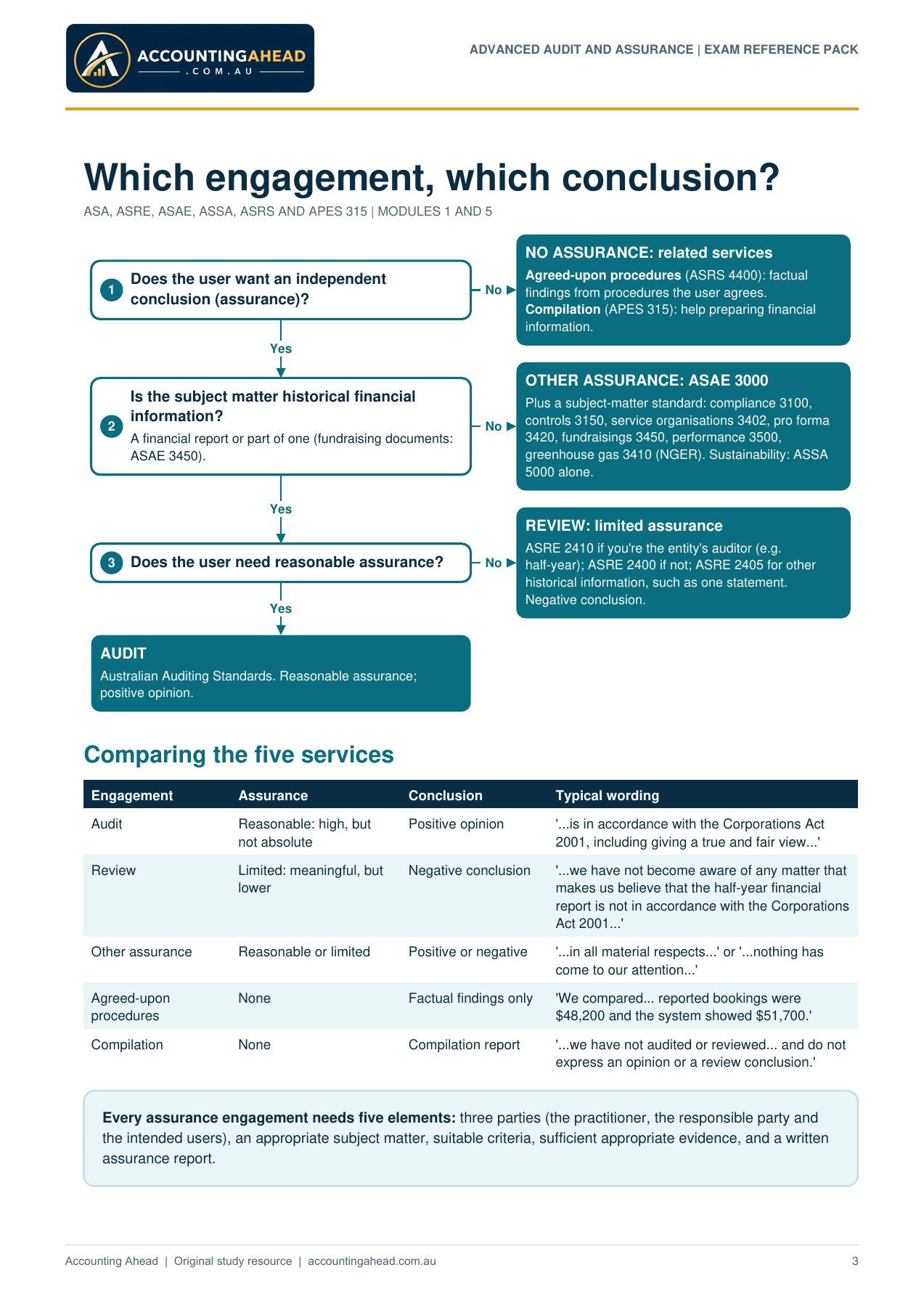
Which engagement, which conclusion?
ASA, ASRE, ASAE, ASSA, ASRS AND APES 315 | MODULES 1 AND 5
1 Does the user want an independent
conclusion (assurance)?
NO ASSURANCE: related services
Agreed-upon procedures (ASRS 4400): factual
findings from procedures the user agrees.
Compilation (APES 315): help preparing financial
information.
No
Yes
2
Is the subject matter historical financial
information?
A financial report or part of one (fundraising documents:
ASAE 3450).
OTHER ASSURANCE: ASAE 3000
Plus a subject-matter standard: compliance 3100,
controls 3150, service organisations 3402, pro forma
3420, fundraisings 3450, performance 3500,
greenhouse gas 3410 (NGER). Sustainability: ASSA
5000 alone.
No
Yes
3 Does the user need reasonable assurance?
REVIEW: limited assurance
ASRE 2410 if you're the entity's auditor (e.g.
half-year); ASRE 2400 if not; ASRE 2405 for other
historical information, such as one statement.
Negative conclusion.
No
Yes
AUDIT
Australian Auditing Standards. Reasonable assurance;
positive opinion.
Comparing the five services
Engagement Assurance Conclusion Typical wording
Audit Reasonable: high, but
not absolute
Positive opinion '...is in accordance with the Corporations Act
2001, including giving a true and fair view...'
Review Limited: meaningful, but
lower
Negative conclusion '...we have not become aware of any matter that
makes us believe that the half-year financial
report is not in accordance with the Corporations
Act 2001...'
Other assurance Reasonable or limited Positive or negative '...in all material respects...' or '...nothing has
come to our attention...'
Agreed-upon
procedures
None Factual findings only 'We compared... reported bookings were
$48,200 and the system showed $51,700.'
Compilation None Compilation report '...we have not audited or reviewed... and do not
express an opinion or a review conclusion.'
Every assurance engagement needs five elements: three parties (the practitioner, the responsible party and
the intended users), an appropriate subject matter, suitable criteria, sufficient appropriate evidence, and a written
assurance report.
ADVANCED AUDIT AND ASSURANCE | EXAM REFERENCE PACK
3
Accounting Ahead | Original study resource | accountingahead.com.au
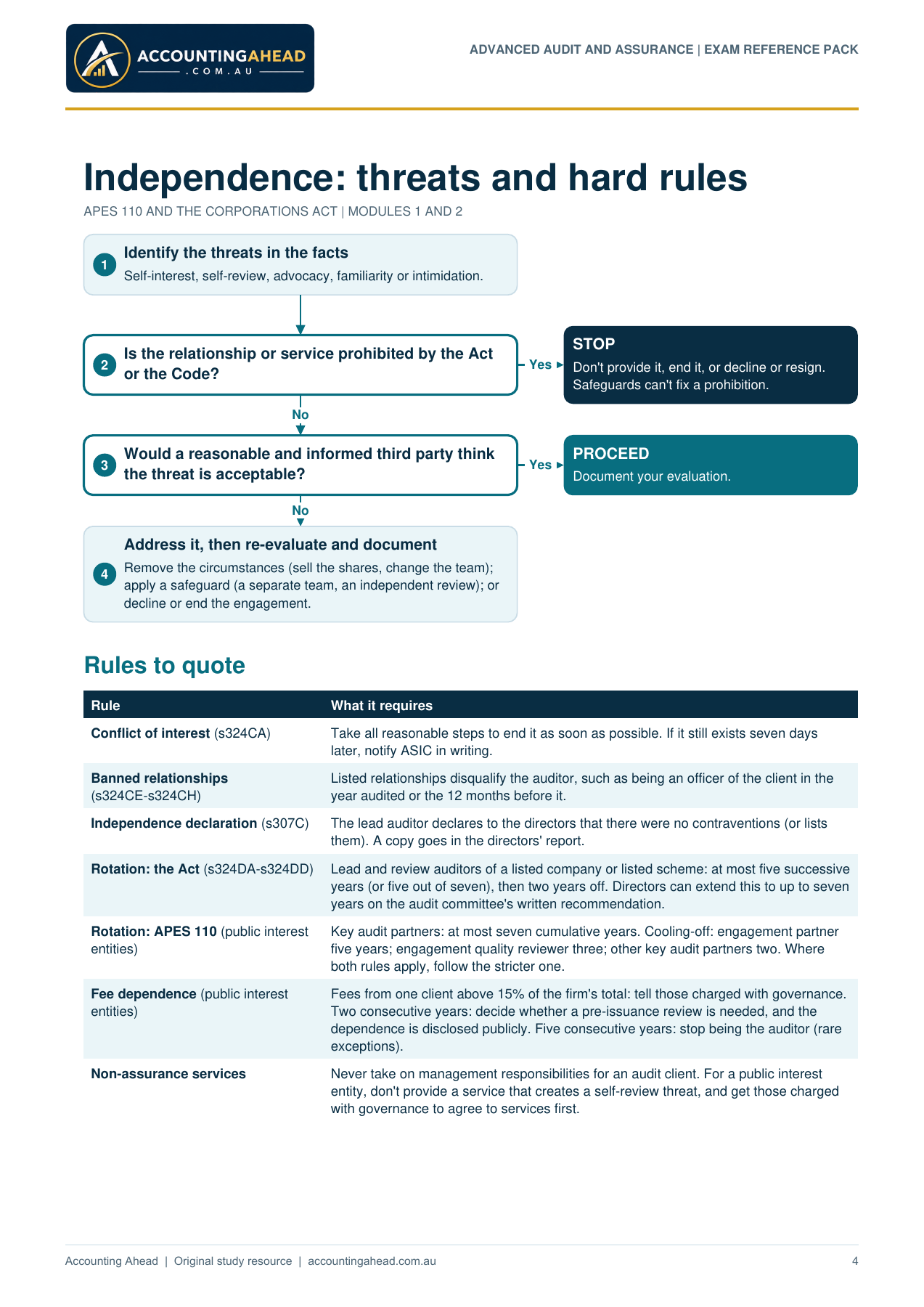
Independence: threats and hard rules
APES 110 AND THE CORPORATIONS ACT | MODULES 1 AND 2
1
Identify the threats in the facts
Self-interest, self-review, advocacy, familiarity or intimidation.
2 Is the relationship or service prohibited by the Act
or the Code?
STOP
Don't provide it, end it, or decline or resign.
Safeguards can't fix a prohibition.
Yes
No
3 Would a reasonable and informed third party think
the threat is acceptable?
PROCEED
Document your evaluation.
Yes
No
4
Address it, then re-evaluate and document
Remove the circumstances (sell the shares, change the team);
apply a safeguard (a separate team, an independent review); or
decline or end the engagement.
Rules to quote
Rule What it requires
Conflict of interest (s324CA) Take all reasonable steps to end it as soon as possible. If it still exists seven days
later, notify ASIC in writing.
Banned relationships
(s324CE-s324CH)
Listed relationships disqualify the auditor, such as being an officer of the client in the
year audited or the 12 months before it.
Independence declaration (s307C) The lead auditor declares to the directors that there were no contraventions (or lists
them). A copy goes in the directors' report.
Rotation: the Act (s324DA-s324DD) Lead and review auditors of a listed company or listed scheme: at most five successive
years (or five out of seven), then two years off. Directors can extend this to up to seven
years on the audit committee's written recommendation.
Rotation: APES 110 (public interest
entities)
Key audit partners: at most seven cumulative years. Cooling-off: engagement partner
five years; engagement quality reviewer three; other key audit partners two. Where
both rules apply, follow the stricter one.
Fee dependence (public interest
entities)
Fees from one client above 15% of the firm's total: tell those charged with governance.
Two consecutive years: decide whether a pre-issuance review is needed, and the
dependence is disclosed publicly. Five consecutive years: stop being the auditor (rare
exceptions).
Non-assurance services Never take on management responsibilities for an audit client. For a public interest
entity, don't provide a service that creates a self-review threat, and get those charged
with governance to agree to services first.
ADVANCED AUDIT AND ASSURANCE | EXAM REFERENCE PACK
4
Accounting Ahead | Original study resource | accountingahead.com.au
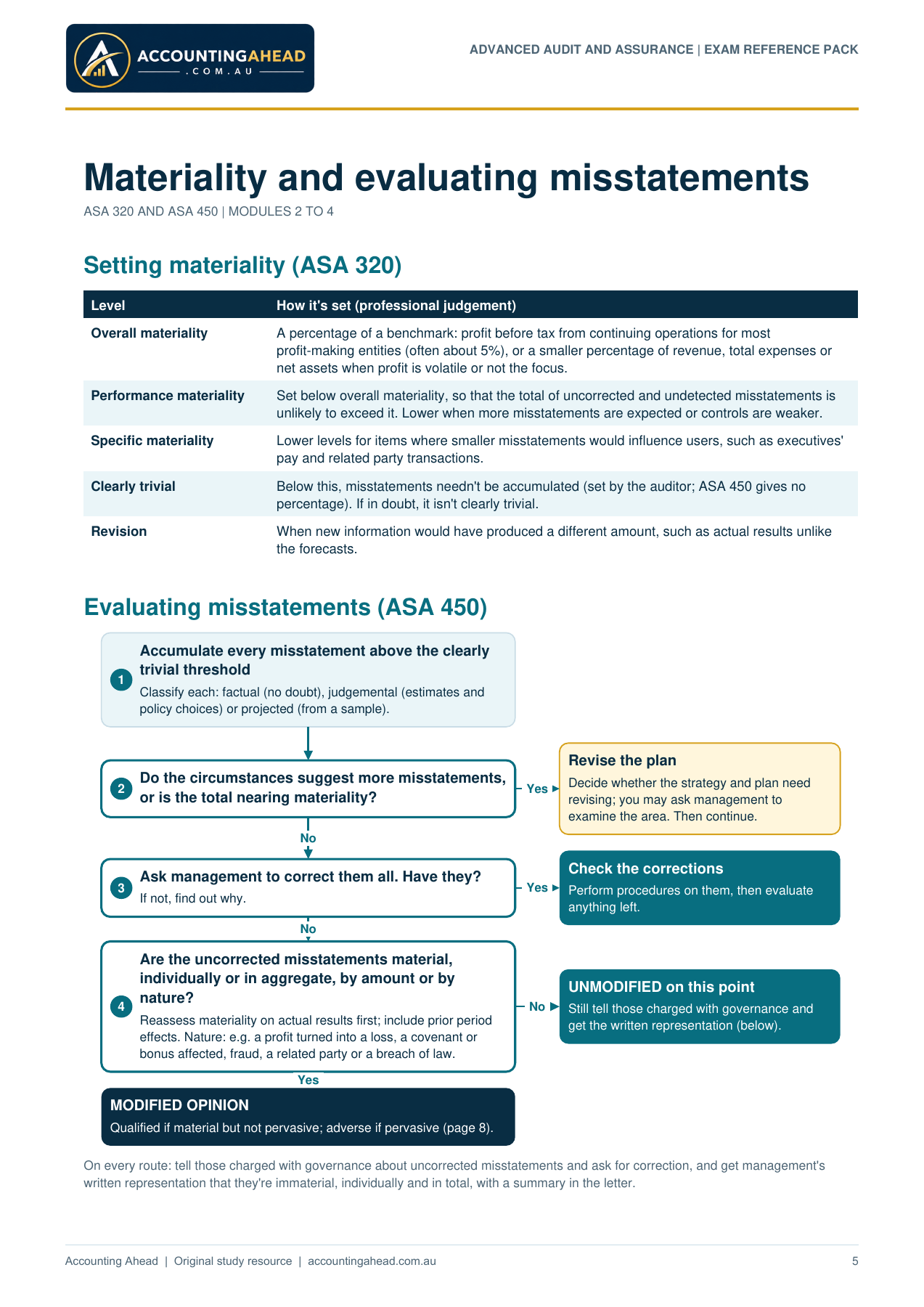
Materiality and evaluating misstatements
ASA 320 AND ASA 450 | MODULES 2 TO 4
Setting materiality (ASA 320)
Level How it's set (professional judgement)
Overall materiality A percentage of a benchmark: profit before tax from continuing operations for most
profit-making entities (often about 5%), or a smaller percentage of revenue, total expenses or
net assets when profit is volatile or not the focus.
Performance materiality Set below overall materiality, so that the total of uncorrected and undetected misstatements is
unlikely to exceed it. Lower when more misstatements are expected or controls are weaker.
Specific materiality Lower levels for items where smaller misstatements would influence users, such as executives'
pay and related party transactions.
Clearly trivial Below this, misstatements needn't be accumulated (set by the auditor; ASA 450 gives no
percentage). If in doubt, it isn't clearly trivial.
Revision When new information would have produced a different amount, such as actual results unlike
the forecasts.
Evaluating misstatements (ASA 450)
1
Accumulate every misstatement above the clearly
trivial threshold
Classify each: factual (no doubt), judgemental (estimates and
policy choices) or projected (from a sample).
2 Do the circumstances suggest more misstatements,
or is the total nearing materiality?
Revise the plan
Decide whether the strategy and plan need
revising; you may ask management to
examine the area. Then continue.
Yes
No
3
Ask management to correct them all. Have they?
If not, find out why.
Check the corrections
Perform procedures on them, then evaluate
anything left.
Yes
No
4
Are the uncorrected misstatements material,
individually or in aggregate, by amount or by
nature?
Reassess materiality on actual results first; include prior period
effects. Nature: e.g. a profit turned into a loss, a covenant or
bonus affected, fraud, a related party or a breach of law.
UNMODIFIED on this point
Still tell those charged with governance and
get the written representation (below).
No
Yes
MODIFIED OPINION
Qualified if material but not pervasive; adverse if pervasive (page 8).
On every route: tell those charged with governance about uncorrected misstatements and ask for correction, and get management's
written representation that they're immaterial, individually and in total, with a summary in the letter.
ADVANCED AUDIT AND ASSURANCE | EXAM REFERENCE PACK
5
Accounting Ahead | Original study resource | accountingahead.com.au
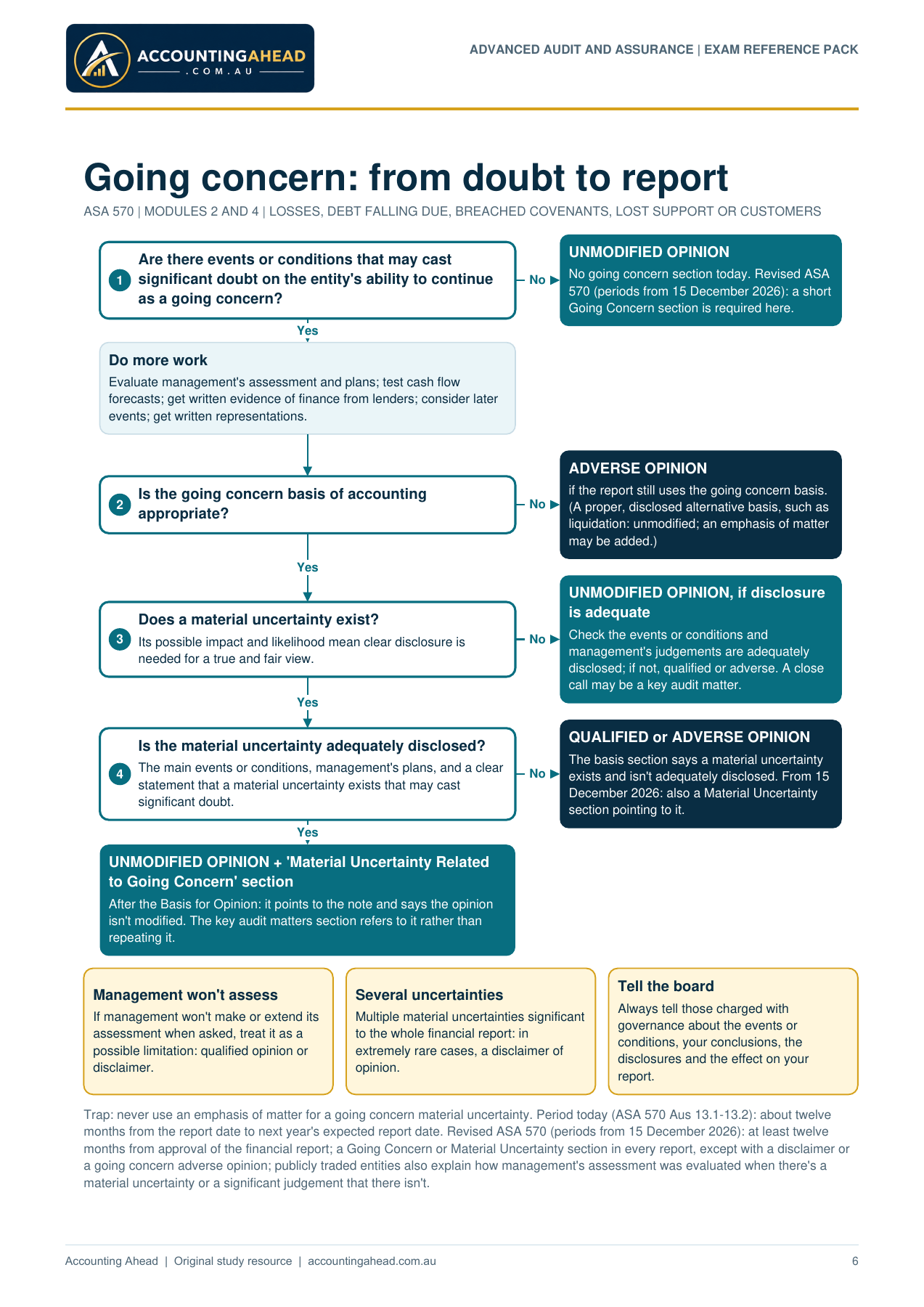
Going concern: from doubt to report
ASA 570 | MODULES 2 AND 4 | LOSSES, DEBT FALLING DUE, BREACHED COVENANTS, LOST SUPPORT OR CUSTOMERS
1
Are there events or conditions that may cast
significant doubt on the entity's ability to continue
as a going concern?
UNMODIFIED OPINION
No going concern section today. Revised ASA
570 (periods from 15 December 2026): a short
Going Concern section is required here.
No
Yes
Do more work
Evaluate management's assessment and plans; test cash flow
forecasts; get written evidence of finance from lenders; consider later
events; get written representations.
2 Is the going concern basis of accounting
appropriate?
ADVERSE OPINION
if the report still uses the going concern basis.
(A proper, disclosed alternative basis, such as
liquidation: unmodified; an emphasis of matter
may be added.)
No
Yes
3
Does a material uncertainty exist?
Its possible impact and likelihood mean clear disclosure is
needed for a true and fair view.
UNMODIFIED OPINION, if disclosure
is adequate
Check the events or conditions and
management's judgements are adequately
disclosed; if not, qualified or adverse. A close
call may be a key audit matter.
No
Yes
4
Is the material uncertainty adequately disclosed?
The main events or conditions, management's plans, and a clear
statement that a material uncertainty exists that may cast
significant doubt.
QUALIFIED or ADVERSE OPINION
The basis section says a material uncertainty
exists and isn't adequately disclosed. From 15
December 2026: also a Material Uncertainty
section pointing to it.
No
Yes
UNMODIFIED OPINION + 'Material Uncertainty Related
to Going Concern' section
After the Basis for Opinion: it points to the note and says the opinion
isn't modified. The key audit matters section refers to it rather than
repeating it.
Management won't assess
If management won't make or extend its
assessment when asked, treat it as a
possible limitation: qualified opinion or
disclaimer.
Several uncertainties
Multiple material uncertainties significant
to the whole financial report: in
extremely rare cases, a disclaimer of
opinion.
Tell the board
Always tell those charged with
governance about the events or
conditions, your conclusions, the
disclosures and the effect on your
report.
Trap: never use an emphasis of matter for a going concern material uncertainty. Period today (ASA 570 Aus 13.1-13.2): about twelve
months from the report date to next year's expected report date. Revised ASA 570 (periods from 15 December 2026): at least twelve
months from approval of the financial report; a Going Concern or Material Uncertainty section in every report, except with a disclaimer or
a going concern adverse opinion; publicly traded entities also explain how management's assessment was evaluated when there's a
material uncertainty or a significant judgement that there isn't.
ADVANCED AUDIT AND ASSURANCE | EXAM REFERENCE PACK
6
Accounting Ahead | Original study resource | accountingahead.com.au
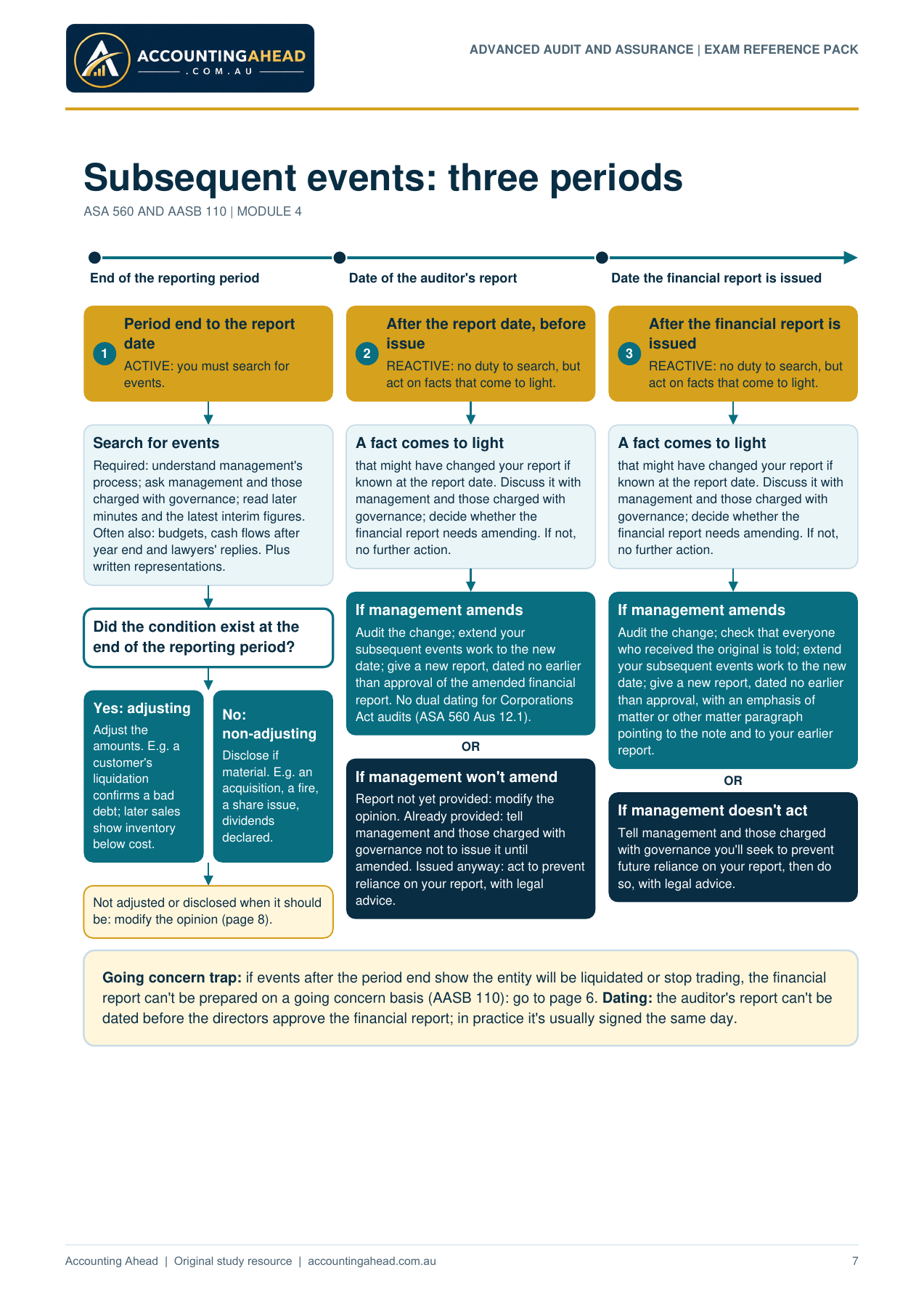
Subsequent events: three periods
ASA 560 AND AASB 110 | MODULE 4
End of the reporting period Date of the auditor's report Date the financial report is issued
1
Period end to the report
date
ACTIVE: you must search for
events.
Search for events
Required: understand management's
process; ask management and those
charged with governance; read later
minutes and the latest interim figures.
Often also: budgets, cash flows after
year end and lawyers' replies. Plus
written representations.
Did the condition exist at the
end of the reporting period?
Yes: adjusting
Adjust the
amounts. E.g. a
customer's
liquidation
confirms a bad
debt; later sales
show inventory
below cost.
No:
non-adjusting
Disclose if
material. E.g. an
acquisition, a fire,
a share issue,
dividends
declared.
Not adjusted or disclosed when it should
be: modify the opinion (page 8).
2
After the report date, before
issue
REACTIVE: no duty to search, but
act on facts that come to light.
A fact comes to light
that might have changed your report if
known at the report date. Discuss it with
management and those charged with
governance; decide whether the
financial report needs amending. If not,
no further action.
If management amends
Audit the change; extend your
subsequent events work to the new
date; give a new report, dated no earlier
than approval of the amended financial
report. No dual dating for Corporations
Act audits (ASA 560 Aus 12.1).
OR
If management won't amend
Report not yet provided: modify the
opinion. Already provided: tell
management and those charged with
governance not to issue it until
amended. Issued anyway: act to prevent
reliance on your report, with legal
advice.
3
After the financial report is
issued
REACTIVE: no duty to search, but
act on facts that come to light.
A fact comes to light
that might have changed your report if
known at the report date. Discuss it with
management and those charged with
governance; decide whether the
financial report needs amending. If not,
no further action.
If management amends
Audit the change; check that everyone
who received the original is told; extend
your subsequent events work to the new
date; give a new report, dated no earlier
than approval, with an emphasis of
matter or other matter paragraph
pointing to the note and to your earlier
report.
OR
If management doesn't act
Tell management and those charged
with governance you'll seek to prevent
future reliance on your report, then do
so, with legal advice.
Going concern trap: if events after the period end show the entity will be liquidated or stop trading, the financial
report can't be prepared on a going concern basis (AASB 110): go to page 6. Dating: the auditor's report can't be
dated before the directors approve the financial report; in practice it's usually signed the same day.
ADVANCED AUDIT AND ASSURANCE | EXAM REFERENCE PACK
7
Accounting Ahead | Original study resource | accountingahead.com.au
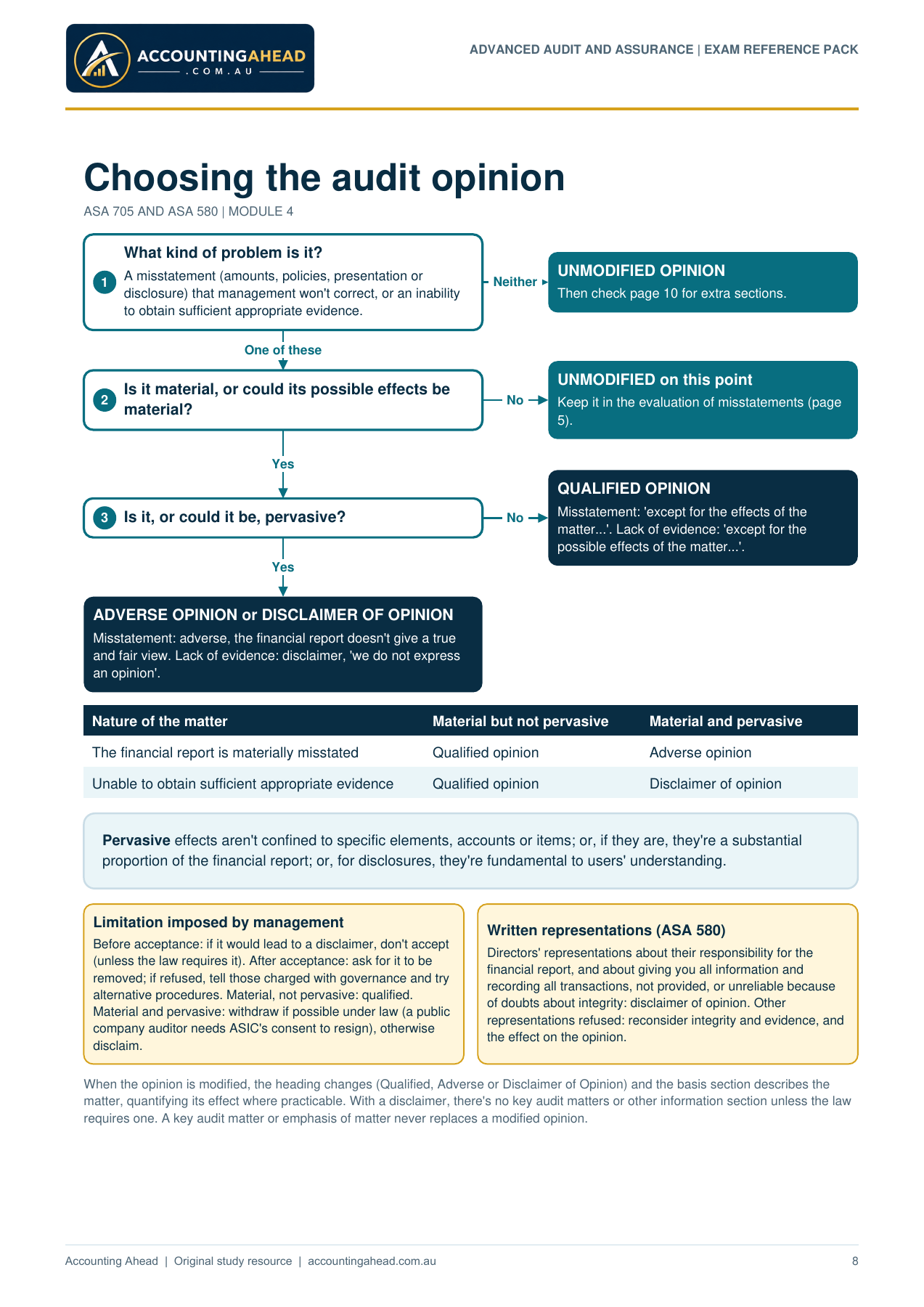
Choosing the audit opinion
ASA 705 AND ASA 580 | MODULE 4
1
What kind of problem is it?
A misstatement (amounts, policies, presentation or
disclosure) that management won't correct, or an inability
to obtain sufficient appropriate evidence.
UNMODIFIED OPINION
Then check page 10 for extra sections.
Neither
One of these
2 Is it material, or could its possible effects be
material?
UNMODIFIED on this point
Keep it in the evaluation of misstatements (page
5).
No
Yes
3 Is it, or could it be, pervasive?
QUALIFIED OPINION
Misstatement: 'except for the effects of the
matter...'. Lack of evidence: 'except for the
possible effects of the matter...'.
No
Yes
ADVERSE OPINION or DISCLAIMER OF OPINION
Misstatement: adverse, the financial report doesn't give a true
and fair view. Lack of evidence: disclaimer, 'we do not express
an opinion'.
Nature of the matter Material but not pervasive Material and pervasive
The financial report is materially misstated Qualified opinion Adverse opinion
Unable to obtain sufficient appropriate evidence Qualified opinion Disclaimer of opinion
Pervasive effects aren't confined to specific elements, accounts or items; or, if they are, they're a substantial
proportion of the financial report; or, for disclosures, they're fundamental to users' understanding.
Limitation imposed by management
Before acceptance: if it would lead to a disclaimer, don't accept
(unless the law requires it). After acceptance: ask for it to be
removed; if refused, tell those charged with governance and try
alternative procedures. Material, not pervasive: qualified.
Material and pervasive: withdraw if possible under law (a public
company auditor needs ASIC's consent to resign), otherwise
disclaim.
Written representations (ASA 580)
Directors' representations about their responsibility for the
financial report, and about giving you all information and
recording all transactions, not provided, or unreliable because
of doubts about integrity: disclaimer of opinion. Other
representations refused: reconsider integrity and evidence, and
the effect on the opinion.
When the opinion is modified, the heading changes (Qualified, Adverse or Disclaimer of Opinion) and the basis section describes the
matter, quantifying its effect where practicable. With a disclaimer, there's no key audit matters or other information section unless the law
requires one. A key audit matter or emphasis of matter never replaces a modified opinion.
ADVANCED AUDIT AND ASSURANCE | EXAM REFERENCE PACK
8
Accounting Ahead | Original study resource | accountingahead.com.au
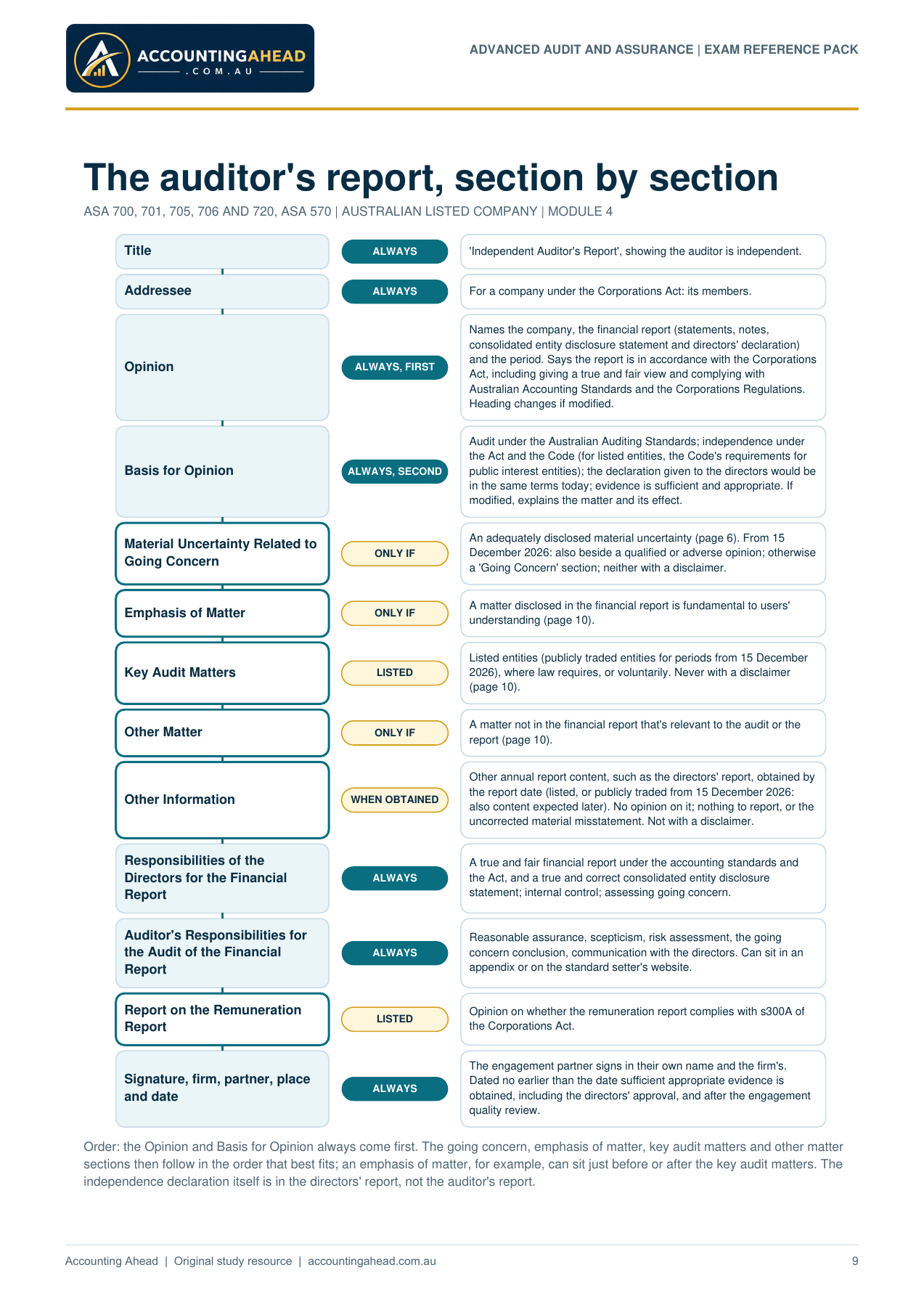
The auditor's report, section by section
ASA 700, 701, 705, 706 AND 720, ASA 570 | AUSTRALIAN LISTED COMPANY | MODULE 4
Title ALWAYS 'Independent Auditor's Report', showing the auditor is independent.
Addressee ALWAYS For a company under the Corporations Act: its members.
Opinion ALWAYS, FIRST
Names the company, the financial report (statements, notes,
consolidated entity disclosure statement and directors' declaration)
and the period. Says the report is in accordance with the Corporations
Act, including giving a true and fair view and complying with
Australian Accounting Standards and the Corporations Regulations.
Heading changes if modified.
Basis for Opinion ALWAYS, SECOND
Audit under the Australian Auditing Standards; independence under
the Act and the Code (for listed entities, the Code's requirements for
public interest entities); the declaration given to the directors would be
in the same terms today; evidence is sufficient and appropriate. If
modified, explains the matter and its effect.
Material Uncertainty Related to
Going Concern ONLY IF
An adequately disclosed material uncertainty (page 6). From 15
December 2026: also beside a qualified or adverse opinion; otherwise
a 'Going Concern' section; neither with a disclaimer.
Emphasis of Matter ONLY IF A matter disclosed in the financial report is fundamental to users'
understanding (page 10).
Key Audit Matters LISTED
Listed entities (publicly traded entities for periods from 15 December
2026), where law requires, or voluntarily. Never with a disclaimer
(page 10).
Other Matter ONLY IF A matter not in the financial report that's relevant to the audit or the
report (page 10).
Other Information WHEN OBTAINED
Other annual report content, such as the directors' report, obtained by
the report date (listed, or publicly traded from 15 December 2026:
also content expected later). No opinion on it; nothing to report, or the
uncorrected material misstatement. Not with a disclaimer.
Responsibilities of the
Directors for the Financial
Report
ALWAYS
A true and fair financial report under the accounting standards and
the Act, and a true and correct consolidated entity disclosure
statement; internal control; assessing going concern.
Auditor's Responsibilities for
the Audit of the Financial
Report
ALWAYS
Reasonable assurance, scepticism, risk assessment, the going
concern conclusion, communication with the directors. Can sit in an
appendix or on the standard setter's website.
Report on the Remuneration
Report LISTED Opinion on whether the remuneration report complies with s300A of
the Corporations Act.
Signature, firm, partner, place
and date ALWAYS
The engagement partner signs in their own name and the firm's.
Dated no earlier than the date sufficient appropriate evidence is
obtained, including the directors' approval, and after the engagement
quality review.
Order: the Opinion and Basis for Opinion always come first. The going concern, emphasis of matter, key audit matters and other matter
sections then follow in the order that best fits; an emphasis of matter, for example, can sit just before or after the key audit matters. The
independence declaration itself is in the directors' report, not the auditor's report.
ADVANCED AUDIT AND ASSURANCE | EXAM REFERENCE PACK
9
Accounting Ahead | Original study resource | accountingahead.com.au
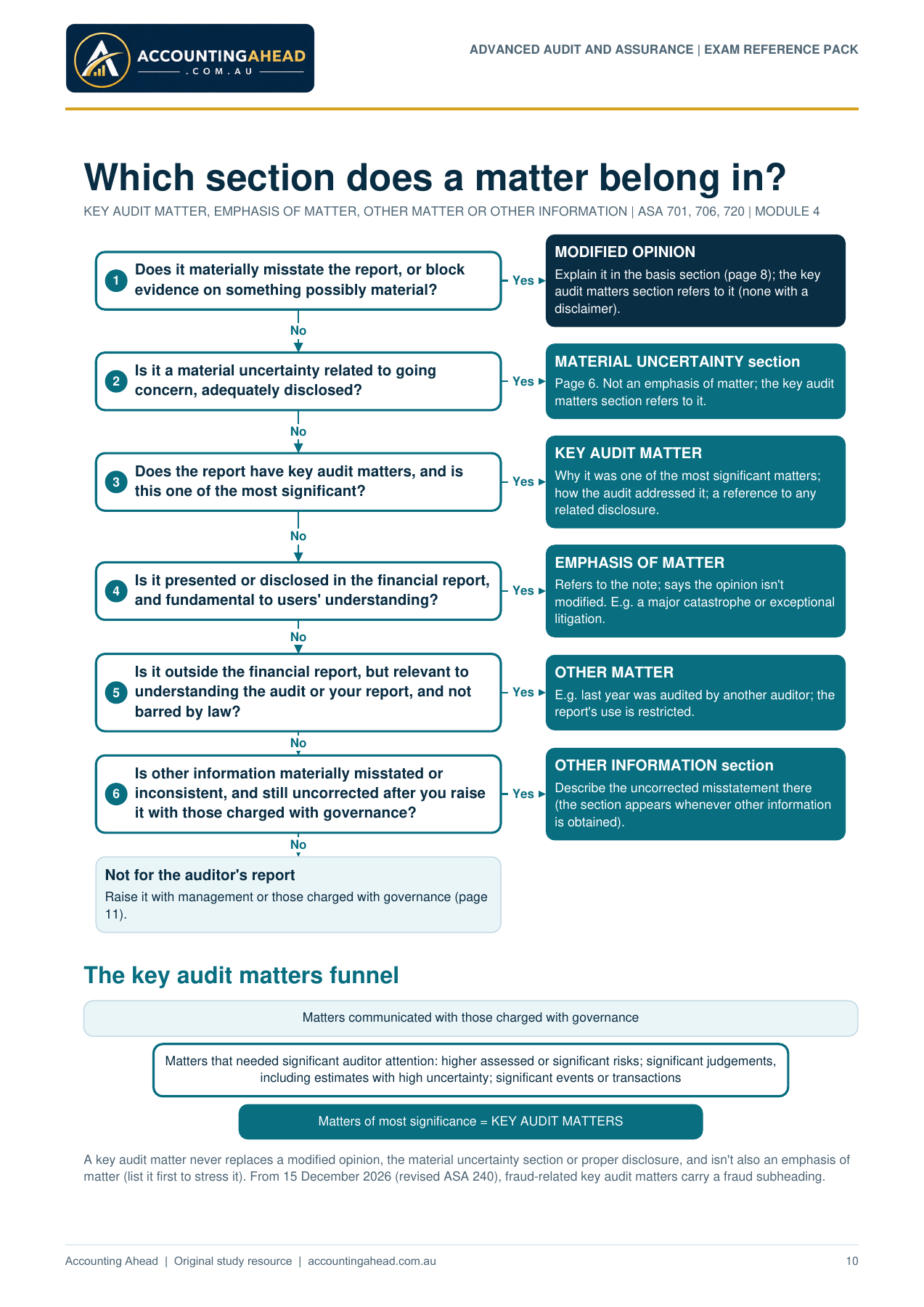
Which section does a matter belong in?
KEY AUDIT MATTER, EMPHASIS OF MATTER, OTHER MATTER OR OTHER INFORMATION | ASA 701, 706, 720 | MODULE 4
1 Does it materially misstate the report, or block
evidence on something possibly material?
MODIFIED OPINION
Explain it in the basis section (page 8); the key
audit matters section refers to it (none with a
disclaimer).
Yes
No
2 Is it a material uncertainty related to going
concern, adequately disclosed?
MATERIAL UNCERTAINTY section
Page 6. Not an emphasis of matter; the key audit
matters section refers to it.
Yes
No
3 Does the report have key audit matters, and is
this one of the most significant?
KEY AUDIT MATTER
Why it was one of the most significant matters;
how the audit addressed it; a reference to any
related disclosure.
Yes
No
4 Is it presented or disclosed in the financial report,
and fundamental to users' understanding?
EMPHASIS OF MATTER
Refers to the note; says the opinion isn't
modified. E.g. a major catastrophe or exceptional
litigation.
Yes
No
5
Is it outside the financial report, but relevant to
understanding the audit or your report, and not
barred by law?
OTHER MATTER
E.g. last year was audited by another auditor; the
report's use is restricted.
Yes
No
6
Is other information materially misstated or
inconsistent, and still uncorrected after you raise
it with those charged with governance?
OTHER INFORMATION section
Describe the uncorrected misstatement there
(the section appears whenever other information
is obtained).
Yes
No
Not for the auditor's report
Raise it with management or those charged with governance (page
11).
The key audit matters funnel
Matters communicated with those charged with governance
Matters that needed significant auditor attention: higher assessed or significant risks; significant judgements,
including estimates with high uncertainty; significant events or transactions
Matters of most significance = KEY AUDIT MATTERS
A key audit matter never replaces a modified opinion, the material uncertainty section or proper disclosure, and isn't also an emphasis of
matter (list it first to stress it). From 15 December 2026 (revised ASA 240), fraud-related key audit matters carry a fraud subheading.
ADVANCED AUDIT AND ASSURANCE | EXAM REFERENCE PACK
10
Accounting Ahead | Original study resource | accountingahead.com.au
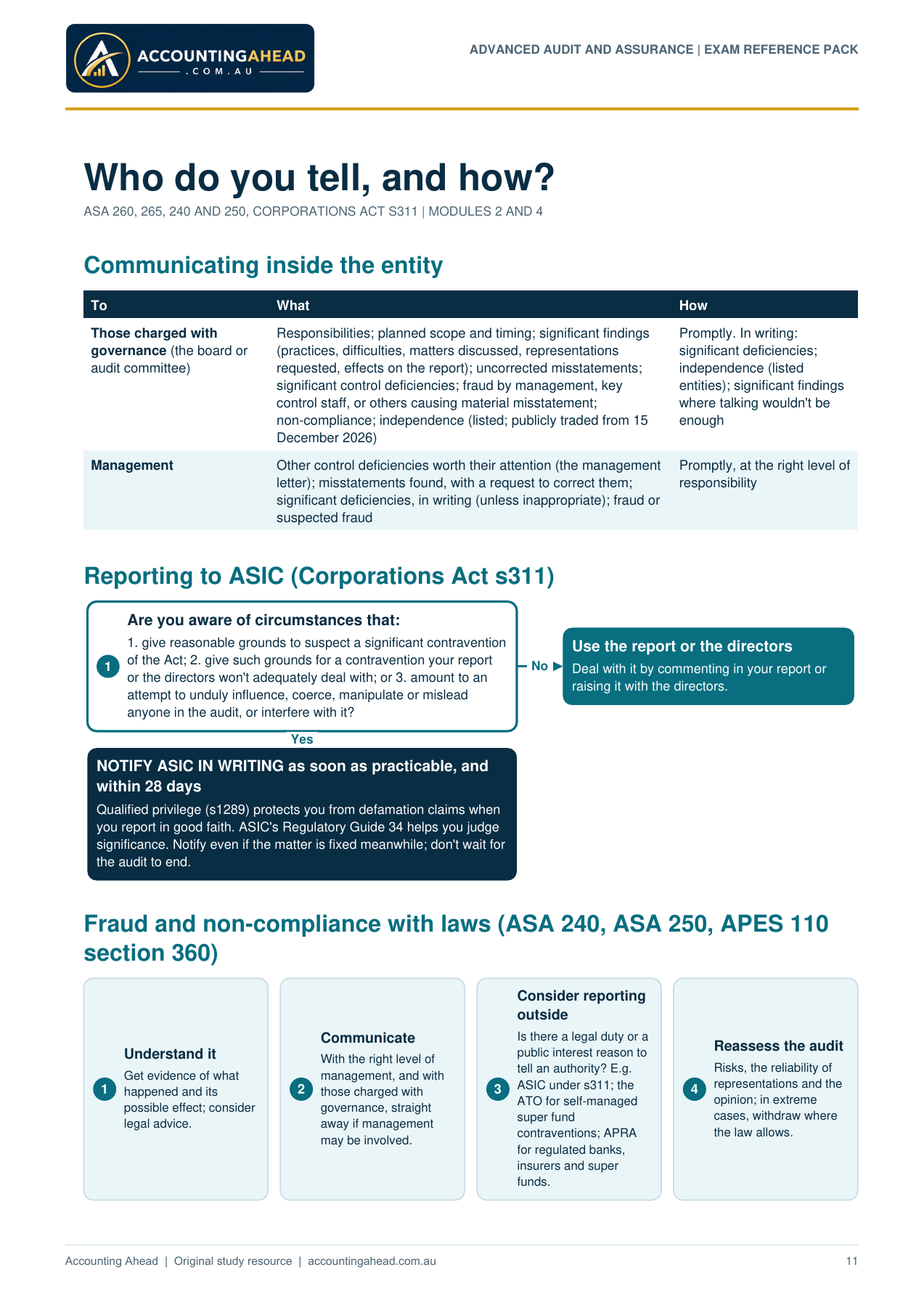
Who do you tell, and how?
ASA 260, 265, 240 AND 250, CORPORATIONS ACT S311 | MODULES 2 AND 4
Communicating inside the entity
To What How
Those charged with
governance (the board or
audit committee)
Responsibilities; planned scope and timing; significant findings
(practices, difficulties, matters discussed, representations
requested, effects on the report); uncorrected misstatements;
significant control deficiencies; fraud by management, key
control staff, or others causing material misstatement;
non-compliance; independence (listed; publicly traded from 15
December 2026)
Promptly. In writing:
significant deficiencies;
independence (listed
entities); significant findings
where talking wouldn't be
enough
Management Other control deficiencies worth their attention (the management
letter); misstatements found, with a request to correct them;
significant deficiencies, in writing (unless inappropriate); fraud or
suspected fraud
Promptly, at the right level of
responsibility
Reporting to ASIC (Corporations Act s311)
1
Are you aware of circumstances that:
1. give reasonable grounds to suspect a significant contravention
of the Act; 2. give such grounds for a contravention your report
or the directors won't adequately deal with; or 3. amount to an
attempt to unduly influence, coerce, manipulate or mislead
anyone in the audit, or interfere with it?
Use the report or the directors
Deal with it by commenting in your report or
raising it with the directors.
No
Yes
NOTIFY ASIC IN WRITING as soon as practicable, and
within 28 days
Qualified privilege (s1289) protects you from defamation claims when
you report in good faith. ASIC's Regulatory Guide 34 helps you judge
significance. Notify even if the matter is fixed meanwhile; don't wait for
the audit to end.
Fraud and non-compliance with laws (ASA 240, ASA 250, APES 110
section 360)
1
Understand it
Get evidence of what
happened and its
possible effect; consider
legal advice.
2
Communicate
With the right level of
management, and with
those charged with
governance, straight
away if management
may be involved.
3
Consider reporting
outside
Is there a legal duty or a
public interest reason to
tell an authority? E.g.
ASIC under s311; the
ATO for self-managed
super fund
contraventions; APRA
for regulated banks,
insurers and super
funds.
4
Reassess the audit
Risks, the reliability of
representations and the
opinion; in extreme
cases, withdraw where
the law allows.
ADVANCED AUDIT AND ASSURANCE | EXAM REFERENCE PACK
11