
Fundamental principles, threats and safeguards
Printable study notes, diagrams and practice support for Part 1.2.1.
Read the handout text
Accounting Ahead | Original study resource | accountingahead.com.au
Fundamental principles, threats and
safeguards
MODULE 1 | 1.2.1 | STUDENT COMPANION
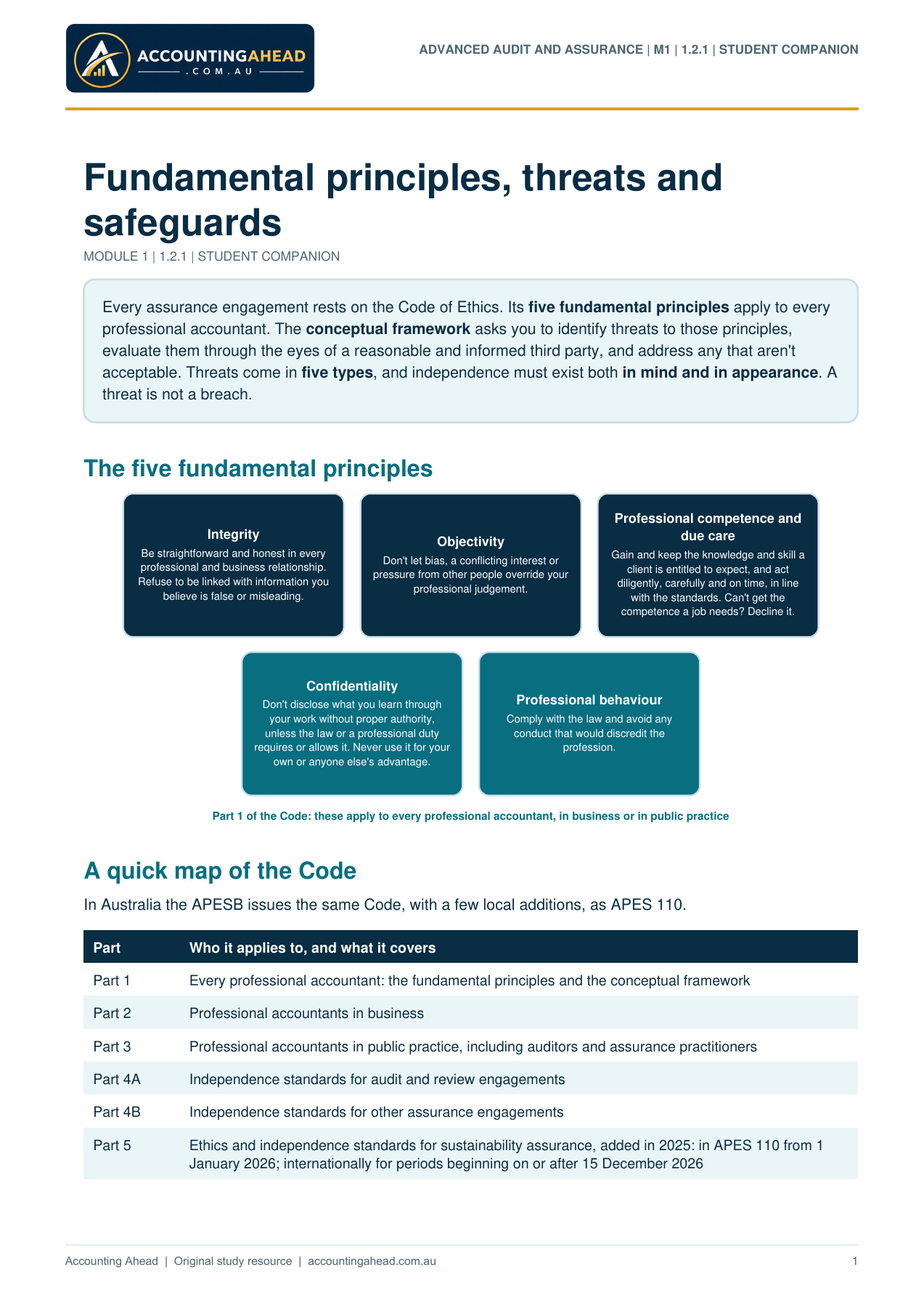
Every assurance engagement rests on the Code of Ethics. Its five fundamental principles apply to every
professional accountant. The conceptual framework asks you to identify threats to those principles,
evaluate them through the eyes of a reasonable and informed third party, and address any that aren't
acceptable. Threats come in five types, and independence must exist both in mind and in appearance. A
threat is not a breach.
The five fundamental principles
Integrity
Be straightforward and honest in every
professional and business relationship.
Refuse to be linked with information you
believe is false or misleading.
Objectivity
Don't let bias, a conflicting interest or
pressure from other people override your
professional judgement.
Professional competence and
due care
Gain and keep the knowledge and skill a
client is entitled to expect, and act
diligently, carefully and on time, in line
with the standards. Can't get the
competence a job needs? Decline it.
Confidentiality
Don't disclose what you learn through
your work without proper authority,
unless the law or a professional duty
requires or allows it. Never use it for your
own or anyone else's advantage.
Professional behaviour
Comply with the law and avoid any
conduct that would discredit the
profession.
Part 1 of the Code: these apply to every professional accountant, in business or in public practice
A quick map of the Code
In Australia the APESB issues the same Code, with a few local additions, as APES 110.
Part Who it applies to, and what it covers
Part 1 Every professional accountant: the fundamental principles and the conceptual framework
Part 2 Professional accountants in business
Part 3 Professional accountants in public practice, including auditors and assurance practitioners
Part 4A Independence standards for audit and review engagements
Part 4B Independence standards for other assurance engagements
Part 5 Ethics and independence standards for sustainability assurance, added in 2025: in APES 110 from 1
January 2026; internationally for periods beginning on or after 15 December 2026
ADVANCED AUDIT AND ASSURANCE | M1 | 1.2.1 | STUDENT COMPANION
1
Accounting Ahead | Original study resource | accountingahead.com.au
When confidential information may be disclosed: when the law requires it (for example, producing
documents in court proceedings, or reporting a breach of the law to the proper authority); when the law permits it
and the client authorises it; or when a professional duty or right applies and the law doesn't forbid it (for example,
a professional body's quality review, a regulator's investigation, or defending yourself in legal proceedings). Even
then, think about how much to disclose, and to whom. The duty continues after the engagement ends.
Case note: PwC Australia and the confidential tax consultations
Between 2013 and 2018, a senior tax partner at PwC Australia took part in confidential Treasury consultations
about new laws targeting multinational tax avoidance: he sat on Treasury's advisory group on base erosion and
profit shifting (November 2013 to June 2017) and joined consultations on the multinational anti-avoidance law
and the diverted profits tax, under confidentiality agreements signed in 2013, 2016 and 2018. The Tax
Practitioners Board later found that he had shared confidential information from those consultations with
colleagues inside the firm, and that the information was used to win and advise clients on how to respond to the
very laws being designed. In November 2022 the Board terminated his registration as a tax agent and banned
him from registering again for two years; it published the decision in January 2023. When the scale of the matter
became public in 2023, a Senate inquiry followed, the firm's chief executive stepped down in May 2023, and in
July 2023 PwC Australia sold its government consulting business to Allegro Funds (it became Scyne Advisory).
Principles broken: confidentiality (information given in confidence was passed on and used), integrity (the
conduct wasn't straightforward or honest with the government that had trusted the partner) and professional
behaviour (few things discredit a profession faster). The damage reached the whole firm and public trust in the
profession, not just one person.
Source: Tax Practitioners Board media release (23 January 2023); Treasury freedom of information release FOI 3269; Senate inquiry
reports (2023).
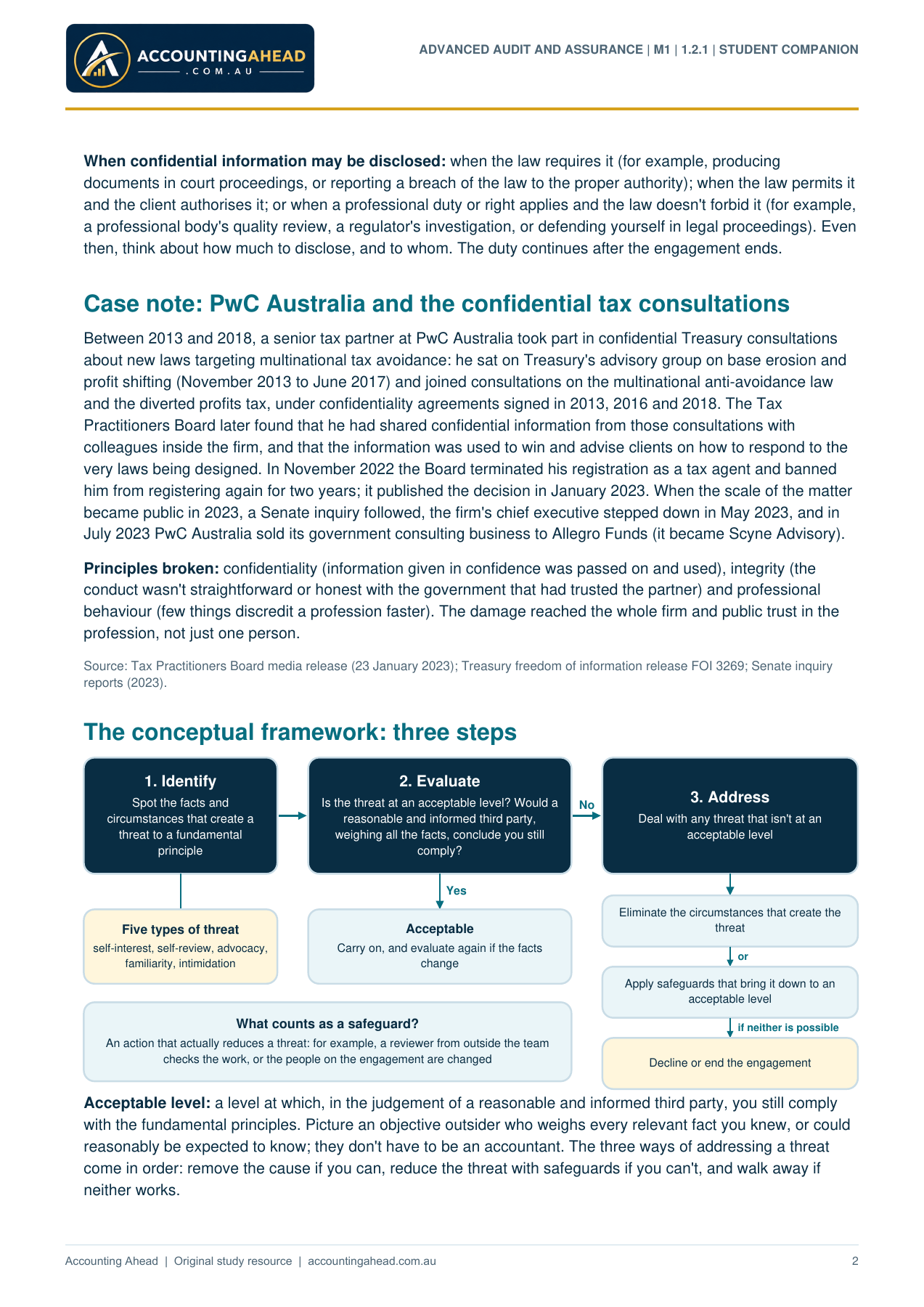
The conceptual framework: three steps
1. Identify
Spot the facts and
circumstances that create a
threat to a fundamental
principle
2. Evaluate
Is the threat at an acceptable level? Would a
reasonable and informed third party,
weighing all the facts, conclude you still
comply?
No 3. Address
Deal with any threat that isn't at an
acceptable level
Five types of threat
self-interest, self-review, advocacy,
familiarity, intimidation
Yes
Acceptable
Carry on, and evaluate again if the facts
change
Eliminate the circumstances that create the
threat
or
Apply safeguards that bring it down to an
acceptable level
if neither is possible
Decline or end the engagement
What counts as a safeguard?
An action that actually reduces a threat: for example, a reviewer from outside the team
checks the work, or the people on the engagement are changed
Acceptable level: a level at which, in the judgement of a reasonable and informed third party, you still comply
with the fundamental principles. Picture an objective outsider who weighs every relevant fact you knew, or could
reasonably be expected to know; they don't have to be an accountant. The three ways of addressing a threat
come in order: remove the cause if you can, reduce the threat with safeguards if you can't, and walk away if
neither works.
ADVANCED AUDIT AND ASSURANCE | M1 | 1.2.1 | STUDENT COMPANION
2
Accounting Ahead | Original study resource | accountingahead.com.au
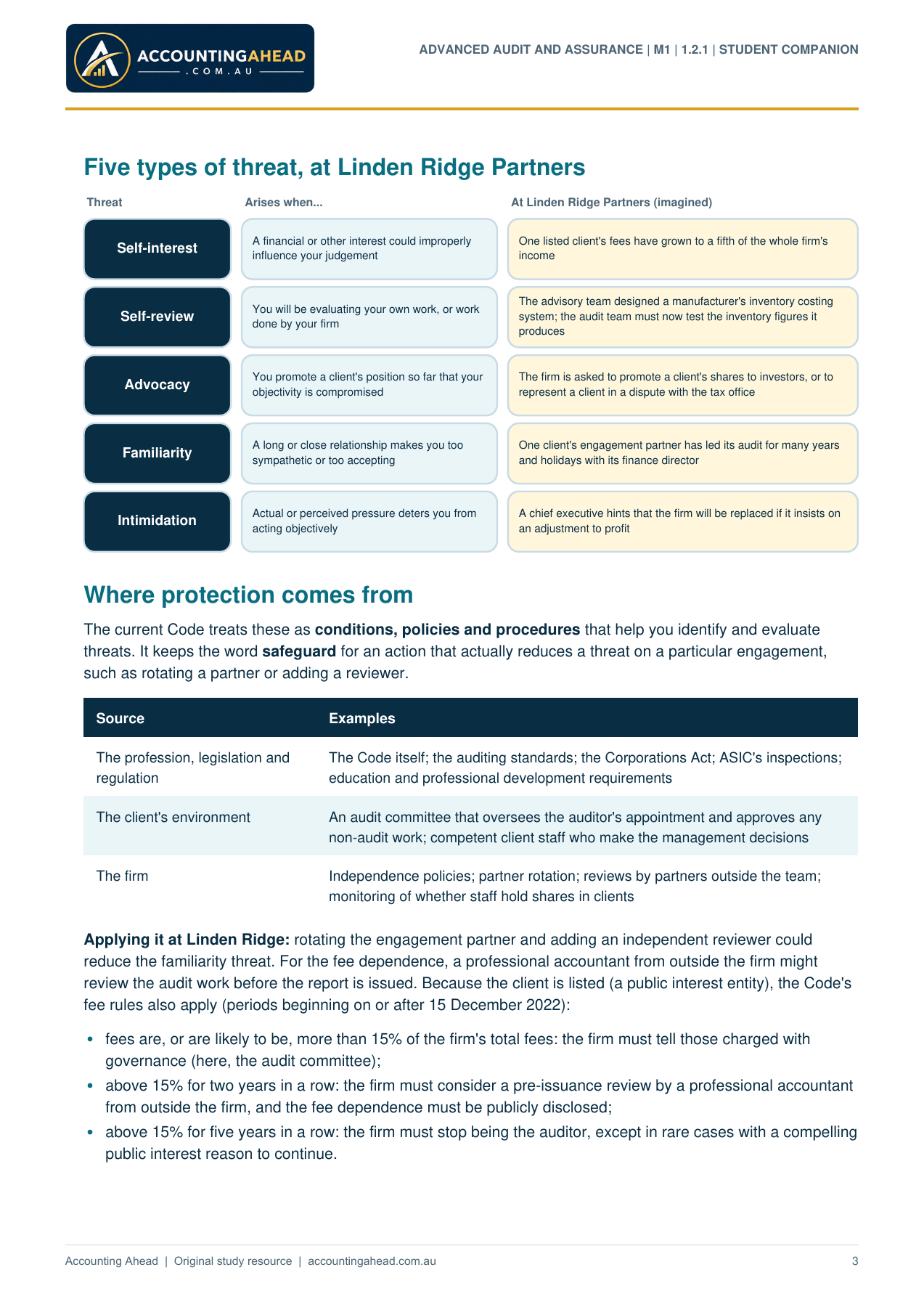
Five types of threat, at Linden Ridge Partners
Threat Arises when... At Linden Ridge Partners (imagined)
Self-interest A financial or other interest could improperly
influence your judgement
One listed client's fees have grown to a fifth of the whole firm's
income
Self-review You will be evaluating your own work, or work
done by your firm
The advisory team designed a manufacturer's inventory costing
system; the audit team must now test the inventory figures it
produces
Advocacy You promote a client's position so far that your
objectivity is compromised
The firm is asked to promote a client's shares to investors, or to
represent a client in a dispute with the tax office
Familiarity A long or close relationship makes you too
sympathetic or too accepting
One client's engagement partner has led its audit for many years
and holidays with its finance director
Intimidation Actual or perceived pressure deters you from
acting objectively
A chief executive hints that the firm will be replaced if it insists on
an adjustment to profit
Where protection comes from
The current Code treats these as conditions, policies and procedures that help you identify and evaluate
threats. It keeps the word safeguard for an action that actually reduces a threat on a particular engagement,
such as rotating a partner or adding a reviewer.
Source Examples
The profession, legislation and
regulation
The Code itself; the auditing standards; the Corporations Act; ASIC's inspections;
education and professional development requirements
The client's environment An audit committee that oversees the auditor's appointment and approves any
non-audit work; competent client staff who make the management decisions
The firm Independence policies; partner rotation; reviews by partners outside the team;
monitoring of whether staff hold shares in clients
Applying it at Linden Ridge: rotating the engagement partner and adding an independent reviewer could
reduce the familiarity threat. For the fee dependence, a professional accountant from outside the firm might
review the audit work before the report is issued. Because the client is listed (a public interest entity), the Code's
fee rules also apply (periods beginning on or after 15 December 2022):
fees are, or are likely to be, more than 15% of the firm's total fees: the firm must tell those charged with
governance (here, the audit committee);
above 15% for two years in a row: the firm must consider a pre-issuance review by a professional accountant
from outside the firm, and the fee dependence must be publicly disclosed;
above 15% for five years in a row: the firm must stop being the auditor, except in rare cases with a compelling
public interest reason to continue.
ADVANCED AUDIT AND ASSURANCE | M1 | 1.2.1 | STUDENT COMPANION
3
Accounting Ahead | Original study resource | accountingahead.com.au
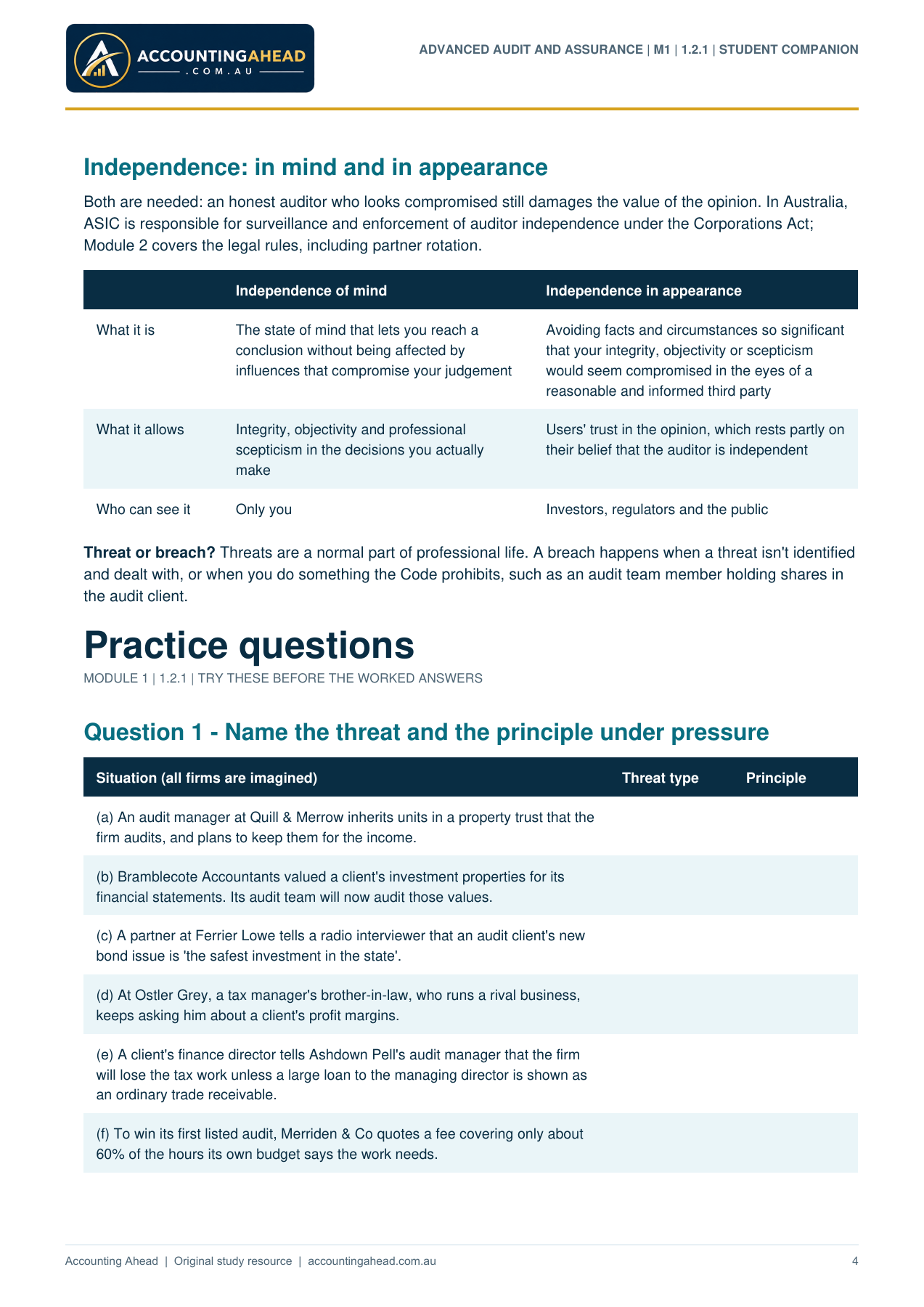
Independence: in mind and in appearance
Both are needed: an honest auditor who looks compromised still damages the value of the opinion. In Australia,
ASIC is responsible for surveillance and enforcement of auditor independence under the Corporations Act;
Module 2 covers the legal rules, including partner rotation.
Independence of mind Independence in appearance
What it is The state of mind that lets you reach a
conclusion without being affected by
influences that compromise your judgement
Avoiding facts and circumstances so significant
that your integrity, objectivity or scepticism
would seem compromised in the eyes of a
reasonable and informed third party
What it allows Integrity, objectivity and professional
scepticism in the decisions you actually
make
Users' trust in the opinion, which rests partly on
their belief that the auditor is independent
Who can see it Only you Investors, regulators and the public
Threat or breach? Threats are a normal part of professional life. A breach happens when a threat isn't identified
and dealt with, or when you do something the Code prohibits, such as an audit team member holding shares in
the audit client.
Practice questions
MODULE 1 | 1.2.1 | TRY THESE BEFORE THE WORKED ANSWERS
Question 1 - Name the threat and the principle under pressure
Situation (all firms are imagined) Threat type Principle
(a) An audit manager at Quill & Merrow inherits units in a property trust that the
firm audits, and plans to keep them for the income.
(b) Bramblecote Accountants valued a client's investment properties for its
financial statements. Its audit team will now audit those values.
(c) A partner at Ferrier Lowe tells a radio interviewer that an audit client's new
bond issue is 'the safest investment in the state'.
(d) At Ostler Grey, a tax manager's brother-in-law, who runs a rival business,
keeps asking him about a client's profit margins.
(e) A client's finance director tells Ashdown Pell's audit manager that the firm
will lose the tax work unless a large loan to the managing director is shown as
an ordinary trade receivable.
(f) To win its first listed audit, Merriden & Co quotes a fee covering only about
60% of the hours its own budget says the work needs.
ADVANCED AUDIT AND ASSURANCE | M1 | 1.2.1 | STUDENT COMPANION
4
Accounting Ahead | Original study resource | accountingahead.com.au
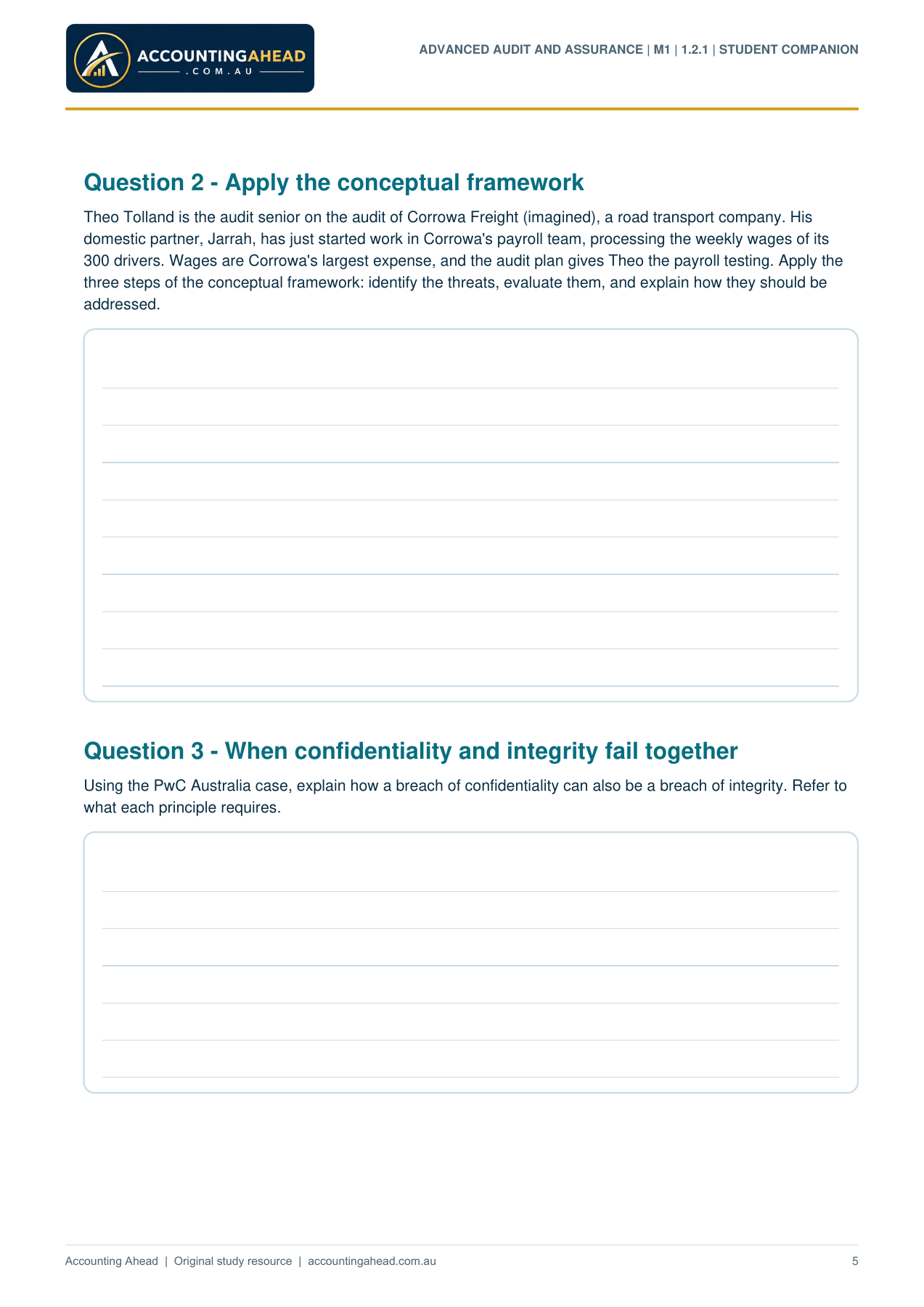
Question 2 - Apply the conceptual framework
Theo Tolland is the audit senior on the audit of Corrowa Freight (imagined), a road transport company. His
domestic partner, Jarrah, has just started work in Corrowa's payroll team, processing the weekly wages of its
300 drivers. Wages are Corrowa's largest expense, and the audit plan gives Theo the payroll testing. Apply the
three steps of the conceptual framework: identify the threats, evaluate them, and explain how they should be
addressed.
Question 3 - When confidentiality and integrity fail together
Using the PwC Australia case, explain how a breach of confidentiality can also be a breach of integrity. Refer to
what each principle requires.
ADVANCED AUDIT AND ASSURANCE | M1 | 1.2.1 | STUDENT COMPANION
5
Accounting Ahead | Original study resource | accountingahead.com.au
Worked answers
MODULE 1 | 1.2.1 | WORKED ANSWERS - ATTEMPT THE QUESTIONS FIRST
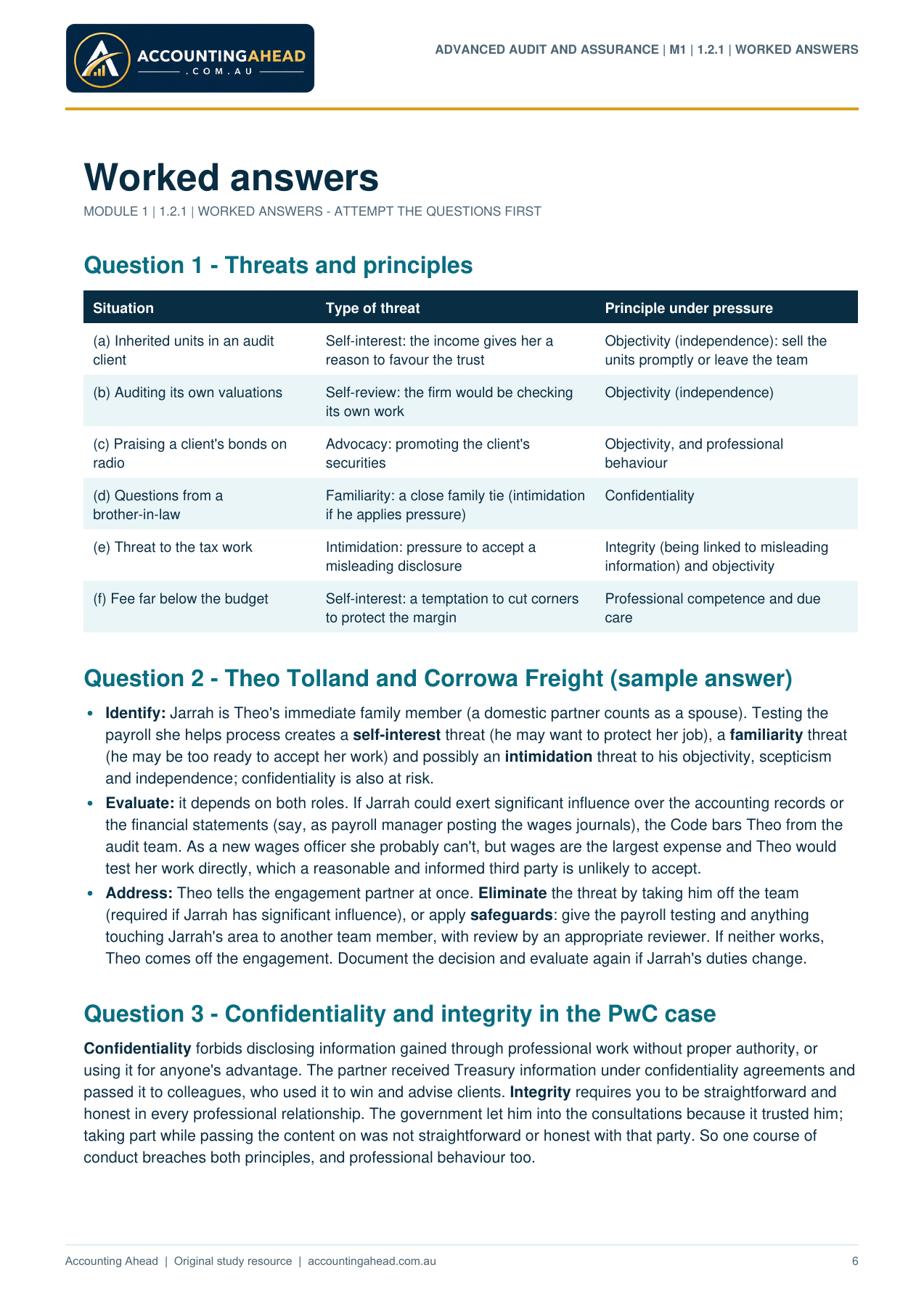
Question 1 - Threats and principles
Situation Type of threat Principle under pressure
(a) Inherited units in an audit
client
Self-interest: the income gives her a
reason to favour the trust
Objectivity (independence): sell the
units promptly or leave the team
(b) Auditing its own valuations Self-review: the firm would be checking
its own work
Objectivity (independence)
(c) Praising a client's bonds on
radio
Advocacy: promoting the client's
securities
Objectivity, and professional
behaviour
(d) Questions from a
brother-in-law
Familiarity: a close family tie (intimidation
if he applies pressure)
Confidentiality
(e) Threat to the tax work Intimidation: pressure to accept a
misleading disclosure
Integrity (being linked to misleading
information) and objectivity
(f) Fee far below the budget Self-interest: a temptation to cut corners
to protect the margin
Professional competence and due
care
Question 2 - Theo Tolland and Corrowa Freight (sample answer)
Identify: Jarrah is Theo's immediate family member (a domestic partner counts as a spouse). Testing the
payroll she helps process creates a self-interest threat (he may want to protect her job), a familiarity threat
(he may be too ready to accept her work) and possibly an intimidation threat to his objectivity, scepticism
and independence; confidentiality is also at risk.
Evaluate: it depends on both roles. If Jarrah could exert significant influence over the accounting records or
the financial statements (say, as payroll manager posting the wages journals), the Code bars Theo from the
audit team. As a new wages officer she probably can't, but wages are the largest expense and Theo would
test her work directly, which a reasonable and informed third party is unlikely to accept.
Address: Theo tells the engagement partner at once. Eliminate the threat by taking him off the team
(required if Jarrah has significant influence), or apply safeguards: give the payroll testing and anything
touching Jarrah's area to another team member, with review by an appropriate reviewer. If neither works,
Theo comes off the engagement. Document the decision and evaluate again if Jarrah's duties change.
Question 3 - Confidentiality and integrity in the PwC case
Confidentiality forbids disclosing information gained through professional work without proper authority, or
using it for anyone's advantage. The partner received Treasury information under confidentiality agreements and
passed it to colleagues, who used it to win and advise clients. Integrity requires you to be straightforward and
honest in every professional relationship. The government let him into the consultations because it trusted him;
taking part while passing the content on was not straightforward or honest with that party. So one course of
conduct breaches both principles, and professional behaviour too.
ADVANCED AUDIT AND ASSURANCE | M1 | 1.2.1 | WORKED ANSWERS
6