
Ethics in public practice
Printable study notes, diagrams and practice support for Part 1.2.2.
Read the handout text
Accounting Ahead | Original study resource | accountingahead.com.au
Ethics in public practice
MODULE 1 | 1.2.2 | STUDENT COMPANION
Part 3 of the Code applies the conceptual framework to situations that public practitioners meet again and
again. For each one, ask which principle is under pressure and what would reduce that pressure.
Some situations have firm rules: contingent fees are banned for audits and reviews, audit teams may
accept only trivial and inconsequential gifts, and when you discover possible non-compliance with laws
and regulations (NOCLAR), you must keep the public interest in view.
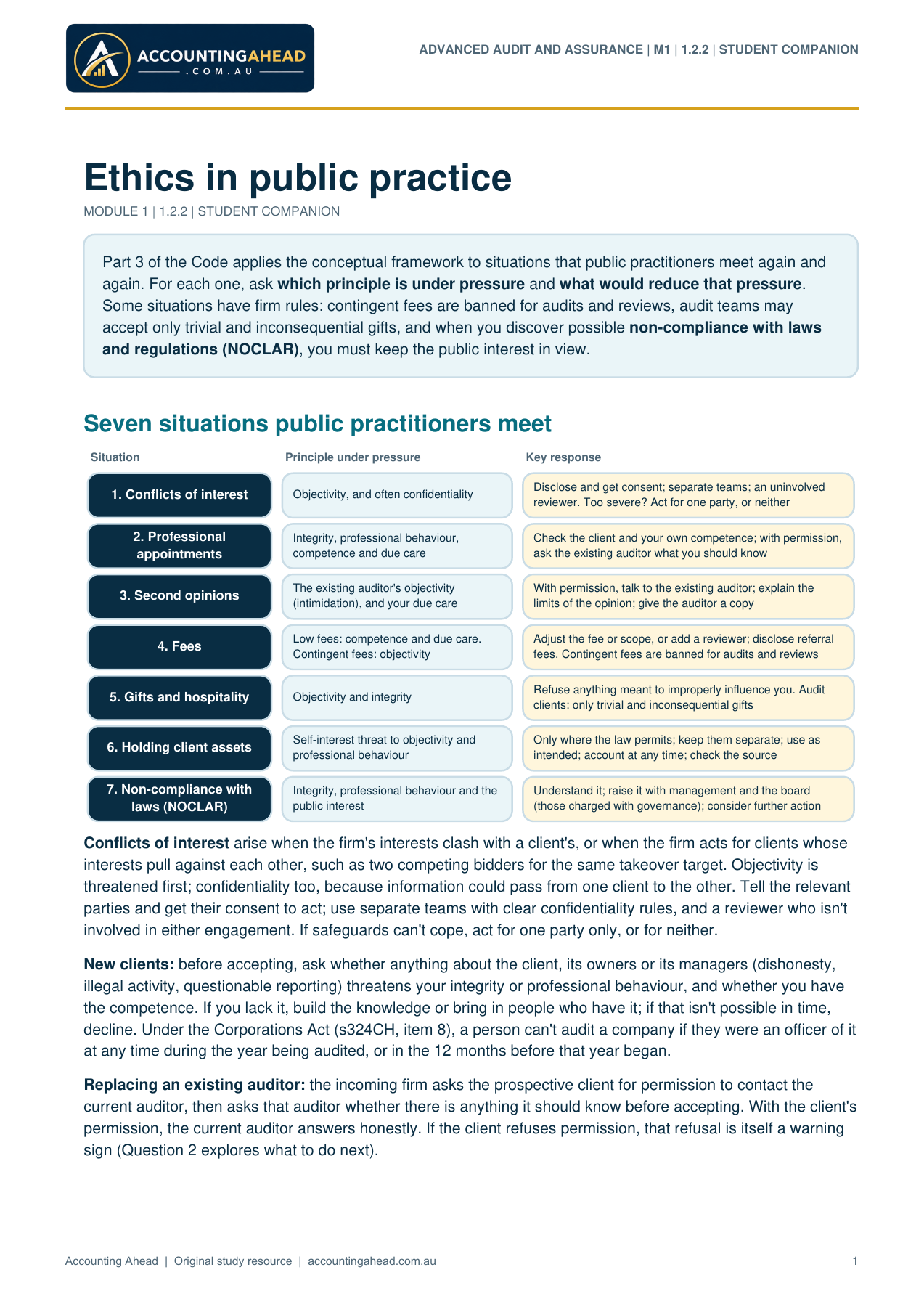
Seven situations public practitioners meet
Situation Principle under pressure Key response
1. Conflicts of interest Objectivity, and often confidentiality Disclose and get consent; separate teams; an uninvolved
reviewer. Too severe? Act for one party, or neither
2. Professional
appointments
Integrity, professional behaviour,
competence and due care
Check the client and your own competence; with permission,
ask the existing auditor what you should know
3. Second opinions The existing auditor's objectivity
(intimidation), and your due care
With permission, talk to the existing auditor; explain the
limits of the opinion; give the auditor a copy
4. Fees Low fees: competence and due care.
Contingent fees: objectivity
Adjust the fee or scope, or add a reviewer; disclose referral
fees. Contingent fees are banned for audits and reviews
5. Gifts and hospitality Objectivity and integrity Refuse anything meant to improperly influence you. Audit
clients: only trivial and inconsequential gifts
6. Holding client assets Self-interest threat to objectivity and
professional behaviour
Only where the law permits; keep them separate; use as
intended; account at any time; check the source
7. Non-compliance with
laws (NOCLAR)
Integrity, professional behaviour and the
public interest
Understand it; raise it with management and the board
(those charged with governance); consider further action
Conflicts of interest arise when the firm's interests clash with a client's, or when the firm acts for clients whose
interests pull against each other, such as two competing bidders for the same takeover target. Objectivity is
threatened first; confidentiality too, because information could pass from one client to the other. Tell the relevant
parties and get their consent to act; use separate teams with clear confidentiality rules, and a reviewer who isn't
involved in either engagement. If safeguards can't cope, act for one party only, or for neither.
New clients: before accepting, ask whether anything about the client, its owners or its managers (dishonesty,
illegal activity, questionable reporting) threatens your integrity or professional behaviour, and whether you have
the competence. If you lack it, build the knowledge or bring in people who have it; if that isn't possible in time,
decline. Under the Corporations Act (s324CH, item 8), a person can't audit a company if they were an officer of it
at any time during the year being audited, or in the 12 months before that year began.
Replacing an existing auditor: the incoming firm asks the prospective client for permission to contact the
current auditor, then asks that auditor whether there is anything it should know before accepting. With the client's
permission, the current auditor answers honestly. If the client refuses permission, that refusal is itself a warning
sign (Question 2 explores what to do next).
ADVANCED AUDIT AND ASSURANCE | M1 | 1.2.2 | STUDENT COMPANION
1
Accounting Ahead | Original study resource | accountingahead.com.au
Second opinions: a company that dislikes its auditor's view may ask another firm for an opinion on the same
issue, hoping to use a favourable answer against its own auditor (opinion shopping). That creates an intimidation
threat to the existing auditor's objectivity, and a risk that the second firm answers without the full facts. The
second firm should seek permission to talk to the existing auditor, explain the limits of its opinion to the client,
and give the existing auditor a copy.
Fees: a firm may charge whatever it considers appropriate, but a fee too low to pay for the work (low-balling)
creates a self-interest threat to competence and due care, because corners get cut: adjust the fee or the scope,
or have a reviewer check the work. Contingent fees, which depend on the result, threaten objectivity and are
prohibited outright for audit and review engagements. Referral fees and commissions also create self-interest
threats; disclosing them to the client and agreeing the arrangements in advance are safeguards that can reduce
the threat.
Gifts and hospitality: the key test is intent. An inducement offered to improperly influence your behaviour is
refused, whatever its size. For audit clients, the independence standards go further: a gift or hospitality can be
accepted only if its value is trivial and inconsequential. Bribery laws apply as well; the Code sits on top of the
criminal law, not in place of it.
Client money and other assets: hold them only where the law permits; keep them separate from the firm's
own; spend them only on what they were entrusted for; and be able to account for them whenever asked. Ask
where the money came from before taking custody, because client funds can be the proceeds of crime. In
Australia, APES 310 Client Monies sets detailed rules for trust accounts.
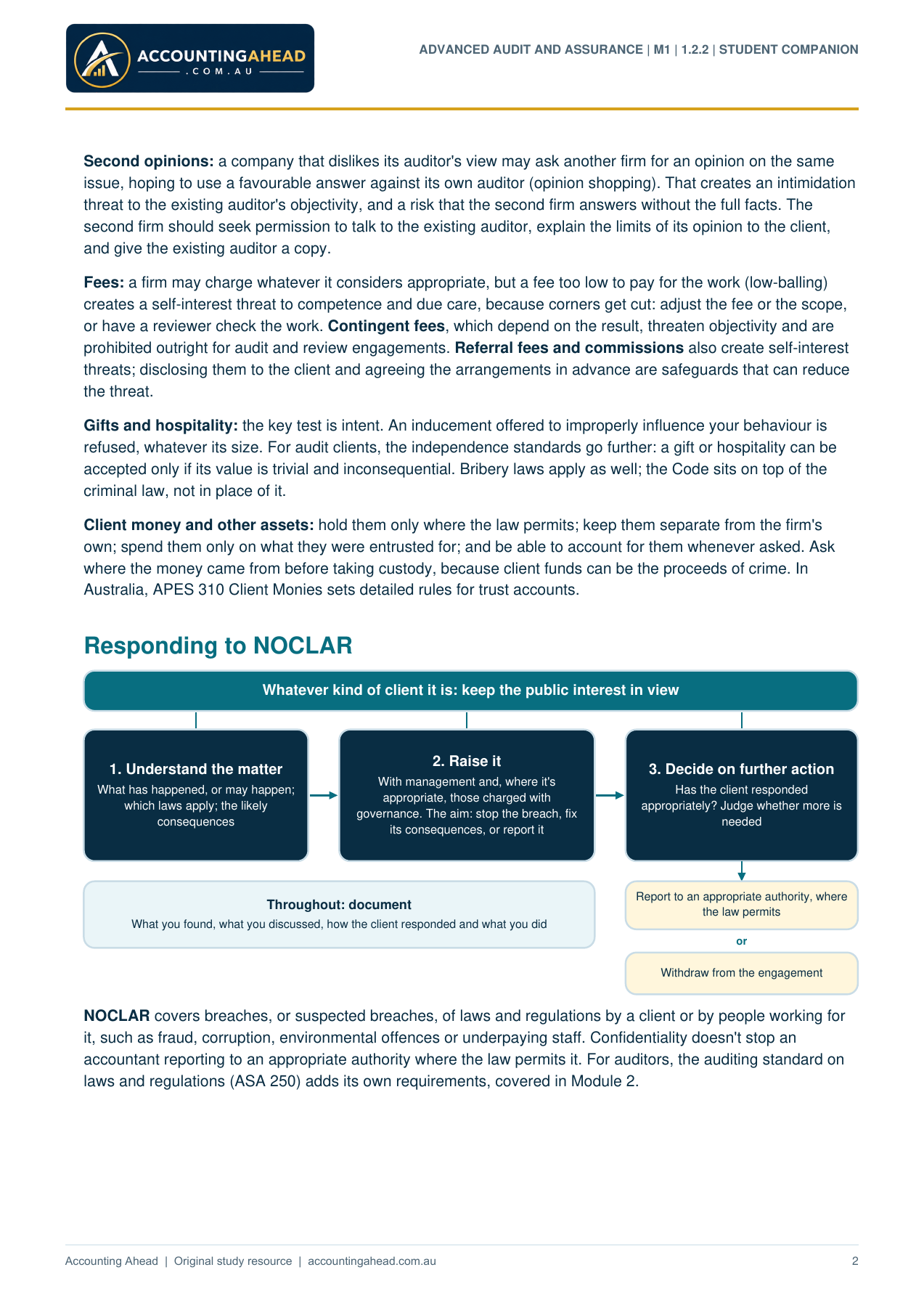
Responding to NOCLAR
Whatever kind of client it is: keep the public interest in view
1. Understand the matter
What has happened, or may happen;
which laws apply; the likely
consequences
2. Raise it
With management and, where it's
appropriate, those charged with
governance. The aim: stop the breach, fix
its consequences, or report it
3. Decide on further action
Has the client responded
appropriately? Judge whether more is
needed
Throughout: document
What you found, what you discussed, how the client responded and what you did
Report to an appropriate authority, where
the law permits
or
Withdraw from the engagement
NOCLAR covers breaches, or suspected breaches, of laws and regulations by a client or by people working for
it, such as fraud, corruption, environmental offences or underpaying staff. Confidentiality doesn't stop an
accountant reporting to an appropriate authority where the law permits it. For auditors, the auditing standard on
laws and regulations (ASA 250) adds its own requirements, covered in Module 2.
ADVANCED AUDIT AND ASSURANCE | M1 | 1.2.2 | STUDENT COMPANION
2
Accounting Ahead | Original study resource | accountingahead.com.au
Case note: Luckin Coffee
Luckin Coffee was a fast-growing Chinese coffee chain listed on Nasdaq. In late January 2020, during its audit of
the 2019 accounts, Ernst & Young's Chinese member firm identified that certain members of management had
been fabricating transactions. It raised the matter with the company's directors, and in March 2020 the board set
up a special committee of independent directors to investigate. On 2 April 2020 Luckin announced that its chief
operating officer and some employees had fabricated about 2.2 billion yuan of sales over the last three quarters
of 2019. Its shares closed down about 75% that day, it was delisted within months, and in December 2020 it
settled fraud charges with the US Securities and Exchange Commission for a US$180 million penalty.
The lesson: the auditor neither stayed quiet nor went to the media. It took what it found to the people charged
with governing the company, and the investigation that followed exposed the fabrication.
Source: Luckin Coffee announcement (2 April 2020); US SEC press release 2020-319 (16 December 2020).
The Australian perspective
APES 110 follows the international Code in structure and content, with some extra Australian requirements. ASA
102 has no international equivalent: it requires auditors, assurance practitioners, engagement quality reviewers
and firms to comply with relevant ethical requirements. Because every other standard points to ASA 102, only
that one standard needs updating whenever the Code changes.
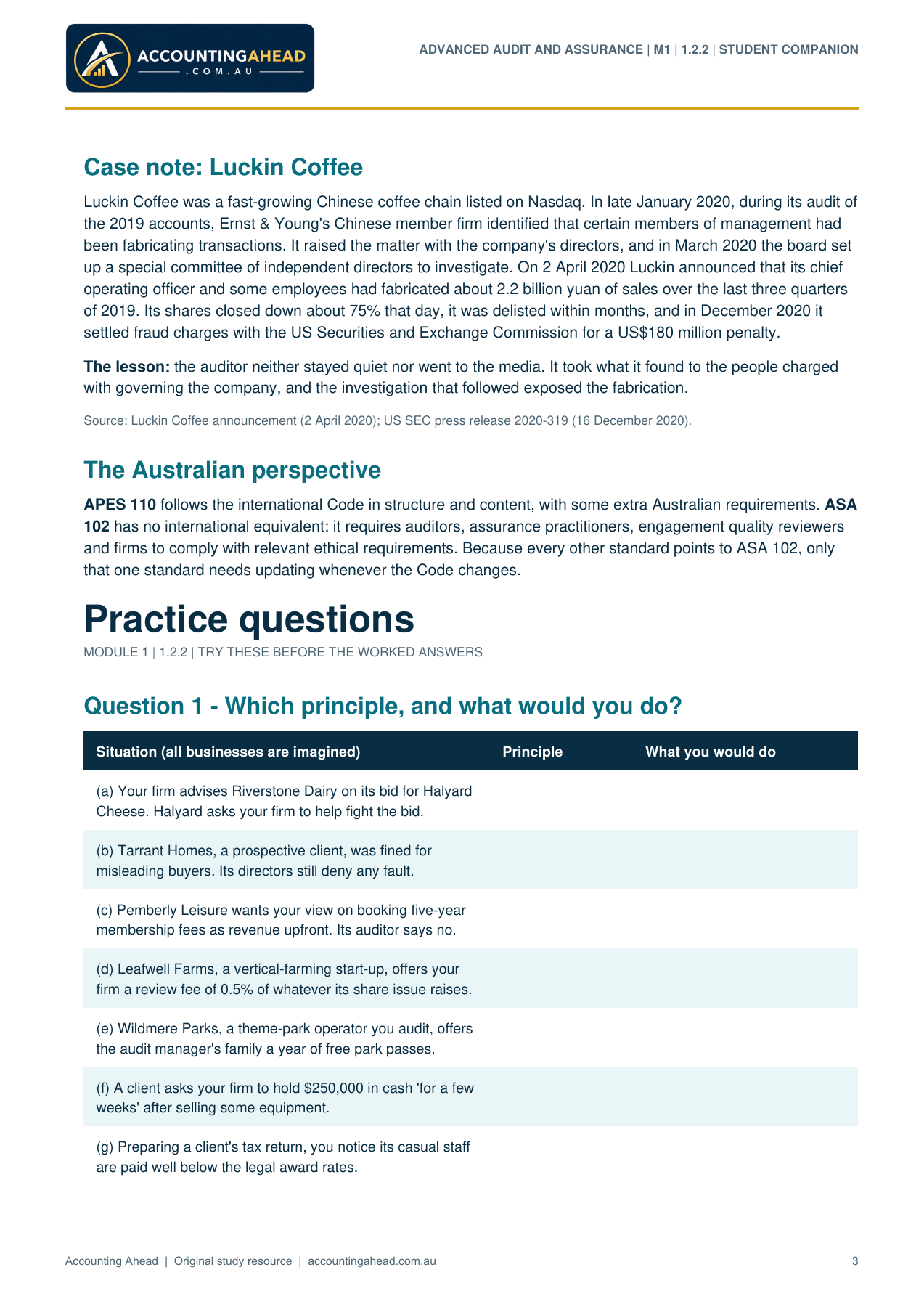
Practice questions
MODULE 1 | 1.2.2 | TRY THESE BEFORE THE WORKED ANSWERS
Question 1 - Which principle, and what would you do?
Situation (all businesses are imagined) Principle What you would do
(a) Your firm advises Riverstone Dairy on its bid for Halyard
Cheese. Halyard asks your firm to help fight the bid.
(b) Tarrant Homes, a prospective client, was fined for
misleading buyers. Its directors still deny any fault.
(c) Pemberly Leisure wants your view on booking five-year
membership fees as revenue upfront. Its auditor says no.
(d) Leafwell Farms, a vertical-farming start-up, offers your
firm a review fee of 0.5% of whatever its share issue raises.
(e) Wildmere Parks, a theme-park operator you audit, offers
the audit manager's family a year of free park passes.
(f) A client asks your firm to hold $250,000 in cash 'for a few
weeks' after selling some equipment.
(g) Preparing a client's tax return, you notice its casual staff
are paid well below the legal award rates.
ADVANCED AUDIT AND ASSURANCE | M1 | 1.2.2 | STUDENT COMPANION
3
Accounting Ahead | Original study resource | accountingahead.com.au
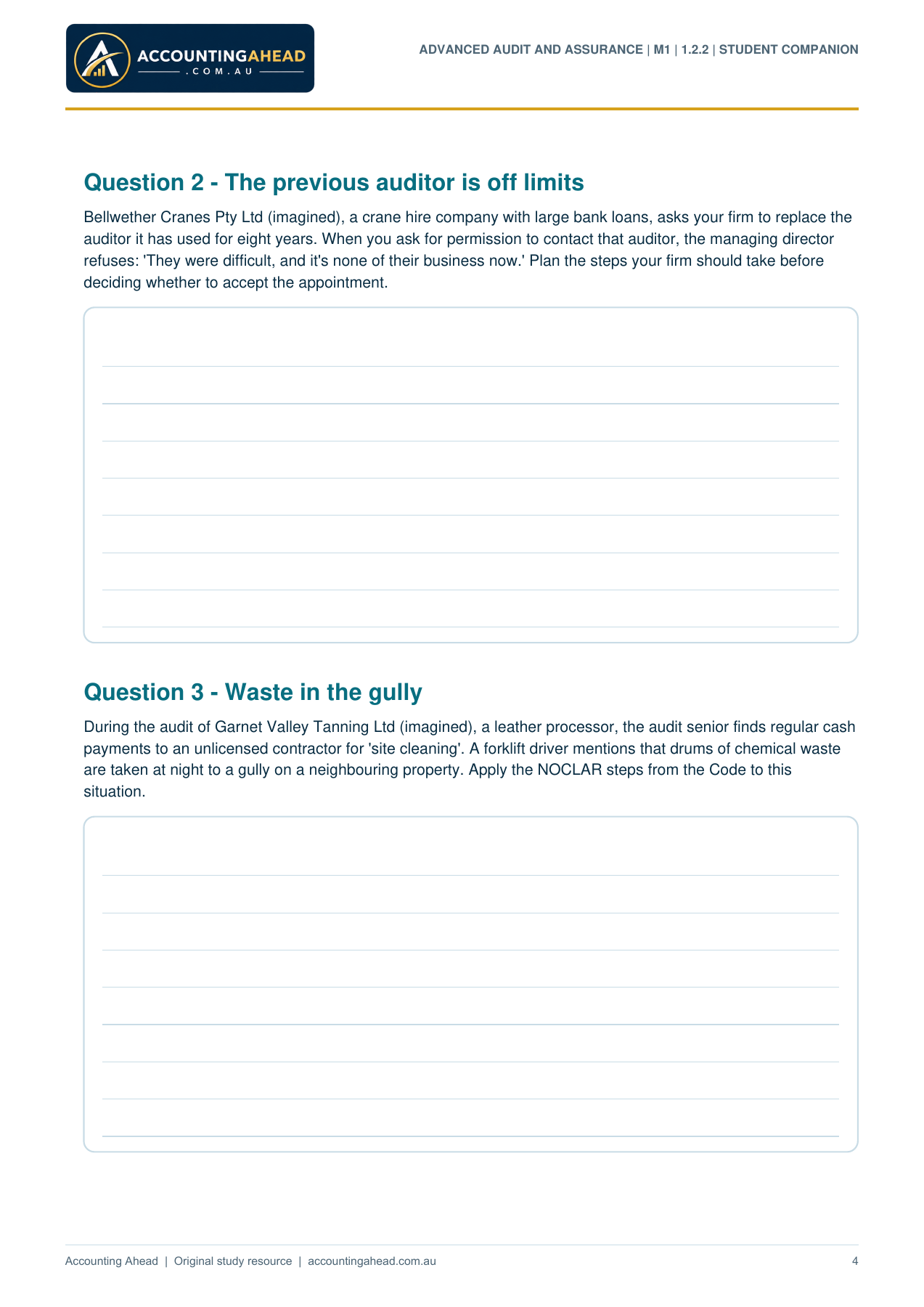
Question 2 - The previous auditor is off limits
Bellwether Cranes Pty Ltd (imagined), a crane hire company with large bank loans, asks your firm to replace the
auditor it has used for eight years. When you ask for permission to contact that auditor, the managing director
refuses: 'They were difficult, and it's none of their business now.' Plan the steps your firm should take before
deciding whether to accept the appointment.
Question 3 - Waste in the gully
During the audit of Garnet Valley Tanning Ltd (imagined), a leather processor, the audit senior finds regular cash
payments to an unlicensed contractor for 'site cleaning'. A forklift driver mentions that drums of chemical waste
are taken at night to a gully on a neighbouring property. Apply the NOCLAR steps from the Code to this
situation.
ADVANCED AUDIT AND ASSURANCE | M1 | 1.2.2 | STUDENT COMPANION
4
Accounting Ahead | Original study resource | accountingahead.com.au
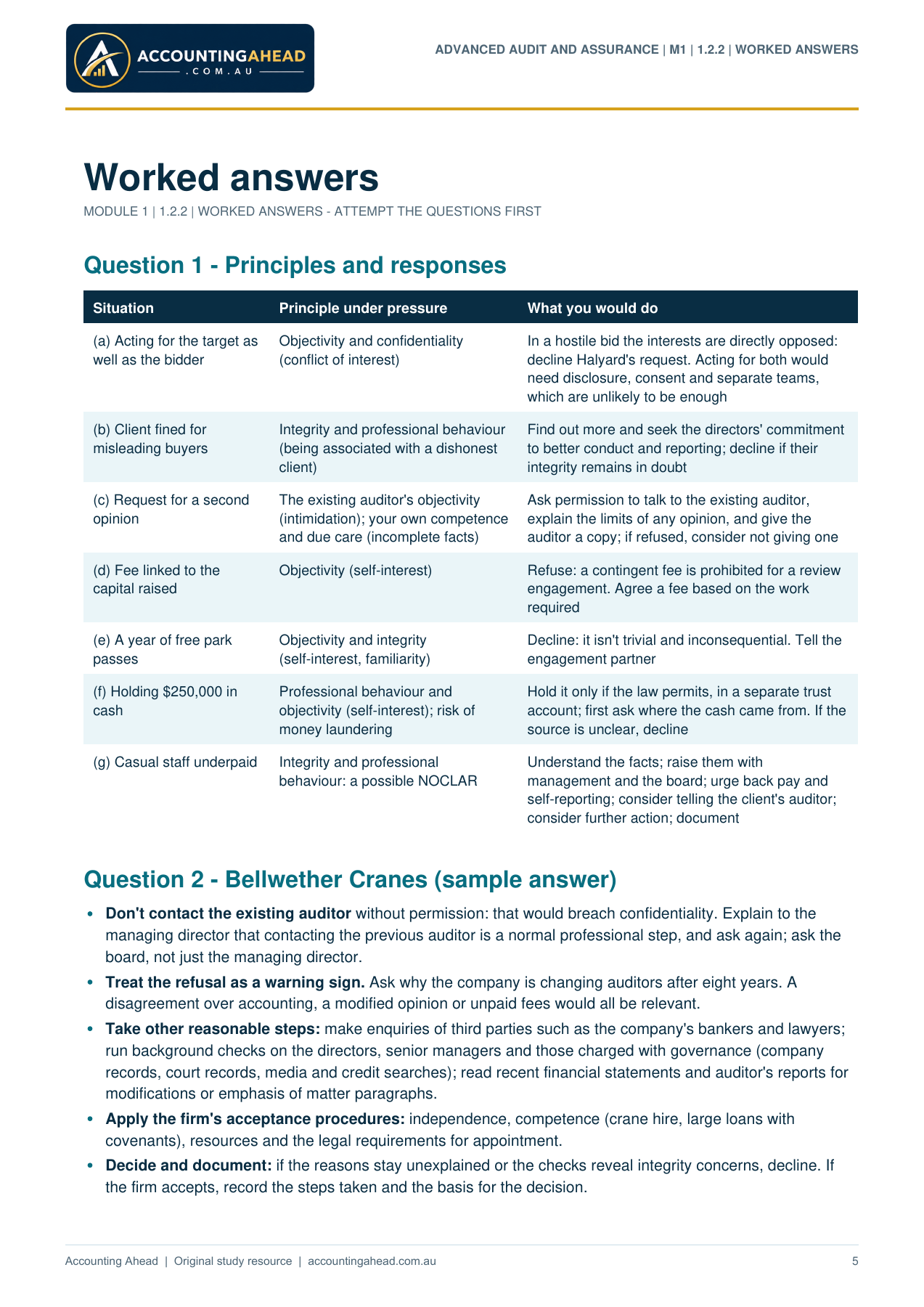
Worked answers
MODULE 1 | 1.2.2 | WORKED ANSWERS - ATTEMPT THE QUESTIONS FIRST
Question 1 - Principles and responses
Situation Principle under pressure What you would do
(a) Acting for the target as
well as the bidder
Objectivity and confidentiality
(conflict of interest)
In a hostile bid the interests are directly opposed:
decline Halyard's request. Acting for both would
need disclosure, consent and separate teams,
which are unlikely to be enough
(b) Client fined for
misleading buyers
Integrity and professional behaviour
(being associated with a dishonest
client)
Find out more and seek the directors' commitment
to better conduct and reporting; decline if their
integrity remains in doubt
(c) Request for a second
opinion
The existing auditor's objectivity
(intimidation); your own competence
and due care (incomplete facts)
Ask permission to talk to the existing auditor,
explain the limits of any opinion, and give the
auditor a copy; if refused, consider not giving one
(d) Fee linked to the
capital raised
Objectivity (self-interest) Refuse: a contingent fee is prohibited for a review
engagement. Agree a fee based on the work
required
(e) A year of free park
passes
Objectivity and integrity
(self-interest, familiarity)
Decline: it isn't trivial and inconsequential. Tell the
engagement partner
(f) Holding $250,000 in
cash
Professional behaviour and
objectivity (self-interest); risk of
money laundering
Hold it only if the law permits, in a separate trust
account; first ask where the cash came from. If the
source is unclear, decline
(g) Casual staff underpaid Integrity and professional
behaviour: a possible NOCLAR
Understand the facts; raise them with
management and the board; urge back pay and
self-reporting; consider telling the client's auditor;
consider further action; document
Question 2 - Bellwether Cranes (sample answer)
Don't contact the existing auditor without permission: that would breach confidentiality. Explain to the
managing director that contacting the previous auditor is a normal professional step, and ask again; ask the
board, not just the managing director.
Treat the refusal as a warning sign. Ask why the company is changing auditors after eight years. A
disagreement over accounting, a modified opinion or unpaid fees would all be relevant.
Take other reasonable steps: make enquiries of third parties such as the company's bankers and lawyers;
run background checks on the directors, senior managers and those charged with governance (company
records, court records, media and credit searches); read recent financial statements and auditor's reports for
modifications or emphasis of matter paragraphs.
Apply the firm's acceptance procedures: independence, competence (crane hire, large loans with
covenants), resources and the legal requirements for appointment.
Decide and document: if the reasons stay unexplained or the checks reveal integrity concerns, decline. If
the firm accepts, record the steps taken and the basis for the decision.
ADVANCED AUDIT AND ASSURANCE | M1 | 1.2.2 | WORKED ANSWERS
5
Accounting Ahead | Original study resource | accountingahead.com.au
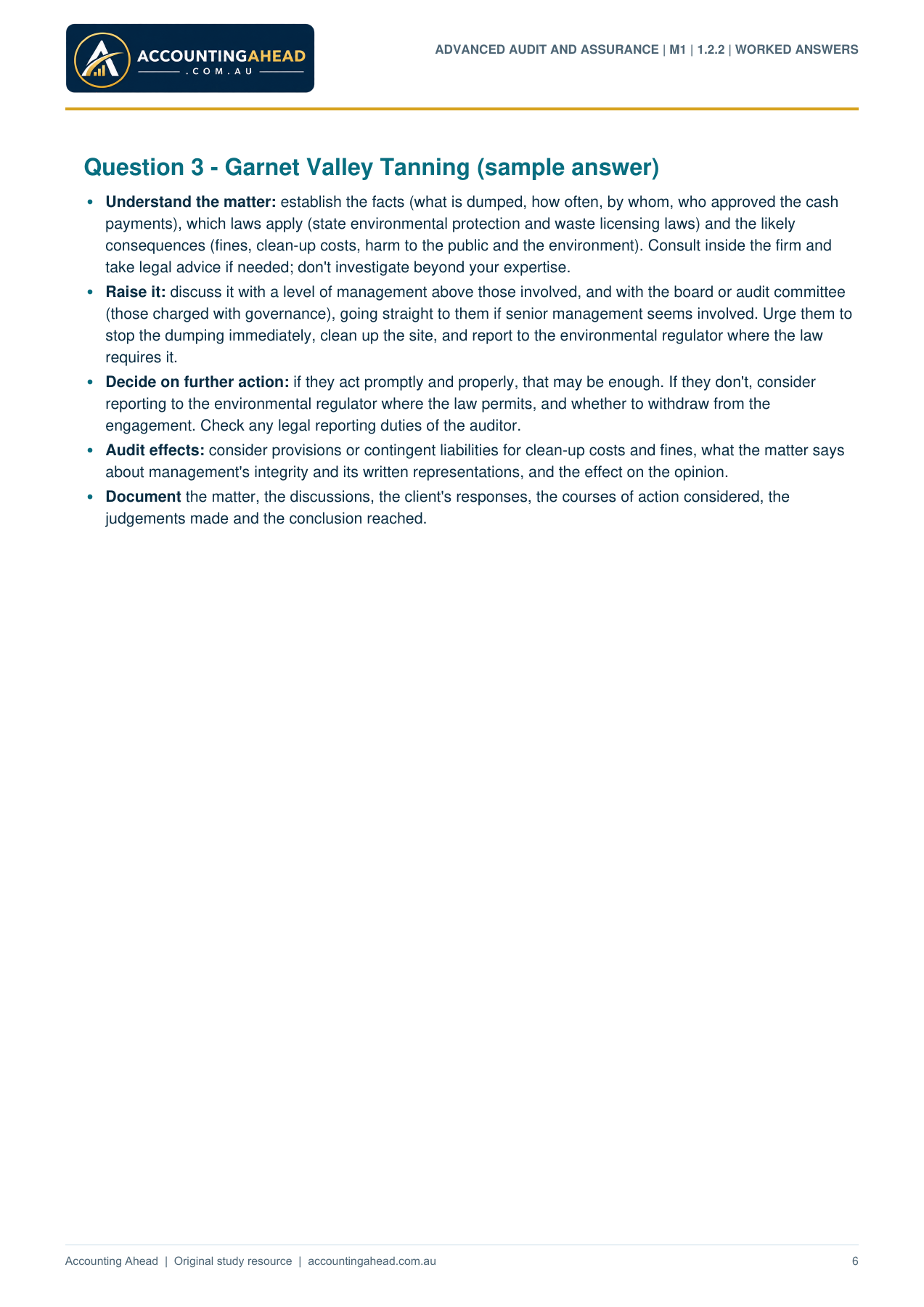
Question 3 - Garnet Valley Tanning (sample answer)
Understand the matter: establish the facts (what is dumped, how often, by whom, who approved the cash
payments), which laws apply (state environmental protection and waste licensing laws) and the likely
consequences (fines, clean-up costs, harm to the public and the environment). Consult inside the firm and
take legal advice if needed; don't investigate beyond your expertise.
Raise it: discuss it with a level of management above those involved, and with the board or audit committee
(those charged with governance), going straight to them if senior management seems involved. Urge them to
stop the dumping immediately, clean up the site, and report to the environmental regulator where the law
requires it.
Decide on further action: if they act promptly and properly, that may be enough. If they don't, consider
reporting to the environmental regulator where the law permits, and whether to withdraw from the
engagement. Check any legal reporting duties of the auditor.
Audit effects: consider provisions or contingent liabilities for clean-up costs and fines, what the matter says
about management's integrity and its written representations, and the effect on the opinion.
Document the matter, the discussions, the client's responses, the courses of action considered, the
judgements made and the conclusion reached.
ADVANCED AUDIT AND ASSURANCE | M1 | 1.2.2 | WORKED ANSWERS
6