
Three parties, subject matter and criteria
Printable study notes, diagrams and practice support for Part 1.2.6.
Read the handout text
Accounting Ahead | Original study resource | accountingahead.com.au
Three parties, subject matter and criteria
MODULE 1 | 1.2.6 | STUDENT COMPANION
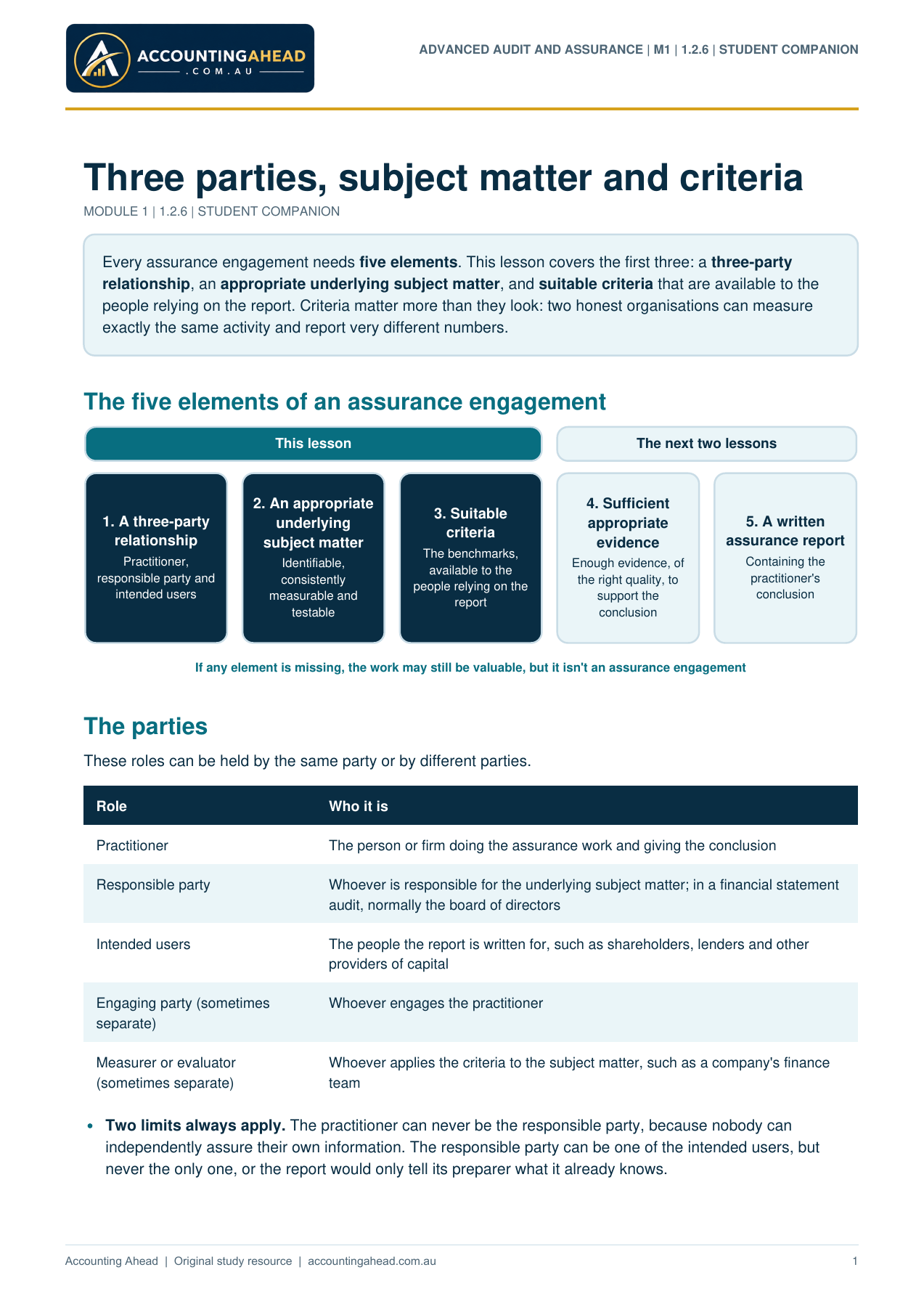
Every assurance engagement needs five elements. This lesson covers the first three: a three-party
relationship, an appropriate underlying subject matter, and suitable criteria that are available to the
people relying on the report. Criteria matter more than they look: two honest organisations can measure
exactly the same activity and report very different numbers.
The five elements of an assurance engagement
This lesson The next two lessons
1. A three-party
relationship
Practitioner,
responsible party and
intended users
2. An appropriate
underlying
subject matter
Identifiable,
consistently
measurable and
testable
3. Suitable
criteria
The benchmarks,
available to the
people relying on the
report
4. Sufficient
appropriate
evidence
Enough evidence, of
the right quality, to
support the
conclusion
5. A written
assurance report
Containing the
practitioner's
conclusion
If any element is missing, the work may still be valuable, but it isn't an assurance engagement
The parties
These roles can be held by the same party or by different parties.
Role Who it is
Practitioner The person or firm doing the assurance work and giving the conclusion
Responsible party Whoever is responsible for the underlying subject matter; in a financial statement
audit, normally the board of directors
Intended users The people the report is written for, such as shareholders, lenders and other
providers of capital
Engaging party (sometimes
separate)
Whoever engages the practitioner
Measurer or evaluator
(sometimes separate)
Whoever applies the criteria to the subject matter, such as a company's finance
team
Two limits always apply. The practitioner can never be the responsible party, because nobody can
independently assure their own information. The responsible party can be one of the intended users, but
never the only one, or the report would only tell its preparer what it already knows.
ADVANCED AUDIT AND ASSURANCE | M1 | 1.2.6 | STUDENT COMPANION
1
Accounting Ahead | Original study resource | accountingahead.com.au
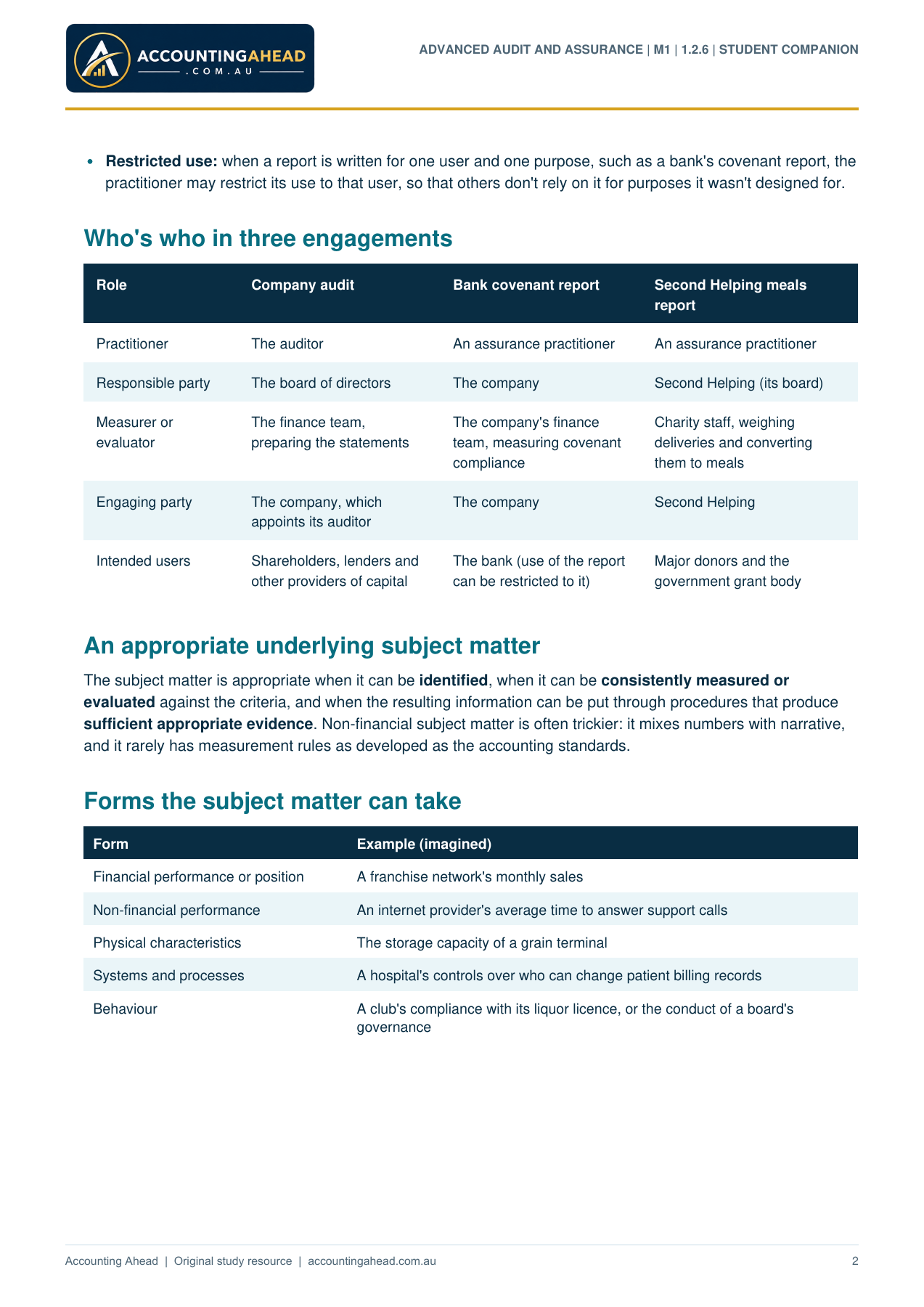
Restricted use: when a report is written for one user and one purpose, such as a bank's covenant report, the
practitioner may restrict its use to that user, so that others don't rely on it for purposes it wasn't designed for.
Who's who in three engagements
Role Company audit Bank covenant report Second Helping meals
report
Practitioner The auditor An assurance practitioner An assurance practitioner
Responsible party The board of directors The company Second Helping (its board)
Measurer or
evaluator
The finance team,
preparing the statements
The company's finance
team, measuring covenant
compliance
Charity staff, weighing
deliveries and converting
them to meals
Engaging party The company, which
appoints its auditor
The company Second Helping
Intended users Shareholders, lenders and
other providers of capital
The bank (use of the report
can be restricted to it)
Major donors and the
government grant body
An appropriate underlying subject matter
The subject matter is appropriate when it can be identified, when it can be consistently measured or
evaluated against the criteria, and when the resulting information can be put through procedures that produce
sufficient appropriate evidence. Non-financial subject matter is often trickier: it mixes numbers with narrative,
and it rarely has measurement rules as developed as the accounting standards.
Forms the subject matter can take
Form Example (imagined)
Financial performance or position A franchise network's monthly sales
Non-financial performance An internet provider's average time to answer support calls
Physical characteristics The storage capacity of a grain terminal
Systems and processes A hospital's controls over who can change patient billing records
Behaviour A club's compliance with its liquor licence, or the conduct of a board's
governance
ADVANCED AUDIT AND ASSURANCE | M1 | 1.2.6 | STUDENT COMPANION
2
Accounting Ahead | Original study resource | accountingahead.com.au
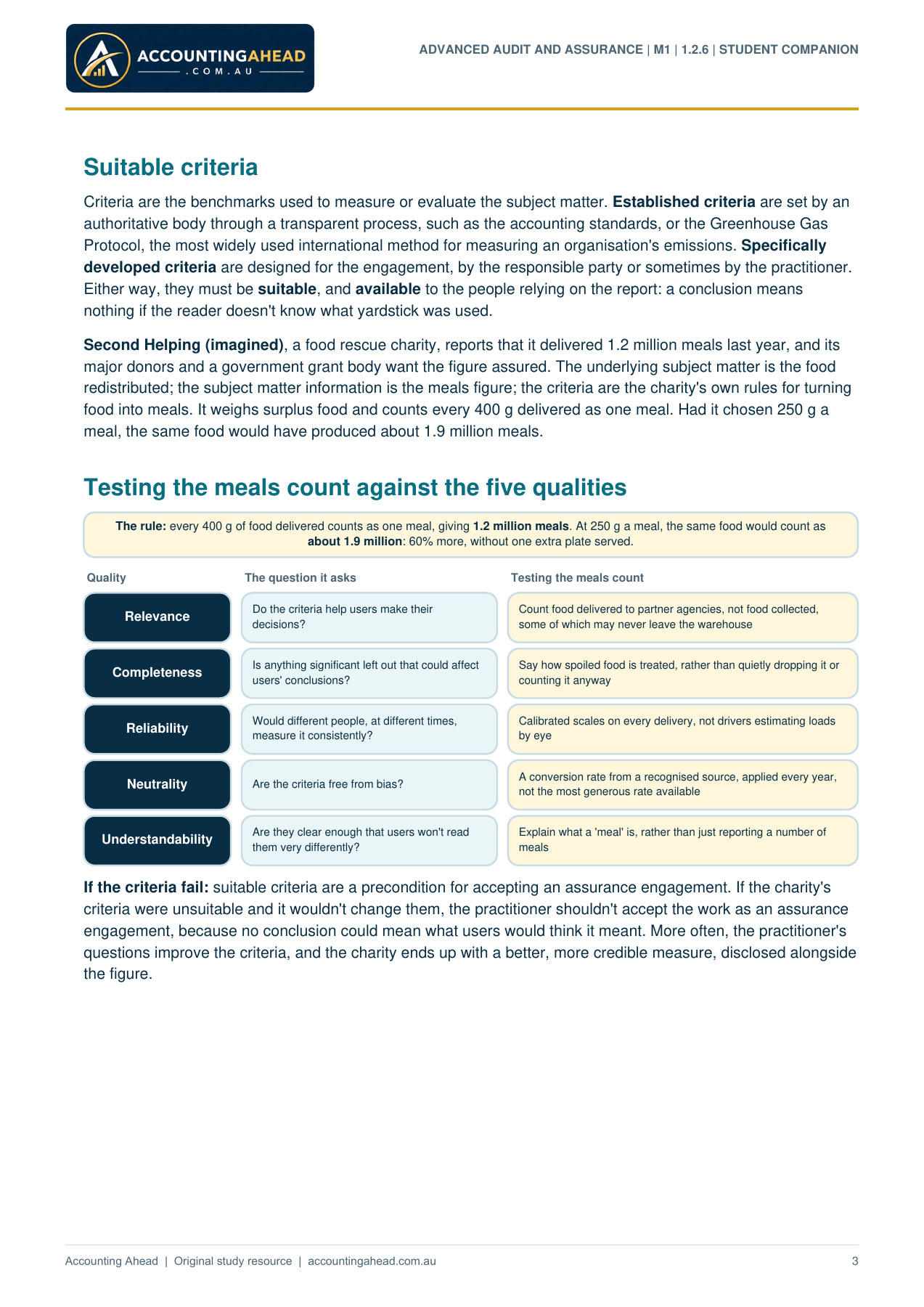
Suitable criteria
Criteria are the benchmarks used to measure or evaluate the subject matter. Established criteria are set by an
authoritative body through a transparent process, such as the accounting standards, or the Greenhouse Gas
Protocol, the most widely used international method for measuring an organisation's emissions. Specifically
developed criteria are designed for the engagement, by the responsible party or sometimes by the practitioner.
Either way, they must be suitable, and available to the people relying on the report: a conclusion means
nothing if the reader doesn't know what yardstick was used.
Second Helping (imagined), a food rescue charity, reports that it delivered 1.2 million meals last year, and its
major donors and a government grant body want the figure assured. The underlying subject matter is the food
redistributed; the subject matter information is the meals figure; the criteria are the charity's own rules for turning
food into meals. It weighs surplus food and counts every 400 g delivered as one meal. Had it chosen 250 g a
meal, the same food would have produced about 1.9 million meals.
Testing the meals count against the five qualities
The rule: every 400 g of food delivered counts as one meal, giving 1.2 million meals. At 250 g a meal, the same food would count as
about 1.9 million: 60% more, without one extra plate served.
Quality The question it asks Testing the meals count
Relevance Do the criteria help users make their
decisions?
Count food delivered to partner agencies, not food collected,
some of which may never leave the warehouse
Completeness Is anything significant left out that could affect
users' conclusions?
Say how spoiled food is treated, rather than quietly dropping it or
counting it anyway
Reliability Would different people, at different times,
measure it consistently?
Calibrated scales on every delivery, not drivers estimating loads
by eye
Neutrality Are the criteria free from bias? A conversion rate from a recognised source, applied every year,
not the most generous rate available
Understandability Are they clear enough that users won't read
them very differently?
Explain what a 'meal' is, rather than just reporting a number of
meals
If the criteria fail: suitable criteria are a precondition for accepting an assurance engagement. If the charity's
criteria were unsuitable and it wouldn't change them, the practitioner shouldn't accept the work as an assurance
engagement, because no conclusion could mean what users would think it meant. More often, the practitioner's
questions improve the criteria, and the charity ends up with a better, more credible measure, disclosed alongside
the figure.
ADVANCED AUDIT AND ASSURANCE | M1 | 1.2.6 | STUDENT COMPANION
3
Accounting Ahead | Original study resource | accountingahead.com.au
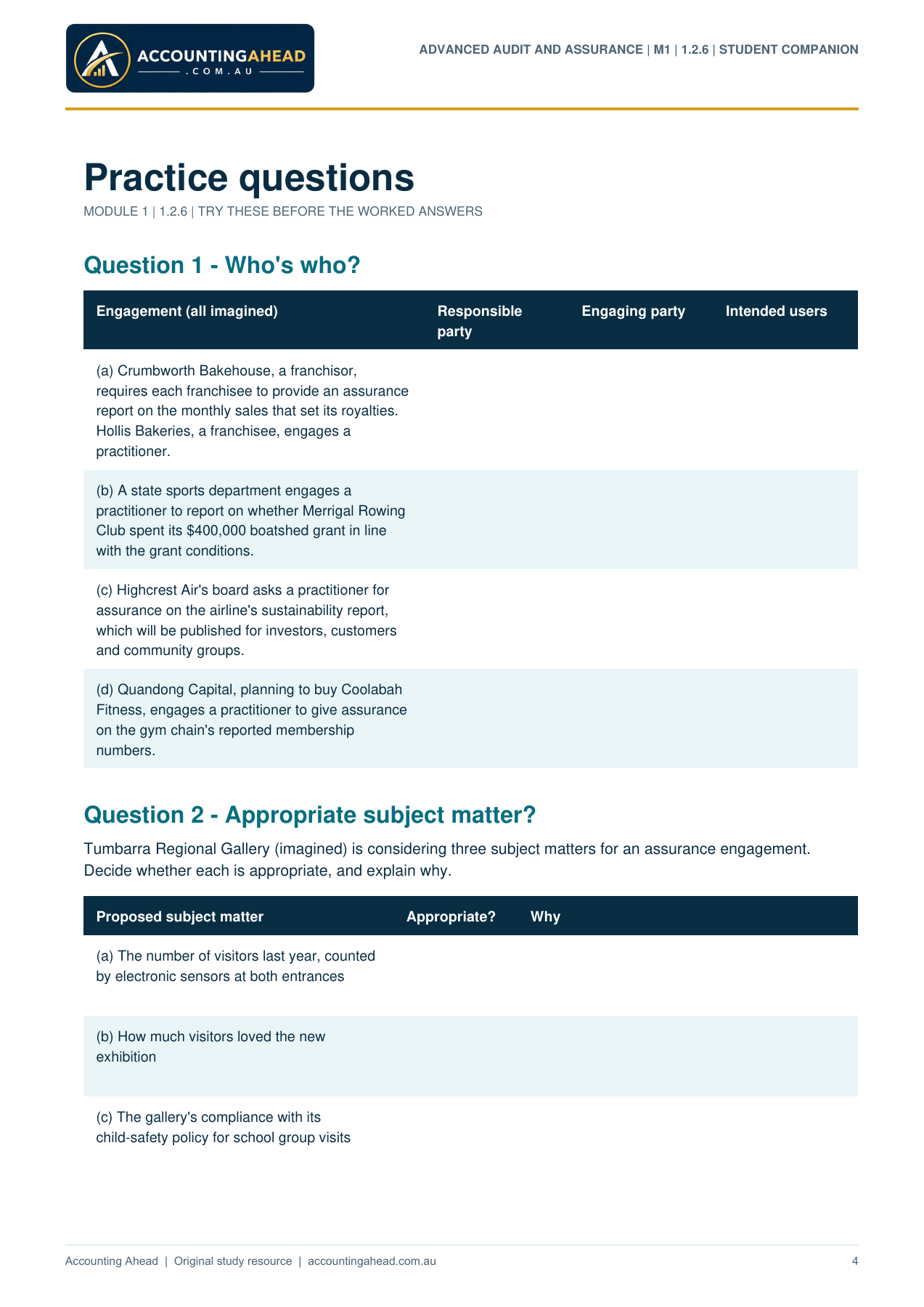
Practice questions
MODULE 1 | 1.2.6 | TRY THESE BEFORE THE WORKED ANSWERS
Question 1 - Who's who?
Engagement (all imagined) Responsible
party
Engaging party Intended users
(a) Crumbworth Bakehouse, a franchisor,
requires each franchisee to provide an assurance
report on the monthly sales that set its royalties.
Hollis Bakeries, a franchisee, engages a
practitioner.
(b) A state sports department engages a
practitioner to report on whether Merrigal Rowing
Club spent its $400,000 boatshed grant in line
with the grant conditions.
(c) Highcrest Air's board asks a practitioner for
assurance on the airline's sustainability report,
which will be published for investors, customers
and community groups.
(d) Quandong Capital, planning to buy Coolabah
Fitness, engages a practitioner to give assurance
on the gym chain's reported membership
numbers.
Question 2 - Appropriate subject matter?
Tumbarra Regional Gallery (imagined) is considering three subject matters for an assurance engagement.
Decide whether each is appropriate, and explain why.
Proposed subject matter Appropriate? Why
(a) The number of visitors last year, counted
by electronic sensors at both entrances
(b) How much visitors loved the new
exhibition
(c) The gallery's compliance with its
child-safety policy for school group visits
ADVANCED AUDIT AND ASSURANCE | M1 | 1.2.6 | STUDENT COMPANION
4
Accounting Ahead | Original study resource | accountingahead.com.au
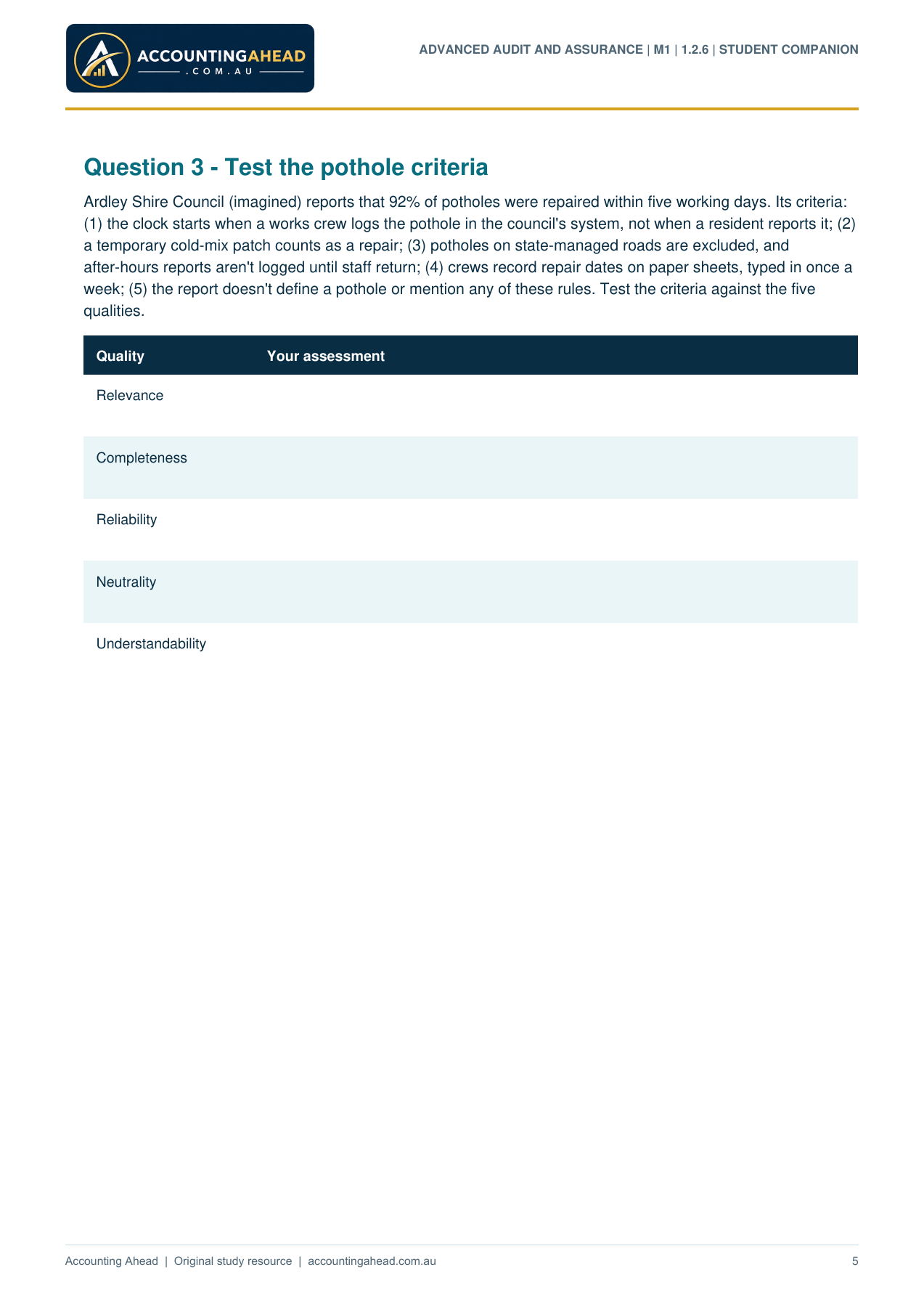
Question 3 - Test the pothole criteria
Ardley Shire Council (imagined) reports that 92% of potholes were repaired within five working days. Its criteria:
(1) the clock starts when a works crew logs the pothole in the council's system, not when a resident reports it; (2)
a temporary cold-mix patch counts as a repair; (3) potholes on state-managed roads are excluded, and
after-hours reports aren't logged until staff return; (4) crews record repair dates on paper sheets, typed in once a
week; (5) the report doesn't define a pothole or mention any of these rules. Test the criteria against the five
qualities.
Quality Your assessment
Relevance
Completeness
Reliability
Neutrality
Understandability
ADVANCED AUDIT AND ASSURANCE | M1 | 1.2.6 | STUDENT COMPANION
5
Accounting Ahead | Original study resource | accountingahead.com.au
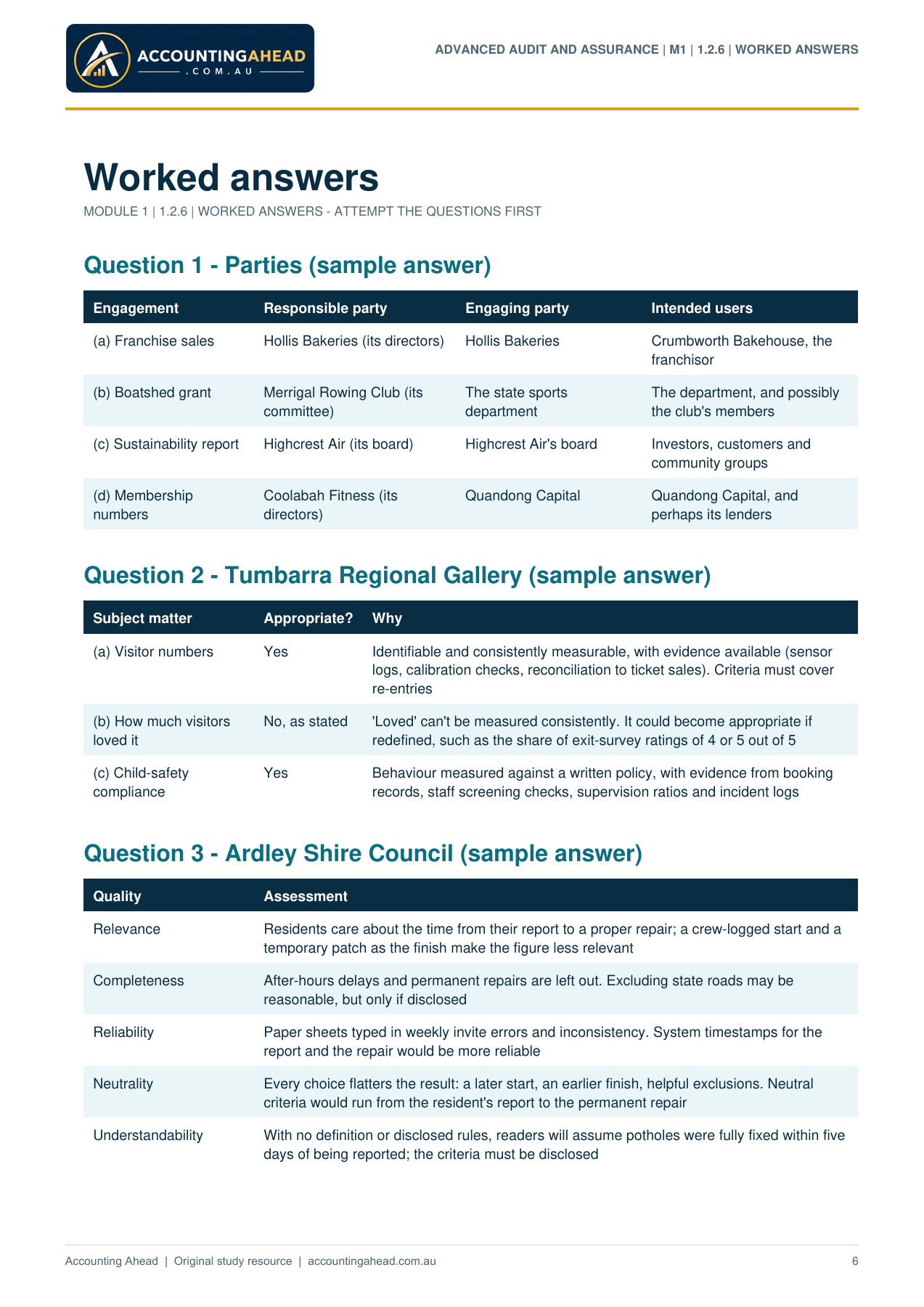
Worked answers
MODULE 1 | 1.2.6 | WORKED ANSWERS - ATTEMPT THE QUESTIONS FIRST
Question 1 - Parties (sample answer)
Engagement Responsible party Engaging party Intended users
(a) Franchise sales Hollis Bakeries (its directors) Hollis Bakeries Crumbworth Bakehouse, the
franchisor
(b) Boatshed grant Merrigal Rowing Club (its
committee)
The state sports
department
The department, and possibly
the club's members
(c) Sustainability report Highcrest Air (its board) Highcrest Air's board Investors, customers and
community groups
(d) Membership
numbers
Coolabah Fitness (its
directors)
Quandong Capital Quandong Capital, and
perhaps its lenders
Question 2 - Tumbarra Regional Gallery (sample answer)
Subject matter Appropriate? Why
(a) Visitor numbers Yes Identifiable and consistently measurable, with evidence available (sensor
logs, calibration checks, reconciliation to ticket sales). Criteria must cover
re-entries
(b) How much visitors
loved it
No, as stated 'Loved' can't be measured consistently. It could become appropriate if
redefined, such as the share of exit-survey ratings of 4 or 5 out of 5
(c) Child-safety
compliance
Yes Behaviour measured against a written policy, with evidence from booking
records, staff screening checks, supervision ratios and incident logs
Question 3 - Ardley Shire Council (sample answer)
Quality Assessment
Relevance Residents care about the time from their report to a proper repair; a crew-logged start and a
temporary patch as the finish make the figure less relevant
Completeness After-hours delays and permanent repairs are left out. Excluding state roads may be
reasonable, but only if disclosed
Reliability Paper sheets typed in weekly invite errors and inconsistency. System timestamps for the
report and the repair would be more reliable
Neutrality Every choice flatters the result: a later start, an earlier finish, helpful exclusions. Neutral
criteria would run from the resident's report to the permanent repair
Understandability With no definition or disclosed rules, readers will assume potholes were fully fixed within five
days of being reported; the criteria must be disclosed
ADVANCED AUDIT AND ASSURANCE | M1 | 1.2.6 | WORKED ANSWERS
6