
Applying the standards
Printable study notes, diagrams and practice support for Part 1.4.
Read the handout text
Accounting Ahead | Original study resource | accountingahead.com.au
Applying the standards
MODULE 1 | 1.4 | STUDENT COMPANION
The auditing standards are grouped by number and all follow one pattern, and an auditor must comply with
every relevant standard. The same standards apply to every entity, with the work scaled to its size and
complexity. The law, not the standards, decides who needs an audit or a review. Auditors-General
apply the standards in the public sector, and the review, assurance and related services standards
complete the family, with some Australian additions.
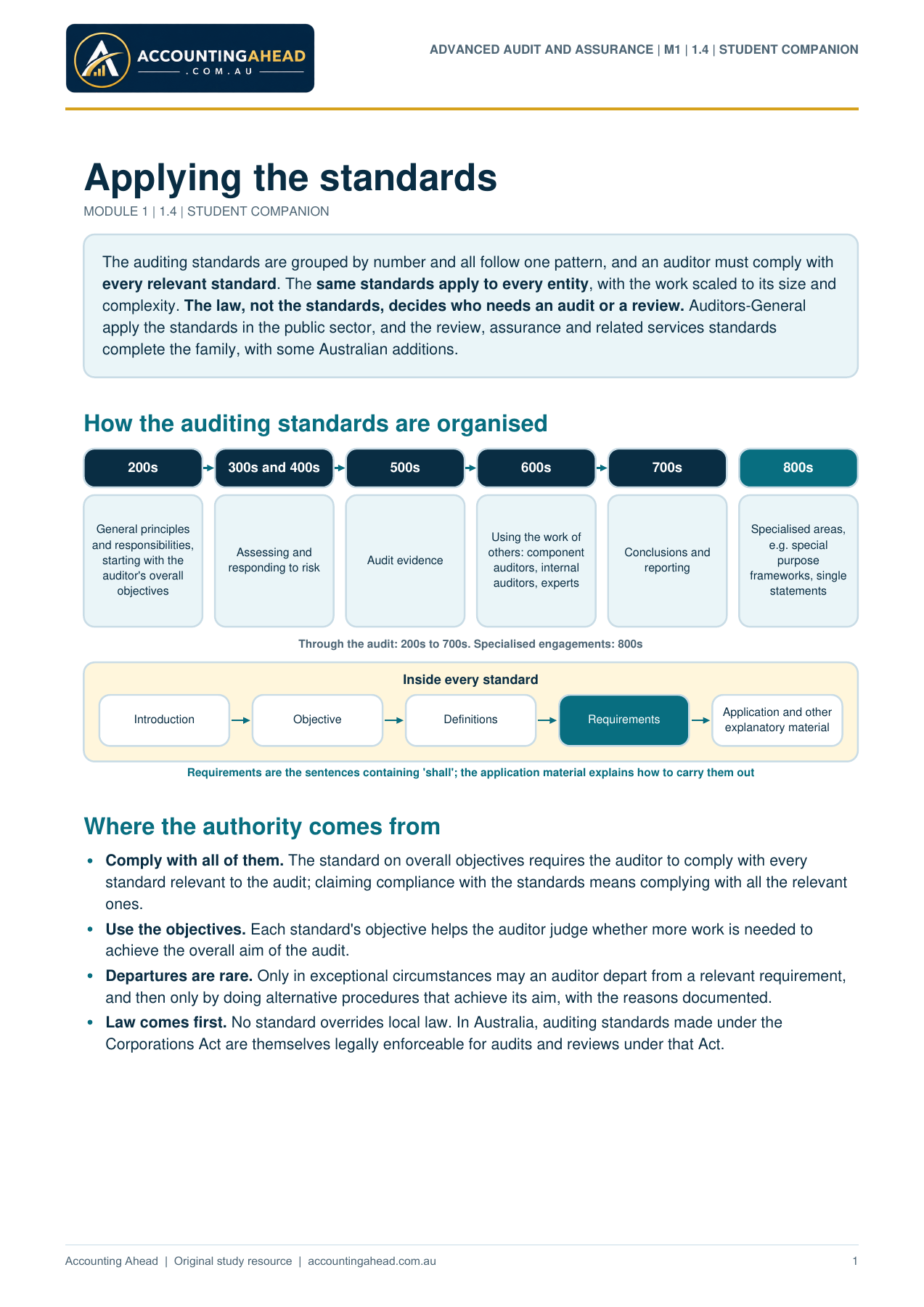
How the auditing standards are organised
200s
General principles
and responsibilities,
starting with the
auditor's overall
objectives
300s and 400s
Assessing and
responding to risk
500s
Audit evidence
600s
Using the work of
others: component
auditors, internal
auditors, experts
700s
Conclusions and
reporting
800s
Specialised areas,
e.g. special
purpose
frameworks, single
statements
Through the audit: 200s to 700s. Specialised engagements: 800s
Inside every standard
Introduction Objective Definitions Requirements Application and other
explanatory material
Requirements are the sentences containing 'shall'; the application material explains how to carry them out
Where the authority comes from
Comply with all of them. The standard on overall objectives requires the auditor to comply with every
standard relevant to the audit; claiming compliance with the standards means complying with all the relevant
ones.
Use the objectives. Each standard's objective helps the auditor judge whether more work is needed to
achieve the overall aim of the audit.
Departures are rare. Only in exceptional circumstances may an auditor depart from a relevant requirement,
and then only by doing alternative procedures that achieve its aim, with the reasons documented.
Law comes first. No standard overrides local law. In Australia, auditing standards made under the
Corporations Act are themselves legally enforceable for audits and reviews under that Act.
ADVANCED AUDIT AND ASSURANCE | M1 | 1.4 | STUDENT COMPANION
1
Accounting Ahead | Original study resource | accountingahead.com.au
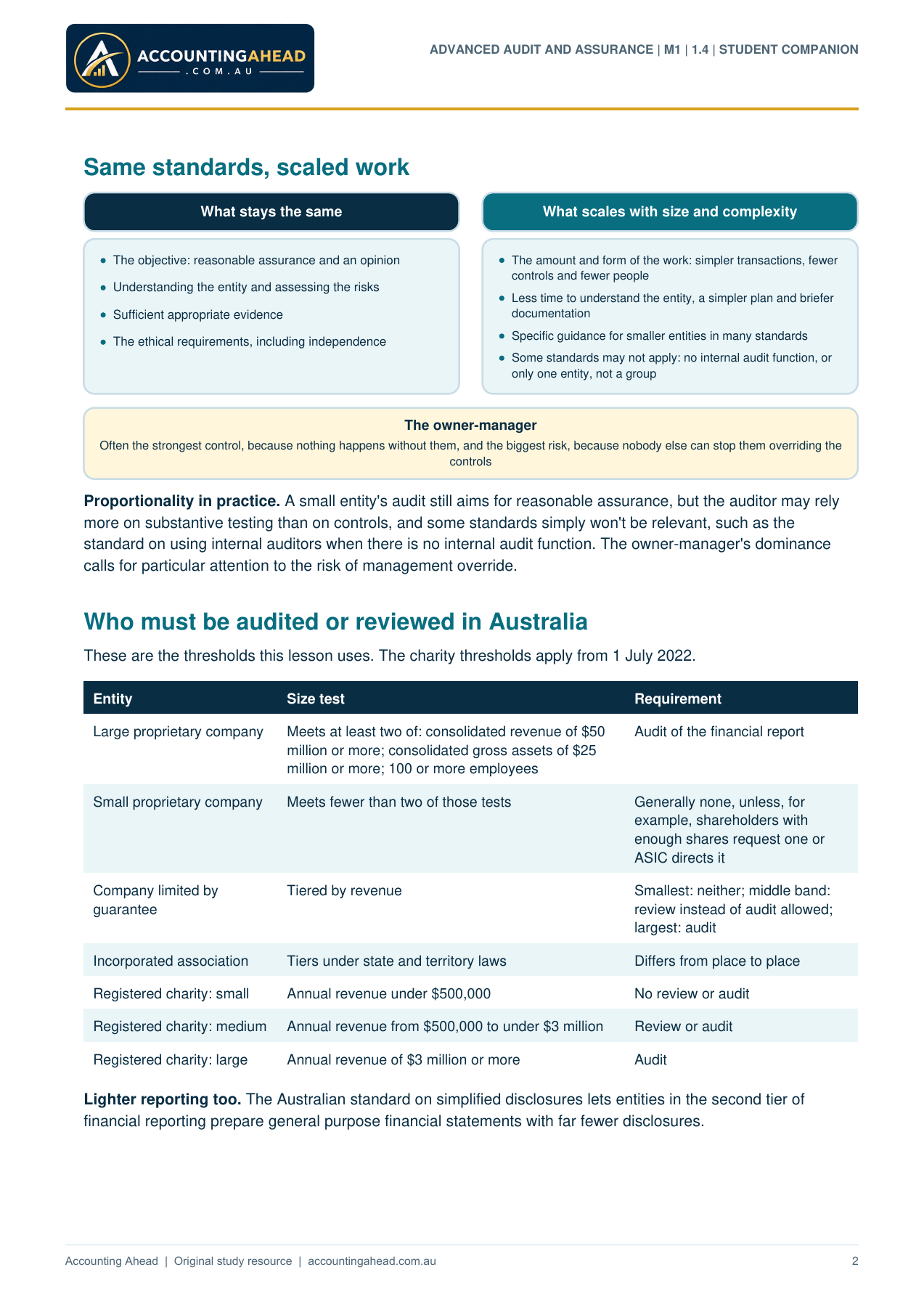
Same standards, scaled work
What stays the same
The objective: reasonable assurance and an opinion
Understanding the entity and assessing the risks
Sufficient appropriate evidence
The ethical requirements, including independence
What scales with size and complexity
The amount and form of the work: simpler transactions, fewer
controls and fewer people
Less time to understand the entity, a simpler plan and briefer
documentation
Specific guidance for smaller entities in many standards
Some standards may not apply: no internal audit function, or
only one entity, not a group
The owner-manager
Often the strongest control, because nothing happens without them, and the biggest risk, because nobody else can stop them overriding the
controls
Proportionality in practice. A small entity's audit still aims for reasonable assurance, but the auditor may rely
more on substantive testing than on controls, and some standards simply won't be relevant, such as the
standard on using internal auditors when there is no internal audit function. The owner-manager's dominance
calls for particular attention to the risk of management override.
Who must be audited or reviewed in Australia
These are the thresholds this lesson uses. The charity thresholds apply from 1 July 2022.
Entity Size test Requirement
Large proprietary company Meets at least two of: consolidated revenue of $50
million or more; consolidated gross assets of $25
million or more; 100 or more employees
Audit of the financial report
Small proprietary company Meets fewer than two of those tests Generally none, unless, for
example, shareholders with
enough shares request one or
ASIC directs it
Company limited by
guarantee
Tiered by revenue Smallest: neither; middle band:
review instead of audit allowed;
largest: audit
Incorporated association Tiers under state and territory laws Differs from place to place
Registered charity: small Annual revenue under $500,000 No review or audit
Registered charity: medium Annual revenue from $500,000 to under $3 million Review or audit
Registered charity: large Annual revenue of $3 million or more Audit
Lighter reporting too. The Australian standard on simplified disclosures lets entities in the second tier of
financial reporting prepare general purpose financial statements with far fewer disclosures.
ADVANCED AUDIT AND ASSURANCE | M1 | 1.4 | STUDENT COMPANION
2
Accounting Ahead | Original study resource | accountingahead.com.au
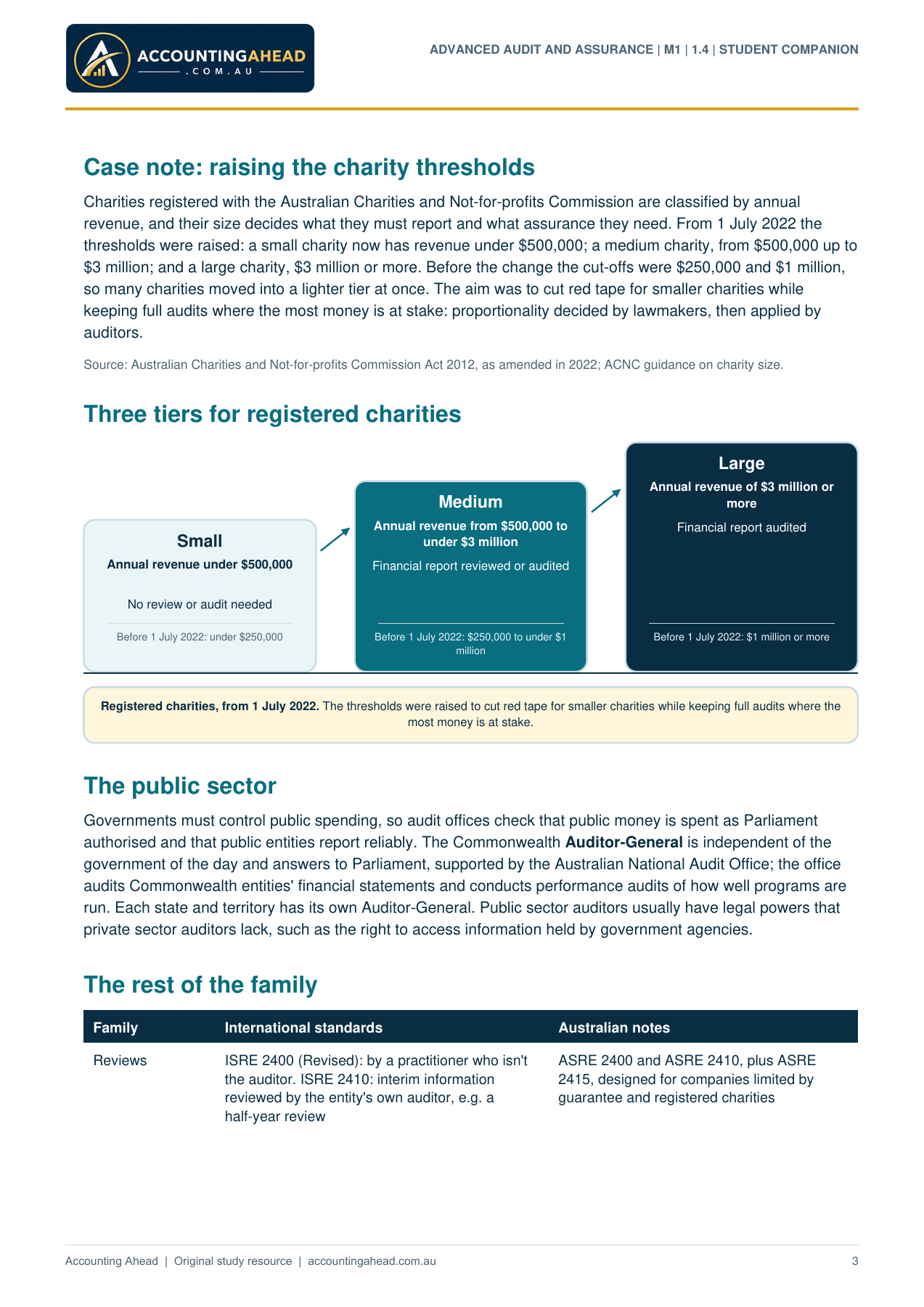
Case note: raising the charity thresholds
Charities registered with the Australian Charities and Not-for-profits Commission are classified by annual
revenue, and their size decides what they must report and what assurance they need. From 1 July 2022 the
thresholds were raised: a small charity now has revenue under $500,000; a medium charity, from $500,000 up to
$3 million; and a large charity, $3 million or more. Before the change the cut-offs were $250,000 and $1 million,
so many charities moved into a lighter tier at once. The aim was to cut red tape for smaller charities while
keeping full audits where the most money is at stake: proportionality decided by lawmakers, then applied by
auditors.
Source: Australian Charities and Not-for-profits Commission Act 2012, as amended in 2022; ACNC guidance on charity size.
Three tiers for registered charities
Small
Annual revenue under $500,000
No review or audit needed
Before 1 July 2022: under $250,000
Medium
Annual revenue from $500,000 to
under $3 million
Financial report reviewed or audited
Before 1 July 2022: $250,000 to under $1
million
Large
Annual revenue of $3 million or
more
Financial report audited
Before 1 July 2022: $1 million or more
Registered charities, from 1 July 2022. The thresholds were raised to cut red tape for smaller charities while keeping full audits where the
most money is at stake.
The public sector
Governments must control public spending, so audit offices check that public money is spent as Parliament
authorised and that public entities report reliably. The Commonwealth Auditor-General is independent of the
government of the day and answers to Parliament, supported by the Australian National Audit Office; the office
audits Commonwealth entities' financial statements and conducts performance audits of how well programs are
run. Each state and territory has its own Auditor-General. Public sector auditors usually have legal powers that
private sector auditors lack, such as the right to access information held by government agencies.
The rest of the family
Family International standards Australian notes
Reviews ISRE 2400 (Revised): by a practitioner who isn't
the auditor. ISRE 2410: interim information
reviewed by the entity's own auditor, e.g. a
half-year review
ASRE 2400 and ASRE 2410, plus ASRE
2415, designed for companies limited by
guarantee and registered charities
ADVANCED AUDIT AND ASSURANCE | M1 | 1.4 | STUDENT COMPANION
3
Accounting Ahead | Original study resource | accountingahead.com.au
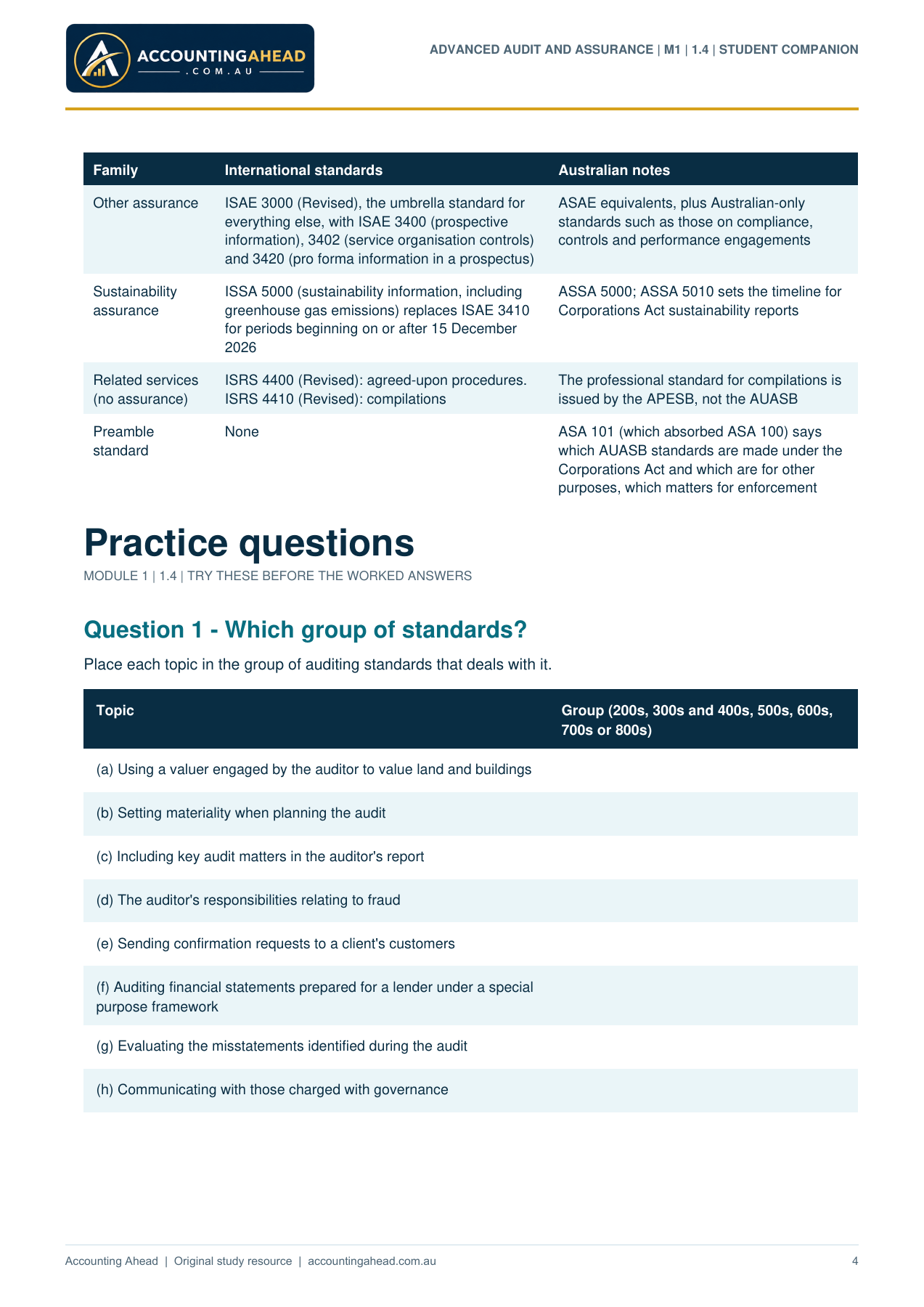
Family International standards Australian notes
Other assurance ISAE 3000 (Revised), the umbrella standard for
everything else, with ISAE 3400 (prospective
information), 3402 (service organisation controls)
and 3420 (pro forma information in a prospectus)
ASAE equivalents, plus Australian-only
standards such as those on compliance,
controls and performance engagements
Sustainability
assurance
ISSA 5000 (sustainability information, including
greenhouse gas emissions) replaces ISAE 3410
for periods beginning on or after 15 December
2026
ASSA 5000; ASSA 5010 sets the timeline for
Corporations Act sustainability reports
Related services
(no assurance)
ISRS 4400 (Revised): agreed-upon procedures.
ISRS 4410 (Revised): compilations
The professional standard for compilations is
issued by the APESB, not the AUASB
Preamble
standard
None ASA 101 (which absorbed ASA 100) says
which AUASB standards are made under the
Corporations Act and which are for other
purposes, which matters for enforcement
Practice questions
MODULE 1 | 1.4 | TRY THESE BEFORE THE WORKED ANSWERS
Question 1 - Which group of standards?
Place each topic in the group of auditing standards that deals with it.
Topic Group (200s, 300s and 400s, 500s, 600s,
700s or 800s)
(a) Using a valuer engaged by the auditor to value land and buildings
(b) Setting materiality when planning the audit
(c) Including key audit matters in the auditor's report
(d) The auditor's responsibilities relating to fraud
(e) Sending confirmation requests to a client's customers
(f) Auditing financial statements prepared for a lender under a special
purpose framework
(g) Evaluating the misstatements identified during the audit
(h) Communicating with those charged with governance
ADVANCED AUDIT AND ASSURANCE | M1 | 1.4 | STUDENT COMPANION
4
Accounting Ahead | Original study resource | accountingahead.com.au
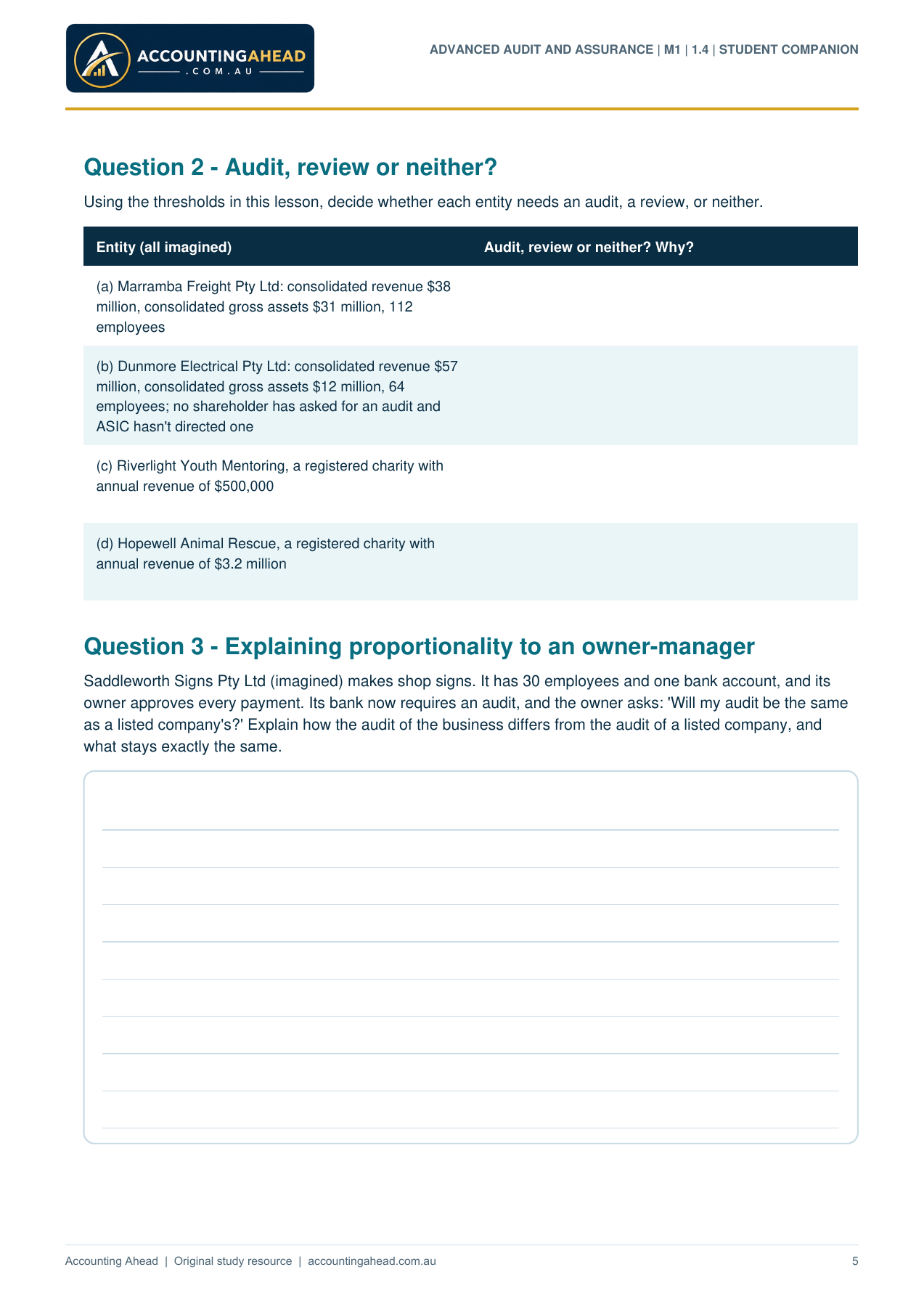
Question 2 - Audit, review or neither?
Using the thresholds in this lesson, decide whether each entity needs an audit, a review, or neither.
Entity (all imagined) Audit, review or neither? Why?
(a) Marramba Freight Pty Ltd: consolidated revenue $38
million, consolidated gross assets $31 million, 112
employees
(b) Dunmore Electrical Pty Ltd: consolidated revenue $57
million, consolidated gross assets $12 million, 64
employees; no shareholder has asked for an audit and
ASIC hasn't directed one
(c) Riverlight Youth Mentoring, a registered charity with
annual revenue of $500,000
(d) Hopewell Animal Rescue, a registered charity with
annual revenue of $3.2 million
Question 3 - Explaining proportionality to an owner-manager
Saddleworth Signs Pty Ltd (imagined) makes shop signs. It has 30 employees and one bank account, and its
owner approves every payment. Its bank now requires an audit, and the owner asks: 'Will my audit be the same
as a listed company's?' Explain how the audit of the business differs from the audit of a listed company, and
what stays exactly the same.
ADVANCED AUDIT AND ASSURANCE | M1 | 1.4 | STUDENT COMPANION
5
Accounting Ahead | Original study resource | accountingahead.com.au
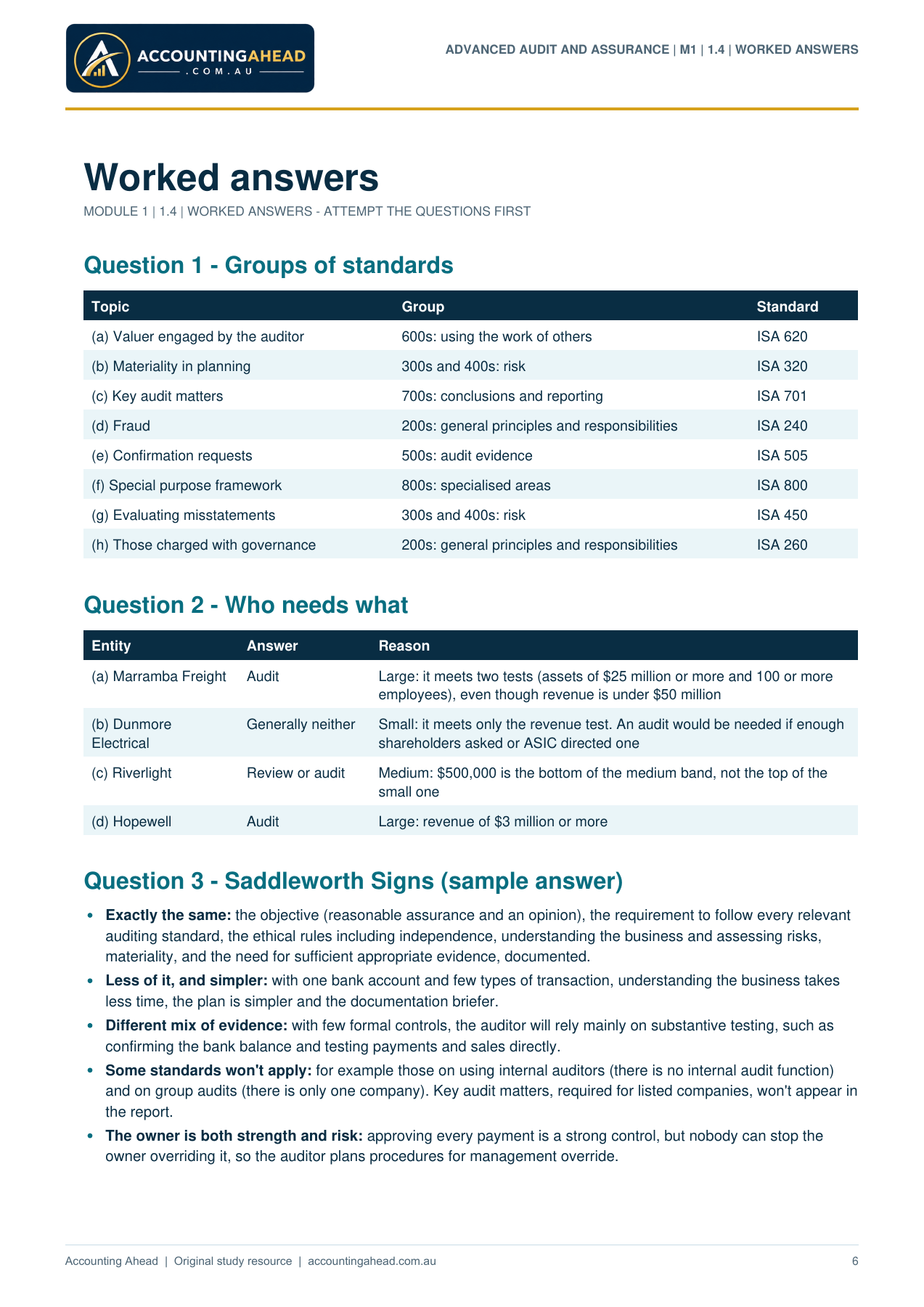
Worked answers
MODULE 1 | 1.4 | WORKED ANSWERS - ATTEMPT THE QUESTIONS FIRST
Question 1 - Groups of standards
Topic Group Standard
(a) Valuer engaged by the auditor 600s: using the work of others ISA 620
(b) Materiality in planning 300s and 400s: risk ISA 320
(c) Key audit matters 700s: conclusions and reporting ISA 701
(d) Fraud 200s: general principles and responsibilities ISA 240
(e) Confirmation requests 500s: audit evidence ISA 505
(f) Special purpose framework 800s: specialised areas ISA 800
(g) Evaluating misstatements 300s and 400s: risk ISA 450
(h) Those charged with governance 200s: general principles and responsibilities ISA 260
Question 2 - Who needs what
Entity Answer Reason
(a) Marramba Freight Audit Large: it meets two tests (assets of $25 million or more and 100 or more
employees), even though revenue is under $50 million
(b) Dunmore
Electrical
Generally neither Small: it meets only the revenue test. An audit would be needed if enough
shareholders asked or ASIC directed one
(c) Riverlight Review or audit Medium: $500,000 is the bottom of the medium band, not the top of the
small one
(d) Hopewell Audit Large: revenue of $3 million or more
Question 3 - Saddleworth Signs (sample answer)
Exactly the same: the objective (reasonable assurance and an opinion), the requirement to follow every relevant
auditing standard, the ethical rules including independence, understanding the business and assessing risks,
materiality, and the need for sufficient appropriate evidence, documented.
Less of it, and simpler: with one bank account and few types of transaction, understanding the business takes
less time, the plan is simpler and the documentation briefer.
Different mix of evidence: with few formal controls, the auditor will rely mainly on substantive testing, such as
confirming the bank balance and testing payments and sales directly.
Some standards won't apply: for example those on using internal auditors (there is no internal audit function)
and on group audits (there is only one company). Key audit matters, required for listed companies, won't appear in
the report.
The owner is both strength and risk: approving every payment is a strong control, but nobody can stop the
owner overriding it, so the auditor plans procedures for management override.
ADVANCED AUDIT AND ASSURANCE | M1 | 1.4 | WORKED ANSWERS
6