
Business models and climate-risk disclosure
Printable study notes, diagrams and practice support for Part 1.5.1.
Read the handout text
Accounting Ahead | Original study resource | accountingahead.com.au
Business models and climate-risk
disclosure
MODULE 1 | 1.5.1 | STUDENT COMPANION
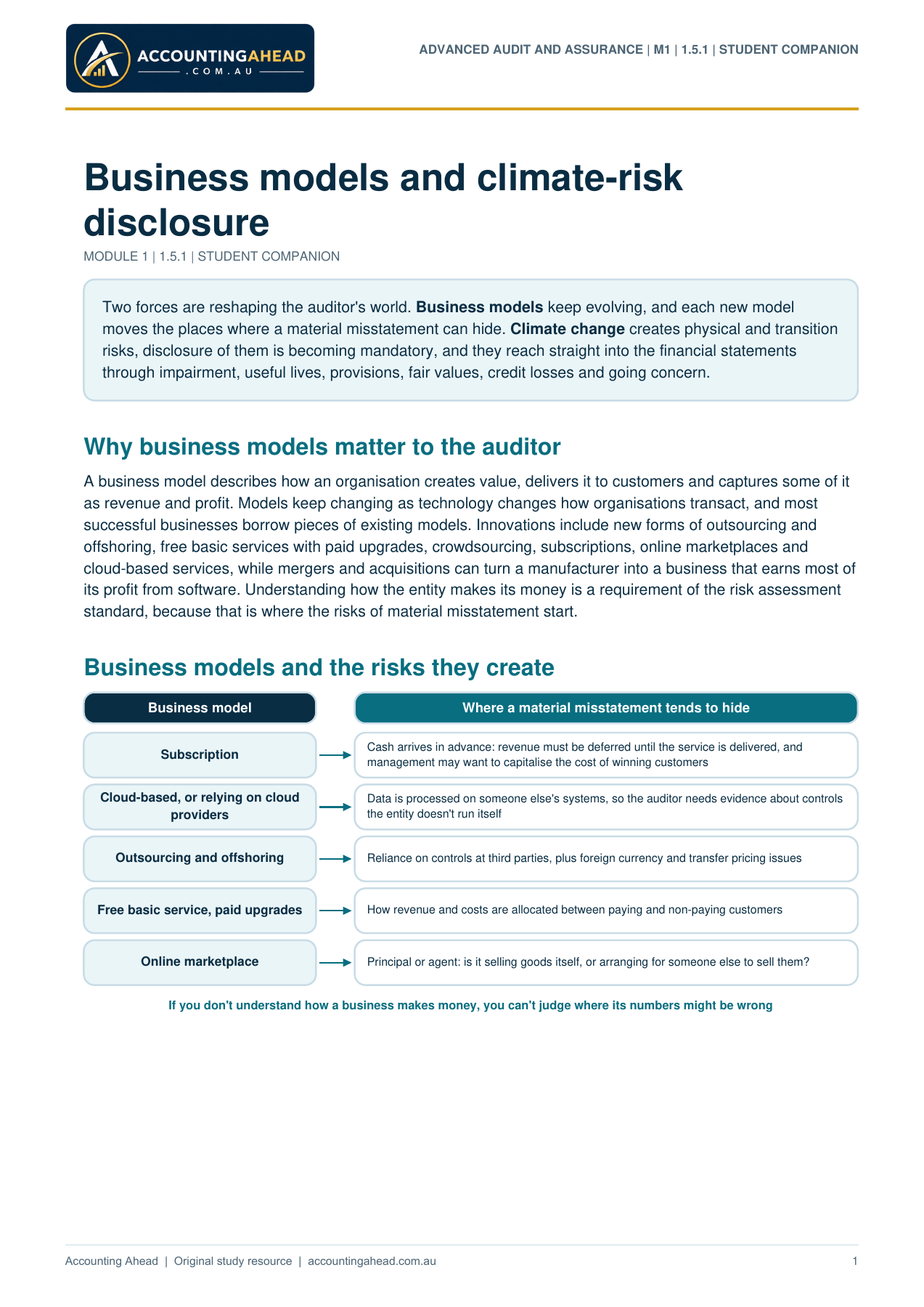
Two forces are reshaping the auditor's world. Business models keep evolving, and each new model
moves the places where a material misstatement can hide. Climate change creates physical and transition
risks, disclosure of them is becoming mandatory, and they reach straight into the financial statements
through impairment, useful lives, provisions, fair values, credit losses and going concern.
Why business models matter to the auditor
A business model describes how an organisation creates value, delivers it to customers and captures some of it
as revenue and profit. Models keep changing as technology changes how organisations transact, and most
successful businesses borrow pieces of existing models. Innovations include new forms of outsourcing and
offshoring, free basic services with paid upgrades, crowdsourcing, subscriptions, online marketplaces and
cloud-based services, while mergers and acquisitions can turn a manufacturer into a business that earns most of
its profit from software. Understanding how the entity makes its money is a requirement of the risk assessment
standard, because that is where the risks of material misstatement start.
Business models and the risks they create
Business model Where a material misstatement tends to hide
Subscription Cash arrives in advance: revenue must be deferred until the service is delivered, and
management may want to capitalise the cost of winning customers
Cloud-based, or relying on cloud
providers
Data is processed on someone else's systems, so the auditor needs evidence about controls
the entity doesn't run itself
Outsourcing and offshoring Reliance on controls at third parties, plus foreign currency and transfer pricing issues
Free basic service, paid upgrades How revenue and costs are allocated between paying and non-paying customers
Online marketplace Principal or agent: is it selling goods itself, or arranging for someone else to sell them?
If you don't understand how a business makes money, you can't judge where its numbers might be wrong
ADVANCED AUDIT AND ASSURANCE | M1 | 1.5.1 | STUDENT COMPANION
1
Accounting Ahead | Original study resource | accountingahead.com.au
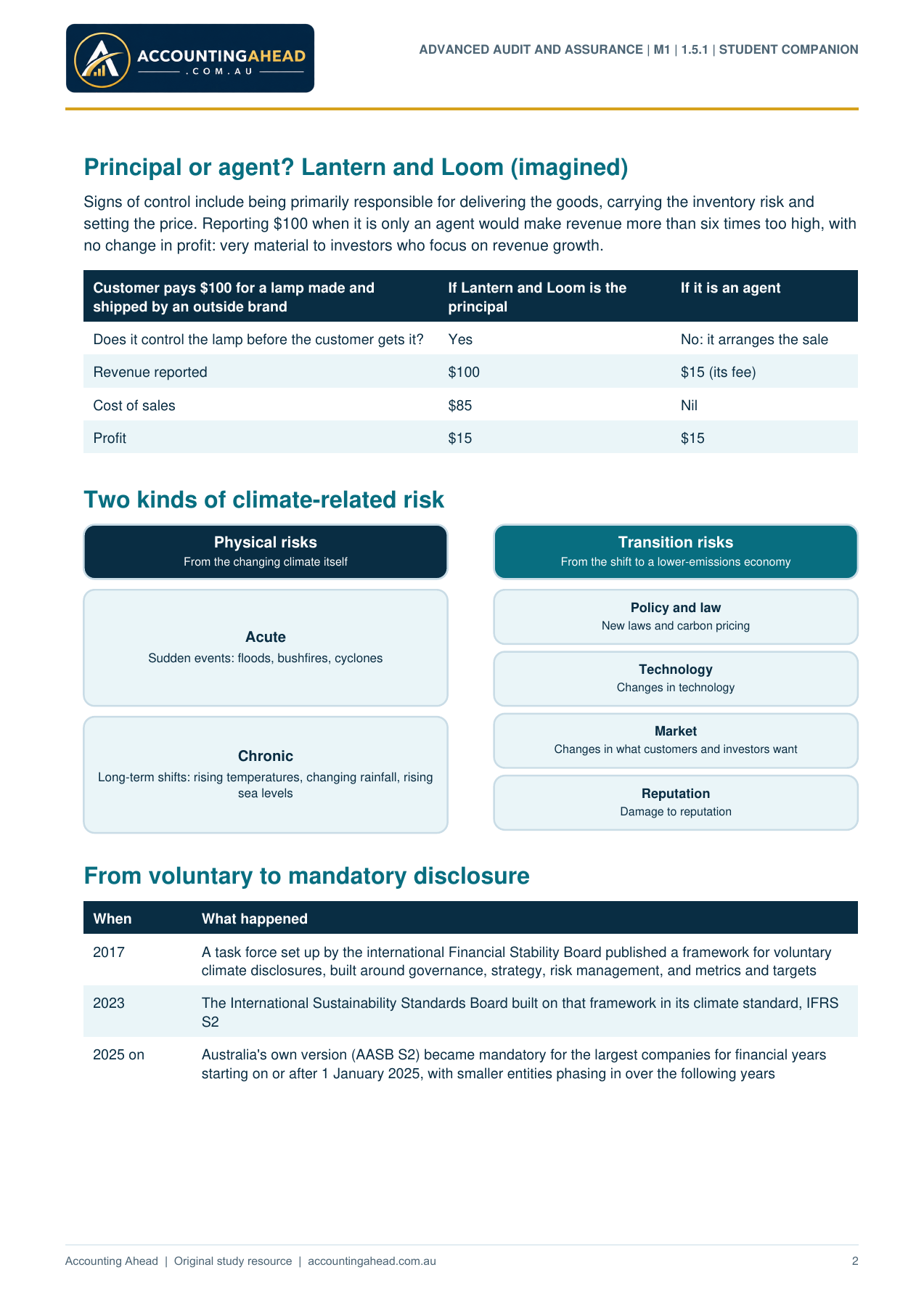
Principal or agent? Lantern and Loom (imagined)
Signs of control include being primarily responsible for delivering the goods, carrying the inventory risk and
setting the price. Reporting $100 when it is only an agent would make revenue more than six times too high, with
no change in profit: very material to investors who focus on revenue growth.
Customer pays $100 for a lamp made and
shipped by an outside brand
If Lantern and Loom is the
principal
If it is an agent
Does it control the lamp before the customer gets it? Yes No: it arranges the sale
Revenue reported $100 $15 (its fee)
Cost of sales $85 Nil
Profit $15 $15
Two kinds of climate-related risk
Physical risks
From the changing climate itself
Transition risks
From the shift to a lower-emissions economy
Acute
Sudden events: floods, bushfires, cyclones
Chronic
Long-term shifts: rising temperatures, changing rainfall, rising
sea levels
Policy and law
New laws and carbon pricing
Technology
Changes in technology
Market
Changes in what customers and investors want
Reputation
Damage to reputation
From voluntary to mandatory disclosure
When What happened
2017 A task force set up by the international Financial Stability Board published a framework for voluntary
climate disclosures, built around governance, strategy, risk management, and metrics and targets
2023 The International Sustainability Standards Board built on that framework in its climate standard, IFRS
S2
2025 on Australia's own version (AASB S2) became mandatory for the largest companies for financial years
starting on or after 1 January 2025, with smaller entities phasing in over the following years
ADVANCED AUDIT AND ASSURANCE | M1 | 1.5.1 | STUDENT COMPANION
2
Accounting Ahead | Original study resource | accountingahead.com.au
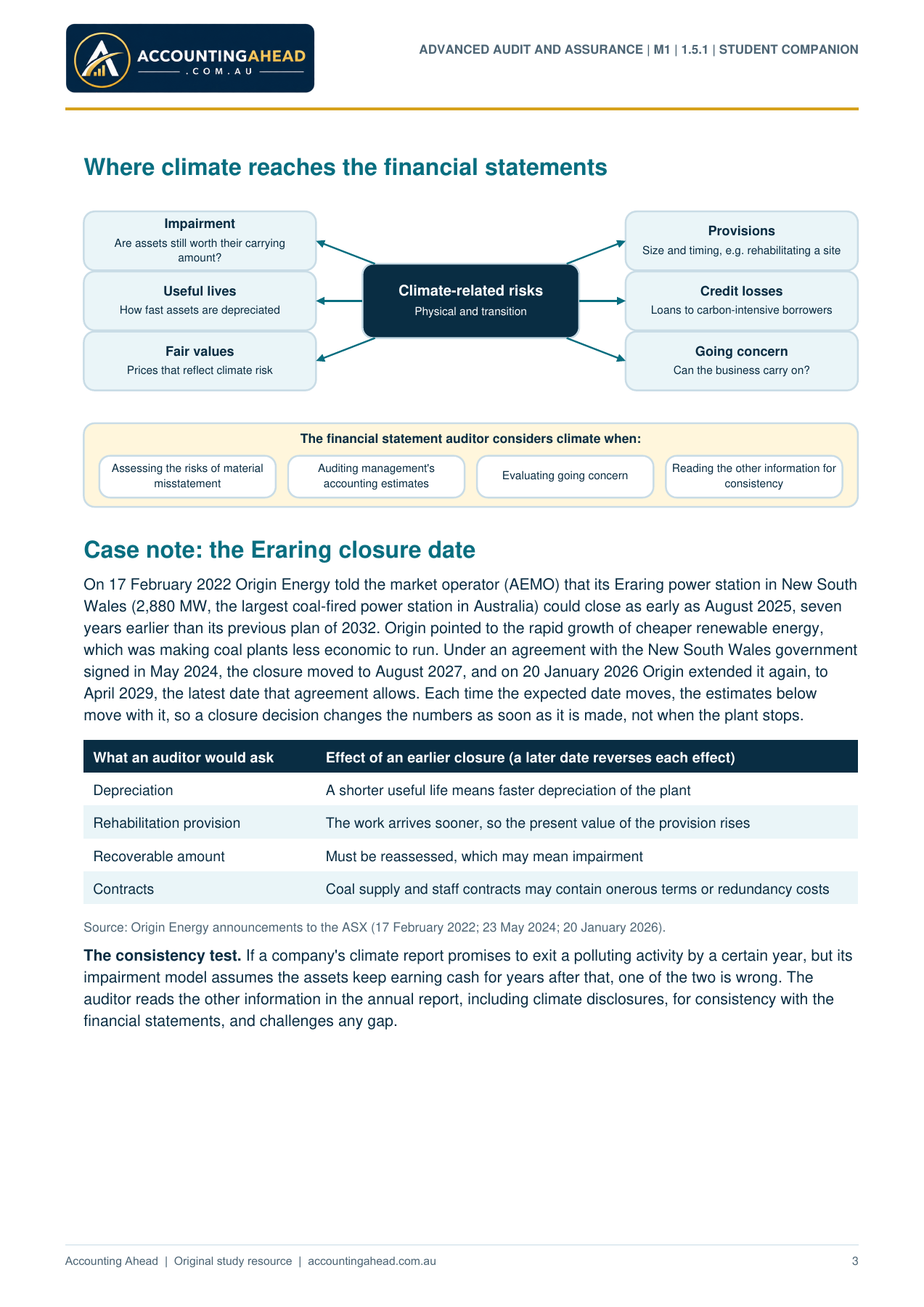
Where climate reaches the financial statements
Climate-related risks
Physical and transition
Impairment
Are assets still worth their carrying
amount?
Provisions
Size and timing, e.g. rehabilitating a site
Useful lives
How fast assets are depreciated
Credit losses
Loans to carbon-intensive borrowers
Fair values
Prices that reflect climate risk
Going concern
Can the business carry on?
The financial statement auditor considers climate when:
Assessing the risks of material
misstatement
Auditing management's
accounting estimates Evaluating going concern Reading the other information for
consistency
Case note: the Eraring closure date
On 17 February 2022 Origin Energy told the market operator (AEMO) that its Eraring power station in New South
Wales (2,880 MW, the largest coal-fired power station in Australia) could close as early as August 2025, seven
years earlier than its previous plan of 2032. Origin pointed to the rapid growth of cheaper renewable energy,
which was making coal plants less economic to run. Under an agreement with the New South Wales government
signed in May 2024, the closure moved to August 2027, and on 20 January 2026 Origin extended it again, to
April 2029, the latest date that agreement allows. Each time the expected date moves, the estimates below
move with it, so a closure decision changes the numbers as soon as it is made, not when the plant stops.
What an auditor would ask Effect of an earlier closure (a later date reverses each effect)
Depreciation A shorter useful life means faster depreciation of the plant
Rehabilitation provision The work arrives sooner, so the present value of the provision rises
Recoverable amount Must be reassessed, which may mean impairment
Contracts Coal supply and staff contracts may contain onerous terms or redundancy costs
Source: Origin Energy announcements to the ASX (17 February 2022; 23 May 2024; 20 January 2026).
The consistency test. If a company's climate report promises to exit a polluting activity by a certain year, but its
impairment model assumes the assets keep earning cash for years after that, one of the two is wrong. The
auditor reads the other information in the annual report, including climate disclosures, for consistency with the
financial statements, and challenges any gap.
ADVANCED AUDIT AND ASSURANCE | M1 | 1.5.1 | STUDENT COMPANION
3
Accounting Ahead | Original study resource | accountingahead.com.au
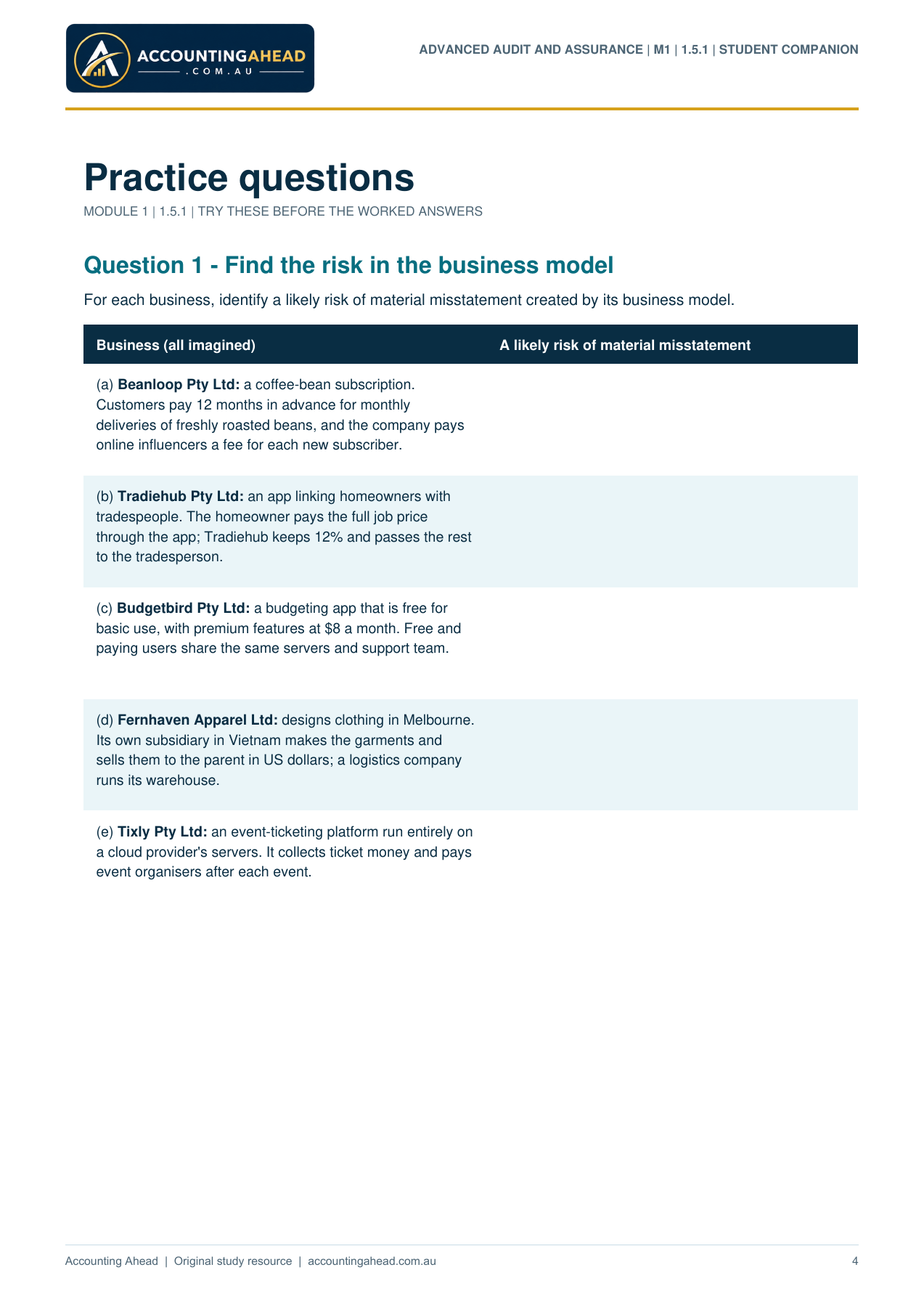
Practice questions
MODULE 1 | 1.5.1 | TRY THESE BEFORE THE WORKED ANSWERS
Question 1 - Find the risk in the business model
For each business, identify a likely risk of material misstatement created by its business model.
Business (all imagined) A likely risk of material misstatement
(a) Beanloop Pty Ltd: a coffee-bean subscription.
Customers pay 12 months in advance for monthly
deliveries of freshly roasted beans, and the company pays
online influencers a fee for each new subscriber.
(b) Tradiehub Pty Ltd: an app linking homeowners with
tradespeople. The homeowner pays the full job price
through the app; Tradiehub keeps 12% and passes the rest
to the tradesperson.
(c) Budgetbird Pty Ltd: a budgeting app that is free for
basic use, with premium features at $8 a month. Free and
paying users share the same servers and support team.
(d) Fernhaven Apparel Ltd: designs clothing in Melbourne.
Its own subsidiary in Vietnam makes the garments and
sells them to the parent in US dollars; a logistics company
runs its warehouse.
(e) Tixly Pty Ltd: an event-ticketing platform run entirely on
a cloud provider's servers. It collects ticket money and pays
event organisers after each event.
ADVANCED AUDIT AND ASSURANCE | M1 | 1.5.1 | STUDENT COMPANION
4
Accounting Ahead | Original study resource | accountingahead.com.au
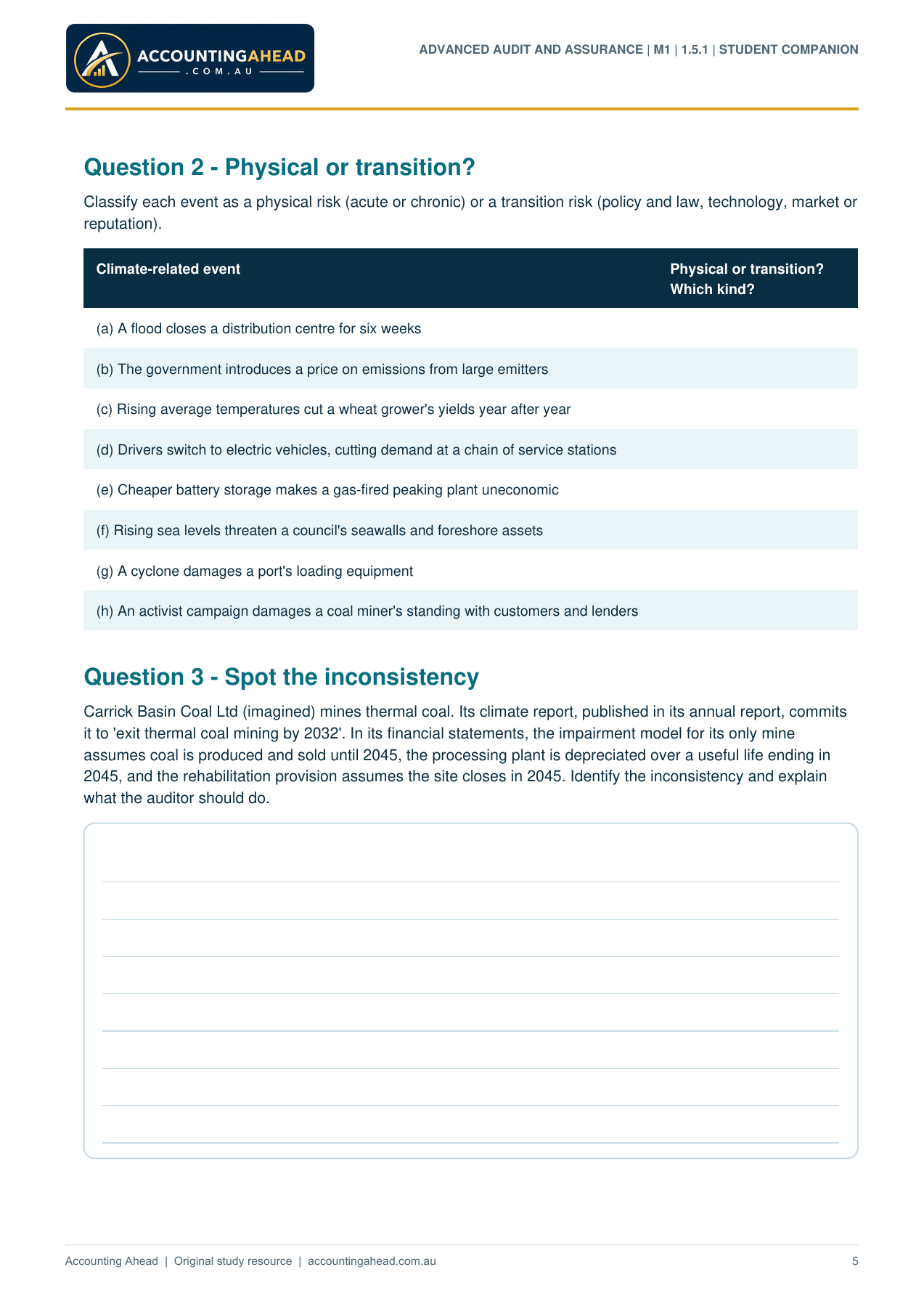
Question 2 - Physical or transition?
Classify each event as a physical risk (acute or chronic) or a transition risk (policy and law, technology, market or
reputation).
Climate-related event Physical or transition?
Which kind?
(a) A flood closes a distribution centre for six weeks
(b) The government introduces a price on emissions from large emitters
(c) Rising average temperatures cut a wheat grower's yields year after year
(d) Drivers switch to electric vehicles, cutting demand at a chain of service stations
(e) Cheaper battery storage makes a gas-fired peaking plant uneconomic
(f) Rising sea levels threaten a council's seawalls and foreshore assets
(g) A cyclone damages a port's loading equipment
(h) An activist campaign damages a coal miner's standing with customers and lenders
Question 3 - Spot the inconsistency
Carrick Basin Coal Ltd (imagined) mines thermal coal. Its climate report, published in its annual report, commits
it to 'exit thermal coal mining by 2032'. In its financial statements, the impairment model for its only mine
assumes coal is produced and sold until 2045, the processing plant is depreciated over a useful life ending in
2045, and the rehabilitation provision assumes the site closes in 2045. Identify the inconsistency and explain
what the auditor should do.
ADVANCED AUDIT AND ASSURANCE | M1 | 1.5.1 | STUDENT COMPANION
5
Accounting Ahead | Original study resource | accountingahead.com.au
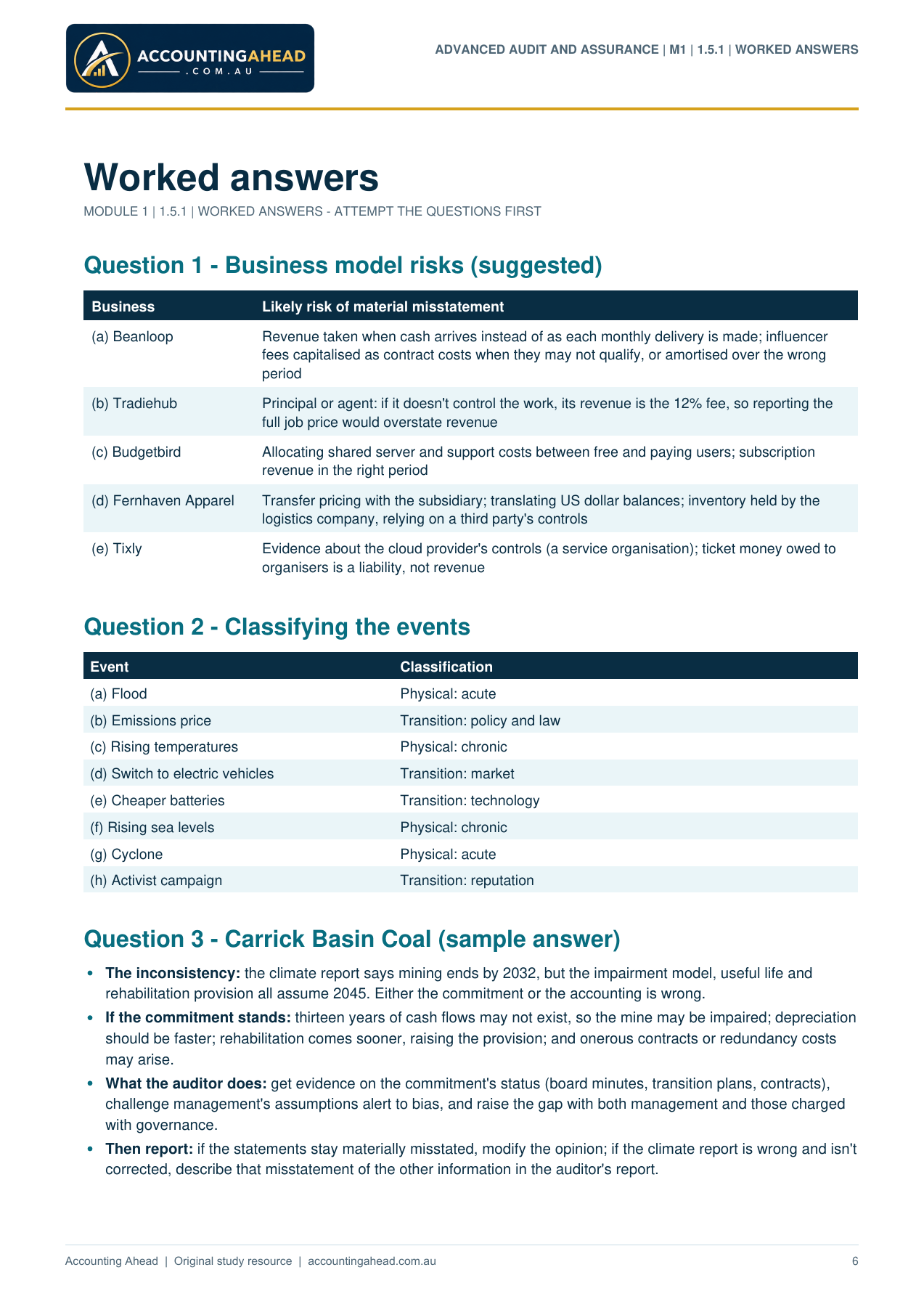
Worked answers
MODULE 1 | 1.5.1 | WORKED ANSWERS - ATTEMPT THE QUESTIONS FIRST
Question 1 - Business model risks (suggested)
Business Likely risk of material misstatement
(a) Beanloop Revenue taken when cash arrives instead of as each monthly delivery is made; influencer
fees capitalised as contract costs when they may not qualify, or amortised over the wrong
period
(b) Tradiehub Principal or agent: if it doesn't control the work, its revenue is the 12% fee, so reporting the
full job price would overstate revenue
(c) Budgetbird Allocating shared server and support costs between free and paying users; subscription
revenue in the right period
(d) Fernhaven Apparel Transfer pricing with the subsidiary; translating US dollar balances; inventory held by the
logistics company, relying on a third party's controls
(e) Tixly Evidence about the cloud provider's controls (a service organisation); ticket money owed to
organisers is a liability, not revenue
Question 2 - Classifying the events
Event Classification
(a) Flood Physical: acute
(b) Emissions price Transition: policy and law
(c) Rising temperatures Physical: chronic
(d) Switch to electric vehicles Transition: market
(e) Cheaper batteries Transition: technology
(f) Rising sea levels Physical: chronic
(g) Cyclone Physical: acute
(h) Activist campaign Transition: reputation
Question 3 - Carrick Basin Coal (sample answer)
The inconsistency: the climate report says mining ends by 2032, but the impairment model, useful life and
rehabilitation provision all assume 2045. Either the commitment or the accounting is wrong.
If the commitment stands: thirteen years of cash flows may not exist, so the mine may be impaired; depreciation
should be faster; rehabilitation comes sooner, raising the provision; and onerous contracts or redundancy costs
may arise.
What the auditor does: get evidence on the commitment's status (board minutes, transition plans, contracts),
challenge management's assumptions alert to bias, and raise the gap with both management and those charged
with governance.
Then report: if the statements stay materially misstated, modify the opinion; if the climate report is wrong and isn't
corrected, describe that misstatement of the other information in the auditor's report.
ADVANCED AUDIT AND ASSURANCE | M1 | 1.5.1 | WORKED ANSWERS
6