
Audit objectives and the audit risk model
Printable study notes, diagrams and practice support for Part 2.1.1.
Read the handout text
Accounting Ahead | Original study resource | accountingahead.com.au
Audit objectives and the audit risk model
MODULE 2 | 2.1.1 | STUDENT COMPANION
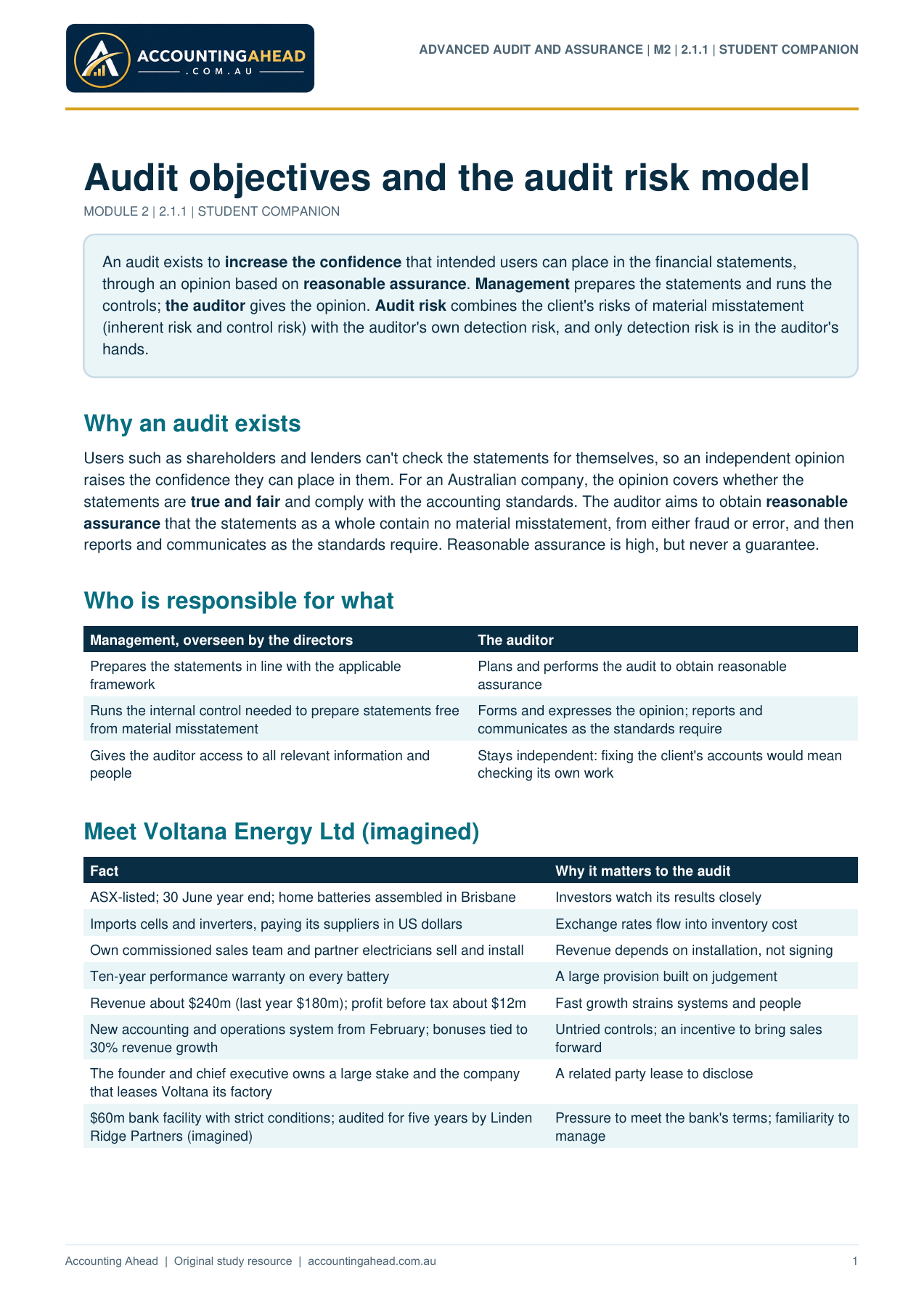
An audit exists to increase the confidence that intended users can place in the financial statements,
through an opinion based on reasonable assurance. Management prepares the statements and runs the
controls; the auditor gives the opinion. Audit risk combines the client's risks of material misstatement
(inherent risk and control risk) with the auditor's own detection risk, and only detection risk is in the auditor's
hands.
Why an audit exists
Users such as shareholders and lenders can't check the statements for themselves, so an independent opinion
raises the confidence they can place in them. For an Australian company, the opinion covers whether the
statements are true and fair and comply with the accounting standards. The auditor aims to obtain reasonable
assurance that the statements as a whole contain no material misstatement, from either fraud or error, and then
reports and communicates as the standards require. Reasonable assurance is high, but never a guarantee.
Who is responsible for what
Management, overseen by the directors The auditor
Prepares the statements in line with the applicable
framework
Plans and performs the audit to obtain reasonable
assurance
Runs the internal control needed to prepare statements free
from material misstatement
Forms and expresses the opinion; reports and
communicates as the standards require
Gives the auditor access to all relevant information and
people
Stays independent: fixing the client's accounts would mean
checking its own work
Meet Voltana Energy Ltd (imagined)
Fact Why it matters to the audit
ASX-listed; 30 June year end; home batteries assembled in Brisbane Investors watch its results closely
Imports cells and inverters, paying its suppliers in US dollars Exchange rates flow into inventory cost
Own commissioned sales team and partner electricians sell and install Revenue depends on installation, not signing
Ten-year performance warranty on every battery A large provision built on judgement
Revenue about $240m (last year $180m); profit before tax about $12m Fast growth strains systems and people
New accounting and operations system from February; bonuses tied to
30% revenue growth
Untried controls; an incentive to bring sales
forward
The founder and chief executive owns a large stake and the company
that leases Voltana its factory
A related party lease to disclose
$60m bank facility with strict conditions; audited for five years by Linden
Ridge Partners (imagined)
Pressure to meet the bank's terms; familiarity to
manage
ADVANCED AUDIT AND ASSURANCE | M2 | 2.1.1 | STUDENT COMPANION
1
Accounting Ahead | Original study resource | accountingahead.com.au
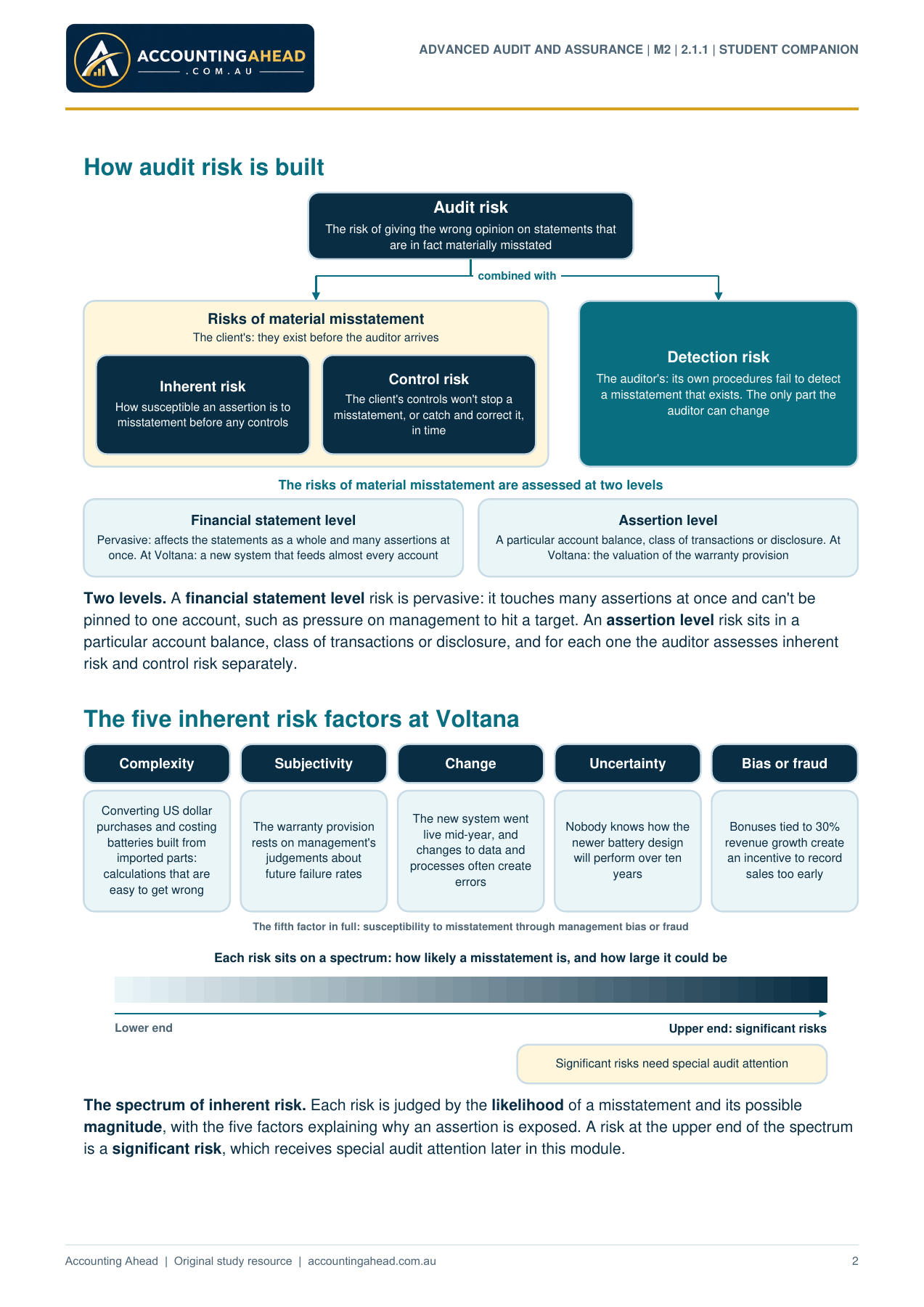
How audit risk is built
Audit risk
The risk of giving the wrong opinion on statements that
are in fact materially misstated
combined with
Risks of material misstatement
The client's: they exist before the auditor arrives
Inherent risk
How susceptible an assertion is to
misstatement before any controls
Control risk
The client's controls won't stop a
misstatement, or catch and correct it,
in time
Detection risk
The auditor's: its own procedures fail to detect
a misstatement that exists. The only part the
auditor can change
The risks of material misstatement are assessed at two levels
Financial statement level
Pervasive: affects the statements as a whole and many assertions at
once. At Voltana: a new system that feeds almost every account
Assertion level
A particular account balance, class of transactions or disclosure. At
Voltana: the valuation of the warranty provision
Two levels. A financial statement level risk is pervasive: it touches many assertions at once and can't be
pinned to one account, such as pressure on management to hit a target. An assertion level risk sits in a
particular account balance, class of transactions or disclosure, and for each one the auditor assesses inherent
risk and control risk separately.
The five inherent risk factors at Voltana
Complexity
Converting US dollar
purchases and costing
batteries built from
imported parts:
calculations that are
easy to get wrong
Subjectivity
The warranty provision
rests on management's
judgements about
future failure rates
Change
The new system went
live mid-year, and
changes to data and
processes often create
errors
Uncertainty
Nobody knows how the
newer battery design
will perform over ten
years
Bias or fraud
Bonuses tied to 30%
revenue growth create
an incentive to record
sales too early
The fifth factor in full: susceptibility to misstatement through management bias or fraud
Each risk sits on a spectrum: how likely a misstatement is, and how large it could be
Lower end Upper end: significant risks
Significant risks need special audit attention
The spectrum of inherent risk. Each risk is judged by the likelihood of a misstatement and its possible
magnitude, with the five factors explaining why an assertion is exposed. A risk at the upper end of the spectrum
is a significant risk, which receives special audit attention later in this module.
ADVANCED AUDIT AND ASSURANCE | M2 | 2.1.1 | STUDENT COMPANION
2
Accounting Ahead | Original study resource | accountingahead.com.au
Control risk
Control risk is the chance that the client's controls won't prevent a material misstatement, or won't detect and
correct it in time. At Voltana the new system raises it: its controls are untried, and any errors in the data moved
from the old system could flow straight into the accounts. The assessment rests on testing. If the auditor
doesn't plan to test whether a control operates effectively, it can't assume the control works, so the assessed risk
of material misstatement is simply the assessment of inherent risk. Both risks belong to the entity, and managing
them is management's job.
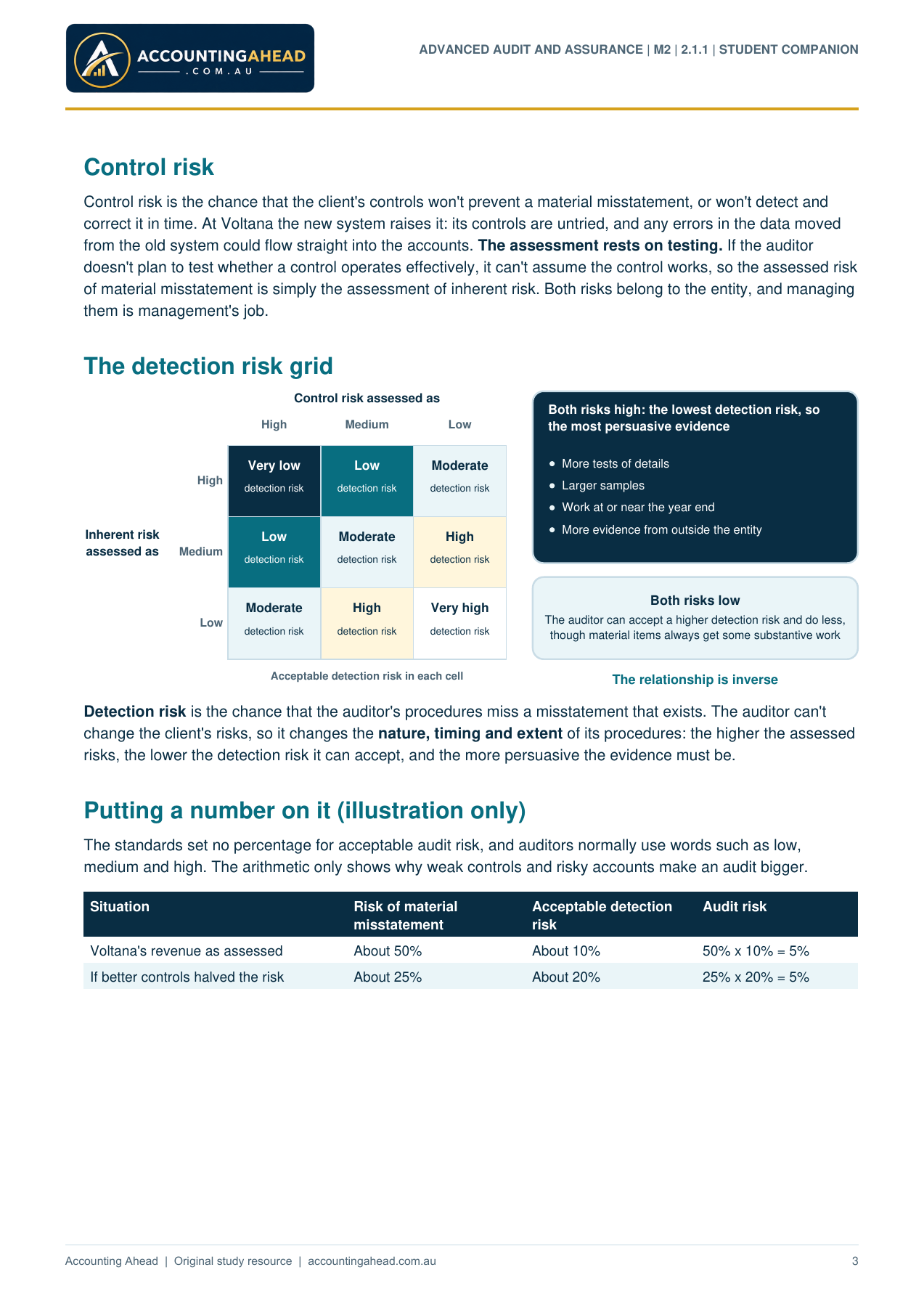
The detection risk grid
Control risk assessed as
High Medium Low
Inherent risk
assessed as
High
Very low
detection risk
Low
detection risk
Moderate
detection risk
Medium
Low
detection risk
Moderate
detection risk
High
detection risk
Low
Moderate
detection risk
High
detection risk
Very high
detection risk
Acceptable detection risk in each cell
Both risks high: the lowest detection risk, so
the most persuasive evidence
More tests of details
Larger samples
Work at or near the year end
More evidence from outside the entity
Both risks low
The auditor can accept a higher detection risk and do less,
though material items always get some substantive work
The relationship is inverse
Detection risk is the chance that the auditor's procedures miss a misstatement that exists. The auditor can't
change the client's risks, so it changes the nature, timing and extent of its procedures: the higher the assessed
risks, the lower the detection risk it can accept, and the more persuasive the evidence must be.
Putting a number on it (illustration only)
The standards set no percentage for acceptable audit risk, and auditors normally use words such as low,
medium and high. The arithmetic only shows why weak controls and risky accounts make an audit bigger.
Situation Risk of material
misstatement
Acceptable detection
risk
Audit risk
Voltana's revenue as assessed About 50% About 10% 50% x 10% = 5%
If better controls halved the risk About 25% About 20% 25% x 20% = 5%
ADVANCED AUDIT AND ASSURANCE | M2 | 2.1.1 | STUDENT COMPANION
3
Accounting Ahead | Original study resource | accountingahead.com.au
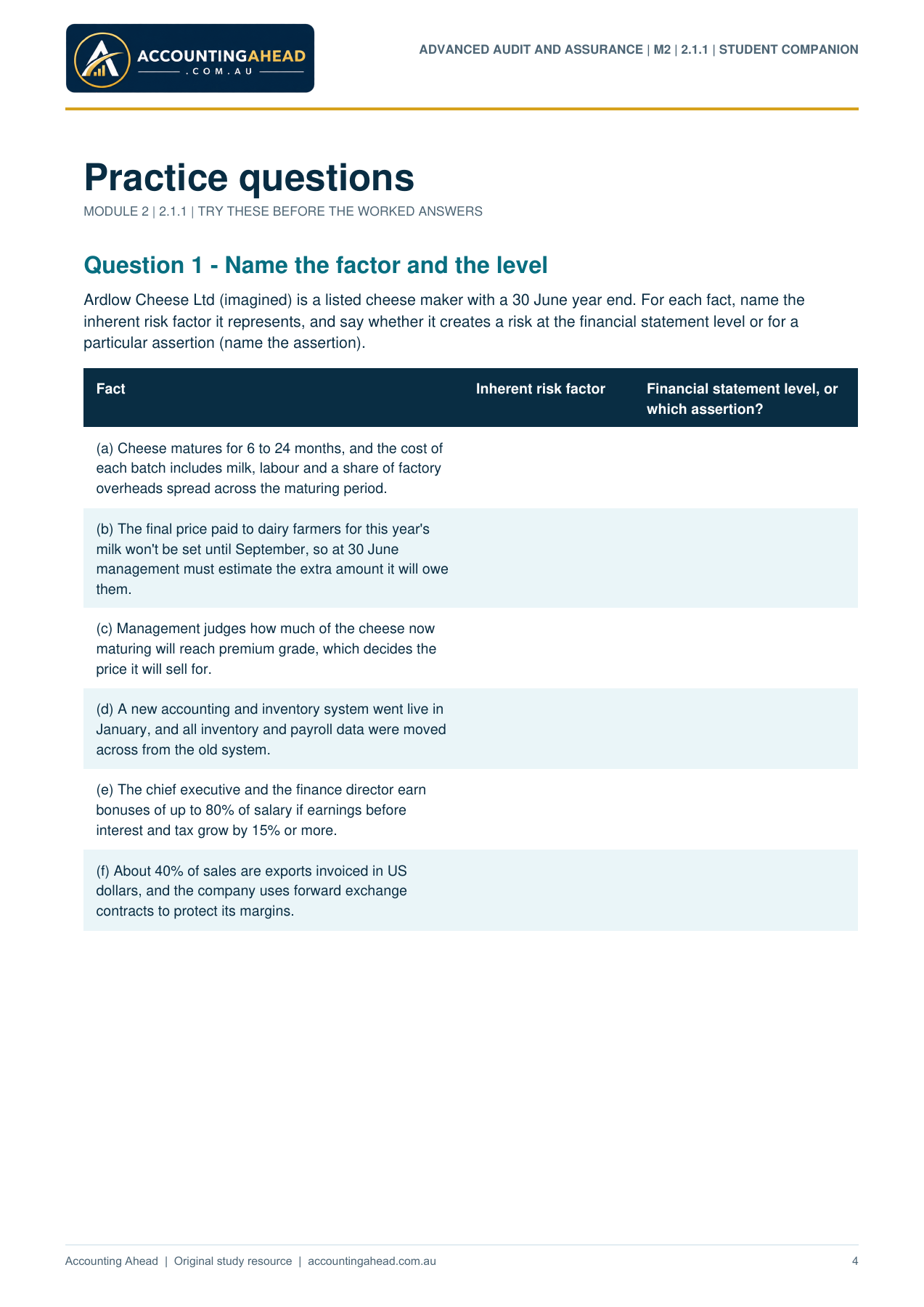
Practice questions
MODULE 2 | 2.1.1 | TRY THESE BEFORE THE WORKED ANSWERS
Question 1 - Name the factor and the level
Ardlow Cheese Ltd (imagined) is a listed cheese maker with a 30 June year end. For each fact, name the
inherent risk factor it represents, and say whether it creates a risk at the financial statement level or for a
particular assertion (name the assertion).
Fact Inherent risk factor Financial statement level, or
which assertion?
(a) Cheese matures for 6 to 24 months, and the cost of
each batch includes milk, labour and a share of factory
overheads spread across the maturing period.
(b) The final price paid to dairy farmers for this year's
milk won't be set until September, so at 30 June
management must estimate the extra amount it will owe
them.
(c) Management judges how much of the cheese now
maturing will reach premium grade, which decides the
price it will sell for.
(d) A new accounting and inventory system went live in
January, and all inventory and payroll data were moved
across from the old system.
(e) The chief executive and the finance director earn
bonuses of up to 80% of salary if earnings before
interest and tax grow by 15% or more.
(f) About 40% of sales are exports invoiced in US
dollars, and the company uses forward exchange
contracts to protect its margins.
ADVANCED AUDIT AND ASSURANCE | M2 | 2.1.1 | STUDENT COMPANION
4
Accounting Ahead | Original study resource | accountingahead.com.au
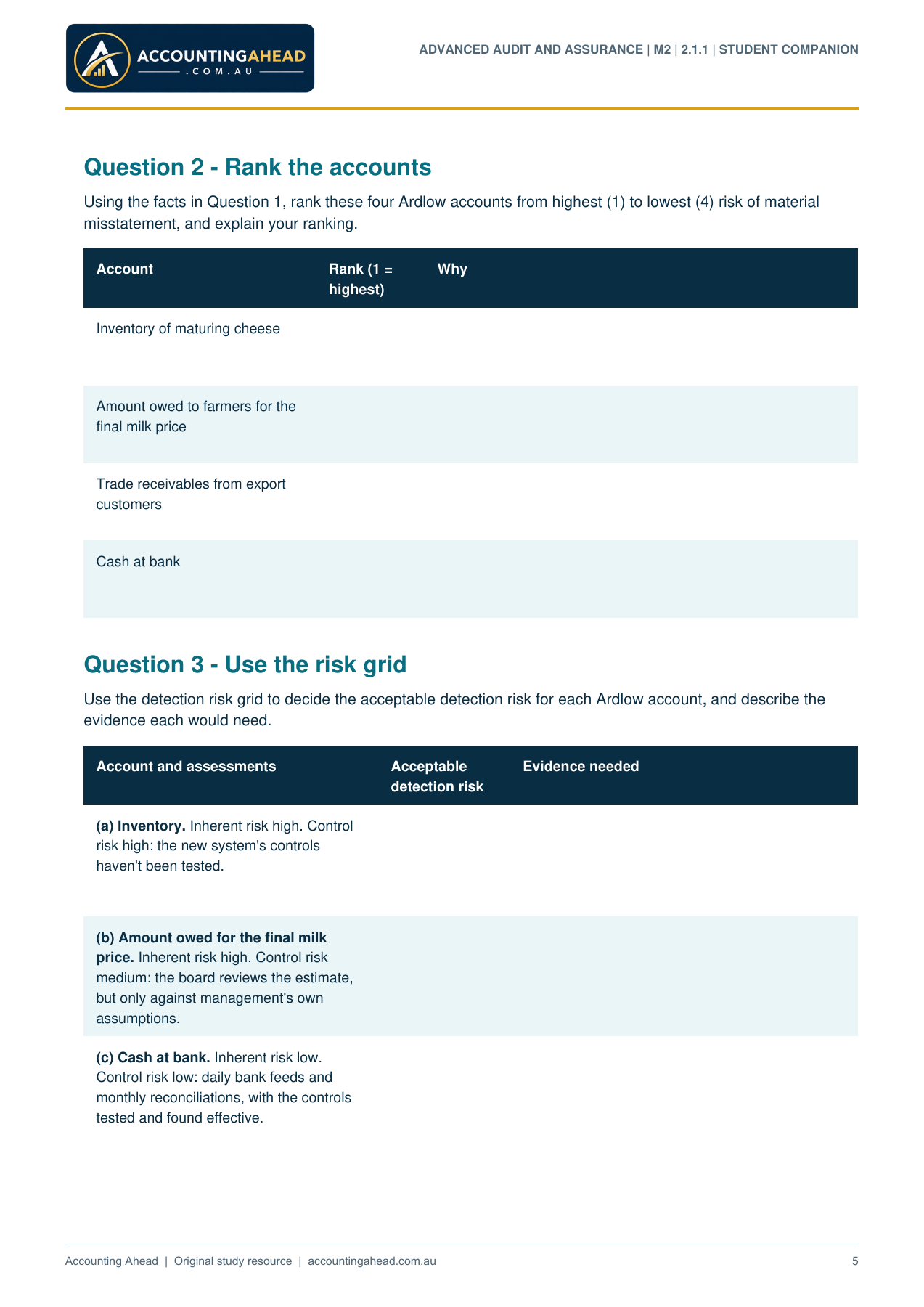
Question 2 - Rank the accounts
Using the facts in Question 1, rank these four Ardlow accounts from highest (1) to lowest (4) risk of material
misstatement, and explain your ranking.
Account Rank (1 =
highest)
Why
Inventory of maturing cheese
Amount owed to farmers for the
final milk price
Trade receivables from export
customers
Cash at bank
Question 3 - Use the risk grid
Use the detection risk grid to decide the acceptable detection risk for each Ardlow account, and describe the
evidence each would need.
Account and assessments Acceptable
detection risk
Evidence needed
(a) Inventory. Inherent risk high. Control
risk high: the new system's controls
haven't been tested.
(b) Amount owed for the final milk
price. Inherent risk high. Control risk
medium: the board reviews the estimate,
but only against management's own
assumptions.
(c) Cash at bank. Inherent risk low.
Control risk low: daily bank feeds and
monthly reconciliations, with the controls
tested and found effective.
ADVANCED AUDIT AND ASSURANCE | M2 | 2.1.1 | STUDENT COMPANION
5
Accounting Ahead | Original study resource | accountingahead.com.au
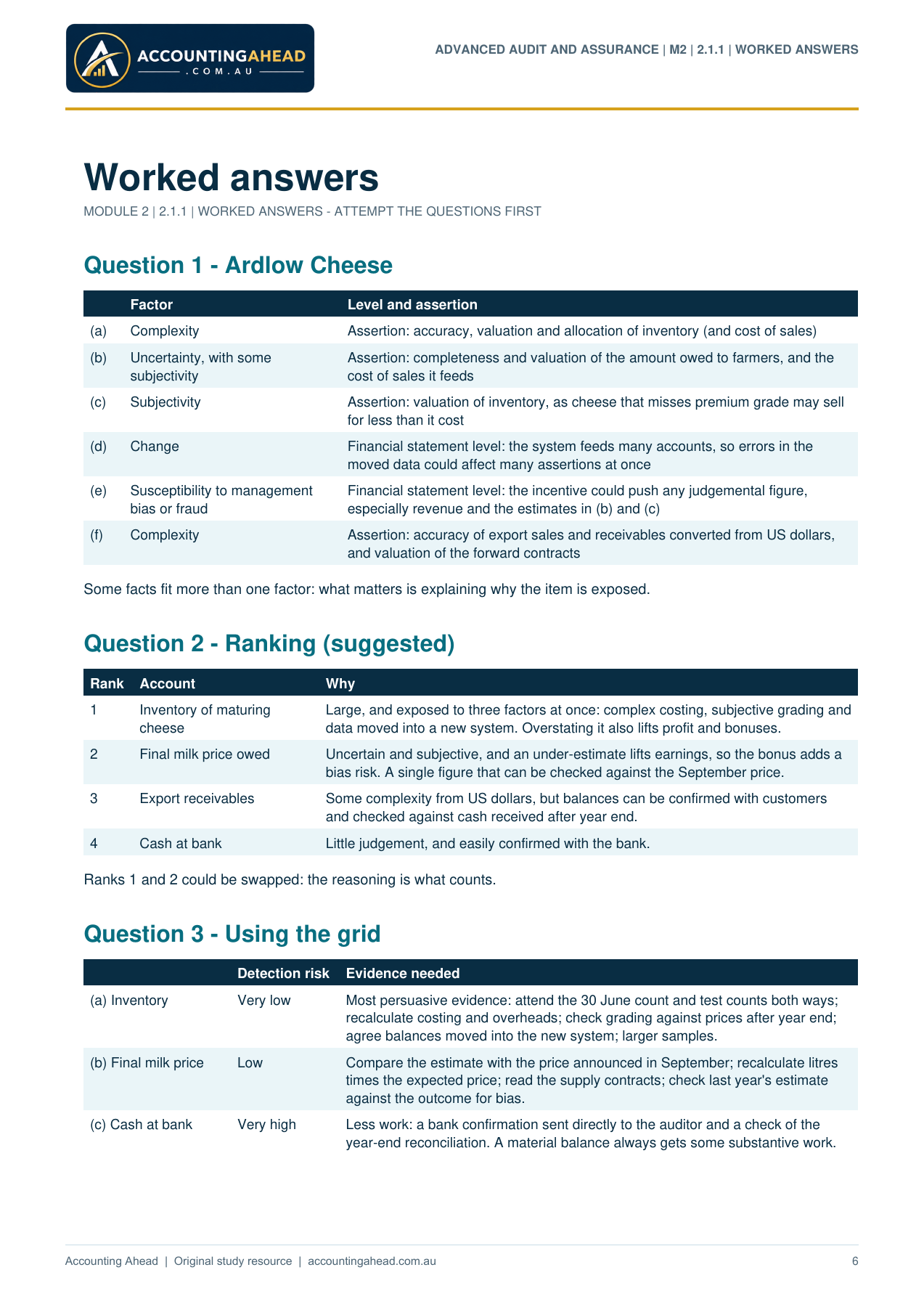
Worked answers
MODULE 2 | 2.1.1 | WORKED ANSWERS - ATTEMPT THE QUESTIONS FIRST
Question 1 - Ardlow Cheese
Factor Level and assertion
(a) Complexity Assertion: accuracy, valuation and allocation of inventory (and cost of sales)
(b) Uncertainty, with some
subjectivity
Assertion: completeness and valuation of the amount owed to farmers, and the
cost of sales it feeds
(c) Subjectivity Assertion: valuation of inventory, as cheese that misses premium grade may sell
for less than it cost
(d) Change Financial statement level: the system feeds many accounts, so errors in the
moved data could affect many assertions at once
(e) Susceptibility to management
bias or fraud
Financial statement level: the incentive could push any judgemental figure,
especially revenue and the estimates in (b) and (c)
(f) Complexity Assertion: accuracy of export sales and receivables converted from US dollars,
and valuation of the forward contracts
Some facts fit more than one factor: what matters is explaining why the item is exposed.
Question 2 - Ranking (suggested)
Rank Account Why
1 Inventory of maturing
cheese
Large, and exposed to three factors at once: complex costing, subjective grading and
data moved into a new system. Overstating it also lifts profit and bonuses.
2 Final milk price owed Uncertain and subjective, and an under-estimate lifts earnings, so the bonus adds a
bias risk. A single figure that can be checked against the September price.
3 Export receivables Some complexity from US dollars, but balances can be confirmed with customers
and checked against cash received after year end.
4 Cash at bank Little judgement, and easily confirmed with the bank.
Ranks 1 and 2 could be swapped: the reasoning is what counts.
Question 3 - Using the grid
Detection risk Evidence needed
(a) Inventory Very low Most persuasive evidence: attend the 30 June count and test counts both ways;
recalculate costing and overheads; check grading against prices after year end;
agree balances moved into the new system; larger samples.
(b) Final milk price Low Compare the estimate with the price announced in September; recalculate litres
times the expected price; read the supply contracts; check last year's estimate
against the outcome for bias.
(c) Cash at bank Very high Less work: a bank confirmation sent directly to the auditor and a check of the
year-end reconciliation. A material balance always gets some substantive work.
ADVANCED AUDIT AND ASSURANCE | M2 | 2.1.1 | WORKED ANSWERS
6