
Audit strategy, audit plan and assertions
Printable study notes, diagrams and practice support for Part 2.3.1.
Read the handout text
Accounting Ahead | Original study resource | accountingahead.com.au
Audit strategy, audit plan and assertions
MODULE 2 | 2.3.1 | STUDENT COMPANION
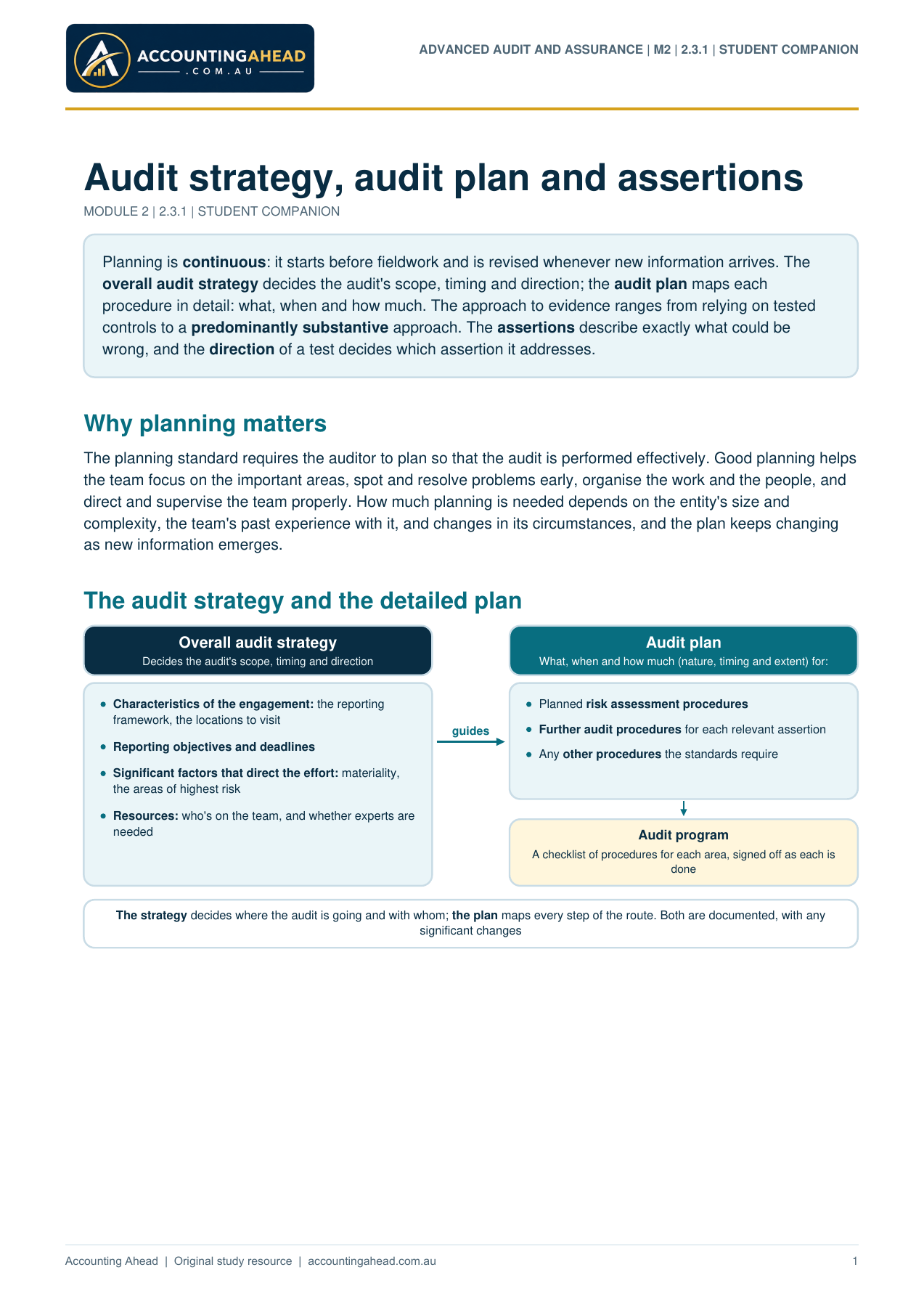
Planning is continuous: it starts before fieldwork and is revised whenever new information arrives. The
overall audit strategy decides the audit's scope, timing and direction; the audit plan maps each
procedure in detail: what, when and how much. The approach to evidence ranges from relying on tested
controls to a predominantly substantive approach. The assertions describe exactly what could be
wrong, and the direction of a test decides which assertion it addresses.
Why planning matters
The planning standard requires the auditor to plan so that the audit is performed effectively. Good planning helps
the team focus on the important areas, spot and resolve problems early, organise the work and the people, and
direct and supervise the team properly. How much planning is needed depends on the entity's size and
complexity, the team's past experience with it, and changes in its circumstances, and the plan keeps changing
as new information emerges.
The audit strategy and the detailed plan
Overall audit strategy
Decides the audit's scope, timing and direction
Characteristics of the engagement: the reporting
framework, the locations to visit
Reporting objectives and deadlines
Significant factors that direct the effort: materiality,
the areas of highest risk
Resources: who's on the team, and whether experts are
needed
Audit plan
What, when and how much (nature, timing and extent) for:
Planned risk assessment procedures
Further audit procedures for each relevant assertion
Any other procedures the standards require
guides
Audit program
A checklist of procedures for each area, signed off as each is
done
The strategy decides where the audit is going and with whom; the plan maps every step of the route. Both are documented, with any
significant changes
ADVANCED AUDIT AND ASSURANCE | M2 | 2.3.1 | STUDENT COMPANION
1
Accounting Ahead | Original study resource | accountingahead.com.au
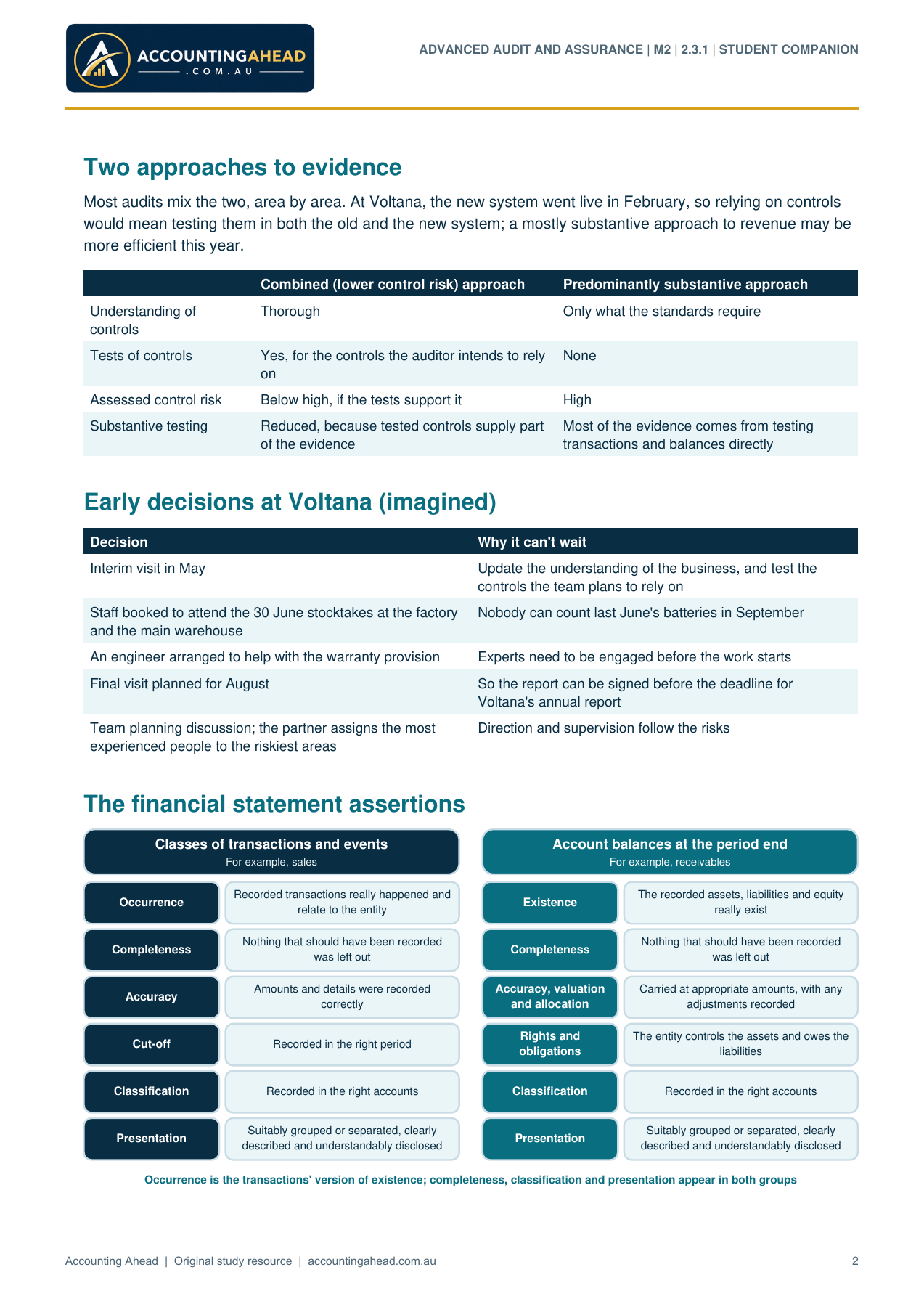
Two approaches to evidence
Most audits mix the two, area by area. At Voltana, the new system went live in February, so relying on controls
would mean testing them in both the old and the new system; a mostly substantive approach to revenue may be
more efficient this year.
Combined (lower control risk) approach Predominantly substantive approach
Understanding of
controls
Thorough Only what the standards require
Tests of controls Yes, for the controls the auditor intends to rely
on
None
Assessed control risk Below high, if the tests support it High
Substantive testing Reduced, because tested controls supply part
of the evidence
Most of the evidence comes from testing
transactions and balances directly
Early decisions at Voltana (imagined)
Decision Why it can't wait
Interim visit in May Update the understanding of the business, and test the
controls the team plans to rely on
Staff booked to attend the 30 June stocktakes at the factory
and the main warehouse
Nobody can count last June's batteries in September
An engineer arranged to help with the warranty provision Experts need to be engaged before the work starts
Final visit planned for August So the report can be signed before the deadline for
Voltana's annual report
Team planning discussion; the partner assigns the most
experienced people to the riskiest areas
Direction and supervision follow the risks
The financial statement assertions
Classes of transactions and events
For example, sales
Occurrence Recorded transactions really happened and
relate to the entity
Completeness Nothing that should have been recorded
was left out
Accuracy Amounts and details were recorded
correctly
Cut-off Recorded in the right period
Classification Recorded in the right accounts
Presentation Suitably grouped or separated, clearly
described and understandably disclosed
Account balances at the period end
For example, receivables
Existence The recorded assets, liabilities and equity
really exist
Completeness Nothing that should have been recorded
was left out
Accuracy, valuation
and allocation
Carried at appropriate amounts, with any
adjustments recorded
Rights and
obligations
The entity controls the assets and owes the
liabilities
Classification Recorded in the right accounts
Presentation Suitably grouped or separated, clearly
described and understandably disclosed
Occurrence is the transactions' version of existence; completeness, classification and presentation appear in both groups
ADVANCED AUDIT AND ASSURANCE | M2 | 2.3.1 | STUDENT COMPANION
2
Accounting Ahead | Original study resource | accountingahead.com.au
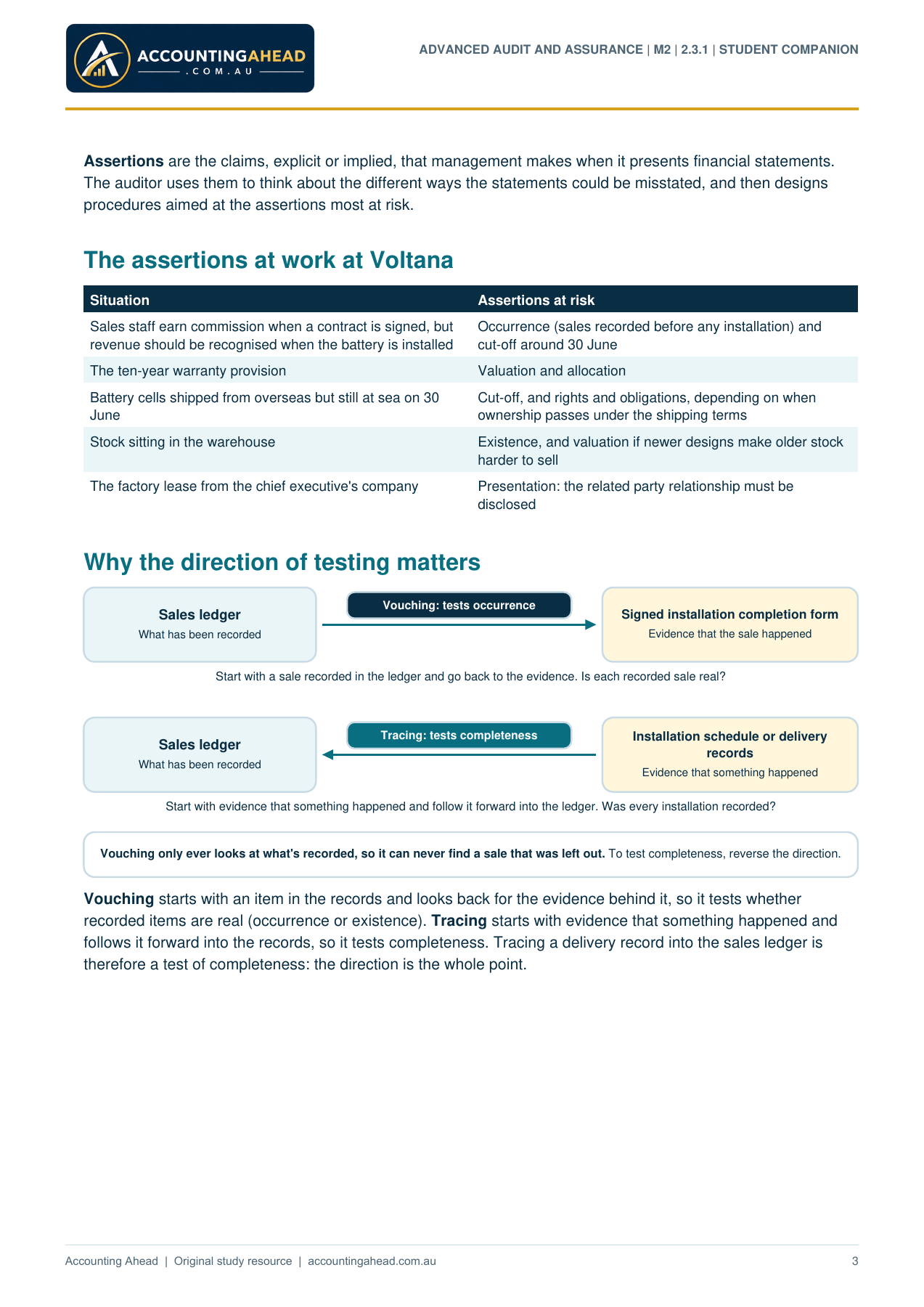
Assertions are the claims, explicit or implied, that management makes when it presents financial statements.
The auditor uses them to think about the different ways the statements could be misstated, and then designs
procedures aimed at the assertions most at risk.
The assertions at work at Voltana
Situation Assertions at risk
Sales staff earn commission when a contract is signed, but
revenue should be recognised when the battery is installed
Occurrence (sales recorded before any installation) and
cut-off around 30 June
The ten-year warranty provision Valuation and allocation
Battery cells shipped from overseas but still at sea on 30
June
Cut-off, and rights and obligations, depending on when
ownership passes under the shipping terms
Stock sitting in the warehouse Existence, and valuation if newer designs make older stock
harder to sell
The factory lease from the chief executive's company Presentation: the related party relationship must be
disclosed
Why the direction of testing matters
Sales ledger
What has been recorded
Signed installation completion form
Evidence that the sale happened
Vouching: tests occurrence
Start with a sale recorded in the ledger and go back to the evidence. Is each recorded sale real?
Sales ledger
What has been recorded
Installation schedule or delivery
records
Evidence that something happened
Tracing: tests completeness
Start with evidence that something happened and follow it forward into the ledger. Was every installation recorded?
Vouching only ever looks at what's recorded, so it can never find a sale that was left out. To test completeness, reverse the direction.
Vouching starts with an item in the records and looks back for the evidence behind it, so it tests whether
recorded items are real (occurrence or existence). Tracing starts with evidence that something happened and
follows it forward into the records, so it tests completeness. Tracing a delivery record into the sales ledger is
therefore a test of completeness: the direction is the whole point.
ADVANCED AUDIT AND ASSURANCE | M2 | 2.3.1 | STUDENT COMPANION
3
Accounting Ahead | Original study resource | accountingahead.com.au
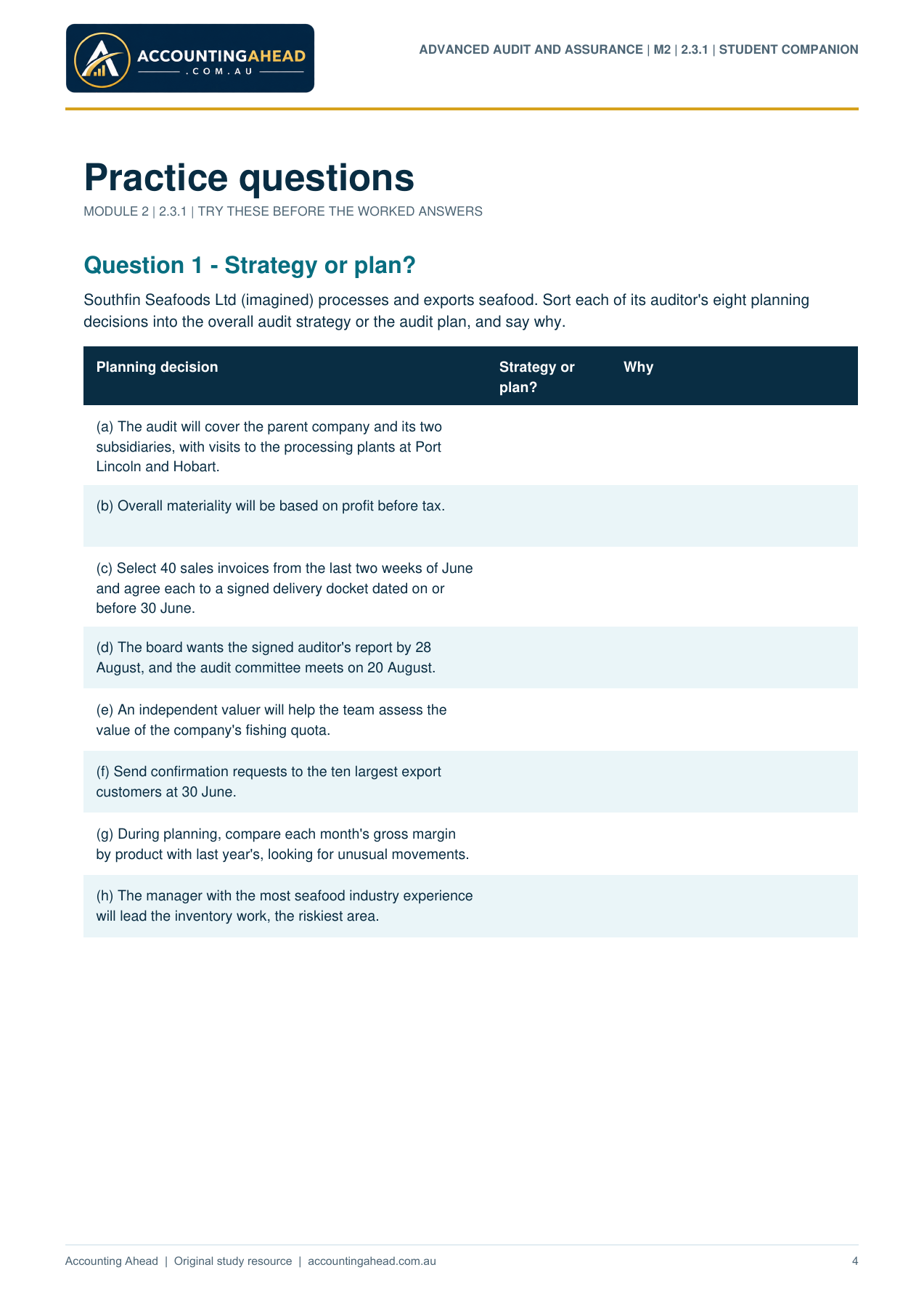
Practice questions
MODULE 2 | 2.3.1 | TRY THESE BEFORE THE WORKED ANSWERS
Question 1 - Strategy or plan?
Southfin Seafoods Ltd (imagined) processes and exports seafood. Sort each of its auditor's eight planning
decisions into the overall audit strategy or the audit plan, and say why.
Planning decision Strategy or
plan?
Why
(a) The audit will cover the parent company and its two
subsidiaries, with visits to the processing plants at Port
Lincoln and Hobart.
(b) Overall materiality will be based on profit before tax.
(c) Select 40 sales invoices from the last two weeks of June
and agree each to a signed delivery docket dated on or
before 30 June.
(d) The board wants the signed auditor's report by 28
August, and the audit committee meets on 20 August.
(e) An independent valuer will help the team assess the
value of the company's fishing quota.
(f) Send confirmation requests to the ten largest export
customers at 30 June.
(g) During planning, compare each month's gross margin
by product with last year's, looking for unusual movements.
(h) The manager with the most seafood industry experience
will lead the inventory work, the riskiest area.
ADVANCED AUDIT AND ASSURANCE | M2 | 2.3.1 | STUDENT COMPANION
4
Accounting Ahead | Original study resource | accountingahead.com.au
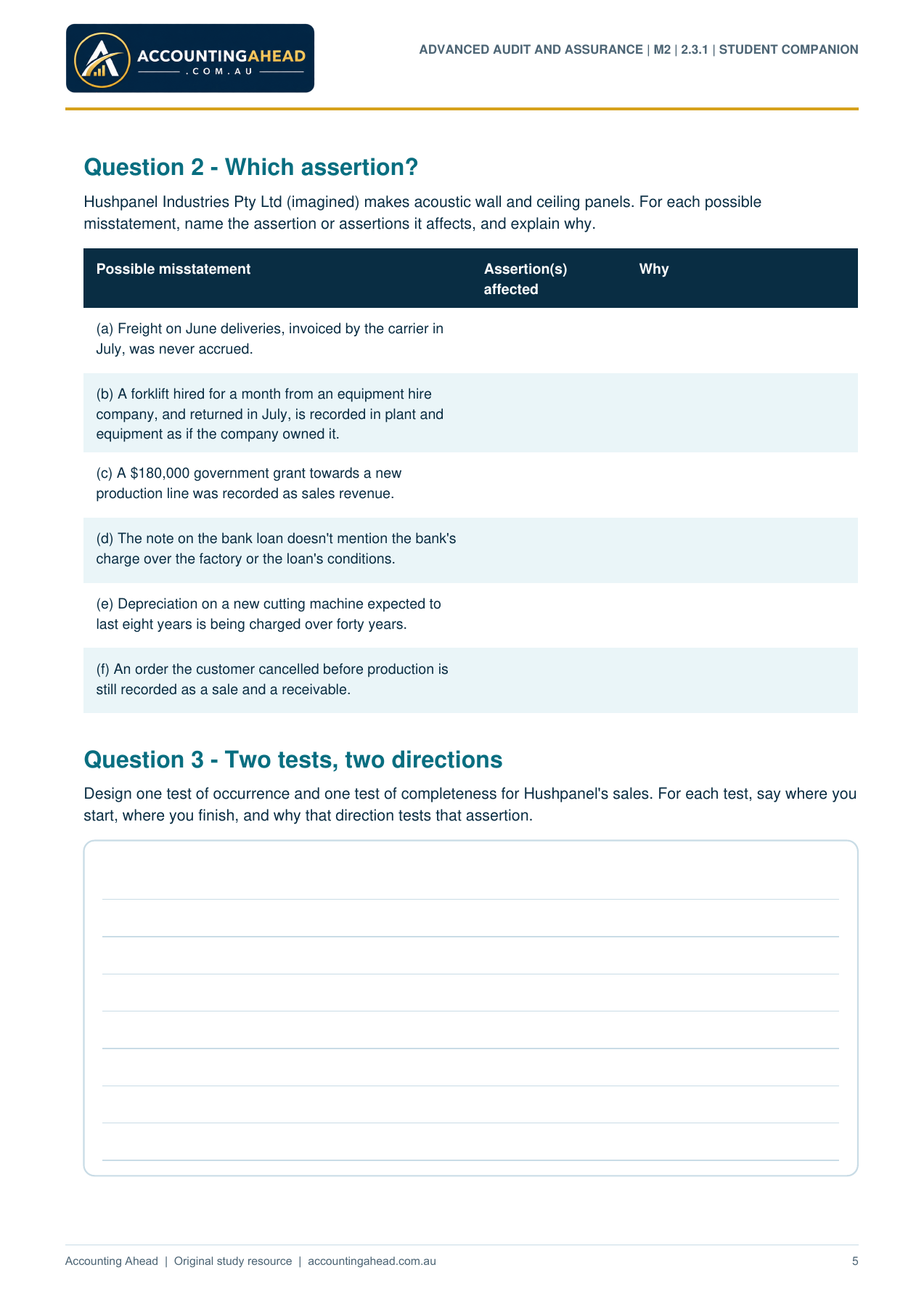
Question 2 - Which assertion?
Hushpanel Industries Pty Ltd (imagined) makes acoustic wall and ceiling panels. For each possible
misstatement, name the assertion or assertions it affects, and explain why.
Possible misstatement Assertion(s)
affected
Why
(a) Freight on June deliveries, invoiced by the carrier in
July, was never accrued.
(b) A forklift hired for a month from an equipment hire
company, and returned in July, is recorded in plant and
equipment as if the company owned it.
(c) A $180,000 government grant towards a new
production line was recorded as sales revenue.
(d) The note on the bank loan doesn't mention the bank's
charge over the factory or the loan's conditions.
(e) Depreciation on a new cutting machine expected to
last eight years is being charged over forty years.
(f) An order the customer cancelled before production is
still recorded as a sale and a receivable.
Question 3 - Two tests, two directions
Design one test of occurrence and one test of completeness for Hushpanel's sales. For each test, say where you
start, where you finish, and why that direction tests that assertion.
ADVANCED AUDIT AND ASSURANCE | M2 | 2.3.1 | STUDENT COMPANION
5
Accounting Ahead | Original study resource | accountingahead.com.au
Worked answers
MODULE 2 | 2.3.1 | WORKED ANSWERS - ATTEMPT THE QUESTIONS FIRST
Question 1 - Southfin Seafoods
Answer Why
(a) Strategy Scope: the entities and locations the audit covers
(b) Strategy Materiality is a significant factor that directs the team's effort
(c) Plan A further audit procedure, with its nature (inspection), timing (year end) and extent (40 items)
(d) Strategy Reporting objectives and deadlines set the timing of the audit
(e) Strategy Resources, including whether experts are needed
(f) Plan A further audit procedure (confirmation) aimed at the existence of receivables
(g) Plan A planned risk assessment procedure (an analytical procedure)
(h) Strategy Direction and resources: matching experience to the riskiest area
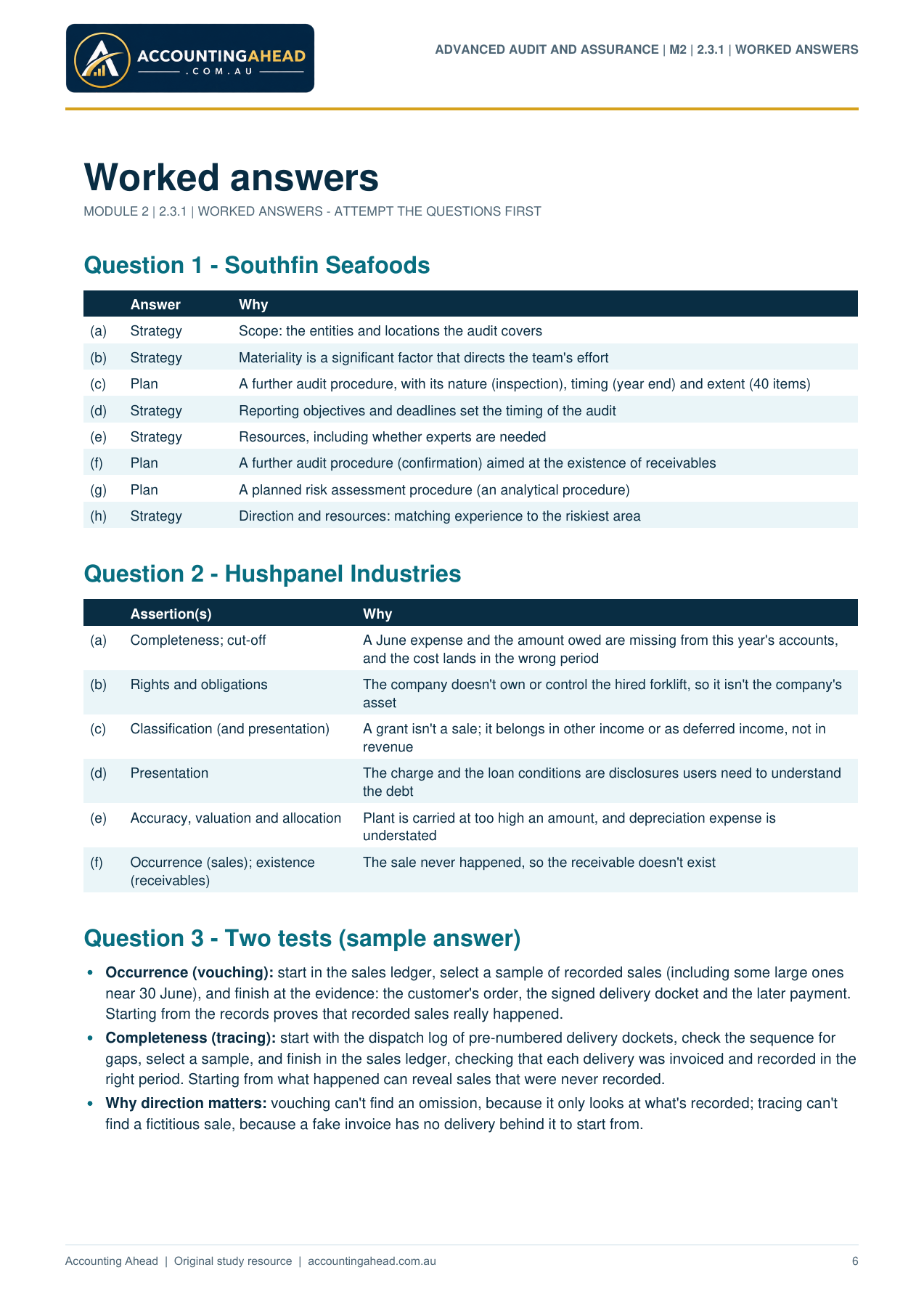
Question 2 - Hushpanel Industries
Assertion(s) Why
(a) Completeness; cut-off A June expense and the amount owed are missing from this year's accounts,
and the cost lands in the wrong period
(b) Rights and obligations The company doesn't own or control the hired forklift, so it isn't the company's
asset
(c) Classification (and presentation) A grant isn't a sale; it belongs in other income or as deferred income, not in
revenue
(d) Presentation The charge and the loan conditions are disclosures users need to understand
the debt
(e) Accuracy, valuation and allocation Plant is carried at too high an amount, and depreciation expense is
understated
(f) Occurrence (sales); existence
(receivables)
The sale never happened, so the receivable doesn't exist
Question 3 - Two tests (sample answer)
Occurrence (vouching): start in the sales ledger, select a sample of recorded sales (including some large ones
near 30 June), and finish at the evidence: the customer's order, the signed delivery docket and the later payment.
Starting from the records proves that recorded sales really happened.
Completeness (tracing): start with the dispatch log of pre-numbered delivery dockets, check the sequence for
gaps, select a sample, and finish in the sales ledger, checking that each delivery was invoiced and recorded in the
right period. Starting from what happened can reveal sales that were never recorded.
Why direction matters: vouching can't find an omission, because it only looks at what's recorded; tracing can't
find a fictitious sale, because a fake invoice has no delivery behind it to start from.
ADVANCED AUDIT AND ASSURANCE | M2 | 2.3.1 | WORKED ANSWERS
6