
Understanding the entity and its environment
Printable study notes, diagrams and practice support for Part 2.4.
Read the handout text
Accounting Ahead | Original study resource | accountingahead.com.au
Understanding the entity and its
environment
MODULE 2 | 2.4 | STUDENT COMPANION
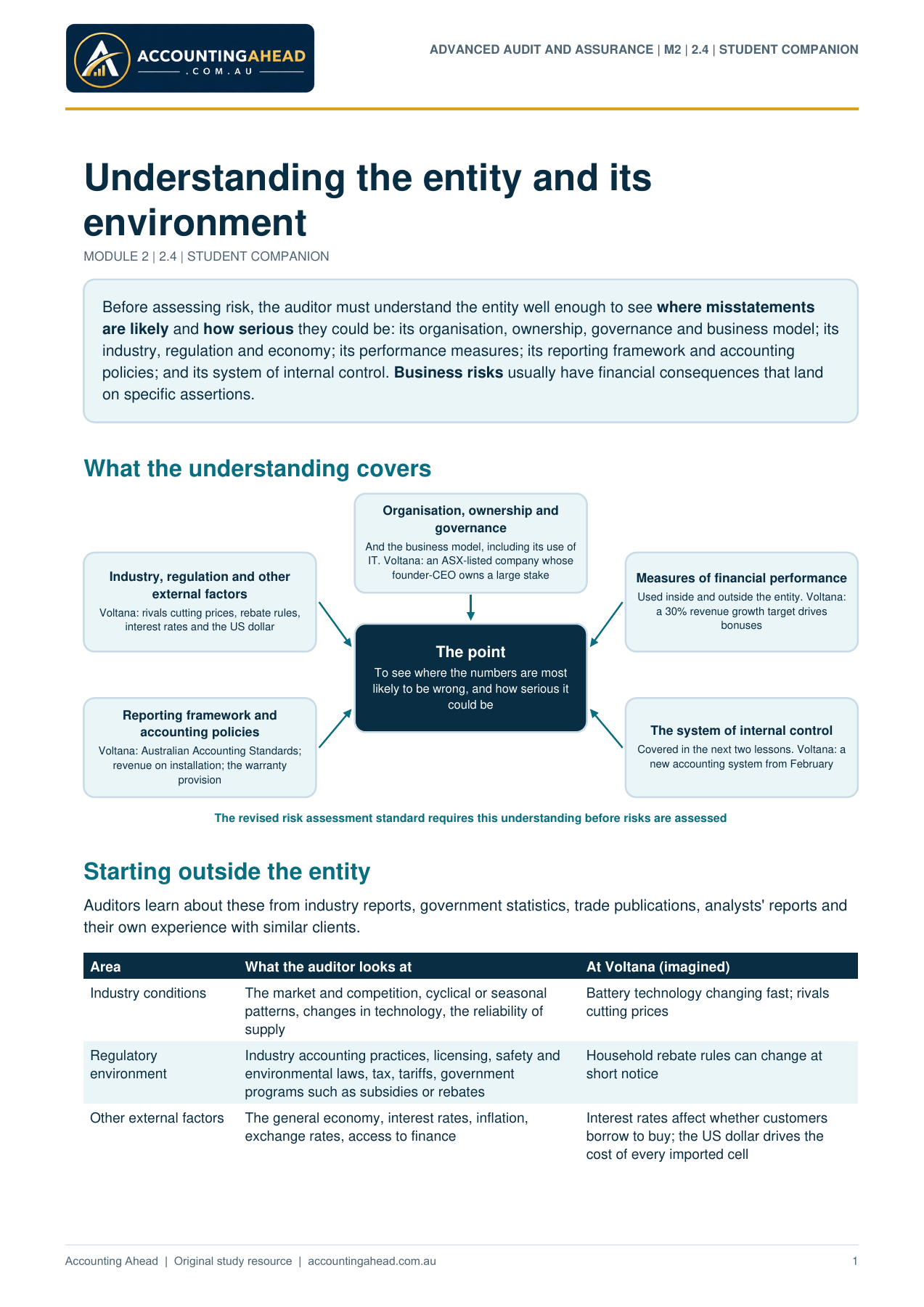
Before assessing risk, the auditor must understand the entity well enough to see where misstatements
are likely and how serious they could be: its organisation, ownership, governance and business model; its
industry, regulation and economy; its performance measures; its reporting framework and accounting
policies; and its system of internal control. Business risks usually have financial consequences that land
on specific assertions.
What the understanding covers
The point
To see where the numbers are most
likely to be wrong, and how serious it
could be
Organisation, ownership and
governance
And the business model, including its use of
IT. Voltana: an ASX-listed company whose
founder-CEO owns a large stakeIndustry, regulation and other
external factors
Voltana: rivals cutting prices, rebate rules,
interest rates and the US dollar
Measures of financial performance
Used inside and outside the entity. Voltana:
a 30% revenue growth target drives
bonuses
Reporting framework and
accounting policies
Voltana: Australian Accounting Standards;
revenue on installation; the warranty
provision
The system of internal control
Covered in the next two lessons. Voltana: a
new accounting system from February
The revised risk assessment standard requires this understanding before risks are assessed
Starting outside the entity
Auditors learn about these from industry reports, government statistics, trade publications, analysts' reports and
their own experience with similar clients.
Area What the auditor looks at At Voltana (imagined)
Industry conditions The market and competition, cyclical or seasonal
patterns, changes in technology, the reliability of
supply
Battery technology changing fast; rivals
cutting prices
Regulatory
environment
Industry accounting practices, licensing, safety and
environmental laws, tax, tariffs, government
programs such as subsidies or rebates
Household rebate rules can change at
short notice
Other external factors The general economy, interest rates, inflation,
exchange rates, access to finance
Interest rates affect whether customers
borrow to buy; the US dollar drives the
cost of every imported cell
ADVANCED AUDIT AND ASSURANCE | M2 | 2.4 | STUDENT COMPANION
1
Accounting Ahead | Original study resource | accountingahead.com.au
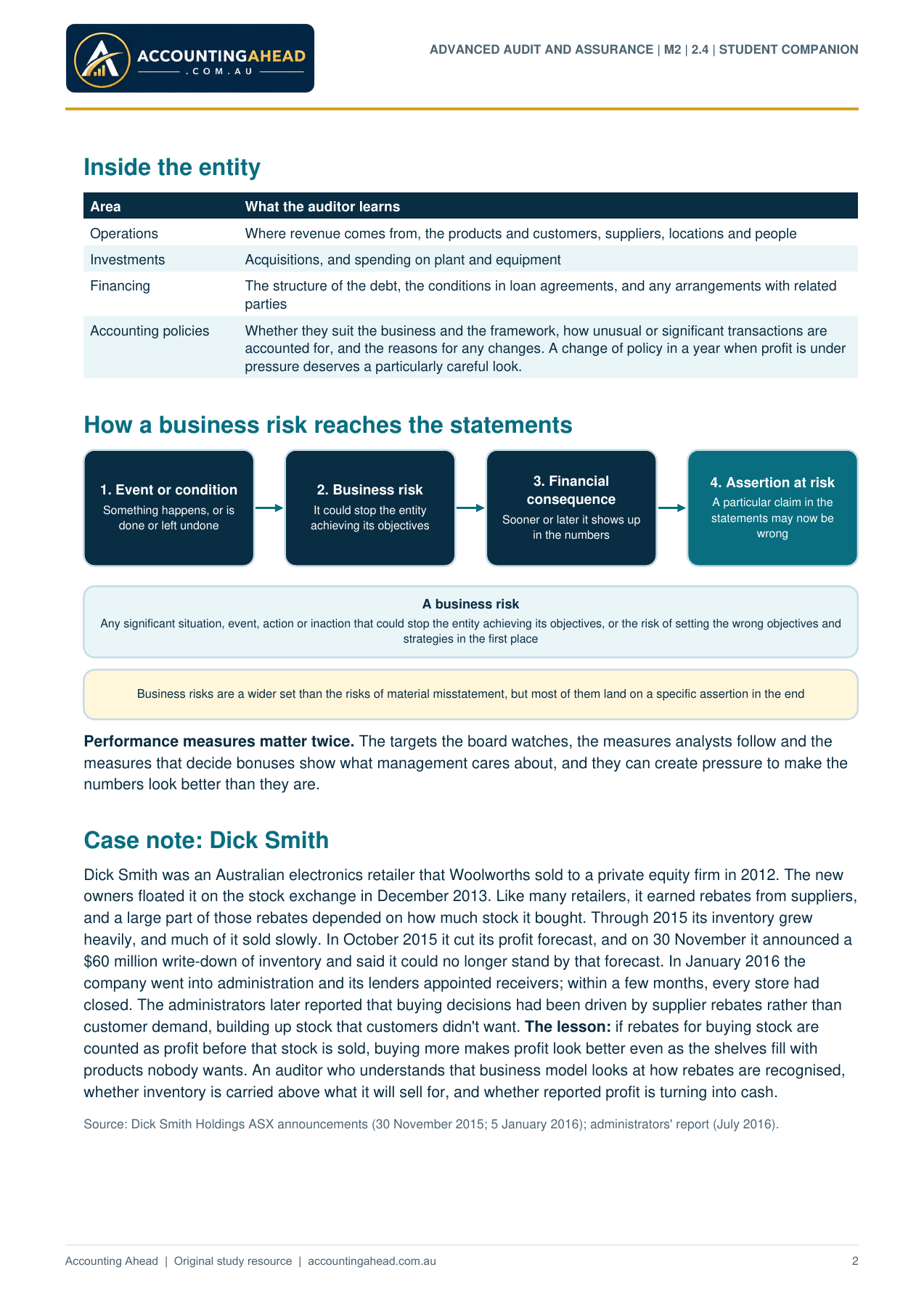
Inside the entity
Area What the auditor learns
Operations Where revenue comes from, the products and customers, suppliers, locations and people
Investments Acquisitions, and spending on plant and equipment
Financing The structure of the debt, the conditions in loan agreements, and any arrangements with related
parties
Accounting policies Whether they suit the business and the framework, how unusual or significant transactions are
accounted for, and the reasons for any changes. A change of policy in a year when profit is under
pressure deserves a particularly careful look.
How a business risk reaches the statements
1. Event or condition
Something happens, or is
done or left undone
2. Business risk
It could stop the entity
achieving its objectives
3. Financial
consequence
Sooner or later it shows up
in the numbers
4. Assertion at risk
A particular claim in the
statements may now be
wrong
A business risk
Any significant situation, event, action or inaction that could stop the entity achieving its objectives, or the risk of setting the wrong objectives and
strategies in the first place
Business risks are a wider set than the risks of material misstatement, but most of them land on a specific assertion in the end
Performance measures matter twice. The targets the board watches, the measures analysts follow and the
measures that decide bonuses show what management cares about, and they can create pressure to make the
numbers look better than they are.
Case note: Dick Smith
Dick Smith was an Australian electronics retailer that Woolworths sold to a private equity firm in 2012. The new
owners floated it on the stock exchange in December 2013. Like many retailers, it earned rebates from suppliers,
and a large part of those rebates depended on how much stock it bought. Through 2015 its inventory grew
heavily, and much of it sold slowly. In October 2015 it cut its profit forecast, and on 30 November it announced a
$60 million write-down of inventory and said it could no longer stand by that forecast. In January 2016 the
company went into administration and its lenders appointed receivers; within a few months, every store had
closed. The administrators later reported that buying decisions had been driven by supplier rebates rather than
customer demand, building up stock that customers didn't want. The lesson: if rebates for buying stock are
counted as profit before that stock is sold, buying more makes profit look better even as the shelves fill with
products nobody wants. An auditor who understands that business model looks at how rebates are recognised,
whether inventory is carried above what it will sell for, and whether reported profit is turning into cash.
Source: Dick Smith Holdings ASX announcements (30 November 2015; 5 January 2016); administrators' report (July 2016).
ADVANCED AUDIT AND ASSURANCE | M2 | 2.4 | STUDENT COMPANION
2
Accounting Ahead | Original study resource | accountingahead.com.au
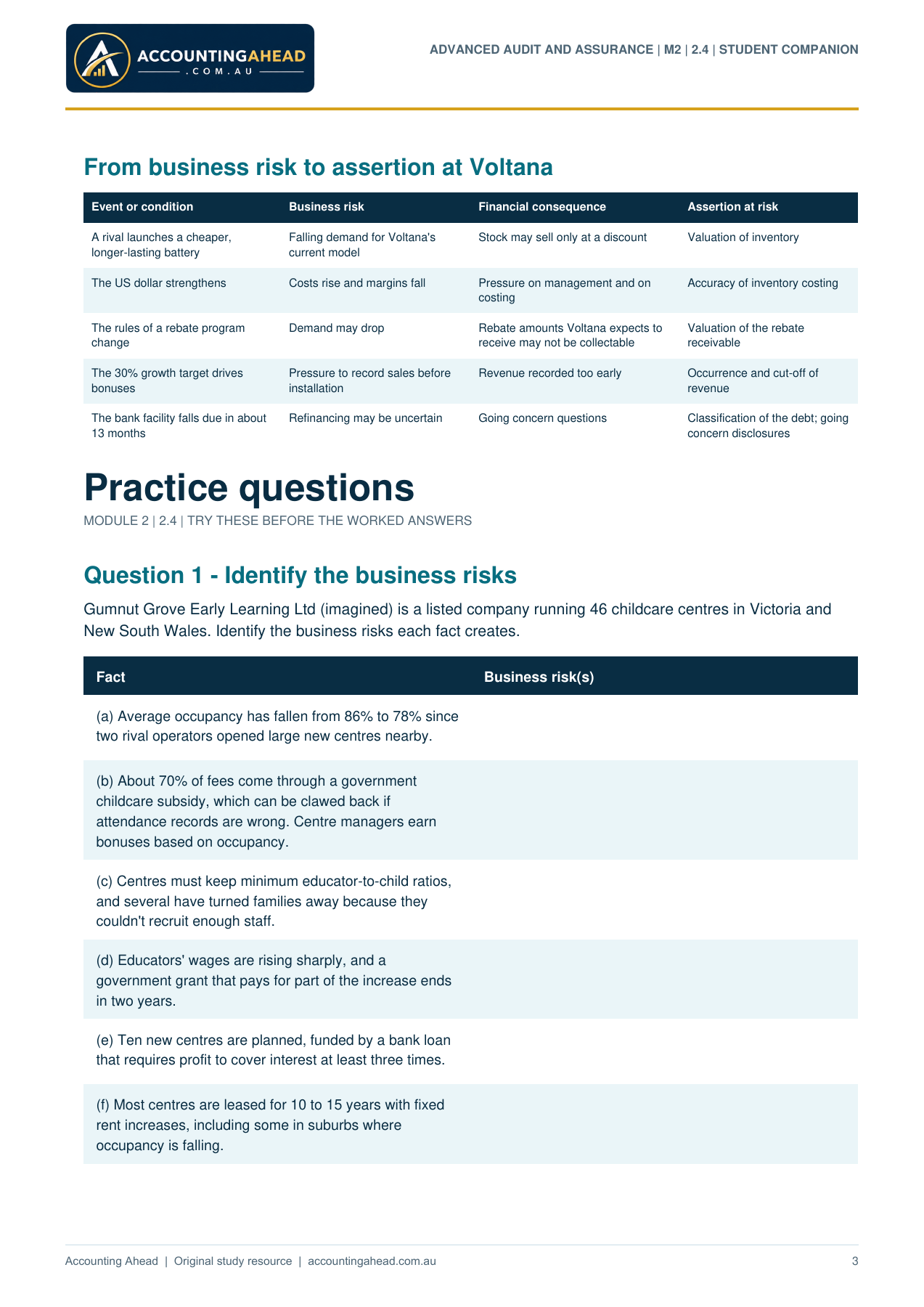
From business risk to assertion at Voltana
Event or condition Business risk Financial consequence Assertion at risk
A rival launches a cheaper,
longer-lasting battery
Falling demand for Voltana's
current model
Stock may sell only at a discount Valuation of inventory
The US dollar strengthens Costs rise and margins fall Pressure on management and on
costing
Accuracy of inventory costing
The rules of a rebate program
change
Demand may drop Rebate amounts Voltana expects to
receive may not be collectable
Valuation of the rebate
receivable
The 30% growth target drives
bonuses
Pressure to record sales before
installation
Revenue recorded too early Occurrence and cut-off of
revenue
The bank facility falls due in about
13 months
Refinancing may be uncertain Going concern questions Classification of the debt; going
concern disclosures
Practice questions
MODULE 2 | 2.4 | TRY THESE BEFORE THE WORKED ANSWERS
Question 1 - Identify the business risks
Gumnut Grove Early Learning Ltd (imagined) is a listed company running 46 childcare centres in Victoria and
New South Wales. Identify the business risks each fact creates.
Fact Business risk(s)
(a) Average occupancy has fallen from 86% to 78% since
two rival operators opened large new centres nearby.
(b) About 70% of fees come through a government
childcare subsidy, which can be clawed back if
attendance records are wrong. Centre managers earn
bonuses based on occupancy.
(c) Centres must keep minimum educator-to-child ratios,
and several have turned families away because they
couldn't recruit enough staff.
(d) Educators' wages are rising sharply, and a
government grant that pays for part of the increase ends
in two years.
(e) Ten new centres are planned, funded by a bank loan
that requires profit to cover interest at least three times.
(f) Most centres are leased for 10 to 15 years with fixed
rent increases, including some in suburbs where
occupancy is falling.
ADVANCED AUDIT AND ASSURANCE | M2 | 2.4 | STUDENT COMPANION
3
Accounting Ahead | Original study resource | accountingahead.com.au
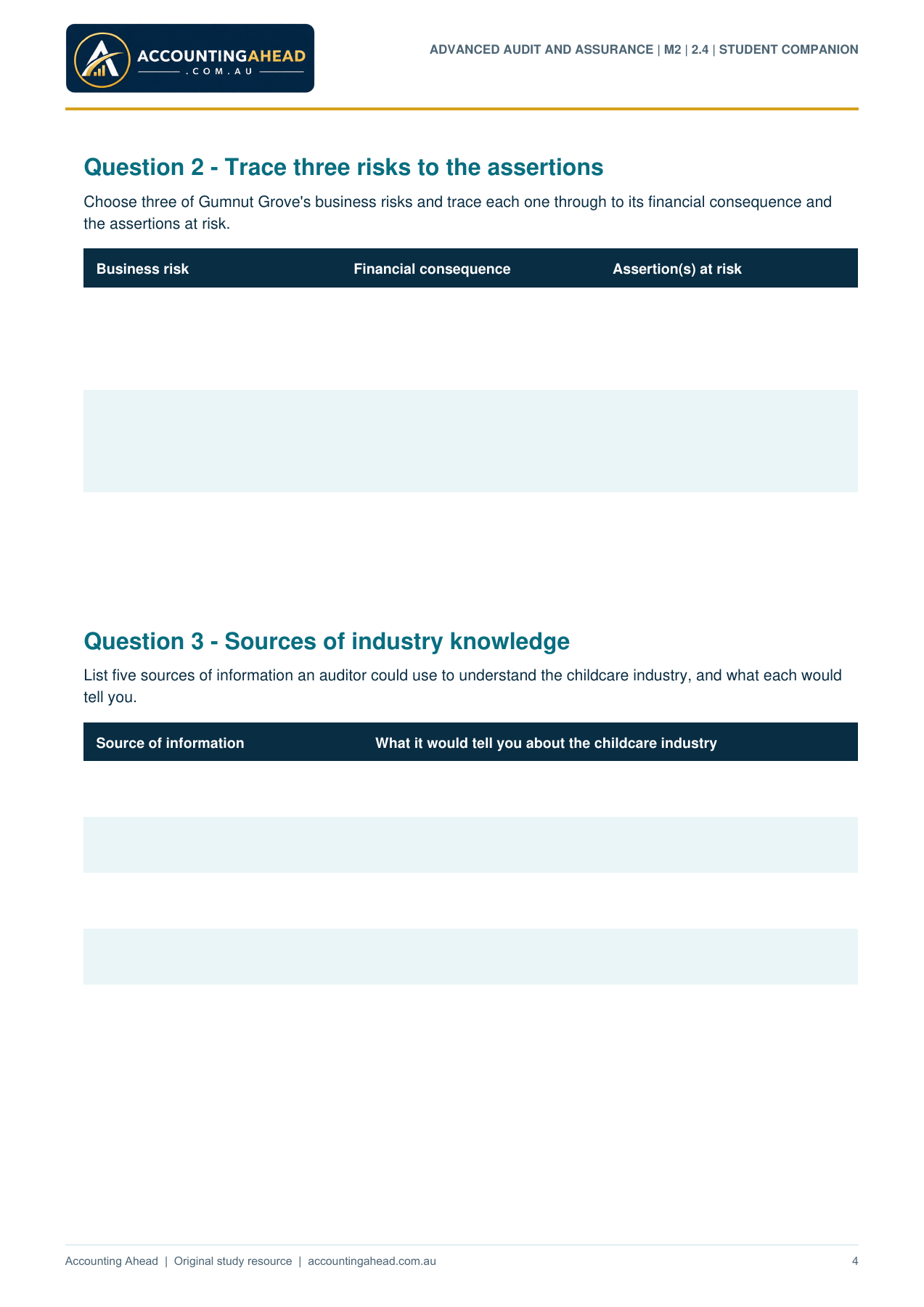
Question 2 - Trace three risks to the assertions
Choose three of Gumnut Grove's business risks and trace each one through to its financial consequence and
the assertions at risk.
Business risk Financial consequence Assertion(s) at risk
Question 3 - Sources of industry knowledge
List five sources of information an auditor could use to understand the childcare industry, and what each would
tell you.
Source of information What it would tell you about the childcare industry
ADVANCED AUDIT AND ASSURANCE | M2 | 2.4 | STUDENT COMPANION
4
Accounting Ahead | Original study resource | accountingahead.com.au
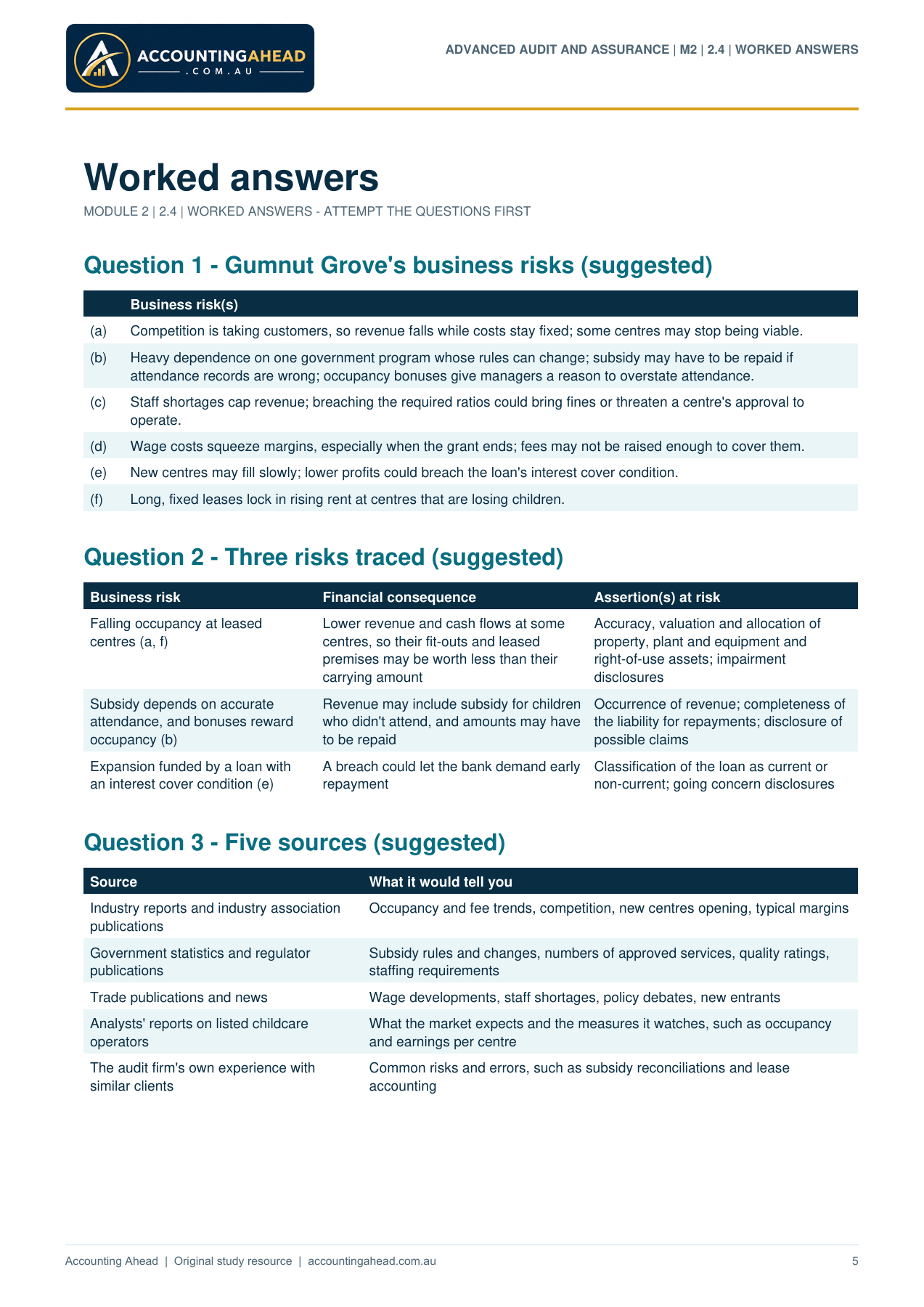
Worked answers
MODULE 2 | 2.4 | WORKED ANSWERS - ATTEMPT THE QUESTIONS FIRST
Question 1 - Gumnut Grove's business risks (suggested)
Business risk(s)
(a) Competition is taking customers, so revenue falls while costs stay fixed; some centres may stop being viable.
(b) Heavy dependence on one government program whose rules can change; subsidy may have to be repaid if
attendance records are wrong; occupancy bonuses give managers a reason to overstate attendance.
(c) Staff shortages cap revenue; breaching the required ratios could bring fines or threaten a centre's approval to
operate.
(d) Wage costs squeeze margins, especially when the grant ends; fees may not be raised enough to cover them.
(e) New centres may fill slowly; lower profits could breach the loan's interest cover condition.
(f) Long, fixed leases lock in rising rent at centres that are losing children.
Question 2 - Three risks traced (suggested)
Business risk Financial consequence Assertion(s) at risk
Falling occupancy at leased
centres (a, f)
Lower revenue and cash flows at some
centres, so their fit-outs and leased
premises may be worth less than their
carrying amount
Accuracy, valuation and allocation of
property, plant and equipment and
right-of-use assets; impairment
disclosures
Subsidy depends on accurate
attendance, and bonuses reward
occupancy (b)
Revenue may include subsidy for children
who didn't attend, and amounts may have
to be repaid
Occurrence of revenue; completeness of
the liability for repayments; disclosure of
possible claims
Expansion funded by a loan with
an interest cover condition (e)
A breach could let the bank demand early
repayment
Classification of the loan as current or
non-current; going concern disclosures
Question 3 - Five sources (suggested)
Source What it would tell you
Industry reports and industry association
publications
Occupancy and fee trends, competition, new centres opening, typical margins
Government statistics and regulator
publications
Subsidy rules and changes, numbers of approved services, quality ratings,
staffing requirements
Trade publications and news Wage developments, staff shortages, policy debates, new entrants
Analysts' reports on listed childcare
operators
What the market expects and the measures it watches, such as occupancy
and earnings per centre
The audit firm's own experience with
similar clients
Common risks and errors, such as subsidy reconciliations and lease
accounting
ADVANCED AUDIT AND ASSURANCE | M2 | 2.4 | WORKED ANSWERS
5