
The five components of internal control
Printable study notes, diagrams and practice support for Part 2.5.1.
Read the handout text
Accounting Ahead | Original study resource | accountingahead.com.au
The five components of internal control
MODULE 2 | 2.5.1 | STUDENT COMPANION
Internal control has five components: the control environment, the way the entity assesses risk, its
process for monitoring the system, the information system and communication, and the control activities.
The auditor must understand each one and evaluate the design of the controls that matter most. Every
system has limitations, above all collusion and management override, and a small business relies on its
owner, who is both its best control and its biggest risk.
What internal control is
Internal control is the process that the board, management and other staff design and run so the entity can be
reasonably confident of meeting its goals for reliable financial reporting, effective and efficient operations,
and compliance with laws and regulations. The auditor must understand each of the five components,
evaluate the design of the controls that matter most to the audit, such as controls over significant risks and over
journal entries, and check that they have actually been put in place. Understanding isn't testing:
understanding asks whether a control is well designed and exists; testing (Module 3) asks whether it worked
throughout the period.
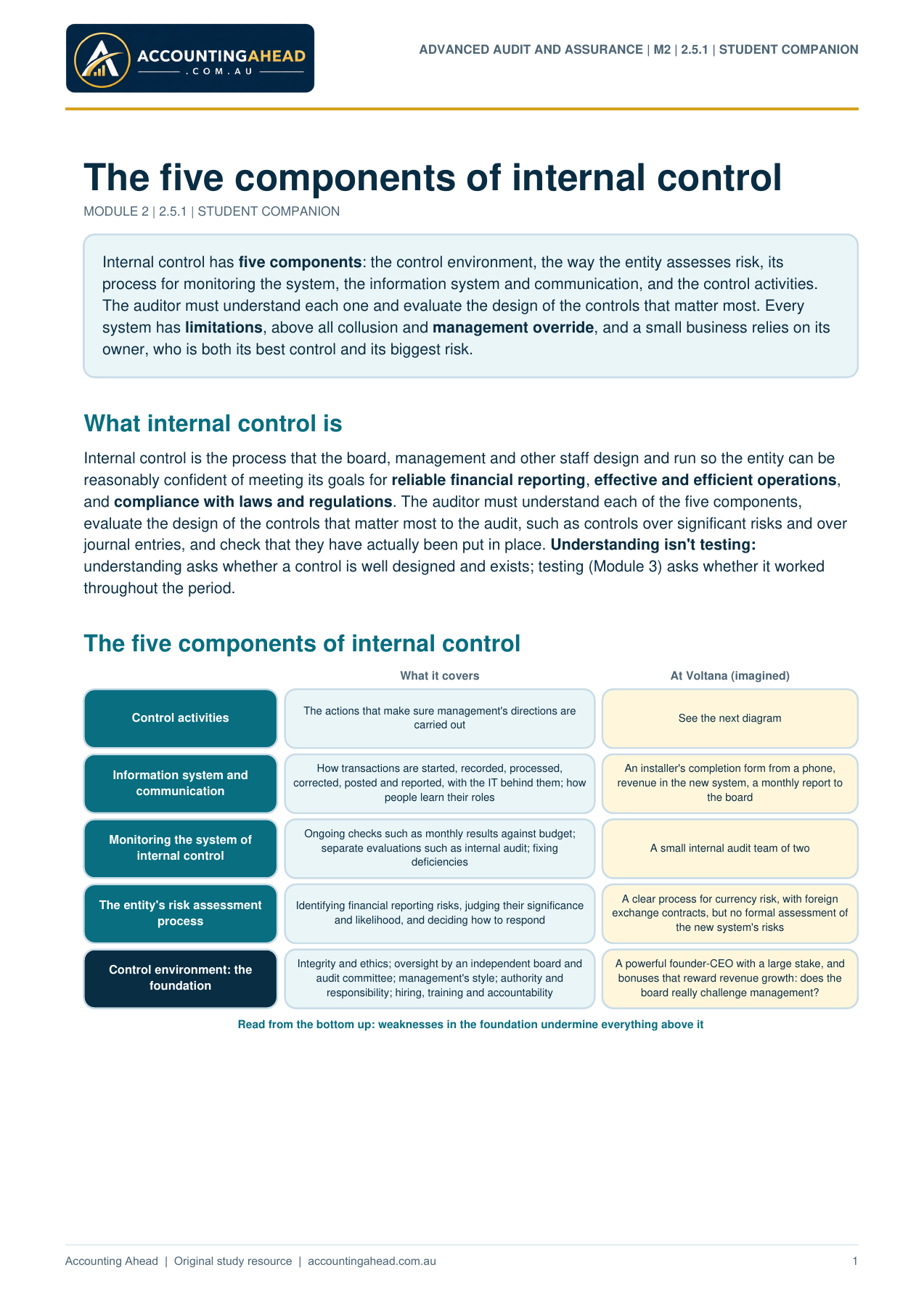
The five components of internal control
What it covers At Voltana (imagined)
Control activities The actions that make sure management's directions are
carried out See the next diagram
Information system and
communication
How transactions are started, recorded, processed,
corrected, posted and reported, with the IT behind them; how
people learn their roles
An installer's completion form from a phone,
revenue in the new system, a monthly report to
the board
Monitoring the system of
internal control
Ongoing checks such as monthly results against budget;
separate evaluations such as internal audit; fixing
deficiencies
A small internal audit team of two
The entity's risk assessment
process
Identifying financial reporting risks, judging their significance
and likelihood, and deciding how to respond
A clear process for currency risk, with foreign
exchange contracts, but no formal assessment of
the new system's risks
Control environment: the
foundation
Integrity and ethics; oversight by an independent board and
audit committee; management's style; authority and
responsibility; hiring, training and accountability
A powerful founder-CEO with a large stake, and
bonuses that reward revenue growth: does the
board really challenge management?
Read from the bottom up: weaknesses in the foundation undermine everything above it
ADVANCED AUDIT AND ASSURANCE | M2 | 2.5.1 | STUDENT COMPANION
1
Accounting Ahead | Original study resource | accountingahead.com.au
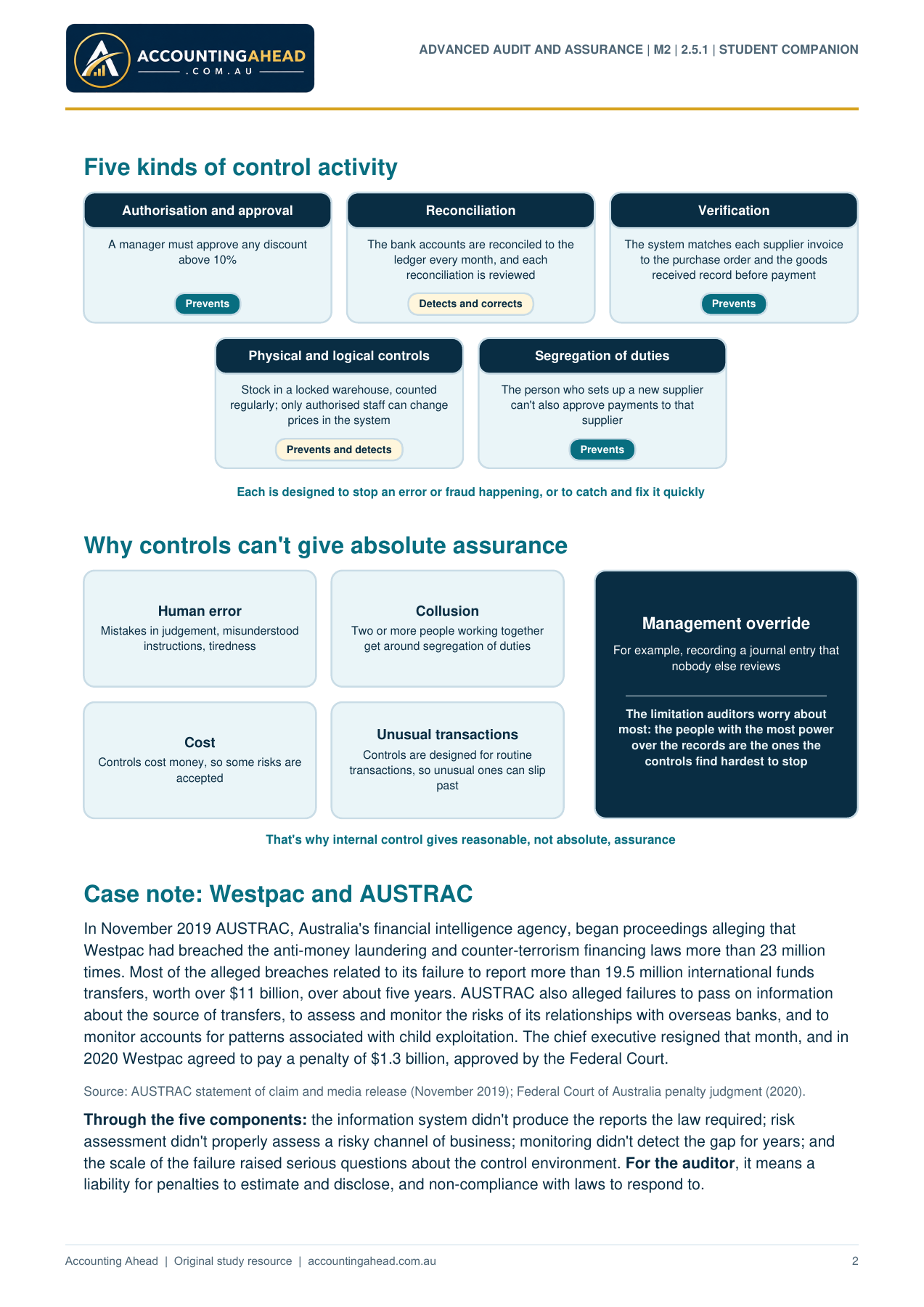
Five kinds of control activity
Authorisation and approval
A manager must approve any discount
above 10%
Prevents
Reconciliation
The bank accounts are reconciled to the
ledger every month, and each
reconciliation is reviewed
Detects and corrects
Verification
The system matches each supplier invoice
to the purchase order and the goods
received record before payment
Prevents
Physical and logical controls
Stock in a locked warehouse, counted
regularly; only authorised staff can change
prices in the system
Prevents and detects
Segregation of duties
The person who sets up a new supplier
can't also approve payments to that
supplier
Prevents
Each is designed to stop an error or fraud happening, or to catch and fix it quickly
Why controls can't give absolute assurance
Human error
Mistakes in judgement, misunderstood
instructions, tiredness
Collusion
Two or more people working together
get around segregation of duties
Cost
Controls cost money, so some risks are
accepted
Unusual transactions
Controls are designed for routine
transactions, so unusual ones can slip
past
Management override
For example, recording a journal entry that
nobody else reviews
The limitation auditors worry about
most: the people with the most power
over the records are the ones the
controls find hardest to stop
That's why internal control gives reasonable, not absolute, assurance
Case note: Westpac and AUSTRAC
In November 2019 AUSTRAC, Australia's financial intelligence agency, began proceedings alleging that
Westpac had breached the anti-money laundering and counter-terrorism financing laws more than 23 million
times. Most of the alleged breaches related to its failure to report more than 19.5 million international funds
transfers, worth over $11 billion, over about five years. AUSTRAC also alleged failures to pass on information
about the source of transfers, to assess and monitor the risks of its relationships with overseas banks, and to
monitor accounts for patterns associated with child exploitation. The chief executive resigned that month, and in
2020 Westpac agreed to pay a penalty of $1.3 billion, approved by the Federal Court.
Source: AUSTRAC statement of claim and media release (November 2019); Federal Court of Australia penalty judgment (2020).
Through the five components: the information system didn't produce the reports the law required; risk
assessment didn't properly assess a risky channel of business; monitoring didn't detect the gap for years; and
the scale of the failure raised serious questions about the control environment. For the auditor, it means a
liability for penalties to estimate and disclose, and non-compliance with laws to respond to.
ADVANCED AUDIT AND ASSURANCE | M2 | 2.5.1 | STUDENT COMPANION
2
Accounting Ahead | Original study resource | accountingahead.com.au
Internal control in a small business
A small entity may have too few people to separate duties, and its controls are often informal. Its best control is
often the owner-manager's own involvement: approving every payment, reading the bank statements and
knowing the customers. But the same owner can override any control, so the auditor weighs the owner's integrity
and usually relies more on substantive evidence. Compensating controls help, such as the owner reviewing a
monthly list of new suppliers, or bank statements going straight to the owner unopened.
Practice questions
MODULE 2 | 2.5.1 | TRY THESE BEFORE THE WORKED ANSWERS
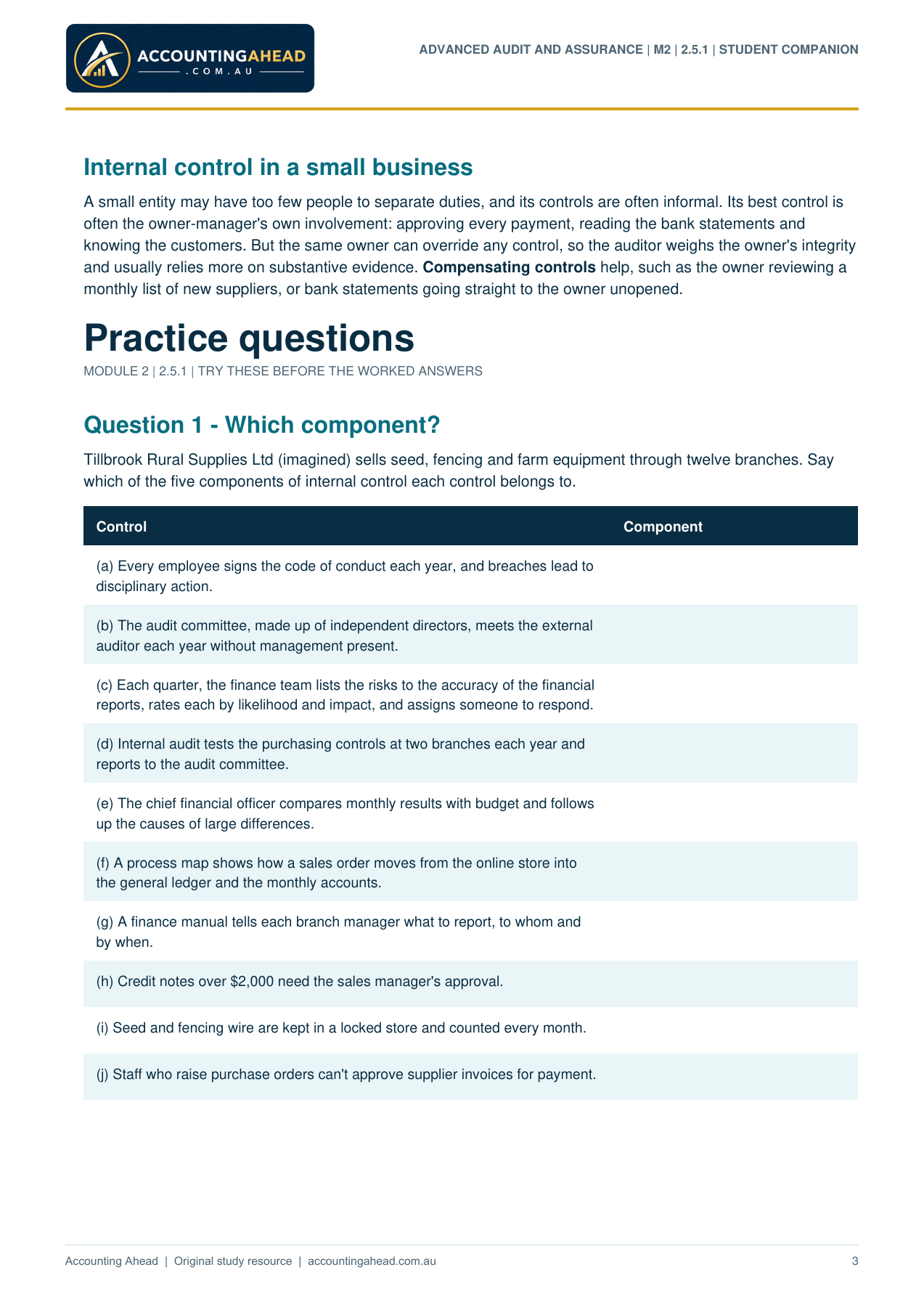
Question 1 - Which component?
Tillbrook Rural Supplies Ltd (imagined) sells seed, fencing and farm equipment through twelve branches. Say
which of the five components of internal control each control belongs to.
Control Component
(a) Every employee signs the code of conduct each year, and breaches lead to
disciplinary action.
(b) The audit committee, made up of independent directors, meets the external
auditor each year without management present.
(c) Each quarter, the finance team lists the risks to the accuracy of the financial
reports, rates each by likelihood and impact, and assigns someone to respond.
(d) Internal audit tests the purchasing controls at two branches each year and
reports to the audit committee.
(e) The chief financial officer compares monthly results with budget and follows
up the causes of large differences.
(f) A process map shows how a sales order moves from the online store into
the general ledger and the monthly accounts.
(g) A finance manual tells each branch manager what to report, to whom and
by when.
(h) Credit notes over $2,000 need the sales manager's approval.
(i) Seed and fencing wire are kept in a locked store and counted every month.
(j) Staff who raise purchase orders can't approve supplier invoices for payment.
ADVANCED AUDIT AND ASSURANCE | M2 | 2.5.1 | STUDENT COMPANION
3
Accounting Ahead | Original study resource | accountingahead.com.au
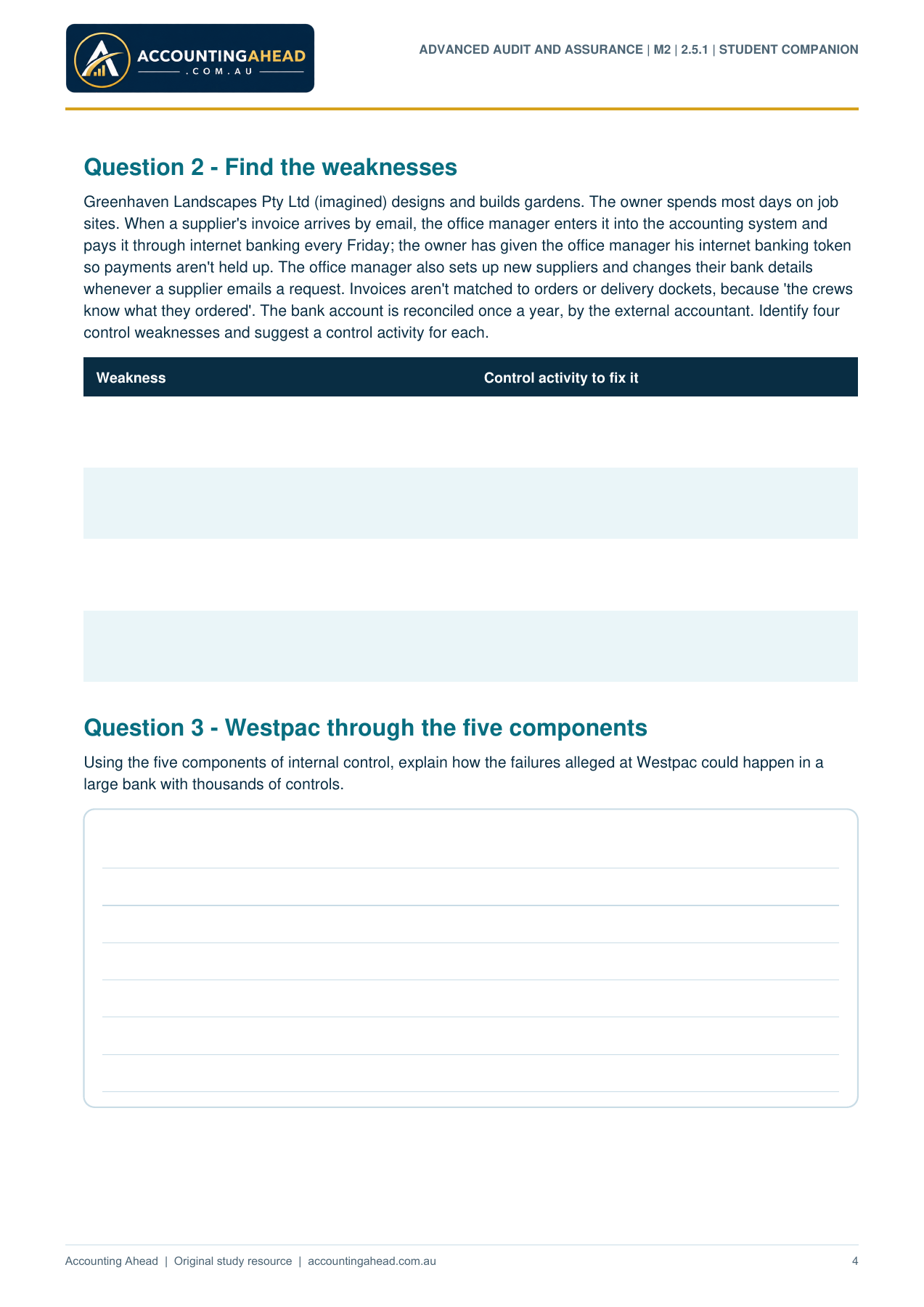
Question 2 - Find the weaknesses
Greenhaven Landscapes Pty Ltd (imagined) designs and builds gardens. The owner spends most days on job
sites. When a supplier's invoice arrives by email, the office manager enters it into the accounting system and
pays it through internet banking every Friday; the owner has given the office manager his internet banking token
so payments aren't held up. The office manager also sets up new suppliers and changes their bank details
whenever a supplier emails a request. Invoices aren't matched to orders or delivery dockets, because 'the crews
know what they ordered'. The bank account is reconciled once a year, by the external accountant. Identify four
control weaknesses and suggest a control activity for each.
Weakness Control activity to fix it
Question 3 - Westpac through the five components
Using the five components of internal control, explain how the failures alleged at Westpac could happen in a
large bank with thousands of controls.
ADVANCED AUDIT AND ASSURANCE | M2 | 2.5.1 | STUDENT COMPANION
4
Accounting Ahead | Original study resource | accountingahead.com.au
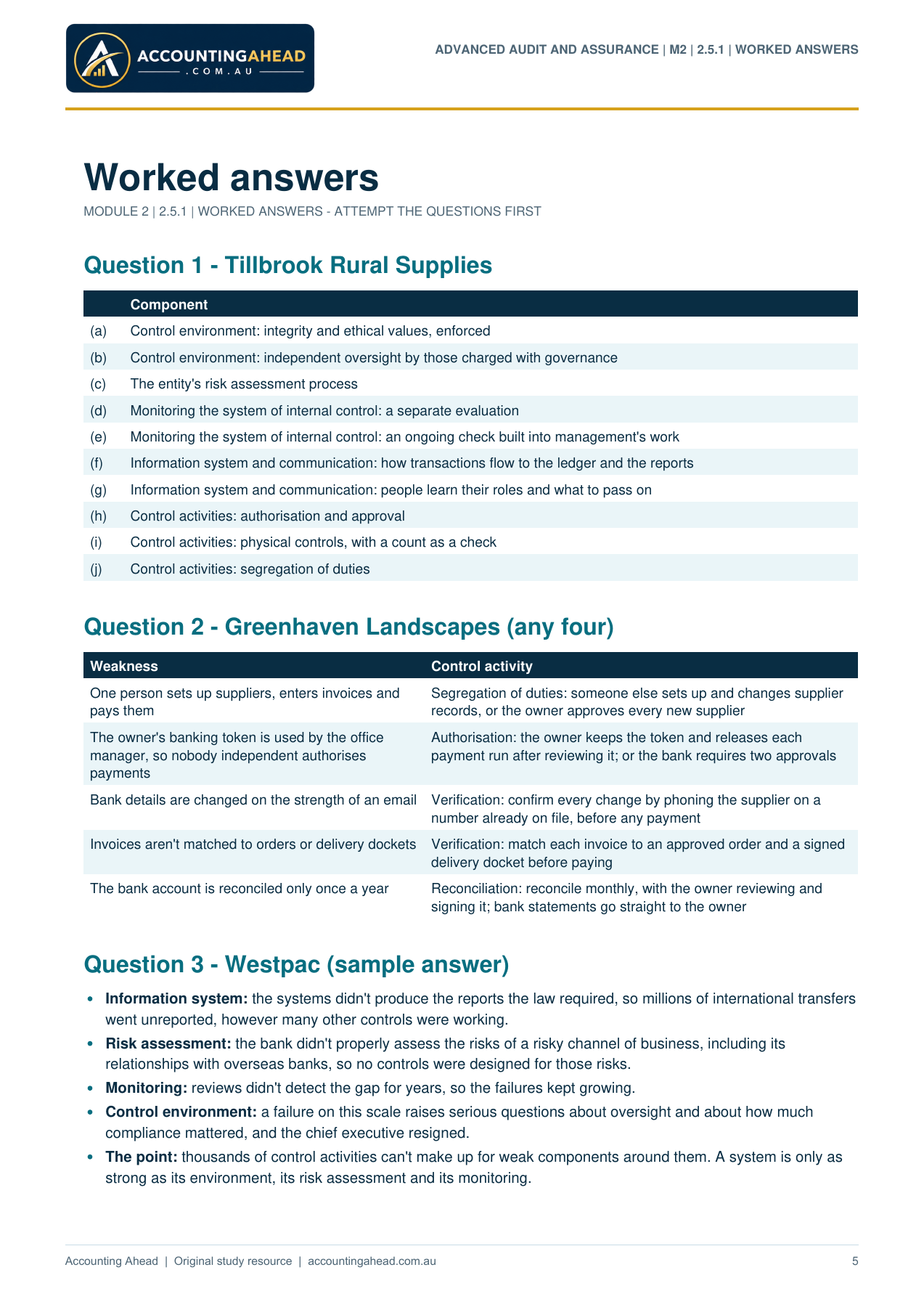
Worked answers
MODULE 2 | 2.5.1 | WORKED ANSWERS - ATTEMPT THE QUESTIONS FIRST
Question 1 - Tillbrook Rural Supplies
Component
(a) Control environment: integrity and ethical values, enforced
(b) Control environment: independent oversight by those charged with governance
(c) The entity's risk assessment process
(d) Monitoring the system of internal control: a separate evaluation
(e) Monitoring the system of internal control: an ongoing check built into management's work
(f) Information system and communication: how transactions flow to the ledger and the reports
(g) Information system and communication: people learn their roles and what to pass on
(h) Control activities: authorisation and approval
(i) Control activities: physical controls, with a count as a check
(j) Control activities: segregation of duties
Question 2 - Greenhaven Landscapes (any four)
Weakness Control activity
One person sets up suppliers, enters invoices and
pays them
Segregation of duties: someone else sets up and changes supplier
records, or the owner approves every new supplier
The owner's banking token is used by the office
manager, so nobody independent authorises
payments
Authorisation: the owner keeps the token and releases each
payment run after reviewing it; or the bank requires two approvals
Bank details are changed on the strength of an email Verification: confirm every change by phoning the supplier on a
number already on file, before any payment
Invoices aren't matched to orders or delivery dockets Verification: match each invoice to an approved order and a signed
delivery docket before paying
The bank account is reconciled only once a year Reconciliation: reconcile monthly, with the owner reviewing and
signing it; bank statements go straight to the owner
Question 3 - Westpac (sample answer)
Information system: the systems didn't produce the reports the law required, so millions of international transfers
went unreported, however many other controls were working.
Risk assessment: the bank didn't properly assess the risks of a risky channel of business, including its
relationships with overseas banks, so no controls were designed for those risks.
Monitoring: reviews didn't detect the gap for years, so the failures kept growing.
Control environment: a failure on this scale raises serious questions about oversight and about how much
compliance mattered, and the chief executive resigned.
The point: thousands of control activities can't make up for weak components around them. A system is only as
strong as its environment, its risk assessment and its monitoring.
ADVANCED AUDIT AND ASSURANCE | M2 | 2.5.1 | WORKED ANSWERS
5