
The auditor and fraud risk
Printable study notes, diagrams and practice support for Part 2.6.1.
Read the handout text
Accounting Ahead | Original study resource | accountingahead.com.au
The auditor and fraud risk
MODULE 2 | 2.6.1 | STUDENT COMPANION
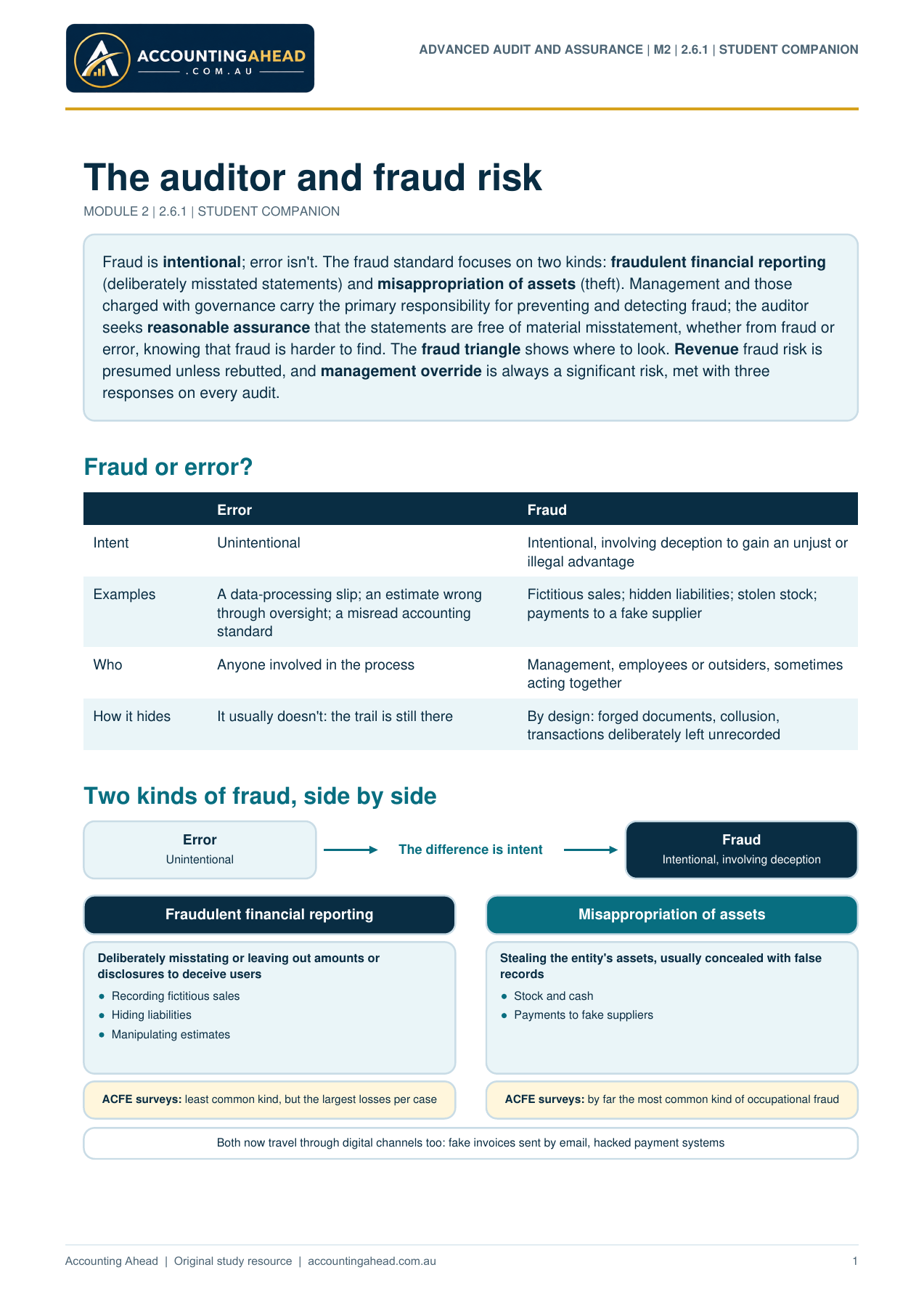
Fraud is intentional; error isn't. The fraud standard focuses on two kinds: fraudulent financial reporting
(deliberately misstated statements) and misappropriation of assets (theft). Management and those
charged with governance carry the primary responsibility for preventing and detecting fraud; the auditor
seeks reasonable assurance that the statements are free of material misstatement, whether from fraud or
error, knowing that fraud is harder to find. The fraud triangle shows where to look. Revenue fraud risk is
presumed unless rebutted, and management override is always a significant risk, met with three
responses on every audit.
Fraud or error?
Error Fraud
Intent Unintentional Intentional, involving deception to gain an unjust or
illegal advantage
Examples A data-processing slip; an estimate wrong
through oversight; a misread accounting
standard
Fictitious sales; hidden liabilities; stolen stock;
payments to a fake supplier
Who Anyone involved in the process Management, employees or outsiders, sometimes
acting together
How it hides It usually doesn't: the trail is still there By design: forged documents, collusion,
transactions deliberately left unrecorded
Two kinds of fraud, side by side
Error
Unintentional
The difference is intent Fraud
Intentional, involving deception
Fraudulent financial reporting
Deliberately misstating or leaving out amounts or
disclosures to deceive users
Recording fictitious sales
Hiding liabilities
Manipulating estimates
ACFE surveys: least common kind, but the largest losses per case
Misappropriation of assets
Stealing the entity's assets, usually concealed with false
records
Stock and cash
Payments to fake suppliers
ACFE surveys: by far the most common kind of occupational fraud
Both now travel through digital channels too: fake invoices sent by email, hacked payment systems
ADVANCED AUDIT AND ASSURANCE | M2 | 2.6.1 | STUDENT COMPANION
1
Accounting Ahead | Original study resource | accountingahead.com.au
Digital channels. Both kinds of fraud increasingly arrive online: a fake invoice emailed from what looks like a
regular supplier, a request to change a supplier's bank details, or a payment system taken over by hackers.
How often, and how costly. The Association of Certified Fraud Examiners' surveys keep finding the same
pattern: theft of assets is by far the most common kind of fraud by people inside an organisation, while financial
statement fraud is the least common but causes the largest losses per case.
Source: Association of Certified Fraud Examiners, Occupational Fraud 2026: A Report to the Nations (14th edition).
Who is responsible?
Management, and those charged with governance Auditor
Primary responsibility for preventing and detecting fraud Reasonable assurance that the statements as a whole
contain no material misstatement, whether from fraud or
error
Build an honest, ethical culture, and run controls that
prevent fraud or catch it quickly
Identify and assess fraud risks, respond to them, and
keep a sceptical mind throughout, whatever past
experience suggests about the client's honesty
Oversight by the board, including of management's own
fraud risk assessment
Accept the limits: fraud is built to be hidden, so a material
fraud is harder to find than an error, and harder still when
management is involved
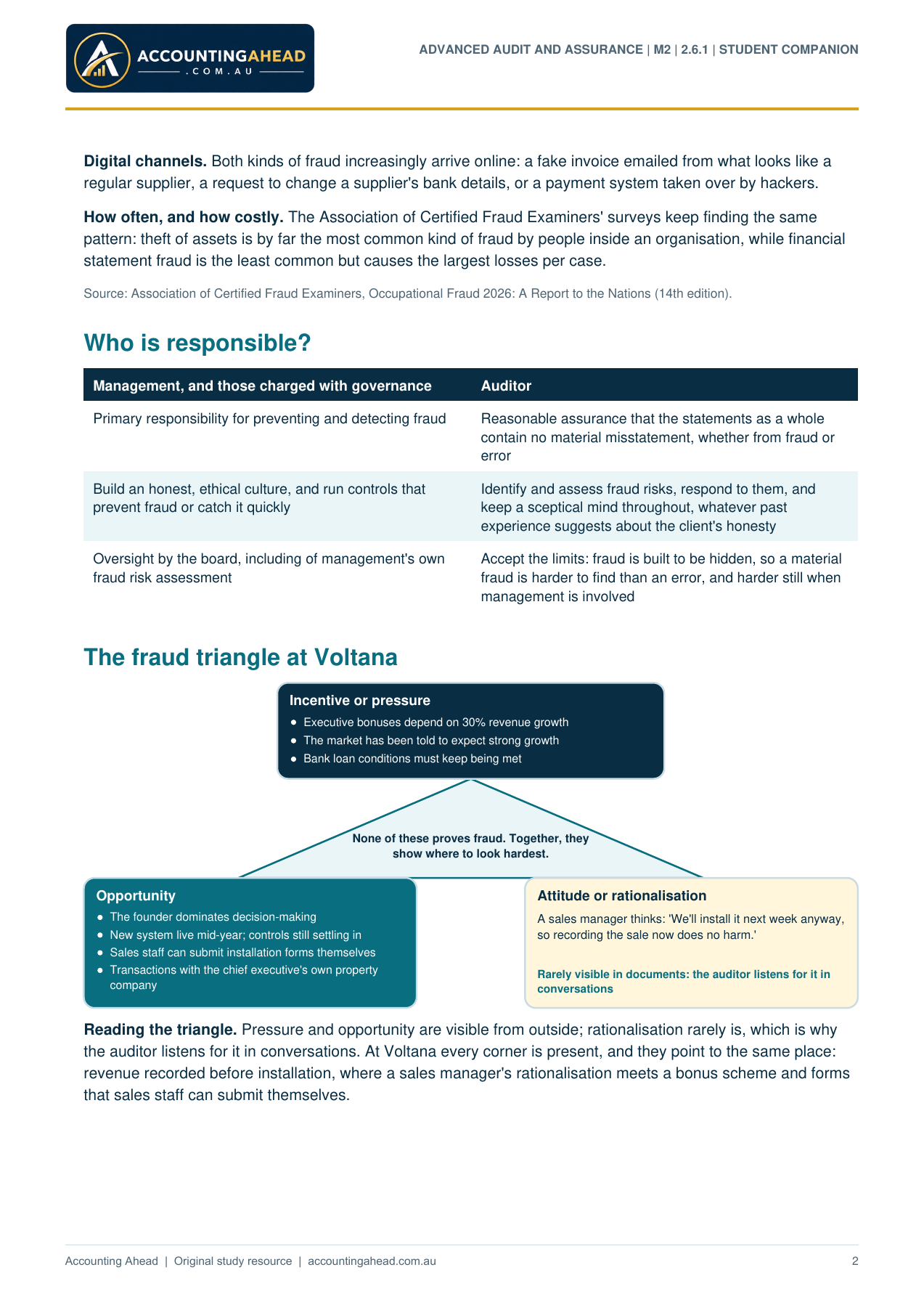
The fraud triangle at Voltana
None of these proves fraud. Together, they
show where to look hardest.
Incentive or pressure
Executive bonuses depend on 30% revenue growth
The market has been told to expect strong growth
Bank loan conditions must keep being met
Opportunity
The founder dominates decision-making
New system live mid-year; controls still settling in
Sales staff can submit installation forms themselves
Transactions with the chief executive's own property
company
Attitude or rationalisation
A sales manager thinks: 'We'll install it next week anyway,
so recording the sale now does no harm.'
Rarely visible in documents: the auditor listens for it in
conversations
Reading the triangle. Pressure and opportunity are visible from outside; rationalisation rarely is, which is why
the auditor listens for it in conversations. At Voltana every corner is present, and they point to the same place:
revenue recorded before installation, where a sales manager's rationalisation meets a bonus scheme and forms
that sales staff can submit themselves.
ADVANCED AUDIT AND ASSURANCE | M2 | 2.6.1 | STUDENT COMPANION
2
Accounting Ahead | Original study resource | accountingahead.com.au
Case note: Steinhoff
Steinhoff was a global retail group with businesses in Europe, Africa, the United States and Australia, built up
through rapid acquisitions. In December 2017 it announced accounting irregularities that needed investigation,
and its chief executive resigned. Its share price collapsed by more than 60% in a single day and kept falling. A
forensic investigation later reported that a small group of former executives had arranged transactions over
many years that inflated the group's profits and asset values, with irregular transactions totalling about EUR 6.5
billion between 2009 and 2017. The pattern: pressure from a growth story the market loved, opportunity from a
powerful leader and a complex web of entities, and transactions designed to look legitimate to anyone who didn't
trace them all the way through.
Source: Steinhoff International Holdings announcement (5 December 2017); overview of PwC's forensic investigation (15 March 2019).
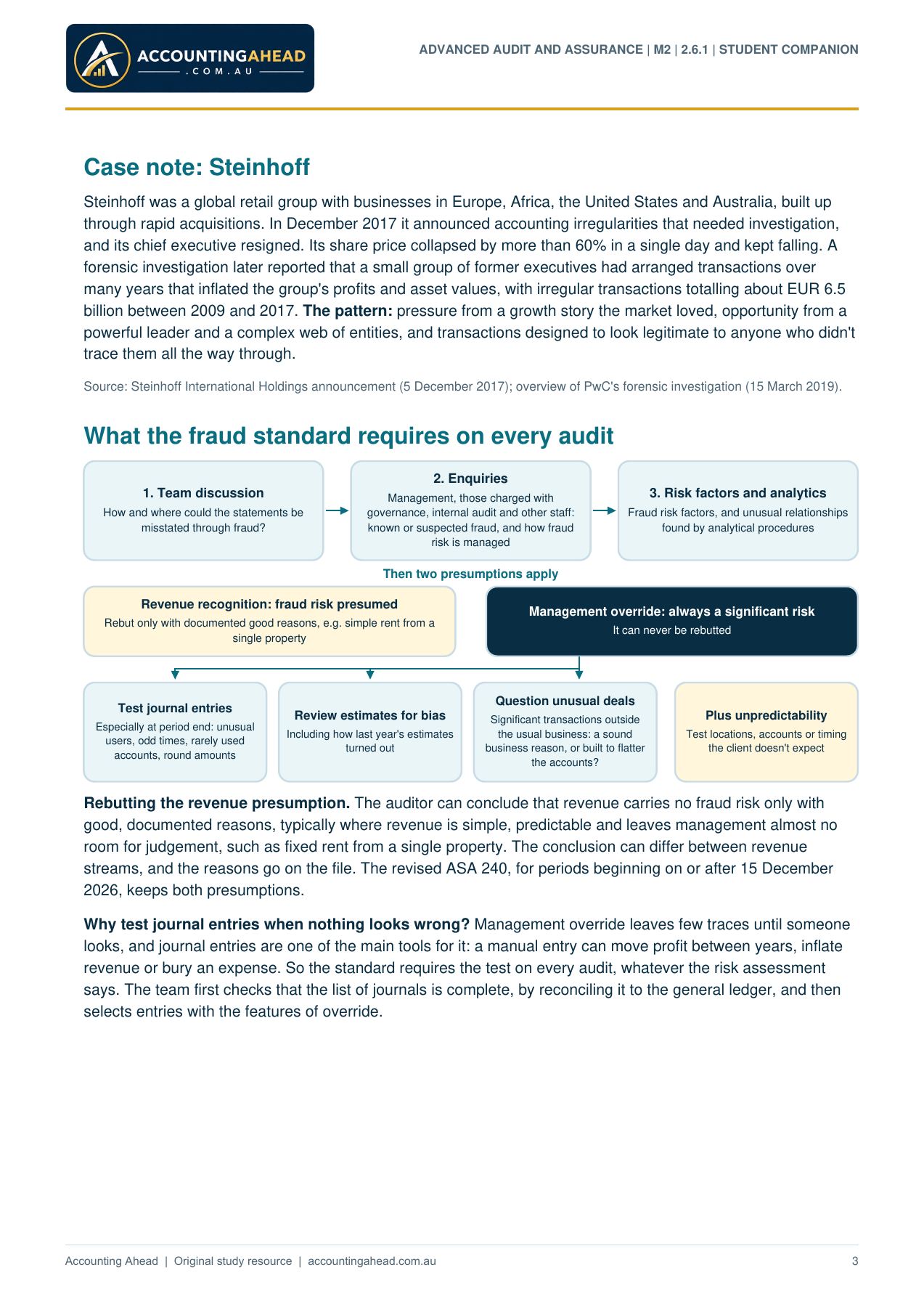
What the fraud standard requires on every audit
1. Team discussion
How and where could the statements be
misstated through fraud?
2. Enquiries
Management, those charged with
governance, internal audit and other staff:
known or suspected fraud, and how fraud
risk is managed
3. Risk factors and analytics
Fraud risk factors, and unusual relationships
found by analytical procedures
Then two presumptions apply
Revenue recognition: fraud risk presumed
Rebut only with documented good reasons, e.g. simple rent from a
single property
Management override: always a significant risk
It can never be rebutted
Test journal entries
Especially at period end: unusual
users, odd times, rarely used
accounts, round amounts
Review estimates for bias
Including how last year's estimates
turned out
Question unusual deals
Significant transactions outside
the usual business: a sound
business reason, or built to flatter
the accounts?
Plus unpredictability
Test locations, accounts or timing
the client doesn't expect
Rebutting the revenue presumption. The auditor can conclude that revenue carries no fraud risk only with
good, documented reasons, typically where revenue is simple, predictable and leaves management almost no
room for judgement, such as fixed rent from a single property. The conclusion can differ between revenue
streams, and the reasons go on the file. The revised ASA 240, for periods beginning on or after 15 December
2026, keeps both presumptions.
Why test journal entries when nothing looks wrong? Management override leaves few traces until someone
looks, and journal entries are one of the main tools for it: a manual entry can move profit between years, inflate
revenue or bury an expense. So the standard requires the test on every audit, whatever the risk assessment
says. The team first checks that the list of journals is complete, by reconciling it to the general ledger, and then
selects entries with the features of override.
ADVANCED AUDIT AND ASSURANCE | M2 | 2.6.1 | STUDENT COMPANION
3
Accounting Ahead | Original study resource | accountingahead.com.au
Practice questions
MODULE 2 | 2.6.1 | TRY THESE BEFORE THE WORKED ANSWERS
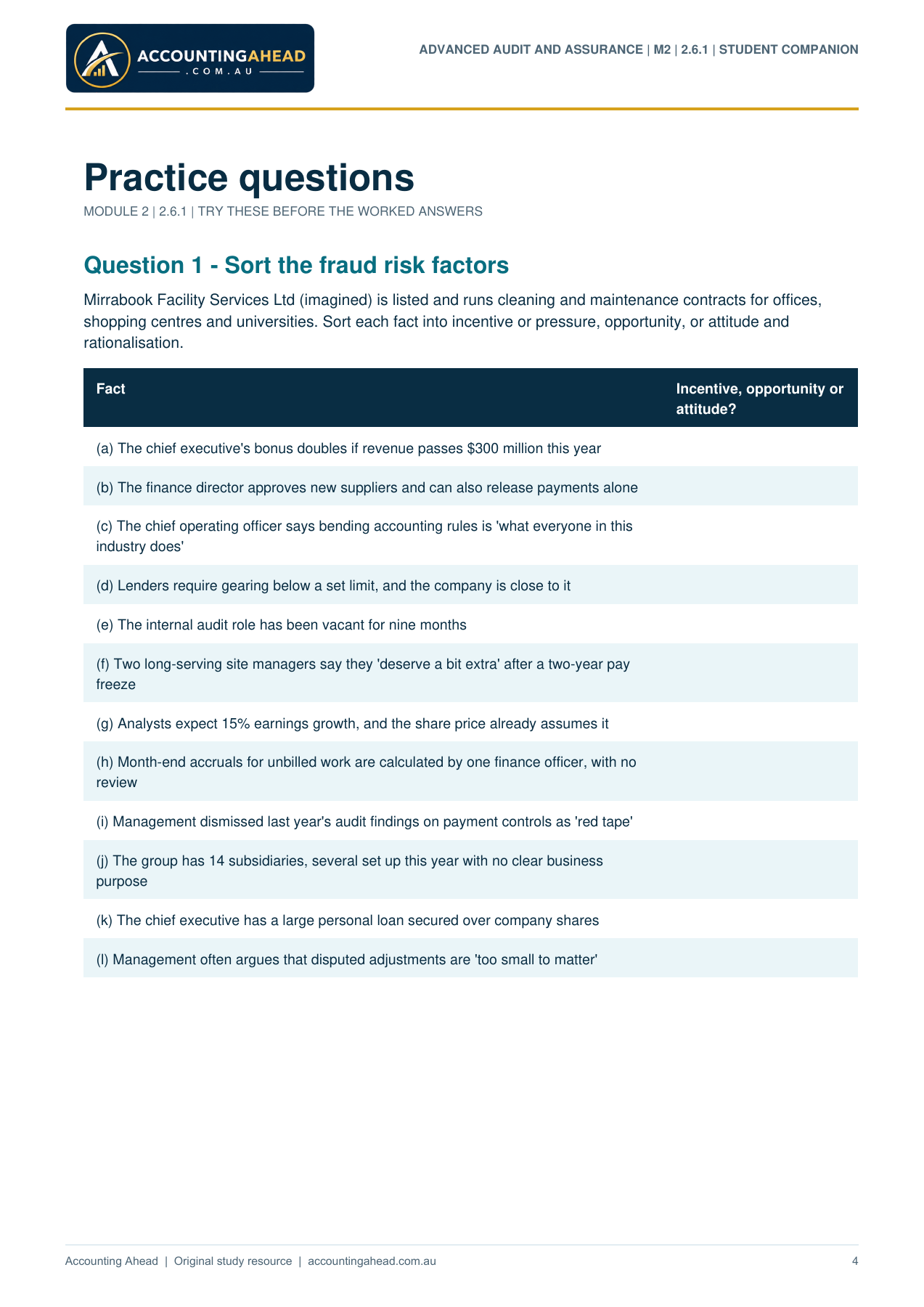
Question 1 - Sort the fraud risk factors
Mirrabook Facility Services Ltd (imagined) is listed and runs cleaning and maintenance contracts for offices,
shopping centres and universities. Sort each fact into incentive or pressure, opportunity, or attitude and
rationalisation.
Fact Incentive, opportunity or
attitude?
(a) The chief executive's bonus doubles if revenue passes $300 million this year
(b) The finance director approves new suppliers and can also release payments alone
(c) The chief operating officer says bending accounting rules is 'what everyone in this
industry does'
(d) Lenders require gearing below a set limit, and the company is close to it
(e) The internal audit role has been vacant for nine months
(f) Two long-serving site managers say they 'deserve a bit extra' after a two-year pay
freeze
(g) Analysts expect 15% earnings growth, and the share price already assumes it
(h) Month-end accruals for unbilled work are calculated by one finance officer, with no
review
(i) Management dismissed last year's audit findings on payment controls as 'red tape'
(j) The group has 14 subsidiaries, several set up this year with no clear business
purpose
(k) The chief executive has a large personal loan secured over company shares
(l) Management often argues that disputed adjustments are 'too small to matter'
ADVANCED AUDIT AND ASSURANCE | M2 | 2.6.1 | STUDENT COMPANION
4
Accounting Ahead | Original study resource | accountingahead.com.au
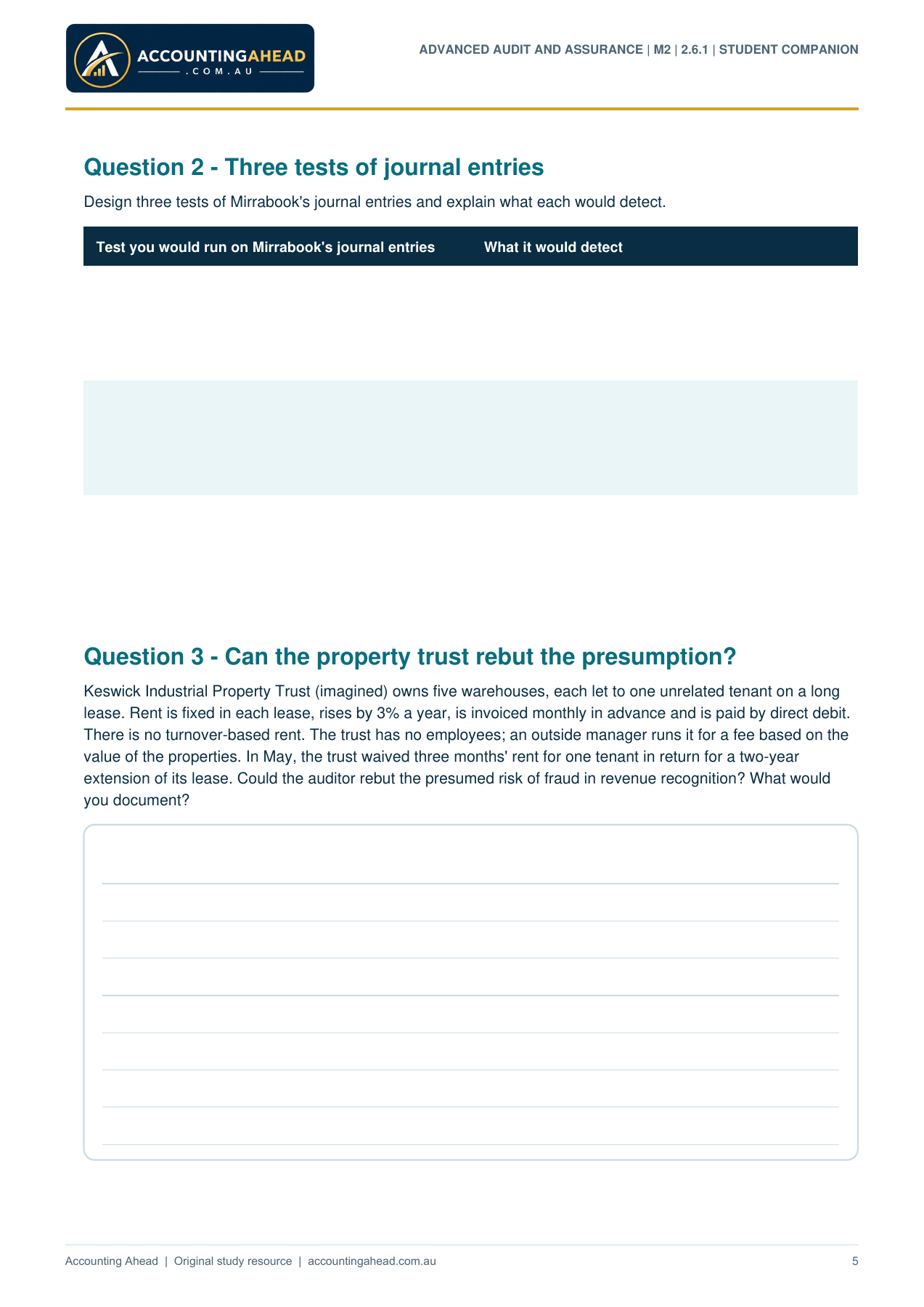
Question 2 - Three tests of journal entries
Design three tests of Mirrabook's journal entries and explain what each would detect.
Test you would run on Mirrabook's journal entries What it would detect
Question 3 - Can the property trust rebut the presumption?
Keswick Industrial Property Trust (imagined) owns five warehouses, each let to one unrelated tenant on a long
lease. Rent is fixed in each lease, rises by 3% a year, is invoiced monthly in advance and is paid by direct debit.
There is no turnover-based rent. The trust has no employees; an outside manager runs it for a fee based on the
value of the properties. In May, the trust waived three months' rent for one tenant in return for a two-year
extension of its lease. Could the auditor rebut the presumed risk of fraud in revenue recognition? What would
you document?
ADVANCED AUDIT AND ASSURANCE | M2 | 2.6.1 | STUDENT COMPANION
5
Accounting Ahead | Original study resource | accountingahead.com.au
Worked answers
MODULE 2 | 2.6.1 | WORKED ANSWERS - ATTEMPT THE QUESTIONS FIRST
Question 1 - Mirrabook Facility Services
Category Why
(a) Incentive A personal reward tied to a revenue target
(b) Opportunity Incompatible duties: one person can create a supplier and pay it
(c) Attitude A ready-made excuse for misstating the accounts
(d) Incentive Pressure to meet a lender's condition
(e) Opportunity Weak monitoring: nobody independent is checking
(f) Attitude A sense of entitlement that can justify theft
(g) Incentive Pressure to meet outside expectations
(h) Opportunity A judgemental figure prepared and controlled by one person
(i) Attitude Disregard for controls and for the auditor
(j) Opportunity A complex, changing structure in which transactions can be hidden
(k) Incentive Personal financial pressure linked to the share price
(l) Attitude Repeatedly justifying doubtful accounting on materiality grounds
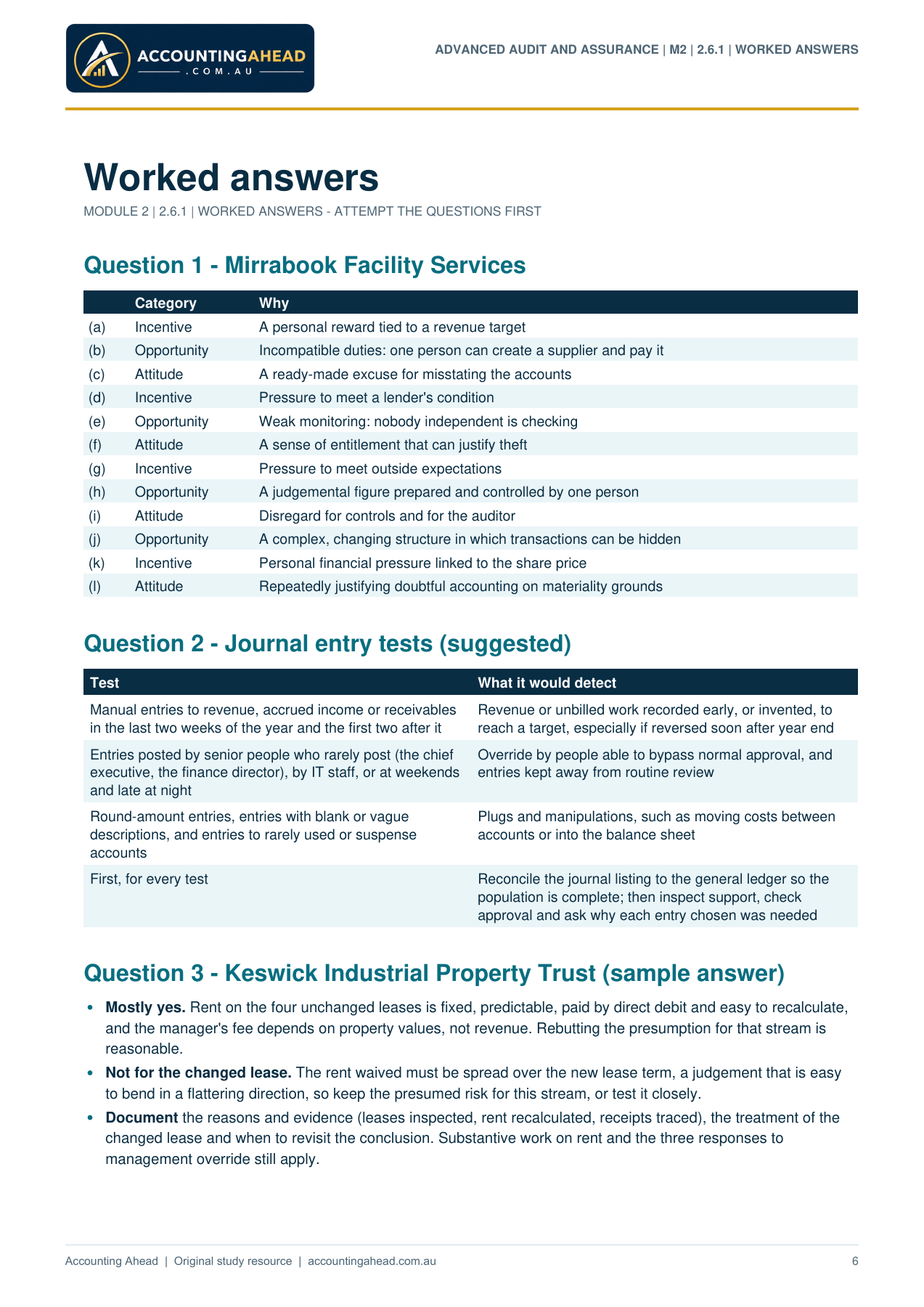
Question 2 - Journal entry tests (suggested)
Test What it would detect
Manual entries to revenue, accrued income or receivables
in the last two weeks of the year and the first two after it
Revenue or unbilled work recorded early, or invented, to
reach a target, especially if reversed soon after year end
Entries posted by senior people who rarely post (the chief
executive, the finance director), by IT staff, or at weekends
and late at night
Override by people able to bypass normal approval, and
entries kept away from routine review
Round-amount entries, entries with blank or vague
descriptions, and entries to rarely used or suspense
accounts
Plugs and manipulations, such as moving costs between
accounts or into the balance sheet
First, for every test Reconcile the journal listing to the general ledger so the
population is complete; then inspect support, check
approval and ask why each entry chosen was needed
Question 3 - Keswick Industrial Property Trust (sample answer)
Mostly yes. Rent on the four unchanged leases is fixed, predictable, paid by direct debit and easy to recalculate,
and the manager's fee depends on property values, not revenue. Rebutting the presumption for that stream is
reasonable.
Not for the changed lease. The rent waived must be spread over the new lease term, a judgement that is easy
to bend in a flattering direction, so keep the presumed risk for this stream, or test it closely.
Document the reasons and evidence (leases inspected, rent recalculated, receipts traced), the treatment of the
changed lease and when to revisit the conclusion. Substantive work on rent and the three responses to
management override still apply.
ADVANCED AUDIT AND ASSURANCE | M2 | 2.6.1 | WORKED ANSWERS
6