
Strategic analysis for risk assessment
Printable study notes, diagrams and practice support for Part 2.7.1.
Read the handout text
Accounting Ahead | Original study resource | accountingahead.com.au
Strategic analysis for risk assessment
MODULE 2 | 2.7.1 | STUDENT COMPANION
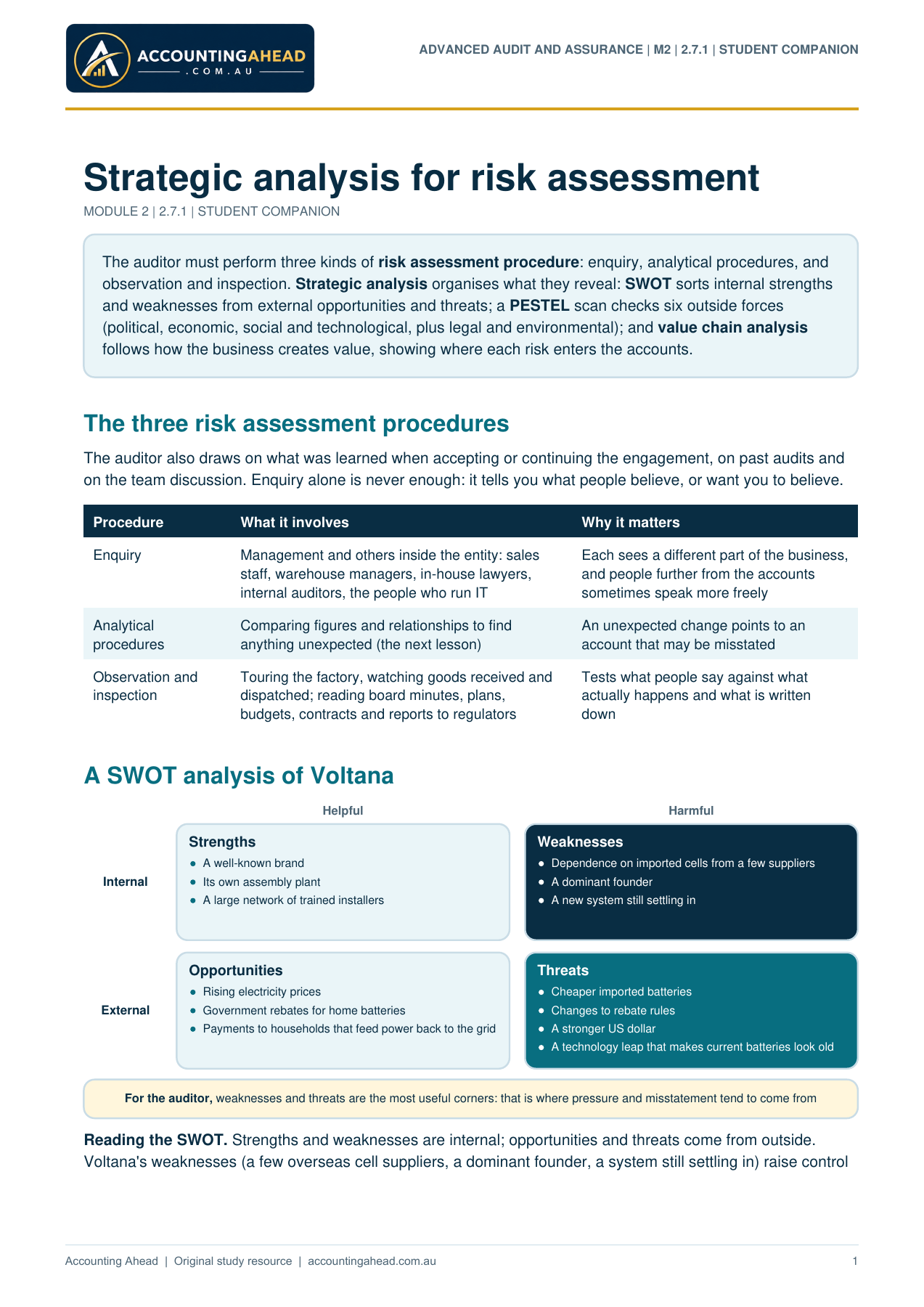
The auditor must perform three kinds of risk assessment procedure: enquiry, analytical procedures, and
observation and inspection. Strategic analysis organises what they reveal: SWOT sorts internal strengths
and weaknesses from external opportunities and threats; a PESTEL scan checks six outside forces
(political, economic, social and technological, plus legal and environmental); and value chain analysis
follows how the business creates value, showing where each risk enters the accounts.
The three risk assessment procedures
The auditor also draws on what was learned when accepting or continuing the engagement, on past audits and
on the team discussion. Enquiry alone is never enough: it tells you what people believe, or want you to believe.
Procedure What it involves Why it matters
Enquiry Management and others inside the entity: sales
staff, warehouse managers, in-house lawyers,
internal auditors, the people who run IT
Each sees a different part of the business,
and people further from the accounts
sometimes speak more freely
Analytical
procedures
Comparing figures and relationships to find
anything unexpected (the next lesson)
An unexpected change points to an
account that may be misstated
Observation and
inspection
Touring the factory, watching goods received and
dispatched; reading board minutes, plans,
budgets, contracts and reports to regulators
Tests what people say against what
actually happens and what is written
down
A SWOT analysis of Voltana
Helpful Harmful
Internal
External
Strengths
A well-known brand
Its own assembly plant
A large network of trained installers
Weaknesses
Dependence on imported cells from a few suppliers
A dominant founder
A new system still settling in
Opportunities
Rising electricity prices
Government rebates for home batteries
Payments to households that feed power back to the grid
Threats
Cheaper imported batteries
Changes to rebate rules
A stronger US dollar
A technology leap that makes current batteries look old
For the auditor, weaknesses and threats are the most useful corners: that is where pressure and misstatement tend to come from
Reading the SWOT. Strengths and weaknesses are internal; opportunities and threats come from outside.
Voltana's weaknesses (a few overseas cell suppliers, a dominant founder, a system still settling in) raise control
ADVANCED AUDIT AND ASSURANCE | M2 | 2.7.1 | STUDENT COMPANION
1
Accounting Ahead | Original study resource | accountingahead.com.au
and fraud risk; its threats (cheaper imports, rebate changes, a stronger US dollar, a technology leap) put
pressure on margins and on the value of its stock.
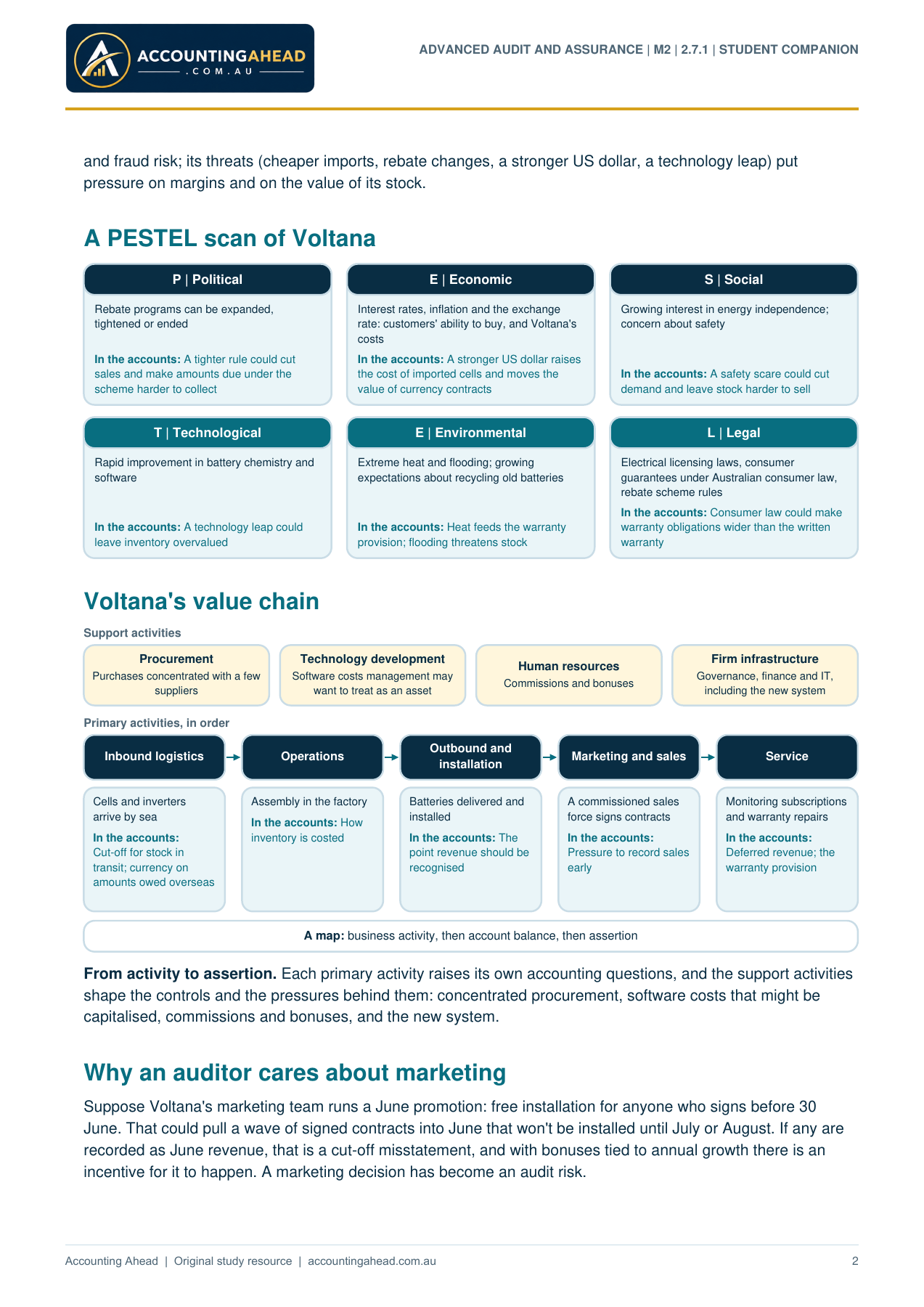
A PESTEL scan of Voltana
P | Political
Rebate programs can be expanded,
tightened or ended
In the accounts: A tighter rule could cut
sales and make amounts due under the
scheme harder to collect
E | Economic
Interest rates, inflation and the exchange
rate: customers' ability to buy, and Voltana's
costs
In the accounts: A stronger US dollar raises
the cost of imported cells and moves the
value of currency contracts
S | Social
Growing interest in energy independence;
concern about safety
In the accounts: A safety scare could cut
demand and leave stock harder to sell
T | Technological
Rapid improvement in battery chemistry and
software
In the accounts: A technology leap could
leave inventory overvalued
E | Environmental
Extreme heat and flooding; growing
expectations about recycling old batteries
In the accounts: Heat feeds the warranty
provision; flooding threatens stock
L | Legal
Electrical licensing laws, consumer
guarantees under Australian consumer law,
rebate scheme rules
In the accounts: Consumer law could make
warranty obligations wider than the written
warranty
Voltana's value chain
Support activities
Procurement
Purchases concentrated with a few
suppliers
Technology development
Software costs management may
want to treat as an asset
Human resources
Commissions and bonuses
Firm infrastructure
Governance, finance and IT,
including the new system
Primary activities, in order
Inbound logistics
Cells and inverters
arrive by sea
In the accounts:
Cut-off for stock in
transit; currency on
amounts owed overseas
Operations
Assembly in the factory
In the accounts: How
inventory is costed
Outbound and
installation
Batteries delivered and
installed
In the accounts: The
point revenue should be
recognised
Marketing and sales
A commissioned sales
force signs contracts
In the accounts:
Pressure to record sales
early
Service
Monitoring subscriptions
and warranty repairs
In the accounts:
Deferred revenue; the
warranty provision
A map: business activity, then account balance, then assertion
From activity to assertion. Each primary activity raises its own accounting questions, and the support activities
shape the controls and the pressures behind them: concentrated procurement, software costs that might be
capitalised, commissions and bonuses, and the new system.
Why an auditor cares about marketing
Suppose Voltana's marketing team runs a June promotion: free installation for anyone who signs before 30
June. That could pull a wave of signed contracts into June that won't be installed until July or August. If any are
recorded as June revenue, that is a cut-off misstatement, and with bonuses tied to annual growth there is an
incentive for it to happen. A marketing decision has become an audit risk.
ADVANCED AUDIT AND ASSURANCE | M2 | 2.7.1 | STUDENT COMPANION
2
Accounting Ahead | Original study resource | accountingahead.com.au
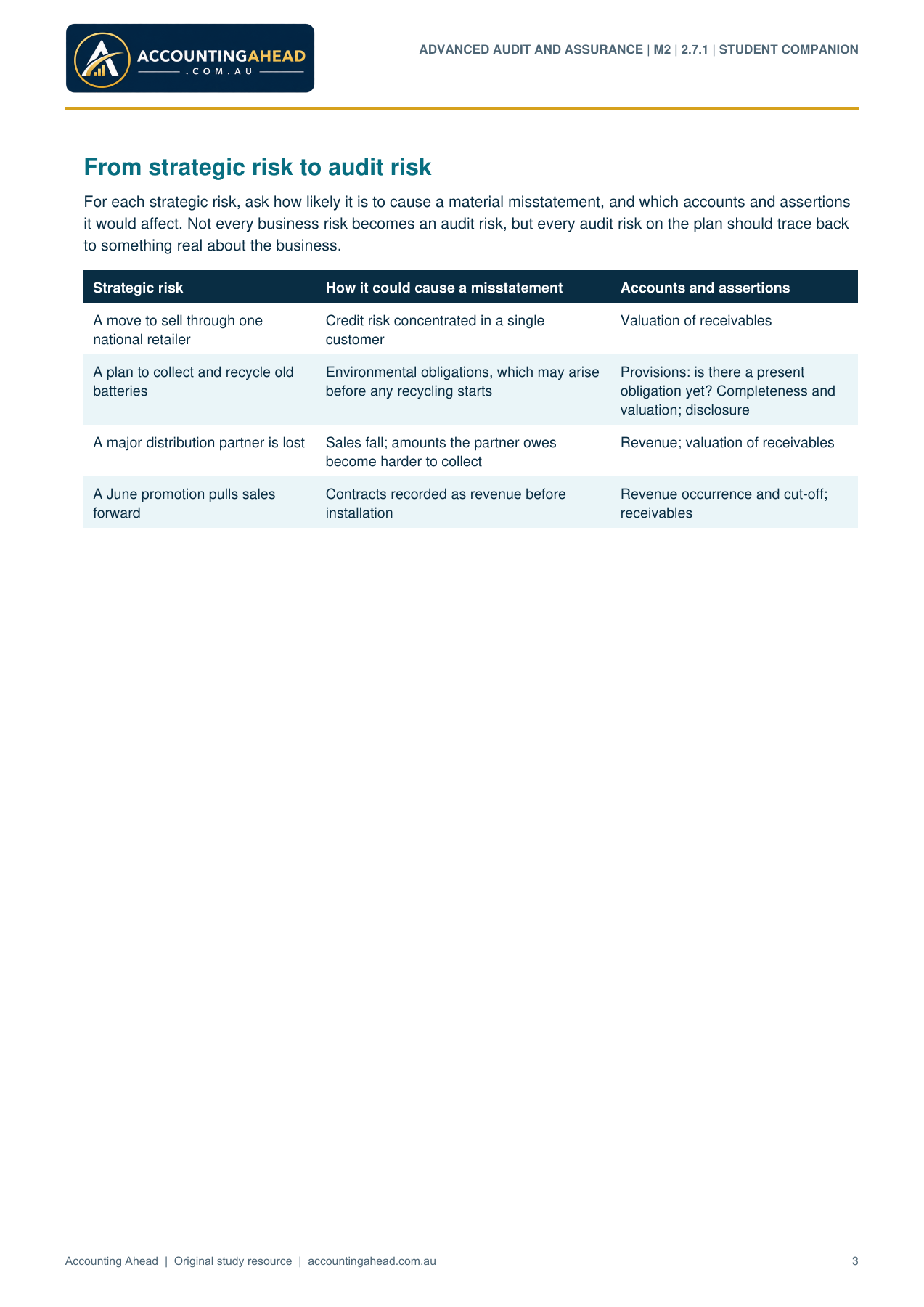
From strategic risk to audit risk
For each strategic risk, ask how likely it is to cause a material misstatement, and which accounts and assertions
it would affect. Not every business risk becomes an audit risk, but every audit risk on the plan should trace back
to something real about the business.
Strategic risk How it could cause a misstatement Accounts and assertions
A move to sell through one
national retailer
Credit risk concentrated in a single
customer
Valuation of receivables
A plan to collect and recycle old
batteries
Environmental obligations, which may arise
before any recycling starts
Provisions: is there a present
obligation yet? Completeness and
valuation; disclosure
A major distribution partner is lost Sales fall; amounts the partner owes
become harder to collect
Revenue; valuation of receivables
A June promotion pulls sales
forward
Contracts recorded as revenue before
installation
Revenue occurrence and cut-off;
receivables
ADVANCED AUDIT AND ASSURANCE | M2 | 2.7.1 | STUDENT COMPANION
3
Accounting Ahead | Original study resource | accountingahead.com.au
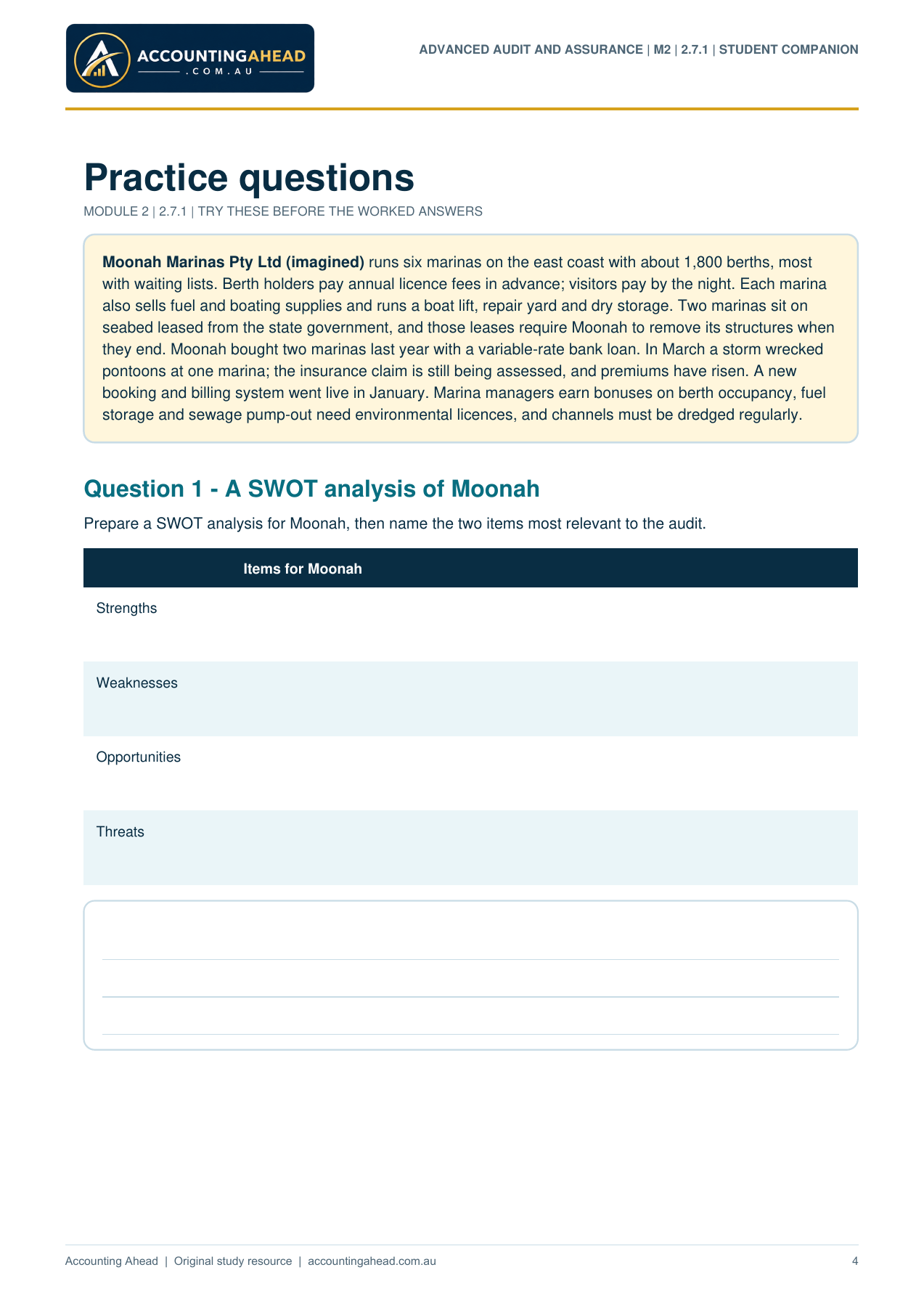
Practice questions
MODULE 2 | 2.7.1 | TRY THESE BEFORE THE WORKED ANSWERS
Moonah Marinas Pty Ltd (imagined) runs six marinas on the east coast with about 1,800 berths, most
with waiting lists. Berth holders pay annual licence fees in advance; visitors pay by the night. Each marina
also sells fuel and boating supplies and runs a boat lift, repair yard and dry storage. Two marinas sit on
seabed leased from the state government, and those leases require Moonah to remove its structures when
they end. Moonah bought two marinas last year with a variable-rate bank loan. In March a storm wrecked
pontoons at one marina; the insurance claim is still being assessed, and premiums have risen. A new
booking and billing system went live in January. Marina managers earn bonuses on berth occupancy, fuel
storage and sewage pump-out need environmental licences, and channels must be dredged regularly.
Question 1 - A SWOT analysis of Moonah
Prepare a SWOT analysis for Moonah, then name the two items most relevant to the audit.
Items for Moonah
Strengths
Weaknesses
Opportunities
Threats
ADVANCED AUDIT AND ASSURANCE | M2 | 2.7.1 | STUDENT COMPANION
4
Accounting Ahead | Original study resource | accountingahead.com.au
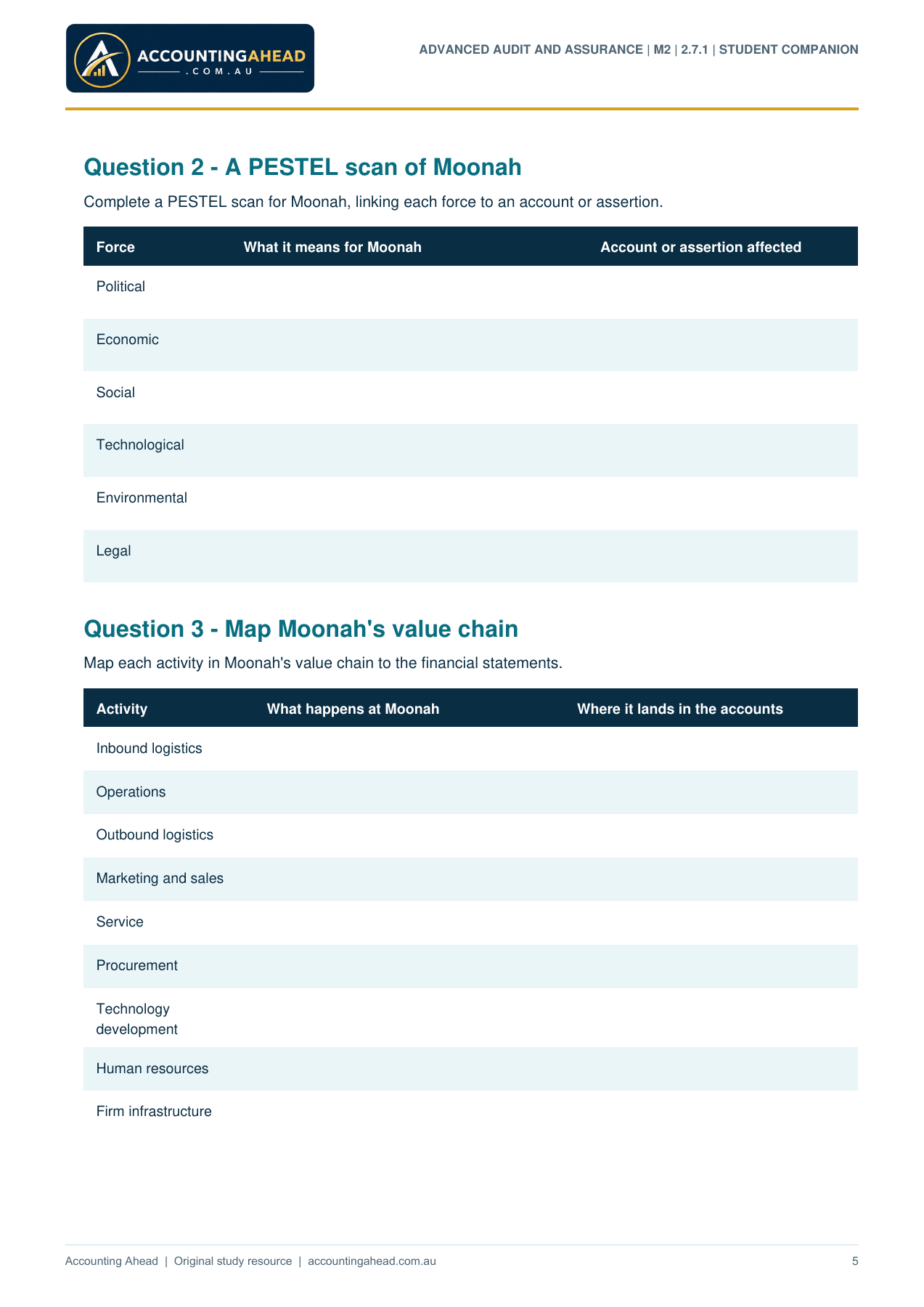
Question 2 - A PESTEL scan of Moonah
Complete a PESTEL scan for Moonah, linking each force to an account or assertion.
Force What it means for Moonah Account or assertion affected
Political
Economic
Social
Technological
Environmental
Legal
Question 3 - Map Moonah's value chain
Map each activity in Moonah's value chain to the financial statements.
Activity What happens at Moonah Where it lands in the accounts
Inbound logistics
Operations
Outbound logistics
Marketing and sales
Service
Procurement
Technology
development
Human resources
Firm infrastructure
ADVANCED AUDIT AND ASSURANCE | M2 | 2.7.1 | STUDENT COMPANION
5
Accounting Ahead | Original study resource | accountingahead.com.au
Worked answers
MODULE 2 | 2.7.1 | WORKED ANSWERS - ATTEMPT THE QUESTIONS FIRST
Question 1 - SWOT (suggested)
Items for Moonah
Strengths Hard-to-copy waterfront sites; waiting lists; fees paid in advance; varied income
Weaknesses Debt-funded acquisitions; storm-exposed pontoons; a new system bedding in; reliance on
state leases
Opportunities Higher prices or more berths for the waiting lists; dry storage; electric boat charging
Threats Storms and rising seas; interest rates; insurance premiums; tougher environmental rules
Most relevant to the audit 1. The storm: impairment of damaged pontoons, repairs versus improvements, and no
insurance recovery until virtually certain. 2. Fees in advance through a new system, with
occupancy bonuses: deferred revenue, occurrence and cut-off, billing controls
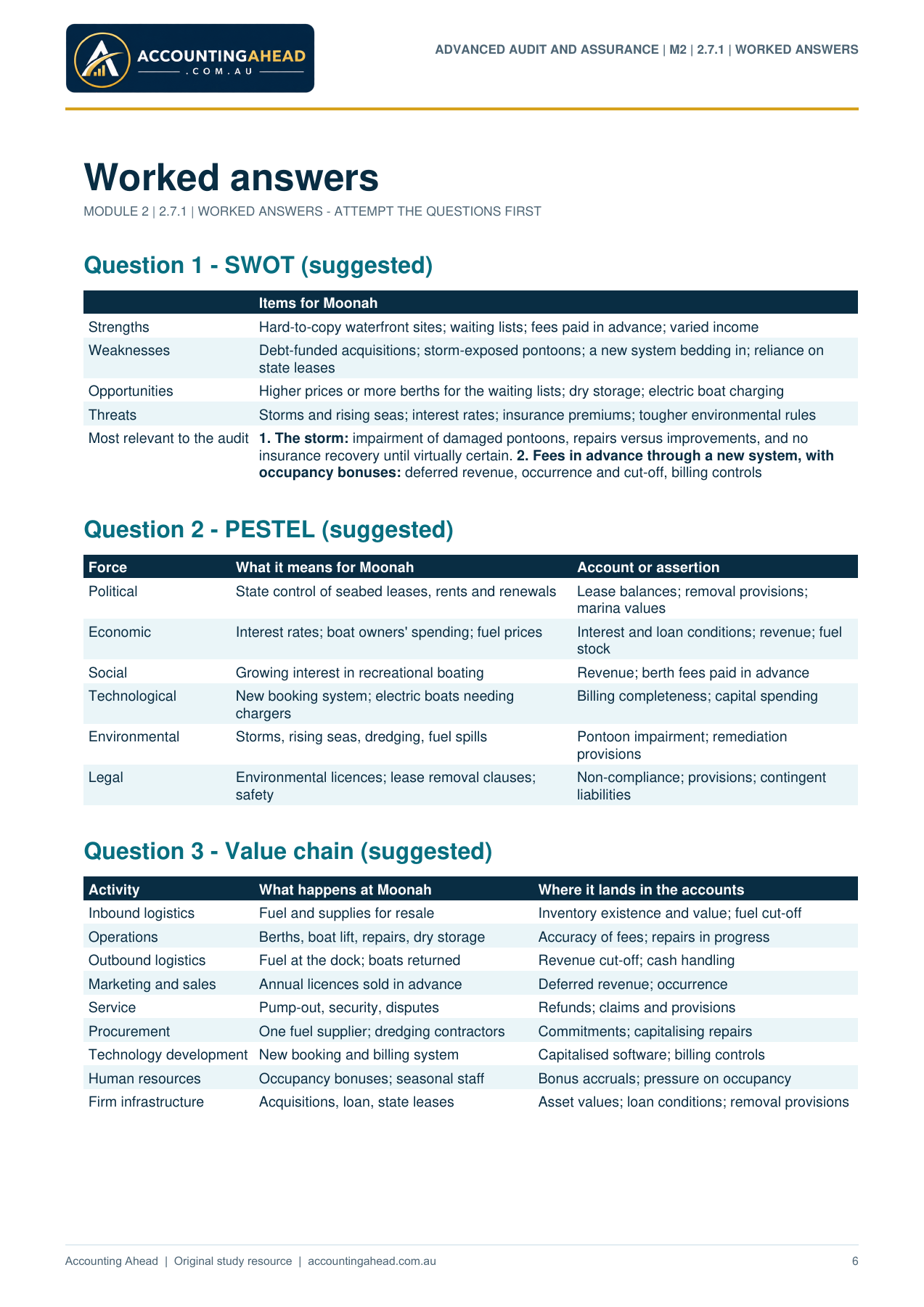
Question 2 - PESTEL (suggested)
Force What it means for Moonah Account or assertion
Political State control of seabed leases, rents and renewals Lease balances; removal provisions;
marina values
Economic Interest rates; boat owners' spending; fuel prices Interest and loan conditions; revenue; fuel
stock
Social Growing interest in recreational boating Revenue; berth fees paid in advance
Technological New booking system; electric boats needing
chargers
Billing completeness; capital spending
Environmental Storms, rising seas, dredging, fuel spills Pontoon impairment; remediation
provisions
Legal Environmental licences; lease removal clauses;
safety
Non-compliance; provisions; contingent
liabilities
Question 3 - Value chain (suggested)
Activity What happens at Moonah Where it lands in the accounts
Inbound logistics Fuel and supplies for resale Inventory existence and value; fuel cut-off
Operations Berths, boat lift, repairs, dry storage Accuracy of fees; repairs in progress
Outbound logistics Fuel at the dock; boats returned Revenue cut-off; cash handling
Marketing and sales Annual licences sold in advance Deferred revenue; occurrence
Service Pump-out, security, disputes Refunds; claims and provisions
Procurement One fuel supplier; dredging contractors Commitments; capitalising repairs
Technology development New booking and billing system Capitalised software; billing controls
Human resources Occupancy bonuses; seasonal staff Bonus accruals; pressure on occupancy
Firm infrastructure Acquisitions, loan, state leases Asset values; loan conditions; removal provisions
ADVANCED AUDIT AND ASSURANCE | M2 | 2.7.1 | WORKED ANSWERS
6