
Responding to assessed risks
Printable study notes, diagrams and practice support for Part 2.8.
Read the handout text
Accounting Ahead | Original study resource | accountingahead.com.au
Responding to assessed risks
MODULE 2 | 2.8 | STUDENT COMPANION
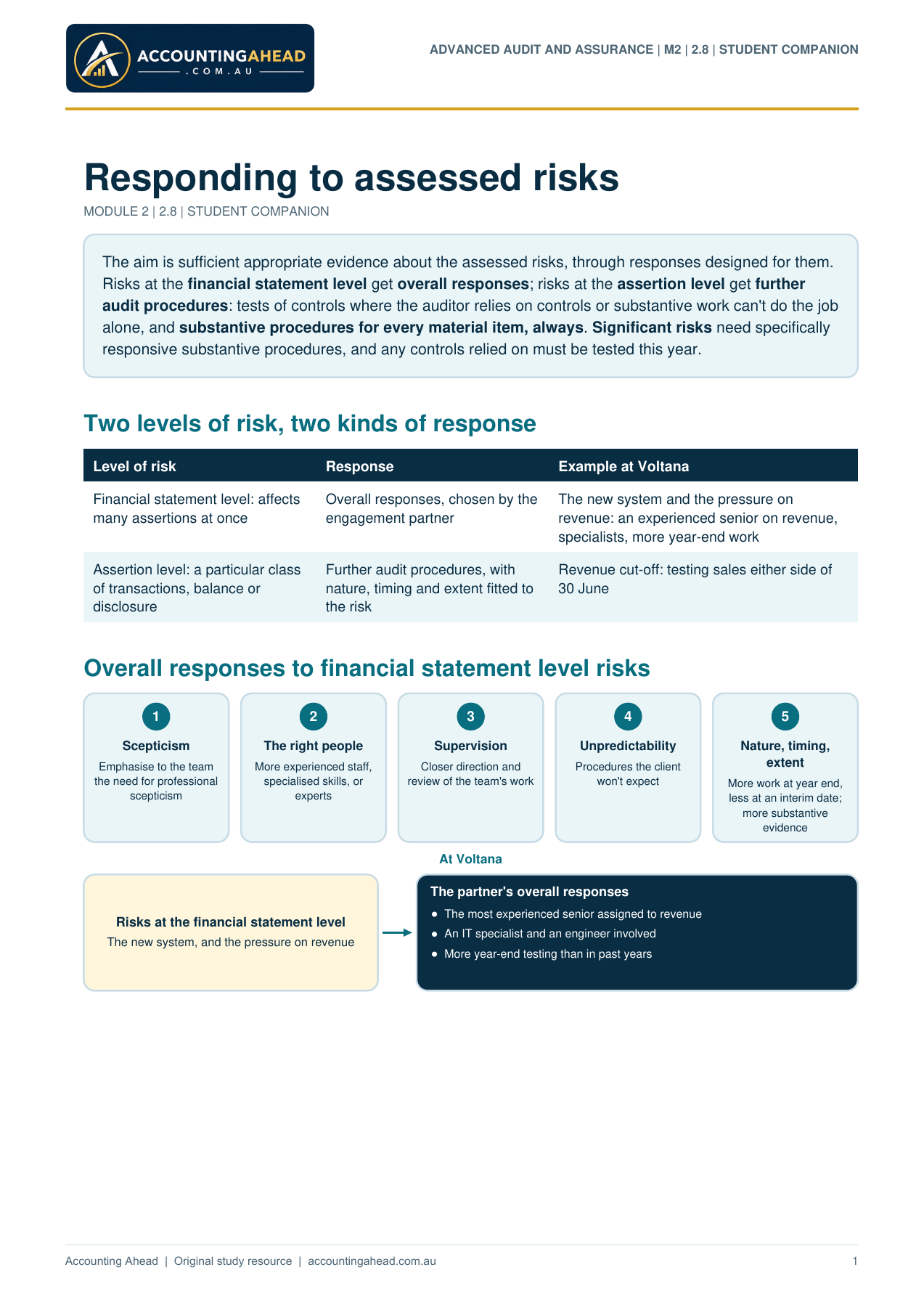
The aim is sufficient appropriate evidence about the assessed risks, through responses designed for them.
Risks at the financial statement level get overall responses; risks at the assertion level get further
audit procedures: tests of controls where the auditor relies on controls or substantive work can't do the job
alone, and substantive procedures for every material item, always. Significant risks need specifically
responsive substantive procedures, and any controls relied on must be tested this year.
Two levels of risk, two kinds of response
Level of risk Response Example at Voltana
Financial statement level: affects
many assertions at once
Overall responses, chosen by the
engagement partner
The new system and the pressure on
revenue: an experienced senior on revenue,
specialists, more year-end work
Assertion level: a particular class
of transactions, balance or
disclosure
Further audit procedures, with
nature, timing and extent fitted to
the risk
Revenue cut-off: testing sales either side of
30 June
Overall responses to financial statement level risks
1
Scepticism
Emphasise to the team
the need for professional
scepticism
2
The right people
More experienced staff,
specialised skills, or
experts
3
Supervision
Closer direction and
review of the team's work
4
Unpredictability
Procedures the client
won't expect
5
Nature, timing,
extent
More work at year end,
less at an interim date;
more substantive
evidence
At Voltana
Risks at the financial statement level
The new system, and the pressure on revenue
The partner's overall responses
The most experienced senior assigned to revenue
An IT specialist and an engineer involved
More year-end testing than in past years
ADVANCED AUDIT AND ASSURANCE | M2 | 2.8 | STUDENT COMPANION
1
Accounting Ahead | Original study resource | accountingahead.com.au
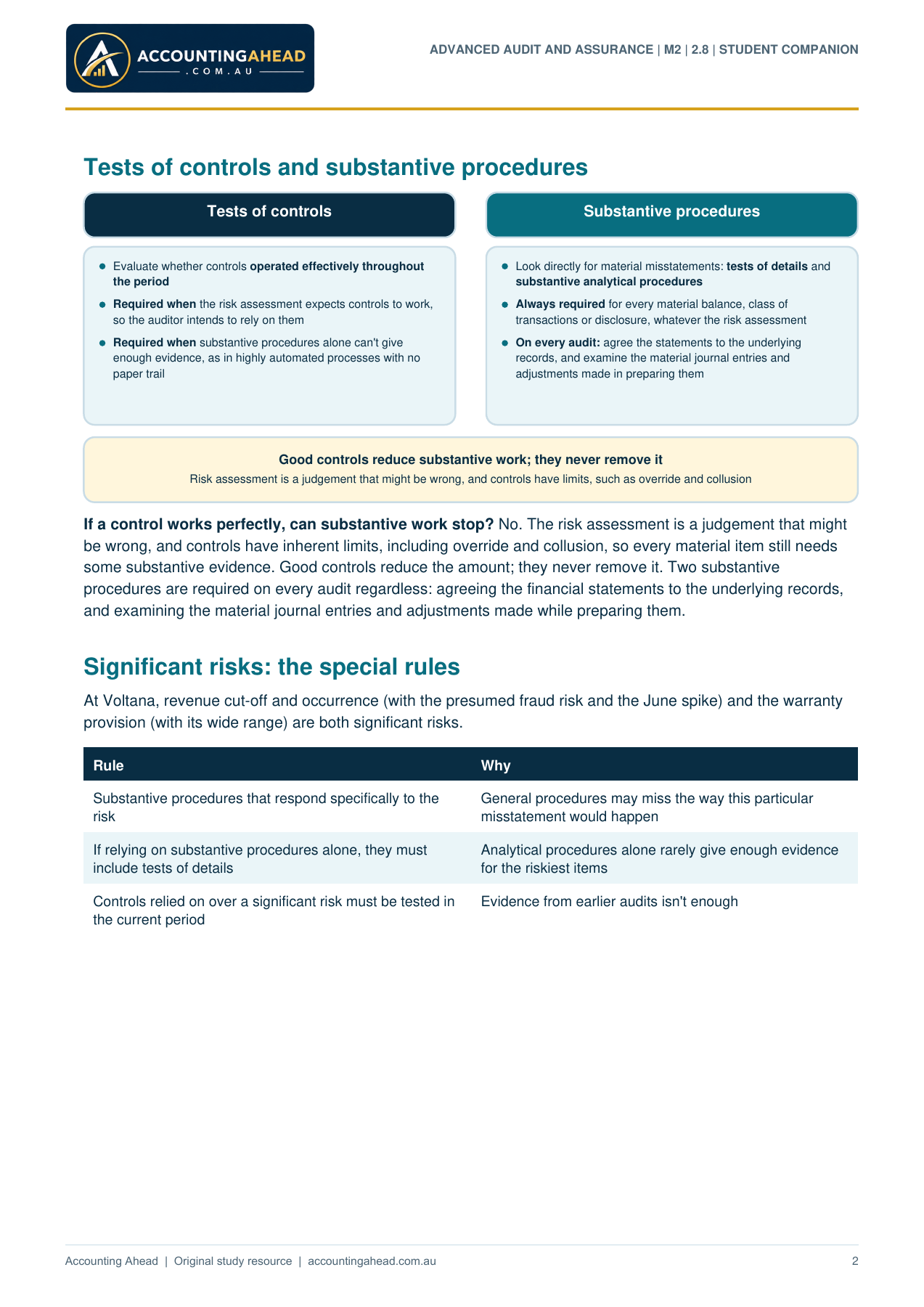
Tests of controls and substantive procedures
Tests of controls
Evaluate whether controls operated effectively throughout
the period
Required when the risk assessment expects controls to work,
so the auditor intends to rely on them
Required when substantive procedures alone can't give
enough evidence, as in highly automated processes with no
paper trail
Substantive procedures
Look directly for material misstatements: tests of details and
substantive analytical procedures
Always required for every material balance, class of
transactions or disclosure, whatever the risk assessment
On every audit: agree the statements to the underlying
records, and examine the material journal entries and
adjustments made in preparing them
Good controls reduce substantive work; they never remove it
Risk assessment is a judgement that might be wrong, and controls have limits, such as override and collusion
If a control works perfectly, can substantive work stop? No. The risk assessment is a judgement that might
be wrong, and controls have inherent limits, including override and collusion, so every material item still needs
some substantive evidence. Good controls reduce the amount; they never remove it. Two substantive
procedures are required on every audit regardless: agreeing the financial statements to the underlying records,
and examining the material journal entries and adjustments made while preparing them.
Significant risks: the special rules
At Voltana, revenue cut-off and occurrence (with the presumed fraud risk and the June spike) and the warranty
provision (with its wide range) are both significant risks.
Rule Why
Substantive procedures that respond specifically to the
risk
General procedures may miss the way this particular
misstatement would happen
If relying on substantive procedures alone, they must
include tests of details
Analytical procedures alone rarely give enough evidence
for the riskiest items
Controls relied on over a significant risk must be tested in
the current period
Evidence from earlier audits isn't enough
ADVANCED AUDIT AND ASSURANCE | M2 | 2.8 | STUDENT COMPANION
2
Accounting Ahead | Original study resource | accountingahead.com.au
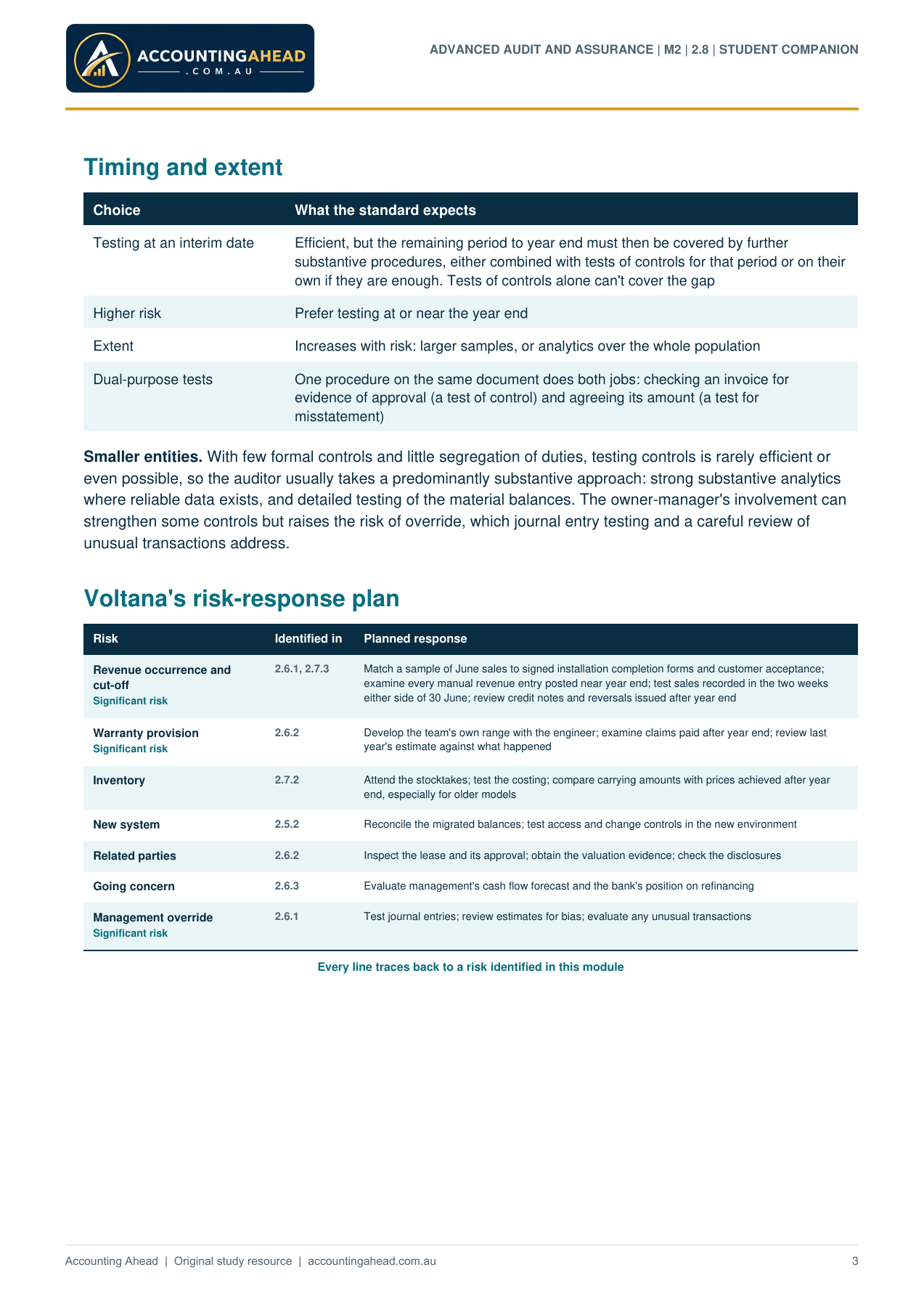
Timing and extent
Choice What the standard expects
Testing at an interim date Efficient, but the remaining period to year end must then be covered by further
substantive procedures, either combined with tests of controls for that period or on their
own if they are enough. Tests of controls alone can't cover the gap
Higher risk Prefer testing at or near the year end
Extent Increases with risk: larger samples, or analytics over the whole population
Dual-purpose tests One procedure on the same document does both jobs: checking an invoice for
evidence of approval (a test of control) and agreeing its amount (a test for
misstatement)
Smaller entities. With few formal controls and little segregation of duties, testing controls is rarely efficient or
even possible, so the auditor usually takes a predominantly substantive approach: strong substantive analytics
where reliable data exists, and detailed testing of the material balances. The owner-manager's involvement can
strengthen some controls but raises the risk of override, which journal entry testing and a careful review of
unusual transactions address.
Voltana's risk-response plan
Risk Identified in Planned response
Revenue occurrence and
cut-off
Significant risk
2.6.1, 2.7.3 Match a sample of June sales to signed installation completion forms and customer acceptance;
examine every manual revenue entry posted near year end; test sales recorded in the two weeks
either side of 30 June; review credit notes and reversals issued after year end
Warranty provision
Significant risk
2.6.2 Develop the team's own range with the engineer; examine claims paid after year end; review last
year's estimate against what happened
Inventory 2.7.2 Attend the stocktakes; test the costing; compare carrying amounts with prices achieved after year
end, especially for older models
New system 2.5.2 Reconcile the migrated balances; test access and change controls in the new environment
Related parties 2.6.2 Inspect the lease and its approval; obtain the valuation evidence; check the disclosures
Going concern 2.6.3 Evaluate management's cash flow forecast and the bank's position on refinancing
Management override
Significant risk
2.6.1 Test journal entries; review estimates for bias; evaluate any unusual transactions
Every line traces back to a risk identified in this module
ADVANCED AUDIT AND ASSURANCE | M2 | 2.8 | STUDENT COMPANION
3
Accounting Ahead | Original study resource | accountingahead.com.au
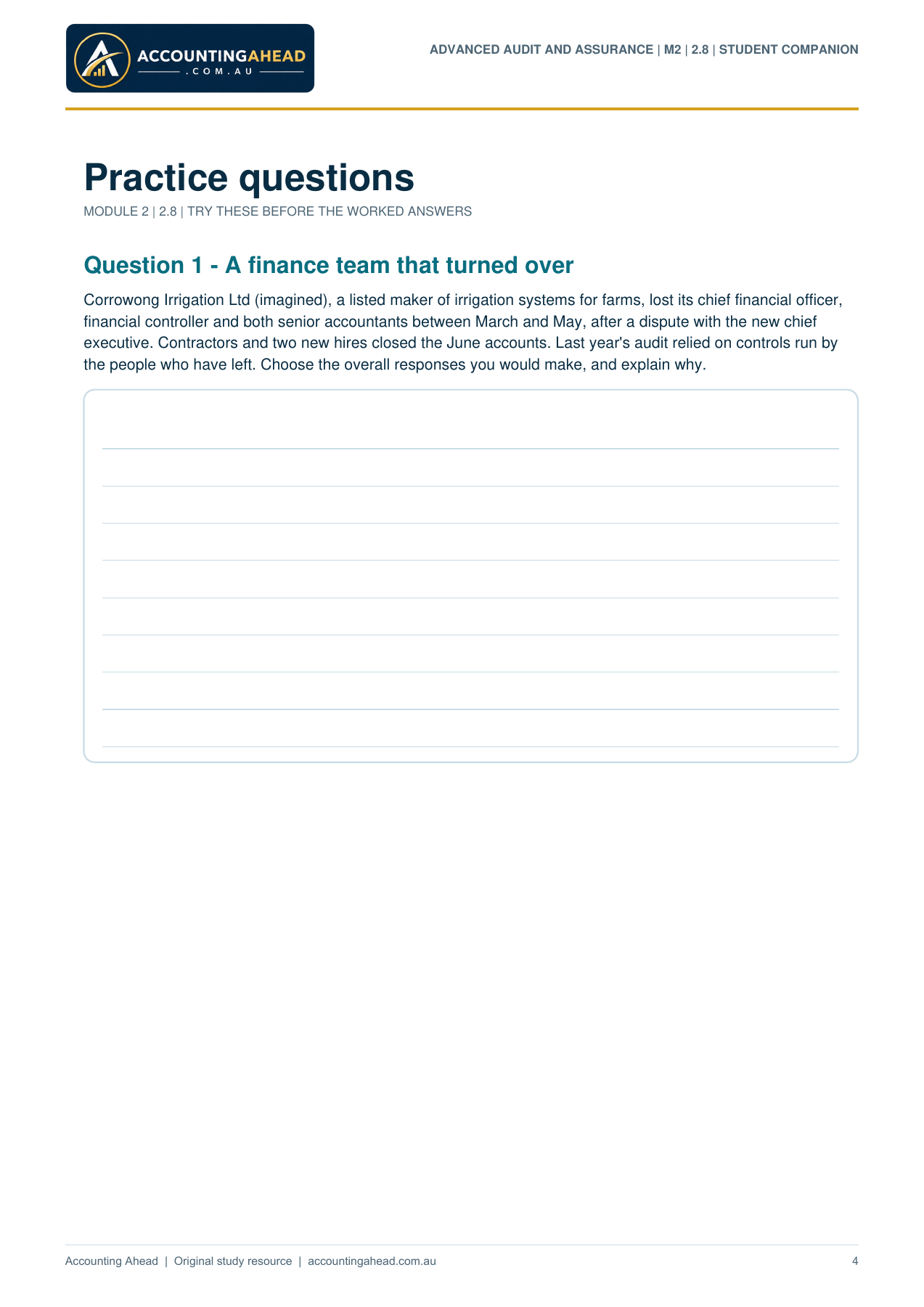
Practice questions
MODULE 2 | 2.8 | TRY THESE BEFORE THE WORKED ANSWERS
Question 1 - A finance team that turned over
Corrowong Irrigation Ltd (imagined), a listed maker of irrigation systems for farms, lost its chief financial officer,
financial controller and both senior accountants between March and May, after a dispute with the new chief
executive. Contractors and two new hires closed the June accounts. Last year's audit relied on controls run by
the people who have left. Choose the overall responses you would make, and explain why.
ADVANCED AUDIT AND ASSURANCE | M2 | 2.8 | STUDENT COMPANION
4
Accounting Ahead | Original study resource | accountingahead.com.au
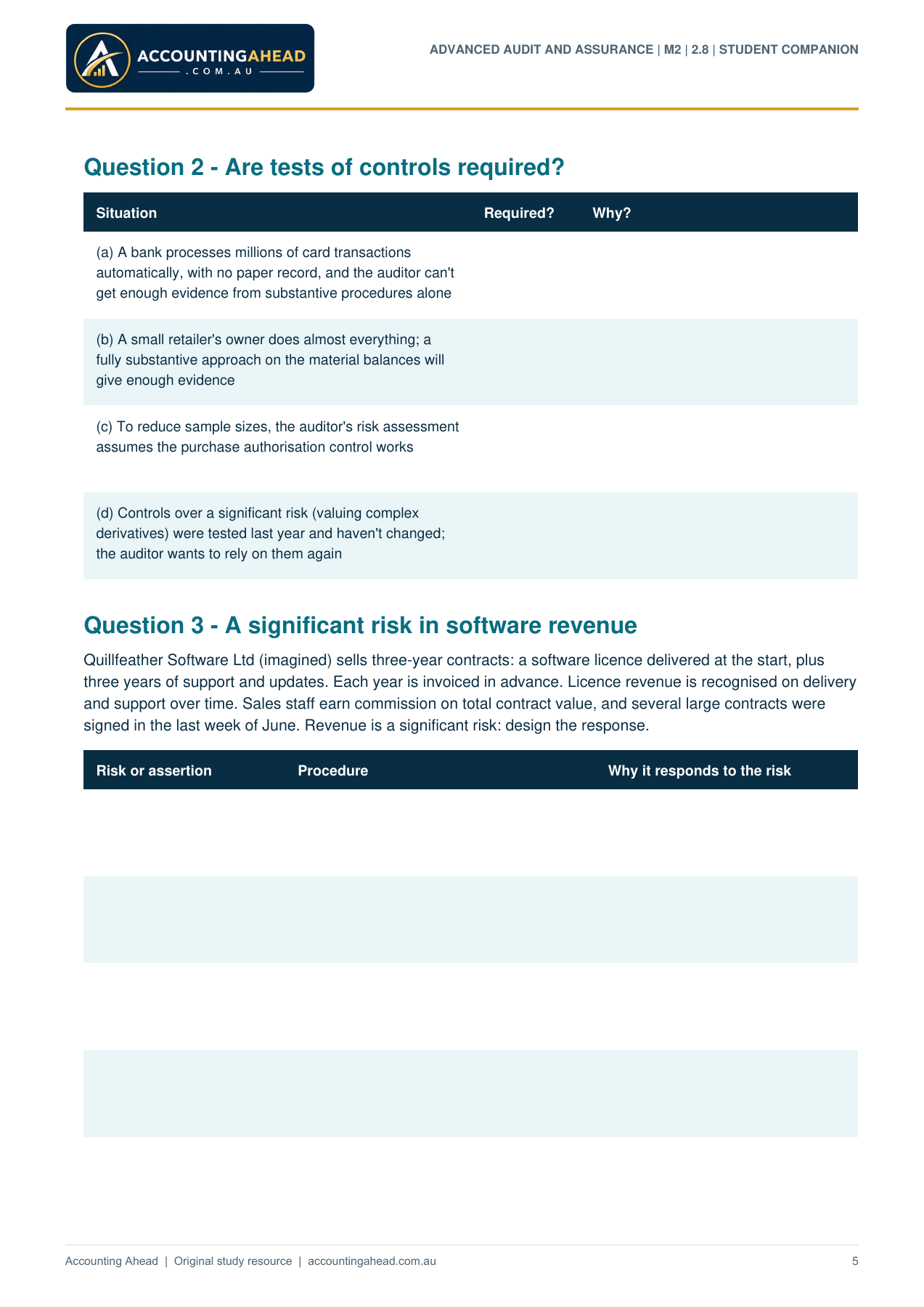
Question 2 - Are tests of controls required?
Situation Required? Why?
(a) A bank processes millions of card transactions
automatically, with no paper record, and the auditor can't
get enough evidence from substantive procedures alone
(b) A small retailer's owner does almost everything; a
fully substantive approach on the material balances will
give enough evidence
(c) To reduce sample sizes, the auditor's risk assessment
assumes the purchase authorisation control works
(d) Controls over a significant risk (valuing complex
derivatives) were tested last year and haven't changed;
the auditor wants to rely on them again
Question 3 - A significant risk in software revenue
Quillfeather Software Ltd (imagined) sells three-year contracts: a software licence delivered at the start, plus
three years of support and updates. Each year is invoiced in advance. Licence revenue is recognised on delivery
and support over time. Sales staff earn commission on total contract value, and several large contracts were
signed in the last week of June. Revenue is a significant risk: design the response.
Risk or assertion Procedure Why it responds to the risk
ADVANCED AUDIT AND ASSURANCE | M2 | 2.8 | STUDENT COMPANION
5
Accounting Ahead | Original study resource | accountingahead.com.au
Worked answers
MODULE 2 | 2.8 | WORKED ANSWERS - ATTEMPT THE QUESTIONS FIRST
Question 1 - Corrowong Irrigation (sample answer)
Emphasise scepticism. New people, an unfamiliar close and a boardroom dispute: errors are more likely, and
the departures themselves need explaining. Ask why they left and whether they disagreed with any accounting.
Assign experienced staff and more supervision. Put an experienced senior on the year-end close, journals
and estimates; more manager and partner review; specialists if system knowledge left with the staff.
Change the nature, timing and extent. Last year's reliance on controls no longer holds, so plan a mainly
substantive approach, more work at year end, larger samples, more external evidence, and a full review of
reconciliations and judgements prepared by the contractors.
Add unpredictability and discuss the plan with those charged with governance.
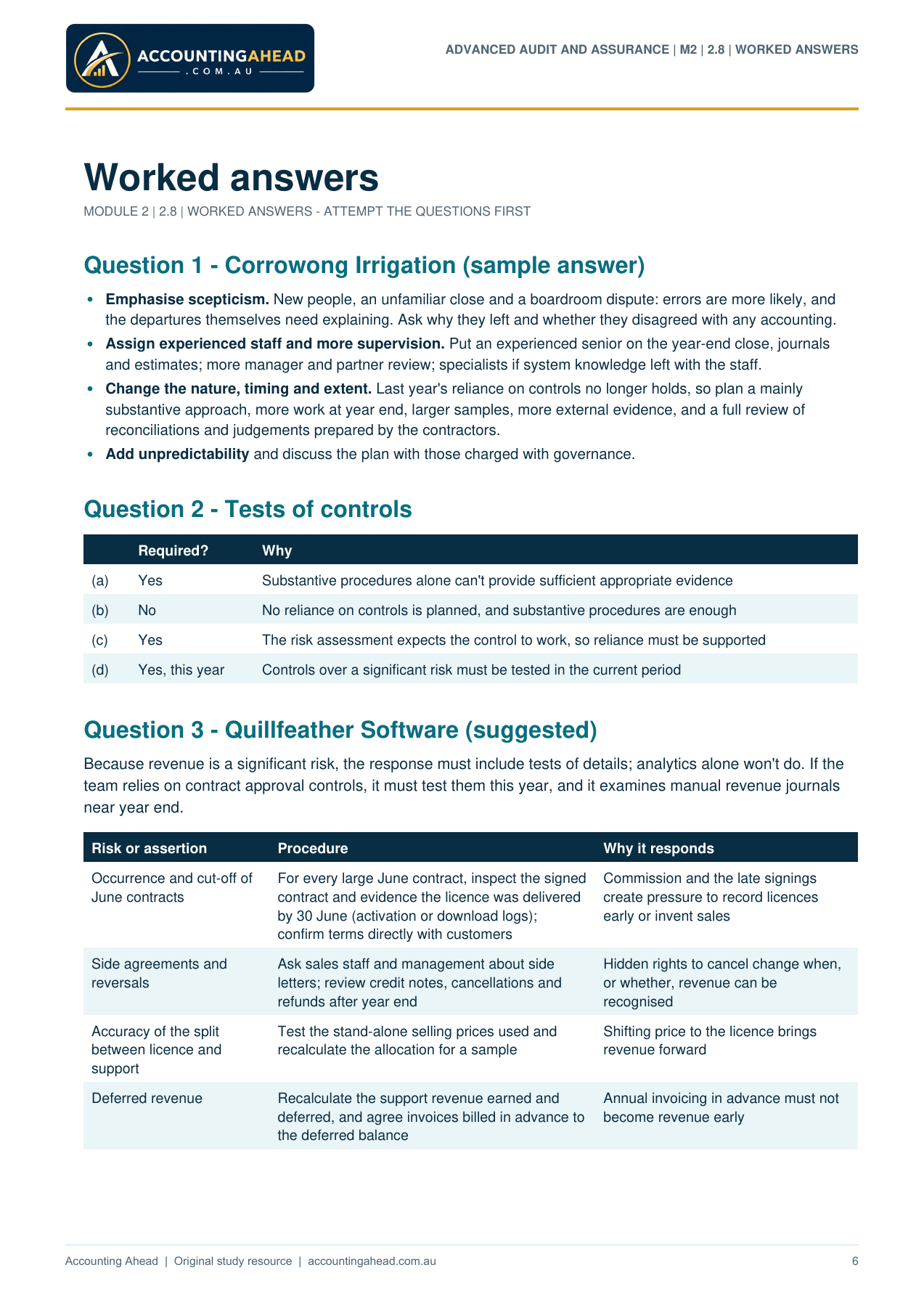
Question 2 - Tests of controls
Required? Why
(a) Yes Substantive procedures alone can't provide sufficient appropriate evidence
(b) No No reliance on controls is planned, and substantive procedures are enough
(c) Yes The risk assessment expects the control to work, so reliance must be supported
(d) Yes, this year Controls over a significant risk must be tested in the current period
Question 3 - Quillfeather Software (suggested)
Because revenue is a significant risk, the response must include tests of details; analytics alone won't do. If the
team relies on contract approval controls, it must test them this year, and it examines manual revenue journals
near year end.
Risk or assertion Procedure Why it responds
Occurrence and cut-off of
June contracts
For every large June contract, inspect the signed
contract and evidence the licence was delivered
by 30 June (activation or download logs);
confirm terms directly with customers
Commission and the late signings
create pressure to record licences
early or invent sales
Side agreements and
reversals
Ask sales staff and management about side
letters; review credit notes, cancellations and
refunds after year end
Hidden rights to cancel change when,
or whether, revenue can be
recognised
Accuracy of the split
between licence and
support
Test the stand-alone selling prices used and
recalculate the allocation for a sample
Shifting price to the licence brings
revenue forward
Deferred revenue Recalculate the support revenue earned and
deferred, and agree invoices billed in advance to
the deferred balance
Annual invoicing in advance must not
become revenue early
ADVANCED AUDIT AND ASSURANCE | M2 | 2.8 | WORKED ANSWERS
6