
Evidence, assertions and audit procedures
Printable study notes, diagrams and practice support for Part 3.1.
Read the handout text
Accounting Ahead | Original study resource | accountingahead.com.au
Evidence, assertions and audit procedures
MODULE 3 | 3.1 | STUDENT COMPANION
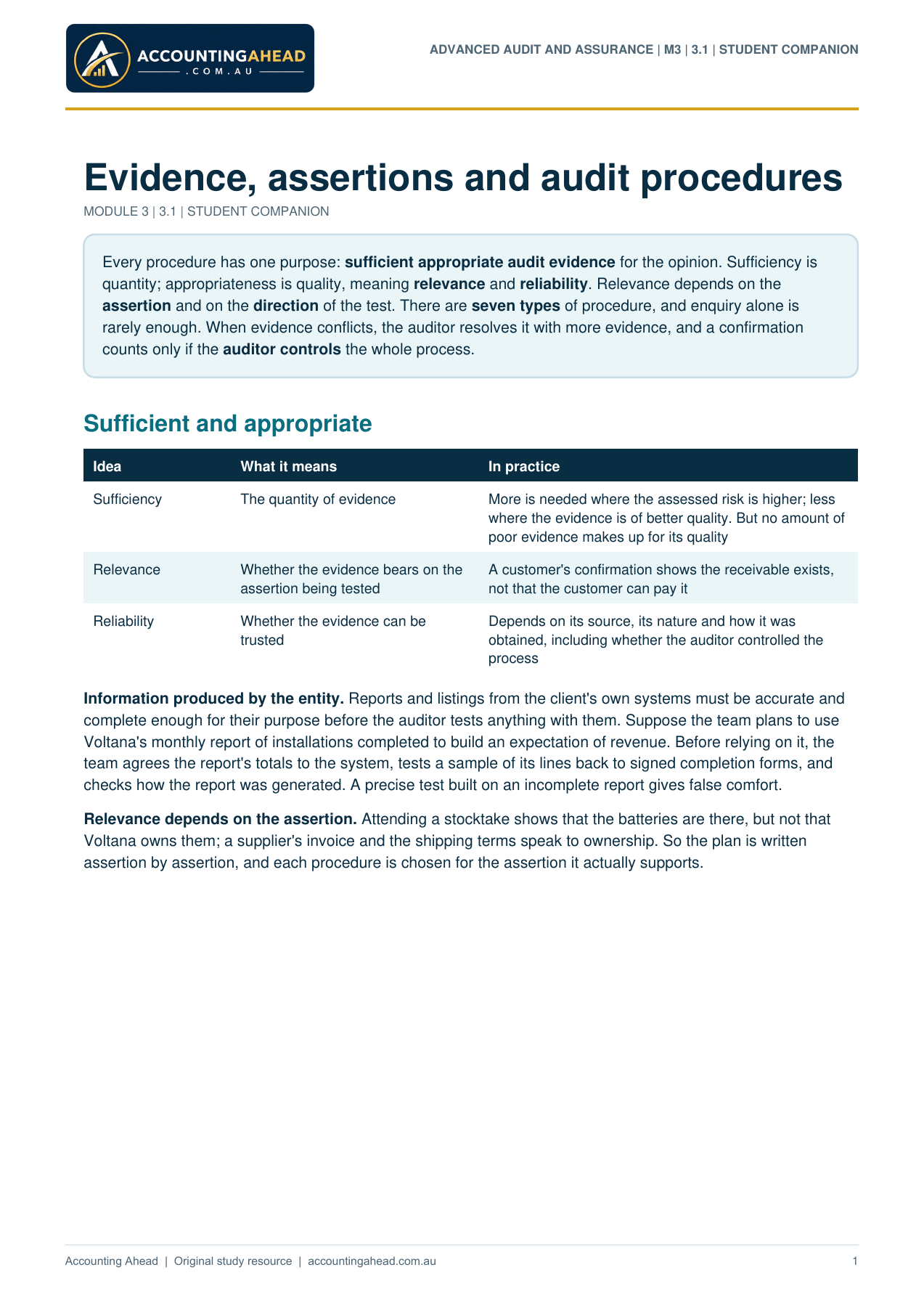
Every procedure has one purpose: sufficient appropriate audit evidence for the opinion. Sufficiency is
quantity; appropriateness is quality, meaning relevance and reliability. Relevance depends on the
assertion and on the direction of the test. There are seven types of procedure, and enquiry alone is
rarely enough. When evidence conflicts, the auditor resolves it with more evidence, and a confirmation
counts only if the auditor controls the whole process.
Sufficient and appropriate
Idea What it means In practice
Sufficiency The quantity of evidence More is needed where the assessed risk is higher; less
where the evidence is of better quality. But no amount of
poor evidence makes up for its quality
Relevance Whether the evidence bears on the
assertion being tested
A customer's confirmation shows the receivable exists,
not that the customer can pay it
Reliability Whether the evidence can be
trusted
Depends on its source, its nature and how it was
obtained, including whether the auditor controlled the
process
Information produced by the entity. Reports and listings from the client's own systems must be accurate and
complete enough for their purpose before the auditor tests anything with them. Suppose the team plans to use
Voltana's monthly report of installations completed to build an expectation of revenue. Before relying on it, the
team agrees the report's totals to the system, tests a sample of its lines back to signed completion forms, and
checks how the report was generated. A precise test built on an incomplete report gives false comfort.
Relevance depends on the assertion. Attending a stocktake shows that the batteries are there, but not that
Voltana owns them; a supplier's invoice and the shipping terms speak to ownership. So the plan is written
assertion by assertion, and each procedure is chosen for the assertion it actually supports.
ADVANCED AUDIT AND ASSURANCE | M3 | 3.1 | STUDENT COMPANION
1
Accounting Ahead | Original study resource | accountingahead.com.au
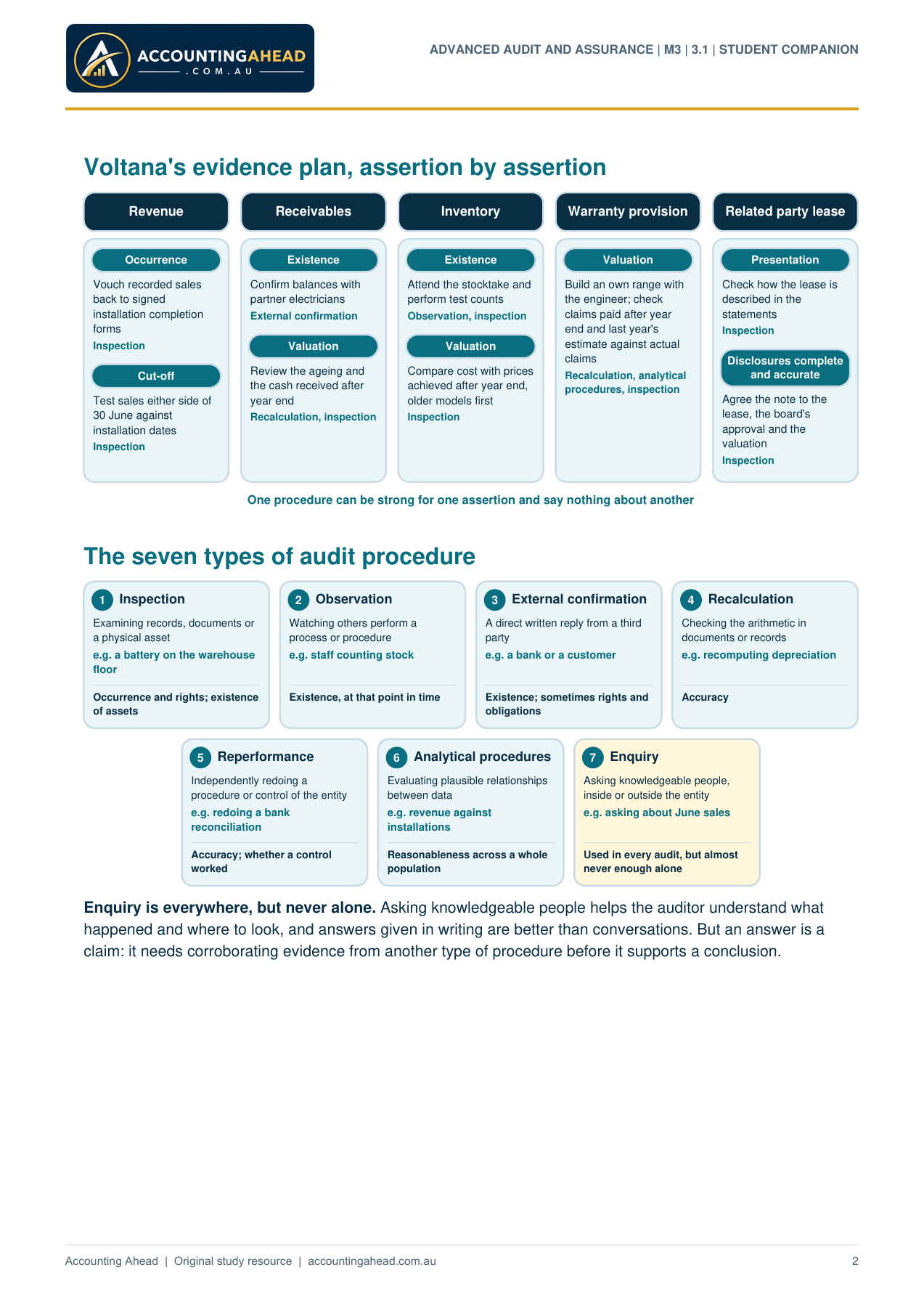
Voltana's evidence plan, assertion by assertion
Revenue
Occurrence
Vouch recorded sales
back to signed
installation completion
forms
Inspection
Cut-off
Test sales either side of
30 June against
installation dates
Inspection
Receivables
Existence
Confirm balances with
partner electricians
External confirmation
Valuation
Review the ageing and
the cash received after
year end
Recalculation, inspection
Inventory
Existence
Attend the stocktake and
perform test counts
Observation, inspection
Valuation
Compare cost with prices
achieved after year end,
older models first
Inspection
Warranty provision
Valuation
Build an own range with
the engineer; check
claims paid after year
end and last year's
estimate against actual
claims
Recalculation, analytical
procedures, inspection
Related party lease
Presentation
Check how the lease is
described in the
statements
Inspection
Disclosures complete
and accurate
Agree the note to the
lease, the board's
approval and the
valuation
Inspection
One procedure can be strong for one assertion and say nothing about another
The seven types of audit procedure
1 Inspection
Examining records, documents or
a physical asset
e.g. a battery on the warehouse
floor
Occurrence and rights; existence
of assets
2 Observation
Watching others perform a
process or procedure
e.g. staff counting stock
Existence, at that point in time
3 External confirmation
A direct written reply from a third
party
e.g. a bank or a customer
Existence; sometimes rights and
obligations
4 Recalculation
Checking the arithmetic in
documents or records
e.g. recomputing depreciation
Accuracy
5 Reperformance
Independently redoing a
procedure or control of the entity
e.g. redoing a bank
reconciliation
Accuracy; whether a control
worked
6 Analytical procedures
Evaluating plausible relationships
between data
e.g. revenue against
installations
Reasonableness across a whole
population
7 Enquiry
Asking knowledgeable people,
inside or outside the entity
e.g. asking about June sales
Used in every audit, but almost
never enough alone
Enquiry is everywhere, but never alone. Asking knowledgeable people helps the auditor understand what
happened and where to look, and answers given in writing are better than conversations. But an answer is a
claim: it needs corroborating evidence from another type of procedure before it supports a conclusion.
ADVANCED AUDIT AND ASSURANCE | M3 | 3.1 | STUDENT COMPANION
2
Accounting Ahead | Original study resource | accountingahead.com.au
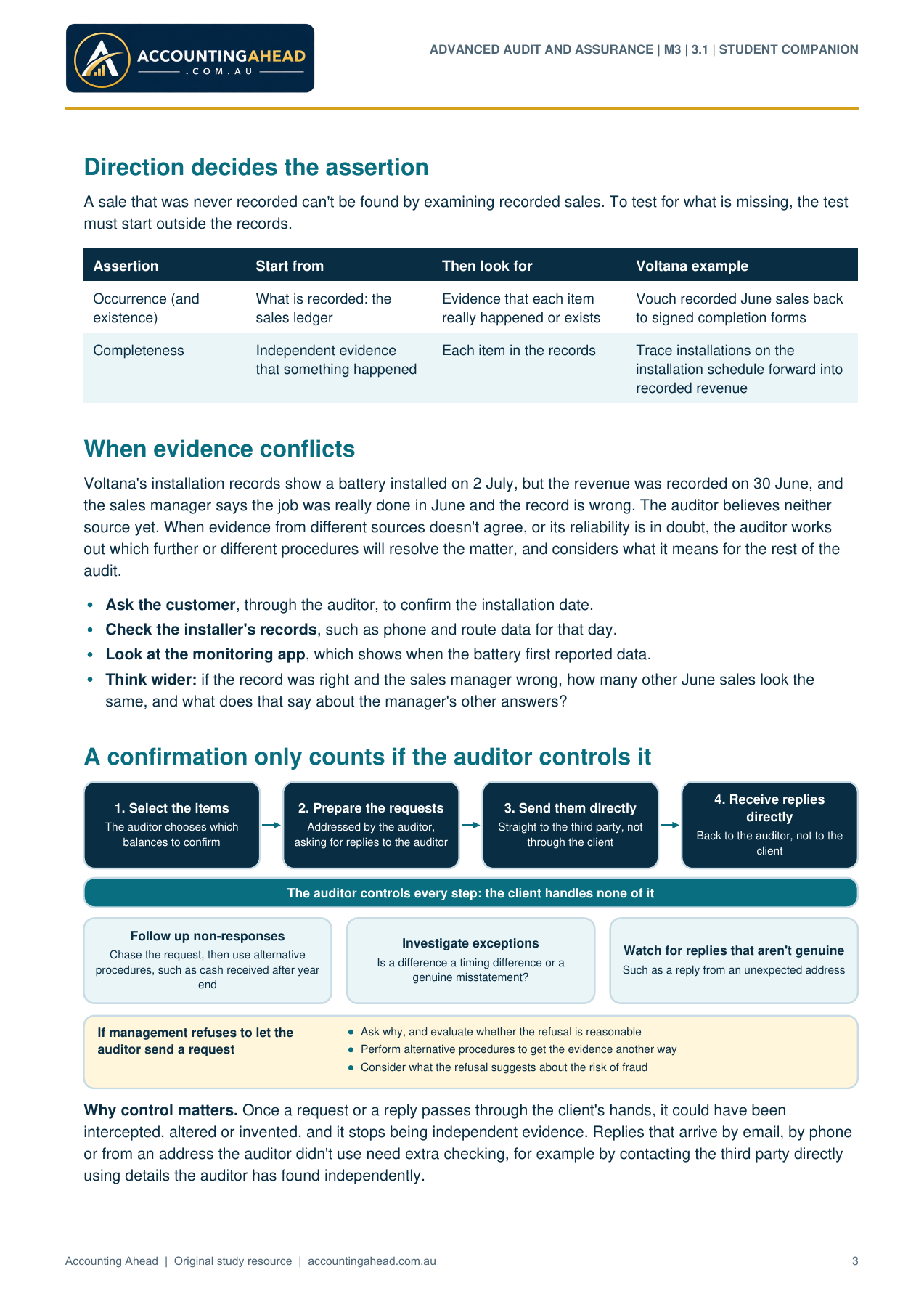
Direction decides the assertion
A sale that was never recorded can't be found by examining recorded sales. To test for what is missing, the test
must start outside the records.
Assertion Start from Then look for Voltana example
Occurrence (and
existence)
What is recorded: the
sales ledger
Evidence that each item
really happened or exists
Vouch recorded June sales back
to signed completion forms
Completeness Independent evidence
that something happened
Each item in the records Trace installations on the
installation schedule forward into
recorded revenue
When evidence conflicts
Voltana's installation records show a battery installed on 2 July, but the revenue was recorded on 30 June, and
the sales manager says the job was really done in June and the record is wrong. The auditor believes neither
source yet. When evidence from different sources doesn't agree, or its reliability is in doubt, the auditor works
out which further or different procedures will resolve the matter, and considers what it means for the rest of the
audit.
Ask the customer, through the auditor, to confirm the installation date.
Check the installer's records, such as phone and route data for that day.
Look at the monitoring app, which shows when the battery first reported data.
Think wider: if the record was right and the sales manager wrong, how many other June sales look the
same, and what does that say about the manager's other answers?
A confirmation only counts if the auditor controls it
1. Select the items
The auditor chooses which
balances to confirm
2. Prepare the requests
Addressed by the auditor,
asking for replies to the auditor
3. Send them directly
Straight to the third party, not
through the client
4. Receive replies
directly
Back to the auditor, not to the
client
The auditor controls every step: the client handles none of it
Follow up non-responses
Chase the request, then use alternative
procedures, such as cash received after year
end
Investigate exceptions
Is a difference a timing difference or a
genuine misstatement?
Watch for replies that aren't genuine
Such as a reply from an unexpected address
If management refuses to let the
auditor send a request
Ask why, and evaluate whether the refusal is reasonable
Perform alternative procedures to get the evidence another way
Consider what the refusal suggests about the risk of fraud
Why control matters. Once a request or a reply passes through the client's hands, it could have been
intercepted, altered or invented, and it stops being independent evidence. Replies that arrive by email, by phone
or from an address the auditor didn't use need extra checking, for example by contacting the third party directly
using details the auditor has found independently.
ADVANCED AUDIT AND ASSURANCE | M3 | 3.1 | STUDENT COMPANION
3
Accounting Ahead | Original study resource | accountingahead.com.au
Practice questions
MODULE 3 | 3.1 | TRY THESE BEFORE THE WORKED ANSWERS
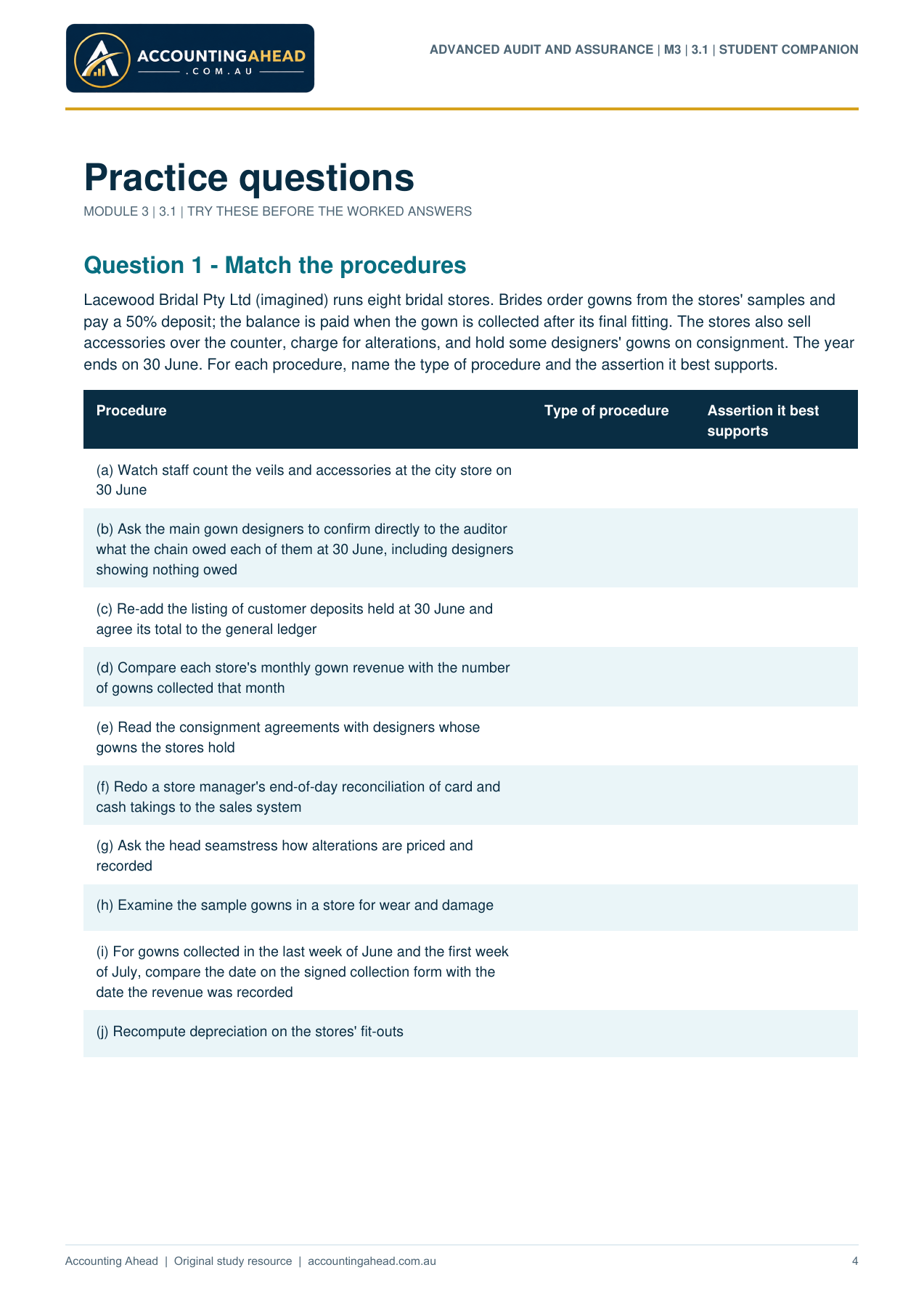
Question 1 - Match the procedures
Lacewood Bridal Pty Ltd (imagined) runs eight bridal stores. Brides order gowns from the stores' samples and
pay a 50% deposit; the balance is paid when the gown is collected after its final fitting. The stores also sell
accessories over the counter, charge for alterations, and hold some designers' gowns on consignment. The year
ends on 30 June. For each procedure, name the type of procedure and the assertion it best supports.
Procedure Type of procedure Assertion it best
supports
(a) Watch staff count the veils and accessories at the city store on
30 June
(b) Ask the main gown designers to confirm directly to the auditor
what the chain owed each of them at 30 June, including designers
showing nothing owed
(c) Re-add the listing of customer deposits held at 30 June and
agree its total to the general ledger
(d) Compare each store's monthly gown revenue with the number
of gowns collected that month
(e) Read the consignment agreements with designers whose
gowns the stores hold
(f) Redo a store manager's end-of-day reconciliation of card and
cash takings to the sales system
(g) Ask the head seamstress how alterations are priced and
recorded
(h) Examine the sample gowns in a store for wear and damage
(i) For gowns collected in the last week of June and the first week
of July, compare the date on the signed collection form with the
date the revenue was recorded
(j) Recompute depreciation on the stores' fit-outs
ADVANCED AUDIT AND ASSURANCE | M3 | 3.1 | STUDENT COMPANION
4
Accounting Ahead | Original study resource | accountingahead.com.au
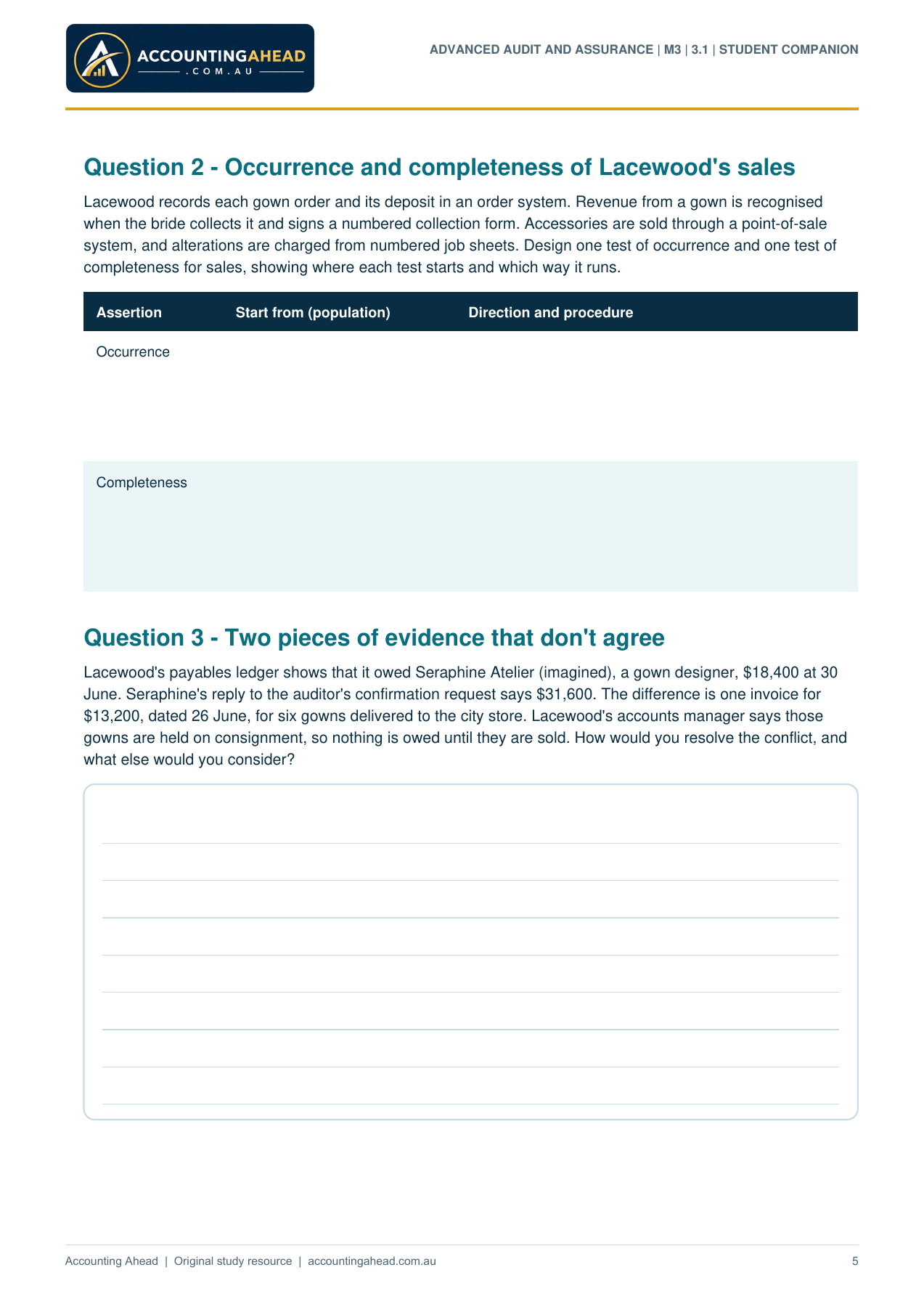
Question 2 - Occurrence and completeness of Lacewood's sales
Lacewood records each gown order and its deposit in an order system. Revenue from a gown is recognised
when the bride collects it and signs a numbered collection form. Accessories are sold through a point-of-sale
system, and alterations are charged from numbered job sheets. Design one test of occurrence and one test of
completeness for sales, showing where each test starts and which way it runs.
Assertion Start from (population) Direction and procedure
Occurrence
Completeness
Question 3 - Two pieces of evidence that don't agree
Lacewood's payables ledger shows that it owed Seraphine Atelier (imagined), a gown designer, $18,400 at 30
June. Seraphine's reply to the auditor's confirmation request says $31,600. The difference is one invoice for
$13,200, dated 26 June, for six gowns delivered to the city store. Lacewood's accounts manager says those
gowns are held on consignment, so nothing is owed until they are sold. How would you resolve the conflict, and
what else would you consider?
ADVANCED AUDIT AND ASSURANCE | M3 | 3.1 | STUDENT COMPANION
5
Accounting Ahead | Original study resource | accountingahead.com.au
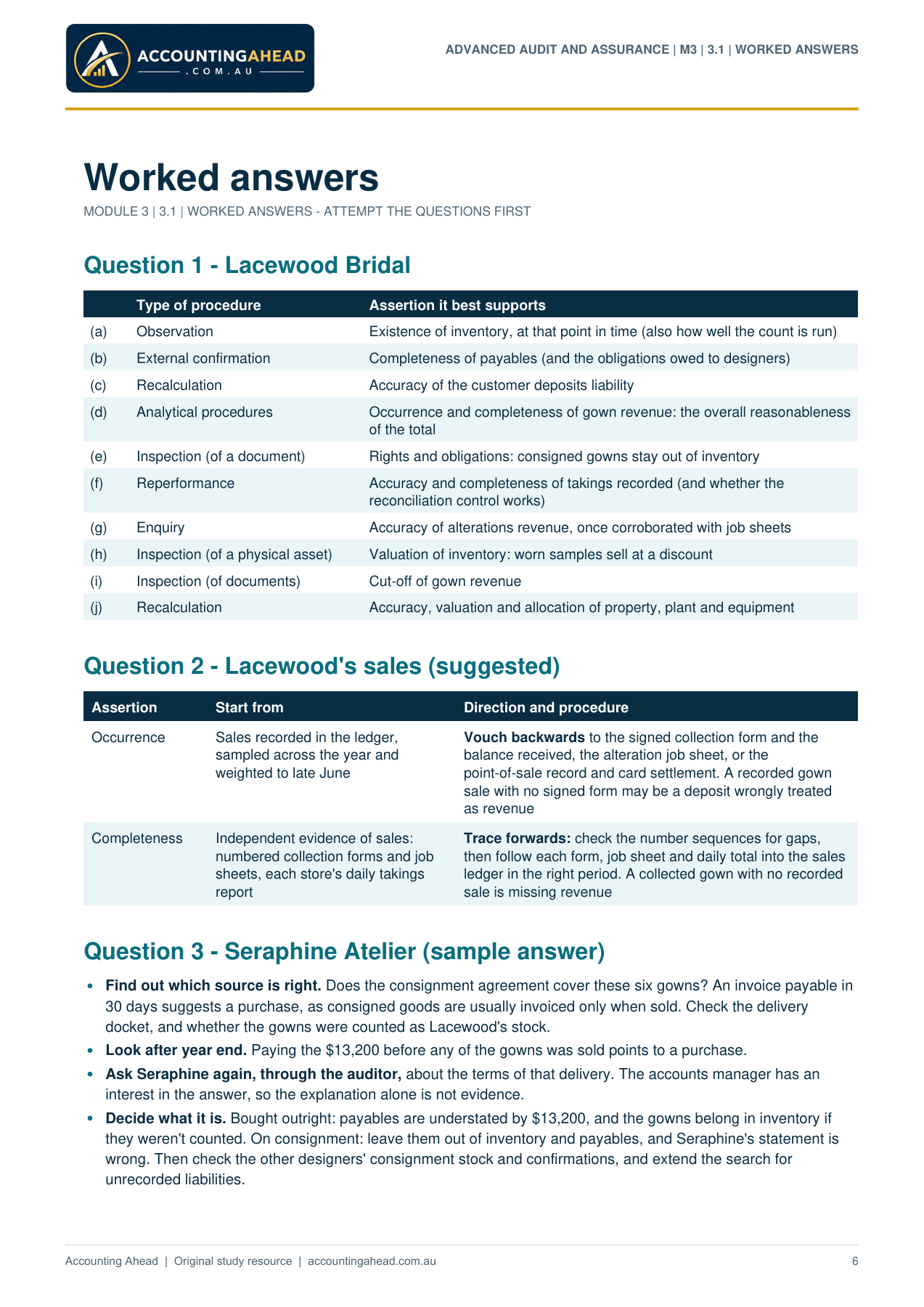
Worked answers
MODULE 3 | 3.1 | WORKED ANSWERS - ATTEMPT THE QUESTIONS FIRST
Question 1 - Lacewood Bridal
Type of procedure Assertion it best supports
(a) Observation Existence of inventory, at that point in time (also how well the count is run)
(b) External confirmation Completeness of payables (and the obligations owed to designers)
(c) Recalculation Accuracy of the customer deposits liability
(d) Analytical procedures Occurrence and completeness of gown revenue: the overall reasonableness
of the total
(e) Inspection (of a document) Rights and obligations: consigned gowns stay out of inventory
(f) Reperformance Accuracy and completeness of takings recorded (and whether the
reconciliation control works)
(g) Enquiry Accuracy of alterations revenue, once corroborated with job sheets
(h) Inspection (of a physical asset) Valuation of inventory: worn samples sell at a discount
(i) Inspection (of documents) Cut-off of gown revenue
(j) Recalculation Accuracy, valuation and allocation of property, plant and equipment
Question 2 - Lacewood's sales (suggested)
Assertion Start from Direction and procedure
Occurrence Sales recorded in the ledger,
sampled across the year and
weighted to late June
Vouch backwards to the signed collection form and the
balance received, the alteration job sheet, or the
point-of-sale record and card settlement. A recorded gown
sale with no signed form may be a deposit wrongly treated
as revenue
Completeness Independent evidence of sales:
numbered collection forms and job
sheets, each store's daily takings
report
Trace forwards: check the number sequences for gaps,
then follow each form, job sheet and daily total into the sales
ledger in the right period. A collected gown with no recorded
sale is missing revenue
Question 3 - Seraphine Atelier (sample answer)
Find out which source is right. Does the consignment agreement cover these six gowns? An invoice payable in
30 days suggests a purchase, as consigned goods are usually invoiced only when sold. Check the delivery
docket, and whether the gowns were counted as Lacewood's stock.
Look after year end. Paying the $13,200 before any of the gowns was sold points to a purchase.
Ask Seraphine again, through the auditor, about the terms of that delivery. The accounts manager has an
interest in the answer, so the explanation alone is not evidence.
Decide what it is. Bought outright: payables are understated by $13,200, and the gowns belong in inventory if
they weren't counted. On consignment: leave them out of inventory and payables, and Seraphine's statement is
wrong. Then check the other designers' consignment stock and confirmations, and extend the search for
unrecorded liabilities.
ADVANCED AUDIT AND ASSURANCE | M3 | 3.1 | WORKED ANSWERS
6