
Tests of controls
Printable study notes, diagrams and practice support for Part 3.2.1.
Read the handout text
Accounting Ahead | Original study resource | accountingahead.com.au
Tests of controls
MODULE 3 | 3.2.1 | STUDENT COMPANION
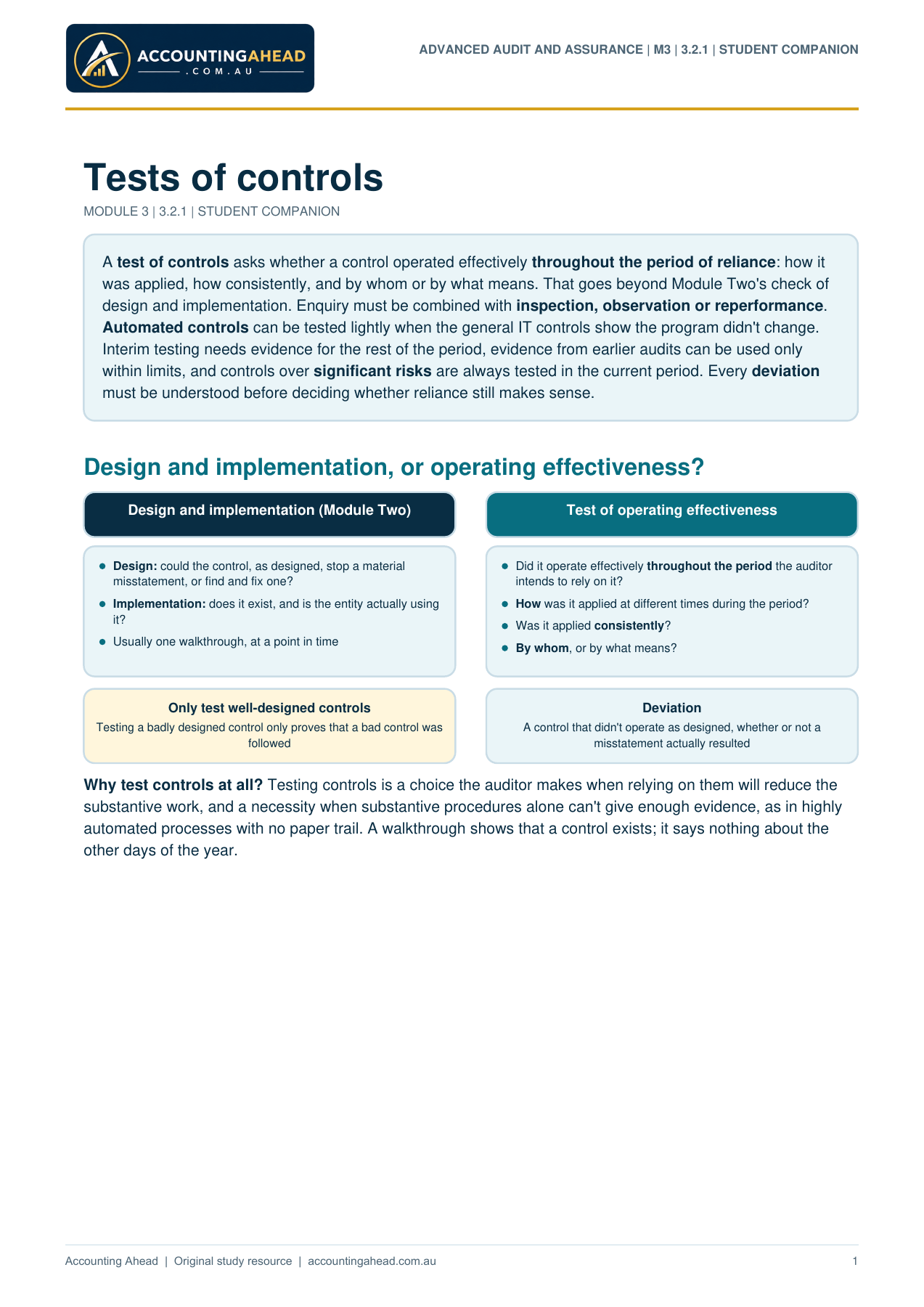
A test of controls asks whether a control operated effectively throughout the period of reliance: how it
was applied, how consistently, and by whom or by what means. That goes beyond Module Two's check of
design and implementation. Enquiry must be combined with inspection, observation or reperformance.
Automated controls can be tested lightly when the general IT controls show the program didn't change.
Interim testing needs evidence for the rest of the period, evidence from earlier audits can be used only
within limits, and controls over significant risks are always tested in the current period. Every deviation
must be understood before deciding whether reliance still makes sense.
Design and implementation, or operating effectiveness?
Design and implementation (Module Two)
Design: could the control, as designed, stop a material
misstatement, or find and fix one?
Implementation: does it exist, and is the entity actually using
it?
Usually one walkthrough, at a point in time
Test of operating effectiveness
Did it operate effectively throughout the period the auditor
intends to rely on it?
How was it applied at different times during the period?
Was it applied consistently?
By whom, or by what means?
Only test well-designed controls
Testing a badly designed control only proves that a bad control was
followed
Deviation
A control that didn't operate as designed, whether or not a
misstatement actually resulted
Why test controls at all? Testing controls is a choice the auditor makes when relying on them will reduce the
substantive work, and a necessity when substantive procedures alone can't give enough evidence, as in highly
automated processes with no paper trail. A walkthrough shows that a control exists; it says nothing about the
other days of the year.
ADVANCED AUDIT AND ASSURANCE | M3 | 3.2.1 | STUDENT COMPANION
1
Accounting Ahead | Original study resource | accountingahead.com.au
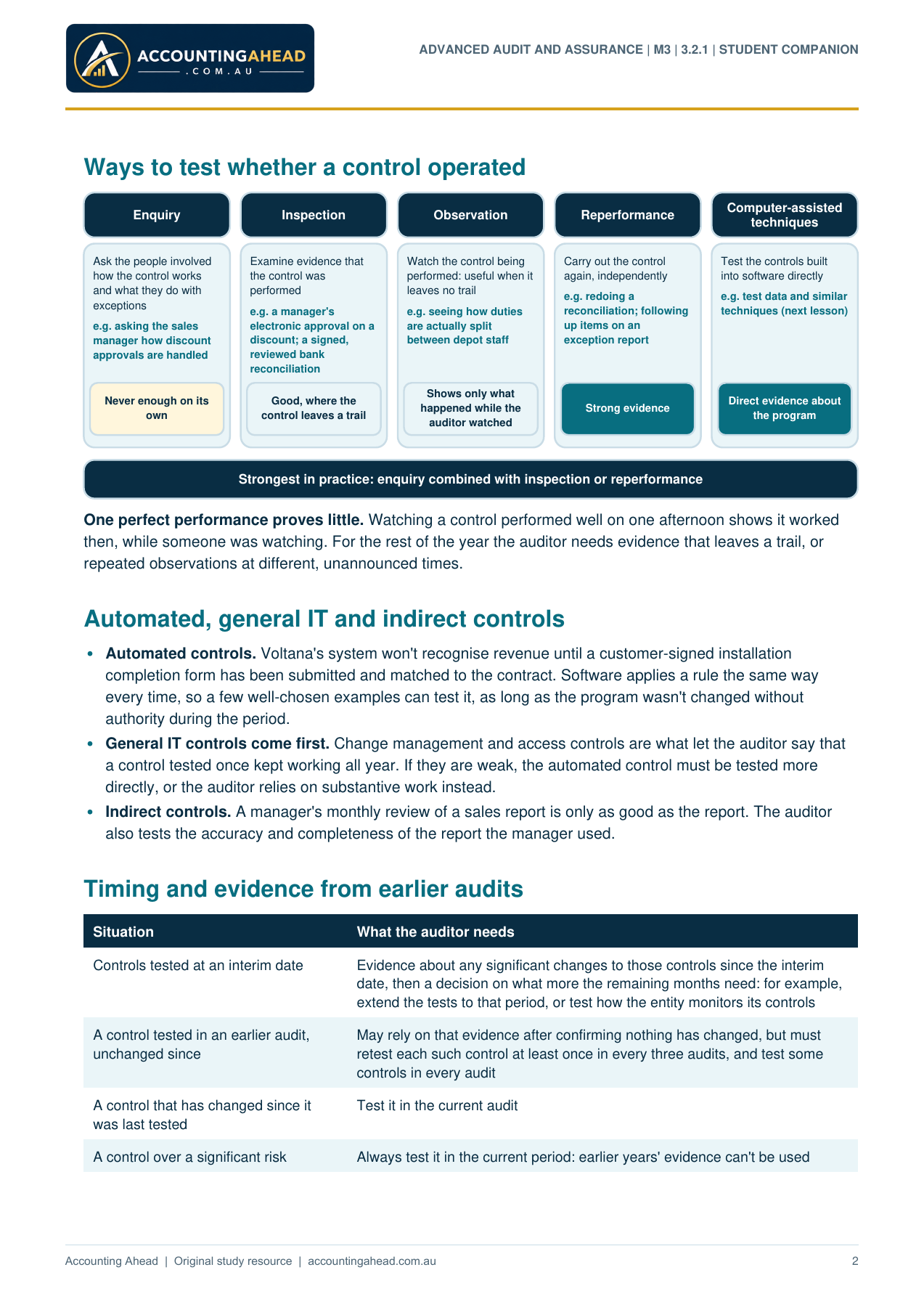
Ways to test whether a control operated
Enquiry
Ask the people involved
how the control works
and what they do with
exceptions
e.g. asking the sales
manager how discount
approvals are handled
Never enough on its
own
Inspection
Examine evidence that
the control was
performed
e.g. a manager's
electronic approval on a
discount; a signed,
reviewed bank
reconciliation
Good, where the
control leaves a trail
Observation
Watch the control being
performed: useful when it
leaves no trail
e.g. seeing how duties
are actually split
between depot staff
Shows only what
happened while the
auditor watched
Reperformance
Carry out the control
again, independently
e.g. redoing a
reconciliation; following
up items on an
exception report
Strong evidence
Computer-assisted
techniques
Test the controls built
into software directly
e.g. test data and similar
techniques (next lesson)
Direct evidence about
the program
Strongest in practice: enquiry combined with inspection or reperformance
One perfect performance proves little. Watching a control performed well on one afternoon shows it worked
then, while someone was watching. For the rest of the year the auditor needs evidence that leaves a trail, or
repeated observations at different, unannounced times.
Automated, general IT and indirect controls
Automated controls. Voltana's system won't recognise revenue until a customer-signed installation
completion form has been submitted and matched to the contract. Software applies a rule the same way
every time, so a few well-chosen examples can test it, as long as the program wasn't changed without
authority during the period.
General IT controls come first. Change management and access controls are what let the auditor say that
a control tested once kept working all year. If they are weak, the automated control must be tested more
directly, or the auditor relies on substantive work instead.
Indirect controls. A manager's monthly review of a sales report is only as good as the report. The auditor
also tests the accuracy and completeness of the report the manager used.
Timing and evidence from earlier audits
Situation What the auditor needs
Controls tested at an interim date Evidence about any significant changes to those controls since the interim
date, then a decision on what more the remaining months need: for example,
extend the tests to that period, or test how the entity monitors its controls
A control tested in an earlier audit,
unchanged since
May rely on that evidence after confirming nothing has changed, but must
retest each such control at least once in every three audits, and test some
controls in every audit
A control that has changed since it
was last tested
Test it in the current audit
A control over a significant risk Always test it in the current period: earlier years' evidence can't be used
ADVANCED AUDIT AND ASSURANCE | M3 | 3.2.1 | STUDENT COMPANION
2
Accounting Ahead | Original study resource | accountingahead.com.au
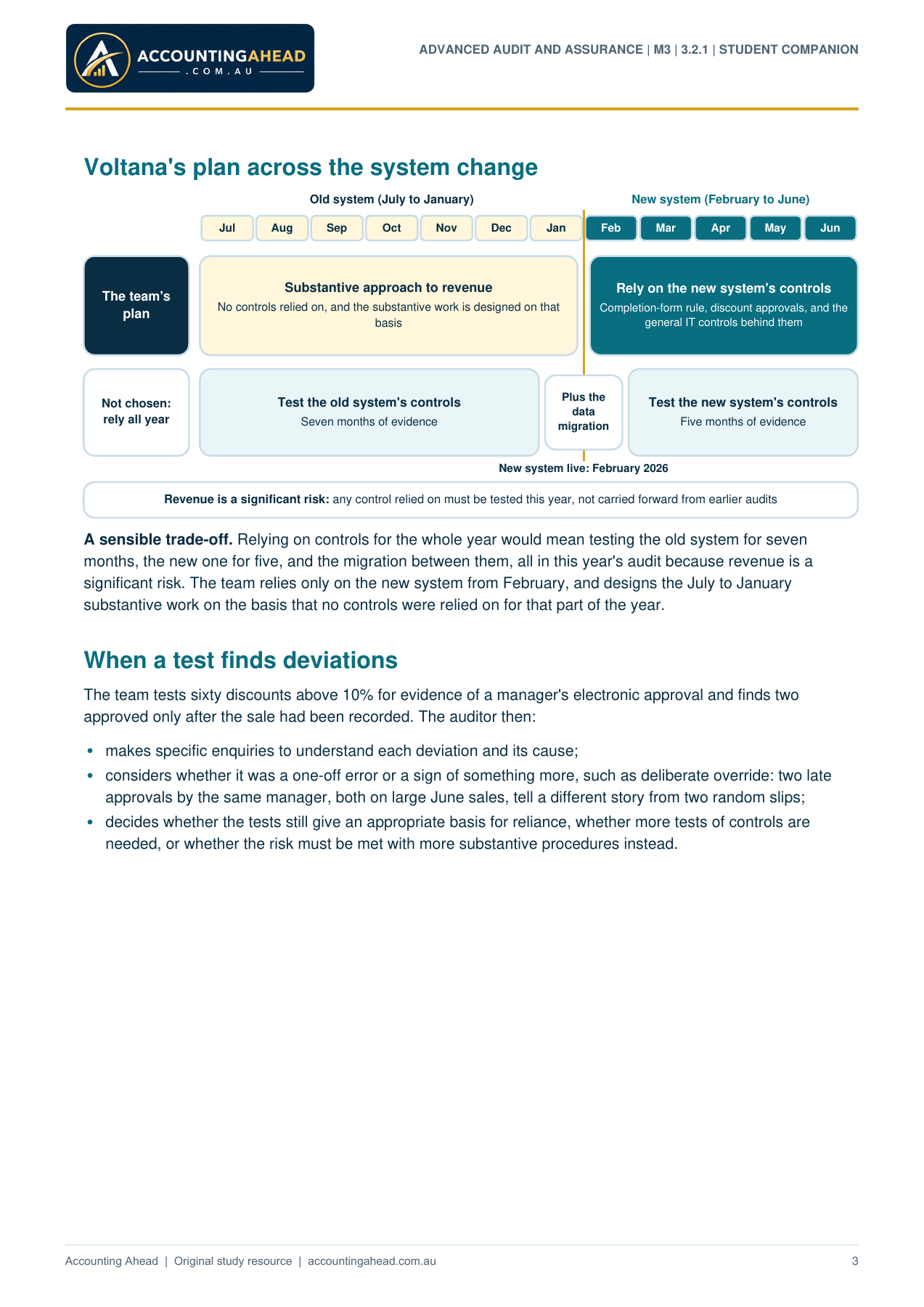
Voltana's plan across the system change
Jul Aug Sep Oct Nov Dec Jan Feb Mar Apr May Jun
Old system (July to January) New system (February to June)
The team's
plan
Substantive approach to revenue
No controls relied on, and the substantive work is designed on that
basis
Rely on the new system's controls
Completion-form rule, discount approvals, and the
general IT controls behind them
Not chosen:
rely all year
Test the old system's controls
Seven months of evidence
Test the new system's controls
Five months of evidence
Plus the
data
migration
New system live: February 2026
Revenue is a significant risk: any control relied on must be tested this year, not carried forward from earlier audits
A sensible trade-off. Relying on controls for the whole year would mean testing the old system for seven
months, the new one for five, and the migration between them, all in this year's audit because revenue is a
significant risk. The team relies only on the new system from February, and designs the July to January
substantive work on the basis that no controls were relied on for that part of the year.
When a test finds deviations
The team tests sixty discounts above 10% for evidence of a manager's electronic approval and finds two
approved only after the sale had been recorded. The auditor then:
makes specific enquiries to understand each deviation and its cause;
considers whether it was a one-off error or a sign of something more, such as deliberate override: two late
approvals by the same manager, both on large June sales, tell a different story from two random slips;
decides whether the tests still give an appropriate basis for reliance, whether more tests of controls are
needed, or whether the risk must be met with more substantive procedures instead.
ADVANCED AUDIT AND ASSURANCE | M3 | 3.2.1 | STUDENT COMPANION
3
Accounting Ahead | Original study resource | accountingahead.com.au
Practice questions
MODULE 3 | 3.2.1 | TRY THESE BEFORE THE WORKED ANSWERS
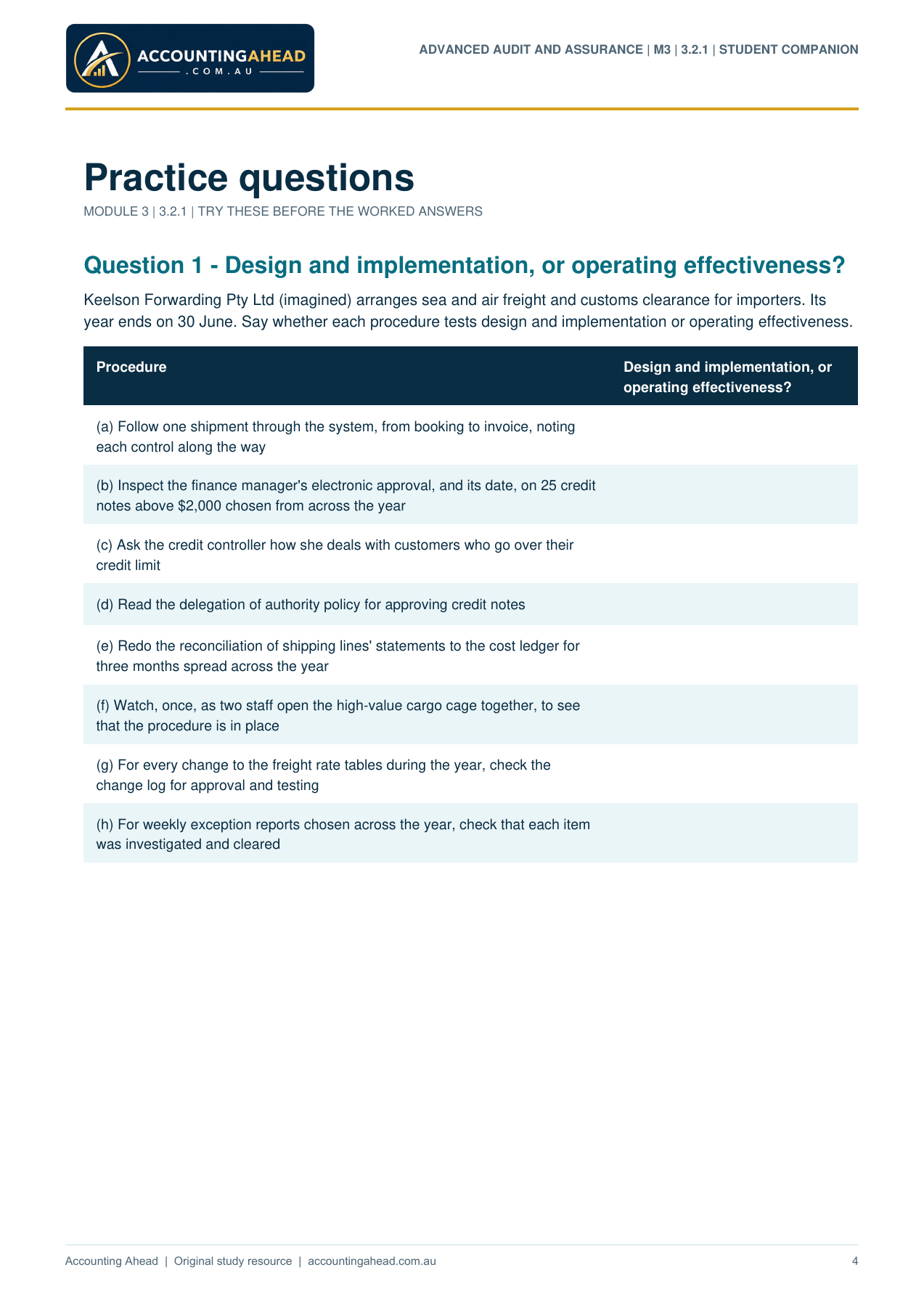
Question 1 - Design and implementation, or operating effectiveness?
Keelson Forwarding Pty Ltd (imagined) arranges sea and air freight and customs clearance for importers. Its
year ends on 30 June. Say whether each procedure tests design and implementation or operating effectiveness.
Procedure Design and implementation, or
operating effectiveness?
(a) Follow one shipment through the system, from booking to invoice, noting
each control along the way
(b) Inspect the finance manager's electronic approval, and its date, on 25 credit
notes above $2,000 chosen from across the year
(c) Ask the credit controller how she deals with customers who go over their
credit limit
(d) Read the delegation of authority policy for approving credit notes
(e) Redo the reconciliation of shipping lines' statements to the cost ledger for
three months spread across the year
(f) Watch, once, as two staff open the high-value cargo cage together, to see
that the procedure is in place
(g) For every change to the freight rate tables during the year, check the
change log for approval and testing
(h) For weekly exception reports chosen across the year, check that each item
was investigated and cleared
ADVANCED AUDIT AND ASSURANCE | M3 | 3.2.1 | STUDENT COMPANION
4
Accounting Ahead | Original study resource | accountingahead.com.au
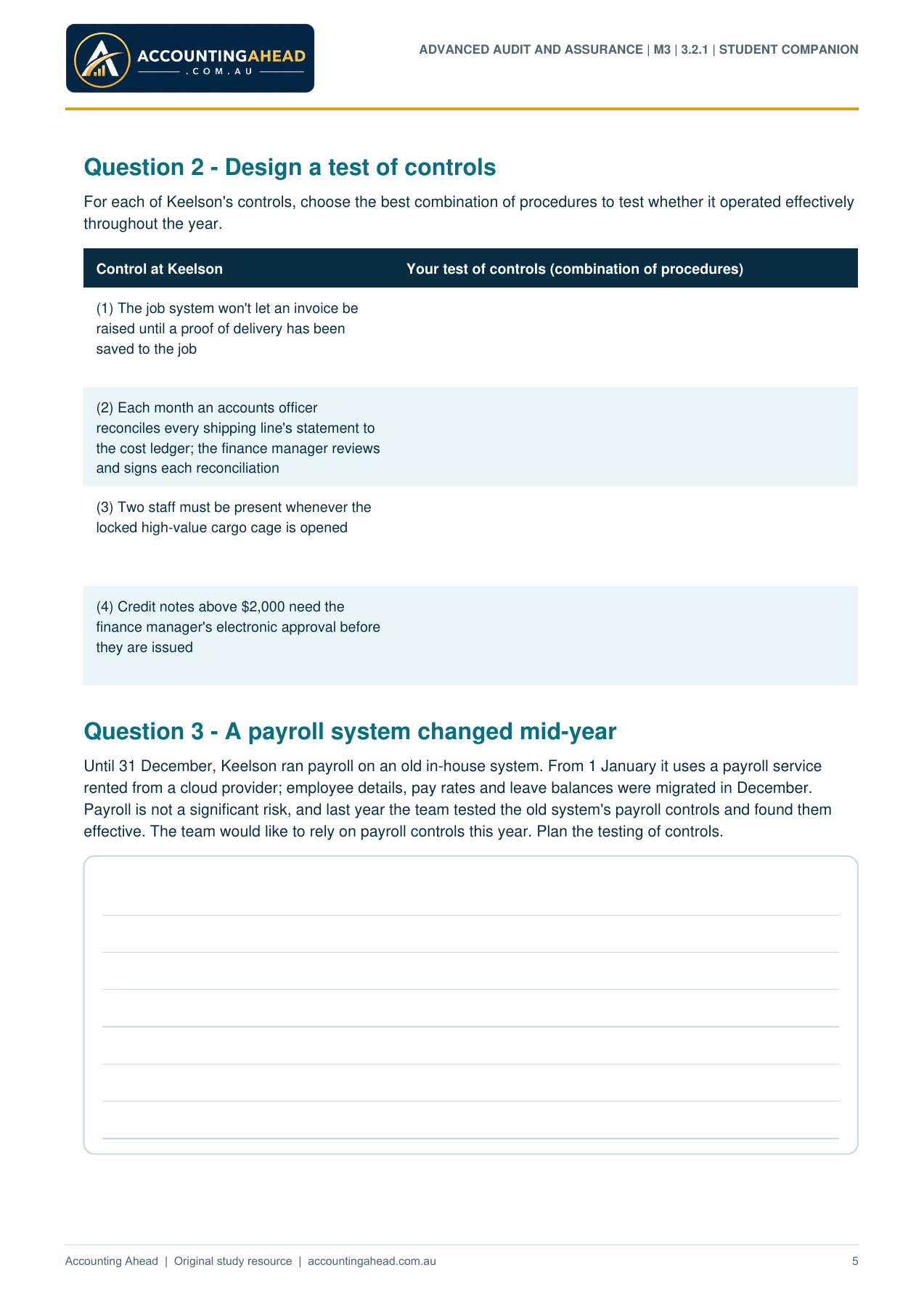
Question 2 - Design a test of controls
For each of Keelson's controls, choose the best combination of procedures to test whether it operated effectively
throughout the year.
Control at Keelson Your test of controls (combination of procedures)
(1) The job system won't let an invoice be
raised until a proof of delivery has been
saved to the job
(2) Each month an accounts officer
reconciles every shipping line's statement to
the cost ledger; the finance manager reviews
and signs each reconciliation
(3) Two staff must be present whenever the
locked high-value cargo cage is opened
(4) Credit notes above $2,000 need the
finance manager's electronic approval before
they are issued
Question 3 - A payroll system changed mid-year
Until 31 December, Keelson ran payroll on an old in-house system. From 1 January it uses a payroll service
rented from a cloud provider; employee details, pay rates and leave balances were migrated in December.
Payroll is not a significant risk, and last year the team tested the old system's payroll controls and found them
effective. The team would like to rely on payroll controls this year. Plan the testing of controls.
ADVANCED AUDIT AND ASSURANCE | M3 | 3.2.1 | STUDENT COMPANION
5
Accounting Ahead | Original study resource | accountingahead.com.au
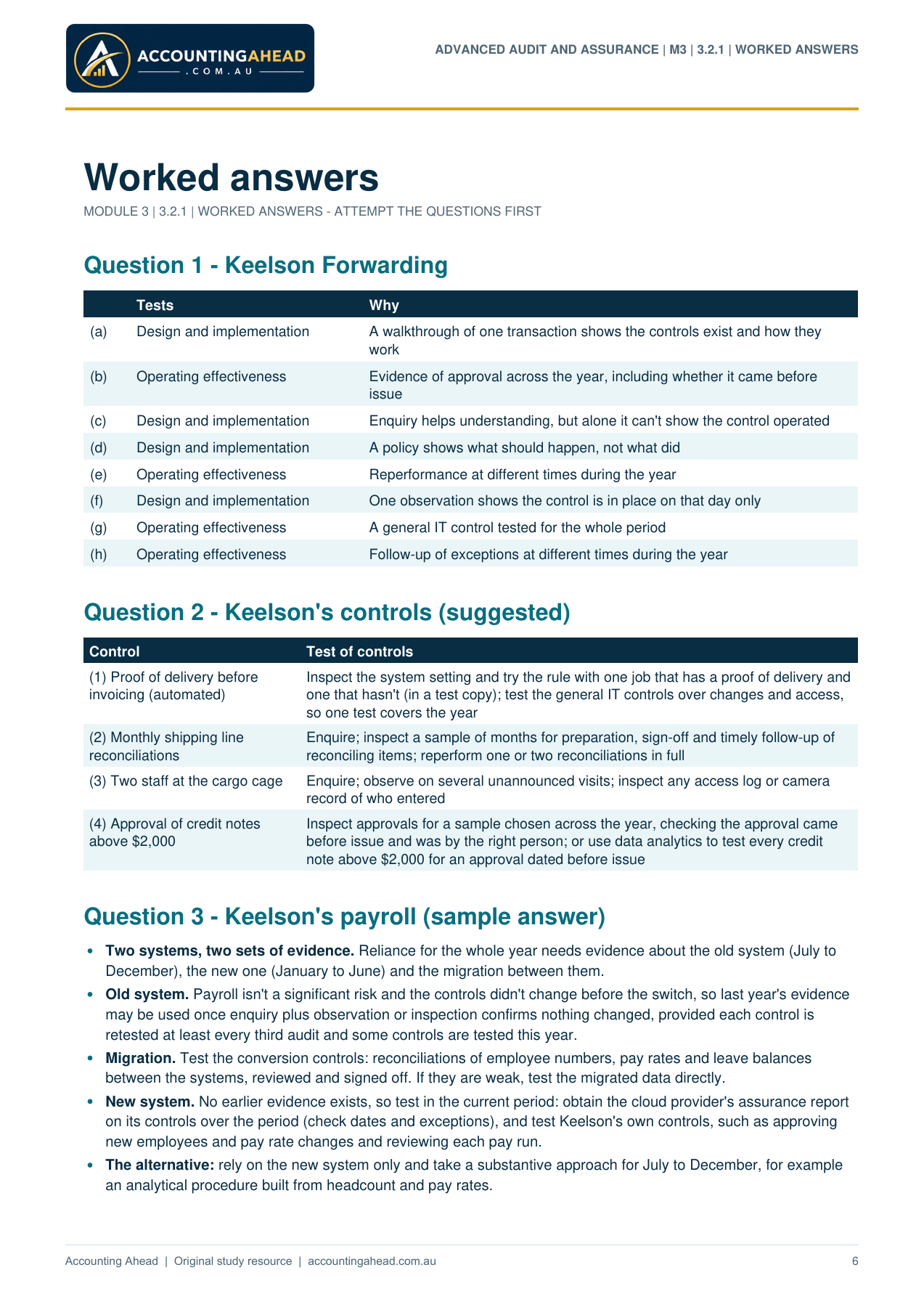
Worked answers
MODULE 3 | 3.2.1 | WORKED ANSWERS - ATTEMPT THE QUESTIONS FIRST
Question 1 - Keelson Forwarding
Tests Why
(a) Design and implementation A walkthrough of one transaction shows the controls exist and how they
work
(b) Operating effectiveness Evidence of approval across the year, including whether it came before
issue
(c) Design and implementation Enquiry helps understanding, but alone it can't show the control operated
(d) Design and implementation A policy shows what should happen, not what did
(e) Operating effectiveness Reperformance at different times during the year
(f) Design and implementation One observation shows the control is in place on that day only
(g) Operating effectiveness A general IT control tested for the whole period
(h) Operating effectiveness Follow-up of exceptions at different times during the year
Question 2 - Keelson's controls (suggested)
Control Test of controls
(1) Proof of delivery before
invoicing (automated)
Inspect the system setting and try the rule with one job that has a proof of delivery and
one that hasn't (in a test copy); test the general IT controls over changes and access,
so one test covers the year
(2) Monthly shipping line
reconciliations
Enquire; inspect a sample of months for preparation, sign-off and timely follow-up of
reconciling items; reperform one or two reconciliations in full
(3) Two staff at the cargo cage Enquire; observe on several unannounced visits; inspect any access log or camera
record of who entered
(4) Approval of credit notes
above $2,000
Inspect approvals for a sample chosen across the year, checking the approval came
before issue and was by the right person; or use data analytics to test every credit
note above $2,000 for an approval dated before issue
Question 3 - Keelson's payroll (sample answer)
Two systems, two sets of evidence. Reliance for the whole year needs evidence about the old system (July to
December), the new one (January to June) and the migration between them.
Old system. Payroll isn't a significant risk and the controls didn't change before the switch, so last year's evidence
may be used once enquiry plus observation or inspection confirms nothing changed, provided each control is
retested at least every third audit and some controls are tested this year.
Migration. Test the conversion controls: reconciliations of employee numbers, pay rates and leave balances
between the systems, reviewed and signed off. If they are weak, test the migrated data directly.
New system. No earlier evidence exists, so test in the current period: obtain the cloud provider's assurance report
on its controls over the period (check dates and exceptions), and test Keelson's own controls, such as approving
new employees and pay rate changes and reviewing each pay run.
The alternative: rely on the new system only and take a substantive approach for July to December, for example
an analytical procedure built from headcount and pay rates.
ADVANCED AUDIT AND ASSURANCE | M3 | 3.2.1 | WORKED ANSWERS
6