
Tests of details
Printable study notes, diagrams and practice support for Part 3.3.2.
Read the handout text
Accounting Ahead | Original study resource | accountingahead.com.au
Tests of details
MODULE 3 | 3.3.2 | STUDENT COMPANION
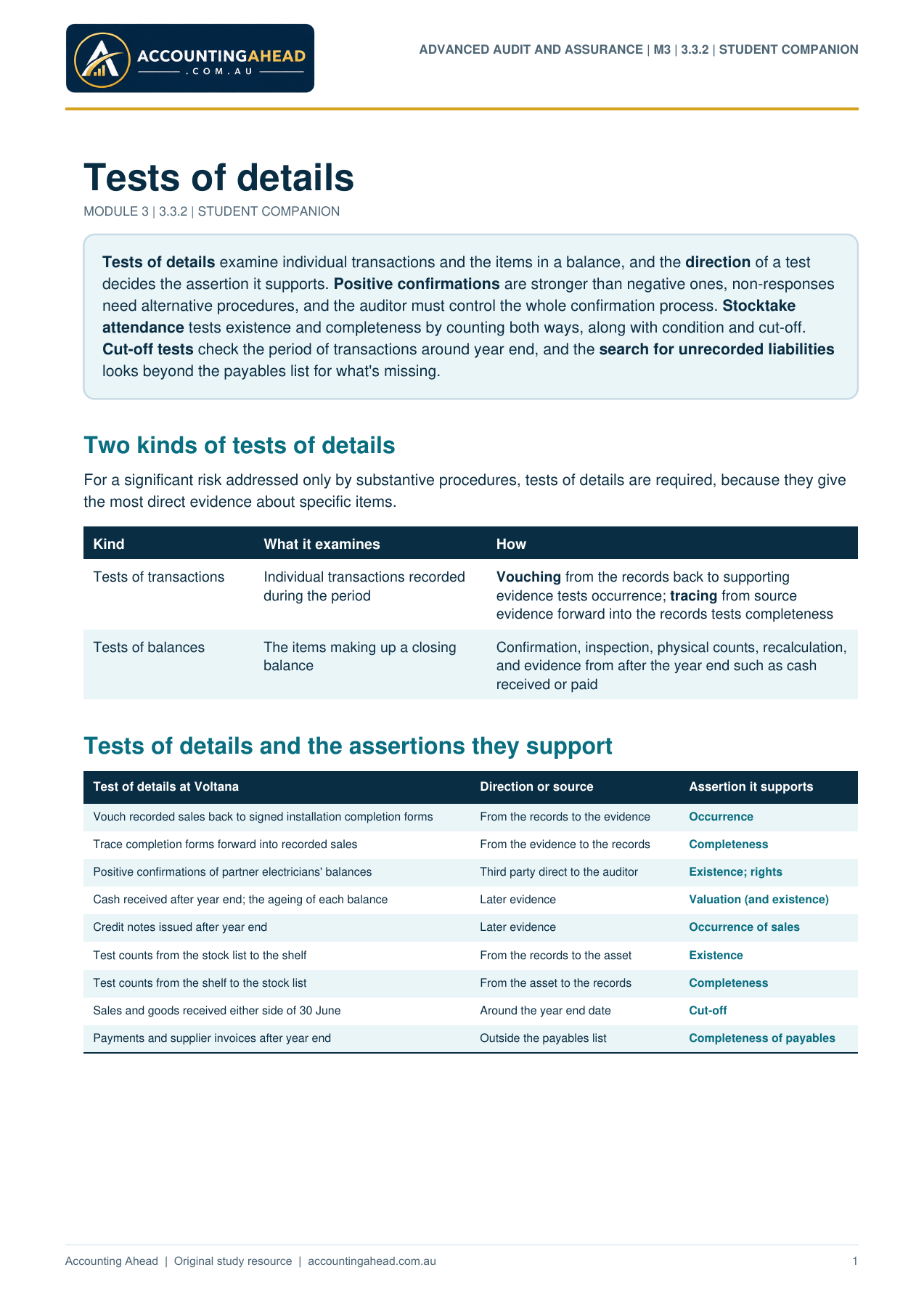
Tests of details examine individual transactions and the items in a balance, and the direction of a test
decides the assertion it supports. Positive confirmations are stronger than negative ones, non-responses
need alternative procedures, and the auditor must control the whole confirmation process. Stocktake
attendance tests existence and completeness by counting both ways, along with condition and cut-off.
Cut-off tests check the period of transactions around year end, and the search for unrecorded liabilities
looks beyond the payables list for what's missing.
Two kinds of tests of details
For a significant risk addressed only by substantive procedures, tests of details are required, because they give
the most direct evidence about specific items.
Kind What it examines How
Tests of transactions Individual transactions recorded
during the period
Vouching from the records back to supporting
evidence tests occurrence; tracing from source
evidence forward into the records tests completeness
Tests of balances The items making up a closing
balance
Confirmation, inspection, physical counts, recalculation,
and evidence from after the year end such as cash
received or paid
Tests of details and the assertions they support
Test of details at Voltana Direction or source Assertion it supports
Vouch recorded sales back to signed installation completion forms From the records to the evidence Occurrence
Trace completion forms forward into recorded sales From the evidence to the records Completeness
Positive confirmations of partner electricians' balances Third party direct to the auditor Existence; rights
Cash received after year end; the ageing of each balance Later evidence Valuation (and existence)
Credit notes issued after year end Later evidence Occurrence of sales
Test counts from the stock list to the shelf From the records to the asset Existence
Test counts from the shelf to the stock list From the asset to the records Completeness
Sales and goods received either side of 30 June Around the year end date Cut-off
Payments and supplier invoices after year end Outside the payables list Completeness of payables
ADVANCED AUDIT AND ASSURANCE | M3 | 3.3.2 | STUDENT COMPANION
1
Accounting Ahead | Original study resource | accountingahead.com.au
External confirmations
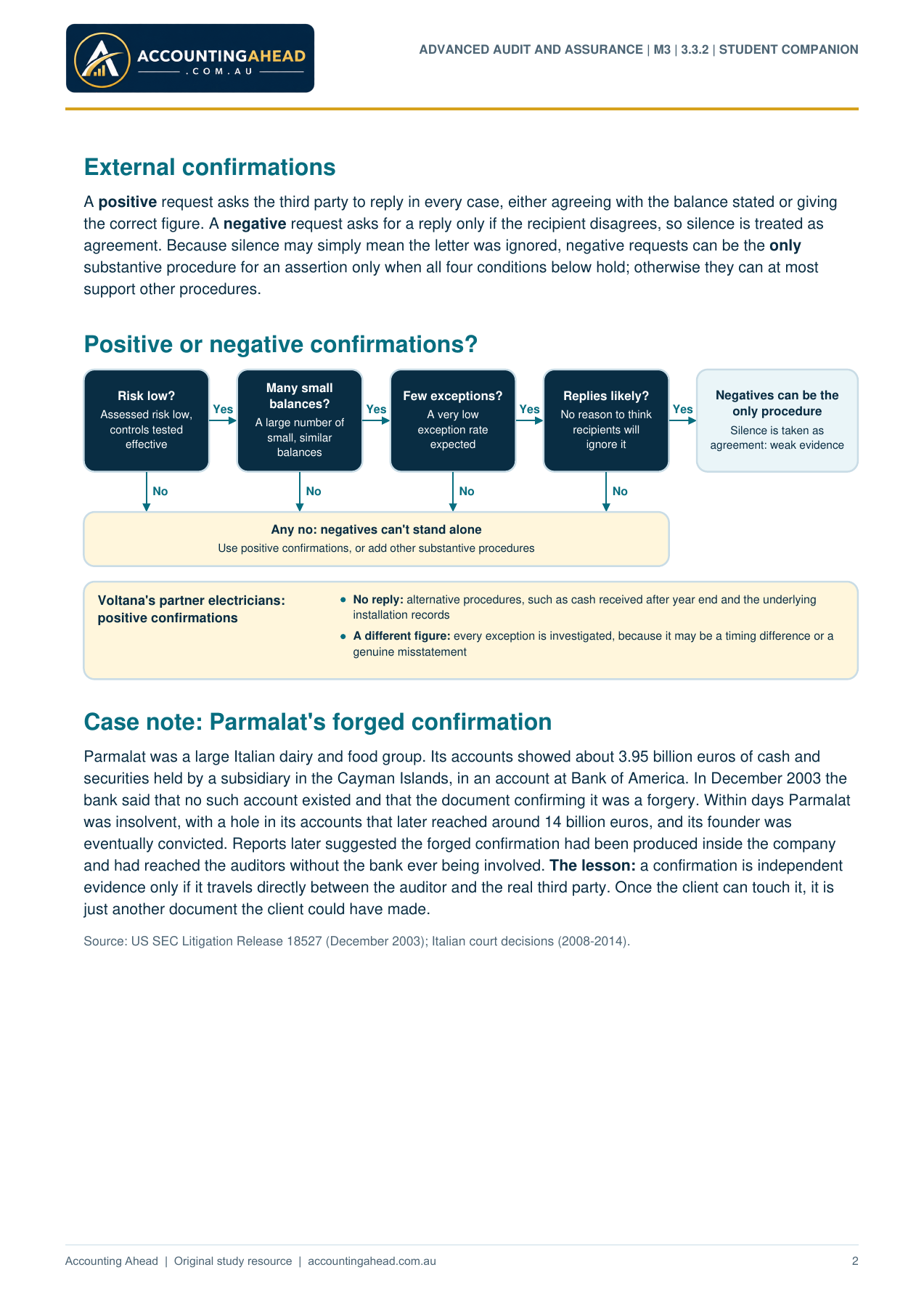
A positive request asks the third party to reply in every case, either agreeing with the balance stated or giving
the correct figure. A negative request asks for a reply only if the recipient disagrees, so silence is treated as
agreement. Because silence may simply mean the letter was ignored, negative requests can be the only
substantive procedure for an assertion only when all four conditions below hold; otherwise they can at most
support other procedures.
Positive or negative confirmations?
Risk low?
Assessed risk low,
controls tested
effective
Yes
No
Many small
balances?
A large number of
small, similar
balances
Yes
No
Few exceptions?
A very low
exception rate
expected
Yes
No
Replies likely?
No reason to think
recipients will
ignore it
Yes
No
Negatives can be the
only procedure
Silence is taken as
agreement: weak evidence
Any no: negatives can't stand alone
Use positive confirmations, or add other substantive procedures
Voltana's partner electricians:
positive confirmations
No reply: alternative procedures, such as cash received after year end and the underlying
installation records
A different figure: every exception is investigated, because it may be a timing difference or a
genuine misstatement
Case note: Parmalat's forged confirmation
Parmalat was a large Italian dairy and food group. Its accounts showed about 3.95 billion euros of cash and
securities held by a subsidiary in the Cayman Islands, in an account at Bank of America. In December 2003 the
bank said that no such account existed and that the document confirming it was a forgery. Within days Parmalat
was insolvent, with a hole in its accounts that later reached around 14 billion euros, and its founder was
eventually convicted. Reports later suggested the forged confirmation had been produced inside the company
and had reached the auditors without the bank ever being involved. The lesson: a confirmation is independent
evidence only if it travels directly between the auditor and the real third party. Once the client can touch it, it is
just another document the client could have made.
Source: US SEC Litigation Release 18527 (December 2003); Italian court decisions (2008-2014).
ADVANCED AUDIT AND ASSURANCE | M3 | 3.3.2 | STUDENT COMPANION
2
Accounting Ahead | Original study resource | accountingahead.com.au
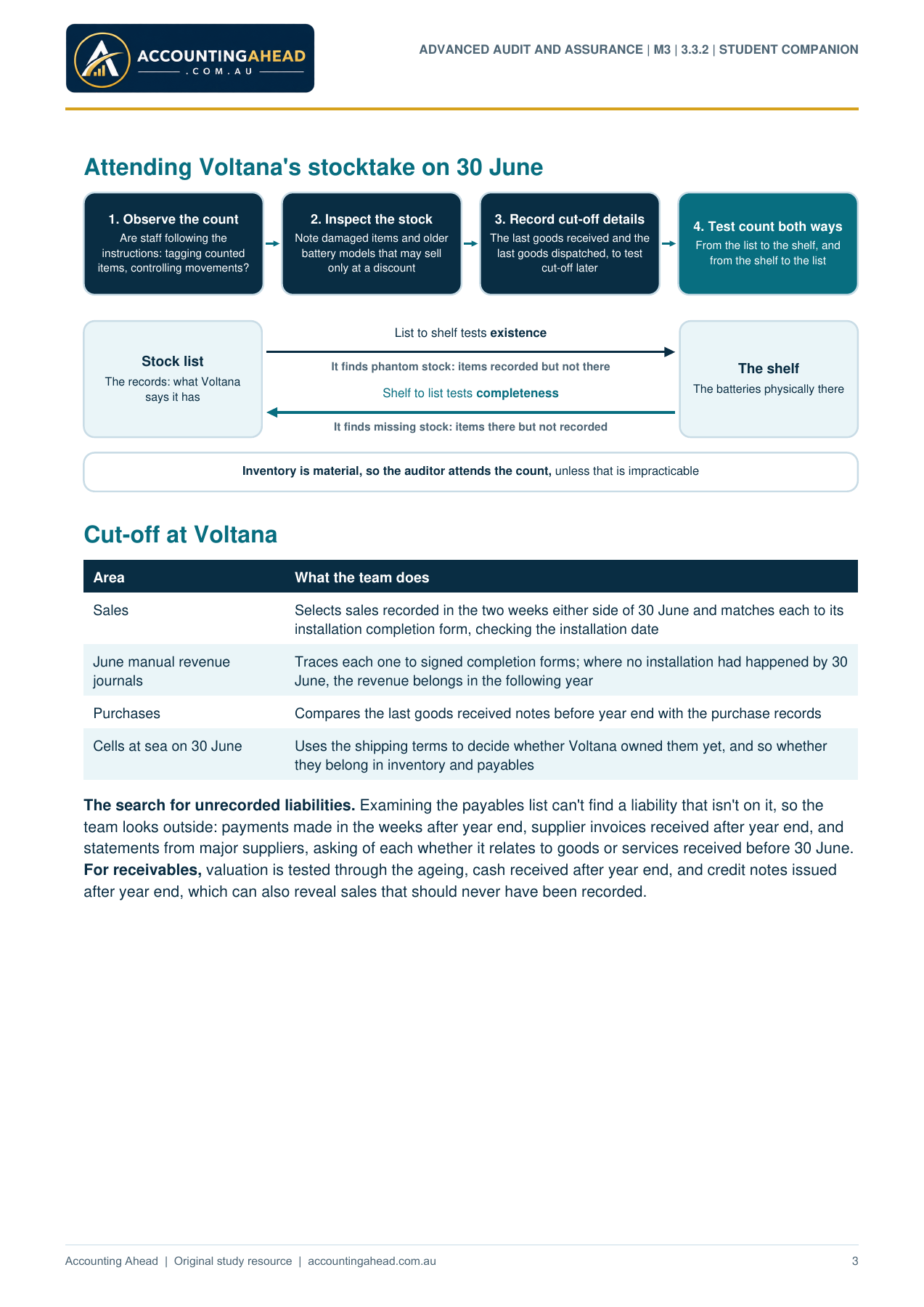
Attending Voltana's stocktake on 30 June
1. Observe the count
Are staff following the
instructions: tagging counted
items, controlling movements?
2. Inspect the stock
Note damaged items and older
battery models that may sell
only at a discount
3. Record cut-off details
The last goods received and the
last goods dispatched, to test
cut-off later
4. Test count both ways
From the list to the shelf, and
from the shelf to the list
Stock list
The records: what Voltana
says it has
The shelf
The batteries physically there
List to shelf tests existence
It finds phantom stock: items recorded but not there
Shelf to list tests completeness
It finds missing stock: items there but not recorded
Inventory is material, so the auditor attends the count, unless that is impracticable
Cut-off at Voltana
Area What the team does
Sales Selects sales recorded in the two weeks either side of 30 June and matches each to its
installation completion form, checking the installation date
June manual revenue
journals
Traces each one to signed completion forms; where no installation had happened by 30
June, the revenue belongs in the following year
Purchases Compares the last goods received notes before year end with the purchase records
Cells at sea on 30 June Uses the shipping terms to decide whether Voltana owned them yet, and so whether
they belong in inventory and payables
The search for unrecorded liabilities. Examining the payables list can't find a liability that isn't on it, so the
team looks outside: payments made in the weeks after year end, supplier invoices received after year end, and
statements from major suppliers, asking of each whether it relates to goods or services received before 30 June.
For receivables, valuation is tested through the ageing, cash received after year end, and credit notes issued
after year end, which can also reveal sales that should never have been recorded.
ADVANCED AUDIT AND ASSURANCE | M3 | 3.3.2 | STUDENT COMPANION
3
Accounting Ahead | Original study resource | accountingahead.com.au
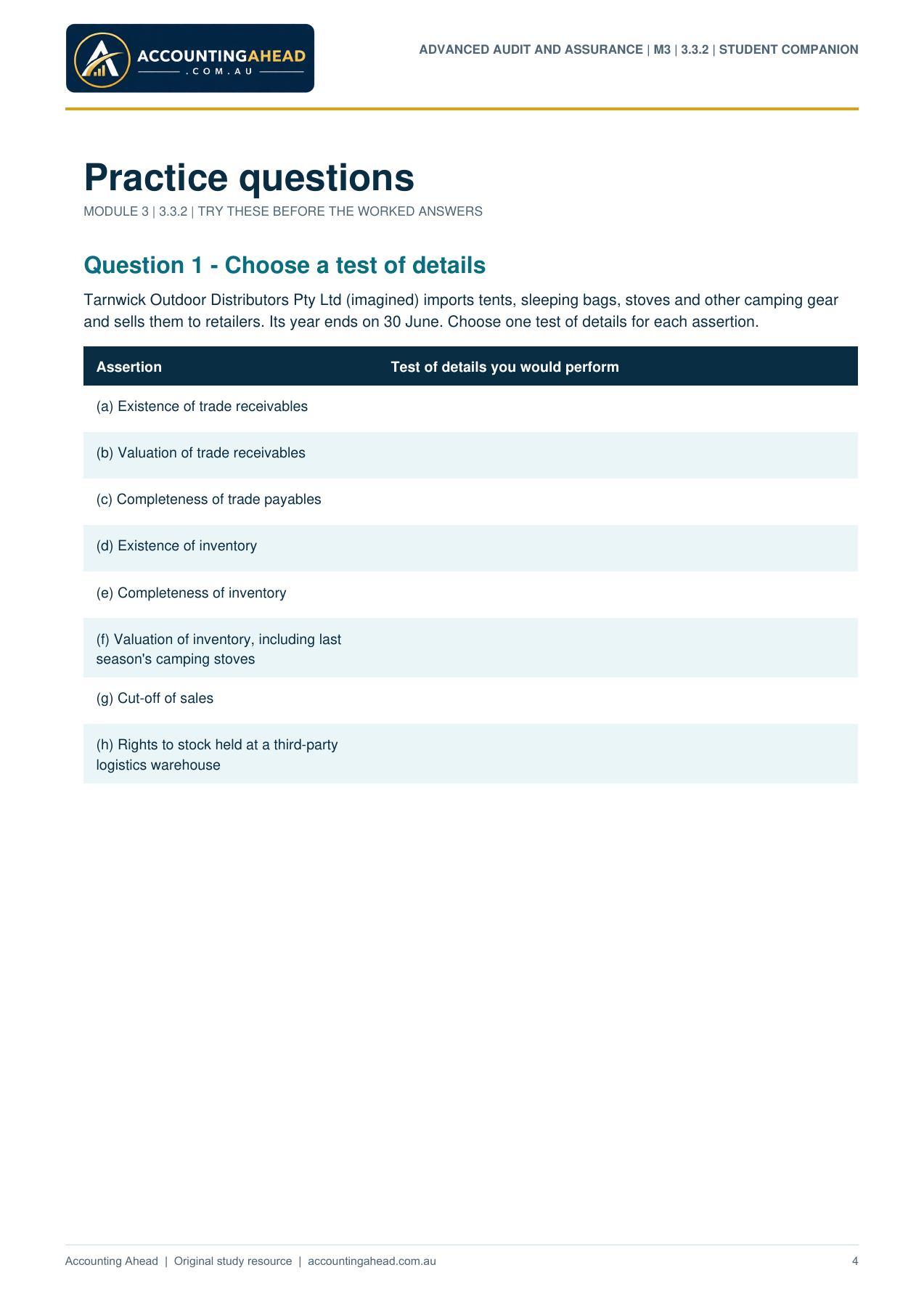
Practice questions
MODULE 3 | 3.3.2 | TRY THESE BEFORE THE WORKED ANSWERS
Question 1 - Choose a test of details
Tarnwick Outdoor Distributors Pty Ltd (imagined) imports tents, sleeping bags, stoves and other camping gear
and sells them to retailers. Its year ends on 30 June. Choose one test of details for each assertion.
Assertion Test of details you would perform
(a) Existence of trade receivables
(b) Valuation of trade receivables
(c) Completeness of trade payables
(d) Existence of inventory
(e) Completeness of inventory
(f) Valuation of inventory, including last
season's camping stoves
(g) Cut-off of sales
(h) Rights to stock held at a third-party
logistics warehouse
ADVANCED AUDIT AND ASSURANCE | M3 | 3.3.2 | STUDENT COMPANION
4
Accounting Ahead | Original study resource | accountingahead.com.au
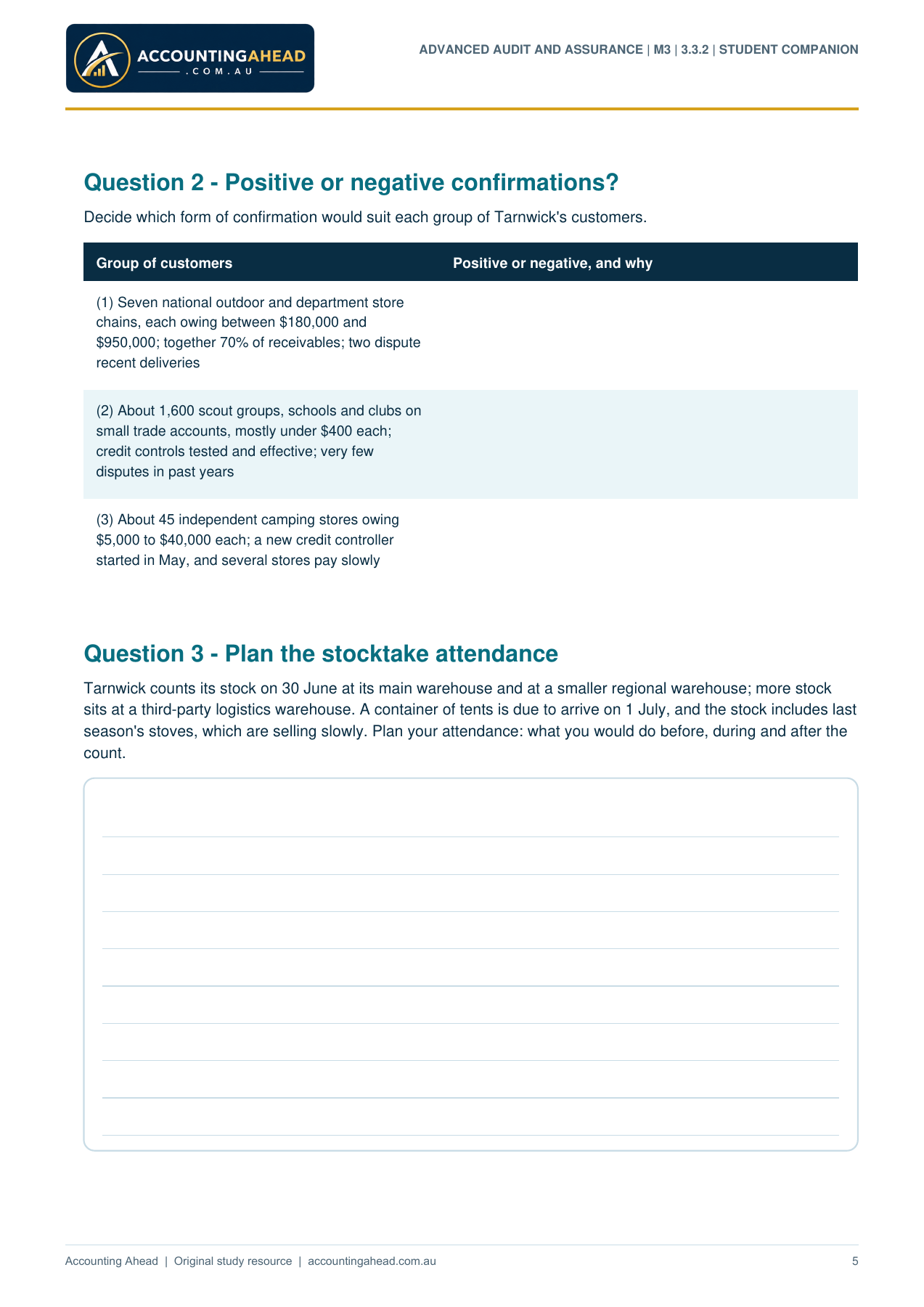
Question 2 - Positive or negative confirmations?
Decide which form of confirmation would suit each group of Tarnwick's customers.
Group of customers Positive or negative, and why
(1) Seven national outdoor and department store
chains, each owing between $180,000 and
$950,000; together 70% of receivables; two dispute
recent deliveries
(2) About 1,600 scout groups, schools and clubs on
small trade accounts, mostly under $400 each;
credit controls tested and effective; very few
disputes in past years
(3) About 45 independent camping stores owing
$5,000 to $40,000 each; a new credit controller
started in May, and several stores pay slowly
Question 3 - Plan the stocktake attendance
Tarnwick counts its stock on 30 June at its main warehouse and at a smaller regional warehouse; more stock
sits at a third-party logistics warehouse. A container of tents is due to arrive on 1 July, and the stock includes last
season's stoves, which are selling slowly. Plan your attendance: what you would do before, during and after the
count.
ADVANCED AUDIT AND ASSURANCE | M3 | 3.3.2 | STUDENT COMPANION
5
Accounting Ahead | Original study resource | accountingahead.com.au
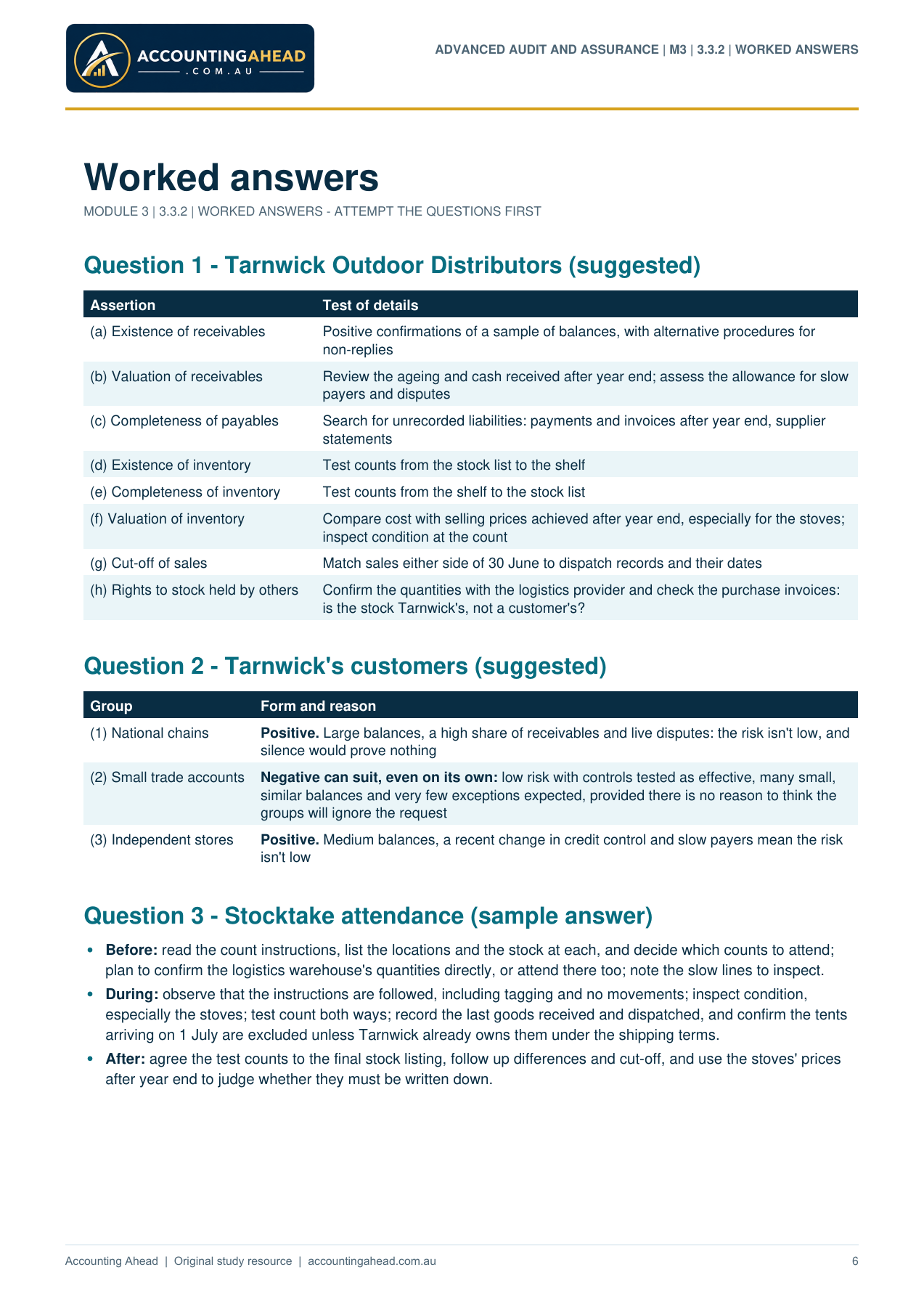
Worked answers
MODULE 3 | 3.3.2 | WORKED ANSWERS - ATTEMPT THE QUESTIONS FIRST
Question 1 - Tarnwick Outdoor Distributors (suggested)
Assertion Test of details
(a) Existence of receivables Positive confirmations of a sample of balances, with alternative procedures for
non-replies
(b) Valuation of receivables Review the ageing and cash received after year end; assess the allowance for slow
payers and disputes
(c) Completeness of payables Search for unrecorded liabilities: payments and invoices after year end, supplier
statements
(d) Existence of inventory Test counts from the stock list to the shelf
(e) Completeness of inventory Test counts from the shelf to the stock list
(f) Valuation of inventory Compare cost with selling prices achieved after year end, especially for the stoves;
inspect condition at the count
(g) Cut-off of sales Match sales either side of 30 June to dispatch records and their dates
(h) Rights to stock held by others Confirm the quantities with the logistics provider and check the purchase invoices:
is the stock Tarnwick's, not a customer's?
Question 2 - Tarnwick's customers (suggested)
Group Form and reason
(1) National chains Positive. Large balances, a high share of receivables and live disputes: the risk isn't low, and
silence would prove nothing
(2) Small trade accounts Negative can suit, even on its own: low risk with controls tested as effective, many small,
similar balances and very few exceptions expected, provided there is no reason to think the
groups will ignore the request
(3) Independent stores Positive. Medium balances, a recent change in credit control and slow payers mean the risk
isn't low
Question 3 - Stocktake attendance (sample answer)
Before: read the count instructions, list the locations and the stock at each, and decide which counts to attend;
plan to confirm the logistics warehouse's quantities directly, or attend there too; note the slow lines to inspect.
During: observe that the instructions are followed, including tagging and no movements; inspect condition,
especially the stoves; test count both ways; record the last goods received and dispatched, and confirm the tents
arriving on 1 July are excluded unless Tarnwick already owns them under the shipping terms.
After: agree the test counts to the final stock listing, follow up differences and cut-off, and use the stoves' prices
after year end to judge whether they must be written down.
ADVANCED AUDIT AND ASSURANCE | M3 | 3.3.2 | WORKED ANSWERS
6