
Group audits and component auditors
Printable study notes, diagrams and practice support for Part 3.6.1.
Read the handout text
Accounting Ahead | Original study resource | accountingahead.com.au
Group audits and component auditors
MODULE 3 | 3.6.1 | STUDENT COMPANION
The group engagement partner is responsible for the whole group audit, including directing, supervising
and reviewing the work of component auditors. The group auditor decides where work is needed by risk,
not just size; expects access to information and people from the start; evaluates and instructs component
auditors and understands their work; sets component performance materiality below group performance
materiality; and audits the consolidation in its own right.
The standard and its terms
Group audits follow the revised international standard on group audits (ASA 600 in Australia), which applies to
periods beginning on or after 15 December 2023 and takes a risk-based approach. A component is whatever
unit the group auditor chooses for planning and performing the work. A component auditor is any auditor who
performs work on a component for the group audit, whether from the same firm, a network firm or an unrelated
firm.
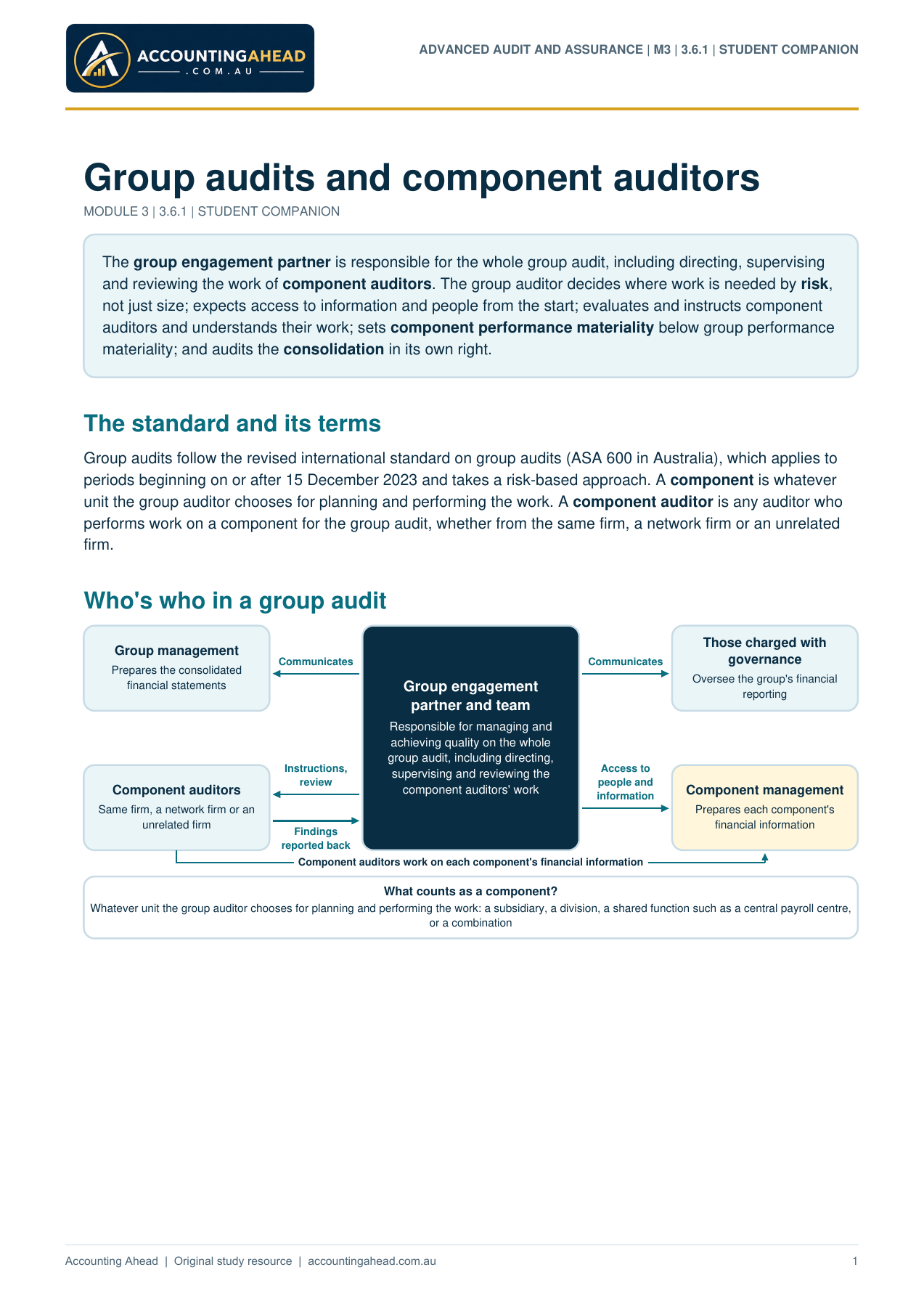
Who's who in a group audit
Group engagement
partner and team
Responsible for managing and
achieving quality on the whole
group audit, including directing,
supervising and reviewing the
component auditors' work
Group management
Prepares the consolidated
financial statements
Those charged with
governance
Oversee the group's financial
reporting
Component auditors
Same firm, a network firm or an
unrelated firm
Component management
Prepares each component's
financial information
Communicates Communicates
Instructions,
review
Findings
reported back
Access to
people and
information
Component auditors work on each component's financial information
What counts as a component?
Whatever unit the group auditor chooses for planning and performing the work: a subsidiary, a division, a shared function such as a central payroll centre,
or a combination
ADVANCED AUDIT AND ASSURANCE | M3 | 3.6.1 | STUDENT COMPANION
1
Accounting Ahead | Original study resource | accountingahead.com.au
Deciding where work is needed
The group auditor first understands the group, its components and the consolidation process, then works out
where the group financial statements could be materially misstated, and only then decides which components
need work, and what kind.
Kind of work When it suits
An audit of the component's financial
information
Components that are large, or that carry risks across many of their
balances
Audit procedures on specific balances or risks Components where the risk sits in particular items, such as stock in
transit or balances between group entities
No further work there, beyond the group
auditor's own risk assessment at group level
Small, low-risk components
Access comes first. When deciding whether to accept the engagement, the group auditor considers whether it
can reasonably expect sufficient appropriate evidence, including access to information and to people at the
components. Serious restrictions can make that evidence unobtainable, leading to a declined engagement or a
disclaimer of opinion.
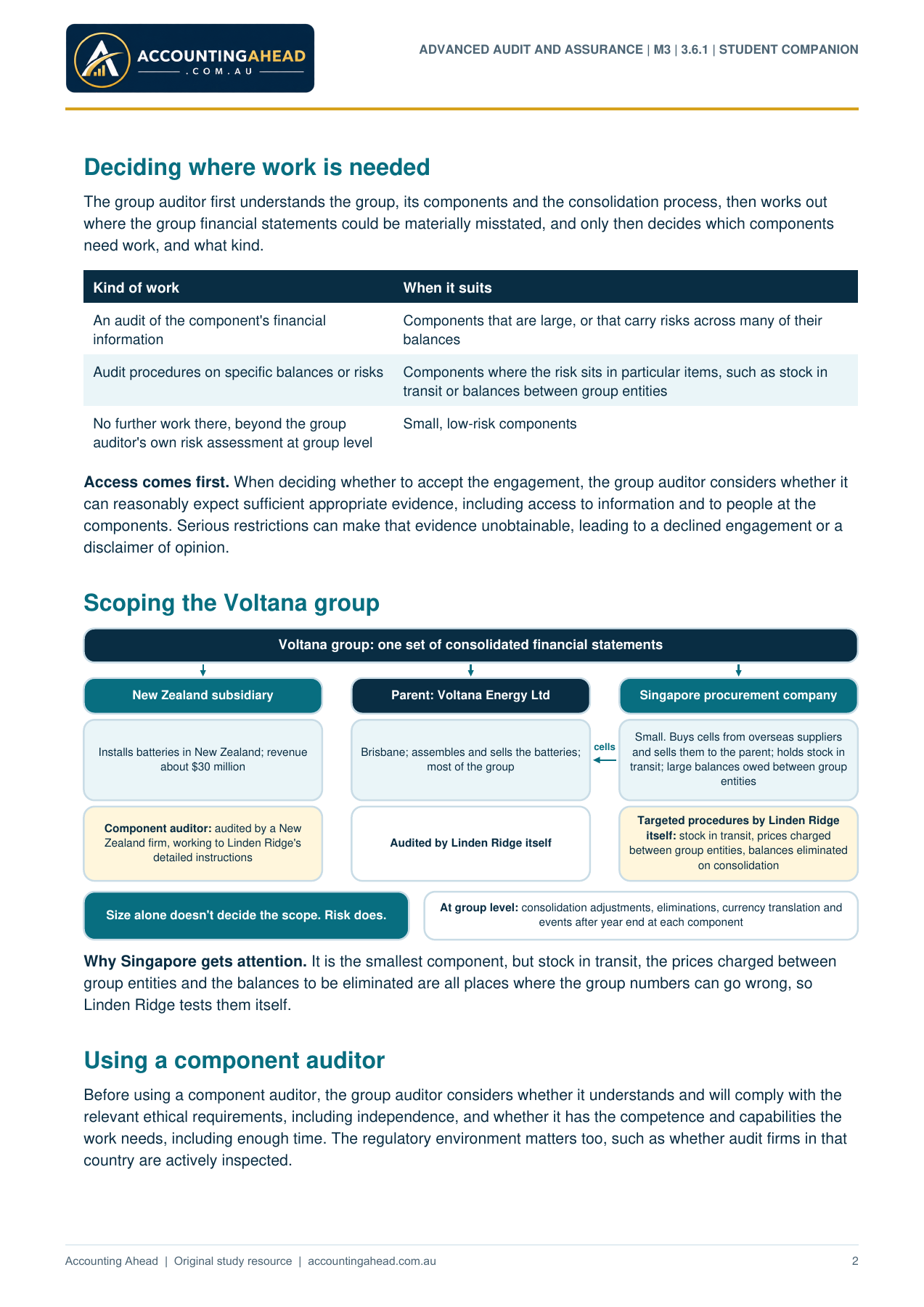
Scoping the Voltana group
Voltana group: one set of consolidated financial statements
New Zealand subsidiary
Installs batteries in New Zealand; revenue
about $30 million
Component auditor: audited by a New
Zealand firm, working to Linden Ridge's
detailed instructions
Parent: Voltana Energy Ltd
Brisbane; assembles and sells the batteries;
most of the group
Audited by Linden Ridge itself
Singapore procurement company
Small. Buys cells from overseas suppliers
and sells them to the parent; holds stock in
transit; large balances owed between group
entities
Targeted procedures by Linden Ridge
itself: stock in transit, prices charged
between group entities, balances eliminated
on consolidation
cells
Size alone doesn't decide the scope. Risk does. At group level: consolidation adjustments, eliminations, currency translation and
events after year end at each component
Why Singapore gets attention. It is the smallest component, but stock in transit, the prices charged between
group entities and the balances to be eliminated are all places where the group numbers can go wrong, so
Linden Ridge tests them itself.
Using a component auditor
Before using a component auditor, the group auditor considers whether it understands and will comply with the
relevant ethical requirements, including independence, and whether it has the competence and capabilities the
work needs, including enough time. The regulatory environment matters too, such as whether audit firms in that
country are actively inspected.
ADVANCED AUDIT AND ASSURANCE | M3 | 3.6.1 | STUDENT COMPANION
2
Accounting Ahead | Original study resource | accountingahead.com.au
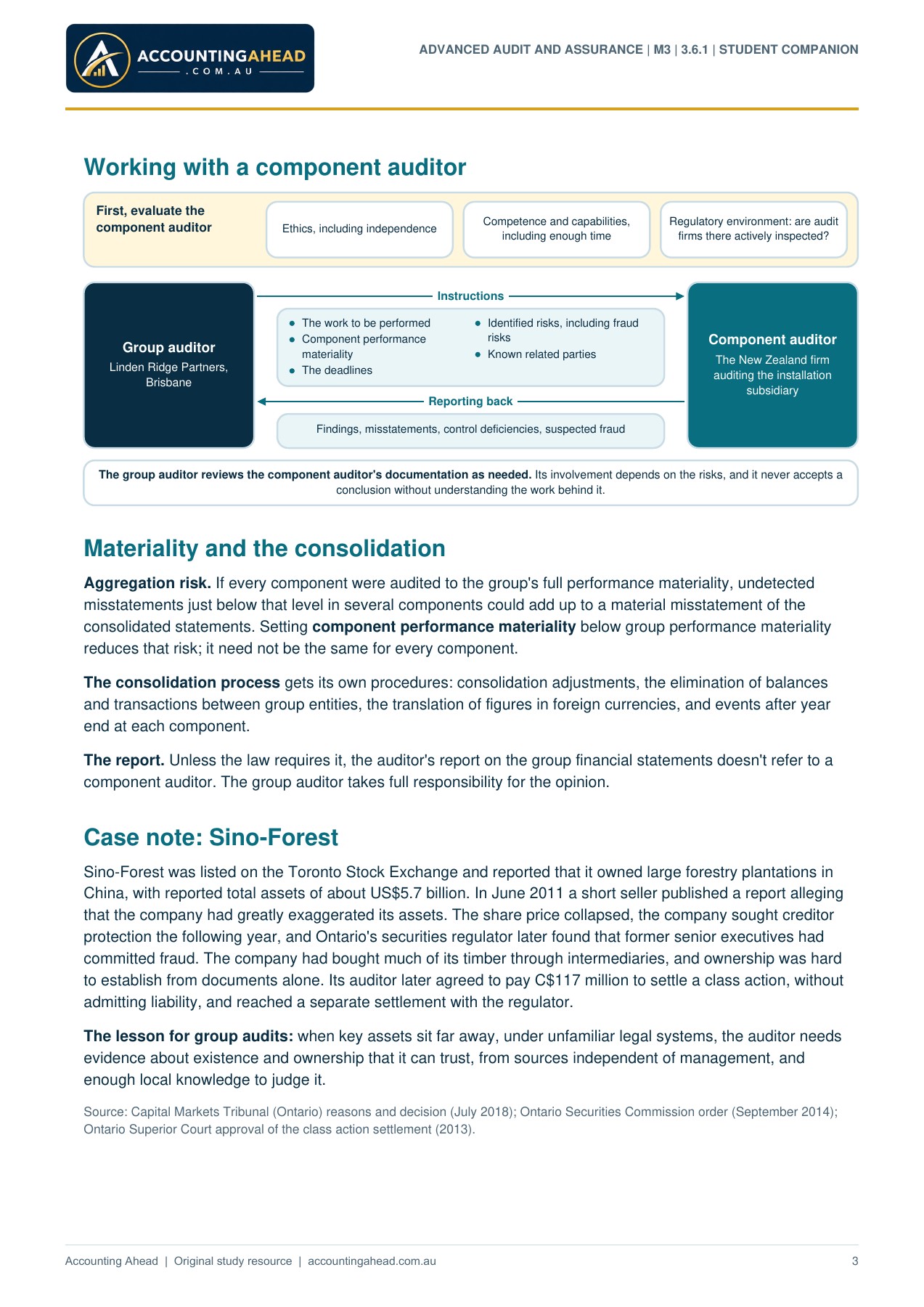
Working with a component auditor
First, evaluate the
component auditor Ethics, including independence Competence and capabilities,
including enough time
Regulatory environment: are audit
firms there actively inspected?
Group auditor
Linden Ridge Partners,
Brisbane
Component auditor
The New Zealand firm
auditing the installation
subsidiary
Instructions
The work to be performed
Component performance
materiality
The deadlines
Identified risks, including fraud
risks
Known related parties
Reporting back
Findings, misstatements, control deficiencies, suspected fraud
The group auditor reviews the component auditor's documentation as needed. Its involvement depends on the risks, and it never accepts a
conclusion without understanding the work behind it.
Materiality and the consolidation
Aggregation risk. If every component were audited to the group's full performance materiality, undetected
misstatements just below that level in several components could add up to a material misstatement of the
consolidated statements. Setting component performance materiality below group performance materiality
reduces that risk; it need not be the same for every component.
The consolidation process gets its own procedures: consolidation adjustments, the elimination of balances
and transactions between group entities, the translation of figures in foreign currencies, and events after year
end at each component.
The report. Unless the law requires it, the auditor's report on the group financial statements doesn't refer to a
component auditor. The group auditor takes full responsibility for the opinion.
Case note: Sino-Forest
Sino-Forest was listed on the Toronto Stock Exchange and reported that it owned large forestry plantations in
China, with reported total assets of about US$5.7 billion. In June 2011 a short seller published a report alleging
that the company had greatly exaggerated its assets. The share price collapsed, the company sought creditor
protection the following year, and Ontario's securities regulator later found that former senior executives had
committed fraud. The company had bought much of its timber through intermediaries, and ownership was hard
to establish from documents alone. Its auditor later agreed to pay C$117 million to settle a class action, without
admitting liability, and reached a separate settlement with the regulator.
The lesson for group audits: when key assets sit far away, under unfamiliar legal systems, the auditor needs
evidence about existence and ownership that it can trust, from sources independent of management, and
enough local knowledge to judge it.
Source: Capital Markets Tribunal (Ontario) reasons and decision (July 2018); Ontario Securities Commission order (September 2014);
Ontario Superior Court approval of the class action settlement (2013).
ADVANCED AUDIT AND ASSURANCE | M3 | 3.6.1 | STUDENT COMPANION
3
Accounting Ahead | Original study resource | accountingahead.com.au
Practice questions
MODULE 3 | 3.6.1 | TRY THESE BEFORE THE WORKED ANSWERS
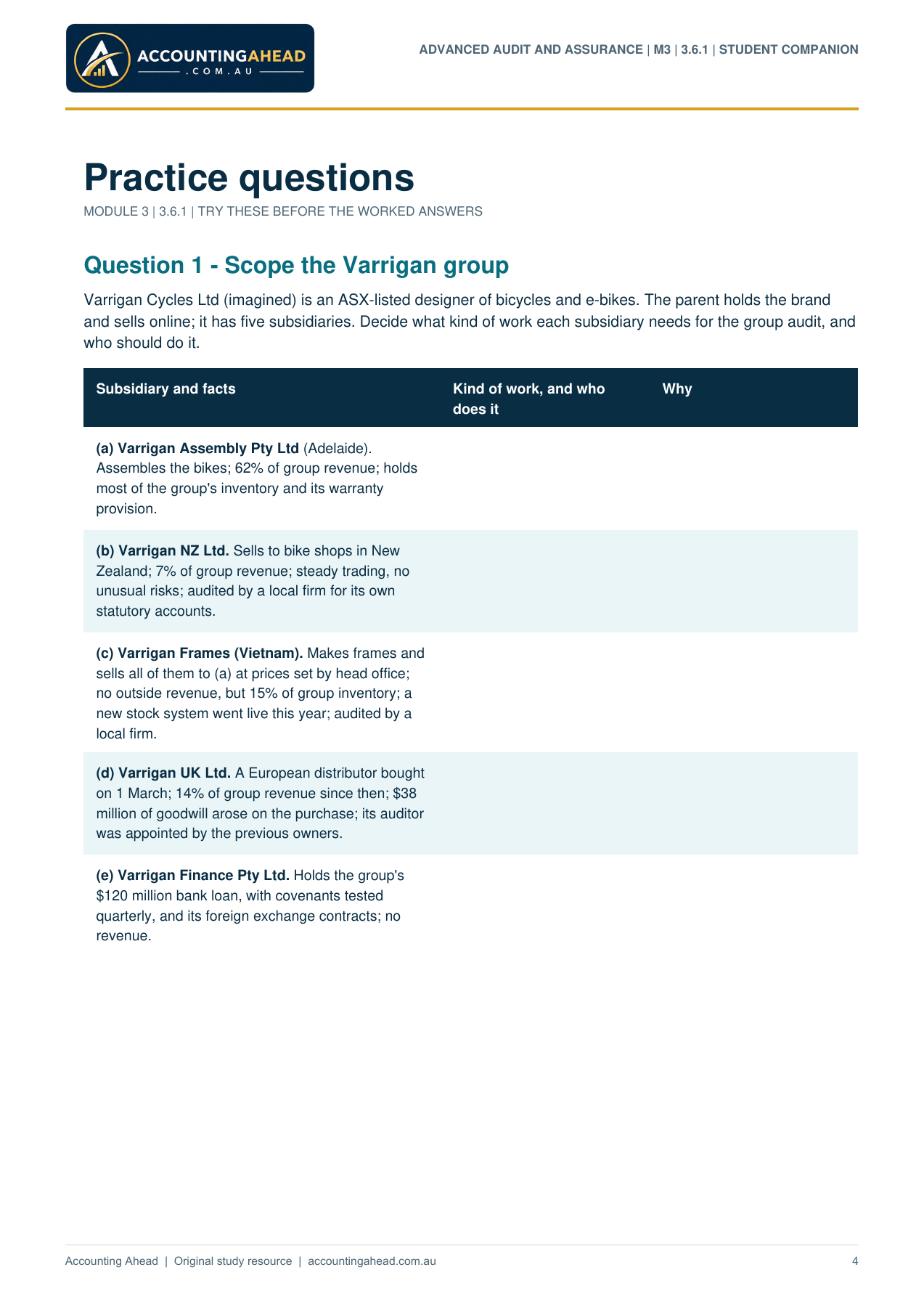
Question 1 - Scope the Varrigan group
Varrigan Cycles Ltd (imagined) is an ASX-listed designer of bicycles and e-bikes. The parent holds the brand
and sells online; it has five subsidiaries. Decide what kind of work each subsidiary needs for the group audit, and
who should do it.
Subsidiary and facts Kind of work, and who
does it
Why
(a) Varrigan Assembly Pty Ltd (Adelaide).
Assembles the bikes; 62% of group revenue; holds
most of the group's inventory and its warranty
provision.
(b) Varrigan NZ Ltd. Sells to bike shops in New
Zealand; 7% of group revenue; steady trading, no
unusual risks; audited by a local firm for its own
statutory accounts.
(c) Varrigan Frames (Vietnam). Makes frames and
sells all of them to (a) at prices set by head office;
no outside revenue, but 15% of group inventory; a
new stock system went live this year; audited by a
local firm.
(d) Varrigan UK Ltd. A European distributor bought
on 1 March; 14% of group revenue since then; $38
million of goodwill arose on the purchase; its auditor
was appointed by the previous owners.
(e) Varrigan Finance Pty Ltd. Holds the group's
$120 million bank loan, with covenants tested
quarterly, and its foreign exchange contracts; no
revenue.
ADVANCED AUDIT AND ASSURANCE | M3 | 3.6.1 | STUDENT COMPANION
4
Accounting Ahead | Original study resource | accountingahead.com.au
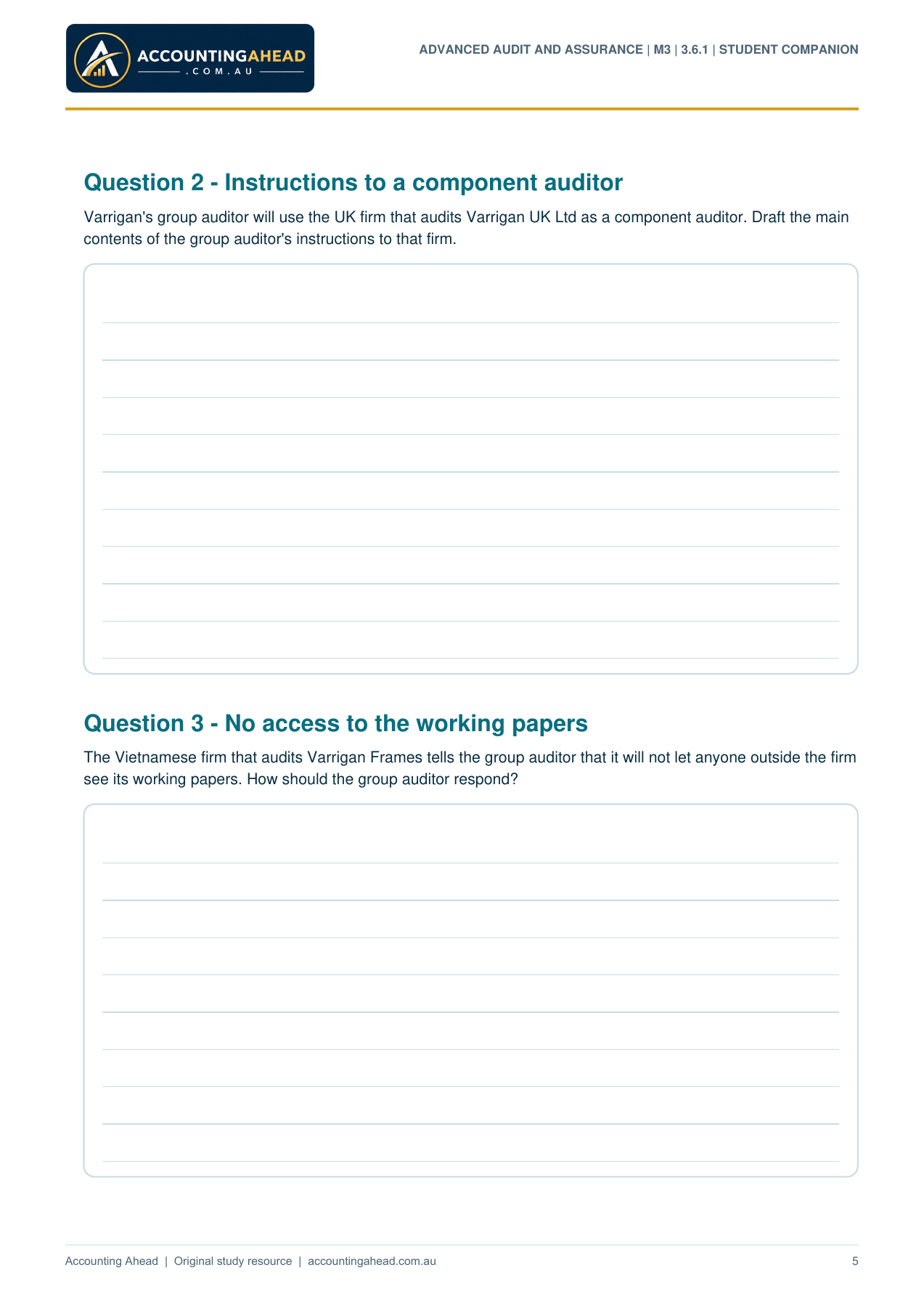
Question 2 - Instructions to a component auditor
Varrigan's group auditor will use the UK firm that audits Varrigan UK Ltd as a component auditor. Draft the main
contents of the group auditor's instructions to that firm.
Question 3 - No access to the working papers
The Vietnamese firm that audits Varrigan Frames tells the group auditor that it will not let anyone outside the firm
see its working papers. How should the group auditor respond?
ADVANCED AUDIT AND ASSURANCE | M3 | 3.6.1 | STUDENT COMPANION
5
Accounting Ahead | Original study resource | accountingahead.com.au
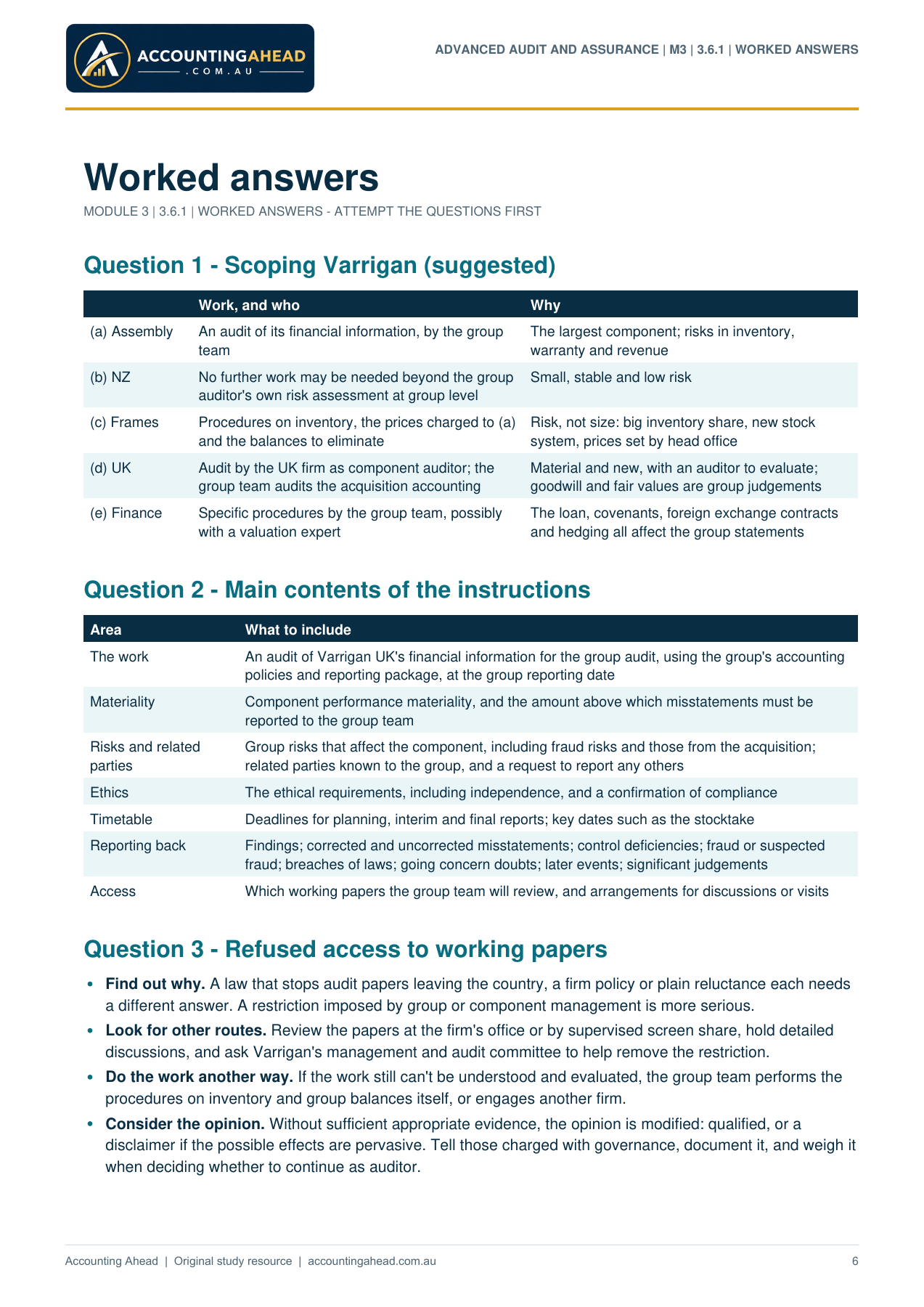
Worked answers
MODULE 3 | 3.6.1 | WORKED ANSWERS - ATTEMPT THE QUESTIONS FIRST
Question 1 - Scoping Varrigan (suggested)
Work, and who Why
(a) Assembly An audit of its financial information, by the group
team
The largest component; risks in inventory,
warranty and revenue
(b) NZ No further work may be needed beyond the group
auditor's own risk assessment at group level
Small, stable and low risk
(c) Frames Procedures on inventory, the prices charged to (a)
and the balances to eliminate
Risk, not size: big inventory share, new stock
system, prices set by head office
(d) UK Audit by the UK firm as component auditor; the
group team audits the acquisition accounting
Material and new, with an auditor to evaluate;
goodwill and fair values are group judgements
(e) Finance Specific procedures by the group team, possibly
with a valuation expert
The loan, covenants, foreign exchange contracts
and hedging all affect the group statements
Question 2 - Main contents of the instructions
Area What to include
The work An audit of Varrigan UK's financial information for the group audit, using the group's accounting
policies and reporting package, at the group reporting date
Materiality Component performance materiality, and the amount above which misstatements must be
reported to the group team
Risks and related
parties
Group risks that affect the component, including fraud risks and those from the acquisition;
related parties known to the group, and a request to report any others
Ethics The ethical requirements, including independence, and a confirmation of compliance
Timetable Deadlines for planning, interim and final reports; key dates such as the stocktake
Reporting back Findings; corrected and uncorrected misstatements; control deficiencies; fraud or suspected
fraud; breaches of laws; going concern doubts; later events; significant judgements
Access Which working papers the group team will review, and arrangements for discussions or visits
Question 3 - Refused access to working papers
Find out why. A law that stops audit papers leaving the country, a firm policy or plain reluctance each needs
a different answer. A restriction imposed by group or component management is more serious.
Look for other routes. Review the papers at the firm's office or by supervised screen share, hold detailed
discussions, and ask Varrigan's management and audit committee to help remove the restriction.
Do the work another way. If the work still can't be understood and evaluated, the group team performs the
procedures on inventory and group balances itself, or engages another firm.
Consider the opinion. Without sufficient appropriate evidence, the opinion is modified: qualified, or a
disclaimer if the possible effects are pervasive. Tell those charged with governance, document it, and weigh it
when deciding whether to continue as auditor.
ADVANCED AUDIT AND ASSURANCE | M3 | 3.6.1 | WORKED ANSWERS
6