
Using internal auditors and experts
Printable study notes, diagrams and practice support for Part 3.6.2.
Read the handout text
Accounting Ahead | Original study resource | accountingahead.com.au
Using internal auditors and experts
MODULE 3 | 3.6.2 | STUDENT COMPANION
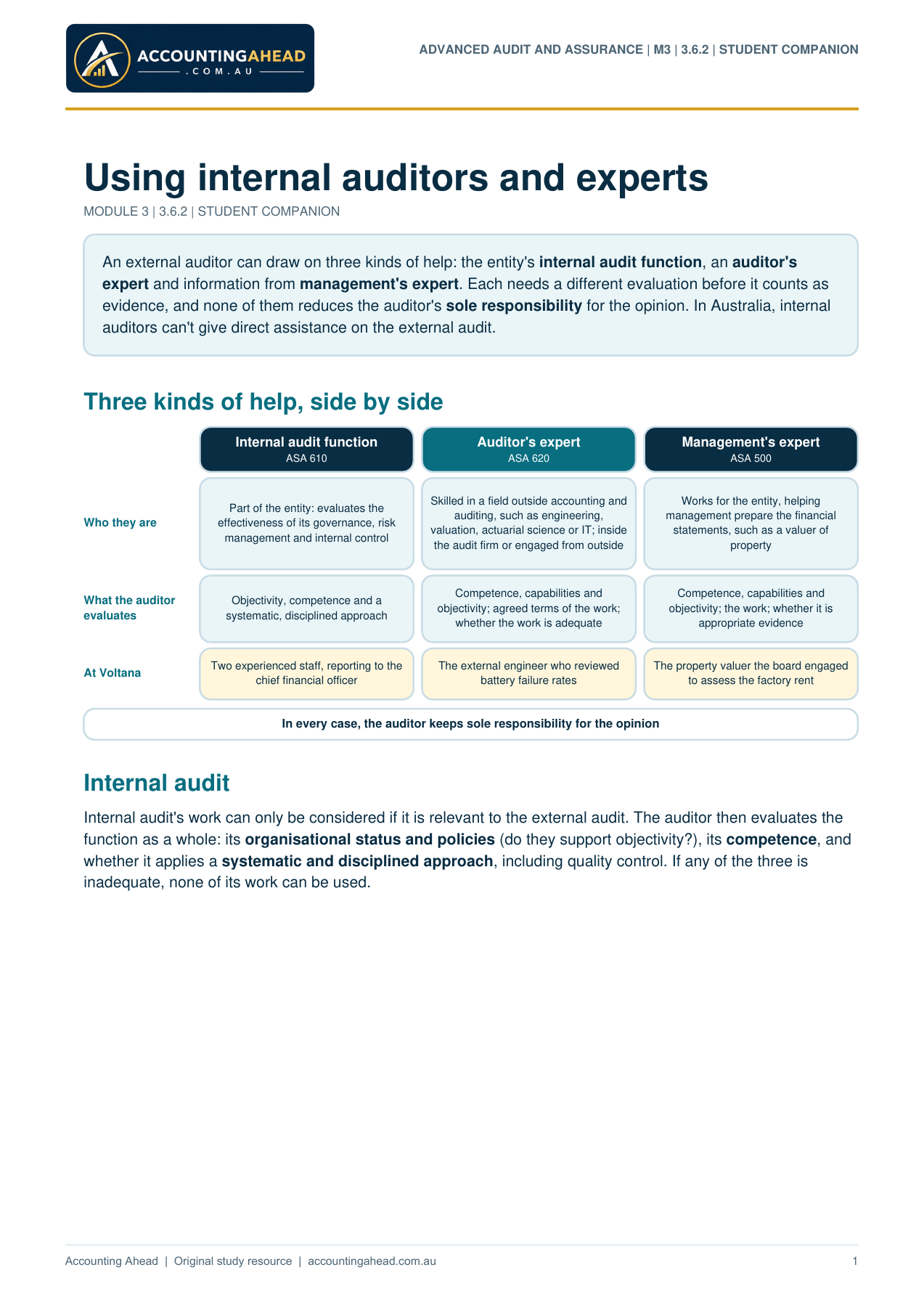
An external auditor can draw on three kinds of help: the entity's internal audit function, an auditor's
expert and information from management's expert. Each needs a different evaluation before it counts as
evidence, and none of them reduces the auditor's sole responsibility for the opinion. In Australia, internal
auditors can't give direct assistance on the external audit.
Three kinds of help, side by side
Internal audit function
ASA 610
Auditor's expert
ASA 620
Management's expert
ASA 500
Who they are
Part of the entity: evaluates the
effectiveness of its governance, risk
management and internal control
Skilled in a field outside accounting and
auditing, such as engineering,
valuation, actuarial science or IT; inside
the audit firm or engaged from outside
Works for the entity, helping
management prepare the financial
statements, such as a valuer of
property
What the auditor
evaluates
Objectivity, competence and a
systematic, disciplined approach
Competence, capabilities and
objectivity; agreed terms of the work;
whether the work is adequate
Competence, capabilities and
objectivity; the work; whether it is
appropriate evidence
At Voltana Two experienced staff, reporting to the
chief financial officer
The external engineer who reviewed
battery failure rates
The property valuer the board engaged
to assess the factory rent
In every case, the auditor keeps sole responsibility for the opinion
Internal audit
Internal audit's work can only be considered if it is relevant to the external audit. The auditor then evaluates the
function as a whole: its organisational status and policies (do they support objectivity?), its competence, and
whether it applies a systematic and disciplined approach, including quality control. If any of the three is
inadequate, none of its work can be used.
ADVANCED AUDIT AND ASSURANCE | M3 | 3.6.2 | STUDENT COMPANION
1
Accounting Ahead | Original study resource | accountingahead.com.au
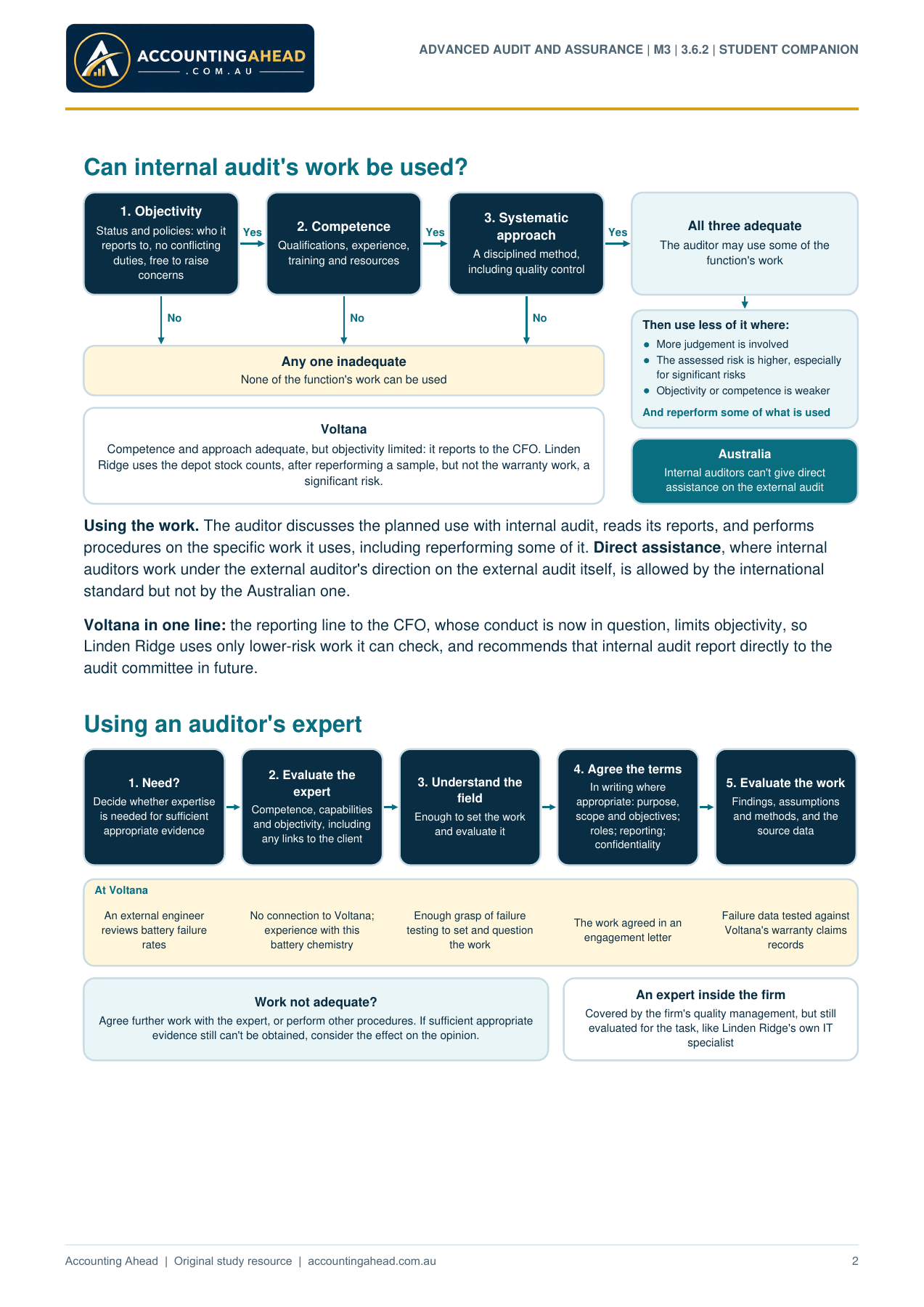
Can internal audit's work be used?
1. Objectivity
Status and policies: who it
reports to, no conflicting
duties, free to raise
concerns
Yes
No
2. Competence
Qualifications, experience,
training and resources
Yes
No
3. Systematic
approach
A disciplined method,
including quality control
Yes
No
All three adequate
The auditor may use some of the
function's work
Any one inadequate
None of the function's work can be used
Then use less of it where:
More judgement is involved
The assessed risk is higher, especially
for significant risks
Objectivity or competence is weaker
And reperform some of what is used
Voltana
Competence and approach adequate, but objectivity limited: it reports to the CFO. Linden
Ridge uses the depot stock counts, after reperforming a sample, but not the warranty work, a
significant risk.
Australia
Internal auditors can't give direct
assistance on the external audit
Using the work. The auditor discusses the planned use with internal audit, reads its reports, and performs
procedures on the specific work it uses, including reperforming some of it. Direct assistance, where internal
auditors work under the external auditor's direction on the external audit itself, is allowed by the international
standard but not by the Australian one.
Voltana in one line: the reporting line to the CFO, whose conduct is now in question, limits objectivity, so
Linden Ridge uses only lower-risk work it can check, and recommends that internal audit report directly to the
audit committee in future.
Using an auditor's expert
1. Need?
Decide whether expertise
is needed for sufficient
appropriate evidence
2. Evaluate the
expert
Competence, capabilities
and objectivity, including
any links to the client
3. Understand the
field
Enough to set the work
and evaluate it
4. Agree the terms
In writing where
appropriate: purpose,
scope and objectives;
roles; reporting;
confidentiality
5. Evaluate the work
Findings, assumptions
and methods, and the
source data
At Voltana
An external engineer
reviews battery failure
rates
No connection to Voltana;
experience with this
battery chemistry
Enough grasp of failure
testing to set and question
the work
The work agreed in an
engagement letter
Failure data tested against
Voltana's warranty claims
records
Work not adequate?
Agree further work with the expert, or perform other procedures. If sufficient appropriate
evidence still can't be obtained, consider the effect on the opinion.
An expert inside the firm
Covered by the firm's quality management, but still
evaluated for the task, like Linden Ridge's own IT
specialist
ADVANCED AUDIT AND ASSURANCE | M3 | 3.6.2 | STUDENT COMPANION
2
Accounting Ahead | Original study resource | accountingahead.com.au
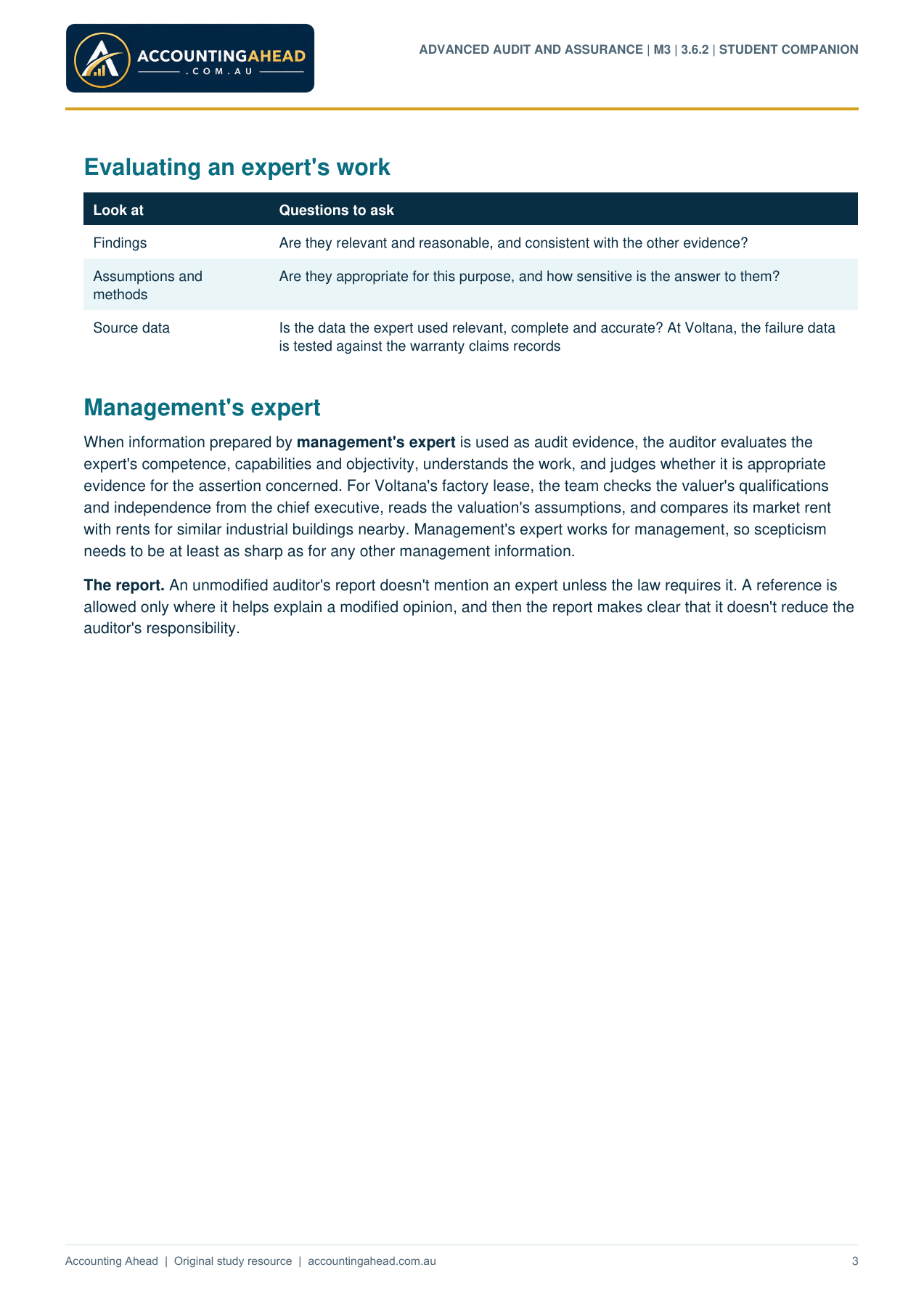
Evaluating an expert's work
Look at Questions to ask
Findings Are they relevant and reasonable, and consistent with the other evidence?
Assumptions and
methods
Are they appropriate for this purpose, and how sensitive is the answer to them?
Source data Is the data the expert used relevant, complete and accurate? At Voltana, the failure data
is tested against the warranty claims records
Management's expert
When information prepared by management's expert is used as audit evidence, the auditor evaluates the
expert's competence, capabilities and objectivity, understands the work, and judges whether it is appropriate
evidence for the assertion concerned. For Voltana's factory lease, the team checks the valuer's qualifications
and independence from the chief executive, reads the valuation's assumptions, and compares its market rent
with rents for similar industrial buildings nearby. Management's expert works for management, so scepticism
needs to be at least as sharp as for any other management information.
The report. An unmodified auditor's report doesn't mention an expert unless the law requires it. A reference is
allowed only where it helps explain a modified opinion, and then the report makes clear that it doesn't reduce the
auditor's responsibility.
ADVANCED AUDIT AND ASSURANCE | M3 | 3.6.2 | STUDENT COMPANION
3
Accounting Ahead | Original study resource | accountingahead.com.au
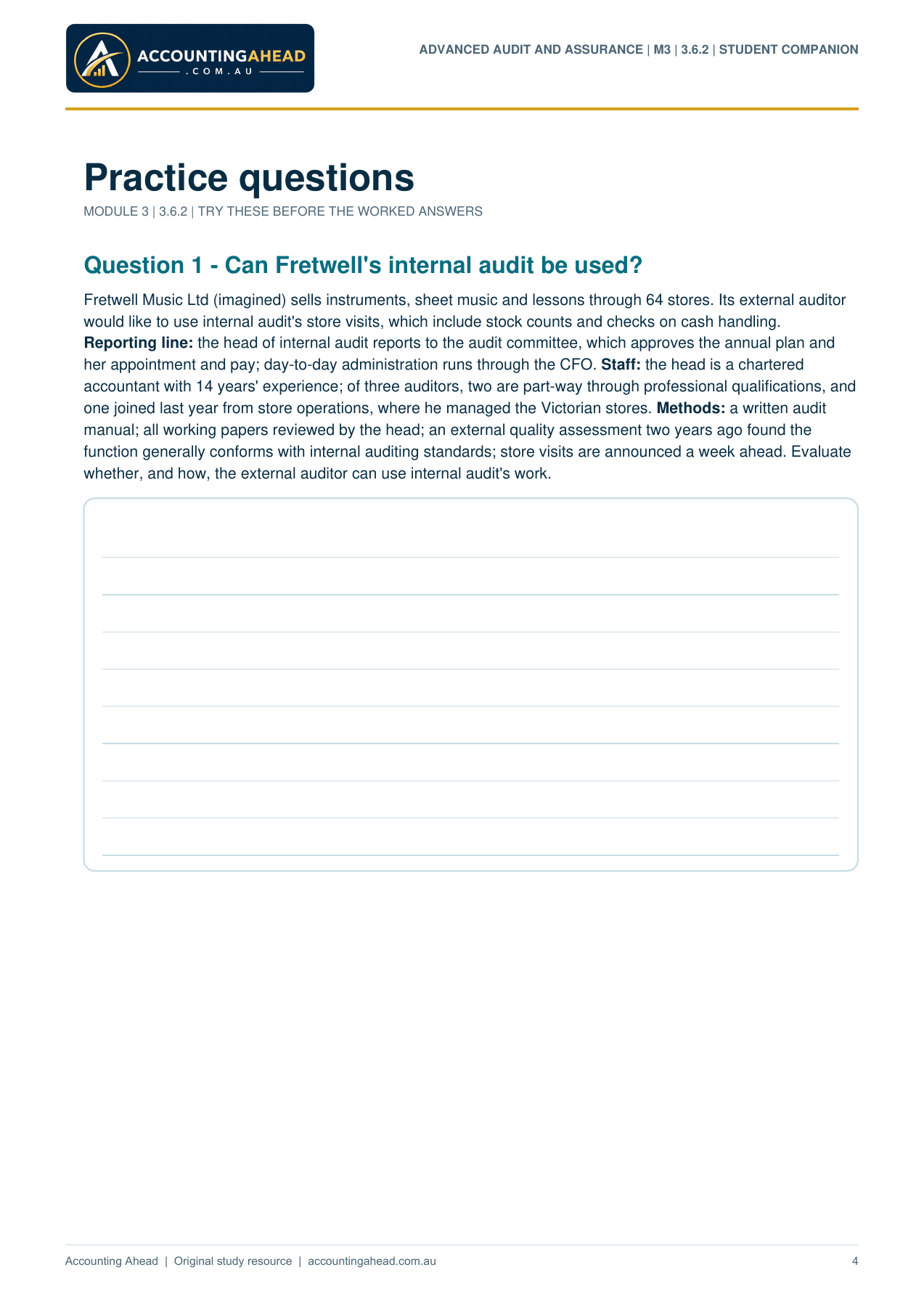
Practice questions
MODULE 3 | 3.6.2 | TRY THESE BEFORE THE WORKED ANSWERS
Question 1 - Can Fretwell's internal audit be used?
Fretwell Music Ltd (imagined) sells instruments, sheet music and lessons through 64 stores. Its external auditor
would like to use internal audit's store visits, which include stock counts and checks on cash handling.
Reporting line: the head of internal audit reports to the audit committee, which approves the annual plan and
her appointment and pay; day-to-day administration runs through the CFO. Staff: the head is a chartered
accountant with 14 years' experience; of three auditors, two are part-way through professional qualifications, and
one joined last year from store operations, where he managed the Victorian stores. Methods: a written audit
manual; all working papers reviewed by the head; an external quality assessment two years ago found the
function generally conforms with internal auditing standards; store visits are announced a week ahead. Evaluate
whether, and how, the external auditor can use internal audit's work.
ADVANCED AUDIT AND ASSURANCE | M3 | 3.6.2 | STUDENT COMPANION
4
Accounting Ahead | Original study resource | accountingahead.com.au
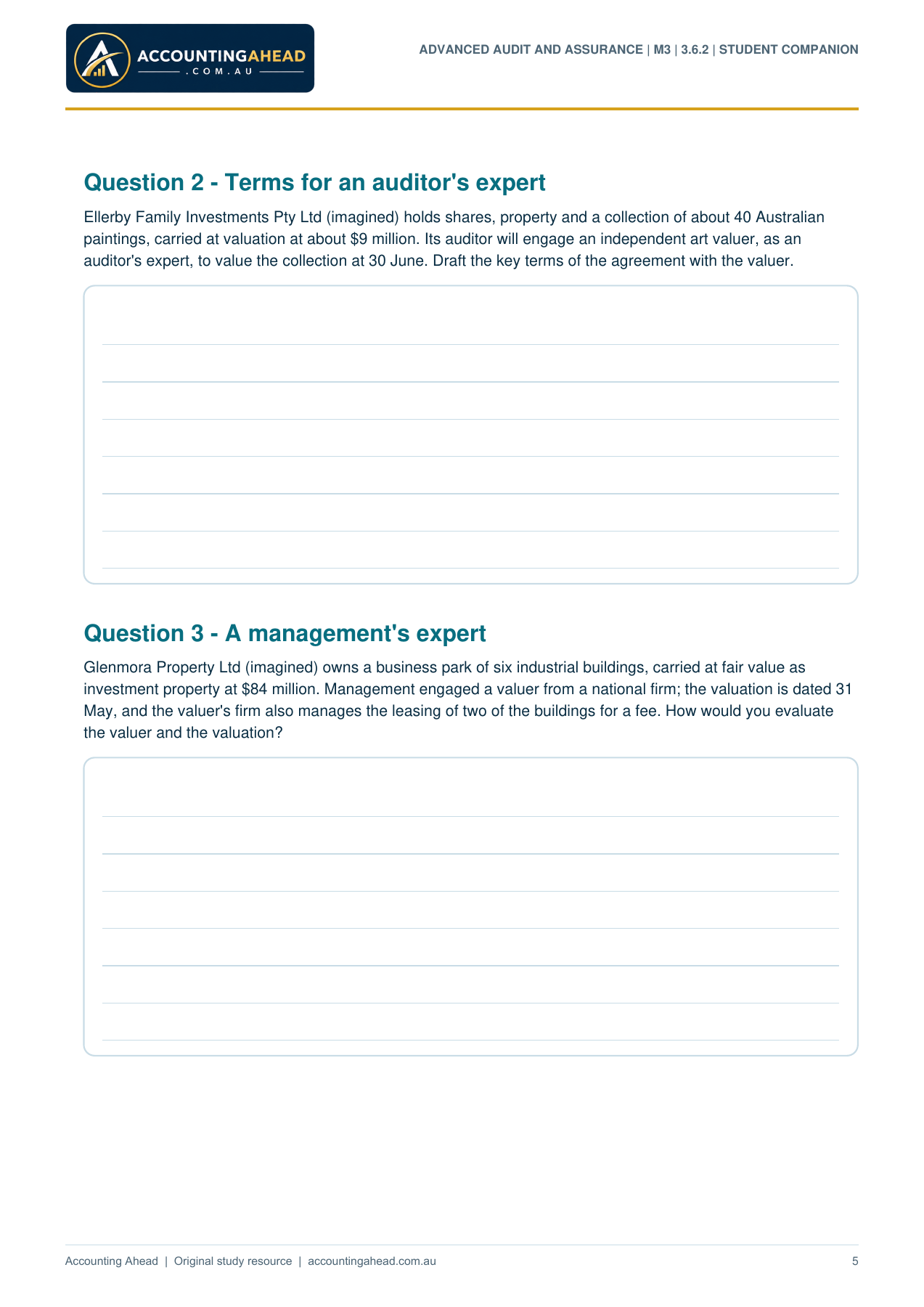
Question 2 - Terms for an auditor's expert
Ellerby Family Investments Pty Ltd (imagined) holds shares, property and a collection of about 40 Australian
paintings, carried at valuation at about $9 million. Its auditor will engage an independent art valuer, as an
auditor's expert, to value the collection at 30 June. Draft the key terms of the agreement with the valuer.
Question 3 - A management's expert
Glenmora Property Ltd (imagined) owns a business park of six industrial buildings, carried at fair value as
investment property at $84 million. Management engaged a valuer from a national firm; the valuation is dated 31
May, and the valuer's firm also manages the leasing of two of the buildings for a fee. How would you evaluate
the valuer and the valuation?
ADVANCED AUDIT AND ASSURANCE | M3 | 3.6.2 | STUDENT COMPANION
5
Accounting Ahead | Original study resource | accountingahead.com.au
Worked answers
MODULE 3 | 3.6.2 | WORKED ANSWERS - ATTEMPT THE QUESTIONS FIRST
Question 1 - Fretwell Music (suggested)
Gate Evaluation
Objectivity Generally supported: the head reports to the audit committee, which approves the plan and her
appointment and pay (administration through the CFO is common). But the former manager of
the Victorian stores would be reviewing his own past work, so his visits to those stores aren't
used
Competence Adequate: an experienced, qualified head, and developing staff whose work she reviews
Systematic approach Adequate: a manual, review of every file and a recent external quality assessment; but
announcing visits a week ahead weakens the stock counts
Conclusion. Some work can be used, but less where judgement or risk is higher, such as slow-moving stock
or any significant risk. Discuss it with the head, read the reports, and reperform a sample: attend some visits
and recount items.
No direct assistance. In Australia, internal auditors can't perform procedures for the external audit under the
external auditor's direction.
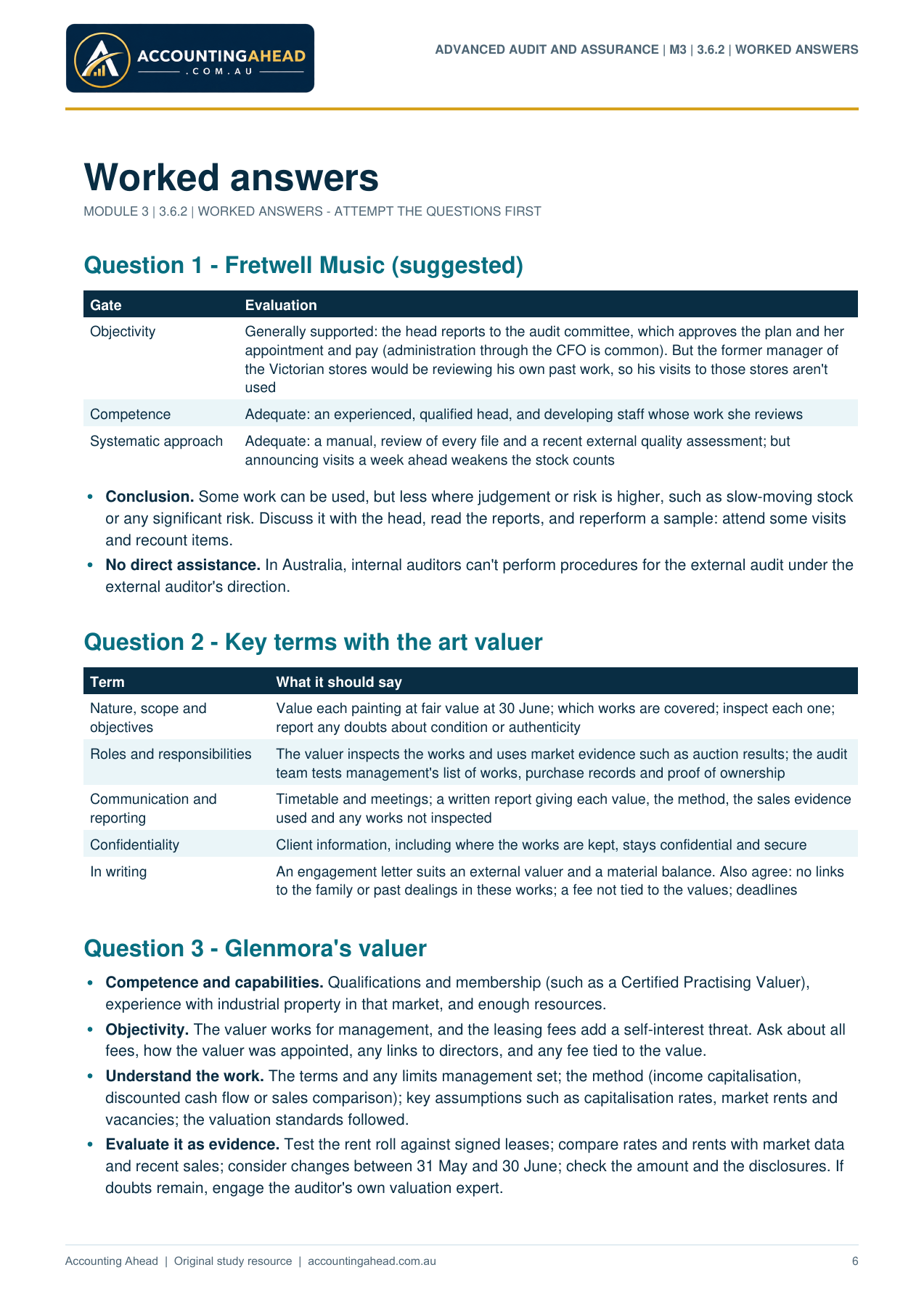
Question 2 - Key terms with the art valuer
Term What it should say
Nature, scope and
objectives
Value each painting at fair value at 30 June; which works are covered; inspect each one;
report any doubts about condition or authenticity
Roles and responsibilities The valuer inspects the works and uses market evidence such as auction results; the audit
team tests management's list of works, purchase records and proof of ownership
Communication and
reporting
Timetable and meetings; a written report giving each value, the method, the sales evidence
used and any works not inspected
Confidentiality Client information, including where the works are kept, stays confidential and secure
In writing An engagement letter suits an external valuer and a material balance. Also agree: no links
to the family or past dealings in these works; a fee not tied to the values; deadlines
Question 3 - Glenmora's valuer
Competence and capabilities. Qualifications and membership (such as a Certified Practising Valuer),
experience with industrial property in that market, and enough resources.
Objectivity. The valuer works for management, and the leasing fees add a self-interest threat. Ask about all
fees, how the valuer was appointed, any links to directors, and any fee tied to the value.
Understand the work. The terms and any limits management set; the method (income capitalisation,
discounted cash flow or sales comparison); key assumptions such as capitalisation rates, market rents and
vacancies; the valuation standards followed.
Evaluate it as evidence. Test the rent roll against signed leases; compare rates and rents with market data
and recent sales; consider changes between 31 May and 30 June; check the amount and the disclosures. If
doubts remain, engage the auditor's own valuation expert.
ADVANCED AUDIT AND ASSURANCE | M3 | 3.6.2 | WORKED ANSWERS
6