
Audit documentation
Printable study notes, diagrams and practice support for Part 3.7.
Read the handout text
Accounting Ahead | Original study resource | accountingahead.com.au
Audit documentation
MODULE 3 | 3.7 | STUDENT COMPANION
Audit documentation is the lasting proof that the work was done and the judgements were sound. A good
working paper lets an experienced auditor with no connection to the engagement see what was done, why,
and what it showed. Files separate permanent from current information; the final file is assembled within
about 60 days of the auditor's report and kept for seven years under the Corporations Act; after assembly
nothing is deleted, and any change is fully explained. Client data is protected throughout.
What documentation does
Shows the basis for the auditor's report, and that the audit was planned and performed in line with the
standards and the law
Lets the team plan, supervise and review the work, and holds people accountable for it
Carries knowledge forward to next year's audit
Allows quality reviews, firm inspections and regulators' inspections: the file is the only lasting record of
what was done
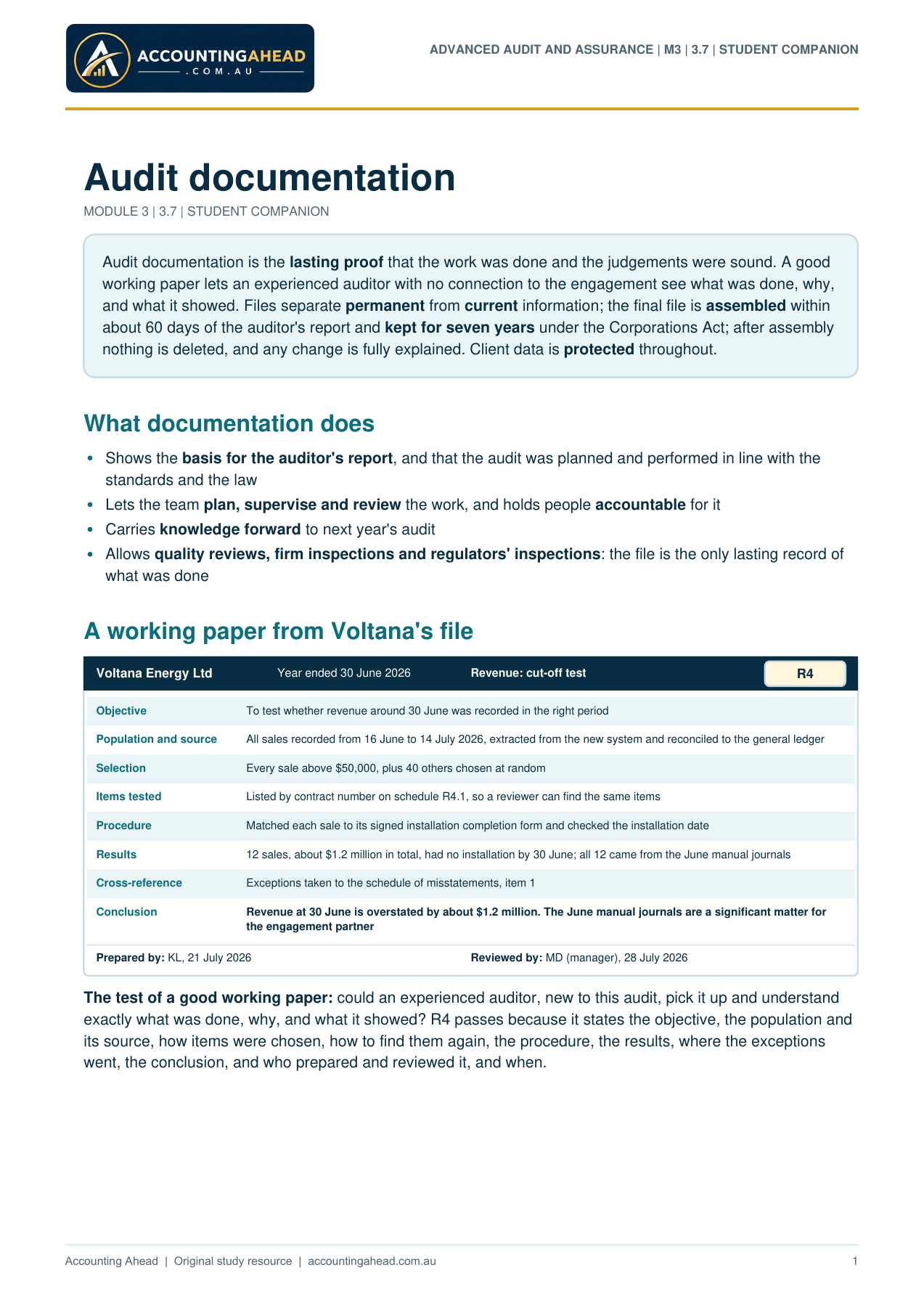
A working paper from Voltana's file
Voltana Energy Ltd Year ended 30 June 2026 Revenue: cut-off test R4
Objective To test whether revenue around 30 June was recorded in the right period
Population and source All sales recorded from 16 June to 14 July 2026, extracted from the new system and reconciled to the general ledger
Selection Every sale above $50,000, plus 40 others chosen at random
Items tested Listed by contract number on schedule R4.1, so a reviewer can find the same items
Procedure Matched each sale to its signed installation completion form and checked the installation date
Results 12 sales, about $1.2 million in total, had no installation by 30 June; all 12 came from the June manual journals
Cross-reference Exceptions taken to the schedule of misstatements, item 1
Conclusion Revenue at 30 June is overstated by about $1.2 million. The June manual journals are a significant matter for
the engagement partner
Prepared by: KL, 21 July 2026 Reviewed by: MD (manager), 28 July 2026
The test of a good working paper: could an experienced auditor, new to this audit, pick it up and understand
exactly what was done, why, and what it showed? R4 passes because it states the objective, the population and
its source, how items were chosen, how to find them again, the procedure, the results, where the exceptions
went, the conclusion, and who prepared and reviewed it, and when.
ADVANCED AUDIT AND ASSURANCE | M3 | 3.7 | STUDENT COMPANION
1
Accounting Ahead | Original study resource | accountingahead.com.au
Beyond the tests
Significant matters, such as the June revenue journals, are documented with the discussions held about them:
what was discussed, with whom and when, and how each was resolved. If the auditor found information that was
inconsistent with its final conclusion, the file shows how that was dealt with. And if, in exceptional
circumstances, the auditor departed from a requirement of the standards, the file explains why, and how the
alternative procedures achieved the requirement's aim.
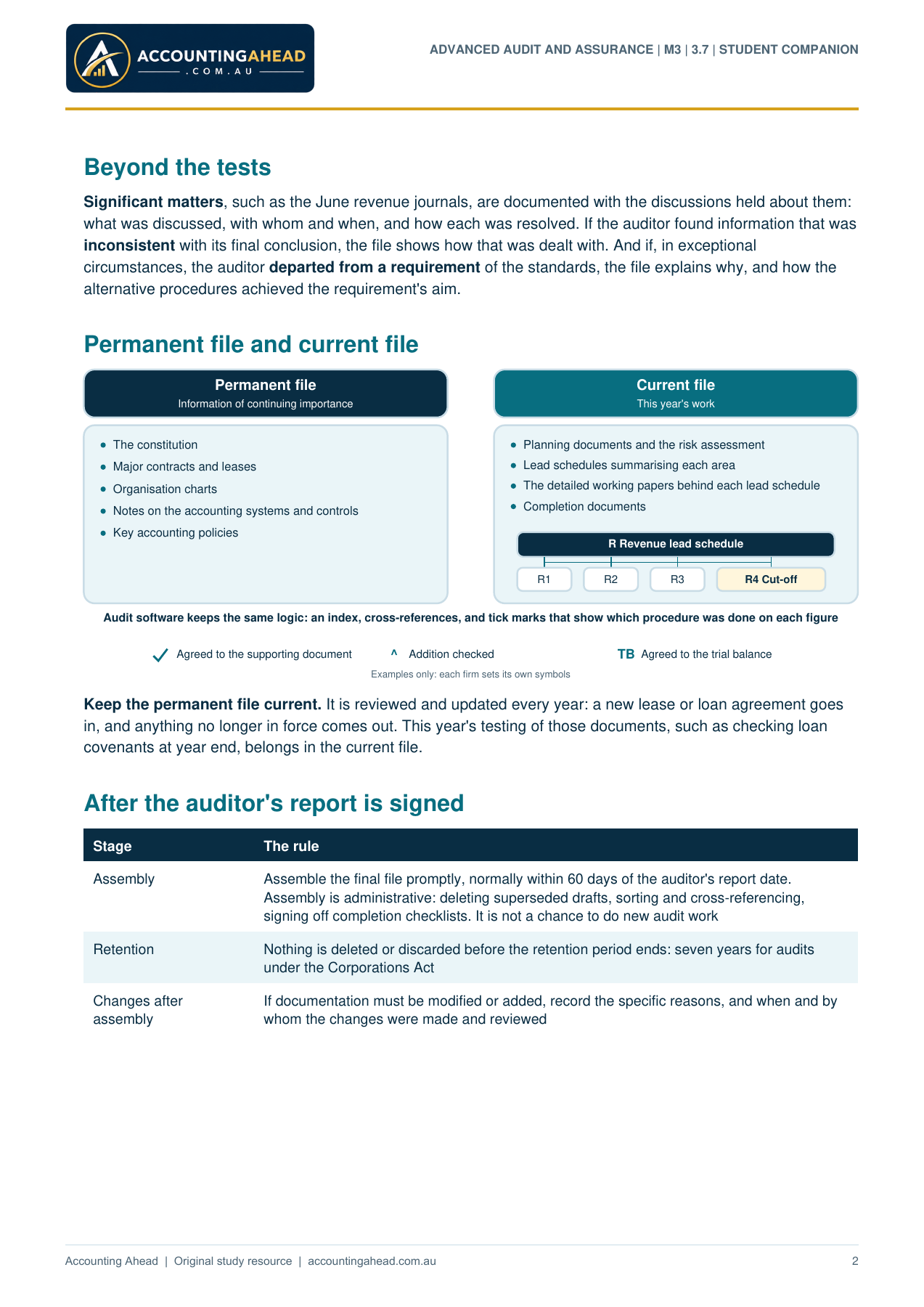
Permanent file and current file
Permanent file
Information of continuing importance
Current file
This year's work
The constitution
Major contracts and leases
Organisation charts
Notes on the accounting systems and controls
Key accounting policies
Planning documents and the risk assessment
Lead schedules summarising each area
The detailed working papers behind each lead schedule
Completion documents
R Revenue lead schedule
R1 R2 R3 R4 Cut-off
Audit software keeps the same logic: an index, cross-references, and tick marks that show which procedure was done on each figure
Agreed to the supporting document ^ Addition checked TB Agreed to the trial balance
Examples only: each firm sets its own symbols
Keep the permanent file current. It is reviewed and updated every year: a new lease or loan agreement goes
in, and anything no longer in force comes out. This year's testing of those documents, such as checking loan
covenants at year end, belongs in the current file.
After the auditor's report is signed
Stage The rule
Assembly Assemble the final file promptly, normally within 60 days of the auditor's report date.
Assembly is administrative: deleting superseded drafts, sorting and cross-referencing,
signing off completion checklists. It is not a chance to do new audit work
Retention Nothing is deleted or discarded before the retention period ends: seven years for audits
under the Corporations Act
Changes after
assembly
If documentation must be modified or added, record the specific reasons, and when and by
whom the changes were made and reviewed
ADVANCED AUDIT AND ASSURANCE | M3 | 3.7 | STUDENT COMPANION
2
Accounting Ahead | Original study resource | accountingahead.com.au
Case note: KPMG and the leaked inspection lists
In the United States, several people at KPMG's American firm obtained confidential lists, leaked by people who
had worked at or for the audit regulator, showing which of the firm's audits the regulator planned to inspect. The
firm's staff then reviewed and revised working papers on some of those audits, after the audit reports had
already been issued, to improve how the files would look to the inspectors. Criminal charges followed in 2018
against six people, including former KPMG partners and former regulator staff. All six were convicted, four by
pleading guilty and two at trial, but by 2024 every conviction had been set aside, after an appeal court ruled in
another case that a regulator's confidential information isn't property under the federal fraud laws. Separately, in
2019 the firm admitted the facts and agreed to pay US$50 million to settle charges with the Securities and
Exchange Commission; the settlement also covered cheating on internal training exams.
Why it matters: inspection only works if files show what was really done, and when. Altering past work to
mislead an inspector attacks the integrity of the whole system.
Source: US SEC press releases 2018-6 (January 2018) and 2019-95 (June 2019); US court orders vacating the convictions (2024).
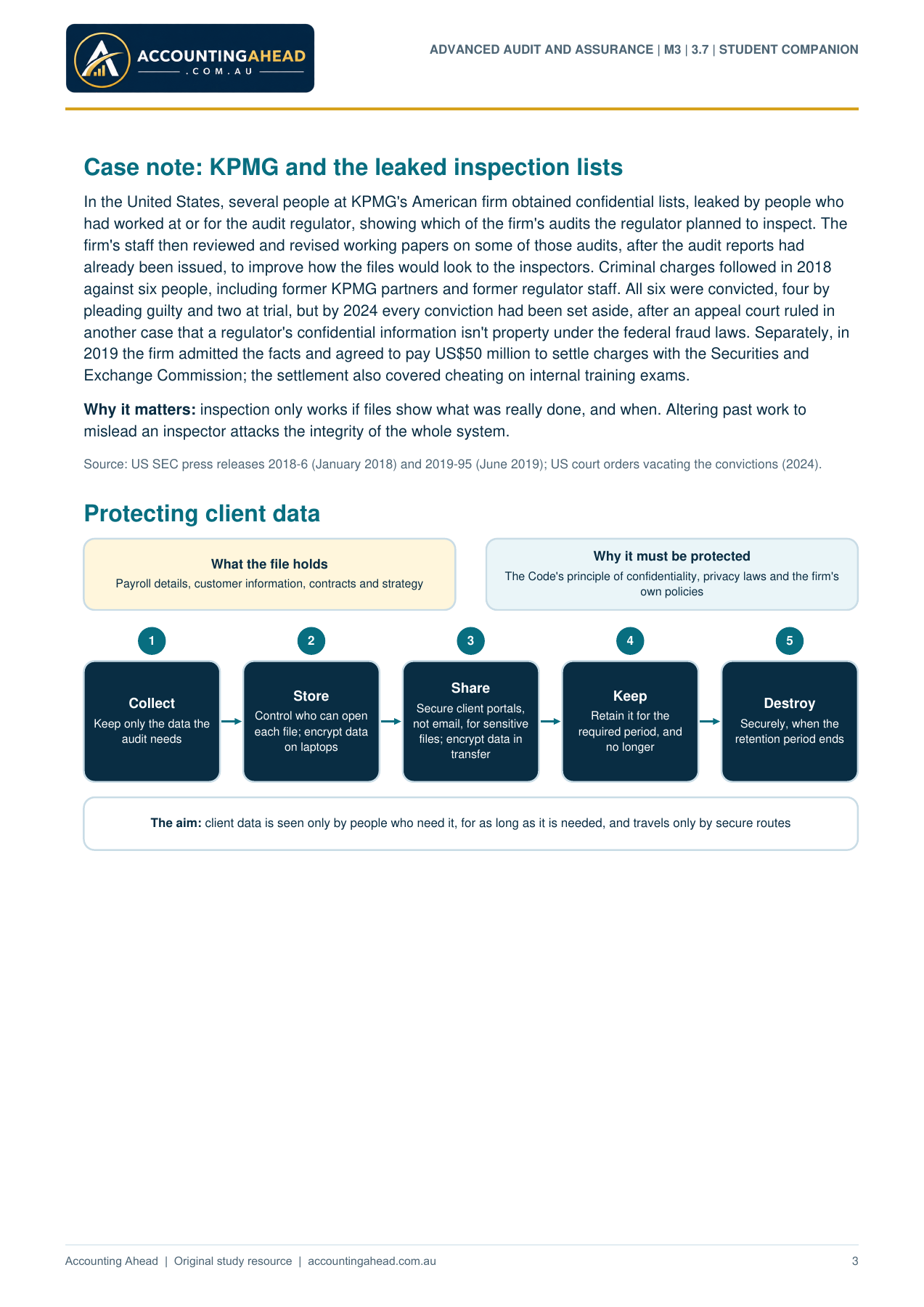
Protecting client data
What the file holds
Payroll details, customer information, contracts and strategy
Why it must be protected
The Code's principle of confidentiality, privacy laws and the firm's
own policies
1
Collect
Keep only the data the
audit needs
2
Store
Control who can open
each file; encrypt data
on laptops
3
Share
Secure client portals,
not email, for sensitive
files; encrypt data in
transfer
4
Keep
Retain it for the
required period, and
no longer
5
Destroy
Securely, when the
retention period ends
The aim: client data is seen only by people who need it, for as long as it is needed, and travels only by secure routes
ADVANCED AUDIT AND ASSURANCE | M3 | 3.7 | STUDENT COMPANION
3
Accounting Ahead | Original study resource | accountingahead.com.au
Practice questions
MODULE 3 | 3.7 | TRY THESE BEFORE THE WORKED ANSWERS
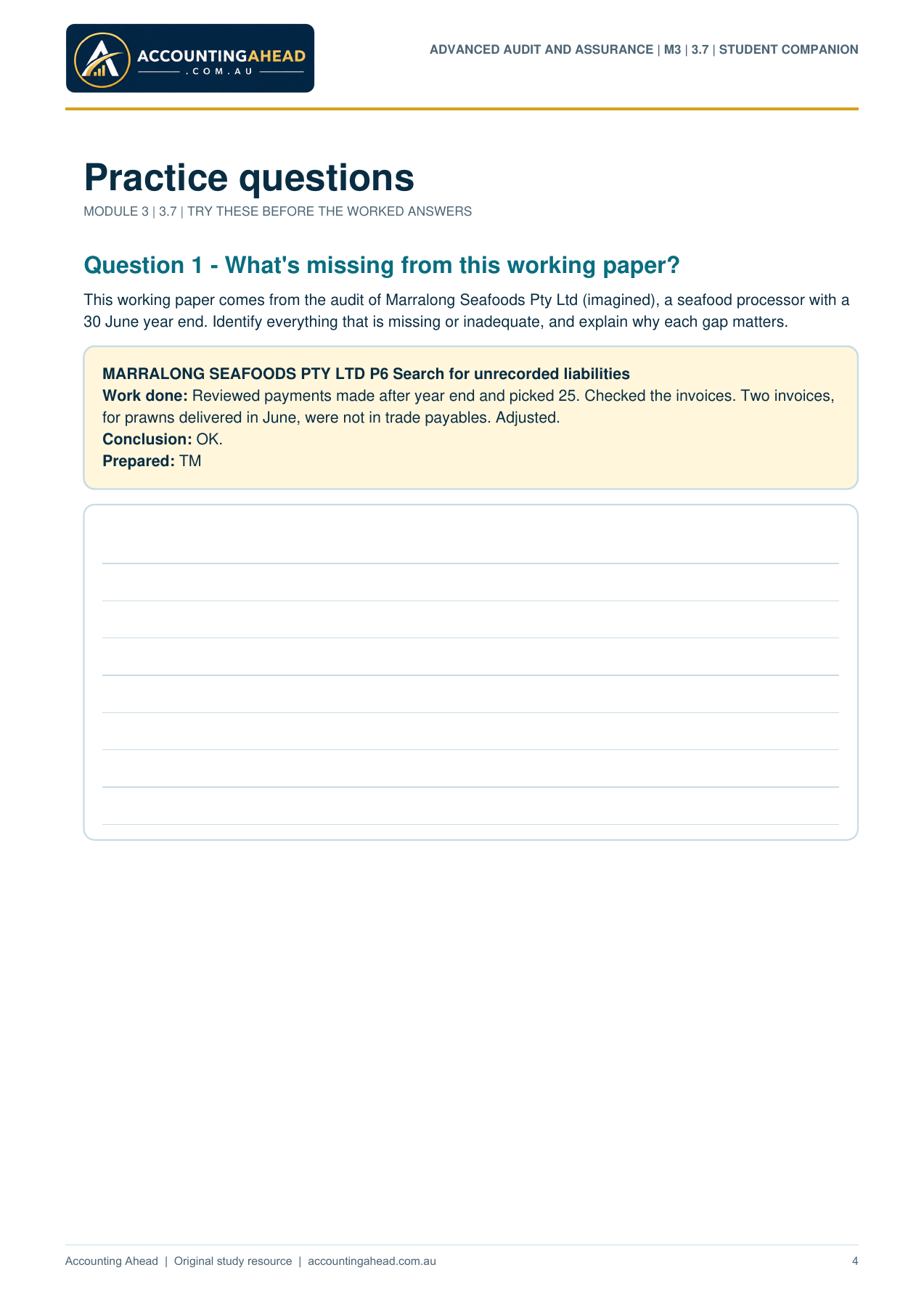
Question 1 - What's missing from this working paper?
This working paper comes from the audit of Marralong Seafoods Pty Ltd (imagined), a seafood processor with a
30 June year end. Identify everything that is missing or inadequate, and explain why each gap matters.
MARRALONG SEAFOODS PTY LTD P6 Search for unrecorded liabilities
Work done: Reviewed payments made after year end and picked 25. Checked the invoices. Two invoices,
for prawns delivered in June, were not in trade payables. Adjusted.
Conclusion: OK.
Prepared: TM
ADVANCED AUDIT AND ASSURANCE | M3 | 3.7 | STUDENT COMPANION
4
Accounting Ahead | Original study resource | accountingahead.com.au
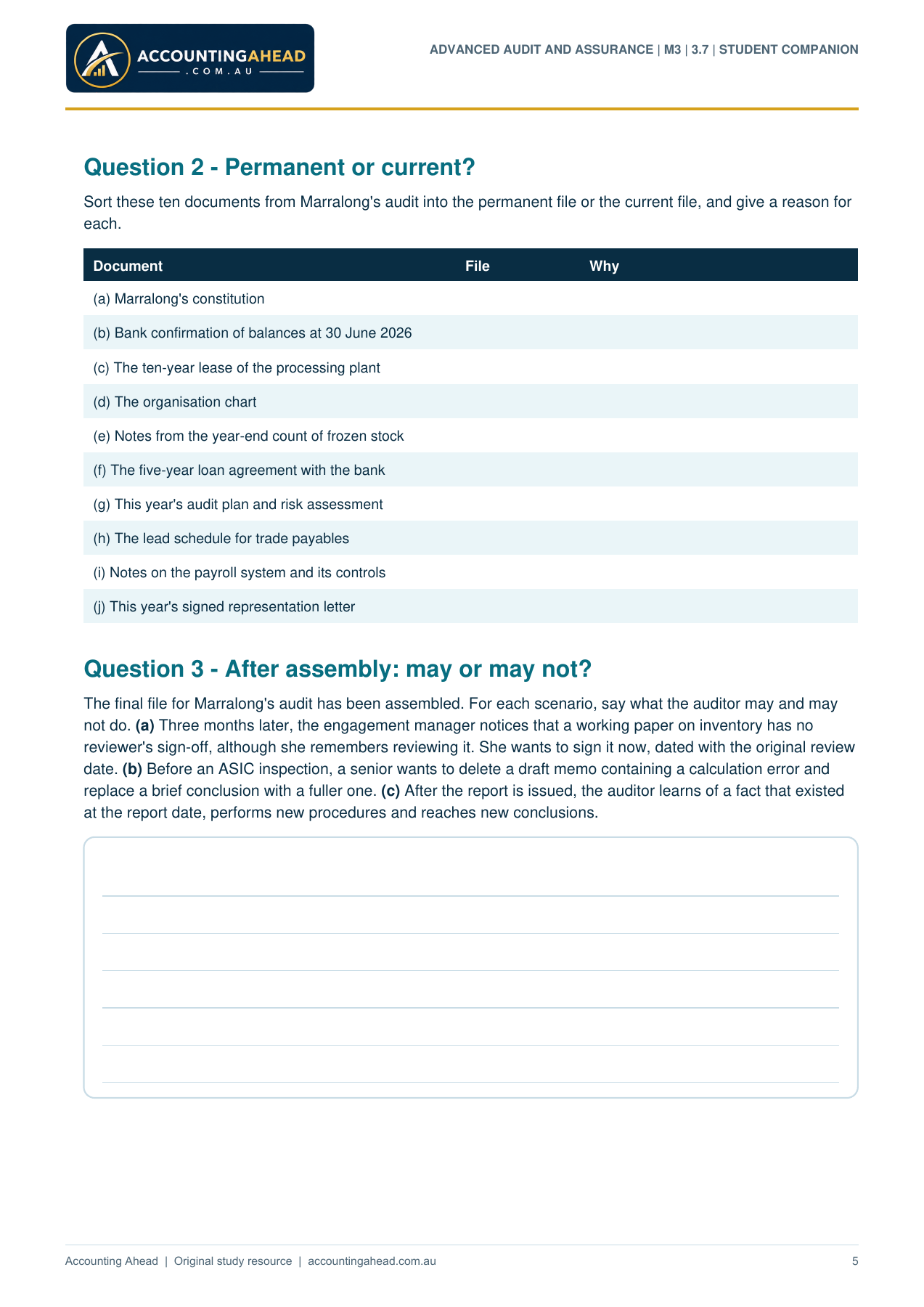
Question 2 - Permanent or current?
Sort these ten documents from Marralong's audit into the permanent file or the current file, and give a reason for
each.
Document File Why
(a) Marralong's constitution
(b) Bank confirmation of balances at 30 June 2026
(c) The ten-year lease of the processing plant
(d) The organisation chart
(e) Notes from the year-end count of frozen stock
(f) The five-year loan agreement with the bank
(g) This year's audit plan and risk assessment
(h) The lead schedule for trade payables
(i) Notes on the payroll system and its controls
(j) This year's signed representation letter
Question 3 - After assembly: may or may not?
The final file for Marralong's audit has been assembled. For each scenario, say what the auditor may and may
not do. (a) Three months later, the engagement manager notices that a working paper on inventory has no
reviewer's sign-off, although she remembers reviewing it. She wants to sign it now, dated with the original review
date. (b) Before an ASIC inspection, a senior wants to delete a draft memo containing a calculation error and
replace a brief conclusion with a fuller one. (c) After the report is issued, the auditor learns of a fact that existed
at the report date, performs new procedures and reaches new conclusions.
ADVANCED AUDIT AND ASSURANCE | M3 | 3.7 | STUDENT COMPANION
5
Accounting Ahead | Original study resource | accountingahead.com.au
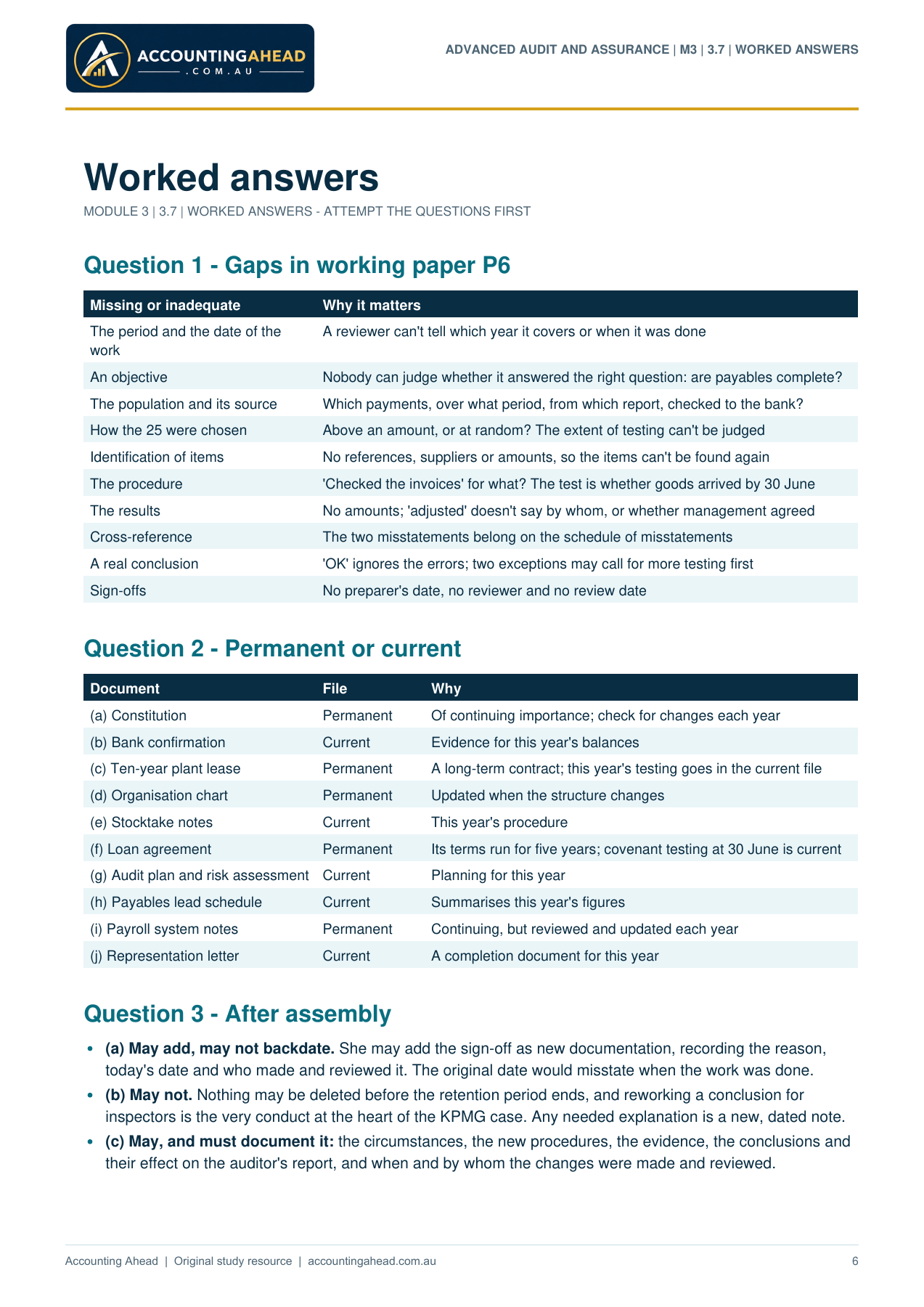
Worked answers
MODULE 3 | 3.7 | WORKED ANSWERS - ATTEMPT THE QUESTIONS FIRST
Question 1 - Gaps in working paper P6
Missing or inadequate Why it matters
The period and the date of the
work
A reviewer can't tell which year it covers or when it was done
An objective Nobody can judge whether it answered the right question: are payables complete?
The population and its source Which payments, over what period, from which report, checked to the bank?
How the 25 were chosen Above an amount, or at random? The extent of testing can't be judged
Identification of items No references, suppliers or amounts, so the items can't be found again
The procedure 'Checked the invoices' for what? The test is whether goods arrived by 30 June
The results No amounts; 'adjusted' doesn't say by whom, or whether management agreed
Cross-reference The two misstatements belong on the schedule of misstatements
A real conclusion 'OK' ignores the errors; two exceptions may call for more testing first
Sign-offs No preparer's date, no reviewer and no review date
Question 2 - Permanent or current
Document File Why
(a) Constitution Permanent Of continuing importance; check for changes each year
(b) Bank confirmation Current Evidence for this year's balances
(c) Ten-year plant lease Permanent A long-term contract; this year's testing goes in the current file
(d) Organisation chart Permanent Updated when the structure changes
(e) Stocktake notes Current This year's procedure
(f) Loan agreement Permanent Its terms run for five years; covenant testing at 30 June is current
(g) Audit plan and risk assessment Current Planning for this year
(h) Payables lead schedule Current Summarises this year's figures
(i) Payroll system notes Permanent Continuing, but reviewed and updated each year
(j) Representation letter Current A completion document for this year
Question 3 - After assembly
(a) May add, may not backdate. She may add the sign-off as new documentation, recording the reason,
today's date and who made and reviewed it. The original date would misstate when the work was done.
(b) May not. Nothing may be deleted before the retention period ends, and reworking a conclusion for
inspectors is the very conduct at the heart of the KPMG case. Any needed explanation is a new, dated note.
(c) May, and must document it: the circumstances, the new procedures, the evidence, the conclusions and
their effect on the auditor's report, and when and by whom the changes were made and reviewed.
ADVANCED AUDIT AND ASSURANCE | M3 | 3.7 | WORKED ANSWERS
6