
Evaluating misstatements and evidence
Printable study notes, diagrams and practice support for Part 3.8.
Read the handout text
Accounting Ahead | Original study resource | accountingahead.com.au
Evaluating misstatements and evidence
MODULE 3 | 3.8 | STUDENT COMPANION
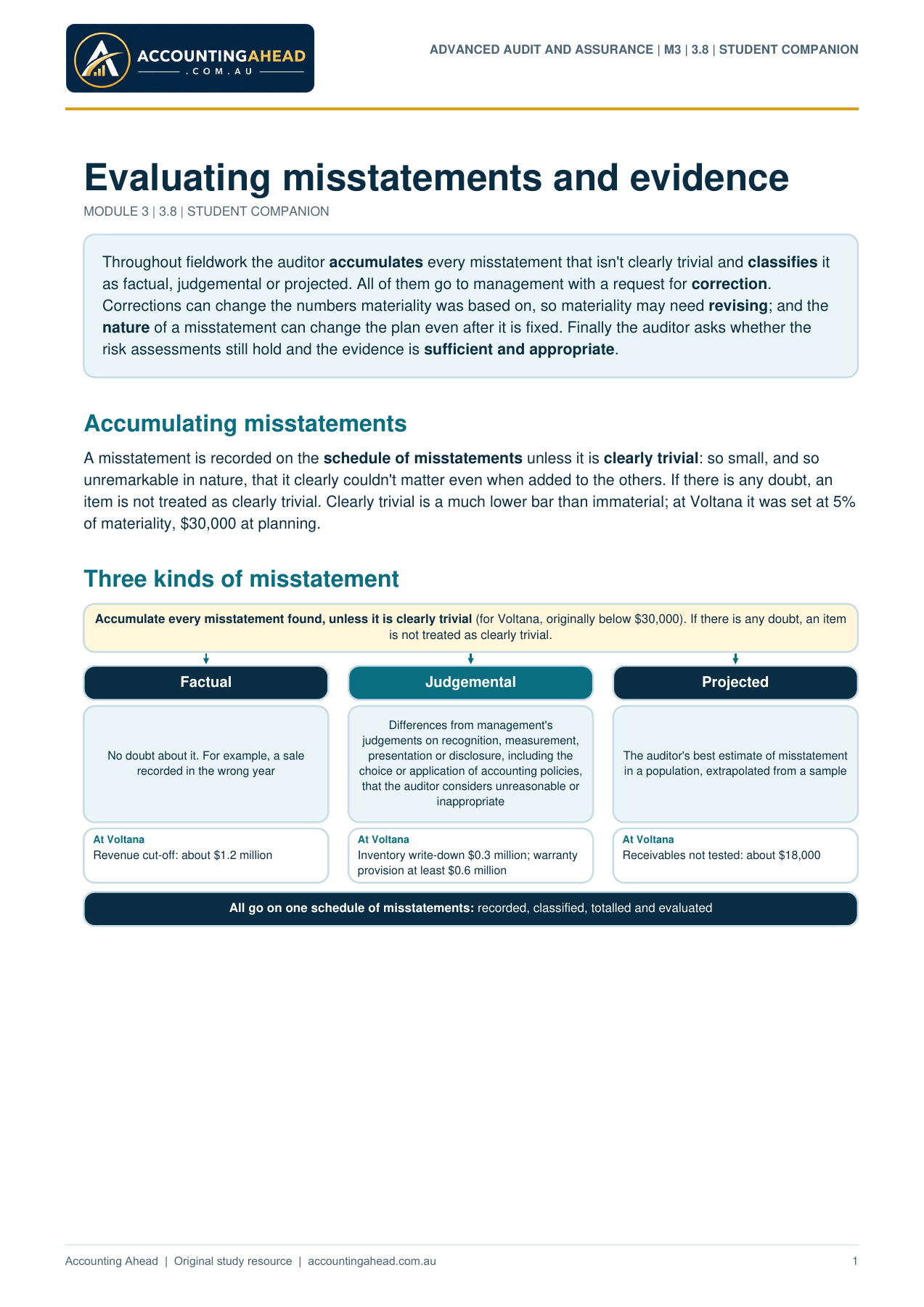
Throughout fieldwork the auditor accumulates every misstatement that isn't clearly trivial and classifies it
as factual, judgemental or projected. All of them go to management with a request for correction.
Corrections can change the numbers materiality was based on, so materiality may need revising; and the
nature of a misstatement can change the plan even after it is fixed. Finally the auditor asks whether the
risk assessments still hold and the evidence is sufficient and appropriate.
Accumulating misstatements
A misstatement is recorded on the schedule of misstatements unless it is clearly trivial: so small, and so
unremarkable in nature, that it clearly couldn't matter even when added to the others. If there is any doubt, an
item is not treated as clearly trivial. Clearly trivial is a much lower bar than immaterial; at Voltana it was set at 5%
of materiality, $30,000 at planning.
Three kinds of misstatement
Accumulate every misstatement found, unless it is clearly trivial (for Voltana, originally below $30,000). If there is any doubt, an item
is not treated as clearly trivial.
Factual
No doubt about it. For example, a sale
recorded in the wrong year
At Voltana
Revenue cut-off: about $1.2 million
Judgemental
Differences from management's
judgements on recognition, measurement,
presentation or disclosure, including the
choice or application of accounting policies,
that the auditor considers unreasonable or
inappropriate
At Voltana
Inventory write-down $0.3 million; warranty
provision at least $0.6 million
Projected
The auditor's best estimate of misstatement
in a population, extrapolated from a sample
At Voltana
Receivables not tested: about $18,000
All go on one schedule of misstatements: recorded, classified, totalled and evaluated
ADVANCED AUDIT AND ASSURANCE | M3 | 3.8 | STUDENT COMPANION
1
Accounting Ahead | Original study resource | accountingahead.com.au
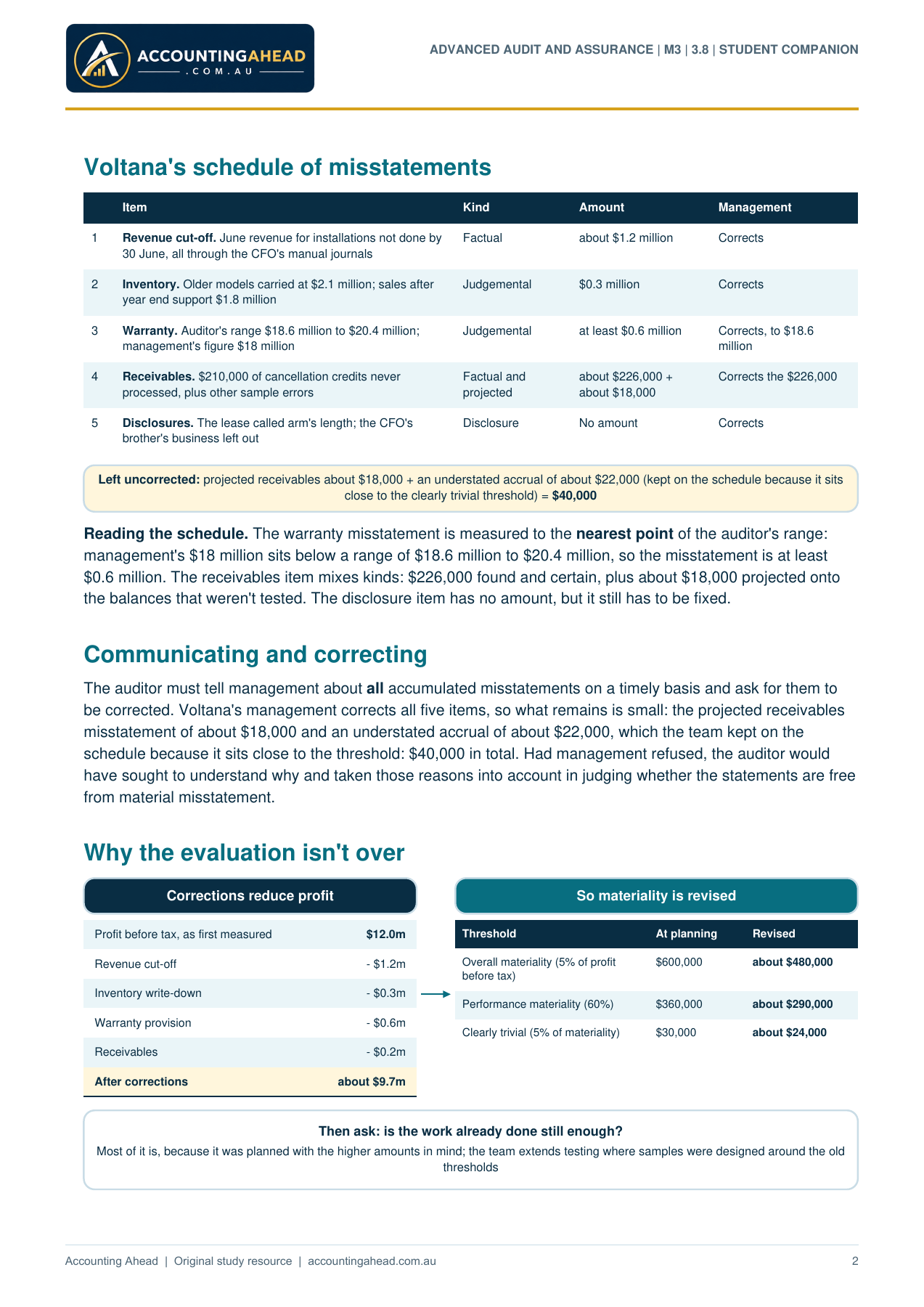
Voltana's schedule of misstatements
Item Kind Amount Management
1 Revenue cut-off. June revenue for installations not done by
30 June, all through the CFO's manual journals
Factual about $1.2 million Corrects
2 Inventory. Older models carried at $2.1 million; sales after
year end support $1.8 million
Judgemental $0.3 million Corrects
3 Warranty. Auditor's range $18.6 million to $20.4 million;
management's figure $18 million
Judgemental at least $0.6 million Corrects, to $18.6
million
4 Receivables. $210,000 of cancellation credits never
processed, plus other sample errors
Factual and
projected
about $226,000 +
about $18,000
Corrects the $226,000
5 Disclosures. The lease called arm's length; the CFO's
brother's business left out
Disclosure No amount Corrects
Left uncorrected: projected receivables about $18,000 + an understated accrual of about $22,000 (kept on the schedule because it sits
close to the clearly trivial threshold) = $40,000
Reading the schedule. The warranty misstatement is measured to the nearest point of the auditor's range:
management's $18 million sits below a range of $18.6 million to $20.4 million, so the misstatement is at least
$0.6 million. The receivables item mixes kinds: $226,000 found and certain, plus about $18,000 projected onto
the balances that weren't tested. The disclosure item has no amount, but it still has to be fixed.
Communicating and correcting
The auditor must tell management about all accumulated misstatements on a timely basis and ask for them to
be corrected. Voltana's management corrects all five items, so what remains is small: the projected receivables
misstatement of about $18,000 and an understated accrual of about $22,000, which the team kept on the
schedule because it sits close to the threshold: $40,000 in total. Had management refused, the auditor would
have sought to understand why and taken those reasons into account in judging whether the statements are free
from material misstatement.
Why the evaluation isn't over
Corrections reduce profit
Profit before tax, as first measured $12.0m
Revenue cut-off - $1.2m
Inventory write-down - $0.3m
Warranty provision - $0.6m
Receivables - $0.2m
After corrections about $9.7m
So materiality is revised
Threshold At planning Revised
Overall materiality (5% of profit
before tax)
$600,000 about $480,000
Performance materiality (60%) $360,000 about $290,000
Clearly trivial (5% of materiality) $30,000 about $24,000
Then ask: is the work already done still enough?
Most of it is, because it was planned with the higher amounts in mind; the team extends testing where samples were designed around the old
thresholds
ADVANCED AUDIT AND ASSURANCE | M3 | 3.8 | STUDENT COMPANION
2
Accounting Ahead | Original study resource | accountingahead.com.au
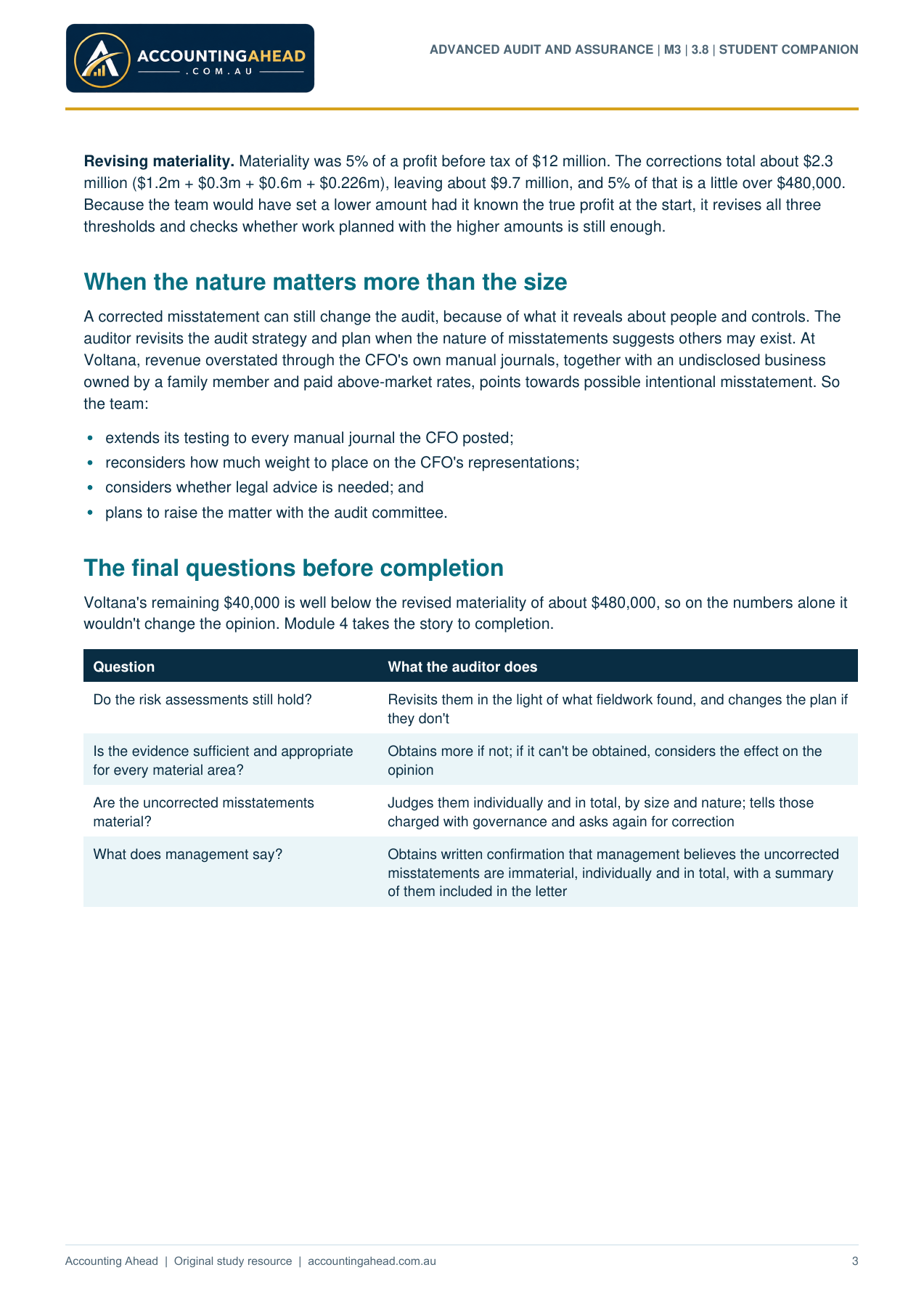
Revising materiality. Materiality was 5% of a profit before tax of $12 million. The corrections total about $2.3
million ($1.2m + $0.3m + $0.6m + $0.226m), leaving about $9.7 million, and 5% of that is a little over $480,000.
Because the team would have set a lower amount had it known the true profit at the start, it revises all three
thresholds and checks whether work planned with the higher amounts is still enough.
When the nature matters more than the size
A corrected misstatement can still change the audit, because of what it reveals about people and controls. The
auditor revisits the audit strategy and plan when the nature of misstatements suggests others may exist. At
Voltana, revenue overstated through the CFO's own manual journals, together with an undisclosed business
owned by a family member and paid above-market rates, points towards possible intentional misstatement. So
the team:
extends its testing to every manual journal the CFO posted;
reconsiders how much weight to place on the CFO's representations;
considers whether legal advice is needed; and
plans to raise the matter with the audit committee.
The final questions before completion
Voltana's remaining $40,000 is well below the revised materiality of about $480,000, so on the numbers alone it
wouldn't change the opinion. Module 4 takes the story to completion.
Question What the auditor does
Do the risk assessments still hold? Revisits them in the light of what fieldwork found, and changes the plan if
they don't
Is the evidence sufficient and appropriate
for every material area?
Obtains more if not; if it can't be obtained, considers the effect on the
opinion
Are the uncorrected misstatements
material?
Judges them individually and in total, by size and nature; tells those
charged with governance and asks again for correction
What does management say? Obtains written confirmation that management believes the uncorrected
misstatements are immaterial, individually and in total, with a summary
of them included in the letter
ADVANCED AUDIT AND ASSURANCE | M3 | 3.8 | STUDENT COMPANION
3
Accounting Ahead | Original study resource | accountingahead.com.au
Practice questions
MODULE 3 | 3.8 | TRY THESE BEFORE THE WORKED ANSWERS
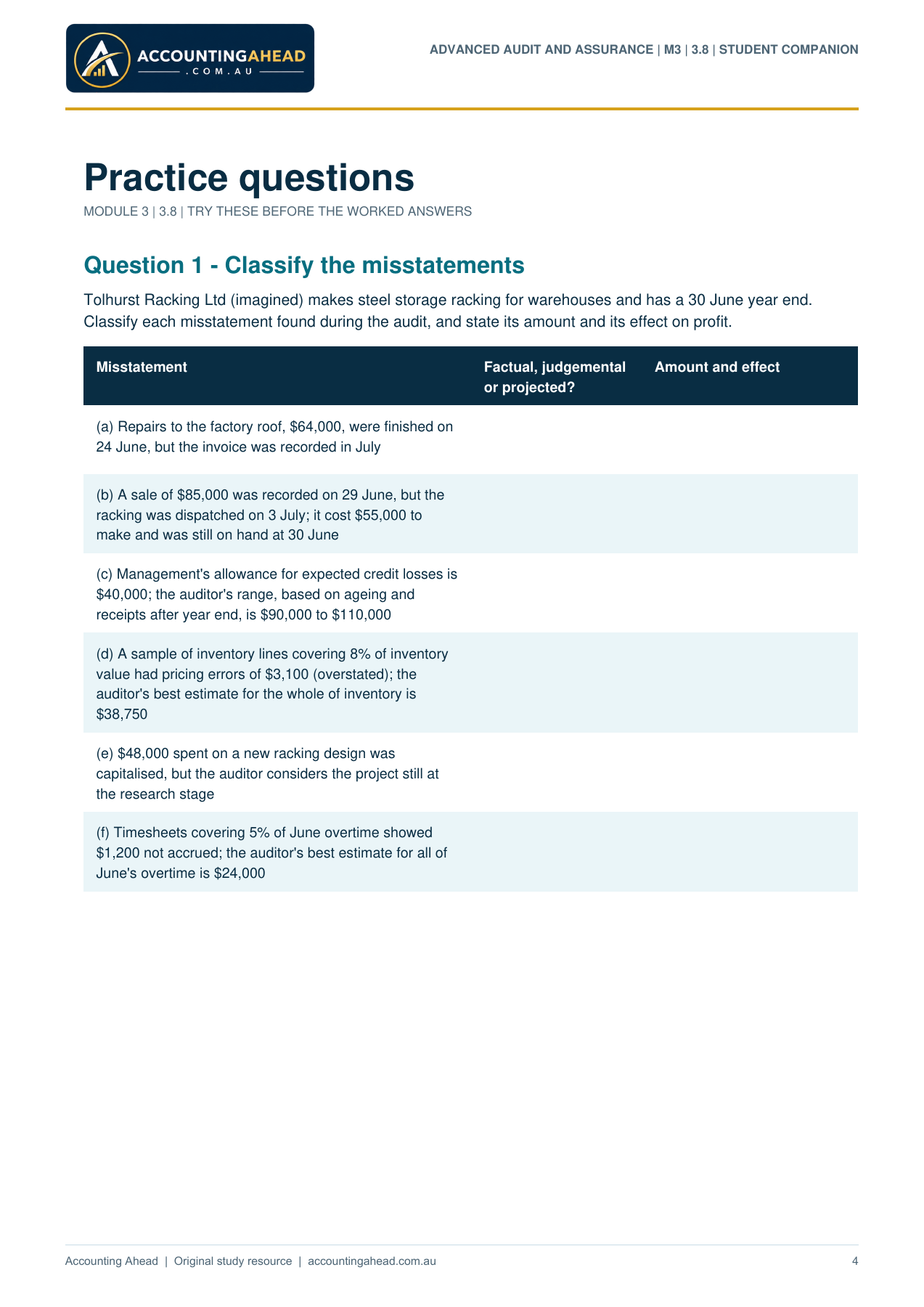
Question 1 - Classify the misstatements
Tolhurst Racking Ltd (imagined) makes steel storage racking for warehouses and has a 30 June year end.
Classify each misstatement found during the audit, and state its amount and its effect on profit.
Misstatement Factual, judgemental
or projected?
Amount and effect
(a) Repairs to the factory roof, $64,000, were finished on
24 June, but the invoice was recorded in July
(b) A sale of $85,000 was recorded on 29 June, but the
racking was dispatched on 3 July; it cost $55,000 to
make and was still on hand at 30 June
(c) Management's allowance for expected credit losses is
$40,000; the auditor's range, based on ageing and
receipts after year end, is $90,000 to $110,000
(d) A sample of inventory lines covering 8% of inventory
value had pricing errors of $3,100 (overstated); the
auditor's best estimate for the whole of inventory is
$38,750
(e) $48,000 spent on a new racking design was
capitalised, but the auditor considers the project still at
the research stage
(f) Timesheets covering 5% of June overtime showed
$1,200 not accrued; the auditor's best estimate for all of
June's overtime is $24,000
ADVANCED AUDIT AND ASSURANCE | M3 | 3.8 | STUDENT COMPANION
4
Accounting Ahead | Original study resource | accountingahead.com.au
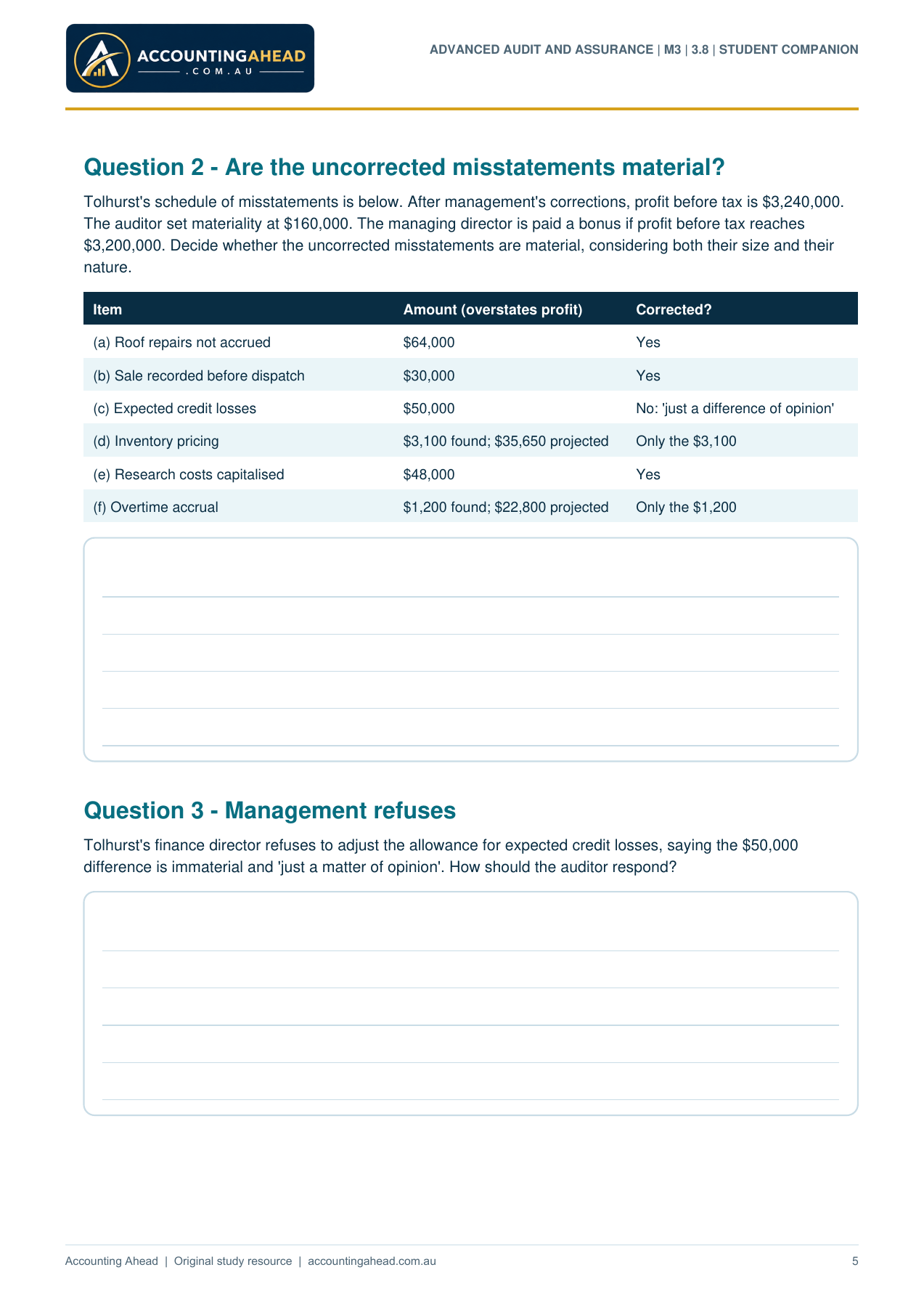
Question 2 - Are the uncorrected misstatements material?
Tolhurst's schedule of misstatements is below. After management's corrections, profit before tax is $3,240,000.
The auditor set materiality at $160,000. The managing director is paid a bonus if profit before tax reaches
$3,200,000. Decide whether the uncorrected misstatements are material, considering both their size and their
nature.
Item Amount (overstates profit) Corrected?
(a) Roof repairs not accrued $64,000 Yes
(b) Sale recorded before dispatch $30,000 Yes
(c) Expected credit losses $50,000 No: 'just a difference of opinion'
(d) Inventory pricing $3,100 found; $35,650 projected Only the $3,100
(e) Research costs capitalised $48,000 Yes
(f) Overtime accrual $1,200 found; $22,800 projected Only the $1,200
Question 3 - Management refuses
Tolhurst's finance director refuses to adjust the allowance for expected credit losses, saying the $50,000
difference is immaterial and 'just a matter of opinion'. How should the auditor respond?
ADVANCED AUDIT AND ASSURANCE | M3 | 3.8 | STUDENT COMPANION
5
Accounting Ahead | Original study resource | accountingahead.com.au
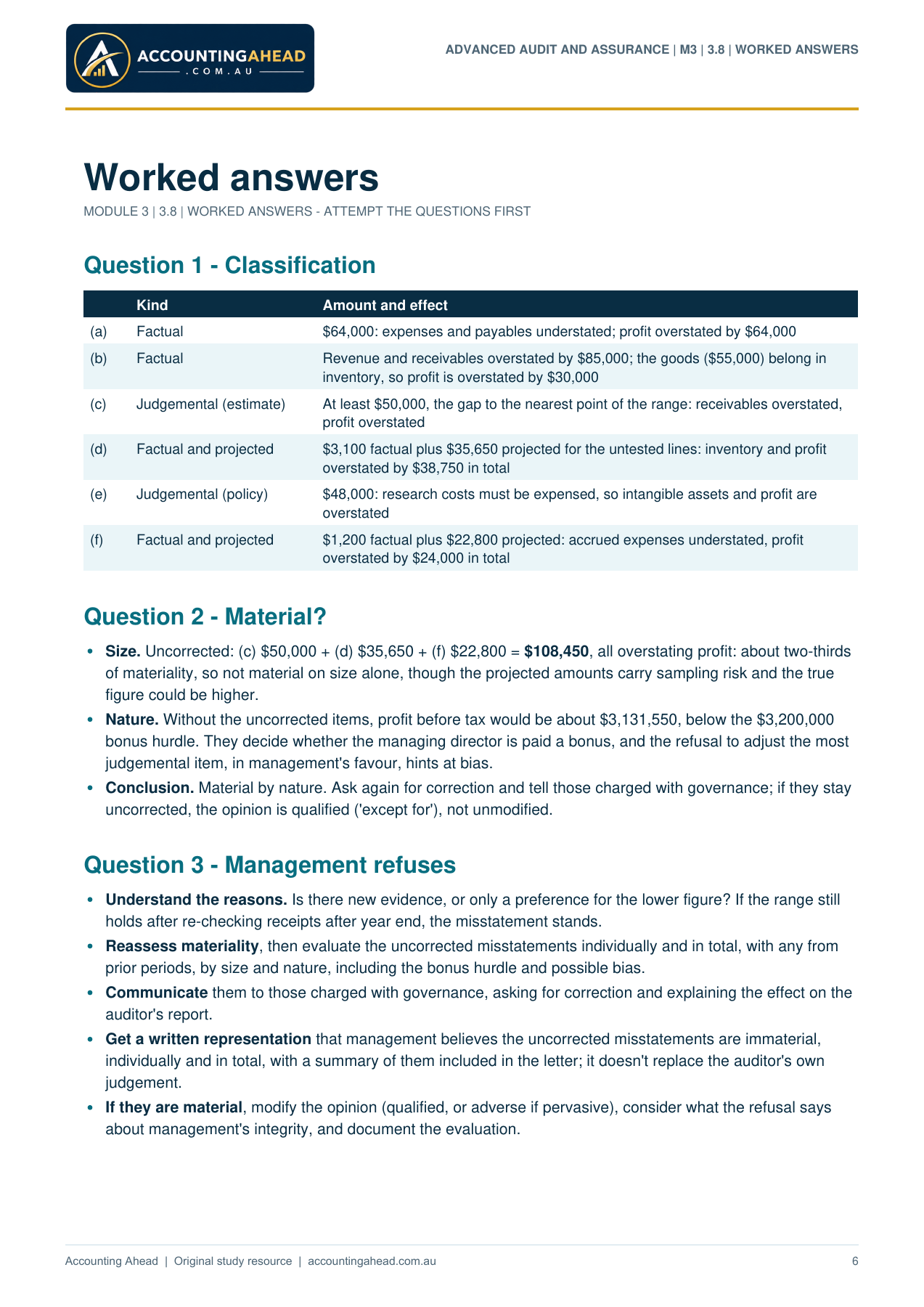
Worked answers
MODULE 3 | 3.8 | WORKED ANSWERS - ATTEMPT THE QUESTIONS FIRST
Question 1 - Classification
Kind Amount and effect
(a) Factual $64,000: expenses and payables understated; profit overstated by $64,000
(b) Factual Revenue and receivables overstated by $85,000; the goods ($55,000) belong in
inventory, so profit is overstated by $30,000
(c) Judgemental (estimate) At least $50,000, the gap to the nearest point of the range: receivables overstated,
profit overstated
(d) Factual and projected $3,100 factual plus $35,650 projected for the untested lines: inventory and profit
overstated by $38,750 in total
(e) Judgemental (policy) $48,000: research costs must be expensed, so intangible assets and profit are
overstated
(f) Factual and projected $1,200 factual plus $22,800 projected: accrued expenses understated, profit
overstated by $24,000 in total
Question 2 - Material?
Size. Uncorrected: (c) $50,000 + (d) $35,650 + (f) $22,800 = $108,450, all overstating profit: about two-thirds
of materiality, so not material on size alone, though the projected amounts carry sampling risk and the true
figure could be higher.
Nature. Without the uncorrected items, profit before tax would be about $3,131,550, below the $3,200,000
bonus hurdle. They decide whether the managing director is paid a bonus, and the refusal to adjust the most
judgemental item, in management's favour, hints at bias.
Conclusion. Material by nature. Ask again for correction and tell those charged with governance; if they stay
uncorrected, the opinion is qualified ('except for'), not unmodified.
Question 3 - Management refuses
Understand the reasons. Is there new evidence, or only a preference for the lower figure? If the range still
holds after re-checking receipts after year end, the misstatement stands.
Reassess materiality, then evaluate the uncorrected misstatements individually and in total, with any from
prior periods, by size and nature, including the bonus hurdle and possible bias.
Communicate them to those charged with governance, asking for correction and explaining the effect on the
auditor's report.
Get a written representation that management believes the uncorrected misstatements are immaterial,
individually and in total, with a summary of them included in the letter; it doesn't replace the auditor's own
judgement.
If they are material, modify the opinion (qualified, or adverse if pervasive), consider what the refusal says
about management's integrity, and document the evaluation.
ADVANCED AUDIT AND ASSURANCE | M3 | 3.8 | WORKED ANSWERS
6