
Significant areas, litigation and claims
Printable study notes, diagrams and practice support for Part 4.1.1.
Read the handout text
Accounting Ahead | Original study resource | accountingahead.com.au
Significant areas, litigation and claims
MODULE 4 | 4.1.1 | STUDENT COMPANION
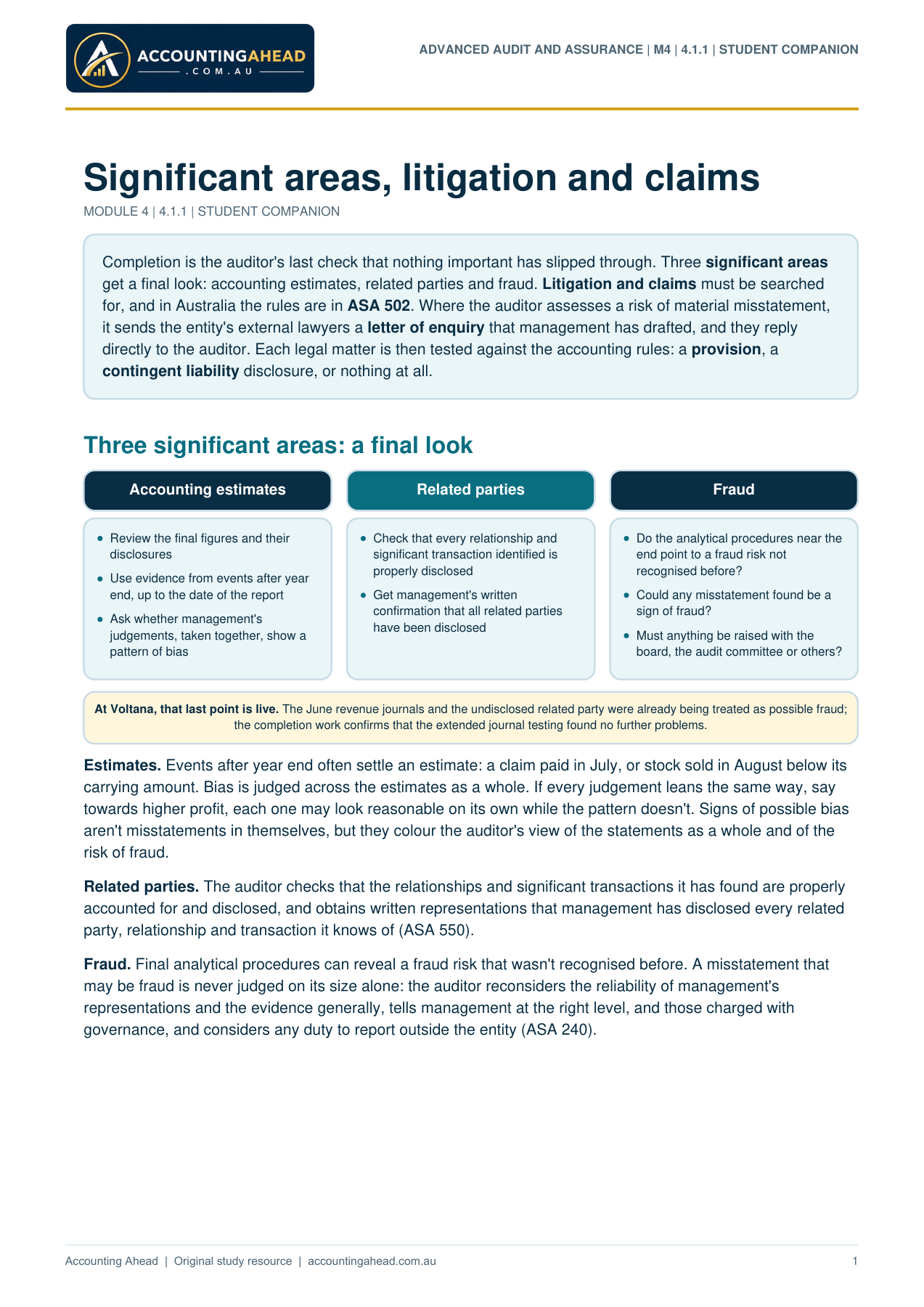
Completion is the auditor's last check that nothing important has slipped through. Three significant areas
get a final look: accounting estimates, related parties and fraud. Litigation and claims must be searched
for, and in Australia the rules are in ASA 502. Where the auditor assesses a risk of material misstatement,
it sends the entity's external lawyers a letter of enquiry that management has drafted, and they reply
directly to the auditor. Each legal matter is then tested against the accounting rules: a provision, a
contingent liability disclosure, or nothing at all.
Three significant areas: a final look
Accounting estimates
Review the final figures and their
disclosures
Use evidence from events after year
end, up to the date of the report
Ask whether management's
judgements, taken together, show a
pattern of bias
Related parties
Check that every relationship and
significant transaction identified is
properly disclosed
Get management's written
confirmation that all related parties
have been disclosed
Fraud
Do the analytical procedures near the
end point to a fraud risk not
recognised before?
Could any misstatement found be a
sign of fraud?
Must anything be raised with the
board, the audit committee or others?
At Voltana, that last point is live. The June revenue journals and the undisclosed related party were already being treated as possible fraud;
the completion work confirms that the extended journal testing found no further problems.
Estimates. Events after year end often settle an estimate: a claim paid in July, or stock sold in August below its
carrying amount. Bias is judged across the estimates as a whole. If every judgement leans the same way, say
towards higher profit, each one may look reasonable on its own while the pattern doesn't. Signs of possible bias
aren't misstatements in themselves, but they colour the auditor's view of the statements as a whole and of the
risk of fraud.
Related parties. The auditor checks that the relationships and significant transactions it has found are properly
accounted for and disclosed, and obtains written representations that management has disclosed every related
party, relationship and transaction it knows of (ASA 550).
Fraud. Final analytical procedures can reveal a fraud risk that wasn't recognised before. A misstatement that
may be fraud is never judged on its size alone: the auditor reconsiders the reliability of management's
representations and the evidence generally, tells management at the right level, and those charged with
governance, and considers any duty to report outside the entity (ASA 240).
ADVANCED AUDIT AND ASSURANCE | M4 | 4.1.1 | STUDENT COMPANION
1
Accounting Ahead | Original study resource | accountingahead.com.au
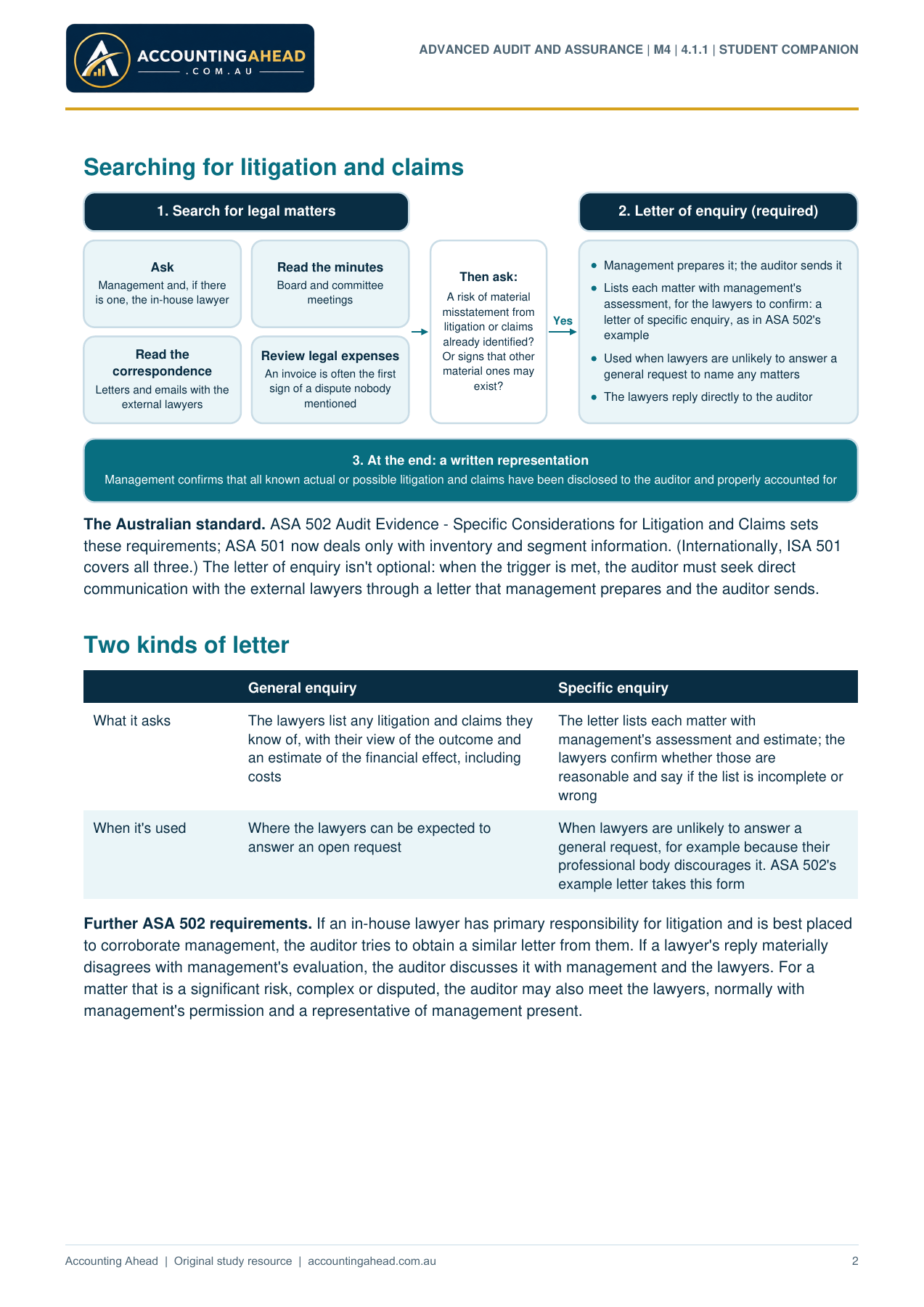
Searching for litigation and claims
1. Search for legal matters
Ask
Management and, if there
is one, the in-house lawyer
Read the minutes
Board and committee
meetings
Read the
correspondence
Letters and emails with the
external lawyers
Review legal expenses
An invoice is often the first
sign of a dispute nobody
mentioned
Then ask:
A risk of material
misstatement from
litigation or claims
already identified?
Or signs that other
material ones may
exist?
Yes
2. Letter of enquiry (required)
Management prepares it; the auditor sends it
Lists each matter with management's
assessment, for the lawyers to confirm: a
letter of specific enquiry, as in ASA 502's
example
Used when lawyers are unlikely to answer a
general request to name any matters
The lawyers reply directly to the auditor
3. At the end: a written representation
Management confirms that all known actual or possible litigation and claims have been disclosed to the auditor and properly accounted for
The Australian standard. ASA 502 Audit Evidence - Specific Considerations for Litigation and Claims sets
these requirements; ASA 501 now deals only with inventory and segment information. (Internationally, ISA 501
covers all three.) The letter of enquiry isn't optional: when the trigger is met, the auditor must seek direct
communication with the external lawyers through a letter that management prepares and the auditor sends.
Two kinds of letter
General enquiry Specific enquiry
What it asks The lawyers list any litigation and claims they
know of, with their view of the outcome and
an estimate of the financial effect, including
costs
The letter lists each matter with
management's assessment and estimate; the
lawyers confirm whether those are
reasonable and say if the list is incomplete or
wrong
When it's used Where the lawyers can be expected to
answer an open request
When lawyers are unlikely to answer a
general request, for example because their
professional body discourages it. ASA 502's
example letter takes this form
Further ASA 502 requirements. If an in-house lawyer has primary responsibility for litigation and is best placed
to corroborate management, the auditor tries to obtain a similar letter from them. If a lawyer's reply materially
disagrees with management's evaluation, the auditor discusses it with management and the lawyers. For a
matter that is a significant risk, complex or disputed, the auditor may also meet the lawyers, normally with
management's permission and a representative of management present.
ADVANCED AUDIT AND ASSURANCE | M4 | 4.1.1 | STUDENT COMPANION
2
Accounting Ahead | Original study resource | accountingahead.com.au
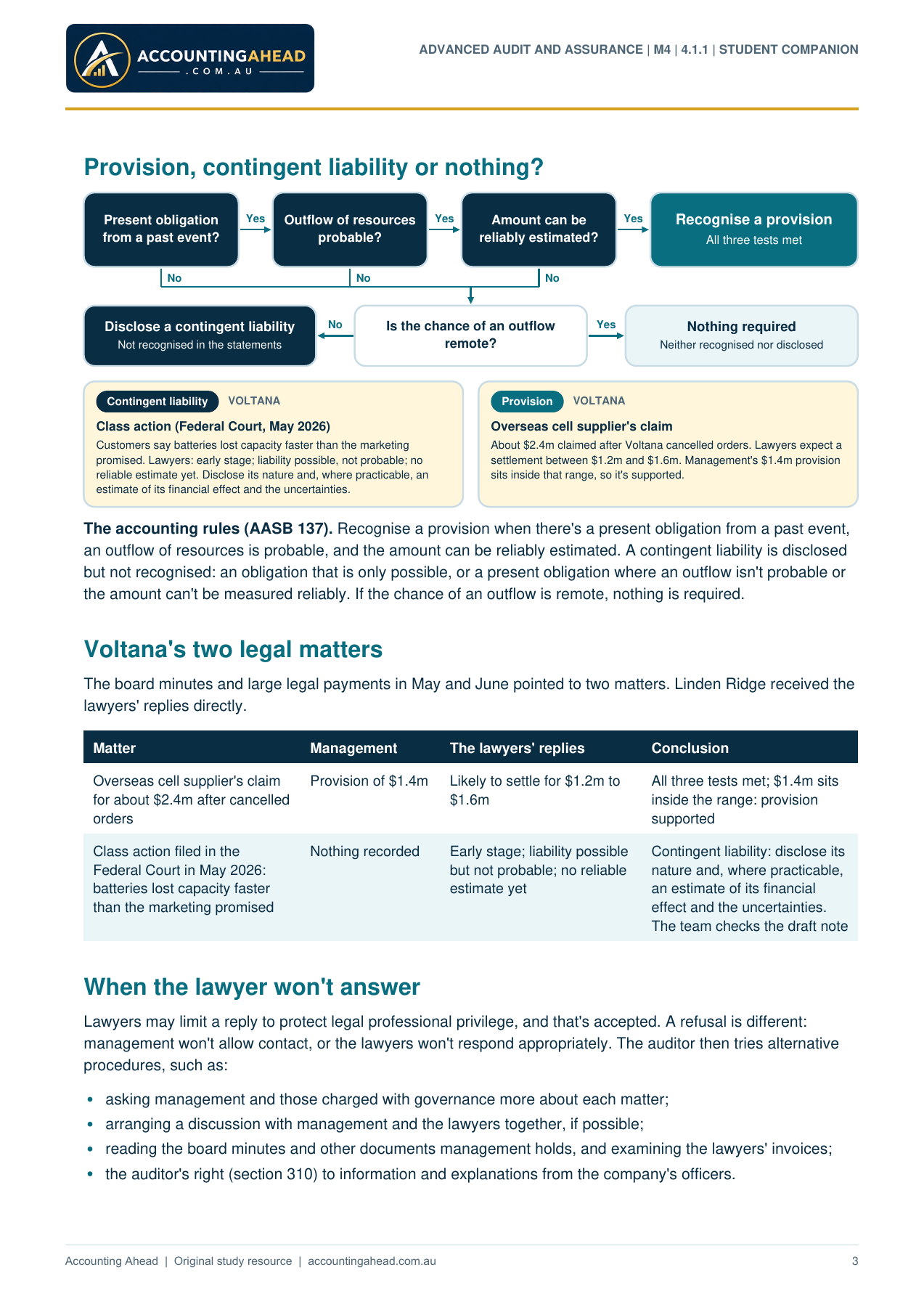
Provision, contingent liability or nothing?
Present obligation
from a past event?
Yes
No
Outflow of resources
probable?
Yes
No
Amount can be
reliably estimated?
Yes
No
Recognise a provision
All three tests met
Is the chance of an outflow
remote?
Disclose a contingent liability
Not recognised in the statements
Nothing required
Neither recognised nor disclosed
No Yes
Contingent liability VOLTANA
Class action (Federal Court, May 2026)
Customers say batteries lost capacity faster than the marketing
promised. Lawyers: early stage; liability possible, not probable; no
reliable estimate yet. Disclose its nature and, where practicable, an
estimate of its financial effect and the uncertainties.
Provision VOLTANA
Overseas cell supplier's claim
About $2.4m claimed after Voltana cancelled orders. Lawyers expect a
settlement between $1.2m and $1.6m. Management's $1.4m provision
sits inside that range, so it's supported.
The accounting rules (AASB 137). Recognise a provision when there's a present obligation from a past event,
an outflow of resources is probable, and the amount can be reliably estimated. A contingent liability is disclosed
but not recognised: an obligation that is only possible, or a present obligation where an outflow isn't probable or
the amount can't be measured reliably. If the chance of an outflow is remote, nothing is required.
Voltana's two legal matters
The board minutes and large legal payments in May and June pointed to two matters. Linden Ridge received the
lawyers' replies directly.
Matter Management The lawyers' replies Conclusion
Overseas cell supplier's claim
for about $2.4m after cancelled
orders
Provision of $1.4m Likely to settle for $1.2m to
$1.6m
All three tests met; $1.4m sits
inside the range: provision
supported
Class action filed in the
Federal Court in May 2026:
batteries lost capacity faster
than the marketing promised
Nothing recorded Early stage; liability possible
but not probable; no reliable
estimate yet
Contingent liability: disclose its
nature and, where practicable,
an estimate of its financial
effect and the uncertainties.
The team checks the draft note
When the lawyer won't answer
Lawyers may limit a reply to protect legal professional privilege, and that's accepted. A refusal is different:
management won't allow contact, or the lawyers won't respond appropriately. The auditor then tries alternative
procedures, such as:
asking management and those charged with governance more about each matter;
arranging a discussion with management and the lawyers together, if possible;
reading the board minutes and other documents management holds, and examining the lawyers' invoices;
the auditor's right (section 310) to information and explanations from the company's officers.
ADVANCED AUDIT AND ASSURANCE | M4 | 4.1.1 | STUDENT COMPANION
3
Accounting Ahead | Original study resource | accountingahead.com.au
If they can't provide sufficient appropriate evidence, the scope of the audit is limited and the opinion must be
modified: qualified if the possible effects are material, a disclaimer if they could be both material and pervasive
(Exam Reference Pack, page 8). Management's word is no substitute: it has the most interest in the answer.
Practice questions
MODULE 4 | 4.1.1 | TRY THESE BEFORE THE WORKED ANSWERS
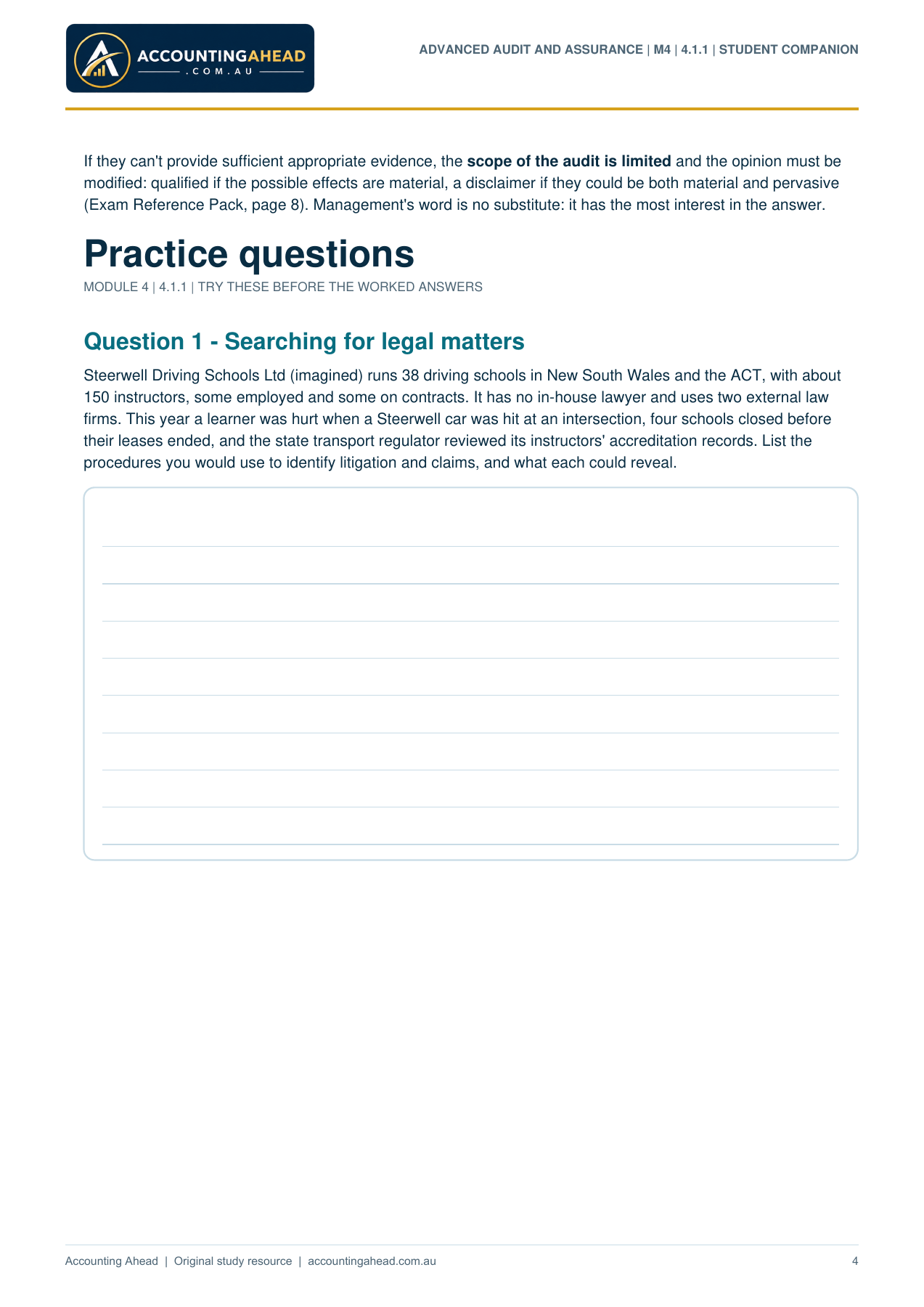
Question 1 - Searching for legal matters
Steerwell Driving Schools Ltd (imagined) runs 38 driving schools in New South Wales and the ACT, with about
150 instructors, some employed and some on contracts. It has no in-house lawyer and uses two external law
firms. This year a learner was hurt when a Steerwell car was hit at an intersection, four schools closed before
their leases ended, and the state transport regulator reviewed its instructors' accreditation records. List the
procedures you would use to identify litigation and claims, and what each could reveal.
ADVANCED AUDIT AND ASSURANCE | M4 | 4.1.1 | STUDENT COMPANION
4
Accounting Ahead | Original study resource | accountingahead.com.au
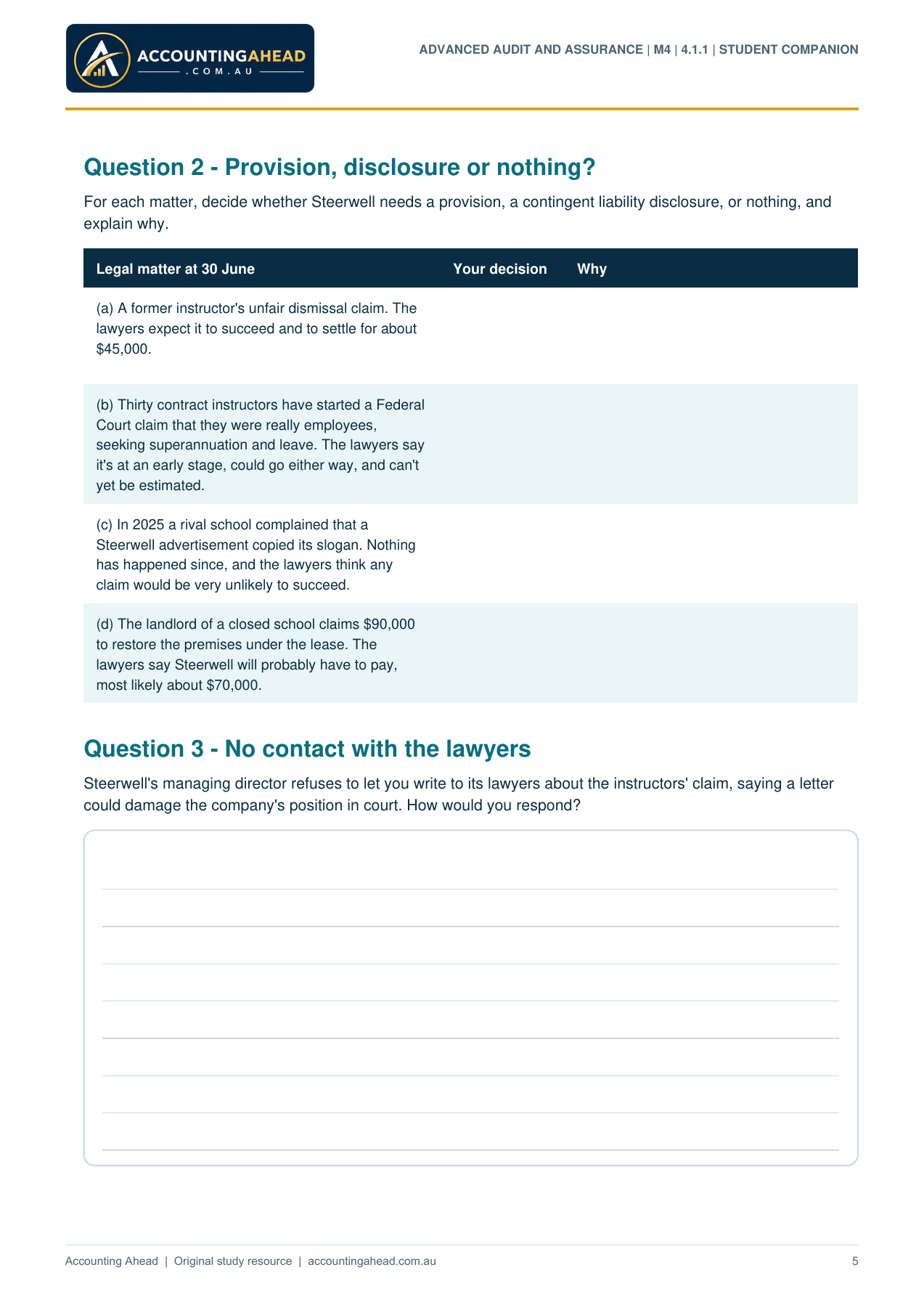
Question 2 - Provision, disclosure or nothing?
For each matter, decide whether Steerwell needs a provision, a contingent liability disclosure, or nothing, and
explain why.
Legal matter at 30 June Your decision Why
(a) A former instructor's unfair dismissal claim. The
lawyers expect it to succeed and to settle for about
$45,000.
(b) Thirty contract instructors have started a Federal
Court claim that they were really employees,
seeking superannuation and leave. The lawyers say
it's at an early stage, could go either way, and can't
yet be estimated.
(c) In 2025 a rival school complained that a
Steerwell advertisement copied its slogan. Nothing
has happened since, and the lawyers think any
claim would be very unlikely to succeed.
(d) The landlord of a closed school claims $90,000
to restore the premises under the lease. The
lawyers say Steerwell will probably have to pay,
most likely about $70,000.
Question 3 - No contact with the lawyers
Steerwell's managing director refuses to let you write to its lawyers about the instructors' claim, saying a letter
could damage the company's position in court. How would you respond?
ADVANCED AUDIT AND ASSURANCE | M4 | 4.1.1 | STUDENT COMPANION
5
Accounting Ahead | Original study resource | accountingahead.com.au
Worked answers
MODULE 4 | 4.1.1 | WORKED ANSWERS - ATTEMPT THE QUESTIONS FIRST
Question 1 - Steerwell Driving Schools (sample answer)
Enquiries of management: the managing director, finance manager and operations manager, about current,
threatened and possible claims: the injured learner, the closed schools, instructor disputes, the regulator.
Minutes: board and committee minutes for the year and up to the report date, for legal matters, settlements, the
closures and the regulator's findings.
Correspondence with both law firms: it can reveal matters management hasn't mentioned, and their status.
Legal expense accounts: match every invoice to a matter; a firm or matter not on management's list needs
following up.
Related records: the insurance claim for the crash, the regulator's letters, the leases and landlords' letters for the
closed schools, and instructors' contracts.
Letter of enquiry and representations: given the risks, management prepares a letter of specific enquiry to both
firms, which you send and they answer directly to you; at the end, management confirms in writing that all known
actual or possible litigation and claims are disclosed and accounted for.
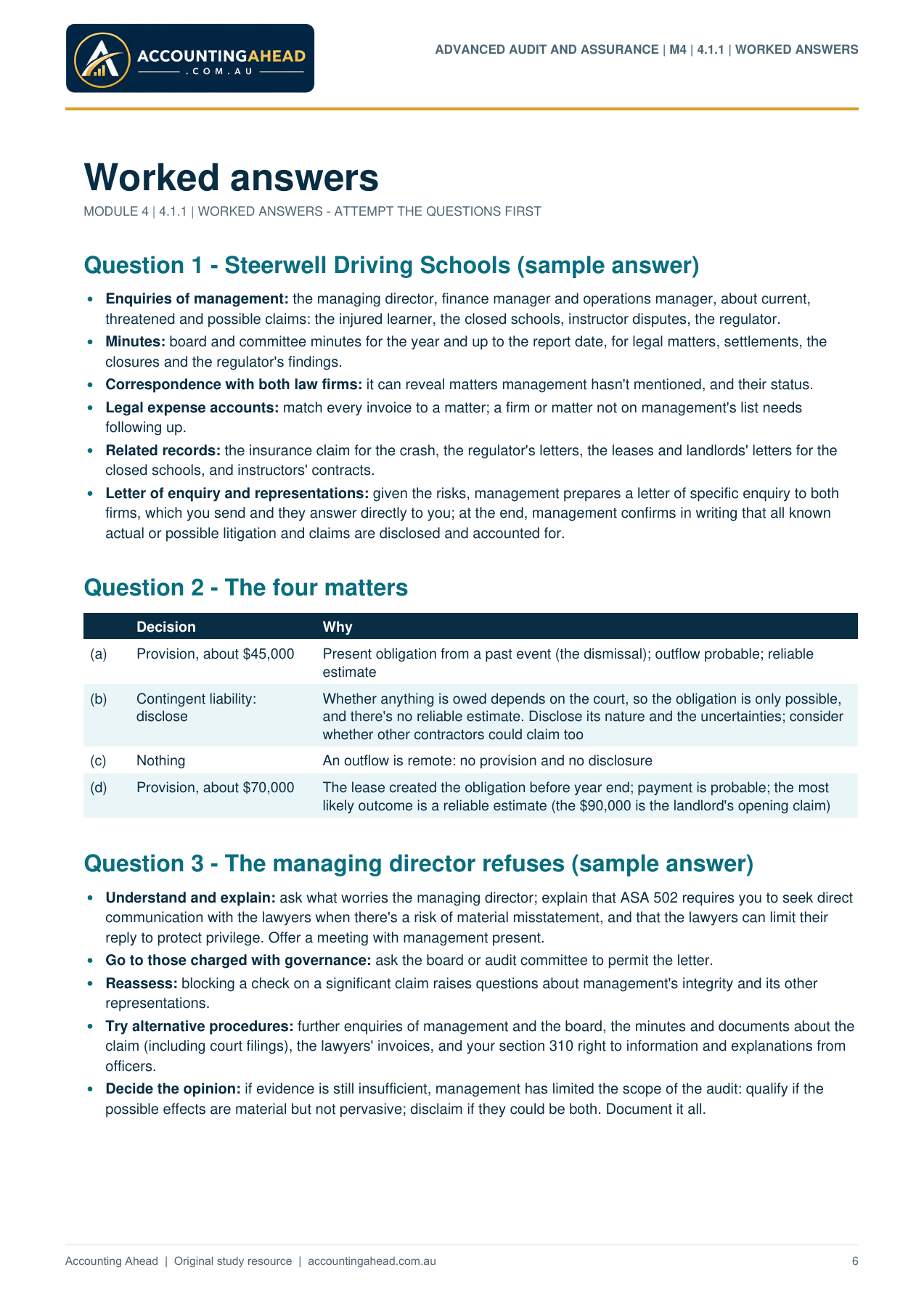
Question 2 - The four matters
Decision Why
(a) Provision, about $45,000 Present obligation from a past event (the dismissal); outflow probable; reliable
estimate
(b) Contingent liability:
disclose
Whether anything is owed depends on the court, so the obligation is only possible,
and there's no reliable estimate. Disclose its nature and the uncertainties; consider
whether other contractors could claim too
(c) Nothing An outflow is remote: no provision and no disclosure
(d) Provision, about $70,000 The lease created the obligation before year end; payment is probable; the most
likely outcome is a reliable estimate (the $90,000 is the landlord's opening claim)
Question 3 - The managing director refuses (sample answer)
Understand and explain: ask what worries the managing director; explain that ASA 502 requires you to seek direct
communication with the lawyers when there's a risk of material misstatement, and that the lawyers can limit their
reply to protect privilege. Offer a meeting with management present.
Go to those charged with governance: ask the board or audit committee to permit the letter.
Reassess: blocking a check on a significant claim raises questions about management's integrity and its other
representations.
Try alternative procedures: further enquiries of management and the board, the minutes and documents about the
claim (including court filings), the lawyers' invoices, and your section 310 right to information and explanations from
officers.
Decide the opinion: if evidence is still insufficient, management has limited the scope of the audit: qualify if the
possible effects are material but not pervasive; disclaim if they could be both. Document it all.
ADVANCED AUDIT AND ASSURANCE | M4 | 4.1.1 | WORKED ANSWERS
6