
Going concern at completion
Printable study notes, diagrams and practice support for Part 4.1.2.
Read the handout text
Accounting Ahead | Original study resource | accountingahead.com.au
Going concern at completion
MODULE 4 | 4.1.2 | STUDENT COMPANION
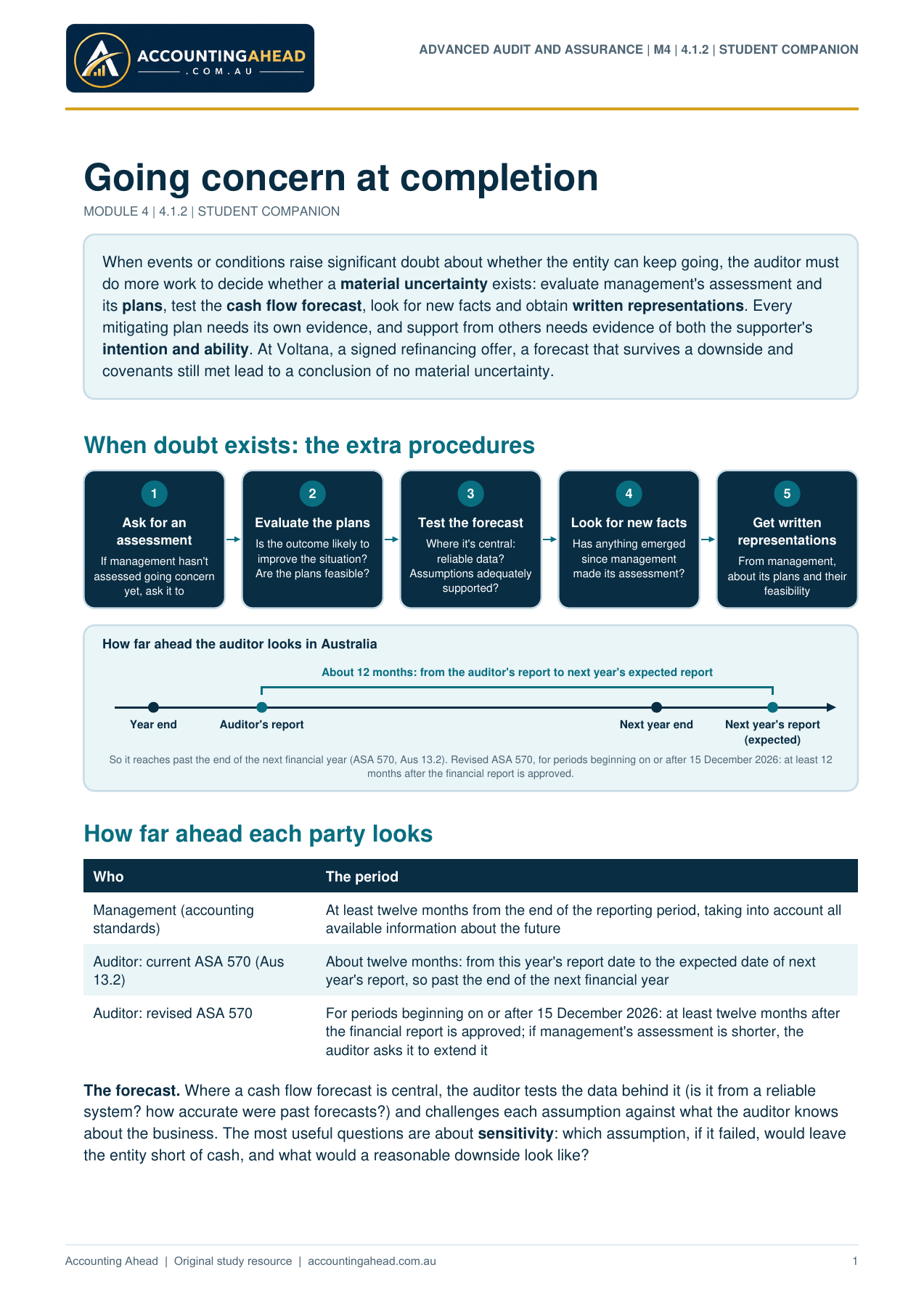
When events or conditions raise significant doubt about whether the entity can keep going, the auditor must
do more work to decide whether a material uncertainty exists: evaluate management's assessment and
its plans, test the cash flow forecast, look for new facts and obtain written representations. Every
mitigating plan needs its own evidence, and support from others needs evidence of both the supporter's
intention and ability. At Voltana, a signed refinancing offer, a forecast that survives a downside and
covenants still met lead to a conclusion of no material uncertainty.
When doubt exists: the extra procedures
1
Ask for an
assessment
If management hasn't
assessed going concern
yet, ask it to
2
Evaluate the plans
Is the outcome likely to
improve the situation?
Are the plans feasible?
3
Test the forecast
Where it's central:
reliable data?
Assumptions adequately
supported?
4
Look for new facts
Has anything emerged
since management
made its assessment?
5
Get written
representations
From management,
about its plans and their
feasibility
How far ahead the auditor looks in Australia
About 12 months: from the auditor's report to next year's expected report
Year end Auditor's report Next year end Next year's report
(expected)
So it reaches past the end of the next financial year (ASA 570, Aus 13.2). Revised ASA 570, for periods beginning on or after 15 December 2026: at least 12
months after the financial report is approved.
How far ahead each party looks
Who The period
Management (accounting
standards)
At least twelve months from the end of the reporting period, taking into account all
available information about the future
Auditor: current ASA 570 (Aus
13.2)
About twelve months: from this year's report date to the expected date of next
year's report, so past the end of the next financial year
Auditor: revised ASA 570 For periods beginning on or after 15 December 2026: at least twelve months after
the financial report is approved; if management's assessment is shorter, the
auditor asks it to extend it
The forecast. Where a cash flow forecast is central, the auditor tests the data behind it (is it from a reliable
system? how accurate were past forecasts?) and challenges each assumption against what the auditor knows
about the business. The most useful questions are about sensitivity: which assumption, if it failed, would leave
the entity short of cash, and what would a reasonable downside look like?
ADVANCED AUDIT AND ASSURANCE | M4 | 4.1.2 | STUDENT COMPANION
1
Accounting Ahead | Original study resource | accountingahead.com.au
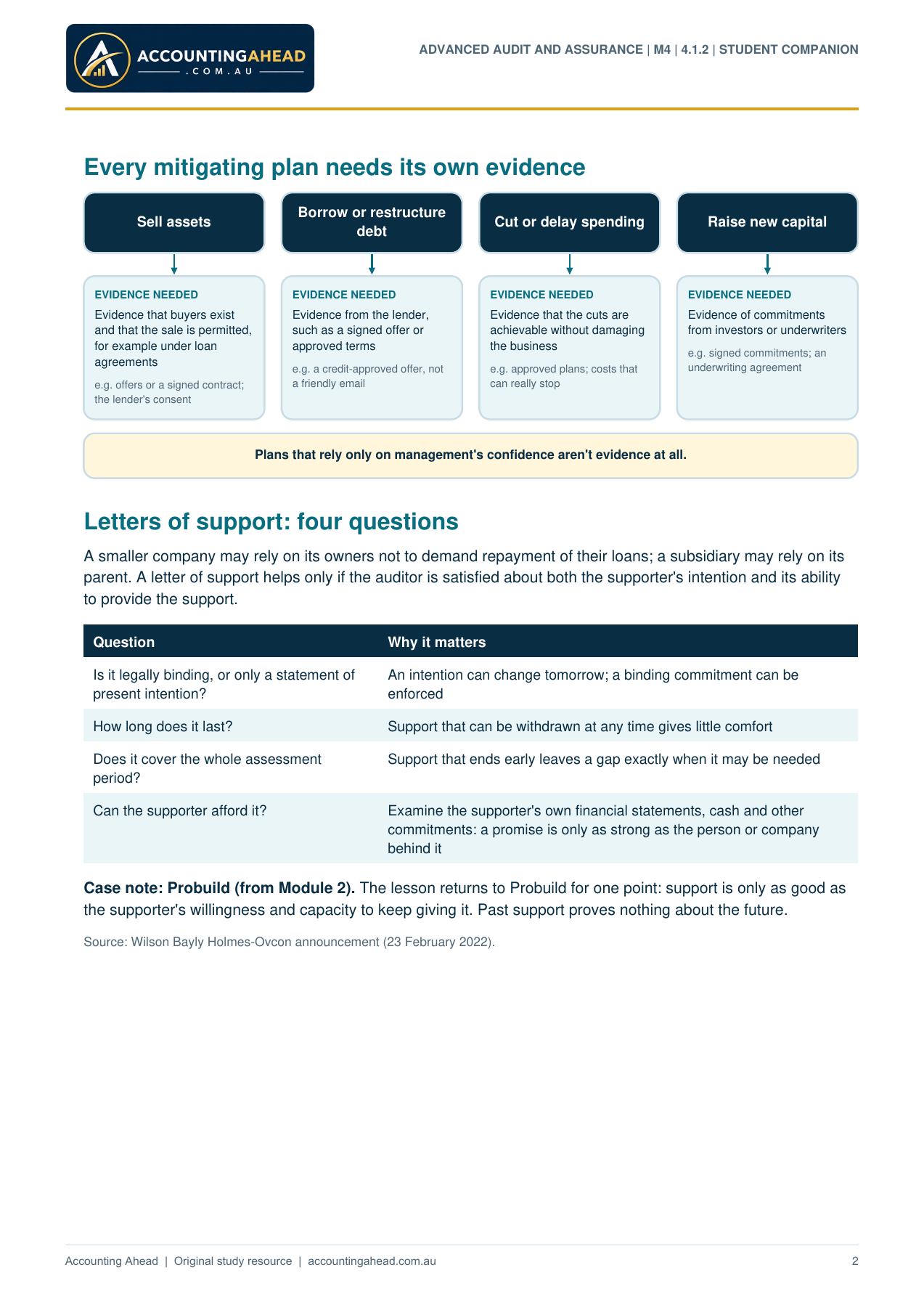
Every mitigating plan needs its own evidence
Sell assets
EVIDENCE NEEDED
Evidence that buyers exist
and that the sale is permitted,
for example under loan
agreements
e.g. offers or a signed contract;
the lender's consent
Borrow or restructure
debt
EVIDENCE NEEDED
Evidence from the lender,
such as a signed offer or
approved terms
e.g. a credit-approved offer, not
a friendly email
Cut or delay spending
EVIDENCE NEEDED
Evidence that the cuts are
achievable without damaging
the business
e.g. approved plans; costs that
can really stop
Raise new capital
EVIDENCE NEEDED
Evidence of commitments
from investors or underwriters
e.g. signed commitments; an
underwriting agreement
Plans that rely only on management's confidence aren't evidence at all.
Letters of support: four questions
A smaller company may rely on its owners not to demand repayment of their loans; a subsidiary may rely on its
parent. A letter of support helps only if the auditor is satisfied about both the supporter's intention and its ability
to provide the support.
Question Why it matters
Is it legally binding, or only a statement of
present intention?
An intention can change tomorrow; a binding commitment can be
enforced
How long does it last? Support that can be withdrawn at any time gives little comfort
Does it cover the whole assessment
period?
Support that ends early leaves a gap exactly when it may be needed
Can the supporter afford it? Examine the supporter's own financial statements, cash and other
commitments: a promise is only as strong as the person or company
behind it
Case note: Probuild (from Module 2). The lesson returns to Probuild for one point: support is only as good as
the supporter's willingness and capacity to keep giving it. Past support proves nothing about the future.
Source: Wilson Bayly Holmes-Ovcon announcement (23 February 2022).
ADVANCED AUDIT AND ASSURANCE | M4 | 4.1.2 | STUDENT COMPANION
2
Accounting Ahead | Original study resource | accountingahead.com.au
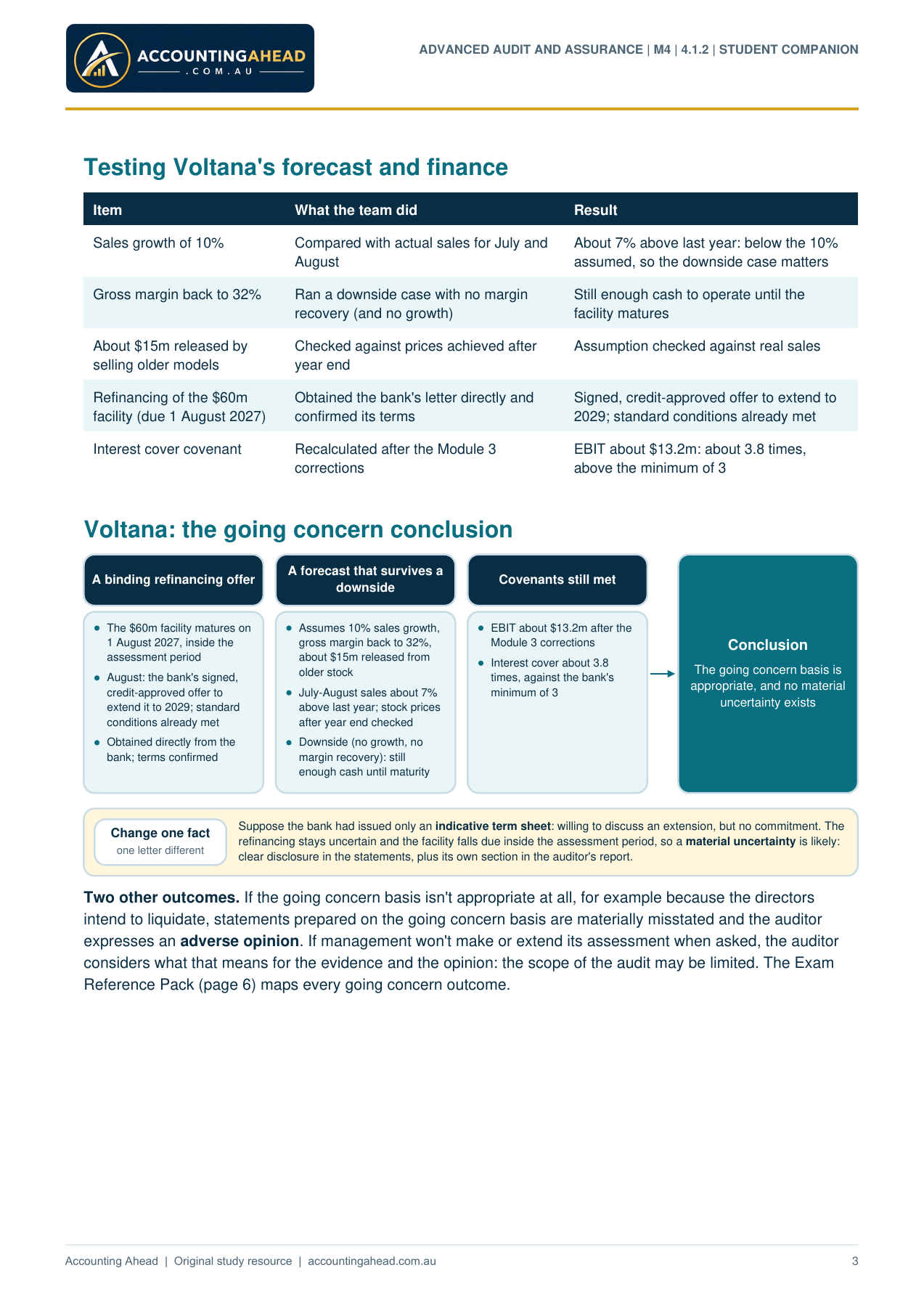
Testing Voltana's forecast and finance
Item What the team did Result
Sales growth of 10% Compared with actual sales for July and
August
About 7% above last year: below the 10%
assumed, so the downside case matters
Gross margin back to 32% Ran a downside case with no margin
recovery (and no growth)
Still enough cash to operate until the
facility matures
About $15m released by
selling older models
Checked against prices achieved after
year end
Assumption checked against real sales
Refinancing of the $60m
facility (due 1 August 2027)
Obtained the bank's letter directly and
confirmed its terms
Signed, credit-approved offer to extend to
2029; standard conditions already met
Interest cover covenant Recalculated after the Module 3
corrections
EBIT about $13.2m: about 3.8 times,
above the minimum of 3
Voltana: the going concern conclusion
A binding refinancing offer
The $60m facility matures on
1 August 2027, inside the
assessment period
August: the bank's signed,
credit-approved offer to
extend it to 2029; standard
conditions already met
Obtained directly from the
bank; terms confirmed
A forecast that survives a
downside
Assumes 10% sales growth,
gross margin back to 32%,
about $15m released from
older stock
July-August sales about 7%
above last year; stock prices
after year end checked
Downside (no growth, no
margin recovery): still
enough cash until maturity
Covenants still met
EBIT about $13.2m after the
Module 3 corrections
Interest cover about 3.8
times, against the bank's
minimum of 3
Conclusion
The going concern basis is
appropriate, and no material
uncertainty exists
Change one fact
one letter different
Suppose the bank had issued only an indicative term sheet: willing to discuss an extension, but no commitment. The
refinancing stays uncertain and the facility falls due inside the assessment period, so a material uncertainty is likely:
clear disclosure in the statements, plus its own section in the auditor's report.
Two other outcomes. If the going concern basis isn't appropriate at all, for example because the directors
intend to liquidate, statements prepared on the going concern basis are materially misstated and the auditor
expresses an adverse opinion. If management won't make or extend its assessment when asked, the auditor
considers what that means for the evidence and the opinion: the scope of the audit may be limited. The Exam
Reference Pack (page 6) maps every going concern outcome.
ADVANCED AUDIT AND ASSURANCE | M4 | 4.1.2 | STUDENT COMPANION
3
Accounting Ahead | Original study resource | accountingahead.com.au
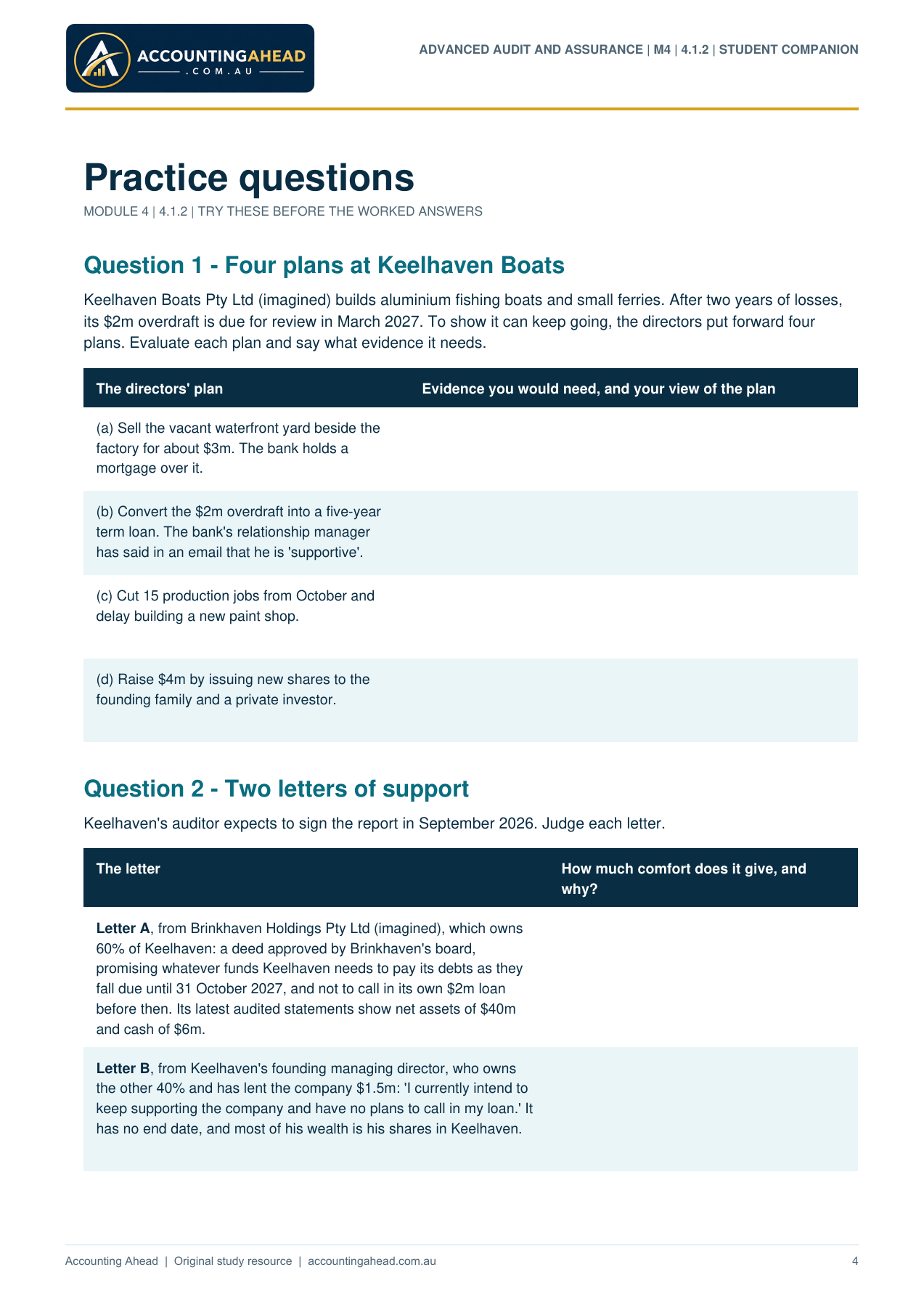
Practice questions
MODULE 4 | 4.1.2 | TRY THESE BEFORE THE WORKED ANSWERS
Question 1 - Four plans at Keelhaven Boats
Keelhaven Boats Pty Ltd (imagined) builds aluminium fishing boats and small ferries. After two years of losses,
its $2m overdraft is due for review in March 2027. To show it can keep going, the directors put forward four
plans. Evaluate each plan and say what evidence it needs.
The directors' plan Evidence you would need, and your view of the plan
(a) Sell the vacant waterfront yard beside the
factory for about $3m. The bank holds a
mortgage over it.
(b) Convert the $2m overdraft into a five-year
term loan. The bank's relationship manager
has said in an email that he is 'supportive'.
(c) Cut 15 production jobs from October and
delay building a new paint shop.
(d) Raise $4m by issuing new shares to the
founding family and a private investor.
Question 2 - Two letters of support
Keelhaven's auditor expects to sign the report in September 2026. Judge each letter.
The letter How much comfort does it give, and
why?
Letter A, from Brinkhaven Holdings Pty Ltd (imagined), which owns
60% of Keelhaven: a deed approved by Brinkhaven's board,
promising whatever funds Keelhaven needs to pay its debts as they
fall due until 31 October 2027, and not to call in its own $2m loan
before then. Its latest audited statements show net assets of $40m
and cash of $6m.
Letter B, from Keelhaven's founding managing director, who owns
the other 40% and has lent the company $1.5m: 'I currently intend to
keep supporting the company and have no plans to call in my loan.' It
has no end date, and most of his wealth is his shares in Keelhaven.
ADVANCED AUDIT AND ASSURANCE | M4 | 4.1.2 | STUDENT COMPANION
4
Accounting Ahead | Original study resource | accountingahead.com.au
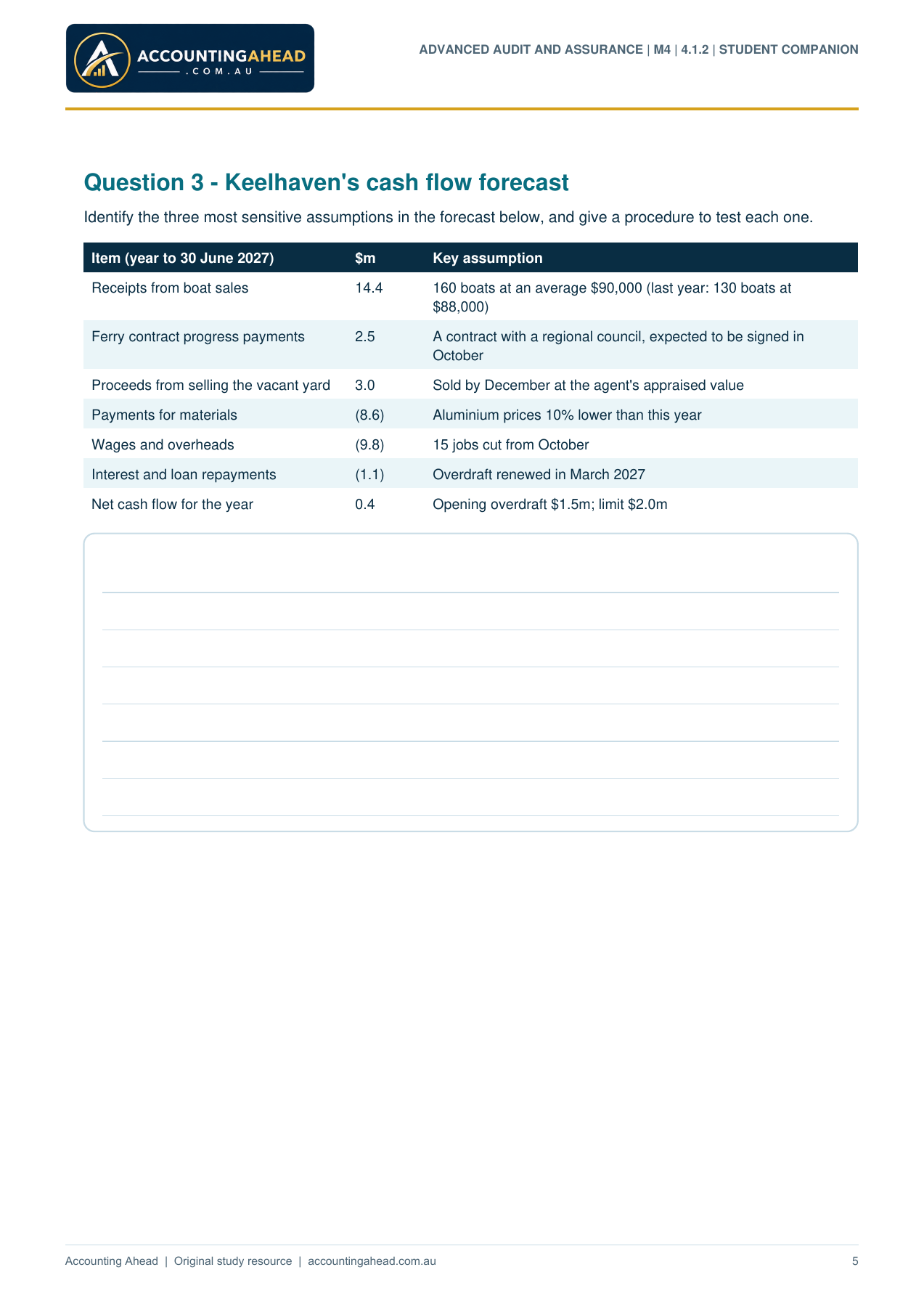
Question 3 - Keelhaven's cash flow forecast
Identify the three most sensitive assumptions in the forecast below, and give a procedure to test each one.
Item (year to 30 June 2027) $m Key assumption
Receipts from boat sales 14.4 160 boats at an average $90,000 (last year: 130 boats at
$88,000)
Ferry contract progress payments 2.5 A contract with a regional council, expected to be signed in
October
Proceeds from selling the vacant yard 3.0 Sold by December at the agent's appraised value
Payments for materials (8.6) Aluminium prices 10% lower than this year
Wages and overheads (9.8) 15 jobs cut from October
Interest and loan repayments (1.1) Overdraft renewed in March 2027
Net cash flow for the year 0.4 Opening overdraft $1.5m; limit $2.0m
ADVANCED AUDIT AND ASSURANCE | M4 | 4.1.2 | STUDENT COMPANION
5
Accounting Ahead | Original study resource | accountingahead.com.au
Worked answers
MODULE 4 | 4.1.2 | WORKED ANSWERS - ATTEMPT THE QUESTIONS FIRST
Question 1 - Keelhaven's four plans (suggested)
Watch for plans that contradict each other: cutting 15 production jobs sits awkwardly with a forecast that needs
23% more boats.
Plan Evidence needed, and comment
(a) Sell the yard An agent's appraisal and, better, written offers or a signed contract; the bank's consent,
because it holds a mortgage and may take the proceeds to reduce the debt; the timing of
settlement; confirmation that the yard isn't needed for production
(b) Convert the overdraft A friendly email isn't a commitment. Look for a signed, credit-approved offer or approved
new terms, with any conditions and covenants, before the March 2027 review
(c) Cut jobs, delay the
paint shop
A board-approved plan, the redundancy costs (cash goes out first), and whether the
remaining staff can still build the boats the forecast assumes; whether the paint shop
contract can be delayed without penalty
(d) Issue shares Signed, unconditional commitments from the investors, evidence they can pay (for
example bank statements), the timetable, and any shareholder approvals needed
Question 2 - The two letters (suggested)
Comfort Why
A Substantial, once
verified
Legally binding, approved by Brinkhaven's board, and it runs to 31 October 2027, beyond
the twelve months after a September 2026 report. Brinkhaven appears able to pay:
confirm the board minute, read its audited statements and recent cash position, and check
that the deed can't be withdrawn
B Little Only a statement of present intention, not binding, with no end date; his ability is doubtful
because his wealth depends on Keelhaven itself. At most it supports the other evidence
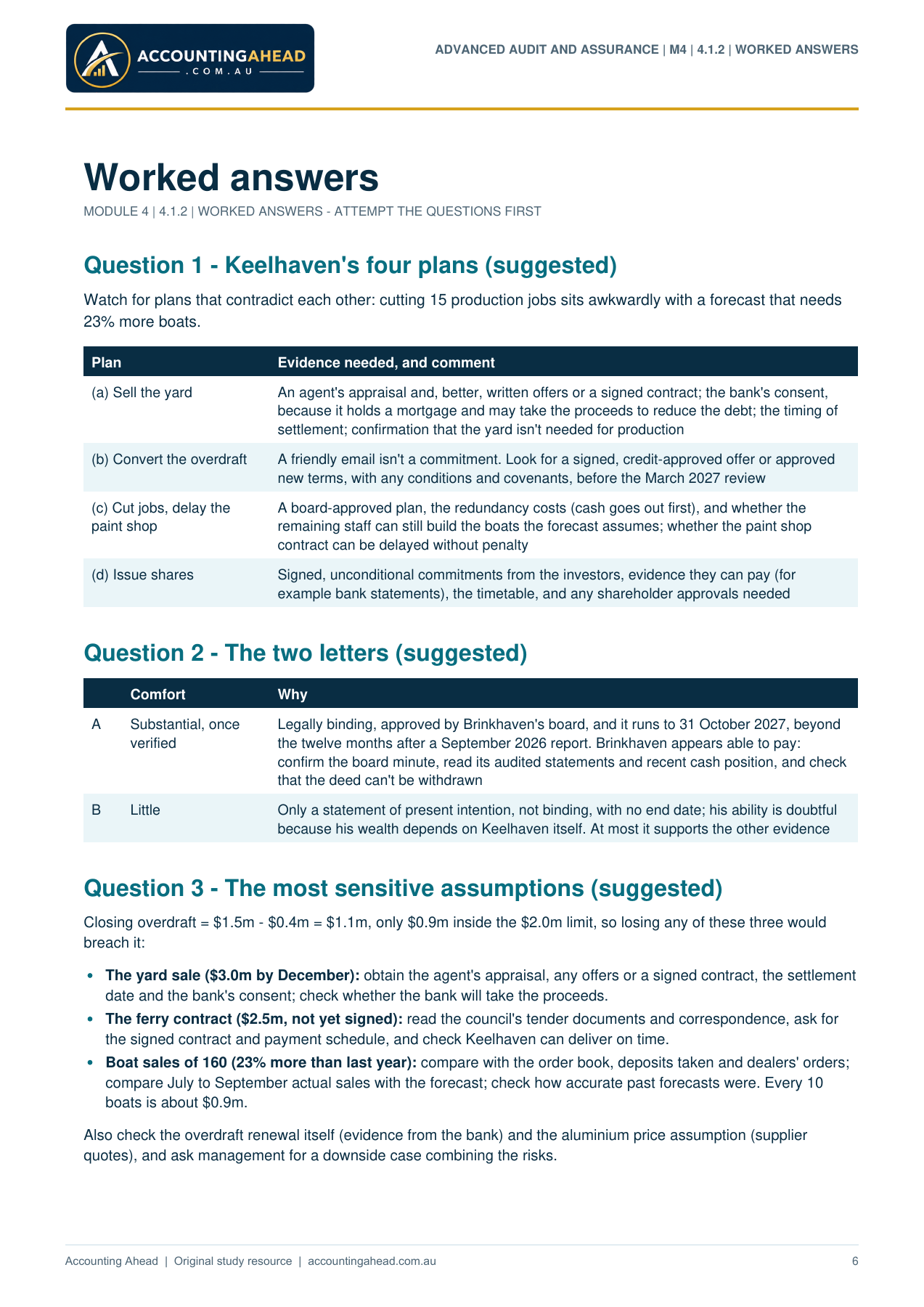
Question 3 - The most sensitive assumptions (suggested)
Closing overdraft = $1.5m - $0.4m = $1.1m, only $0.9m inside the $2.0m limit, so losing any of these three would
breach it:
The yard sale ($3.0m by December): obtain the agent's appraisal, any offers or a signed contract, the settlement
date and the bank's consent; check whether the bank will take the proceeds.
The ferry contract ($2.5m, not yet signed): read the council's tender documents and correspondence, ask for
the signed contract and payment schedule, and check Keelhaven can deliver on time.
Boat sales of 160 (23% more than last year): compare with the order book, deposits taken and dealers' orders;
compare July to September actual sales with the forecast; check how accurate past forecasts were. Every 10
boats is about $0.9m.
Also check the overdraft renewal itself (evidence from the bank) and the aluminium price assumption (supplier
quotes), and ask management for a downside case combining the risks.
ADVANCED AUDIT AND ASSURANCE | M4 | 4.1.2 | WORKED ANSWERS
6