
Final evaluation of misstatements
Printable study notes, diagrams and practice support for Part 4.2.1.
Read the handout text
Accounting Ahead | Original study resource | accountingahead.com.au
Final evaluation of misstatements
MODULE 4 | 4.2.1 | STUDENT COMPANION
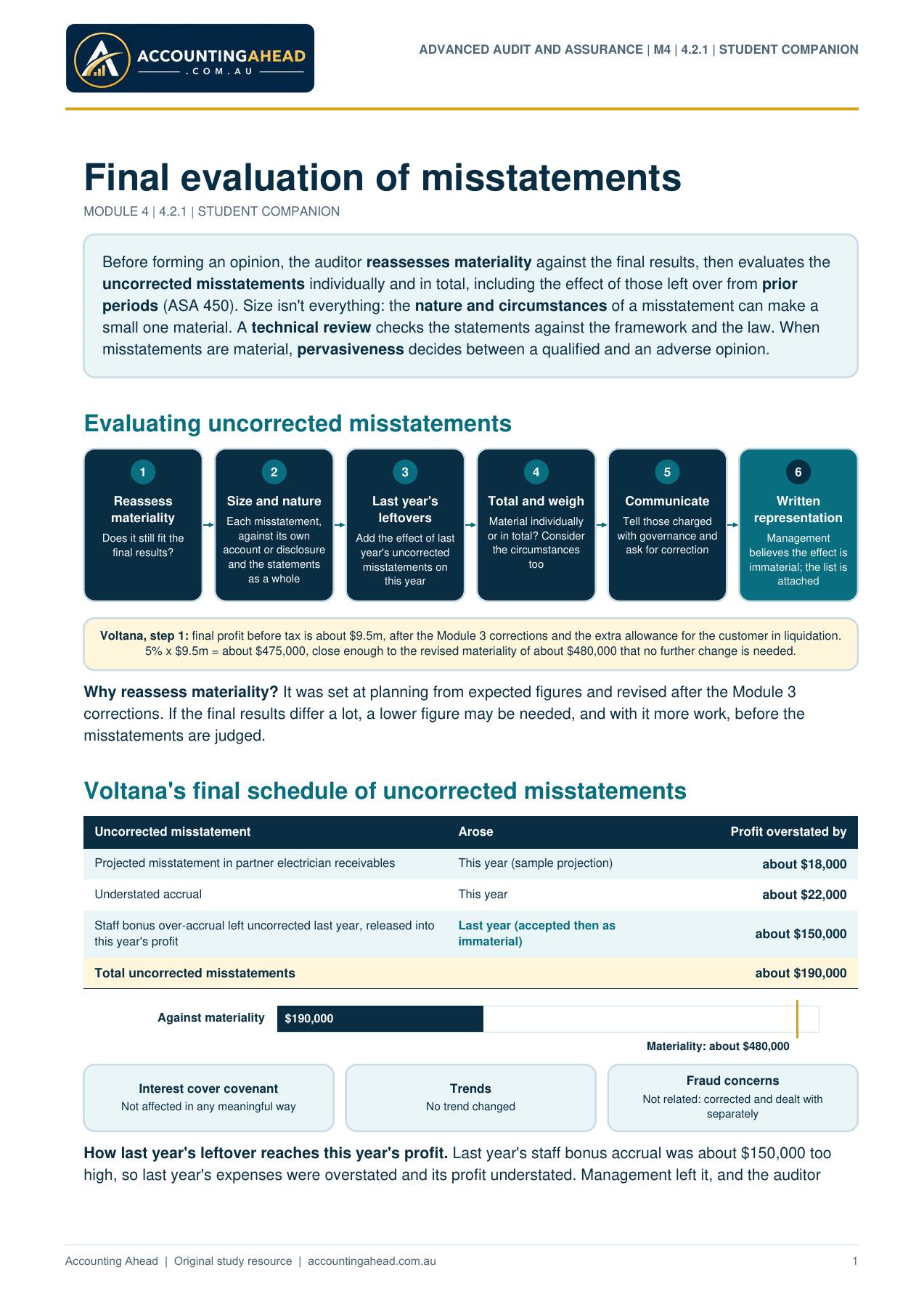
Before forming an opinion, the auditor reassesses materiality against the final results, then evaluates the
uncorrected misstatements individually and in total, including the effect of those left over from prior
periods (ASA 450). Size isn't everything: the nature and circumstances of a misstatement can make a
small one material. A technical review checks the statements against the framework and the law. When
misstatements are material, pervasiveness decides between a qualified and an adverse opinion.
Evaluating uncorrected misstatements
1
Reassess
materiality
Does it still fit the
final results?
2
Size and nature
Each misstatement,
against its own
account or disclosure
and the statements
as a whole
3
Last year's
leftovers
Add the effect of last
year's uncorrected
misstatements on
this year
4
Total and weigh
Material individually
or in total? Consider
the circumstances
too
5
Communicate
Tell those charged
with governance and
ask for correction
6
Written
representation
Management
believes the effect is
immaterial; the list is
attached
Voltana, step 1: final profit before tax is about $9.5m, after the Module 3 corrections and the extra allowance for the customer in liquidation.
5% x $9.5m = about $475,000, close enough to the revised materiality of about $480,000 that no further change is needed.
Why reassess materiality? It was set at planning from expected figures and revised after the Module 3
corrections. If the final results differ a lot, a lower figure may be needed, and with it more work, before the
misstatements are judged.
Voltana's final schedule of uncorrected misstatements
Uncorrected misstatement Arose Profit overstated by
Projected misstatement in partner electrician receivables This year (sample projection) about $18,000
Understated accrual This year about $22,000
Staff bonus over-accrual left uncorrected last year, released into
this year's profit
Last year (accepted then as
immaterial) about $150,000
Total uncorrected misstatements about $190,000
Against materiality $190,000
Materiality: about $480,000
Interest cover covenant
Not affected in any meaningful way
Trends
No trend changed
Fraud concerns
Not related: corrected and dealt with
separately
How last year's leftover reaches this year's profit. Last year's staff bonus accrual was about $150,000 too
high, so last year's expenses were overstated and its profit understated. Management left it, and the auditor
ADVANCED AUDIT AND ASSURANCE | M4 | 4.2.1 | STUDENT COMPANION
1
Accounting Ahead | Original study resource | accountingahead.com.au
accepted it as immaterial. This year the excess was released, so this year's expenses are understated and profit
overstated by the same $150,000. ASA 450 accepts more than one way to evaluate prior-period misstatements,
for example by their effect on this year's profit or on the closing balances, as long as the approach is applied
consistently from year to year.
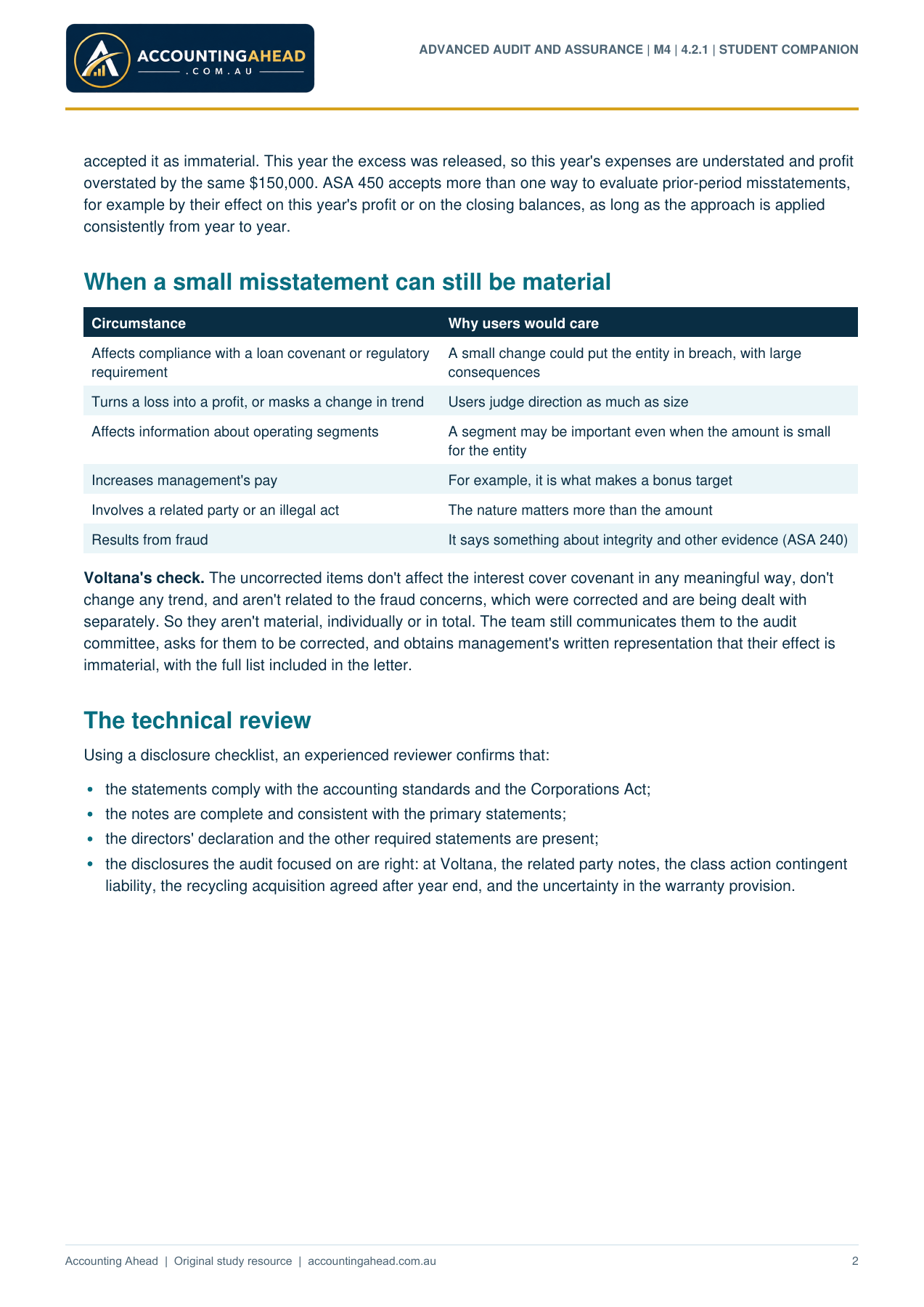
When a small misstatement can still be material
Circumstance Why users would care
Affects compliance with a loan covenant or regulatory
requirement
A small change could put the entity in breach, with large
consequences
Turns a loss into a profit, or masks a change in trend Users judge direction as much as size
Affects information about operating segments A segment may be important even when the amount is small
for the entity
Increases management's pay For example, it is what makes a bonus target
Involves a related party or an illegal act The nature matters more than the amount
Results from fraud It says something about integrity and other evidence (ASA 240)
Voltana's check. The uncorrected items don't affect the interest cover covenant in any meaningful way, don't
change any trend, and aren't related to the fraud concerns, which were corrected and are being dealt with
separately. So they aren't material, individually or in total. The team still communicates them to the audit
committee, asks for them to be corrected, and obtains management's written representation that their effect is
immaterial, with the full list included in the letter.
The technical review
Using a disclosure checklist, an experienced reviewer confirms that:
the statements comply with the accounting standards and the Corporations Act;
the notes are complete and consistent with the primary statements;
the directors' declaration and the other required statements are present;
the disclosures the audit focused on are right: at Voltana, the related party notes, the class action contingent
liability, the recycling acquisition agreed after year end, and the uncertainty in the warranty provision.
ADVANCED AUDIT AND ASSURANCE | M4 | 4.2.1 | STUDENT COMPANION
2
Accounting Ahead | Original study resource | accountingahead.com.au
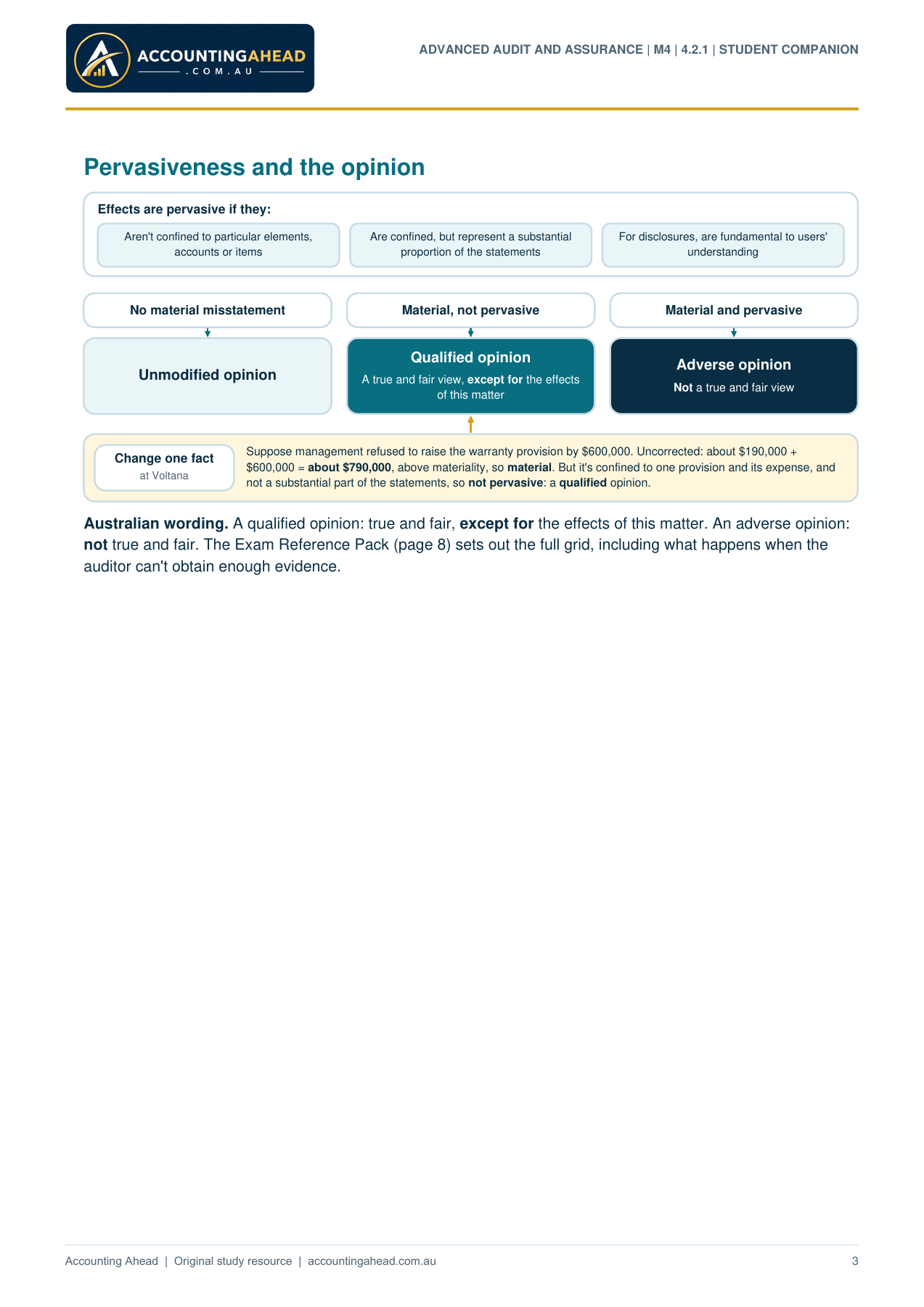
Pervasiveness and the opinion
Effects are pervasive if they:
Aren't confined to particular elements,
accounts or items
Are confined, but represent a substantial
proportion of the statements
For disclosures, are fundamental to users'
understanding
No material misstatement
Unmodified opinion
Material, not pervasive
Qualified opinion
A true and fair view, except for the effects
of this matter
Material and pervasive
Adverse opinion
Not a true and fair view
Change one fact
at Voltana
Suppose management refused to raise the warranty provision by $600,000. Uncorrected: about $190,000 +
$600,000 = about $790,000, above materiality, so material. But it's confined to one provision and its expense, and
not a substantial part of the statements, so not pervasive: a qualified opinion.
Australian wording. A qualified opinion: true and fair, except for the effects of this matter. An adverse opinion:
not true and fair. The Exam Reference Pack (page 8) sets out the full grid, including what happens when the
auditor can't obtain enough evidence.
ADVANCED AUDIT AND ASSURANCE | M4 | 4.2.1 | STUDENT COMPANION
3
Accounting Ahead | Original study resource | accountingahead.com.au
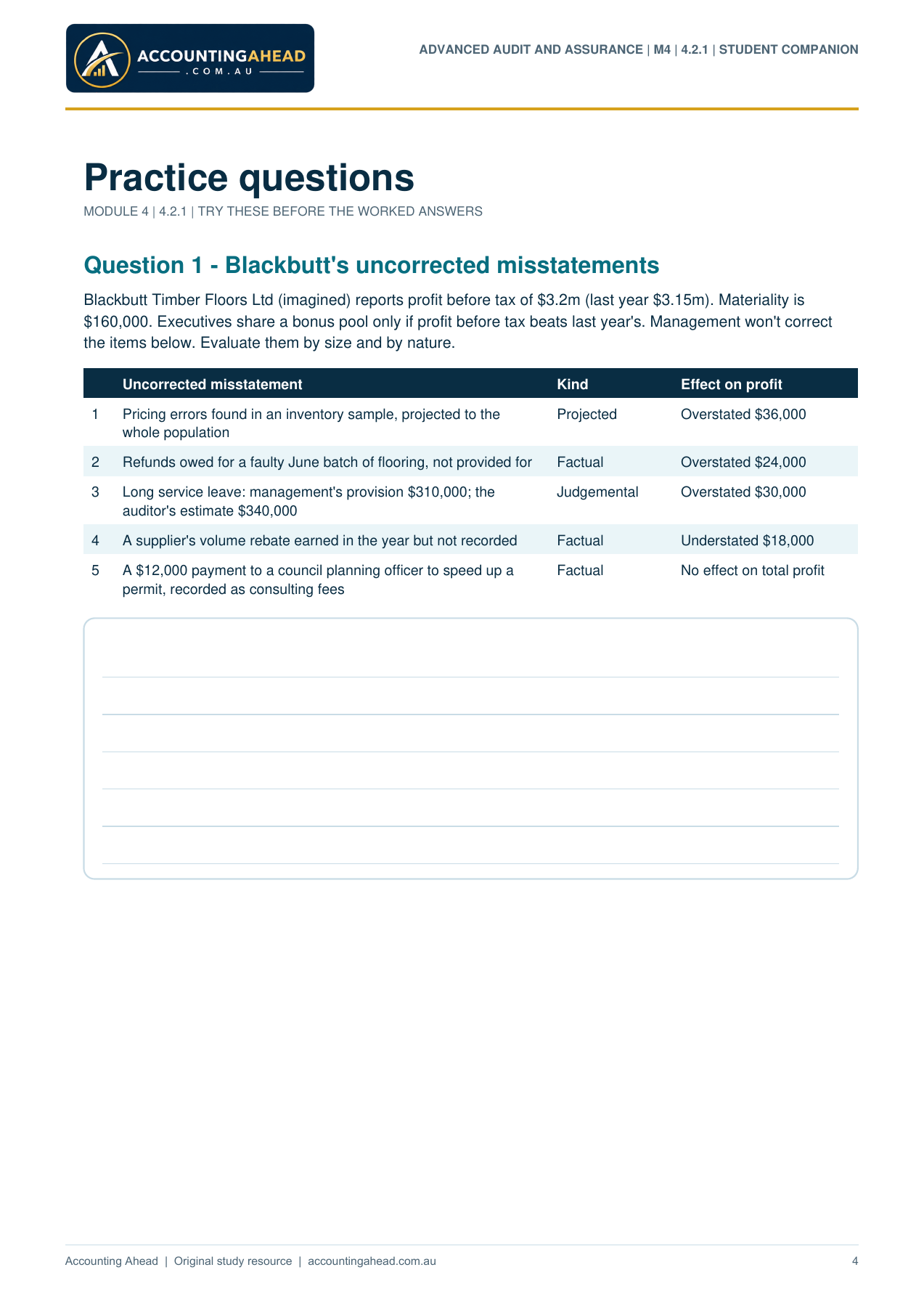
Practice questions
MODULE 4 | 4.2.1 | TRY THESE BEFORE THE WORKED ANSWERS
Question 1 - Blackbutt's uncorrected misstatements
Blackbutt Timber Floors Ltd (imagined) reports profit before tax of $3.2m (last year $3.15m). Materiality is
$160,000. Executives share a bonus pool only if profit before tax beats last year's. Management won't correct
the items below. Evaluate them by size and by nature.
Uncorrected misstatement Kind Effect on profit
1 Pricing errors found in an inventory sample, projected to the
whole population
Projected Overstated $36,000
2 Refunds owed for a faulty June batch of flooring, not provided for Factual Overstated $24,000
3 Long service leave: management's provision $310,000; the
auditor's estimate $340,000
Judgemental Overstated $30,000
4 A supplier's volume rebate earned in the year but not recorded Factual Understated $18,000
5 A $12,000 payment to a council planning officer to speed up a
permit, recorded as consulting fees
Factual No effect on total profit
ADVANCED AUDIT AND ASSURANCE | M4 | 4.2.1 | STUDENT COMPANION
4
Accounting Ahead | Original study resource | accountingahead.com.au
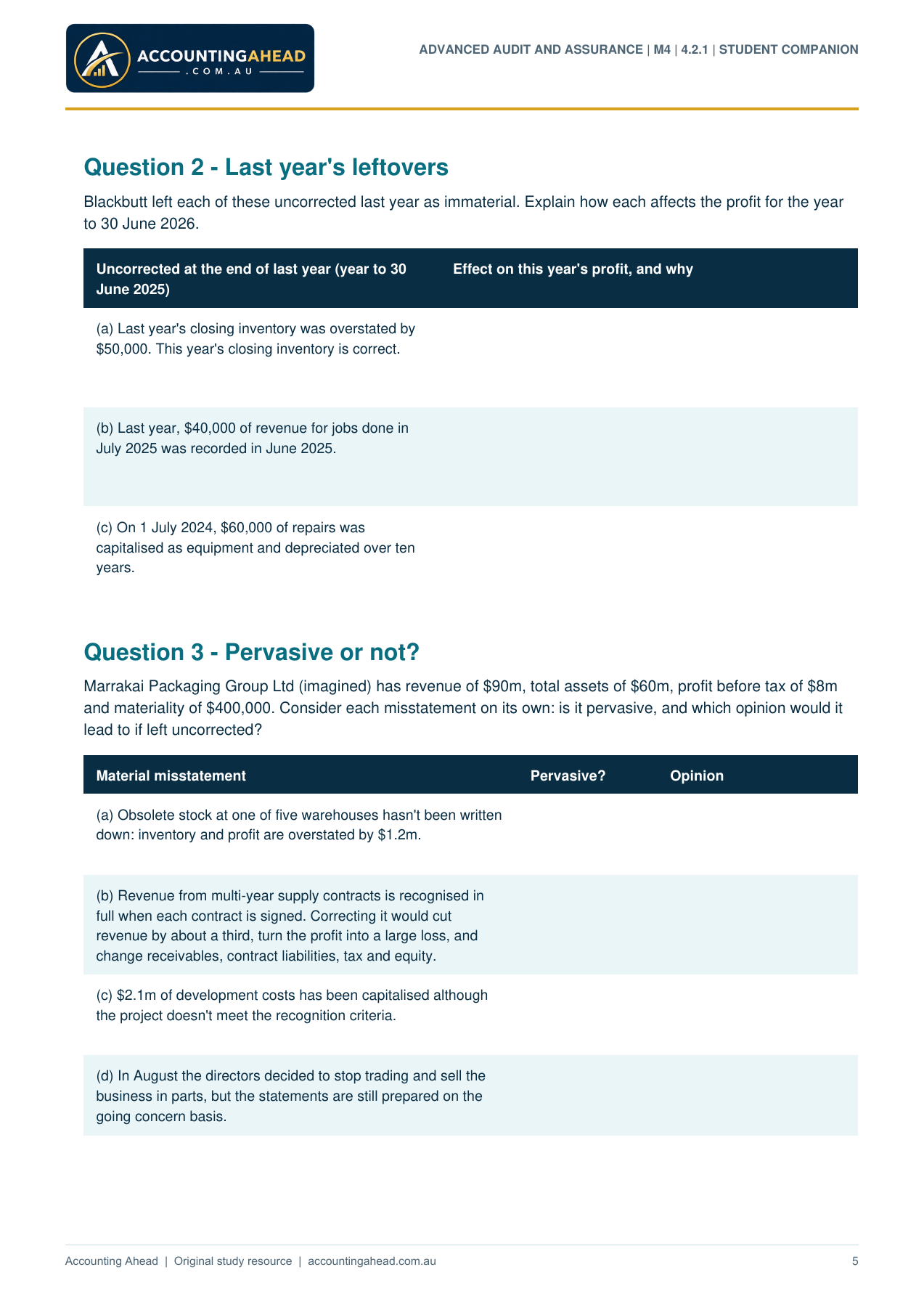
Question 2 - Last year's leftovers
Blackbutt left each of these uncorrected last year as immaterial. Explain how each affects the profit for the year
to 30 June 2026.
Uncorrected at the end of last year (year to 30
June 2025)
Effect on this year's profit, and why
(a) Last year's closing inventory was overstated by
$50,000. This year's closing inventory is correct.
(b) Last year, $40,000 of revenue for jobs done in
July 2025 was recorded in June 2025.
(c) On 1 July 2024, $60,000 of repairs was
capitalised as equipment and depreciated over ten
years.
Question 3 - Pervasive or not?
Marrakai Packaging Group Ltd (imagined) has revenue of $90m, total assets of $60m, profit before tax of $8m
and materiality of $400,000. Consider each misstatement on its own: is it pervasive, and which opinion would it
lead to if left uncorrected?
Material misstatement Pervasive? Opinion
(a) Obsolete stock at one of five warehouses hasn't been written
down: inventory and profit are overstated by $1.2m.
(b) Revenue from multi-year supply contracts is recognised in
full when each contract is signed. Correcting it would cut
revenue by about a third, turn the profit into a large loss, and
change receivables, contract liabilities, tax and equity.
(c) $2.1m of development costs has been capitalised although
the project doesn't meet the recognition criteria.
(d) In August the directors decided to stop trading and sell the
business in parts, but the statements are still prepared on the
going concern basis.
ADVANCED AUDIT AND ASSURANCE | M4 | 4.2.1 | STUDENT COMPANION
5
Accounting Ahead | Original study resource | accountingahead.com.au
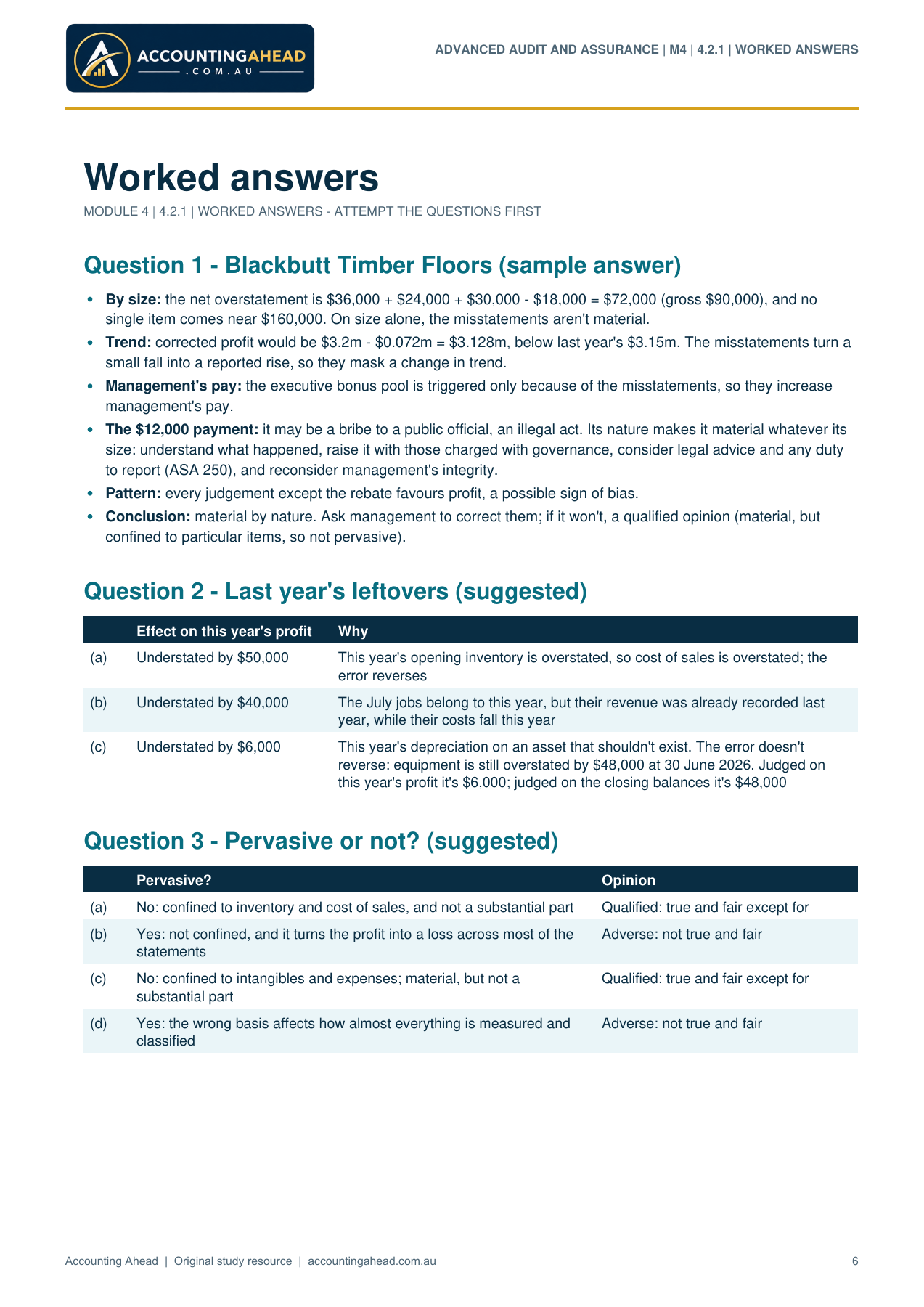
Worked answers
MODULE 4 | 4.2.1 | WORKED ANSWERS - ATTEMPT THE QUESTIONS FIRST
Question 1 - Blackbutt Timber Floors (sample answer)
By size: the net overstatement is $36,000 + $24,000 + $30,000 - $18,000 = $72,000 (gross $90,000), and no
single item comes near $160,000. On size alone, the misstatements aren't material.
Trend: corrected profit would be $3.2m - $0.072m = $3.128m, below last year's $3.15m. The misstatements turn a
small fall into a reported rise, so they mask a change in trend.
Management's pay: the executive bonus pool is triggered only because of the misstatements, so they increase
management's pay.
The $12,000 payment: it may be a bribe to a public official, an illegal act. Its nature makes it material whatever its
size: understand what happened, raise it with those charged with governance, consider legal advice and any duty
to report (ASA 250), and reconsider management's integrity.
Pattern: every judgement except the rebate favours profit, a possible sign of bias.
Conclusion: material by nature. Ask management to correct them; if it won't, a qualified opinion (material, but
confined to particular items, so not pervasive).
Question 2 - Last year's leftovers (suggested)
Effect on this year's profit Why
(a) Understated by $50,000 This year's opening inventory is overstated, so cost of sales is overstated; the
error reverses
(b) Understated by $40,000 The July jobs belong to this year, but their revenue was already recorded last
year, while their costs fall this year
(c) Understated by $6,000 This year's depreciation on an asset that shouldn't exist. The error doesn't
reverse: equipment is still overstated by $48,000 at 30 June 2026. Judged on
this year's profit it's $6,000; judged on the closing balances it's $48,000
Question 3 - Pervasive or not? (suggested)
Pervasive? Opinion
(a) No: confined to inventory and cost of sales, and not a substantial part Qualified: true and fair except for
(b) Yes: not confined, and it turns the profit into a loss across most of the
statements
Adverse: not true and fair
(c) No: confined to intangibles and expenses; material, but not a
substantial part
Qualified: true and fair except for
(d) Yes: the wrong basis affects how almost everything is measured and
classified
Adverse: not true and fair
ADVANCED AUDIT AND ASSURANCE | M4 | 4.2.1 | WORKED ANSWERS
6