
Going concern reporting and key audit matters
Printable study notes, diagrams and practice support for Part 4.3.2.
Read the handout text
Accounting Ahead | Original study resource | accountingahead.com.au
Going concern reporting and key audit
matters
MODULE 4 | 4.3.2 | STUDENT COMPANION
If the going concern basis is right but a material uncertainty exists and is adequately disclosed, the
opinion stays unmodified and a separate section draws attention to the disclosure. Inadequate disclosure
leads to a qualified or adverse opinion; statements prepared on an inappropriate going concern basis get
an adverse opinion. Key audit matters, required for listed entities, are chosen from the matters
communicated to those charged with governance, narrowed to those that needed significant auditor
attention and then to those of most significance. Each explains why it mattered and how the audit
addressed it.
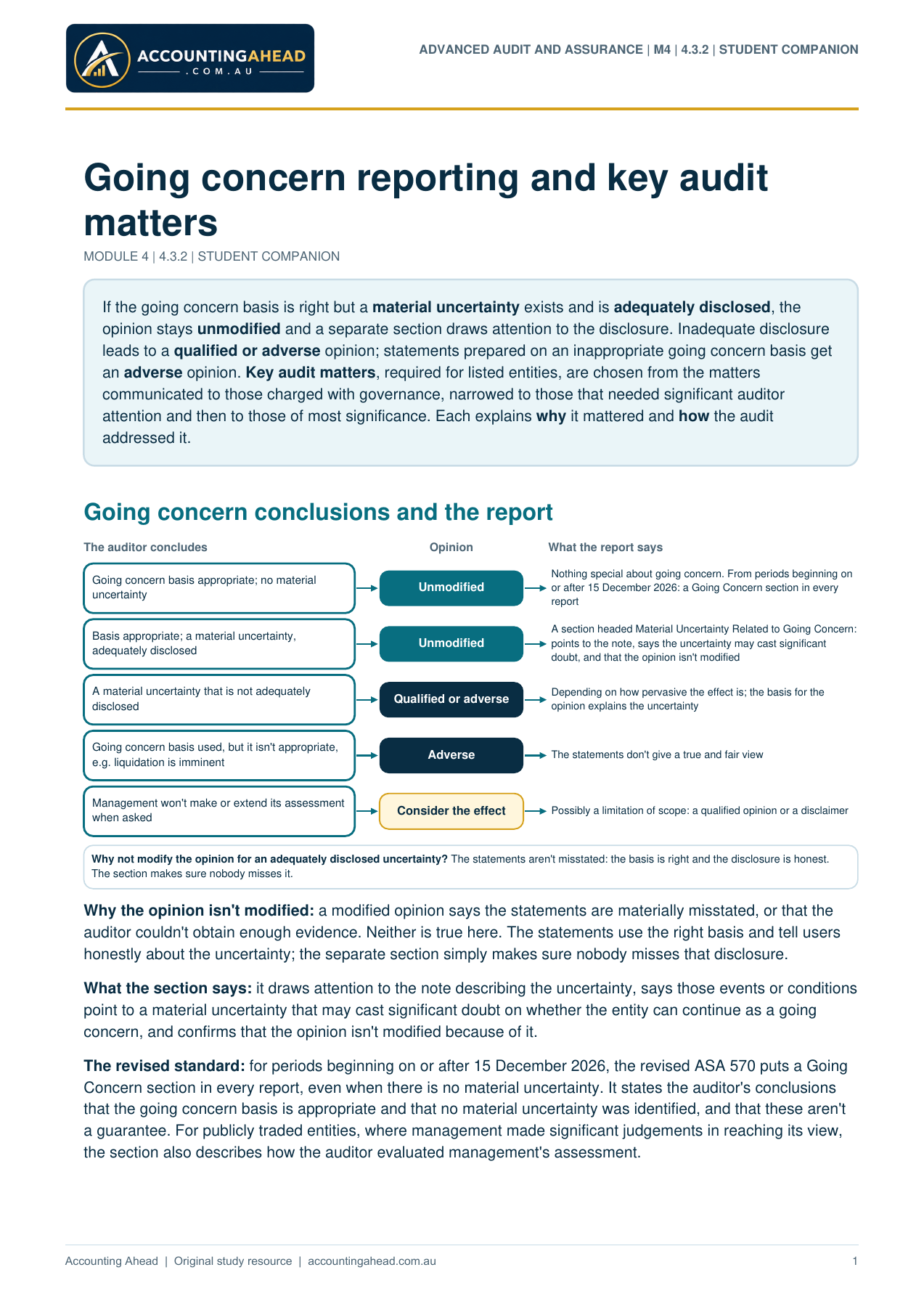
Going concern conclusions and the report
The auditor concludes Opinion What the report says
Going concern basis appropriate; no material
uncertainty Unmodified
Nothing special about going concern. From periods beginning on
or after 15 December 2026: a Going Concern section in every
report
Basis appropriate; a material uncertainty,
adequately disclosed Unmodified
A section headed Material Uncertainty Related to Going Concern:
points to the note, says the uncertainty may cast significant
doubt, and that the opinion isn't modified
A material uncertainty that is not adequately
disclosed Qualified or adverse Depending on how pervasive the effect is; the basis for the
opinion explains the uncertainty
Going concern basis used, but it isn't appropriate,
e.g. liquidation is imminent Adverse The statements don't give a true and fair view
Management won't make or extend its assessment
when asked Consider the effect Possibly a limitation of scope: a qualified opinion or a disclaimer
Why not modify the opinion for an adequately disclosed uncertainty? The statements aren't misstated: the basis is right and the disclosure is honest.
The section makes sure nobody misses it.
Why the opinion isn't modified: a modified opinion says the statements are materially misstated, or that the
auditor couldn't obtain enough evidence. Neither is true here. The statements use the right basis and tell users
honestly about the uncertainty; the separate section simply makes sure nobody misses that disclosure.
What the section says: it draws attention to the note describing the uncertainty, says those events or conditions
point to a material uncertainty that may cast significant doubt on whether the entity can continue as a going
concern, and confirms that the opinion isn't modified because of it.
The revised standard: for periods beginning on or after 15 December 2026, the revised ASA 570 puts a Going
Concern section in every report, even when there is no material uncertainty. It states the auditor's conclusions
that the going concern basis is appropriate and that no material uncertainty was identified, and that these aren't
a guarantee. For publicly traded entities, where management made significant judgements in reaching its view,
the section also describes how the auditor evaluated management's assessment.
ADVANCED AUDIT AND ASSURANCE | M4 | 4.3.2 | STUDENT COMPANION
1
Accounting Ahead | Original study resource | accountingahead.com.au
Case note: The Star Entertainment Group (2024)
By 2024, The Star Entertainment Group, which ran casinos in Sydney, Brisbane and on the Gold Coast, had
been through inquiries that found it unsuitable to hold its casino licences. It faced heavy losses, large regulatory
penalties and the need to raise more funding. Its shares were suspended on 2 September 2024 after it missed
the reporting deadline; its full-year results followed late, on 26 September, and the audited financial report on 30
September. Its auditor, EY, included a section headed Material Uncertainties Relating to Going Concern,
directing readers to the note explaining the uncertainties, including the company's funding needs and the
outcomes of regulatory and legal matters. The opinion itself was unmodified, because the uncertainties were
adequately disclosed.
Why it matters: the opinion was clean, yet for a reader that one section changes how the whole annual report
should be read.
Source: The Star Entertainment Group FY2024 financial report and EY auditor's report (30 September 2024); ASX announcements (2
and 26 September 2024).
Key audit matters
Who must include them: the auditor of a listed entity must communicate key audit matters, and for periods
beginning on or after 15 December 2026 the requirement extends to all publicly traded entities (AUASB 2025-9).
Other entities may include them voluntarily, or because the law requires it. They are the matters that, in the
auditor's judgement, were of most significance in this year's audit.
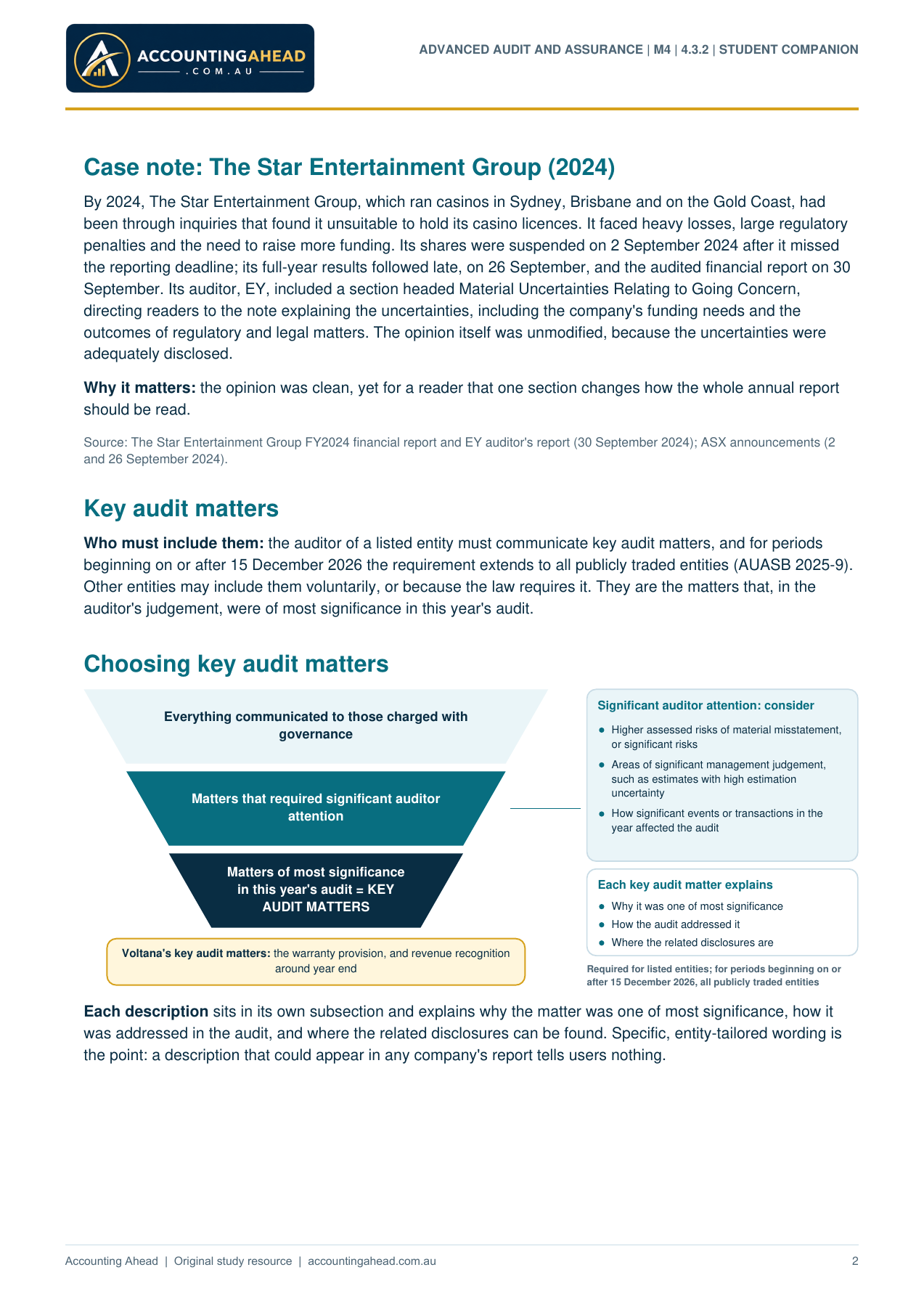
Choosing key audit matters
Everything communicated to those charged with
governance
Matters that required significant auditor
attention
Matters of most significance
in this year's audit = KEY
AUDIT MATTERS
Voltana's key audit matters: the warranty provision, and revenue recognition
around year end
Significant auditor attention: consider
Higher assessed risks of material misstatement,
or significant risks
Areas of significant management judgement,
such as estimates with high estimation
uncertainty
How significant events or transactions in the
year affected the audit
Each key audit matter explains
Why it was one of most significance
How the audit addressed it
Where the related disclosures are
Required for listed entities; for periods beginning on or
after 15 December 2026, all publicly traded entities
Each description sits in its own subsection and explains why the matter was one of most significance, how it
was addressed in the audit, and where the related disclosures can be found. Specific, entity-tailored wording is
the point: a description that could appear in any company's report tells users nothing.
ADVANCED AUDIT AND ASSURANCE | M4 | 4.3.2 | STUDENT COMPANION
2
Accounting Ahead | Original study resource | accountingahead.com.au
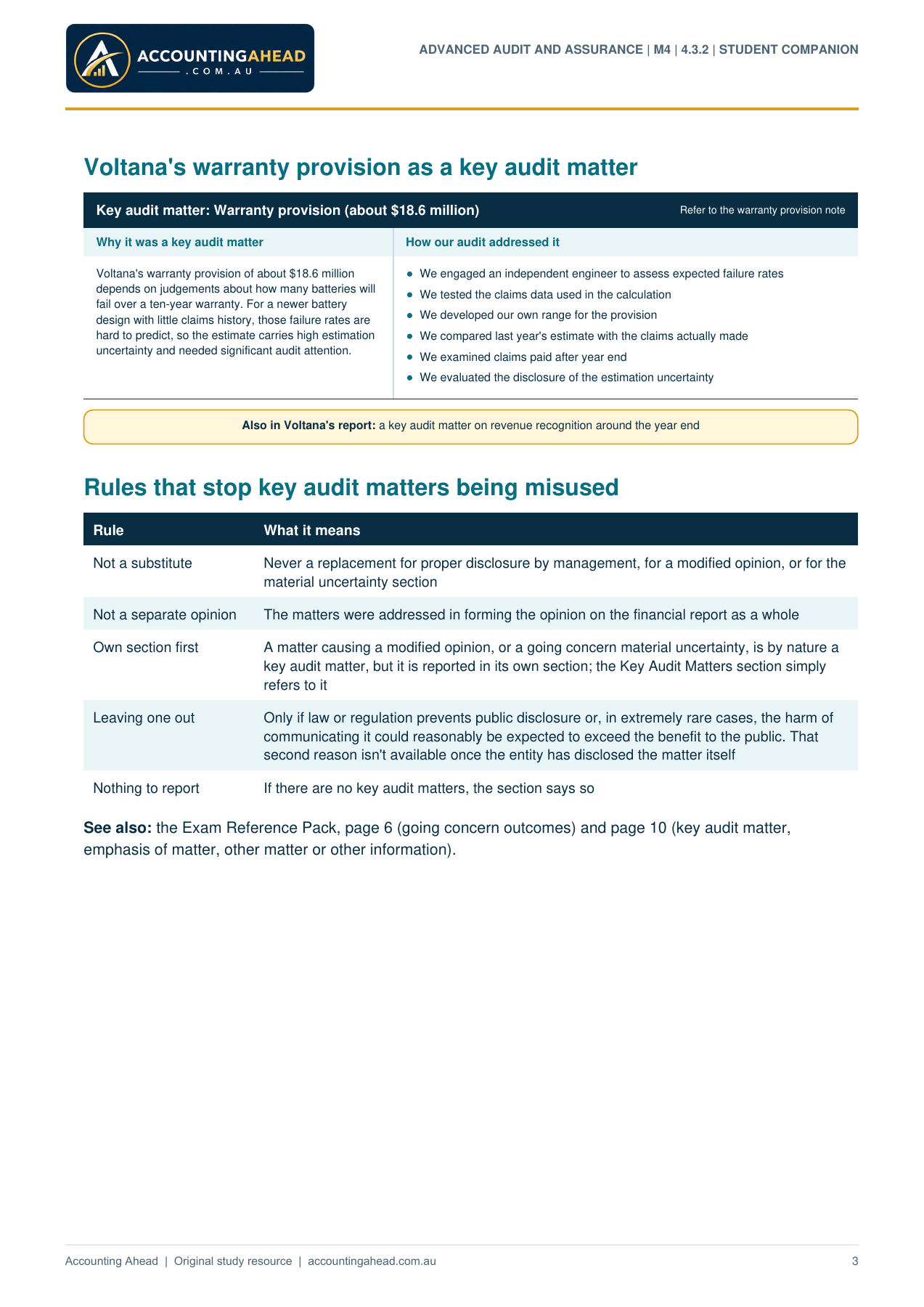
Voltana's warranty provision as a key audit matter
Key audit matter: Warranty provision (about $18.6 million) Refer to the warranty provision note
Why it was a key audit matter How our audit addressed it
Voltana's warranty provision of about $18.6 million
depends on judgements about how many batteries will
fail over a ten-year warranty. For a newer battery
design with little claims history, those failure rates are
hard to predict, so the estimate carries high estimation
uncertainty and needed significant audit attention.
We engaged an independent engineer to assess expected failure rates
We tested the claims data used in the calculation
We developed our own range for the provision
We compared last year's estimate with the claims actually made
We examined claims paid after year end
We evaluated the disclosure of the estimation uncertainty
Also in Voltana's report: a key audit matter on revenue recognition around the year end
Rules that stop key audit matters being misused
Rule What it means
Not a substitute Never a replacement for proper disclosure by management, for a modified opinion, or for the
material uncertainty section
Not a separate opinion The matters were addressed in forming the opinion on the financial report as a whole
Own section first A matter causing a modified opinion, or a going concern material uncertainty, is by nature a
key audit matter, but it is reported in its own section; the Key Audit Matters section simply
refers to it
Leaving one out Only if law or regulation prevents public disclosure or, in extremely rare cases, the harm of
communicating it could reasonably be expected to exceed the benefit to the public. That
second reason isn't available once the entity has disclosed the matter itself
Nothing to report If there are no key audit matters, the section says so
See also: the Exam Reference Pack, page 6 (going concern outcomes) and page 10 (key audit matter,
emphasis of matter, other matter or other information).
ADVANCED AUDIT AND ASSURANCE | M4 | 4.3.2 | STUDENT COMPANION
3
Accounting Ahead | Original study resource | accountingahead.com.au
Practice questions
MODULE 4 | 4.3.2 | TRY THESE BEFORE THE WORKED ANSWERS
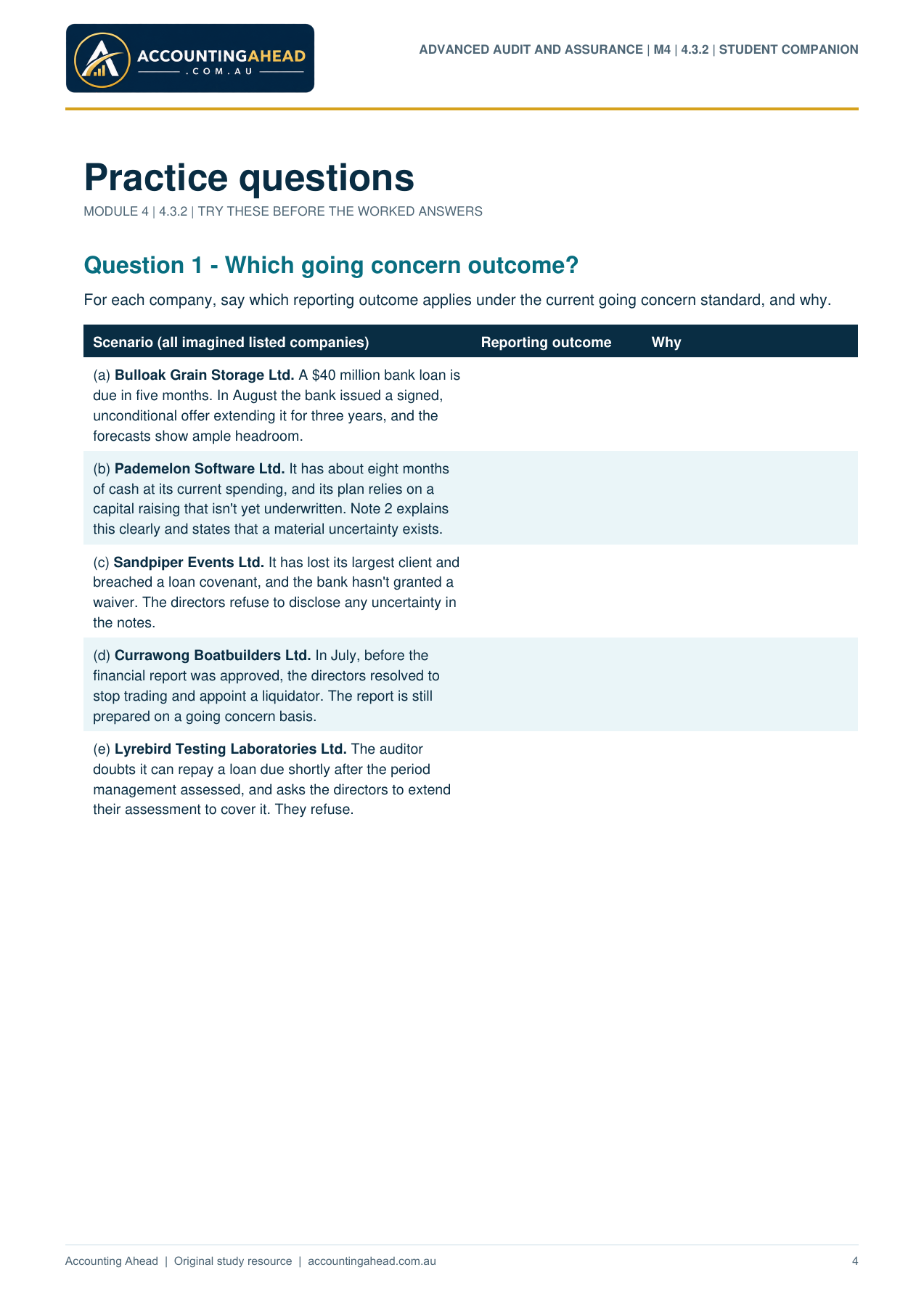
Question 1 - Which going concern outcome?
For each company, say which reporting outcome applies under the current going concern standard, and why.
Scenario (all imagined listed companies) Reporting outcome Why
(a) Bulloak Grain Storage Ltd. A $40 million bank loan is
due in five months. In August the bank issued a signed,
unconditional offer extending it for three years, and the
forecasts show ample headroom.
(b) Pademelon Software Ltd. It has about eight months
of cash at its current spending, and its plan relies on a
capital raising that isn't yet underwritten. Note 2 explains
this clearly and states that a material uncertainty exists.
(c) Sandpiper Events Ltd. It has lost its largest client and
breached a loan covenant, and the bank hasn't granted a
waiver. The directors refuse to disclose any uncertainty in
the notes.
(d) Currawong Boatbuilders Ltd. In July, before the
financial report was approved, the directors resolved to
stop trading and appoint a liquidator. The report is still
prepared on a going concern basis.
(e) Lyrebird Testing Laboratories Ltd. The auditor
doubts it can repay a loan due shortly after the period
management assessed, and asks the directors to extend
their assessment to cover it. They refuse.
ADVANCED AUDIT AND ASSURANCE | M4 | 4.3.2 | STUDENT COMPANION
4
Accounting Ahead | Original study resource | accountingahead.com.au
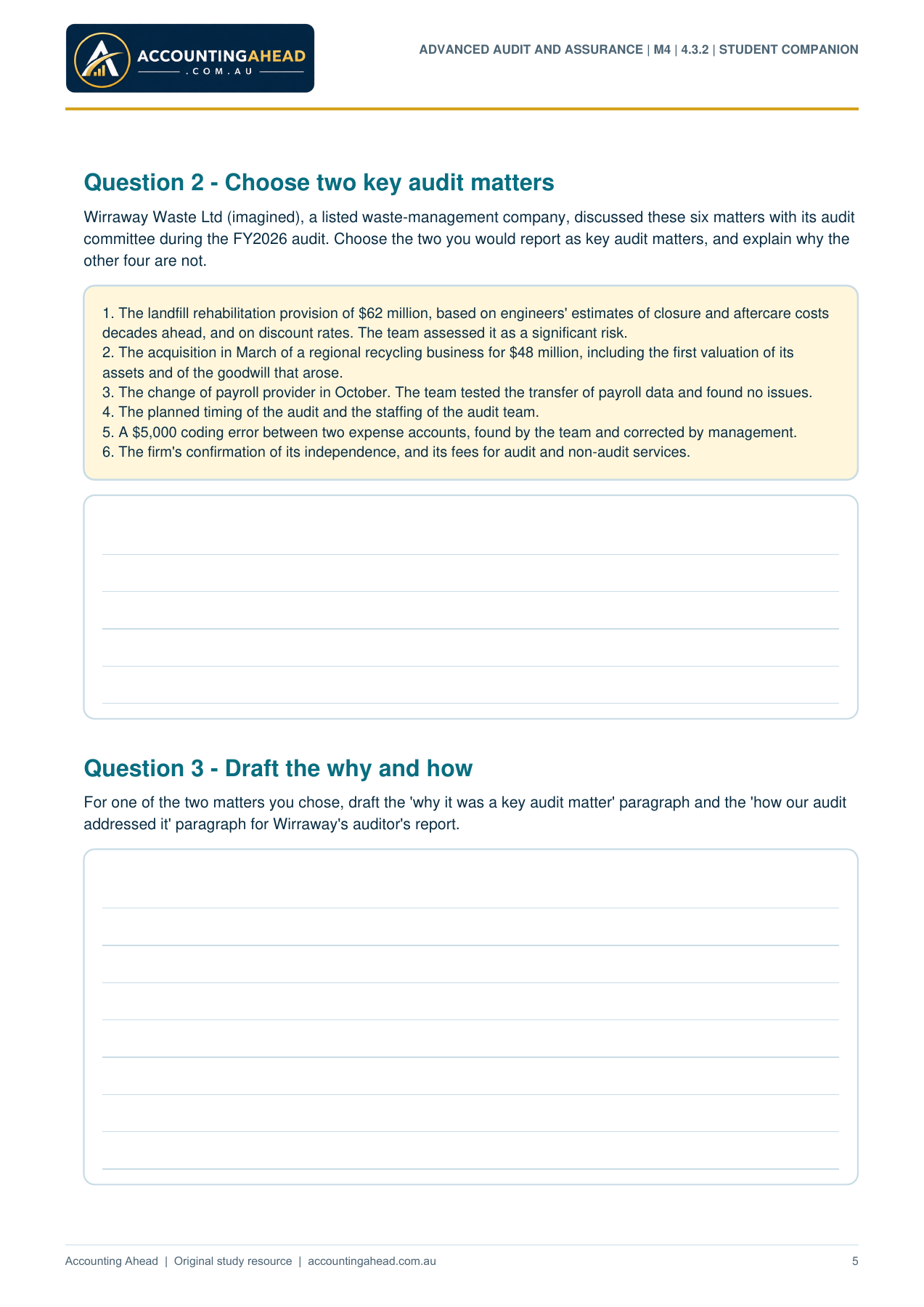
Question 2 - Choose two key audit matters
Wirraway Waste Ltd (imagined), a listed waste-management company, discussed these six matters with its audit
committee during the FY2026 audit. Choose the two you would report as key audit matters, and explain why the
other four are not.
1. The landfill rehabilitation provision of $62 million, based on engineers' estimates of closure and aftercare costs
decades ahead, and on discount rates. The team assessed it as a significant risk.
2. The acquisition in March of a regional recycling business for $48 million, including the first valuation of its
assets and of the goodwill that arose.
3. The change of payroll provider in October. The team tested the transfer of payroll data and found no issues.
4. The planned timing of the audit and the staffing of the audit team.
5. A $5,000 coding error between two expense accounts, found by the team and corrected by management.
6. The firm's confirmation of its independence, and its fees for audit and non-audit services.
Question 3 - Draft the why and how
For one of the two matters you chose, draft the 'why it was a key audit matter' paragraph and the 'how our audit
addressed it' paragraph for Wirraway's auditor's report.
ADVANCED AUDIT AND ASSURANCE | M4 | 4.3.2 | STUDENT COMPANION
5
Accounting Ahead | Original study resource | accountingahead.com.au
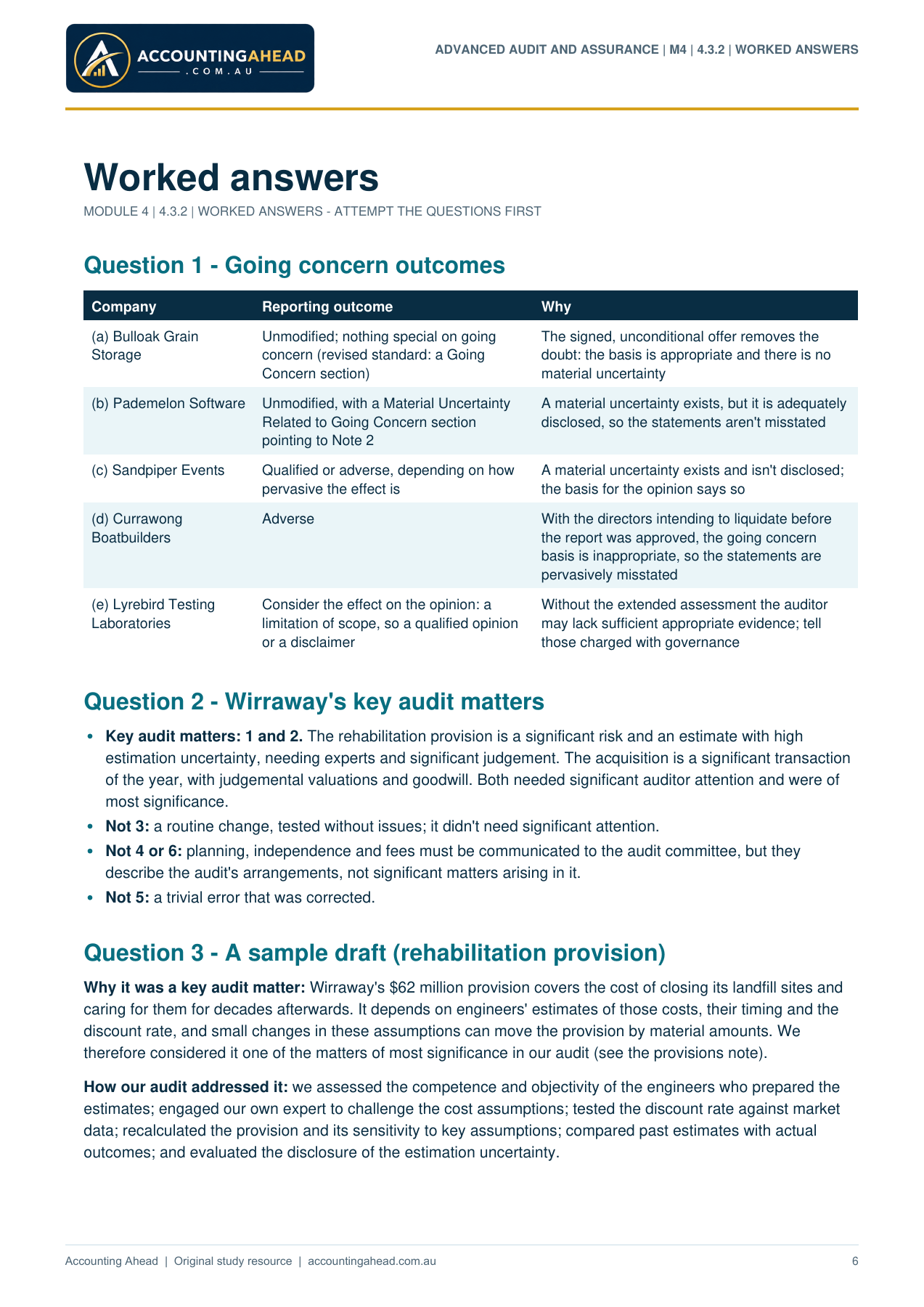
Worked answers
MODULE 4 | 4.3.2 | WORKED ANSWERS - ATTEMPT THE QUESTIONS FIRST
Question 1 - Going concern outcomes
Company Reporting outcome Why
(a) Bulloak Grain
Storage
Unmodified; nothing special on going
concern (revised standard: a Going
Concern section)
The signed, unconditional offer removes the
doubt: the basis is appropriate and there is no
material uncertainty
(b) Pademelon Software Unmodified, with a Material Uncertainty
Related to Going Concern section
pointing to Note 2
A material uncertainty exists, but it is adequately
disclosed, so the statements aren't misstated
(c) Sandpiper Events Qualified or adverse, depending on how
pervasive the effect is
A material uncertainty exists and isn't disclosed;
the basis for the opinion says so
(d) Currawong
Boatbuilders
Adverse With the directors intending to liquidate before
the report was approved, the going concern
basis is inappropriate, so the statements are
pervasively misstated
(e) Lyrebird Testing
Laboratories
Consider the effect on the opinion: a
limitation of scope, so a qualified opinion
or a disclaimer
Without the extended assessment the auditor
may lack sufficient appropriate evidence; tell
those charged with governance
Question 2 - Wirraway's key audit matters
Key audit matters: 1 and 2. The rehabilitation provision is a significant risk and an estimate with high
estimation uncertainty, needing experts and significant judgement. The acquisition is a significant transaction
of the year, with judgemental valuations and goodwill. Both needed significant auditor attention and were of
most significance.
Not 3: a routine change, tested without issues; it didn't need significant attention.
Not 4 or 6: planning, independence and fees must be communicated to the audit committee, but they
describe the audit's arrangements, not significant matters arising in it.
Not 5: a trivial error that was corrected.
Question 3 - A sample draft (rehabilitation provision)
Why it was a key audit matter: Wirraway's $62 million provision covers the cost of closing its landfill sites and
caring for them for decades afterwards. It depends on engineers' estimates of those costs, their timing and the
discount rate, and small changes in these assumptions can move the provision by material amounts. We
therefore considered it one of the matters of most significance in our audit (see the provisions note).
How our audit addressed it: we assessed the competence and objectivity of the engineers who prepared the
estimates; engaged our own expert to challenge the cost assumptions; tested the discount rate against market
data; recalculated the provision and its sensitivity to key assumptions; compared past estimates with actual
outcomes; and evaluated the disclosure of the estimation uncertainty.
ADVANCED AUDIT AND ASSURANCE | M4 | 4.3.2 | WORKED ANSWERS
6