
Modified opinions
Printable study notes, diagrams and practice support for Part 4.3.4.
Read the handout text
Accounting Ahead | Original study resource | accountingahead.com.au
Modified opinions
MODULE 4 | 4.3.4 | STUDENT COMPANION
An opinion is modified when the statements are materially misstated, or when the auditor can't obtain
sufficient appropriate evidence that they aren't. Two questions decide which modified opinion: the
nature of the problem, and whether its effects, or possible effects, are pervasive. A material but contained
problem gives a qualified opinion of either kind; a pervasive misstatement gives an adverse opinion;
pervasive possible effects of missing evidence give a disclaimer. The basis section explains the matter
and, where practicable, its financial effect.
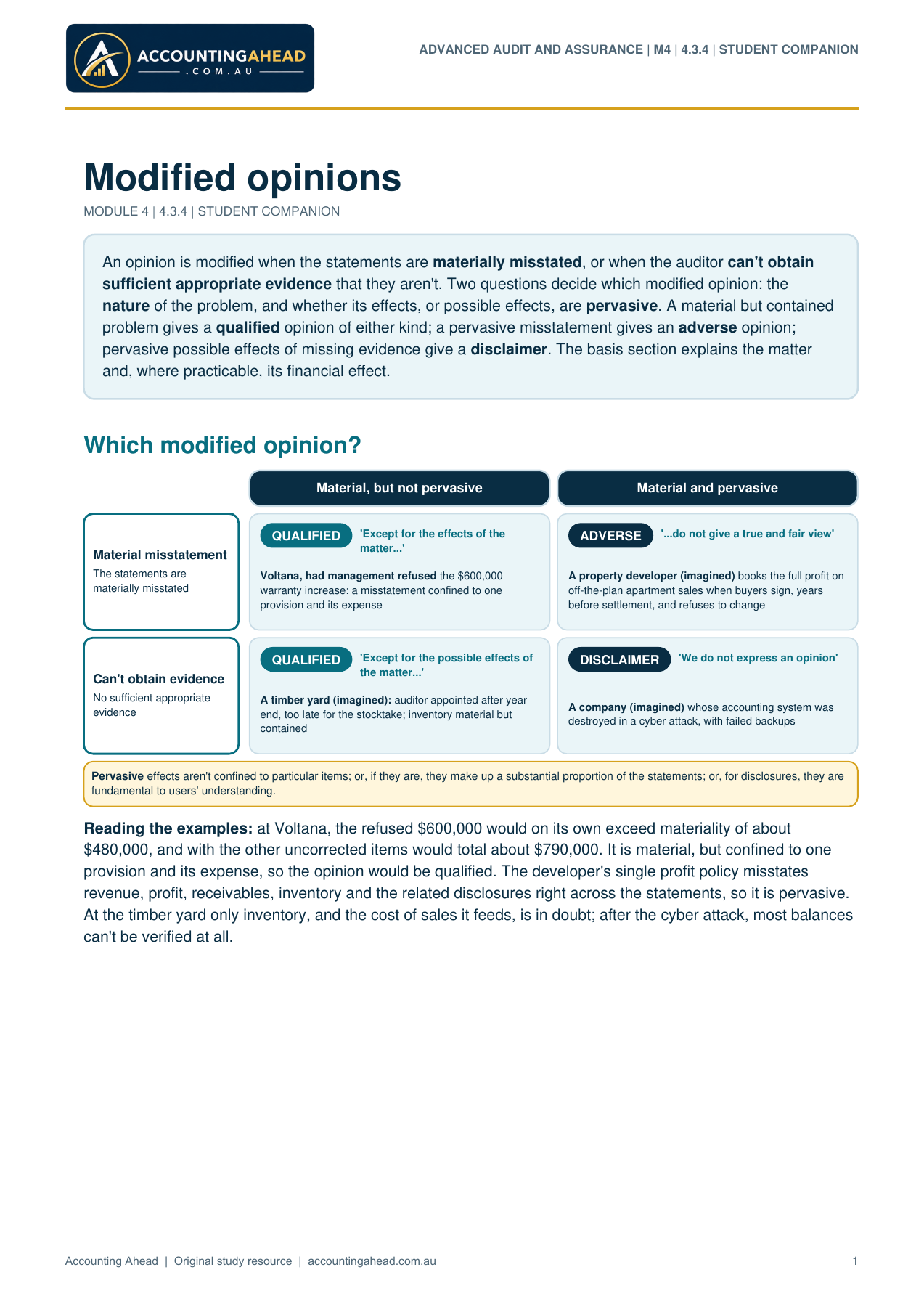
Which modified opinion?
Material, but not pervasive Material and pervasive
Material misstatement
The statements are
materially misstated
QUALIFIED 'Except for the effects of the
matter...'
Voltana, had management refused the $600,000
warranty increase: a misstatement confined to one
provision and its expense
ADVERSE '...do not give a true and fair view'
A property developer (imagined) books the full profit on
off-the-plan apartment sales when buyers sign, years
before settlement, and refuses to change
Can't obtain evidence
No sufficient appropriate
evidence
QUALIFIED 'Except for the possible effects of
the matter...'
A timber yard (imagined): auditor appointed after year
end, too late for the stocktake; inventory material but
contained
DISCLAIMER 'We do not express an opinion'
A company (imagined) whose accounting system was
destroyed in a cyber attack, with failed backups
Pervasive effects aren't confined to particular items; or, if they are, they make up a substantial proportion of the statements; or, for disclosures, they are
fundamental to users' understanding.
Reading the examples: at Voltana, the refused $600,000 would on its own exceed materiality of about
$480,000, and with the other uncorrected items would total about $790,000. It is material, but confined to one
provision and its expense, so the opinion would be qualified. The developer's single profit policy misstates
revenue, profit, receivables, inventory and the related disclosures right across the statements, so it is pervasive.
At the timber yard only inventory, and the cost of sales it feeds, is in doubt; after the cyber attack, most balances
can't be verified at all.
ADVANCED AUDIT AND ASSURANCE | M4 | 4.3.4 | STUDENT COMPANION
1
Accounting Ahead | Original study resource | accountingahead.com.au
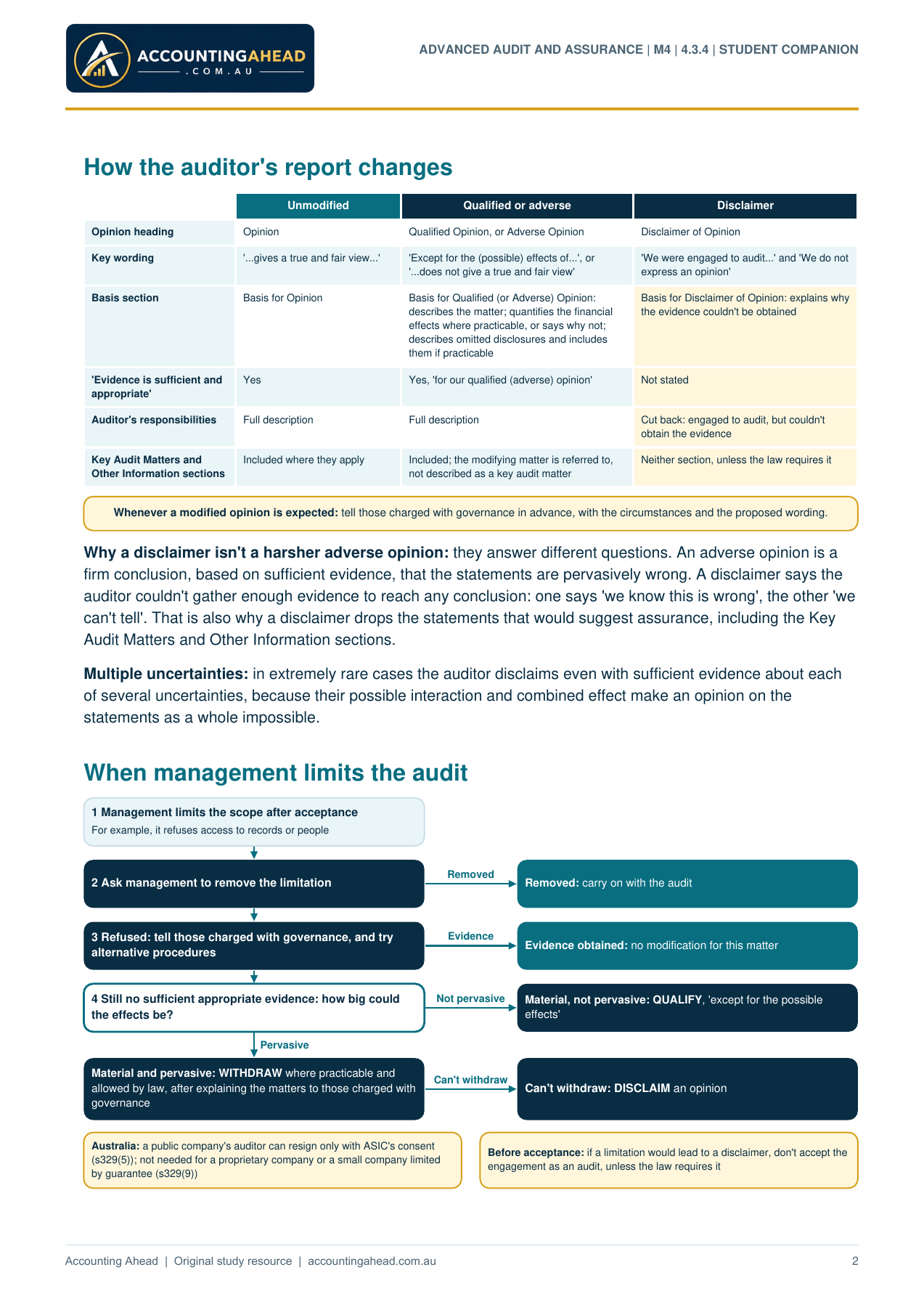
How the auditor's report changes
Unmodified Qualified or adverse Disclaimer
Opinion heading Opinion Qualified Opinion, or Adverse Opinion Disclaimer of Opinion
Key wording '...gives a true and fair view...' 'Except for the (possible) effects of...', or
'...does not give a true and fair view'
'We were engaged to audit...' and 'We do not
express an opinion'
Basis section Basis for Opinion Basis for Qualified (or Adverse) Opinion:
describes the matter; quantifies the financial
effects where practicable, or says why not;
describes omitted disclosures and includes
them if practicable
Basis for Disclaimer of Opinion: explains why
the evidence couldn't be obtained
'Evidence is sufficient and
appropriate'
Yes Yes, 'for our qualified (adverse) opinion' Not stated
Auditor's responsibilities Full description Full description Cut back: engaged to audit, but couldn't
obtain the evidence
Key Audit Matters and
Other Information sections
Included where they apply Included; the modifying matter is referred to,
not described as a key audit matter
Neither section, unless the law requires it
Whenever a modified opinion is expected: tell those charged with governance in advance, with the circumstances and the proposed wording.
Why a disclaimer isn't a harsher adverse opinion: they answer different questions. An adverse opinion is a
firm conclusion, based on sufficient evidence, that the statements are pervasively wrong. A disclaimer says the
auditor couldn't gather enough evidence to reach any conclusion: one says 'we know this is wrong', the other 'we
can't tell'. That is also why a disclaimer drops the statements that would suggest assurance, including the Key
Audit Matters and Other Information sections.
Multiple uncertainties: in extremely rare cases the auditor disclaims even with sufficient evidence about each
of several uncertainties, because their possible interaction and combined effect make an opinion on the
statements as a whole impossible.
When management limits the audit
1 Management limits the scope after acceptance
For example, it refuses access to records or people
2 Ask management to remove the limitation
3 Refused: tell those charged with governance, and try
alternative procedures
4 Still no sufficient appropriate evidence: how big could
the effects be?
Removed: carry on with the auditRemoved
Evidence obtained: no modification for this matterEvidence
Material, not pervasive: QUALIFY, 'except for the possible
effects'
Not pervasive
Material and pervasive: WITHDRAW where practicable and
allowed by law, after explaining the matters to those charged with
governance
Pervasive
Can't withdraw: DISCLAIM an opinionCan't withdraw
Australia: a public company's auditor can resign only with ASIC's consent
(s329(5)); not needed for a proprietary company or a small company limited
by guarantee (s329(9))
Before acceptance: if a limitation would lead to a disclaimer, don't accept the
engagement as an audit, unless the law requires it
ADVANCED AUDIT AND ASSURANCE | M4 | 4.3.4 | STUDENT COMPANION
2
Accounting Ahead | Original study resource | accountingahead.com.au
Australian points: the company's officers must give the auditor access to the books and the information,
explanations and assistance the audit needs (s312), and a management-imposed limitation may itself have to be
reported to ASIC under s311 as an attempt to interfere with the audit. Before accepting an engagement, an
auditor shouldn't accept it as an audit if a limitation in its proposed terms would lead to a disclaimer, unless the
law requires it (ASA 210).
See also: the Exam Reference Pack, page 8, for the full opinion decision path.
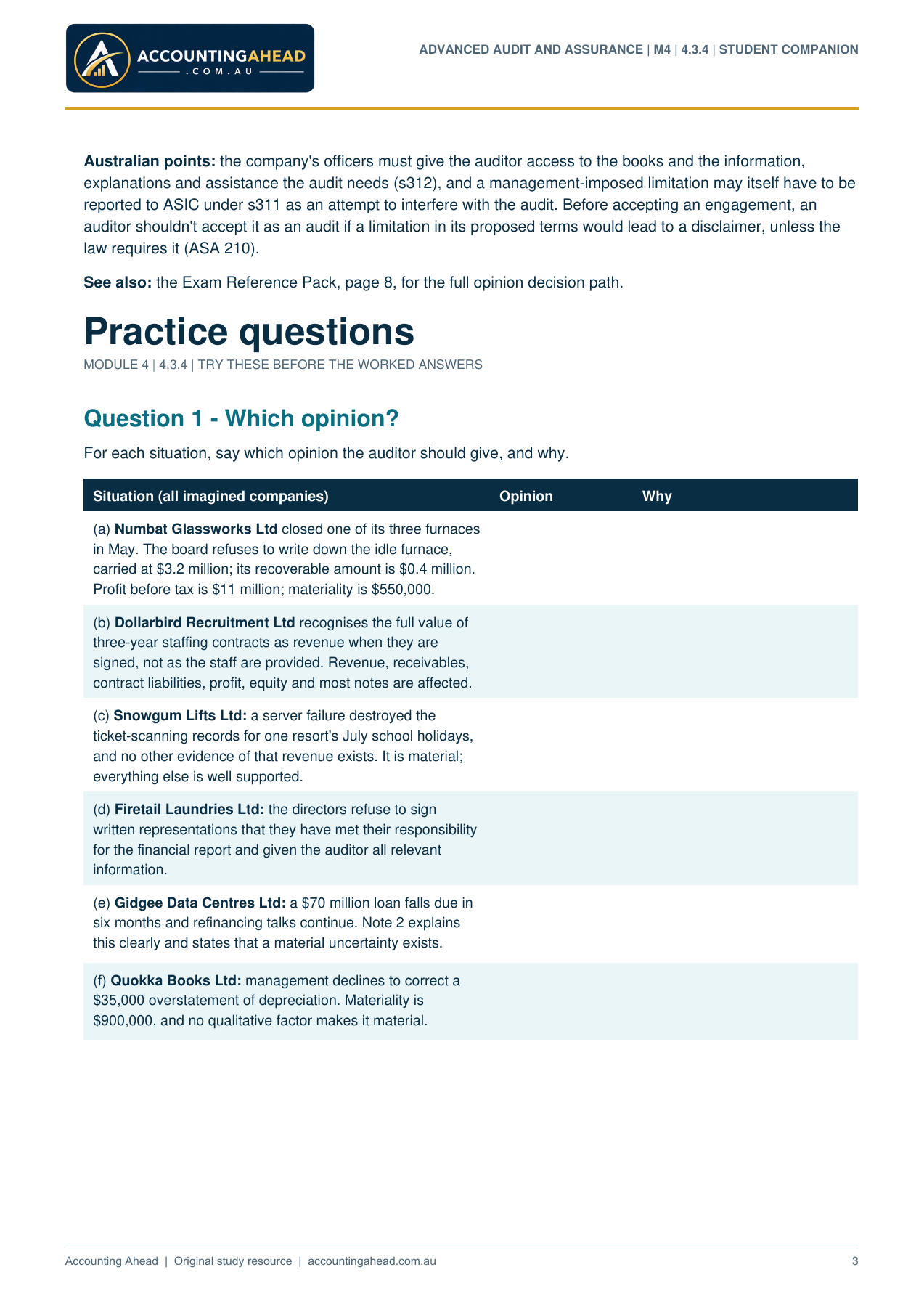
Practice questions
MODULE 4 | 4.3.4 | TRY THESE BEFORE THE WORKED ANSWERS
Question 1 - Which opinion?
For each situation, say which opinion the auditor should give, and why.
Situation (all imagined companies) Opinion Why
(a) Numbat Glassworks Ltd closed one of its three furnaces
in May. The board refuses to write down the idle furnace,
carried at $3.2 million; its recoverable amount is $0.4 million.
Profit before tax is $11 million; materiality is $550,000.
(b) Dollarbird Recruitment Ltd recognises the full value of
three-year staffing contracts as revenue when they are
signed, not as the staff are provided. Revenue, receivables,
contract liabilities, profit, equity and most notes are affected.
(c) Snowgum Lifts Ltd: a server failure destroyed the
ticket-scanning records for one resort's July school holidays,
and no other evidence of that revenue exists. It is material;
everything else is well supported.
(d) Firetail Laundries Ltd: the directors refuse to sign
written representations that they have met their responsibility
for the financial report and given the auditor all relevant
information.
(e) Gidgee Data Centres Ltd: a $70 million loan falls due in
six months and refinancing talks continue. Note 2 explains
this clearly and states that a material uncertainty exists.
(f) Quokka Books Ltd: management declines to correct a
$35,000 overstatement of depreciation. Materiality is
$900,000, and no qualitative factor makes it material.
ADVANCED AUDIT AND ASSURANCE | M4 | 4.3.4 | STUDENT COMPANION
3
Accounting Ahead | Original study resource | accountingahead.com.au
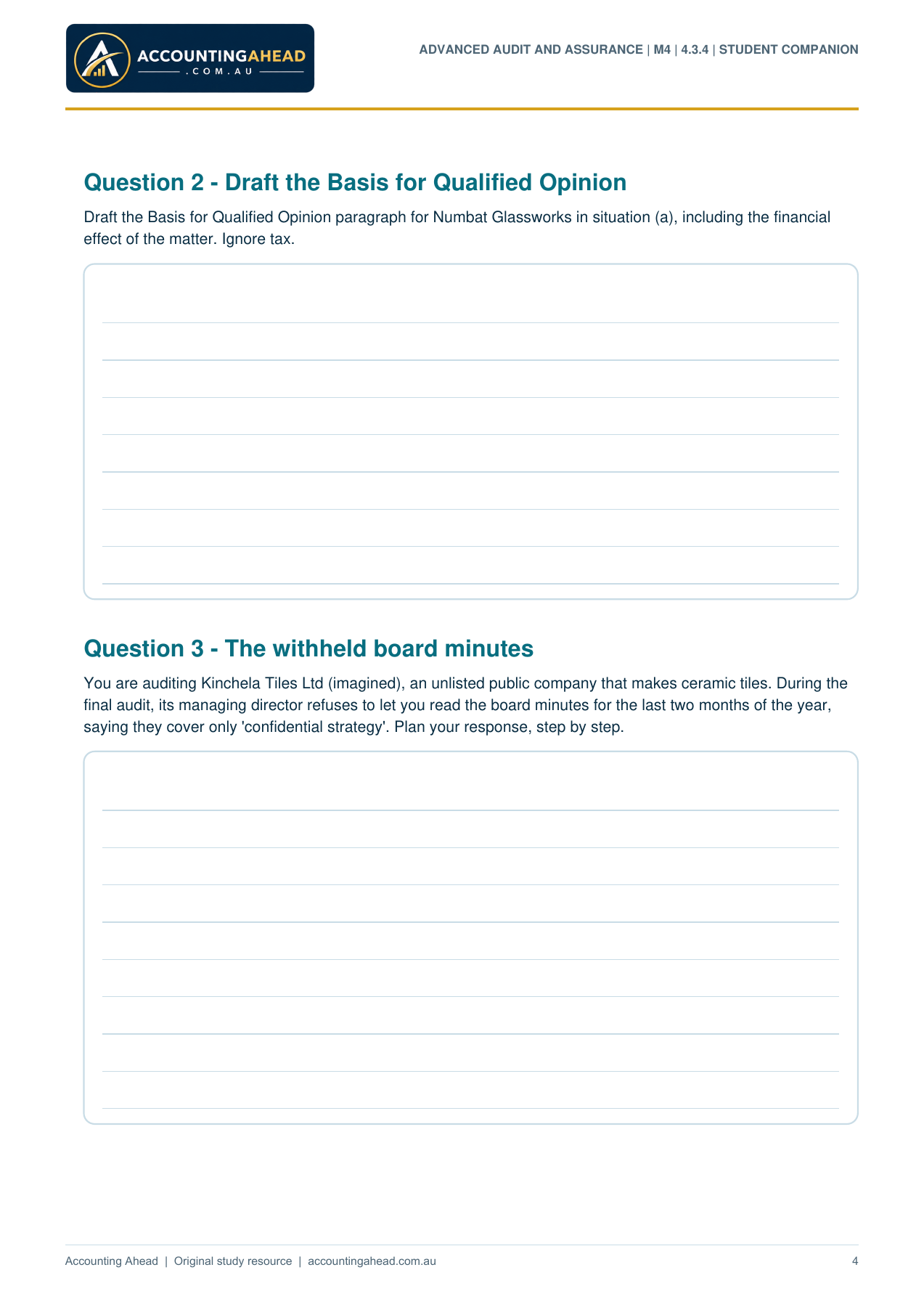
Question 2 - Draft the Basis for Qualified Opinion
Draft the Basis for Qualified Opinion paragraph for Numbat Glassworks in situation (a), including the financial
effect of the matter. Ignore tax.
Question 3 - The withheld board minutes
You are auditing Kinchela Tiles Ltd (imagined), an unlisted public company that makes ceramic tiles. During the
final audit, its managing director refuses to let you read the board minutes for the last two months of the year,
saying they cover only 'confidential strategy'. Plan your response, step by step.
ADVANCED AUDIT AND ASSURANCE | M4 | 4.3.4 | STUDENT COMPANION
4
Accounting Ahead | Original study resource | accountingahead.com.au
Worked answers
MODULE 4 | 4.3.4 | WORKED ANSWERS - ATTEMPT THE QUESTIONS FIRST
Question 1 - The opinions
Situation Opinion Why
(a) Numbat Glassworks Qualified ('except for the effects') A $2.8 million overstatement is material, but confined to
one asset and its expense: not pervasive
(b) Dollarbird
Recruitment
Adverse The misstatement runs through revenue, receivables,
liabilities, profit, equity and most notes: material and
pervasive
(c) Snowgum Lifts Qualified ('except for the possible
effects')
An inability to obtain evidence, material but confined to
one revenue stream: not pervasive
(d) Firetail Laundries Disclaimer Without the representations about the directors' own
responsibilities, the auditor must disclaim (ASA 580);
the evidence gap is pervasive
(e) Gidgee Data
Centres
Unmodified, with a Material
Uncertainty Related to Going
Concern section
The uncertainty is adequately disclosed, so the
statements aren't misstated
(f) Quokka Books Unmodified The misstatement is clearly below materiality with no
qualitative factor; it is still communicated and covered in
the representations
Question 2 - Numbat Glassworks: a sample paragraph
Basis for Qualified Opinion. Property, plant and equipment includes a furnace, idle since May 2026, carried at
$3.2 million (see the property, plant and equipment note). Its recoverable amount is $0.4 million, and AASB 136
Impairment of Assets requires it to be written down to that amount. Had it been written down, property, plant
and equipment and equity would each be $2.8 million lower, and an impairment expense of $2.8 million would
reduce profit before tax from $11.0 million to $8.2 million. [The standard statements follow: the audit was
conducted under the Australian Auditing Standards; independence; and the evidence is sufficient and
appropriate for our qualified opinion.]
The opinion paragraph then reads 'except for the effects of the matter described in the Basis for Qualified
Opinion section', followed by the usual true and fair wording.
Question 3 - Kinchela Tiles: the response
Ask why, and treat it as a warning sign. Minutes record decisions on borrowings, litigation, major contracts,
related party dealings and events after year end. Withholding two months of them could hide something
material, so raise your scepticism and reassess the risk of fraud.
Ask management to remove the restriction. It is a management-imposed limitation on the scope of the
audit, and officers must give the auditor access to the company's books, which include its minutes (s312).
ADVANCED AUDIT AND ASSURANCE | M4 | 4.3.4 | WORKED ANSWERS
5
Accounting Ahead | Original study resource | accountingahead.com.au
If refused, tell those charged with governance: the board, through its chair or the audit committee, and
ask them to give access.
Try alternative procedures: enquiries of the directors, including the non-executive directors; a review of
events and documents after year end, such as legal letters and new contracts; and written representations
about the matters discussed. These are unlikely to substitute fully for the minutes.
Decide the opinion. Possible effects material but not pervasive: qualify ('except for the possible effects').
Material and pervasive: withdraw where practicable and allowed by law, after explaining the matters to those
charged with governance; as Kinchela is a public company, resigning needs ASIC's consent (s329(5)). If you
can't withdraw, disclaim.
Consider integrity and fraud. Does the refusal cast doubt on management's integrity, and so on its
representations? An attempt to interfere with the audit must be notified to ASIC under s311, as soon as
practicable and within 28 days.
Communicate and document: tell those charged with governance in advance of any expected modification
and its wording, and record each step and your reasoning.
ADVANCED AUDIT AND ASSURANCE | M4 | 4.3.4 | WORKED ANSWERS
6