
Reporting to shareholders and regulators
Printable study notes, diagrams and practice support for Part 4.4.2.
Read the handout text
Accounting Ahead | Original study resource | accountingahead.com.au
Reporting to shareholders and regulators
MODULE 4 | 4.4.2 | STUDENT COMPANION
Under the Corporations Act the auditor forms opinions on the financial report, on the information and
explanations received and on the company's records, reporting on the information and the records only
by exception. At a listed company's annual general meeting, the auditor attends and answers members'
questions. And the auditor must notify ASIC in writing, as soon as practicable and within 28 days, when
there are reasonable grounds to suspect a significant contravention, a contravention that won't be
adequately dealt with otherwise, or an attempt to mislead or interfere with the audit.
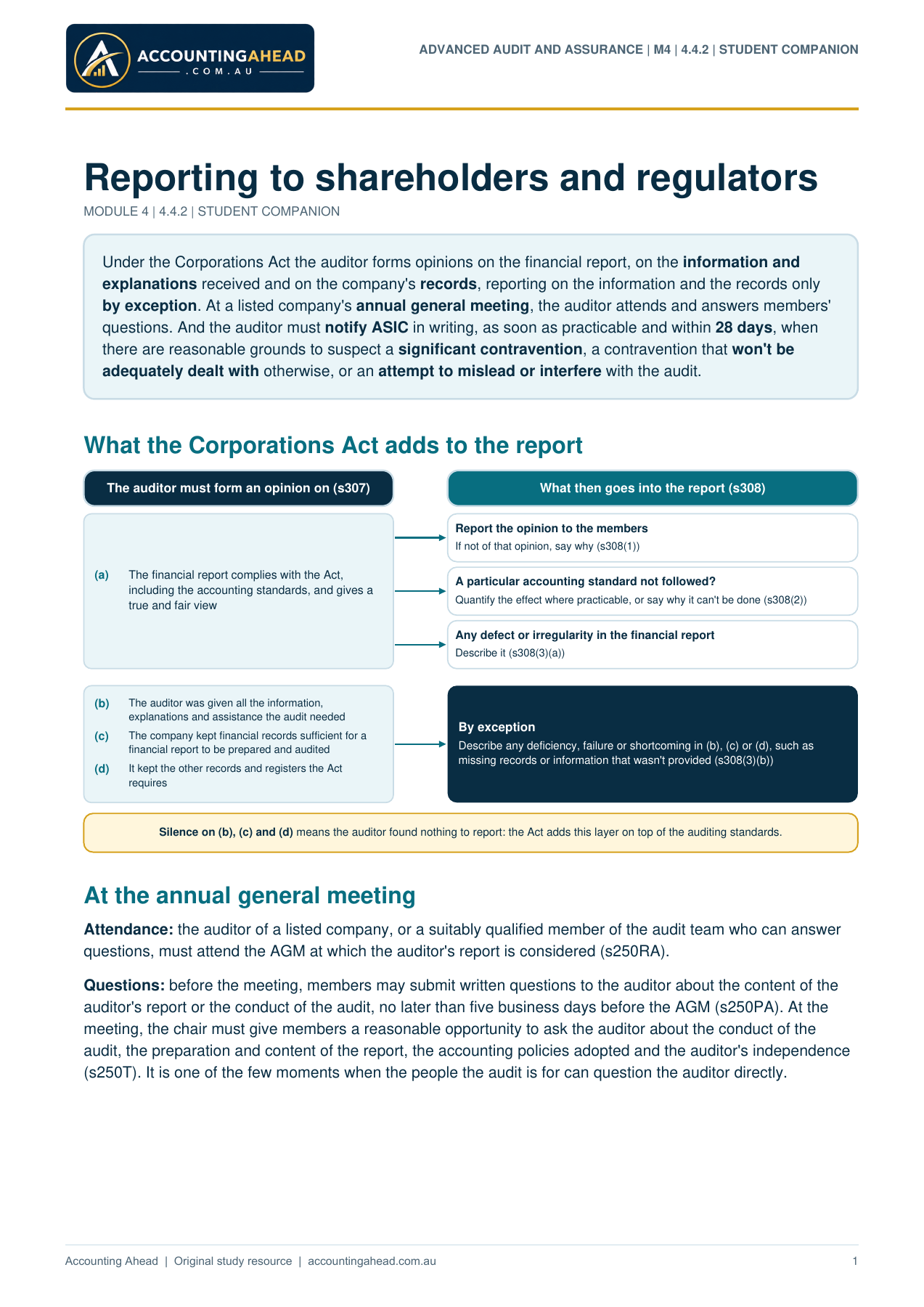
What the Corporations Act adds to the report
The auditor must form an opinion on (s307) What then goes into the report (s308)
(a) The financial report complies with the Act,
including the accounting standards, and gives a
true and fair view
Report the opinion to the members
If not of that opinion, say why (s308(1))
A particular accounting standard not followed?
Quantify the effect where practicable, or say why it can't be done (s308(2))
Any defect or irregularity in the financial report
Describe it (s308(3)(a))
(b) The auditor was given all the information,
explanations and assistance the audit needed
(c) The company kept financial records sufficient for a
financial report to be prepared and audited
(d) It kept the other records and registers the Act
requires
By exception
Describe any deficiency, failure or shortcoming in (b), (c) or (d), such as
missing records or information that wasn't provided (s308(3)(b))
Silence on (b), (c) and (d) means the auditor found nothing to report: the Act adds this layer on top of the auditing standards.
At the annual general meeting
Attendance: the auditor of a listed company, or a suitably qualified member of the audit team who can answer
questions, must attend the AGM at which the auditor's report is considered (s250RA).
Questions: before the meeting, members may submit written questions to the auditor about the content of the
auditor's report or the conduct of the audit, no later than five business days before the AGM (s250PA). At the
meeting, the chair must give members a reasonable opportunity to ask the auditor about the conduct of the
audit, the preparation and content of the report, the accounting policies adopted and the auditor's independence
(s250T). It is one of the few moments when the people the audit is for can question the auditor directly.
ADVANCED AUDIT AND ASSURANCE | M4 | 4.4.2 | STUDENT COMPANION
1
Accounting Ahead | Original study resource | accountingahead.com.au
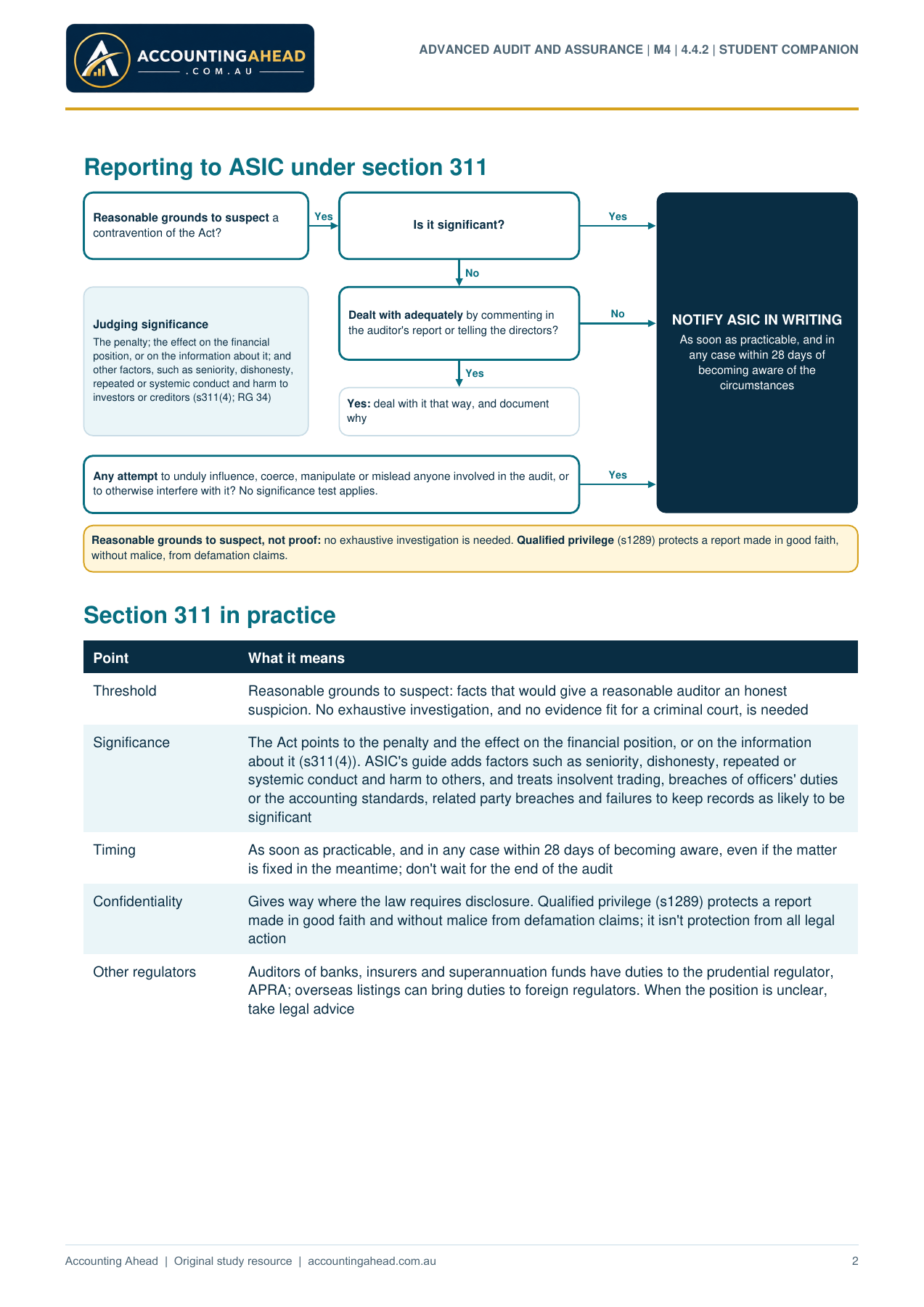
Reporting to ASIC under section 311
Reasonable grounds to suspect a
contravention of the Act? Is it significant?Yes
Dealt with adequately by commenting in
the auditor's report or telling the directors?
No
Yes: deal with it that way, and document
why
Yes
Judging significance
The penalty; the effect on the financial
position, or on the information about it; and
other factors, such as seniority, dishonesty,
repeated or systemic conduct and harm to
investors or creditors (s311(4); RG 34)
Any attempt to unduly influence, coerce, manipulate or mislead anyone involved in the audit, or
to otherwise interfere with it? No significance test applies.
NOTIFY ASIC IN WRITING
As soon as practicable, and in
any case within 28 days of
becoming aware of the
circumstances
Yes
No
Yes
Reasonable grounds to suspect, not proof: no exhaustive investigation is needed. Qualified privilege (s1289) protects a report made in good faith,
without malice, from defamation claims.
Section 311 in practice
Point What it means
Threshold Reasonable grounds to suspect: facts that would give a reasonable auditor an honest
suspicion. No exhaustive investigation, and no evidence fit for a criminal court, is needed
Significance The Act points to the penalty and the effect on the financial position, or on the information
about it (s311(4)). ASIC's guide adds factors such as seniority, dishonesty, repeated or
systemic conduct and harm to others, and treats insolvent trading, breaches of officers' duties
or the accounting standards, related party breaches and failures to keep records as likely to be
significant
Timing As soon as practicable, and in any case within 28 days of becoming aware, even if the matter
is fixed in the meantime; don't wait for the end of the audit
Confidentiality Gives way where the law requires disclosure. Qualified privilege (s1289) protects a report
made in good faith and without malice from defamation claims; it isn't protection from all legal
action
Other regulators Auditors of banks, insurers and superannuation funds have duties to the prudential regulator,
APRA; overseas listings can bring duties to foreign regulators. When the position is unclear,
take legal advice
ADVANCED AUDIT AND ASSURANCE | M4 | 4.4.2 | STUDENT COMPANION
2
Accounting Ahead | Original study resource | accountingahead.com.au
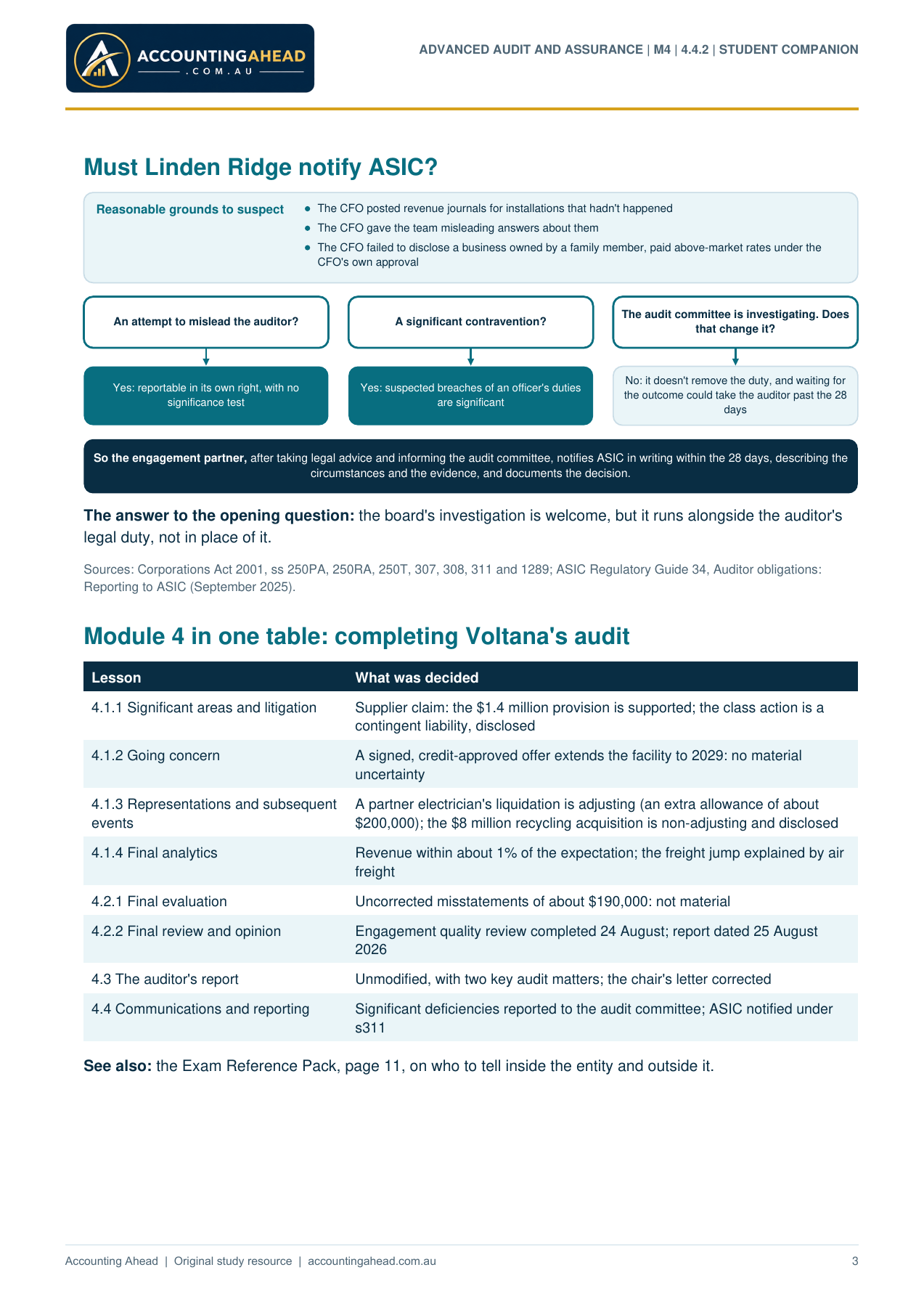
Must Linden Ridge notify ASIC?
Reasonable grounds to suspect The CFO posted revenue journals for installations that hadn't happened
The CFO gave the team misleading answers about them
The CFO failed to disclose a business owned by a family member, paid above-market rates under the
CFO's own approval
An attempt to mislead the auditor?
Yes: reportable in its own right, with no
significance test
A significant contravention?
Yes: suspected breaches of an officer's duties
are significant
The audit committee is investigating. Does
that change it?
No: it doesn't remove the duty, and waiting for
the outcome could take the auditor past the 28
days
So the engagement partner, after taking legal advice and informing the audit committee, notifies ASIC in writing within the 28 days, describing the
circumstances and the evidence, and documents the decision.
The answer to the opening question: the board's investigation is welcome, but it runs alongside the auditor's
legal duty, not in place of it.
Sources: Corporations Act 2001, ss 250PA, 250RA, 250T, 307, 308, 311 and 1289; ASIC Regulatory Guide 34, Auditor obligations:
Reporting to ASIC (September 2025).
Module 4 in one table: completing Voltana's audit
Lesson What was decided
4.1.1 Significant areas and litigation Supplier claim: the $1.4 million provision is supported; the class action is a
contingent liability, disclosed
4.1.2 Going concern A signed, credit-approved offer extends the facility to 2029: no material
uncertainty
4.1.3 Representations and subsequent
events
A partner electrician's liquidation is adjusting (an extra allowance of about
$200,000); the $8 million recycling acquisition is non-adjusting and disclosed
4.1.4 Final analytics Revenue within about 1% of the expectation; the freight jump explained by air
freight
4.2.1 Final evaluation Uncorrected misstatements of about $190,000: not material
4.2.2 Final review and opinion Engagement quality review completed 24 August; report dated 25 August
2026
4.3 The auditor's report Unmodified, with two key audit matters; the chair's letter corrected
4.4 Communications and reporting Significant deficiencies reported to the audit committee; ASIC notified under
s311
See also: the Exam Reference Pack, page 11, on who to tell inside the entity and outside it.
ADVANCED AUDIT AND ASSURANCE | M4 | 4.4.2 | STUDENT COMPANION
3
Accounting Ahead | Original study resource | accountingahead.com.au
Practice questions
MODULE 4 | 4.4.2 | TRY THESE BEFORE THE WORKED ANSWERS
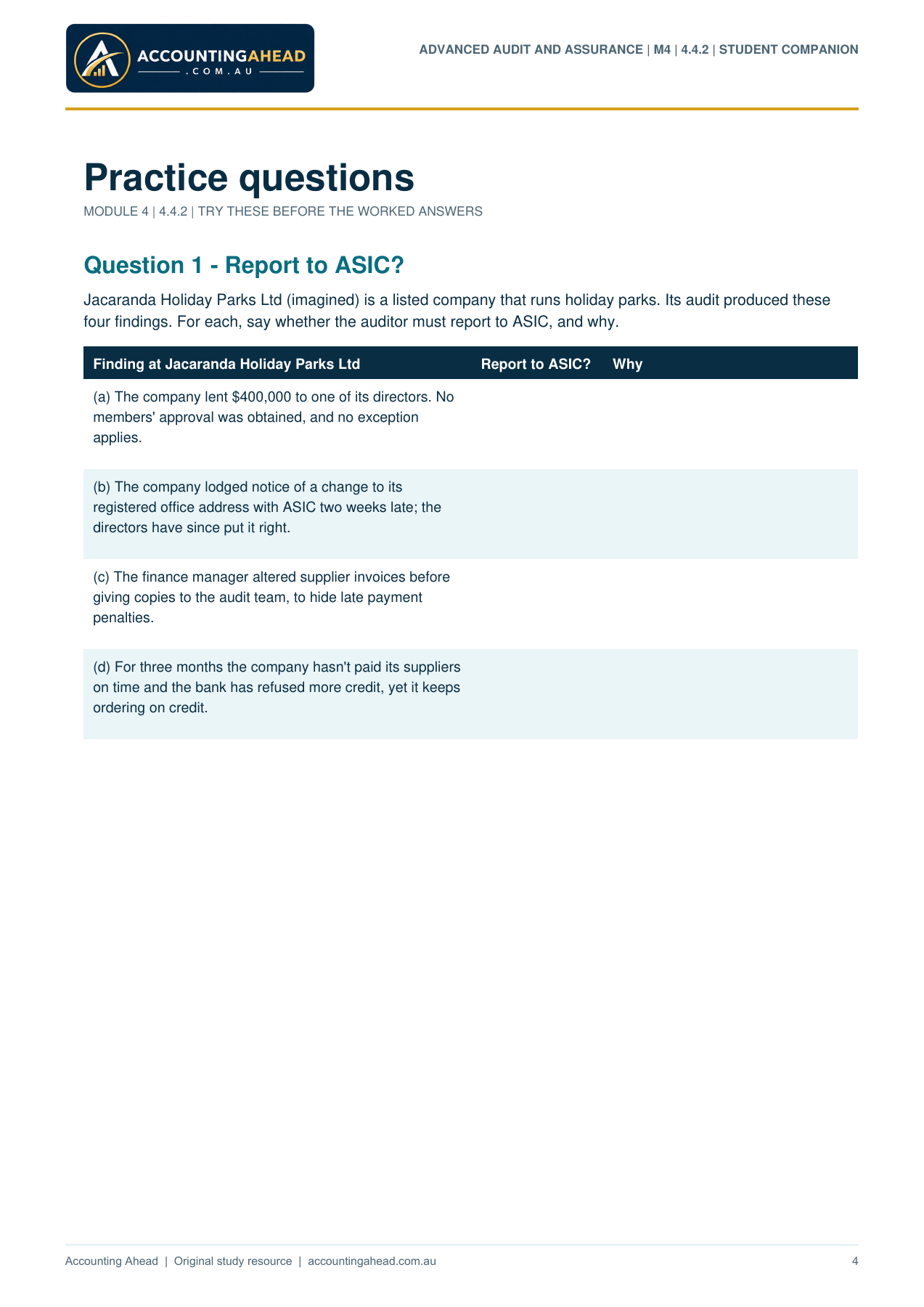
Question 1 - Report to ASIC?
Jacaranda Holiday Parks Ltd (imagined) is a listed company that runs holiday parks. Its audit produced these
four findings. For each, say whether the auditor must report to ASIC, and why.
Finding at Jacaranda Holiday Parks Ltd Report to ASIC? Why
(a) The company lent $400,000 to one of its directors. No
members' approval was obtained, and no exception
applies.
(b) The company lodged notice of a change to its
registered office address with ASIC two weeks late; the
directors have since put it right.
(c) The finance manager altered supplier invoices before
giving copies to the audit team, to hide late payment
penalties.
(d) For three months the company hasn't paid its suppliers
on time and the bank has refused more credit, yet it keeps
ordering on credit.
ADVANCED AUDIT AND ASSURANCE | M4 | 4.4.2 | STUDENT COMPANION
4
Accounting Ahead | Original study resource | accountingahead.com.au
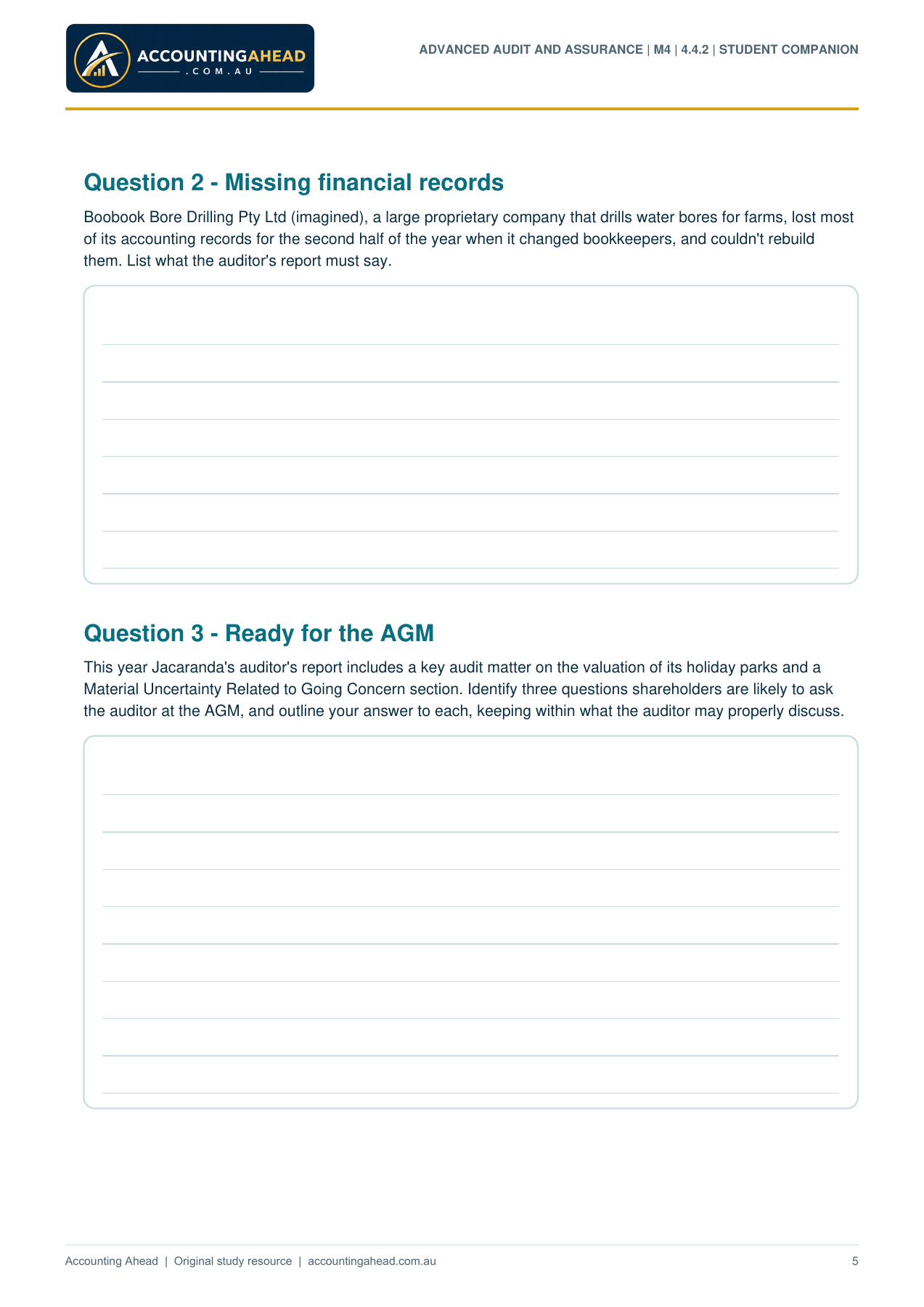
Question 2 - Missing financial records
Boobook Bore Drilling Pty Ltd (imagined), a large proprietary company that drills water bores for farms, lost most
of its accounting records for the second half of the year when it changed bookkeepers, and couldn't rebuild
them. List what the auditor's report must say.
Question 3 - Ready for the AGM
This year Jacaranda's auditor's report includes a key audit matter on the valuation of its holiday parks and a
Material Uncertainty Related to Going Concern section. Identify three questions shareholders are likely to ask
the auditor at the AGM, and outline your answer to each, keeping within what the auditor may properly discuss.
ADVANCED AUDIT AND ASSURANCE | M4 | 4.4.2 | STUDENT COMPANION
5
Accounting Ahead | Original study resource | accountingahead.com.au
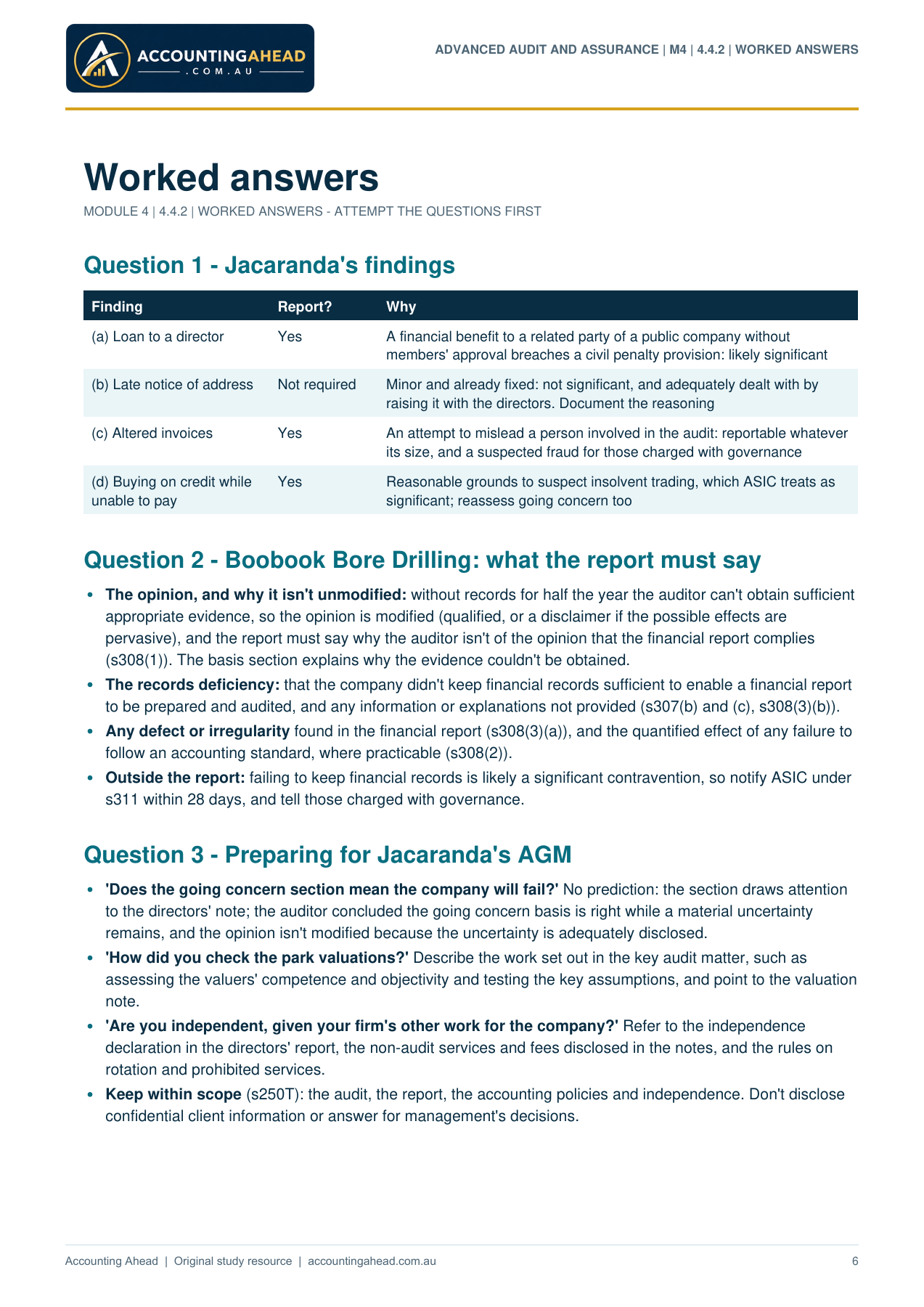
Worked answers
MODULE 4 | 4.4.2 | WORKED ANSWERS - ATTEMPT THE QUESTIONS FIRST
Question 1 - Jacaranda's findings
Finding Report? Why
(a) Loan to a director Yes A financial benefit to a related party of a public company without
members' approval breaches a civil penalty provision: likely significant
(b) Late notice of address Not required Minor and already fixed: not significant, and adequately dealt with by
raising it with the directors. Document the reasoning
(c) Altered invoices Yes An attempt to mislead a person involved in the audit: reportable whatever
its size, and a suspected fraud for those charged with governance
(d) Buying on credit while
unable to pay
Yes Reasonable grounds to suspect insolvent trading, which ASIC treats as
significant; reassess going concern too
Question 2 - Boobook Bore Drilling: what the report must say
The opinion, and why it isn't unmodified: without records for half the year the auditor can't obtain sufficient
appropriate evidence, so the opinion is modified (qualified, or a disclaimer if the possible effects are
pervasive), and the report must say why the auditor isn't of the opinion that the financial report complies
(s308(1)). The basis section explains why the evidence couldn't be obtained.
The records deficiency: that the company didn't keep financial records sufficient to enable a financial report
to be prepared and audited, and any information or explanations not provided (s307(b) and (c), s308(3)(b)).
Any defect or irregularity found in the financial report (s308(3)(a)), and the quantified effect of any failure to
follow an accounting standard, where practicable (s308(2)).
Outside the report: failing to keep financial records is likely a significant contravention, so notify ASIC under
s311 within 28 days, and tell those charged with governance.
Question 3 - Preparing for Jacaranda's AGM
'Does the going concern section mean the company will fail?' No prediction: the section draws attention
to the directors' note; the auditor concluded the going concern basis is right while a material uncertainty
remains, and the opinion isn't modified because the uncertainty is adequately disclosed.
'How did you check the park valuations?' Describe the work set out in the key audit matter, such as
assessing the valuers' competence and objectivity and testing the key assumptions, and point to the valuation
note.
'Are you independent, given your firm's other work for the company?' Refer to the independence
declaration in the directors' report, the non-audit services and fees disclosed in the notes, and the rules on
rotation and prohibited services.
Keep within scope (s250T): the audit, the report, the accounting policies and independence. Don't disclose
confidential client information or answer for management's decisions.
ADVANCED AUDIT AND ASSURANCE | M4 | 4.4.2 | WORKED ANSWERS
6