
The overarching assurance standard
Printable study notes, diagrams and practice support for Part 5.3.1.
Read the handout text
Accounting Ahead | Original study resource | accountingahead.com.au
The overarching assurance standard
MODULE 5 | 5.3.1 | STUDENT COMPANION
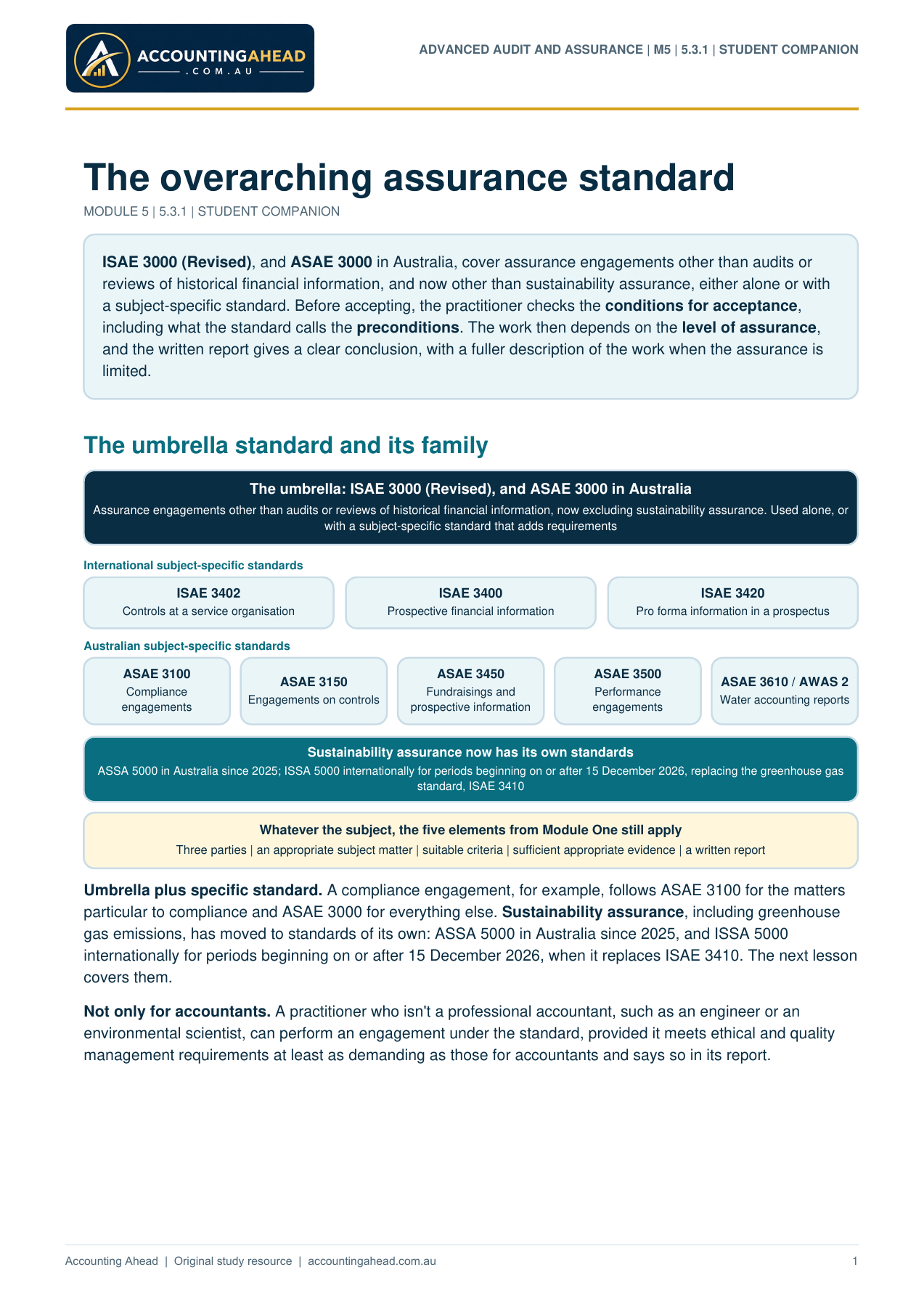
ISAE 3000 (Revised), and ASAE 3000 in Australia, cover assurance engagements other than audits or
reviews of historical financial information, and now other than sustainability assurance, either alone or with
a subject-specific standard. Before accepting, the practitioner checks the conditions for acceptance,
including what the standard calls the preconditions. The work then depends on the level of assurance,
and the written report gives a clear conclusion, with a fuller description of the work when the assurance is
limited.
The umbrella standard and its family
The umbrella: ISAE 3000 (Revised), and ASAE 3000 in Australia
Assurance engagements other than audits or reviews of historical financial information, now excluding sustainability assurance. Used alone, or
with a subject-specific standard that adds requirements
International subject-specific standards
ISAE 3402
Controls at a service organisation
ISAE 3400
Prospective financial information
ISAE 3420
Pro forma information in a prospectus
Australian subject-specific standards
ASAE 3100
Compliance
engagements
ASAE 3150
Engagements on controls
ASAE 3450
Fundraisings and
prospective information
ASAE 3500
Performance
engagements
ASAE 3610 / AWAS 2
Water accounting reports
Sustainability assurance now has its own standards
ASSA 5000 in Australia since 2025; ISSA 5000 internationally for periods beginning on or after 15 December 2026, replacing the greenhouse gas
standard, ISAE 3410
Whatever the subject, the five elements from Module One still apply
Three parties | an appropriate subject matter | suitable criteria | sufficient appropriate evidence | a written report
Umbrella plus specific standard. A compliance engagement, for example, follows ASAE 3100 for the matters
particular to compliance and ASAE 3000 for everything else. Sustainability assurance, including greenhouse
gas emissions, has moved to standards of its own: ASSA 5000 in Australia since 2025, and ISSA 5000
internationally for periods beginning on or after 15 December 2026, when it replaces ISAE 3410. The next lesson
covers them.
Not only for accountants. A practitioner who isn't a professional accountant, such as an engineer or an
environmental scientist, can perform an engagement under the standard, provided it meets ethical and quality
management requirements at least as demanding as those for accountants and says so in its report.
ADVANCED AUDIT AND ASSURANCE | M5 | 5.3.1 | STUDENT COMPANION
1
Accounting Ahead | Original study resource | accountingahead.com.au
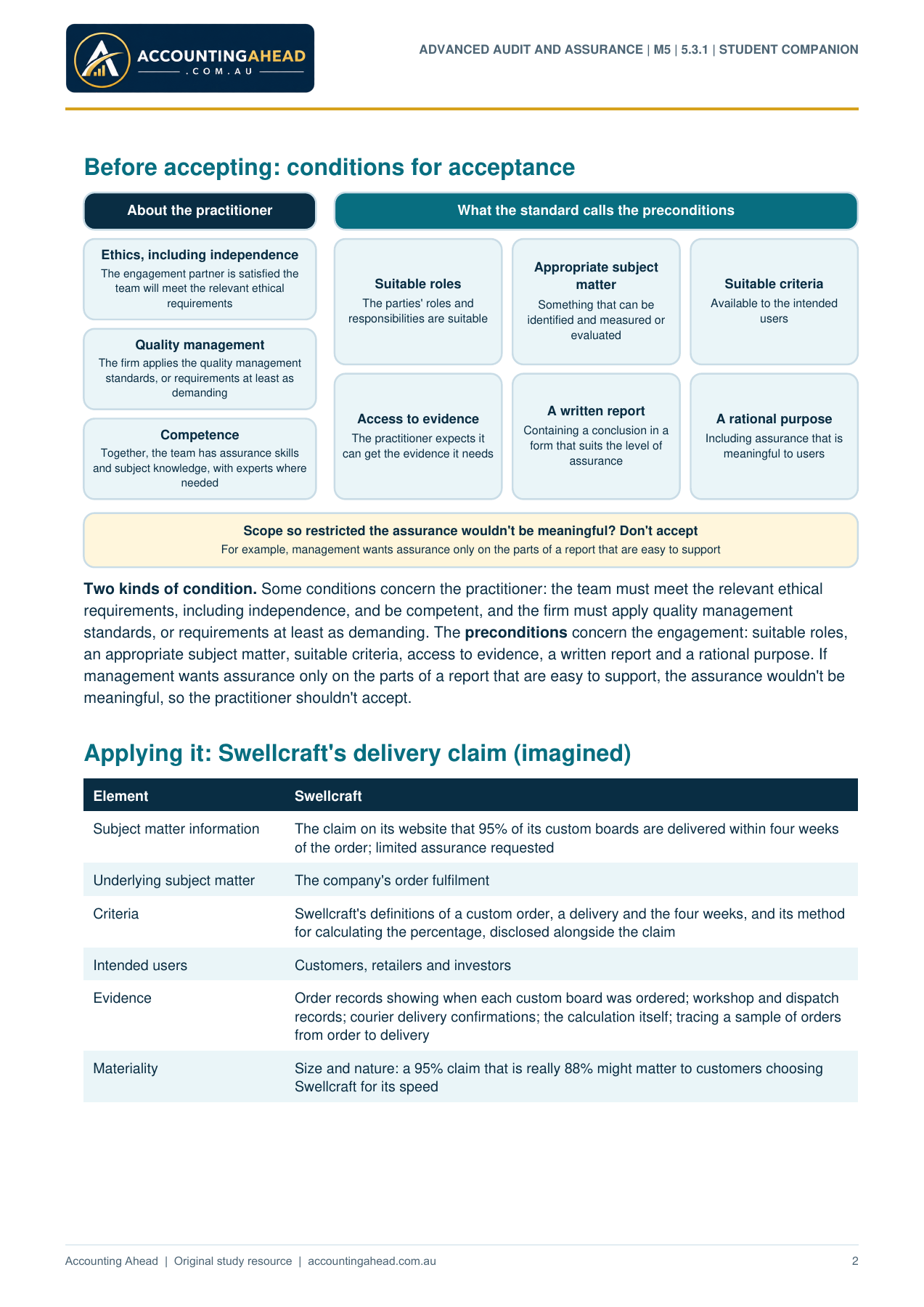
Before accepting: conditions for acceptance
About the practitioner
Ethics, including independence
The engagement partner is satisfied the
team will meet the relevant ethical
requirements
Quality management
The firm applies the quality management
standards, or requirements at least as
demanding
Competence
Together, the team has assurance skills
and subject knowledge, with experts where
needed
What the standard calls the preconditions
Suitable roles
The parties' roles and
responsibilities are suitable
Appropriate subject
matter
Something that can be
identified and measured or
evaluated
Suitable criteria
Available to the intended
users
Access to evidence
The practitioner expects it
can get the evidence it needs
A written report
Containing a conclusion in a
form that suits the level of
assurance
A rational purpose
Including assurance that is
meaningful to users
Scope so restricted the assurance wouldn't be meaningful? Don't accept
For example, management wants assurance only on the parts of a report that are easy to support
Two kinds of condition. Some conditions concern the practitioner: the team must meet the relevant ethical
requirements, including independence, and be competent, and the firm must apply quality management
standards, or requirements at least as demanding. The preconditions concern the engagement: suitable roles,
an appropriate subject matter, suitable criteria, access to evidence, a written report and a rational purpose. If
management wants assurance only on the parts of a report that are easy to support, the assurance wouldn't be
meaningful, so the practitioner shouldn't accept.
Applying it: Swellcraft's delivery claim (imagined)
Element Swellcraft
Subject matter information The claim on its website that 95% of its custom boards are delivered within four weeks
of the order; limited assurance requested
Underlying subject matter The company's order fulfilment
Criteria Swellcraft's definitions of a custom order, a delivery and the four weeks, and its method
for calculating the percentage, disclosed alongside the claim
Intended users Customers, retailers and investors
Evidence Order records showing when each custom board was ordered; workshop and dispatch
records; courier delivery confirmations; the calculation itself; tracing a sample of orders
from order to delivery
Materiality Size and nature: a 95% claim that is really 88% might matter to customers choosing
Swellcraft for its speed
ADVANCED AUDIT AND ASSURANCE | M5 | 5.3.1 | STUDENT COMPANION
2
Accounting Ahead | Original study resource | accountingahead.com.au
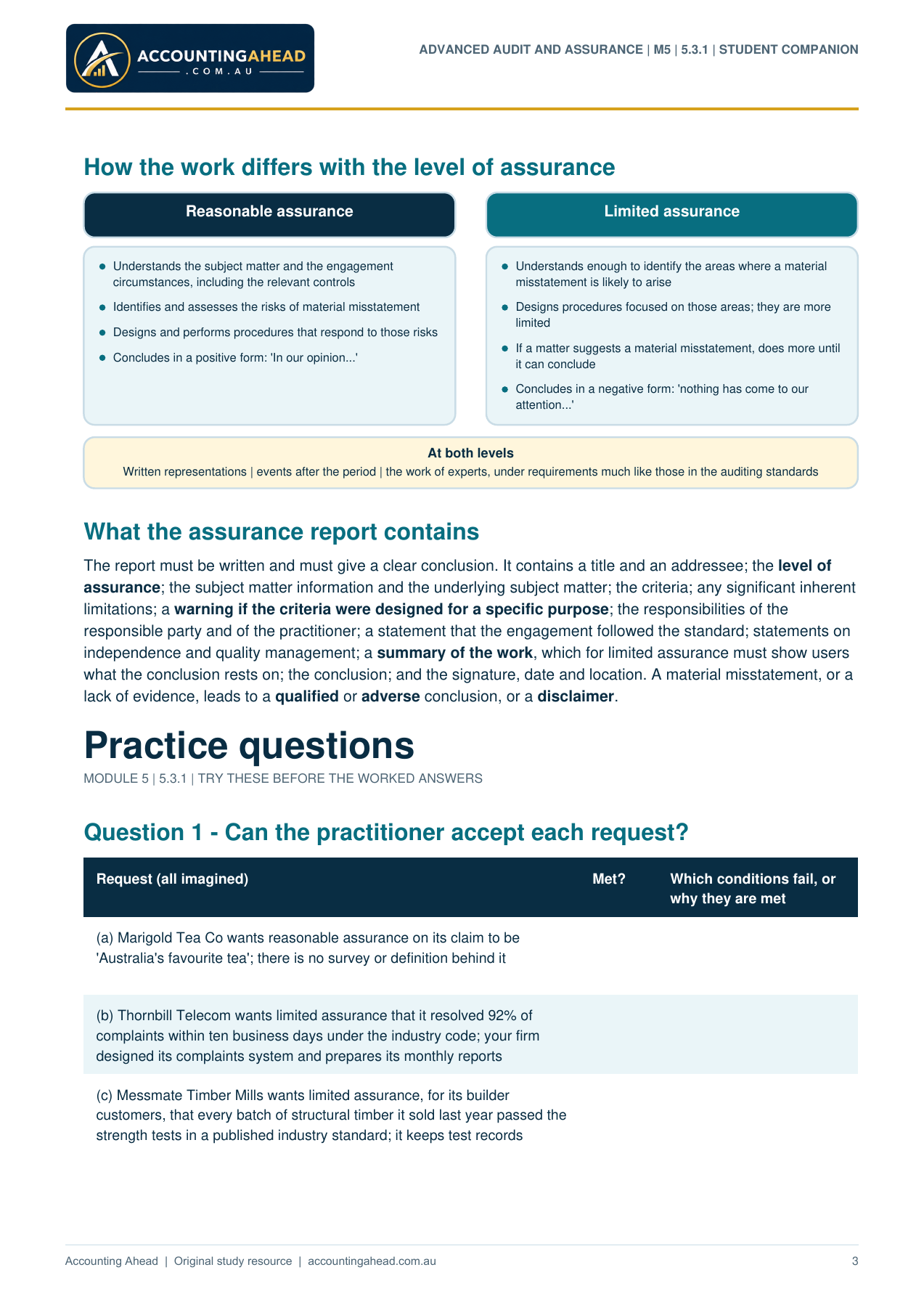
How the work differs with the level of assurance
Reasonable assurance
Understands the subject matter and the engagement
circumstances, including the relevant controls
Identifies and assesses the risks of material misstatement
Designs and performs procedures that respond to those risks
Concludes in a positive form: 'In our opinion...'
Limited assurance
Understands enough to identify the areas where a material
misstatement is likely to arise
Designs procedures focused on those areas; they are more
limited
If a matter suggests a material misstatement, does more until
it can conclude
Concludes in a negative form: 'nothing has come to our
attention...'
At both levels
Written representations | events after the period | the work of experts, under requirements much like those in the auditing standards
What the assurance report contains
The report must be written and must give a clear conclusion. It contains a title and an addressee; the level of
assurance; the subject matter information and the underlying subject matter; the criteria; any significant inherent
limitations; a warning if the criteria were designed for a specific purpose; the responsibilities of the
responsible party and of the practitioner; a statement that the engagement followed the standard; statements on
independence and quality management; a summary of the work, which for limited assurance must show users
what the conclusion rests on; the conclusion; and the signature, date and location. A material misstatement, or a
lack of evidence, leads to a qualified or adverse conclusion, or a disclaimer.
Practice questions
MODULE 5 | 5.3.1 | TRY THESE BEFORE THE WORKED ANSWERS
Question 1 - Can the practitioner accept each request?
Request (all imagined) Met? Which conditions fail, or
why they are met
(a) Marigold Tea Co wants reasonable assurance on its claim to be
'Australia's favourite tea'; there is no survey or definition behind it
(b) Thornbill Telecom wants limited assurance that it resolved 92% of
complaints within ten business days under the industry code; your firm
designed its complaints system and prepares its monthly reports
(c) Messmate Timber Mills wants limited assurance, for its builder
customers, that every batch of structural timber it sold last year passed the
strength tests in a published industry standard; it keeps test records
ADVANCED AUDIT AND ASSURANCE | M5 | 5.3.1 | STUDENT COMPANION
3
Accounting Ahead | Original study resource | accountingahead.com.au
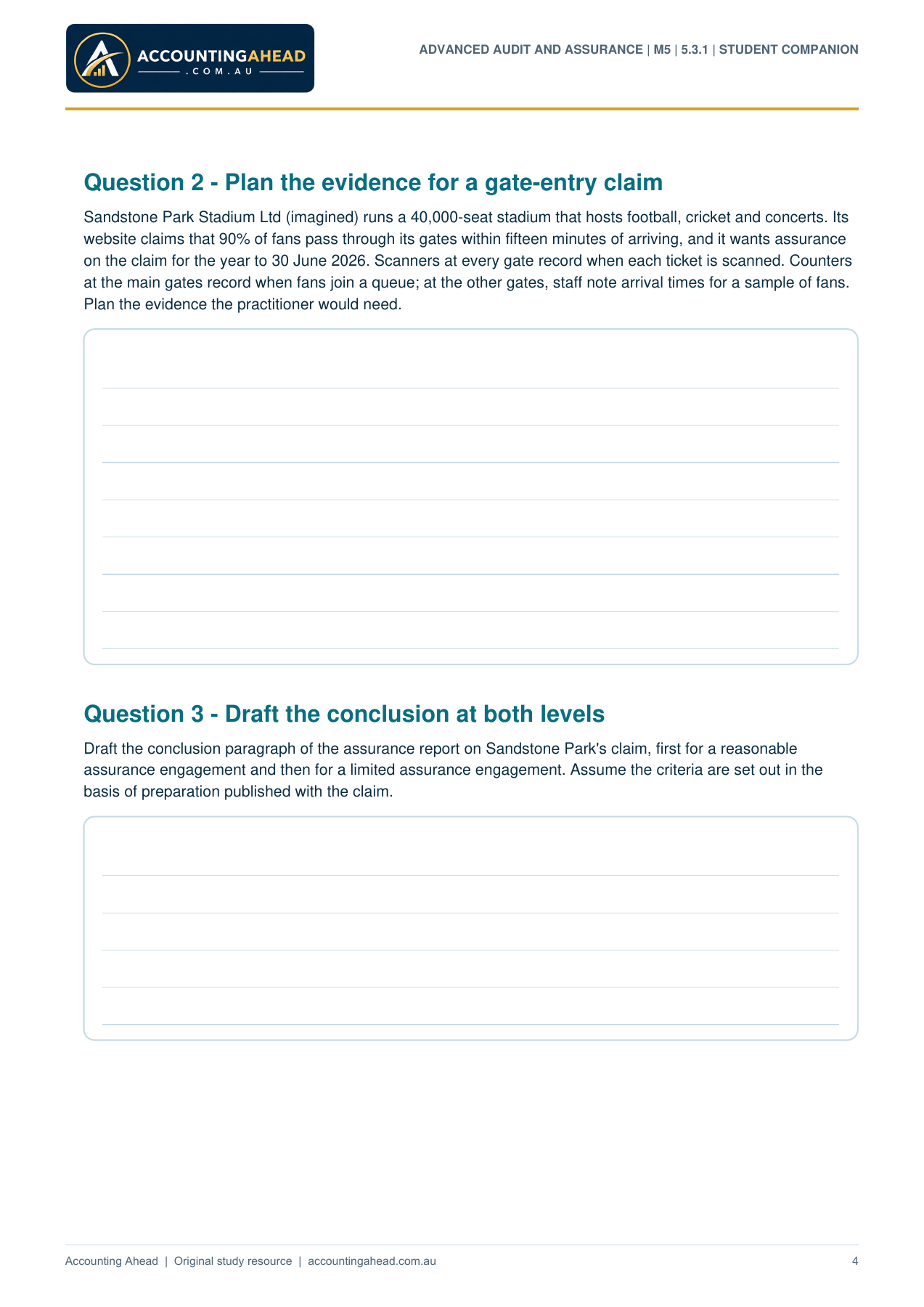
Question 2 - Plan the evidence for a gate-entry claim
Sandstone Park Stadium Ltd (imagined) runs a 40,000-seat stadium that hosts football, cricket and concerts. Its
website claims that 90% of fans pass through its gates within fifteen minutes of arriving, and it wants assurance
on the claim for the year to 30 June 2026. Scanners at every gate record when each ticket is scanned. Counters
at the main gates record when fans join a queue; at the other gates, staff note arrival times for a sample of fans.
Plan the evidence the practitioner would need.
Question 3 - Draft the conclusion at both levels
Draft the conclusion paragraph of the assurance report on Sandstone Park's claim, first for a reasonable
assurance engagement and then for a limited assurance engagement. Assume the criteria are set out in the
basis of preparation published with the claim.
ADVANCED AUDIT AND ASSURANCE | M5 | 5.3.1 | STUDENT COMPANION
4
Accounting Ahead | Original study resource | accountingahead.com.au
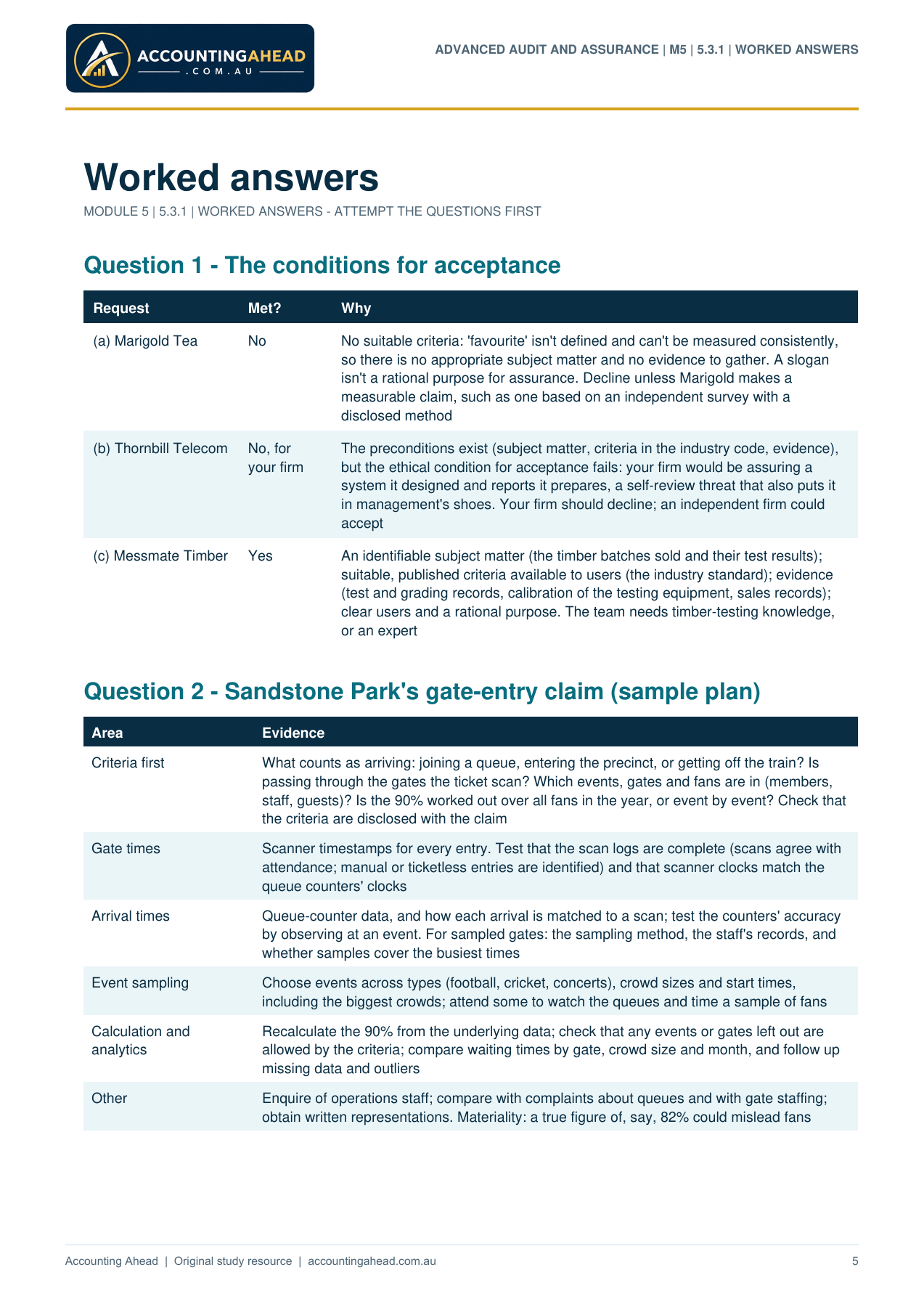
Worked answers
MODULE 5 | 5.3.1 | WORKED ANSWERS - ATTEMPT THE QUESTIONS FIRST
Question 1 - The conditions for acceptance
Request Met? Why
(a) Marigold Tea No No suitable criteria: 'favourite' isn't defined and can't be measured consistently,
so there is no appropriate subject matter and no evidence to gather. A slogan
isn't a rational purpose for assurance. Decline unless Marigold makes a
measurable claim, such as one based on an independent survey with a
disclosed method
(b) Thornbill Telecom No, for
your firm
The preconditions exist (subject matter, criteria in the industry code, evidence),
but the ethical condition for acceptance fails: your firm would be assuring a
system it designed and reports it prepares, a self-review threat that also puts it
in management's shoes. Your firm should decline; an independent firm could
accept
(c) Messmate Timber Yes An identifiable subject matter (the timber batches sold and their test results);
suitable, published criteria available to users (the industry standard); evidence
(test and grading records, calibration of the testing equipment, sales records);
clear users and a rational purpose. The team needs timber-testing knowledge,
or an expert
Question 2 - Sandstone Park's gate-entry claim (sample plan)
Area Evidence
Criteria first What counts as arriving: joining a queue, entering the precinct, or getting off the train? Is
passing through the gates the ticket scan? Which events, gates and fans are in (members,
staff, guests)? Is the 90% worked out over all fans in the year, or event by event? Check that
the criteria are disclosed with the claim
Gate times Scanner timestamps for every entry. Test that the scan logs are complete (scans agree with
attendance; manual or ticketless entries are identified) and that scanner clocks match the
queue counters' clocks
Arrival times Queue-counter data, and how each arrival is matched to a scan; test the counters' accuracy
by observing at an event. For sampled gates: the sampling method, the staff's records, and
whether samples cover the busiest times
Event sampling Choose events across types (football, cricket, concerts), crowd sizes and start times,
including the biggest crowds; attend some to watch the queues and time a sample of fans
Calculation and
analytics
Recalculate the 90% from the underlying data; check that any events or gates left out are
allowed by the criteria; compare waiting times by gate, crowd size and month, and follow up
missing data and outliers
Other Enquire of operations staff; compare with complaints about queues and with gate staffing;
obtain written representations. Materiality: a true figure of, say, 82% could mislead fans
ADVANCED AUDIT AND ASSURANCE | M5 | 5.3.1 | WORKED ANSWERS
5
Accounting Ahead | Original study resource | accountingahead.com.au
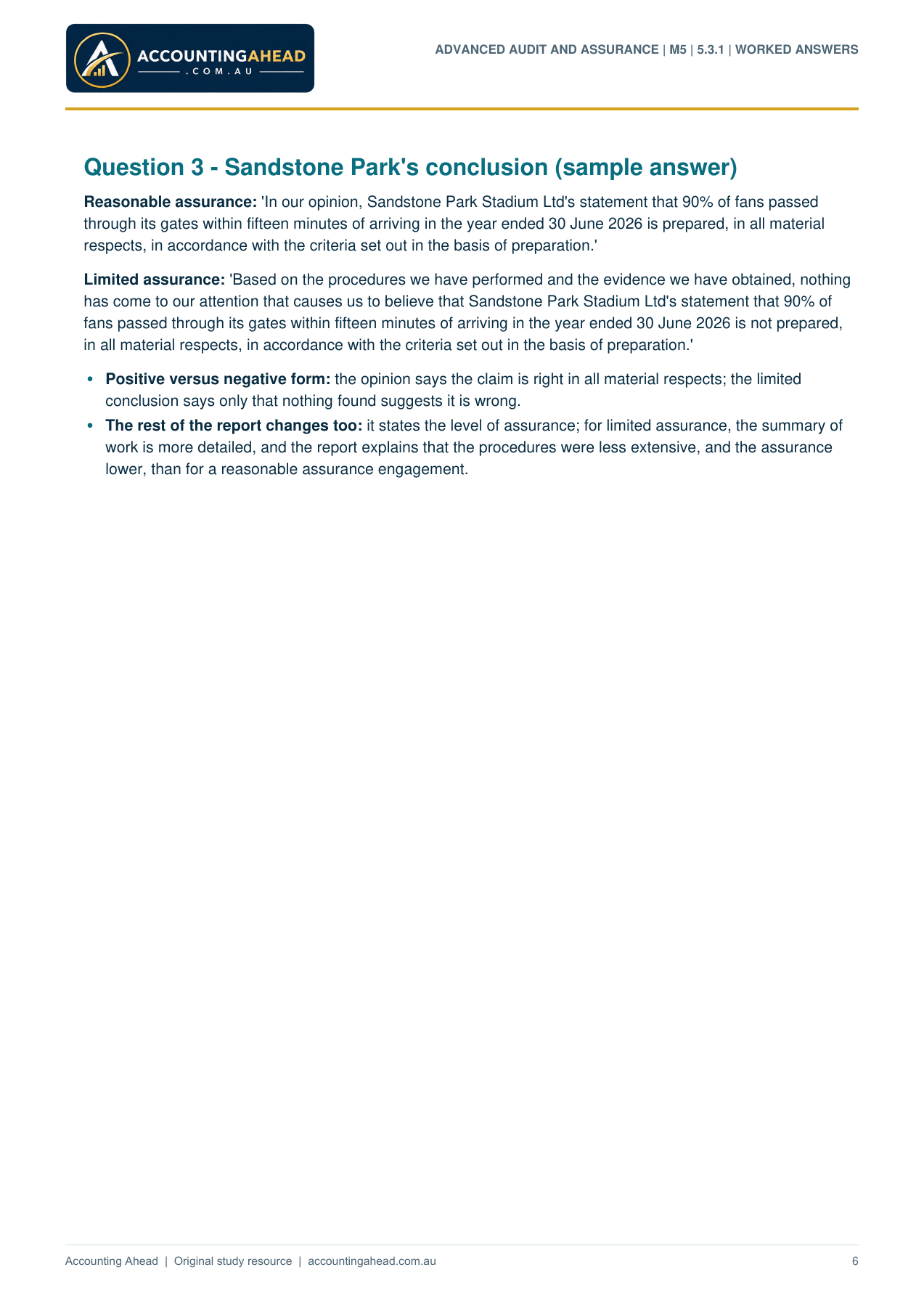
Question 3 - Sandstone Park's conclusion (sample answer)
Reasonable assurance: 'In our opinion, Sandstone Park Stadium Ltd's statement that 90% of fans passed
through its gates within fifteen minutes of arriving in the year ended 30 June 2026 is prepared, in all material
respects, in accordance with the criteria set out in the basis of preparation.'
Limited assurance: 'Based on the procedures we have performed and the evidence we have obtained, nothing
has come to our attention that causes us to believe that Sandstone Park Stadium Ltd's statement that 90% of
fans passed through its gates within fifteen minutes of arriving in the year ended 30 June 2026 is not prepared,
in all material respects, in accordance with the criteria set out in the basis of preparation.'
Positive versus negative form: the opinion says the claim is right in all material respects; the limited
conclusion says only that nothing found suggests it is wrong.
The rest of the report changes too: it states the level of assurance; for limited assurance, the summary of
work is more detailed, and the report explains that the procedures were less extensive, and the assurance
lower, than for a reasonable assurance engagement.
ADVANCED AUDIT AND ASSURANCE | M5 | 5.3.1 | WORKED ANSWERS
6