
Greenhouse gas and sustainability assurance
Printable study notes, diagrams and practice support for Part 5.3.2.
Read the handout text
Accounting Ahead | Original study resource | accountingahead.com.au
Greenhouse gas and sustainability
assurance
MODULE 5 | 5.3.2 | STUDENT COMPANION
Emissions are reported in three scopes. The figures go wrong in predictable ways, and practitioners
respond with site visits, agreement to source data, checks on factors, recalculation and analytics.
Sustainability reports are wider and harder to assure, and most assurance today is limited. ISSA 5000 (in
Australia, ASSA 5000) covers any sustainability topic at either level, for any practitioner who meets
equivalent ethical and quality requirements.
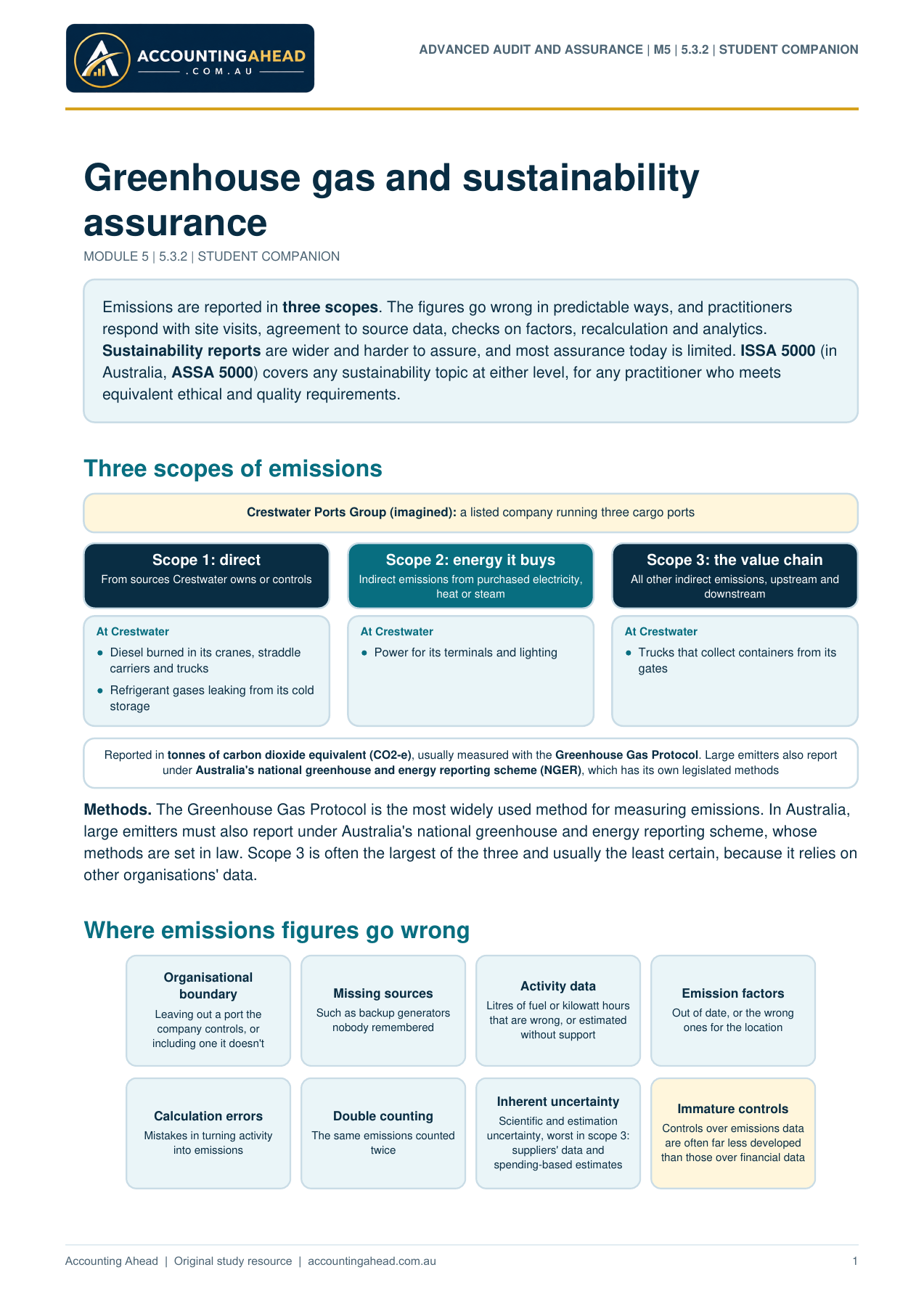
Three scopes of emissions
Crestwater Ports Group (imagined): a listed company running three cargo ports
Scope 1: direct
From sources Crestwater owns or controls
At Crestwater
Diesel burned in its cranes, straddle
carriers and trucks
Refrigerant gases leaking from its cold
storage
Scope 2: energy it buys
Indirect emissions from purchased electricity,
heat or steam
At Crestwater
Power for its terminals and lighting
Scope 3: the value chain
All other indirect emissions, upstream and
downstream
At Crestwater
Trucks that collect containers from its
gates
Reported in tonnes of carbon dioxide equivalent (CO2-e), usually measured with the Greenhouse Gas Protocol. Large emitters also report
under Australia's national greenhouse and energy reporting scheme (NGER), which has its own legislated methods
Methods. The Greenhouse Gas Protocol is the most widely used method for measuring emissions. In Australia,
large emitters must also report under Australia's national greenhouse and energy reporting scheme, whose
methods are set in law. Scope 3 is often the largest of the three and usually the least certain, because it relies on
other organisations' data.
Where emissions figures go wrong
Organisational
boundary
Leaving out a port the
company controls, or
including one it doesn't
Missing sources
Such as backup generators
nobody remembered
Activity data
Litres of fuel or kilowatt hours
that are wrong, or estimated
without support
Emission factors
Out of date, or the wrong
ones for the location
Calculation errors
Mistakes in turning activity
into emissions
Double counting
The same emissions counted
twice
Inherent uncertainty
Scientific and estimation
uncertainty, worst in scope 3:
suppliers' data and
spending-based estimates
Immature controls
Controls over emissions data
are often far less developed
than those over financial data
ADVANCED AUDIT AND ASSURANCE | M5 | 5.3.2 | STUDENT COMPANION
1
Accounting Ahead | Original study resource | accountingahead.com.au
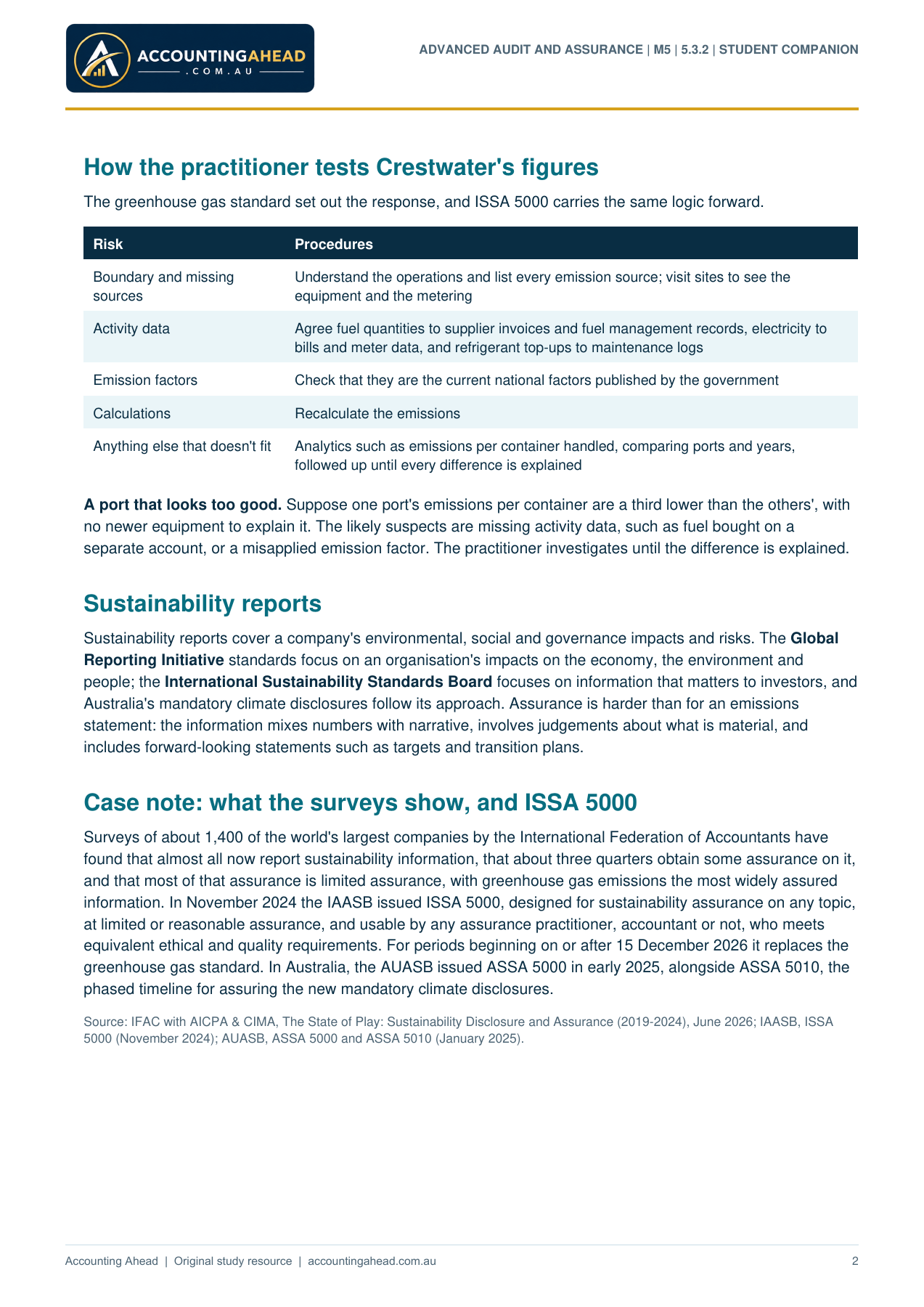
How the practitioner tests Crestwater's figures
The greenhouse gas standard set out the response, and ISSA 5000 carries the same logic forward.
Risk Procedures
Boundary and missing
sources
Understand the operations and list every emission source; visit sites to see the
equipment and the metering
Activity data Agree fuel quantities to supplier invoices and fuel management records, electricity to
bills and meter data, and refrigerant top-ups to maintenance logs
Emission factors Check that they are the current national factors published by the government
Calculations Recalculate the emissions
Anything else that doesn't fit Analytics such as emissions per container handled, comparing ports and years,
followed up until every difference is explained
A port that looks too good. Suppose one port's emissions per container are a third lower than the others', with
no newer equipment to explain it. The likely suspects are missing activity data, such as fuel bought on a
separate account, or a misapplied emission factor. The practitioner investigates until the difference is explained.
Sustainability reports
Sustainability reports cover a company's environmental, social and governance impacts and risks. The Global
Reporting Initiative standards focus on an organisation's impacts on the economy, the environment and
people; the International Sustainability Standards Board focuses on information that matters to investors, and
Australia's mandatory climate disclosures follow its approach. Assurance is harder than for an emissions
statement: the information mixes numbers with narrative, involves judgements about what is material, and
includes forward-looking statements such as targets and transition plans.
Case note: what the surveys show, and ISSA 5000
Surveys of about 1,400 of the world's largest companies by the International Federation of Accountants have
found that almost all now report sustainability information, that about three quarters obtain some assurance on it,
and that most of that assurance is limited assurance, with greenhouse gas emissions the most widely assured
information. In November 2024 the IAASB issued ISSA 5000, designed for sustainability assurance on any topic,
at limited or reasonable assurance, and usable by any assurance practitioner, accountant or not, who meets
equivalent ethical and quality requirements. For periods beginning on or after 15 December 2026 it replaces the
greenhouse gas standard. In Australia, the AUASB issued ASSA 5000 in early 2025, alongside ASSA 5010, the
phased timeline for assuring the new mandatory climate disclosures.
Source: IFAC with AICPA & CIMA, The State of Play: Sustainability Disclosure and Assurance (2019-2024), June 2026; IAASB, ISSA
5000 (November 2024); AUASB, ASSA 5000 and ASSA 5010 (January 2025).
ADVANCED AUDIT AND ASSURANCE | M5 | 5.3.2 | STUDENT COMPANION
2
Accounting Ahead | Original study resource | accountingahead.com.au
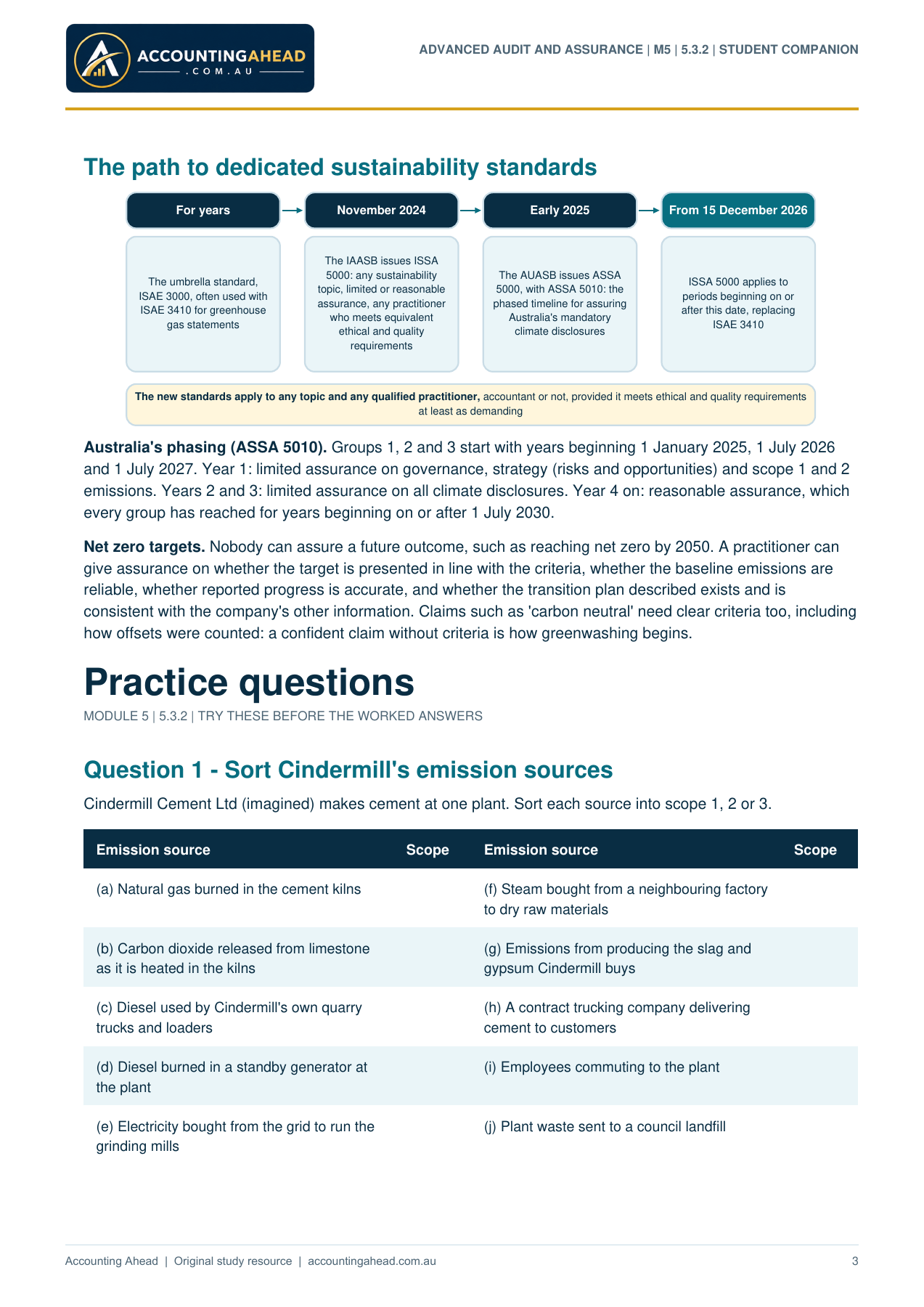
The path to dedicated sustainability standards
For years
The umbrella standard,
ISAE 3000, often used with
ISAE 3410 for greenhouse
gas statements
November 2024
The IAASB issues ISSA
5000: any sustainability
topic, limited or reasonable
assurance, any practitioner
who meets equivalent
ethical and quality
requirements
Early 2025
The AUASB issues ASSA
5000, with ASSA 5010: the
phased timeline for assuring
Australia's mandatory
climate disclosures
From 15 December 2026
ISSA 5000 applies to
periods beginning on or
after this date, replacing
ISAE 3410
The new standards apply to any topic and any qualified practitioner, accountant or not, provided it meets ethical and quality requirements
at least as demanding
Australia's phasing (ASSA 5010). Groups 1, 2 and 3 start with years beginning 1 January 2025, 1 July 2026
and 1 July 2027. Year 1: limited assurance on governance, strategy (risks and opportunities) and scope 1 and 2
emissions. Years 2 and 3: limited assurance on all climate disclosures. Year 4 on: reasonable assurance, which
every group has reached for years beginning on or after 1 July 2030.
Net zero targets. Nobody can assure a future outcome, such as reaching net zero by 2050. A practitioner can
give assurance on whether the target is presented in line with the criteria, whether the baseline emissions are
reliable, whether reported progress is accurate, and whether the transition plan described exists and is
consistent with the company's other information. Claims such as 'carbon neutral' need clear criteria too, including
how offsets were counted: a confident claim without criteria is how greenwashing begins.
Practice questions
MODULE 5 | 5.3.2 | TRY THESE BEFORE THE WORKED ANSWERS
Question 1 - Sort Cindermill's emission sources
Cindermill Cement Ltd (imagined) makes cement at one plant. Sort each source into scope 1, 2 or 3.
Emission source Scope Emission source Scope
(a) Natural gas burned in the cement kilns (f) Steam bought from a neighbouring factory
to dry raw materials
(b) Carbon dioxide released from limestone
as it is heated in the kilns
(g) Emissions from producing the slag and
gypsum Cindermill buys
(c) Diesel used by Cindermill's own quarry
trucks and loaders
(h) A contract trucking company delivering
cement to customers
(d) Diesel burned in a standby generator at
the plant
(i) Employees commuting to the plant
(e) Electricity bought from the grid to run the
grinding mills
(j) Plant waste sent to a council landfill
ADVANCED AUDIT AND ASSURANCE | M5 | 5.3.2 | STUDENT COMPANION
3
Accounting Ahead | Original study resource | accountingahead.com.au
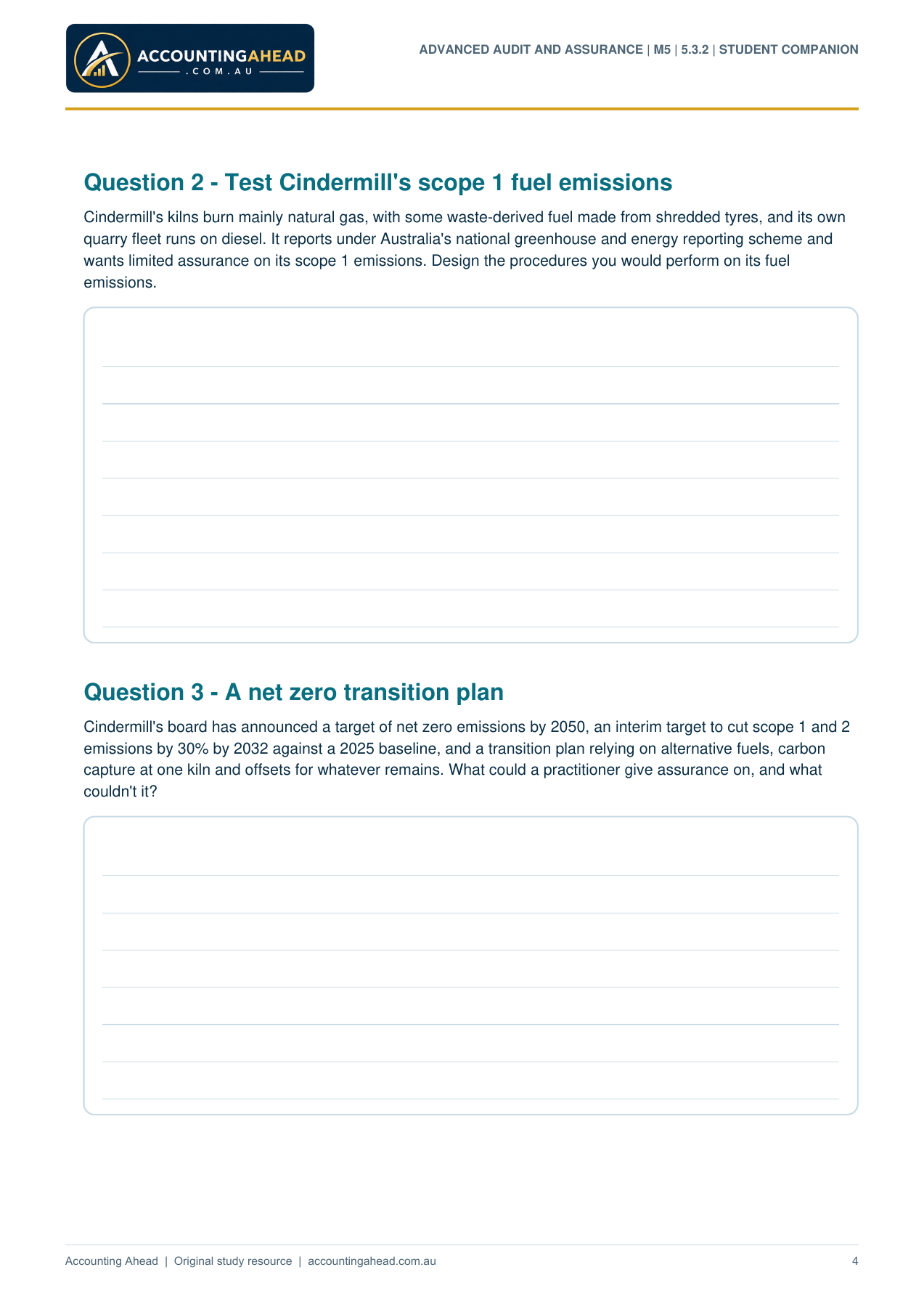
Question 2 - Test Cindermill's scope 1 fuel emissions
Cindermill's kilns burn mainly natural gas, with some waste-derived fuel made from shredded tyres, and its own
quarry fleet runs on diesel. It reports under Australia's national greenhouse and energy reporting scheme and
wants limited assurance on its scope 1 emissions. Design the procedures you would perform on its fuel
emissions.
Question 3 - A net zero transition plan
Cindermill's board has announced a target of net zero emissions by 2050, an interim target to cut scope 1 and 2
emissions by 30% by 2032 against a 2025 baseline, and a transition plan relying on alternative fuels, carbon
capture at one kiln and offsets for whatever remains. What could a practitioner give assurance on, and what
couldn't it?
ADVANCED AUDIT AND ASSURANCE | M5 | 5.3.2 | STUDENT COMPANION
4
Accounting Ahead | Original study resource | accountingahead.com.au
Worked answers
MODULE 5 | 5.3.2 | WORKED ANSWERS - ATTEMPT THE QUESTIONS FIRST
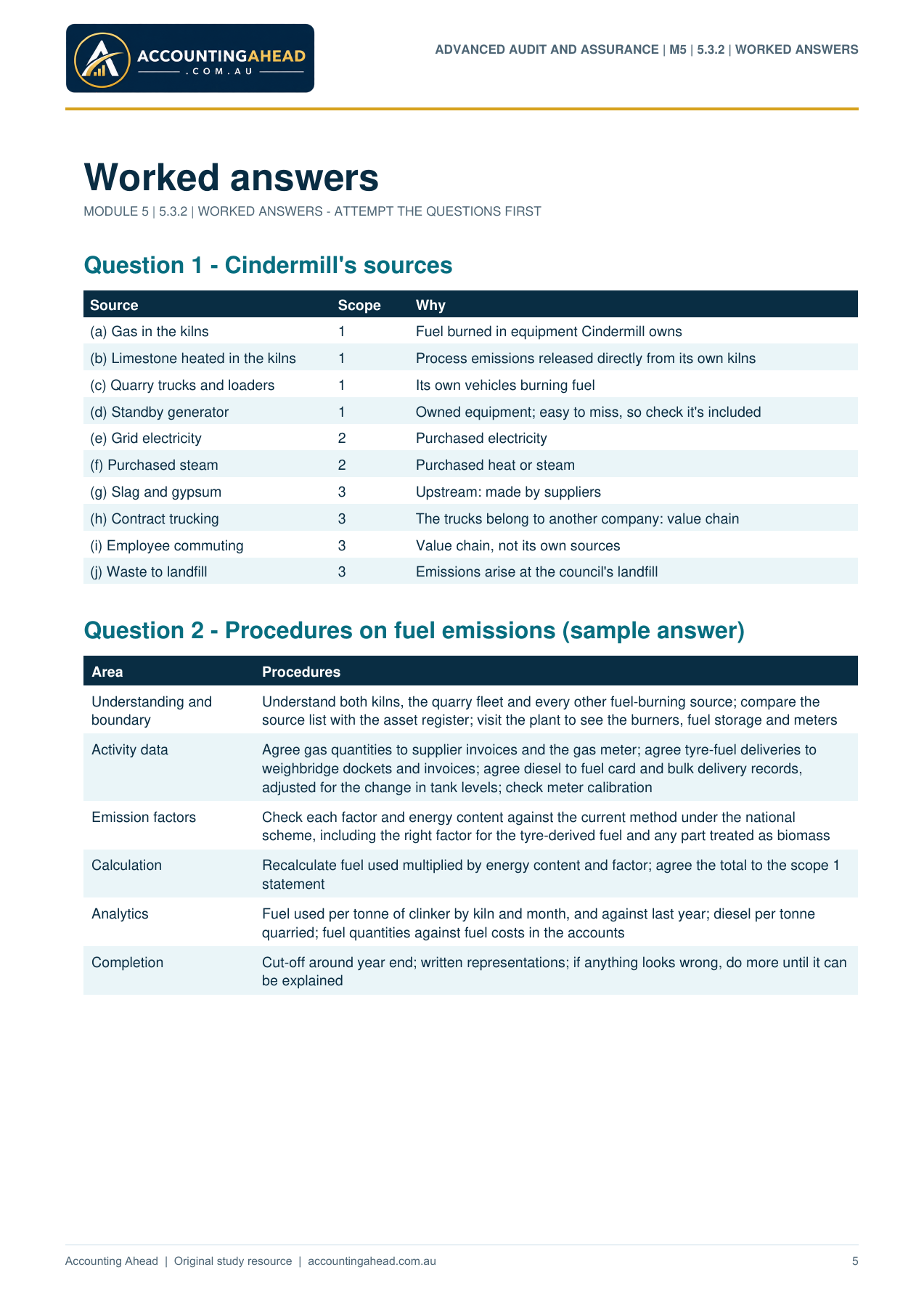
Question 1 - Cindermill's sources
Source Scope Why
(a) Gas in the kilns 1 Fuel burned in equipment Cindermill owns
(b) Limestone heated in the kilns 1 Process emissions released directly from its own kilns
(c) Quarry trucks and loaders 1 Its own vehicles burning fuel
(d) Standby generator 1 Owned equipment; easy to miss, so check it's included
(e) Grid electricity 2 Purchased electricity
(f) Purchased steam 2 Purchased heat or steam
(g) Slag and gypsum 3 Upstream: made by suppliers
(h) Contract trucking 3 The trucks belong to another company: value chain
(i) Employee commuting 3 Value chain, not its own sources
(j) Waste to landfill 3 Emissions arise at the council's landfill
Question 2 - Procedures on fuel emissions (sample answer)
Area Procedures
Understanding and
boundary
Understand both kilns, the quarry fleet and every other fuel-burning source; compare the
source list with the asset register; visit the plant to see the burners, fuel storage and meters
Activity data Agree gas quantities to supplier invoices and the gas meter; agree tyre-fuel deliveries to
weighbridge dockets and invoices; agree diesel to fuel card and bulk delivery records,
adjusted for the change in tank levels; check meter calibration
Emission factors Check each factor and energy content against the current method under the national
scheme, including the right factor for the tyre-derived fuel and any part treated as biomass
Calculation Recalculate fuel used multiplied by energy content and factor; agree the total to the scope 1
statement
Analytics Fuel used per tonne of clinker by kiln and month, and against last year; diesel per tonne
quarried; fuel quantities against fuel costs in the accounts
Completion Cut-off around year end; written representations; if anything looks wrong, do more until it can
be explained
ADVANCED AUDIT AND ASSURANCE | M5 | 5.3.2 | WORKED ANSWERS
5
Accounting Ahead | Original study resource | accountingahead.com.au
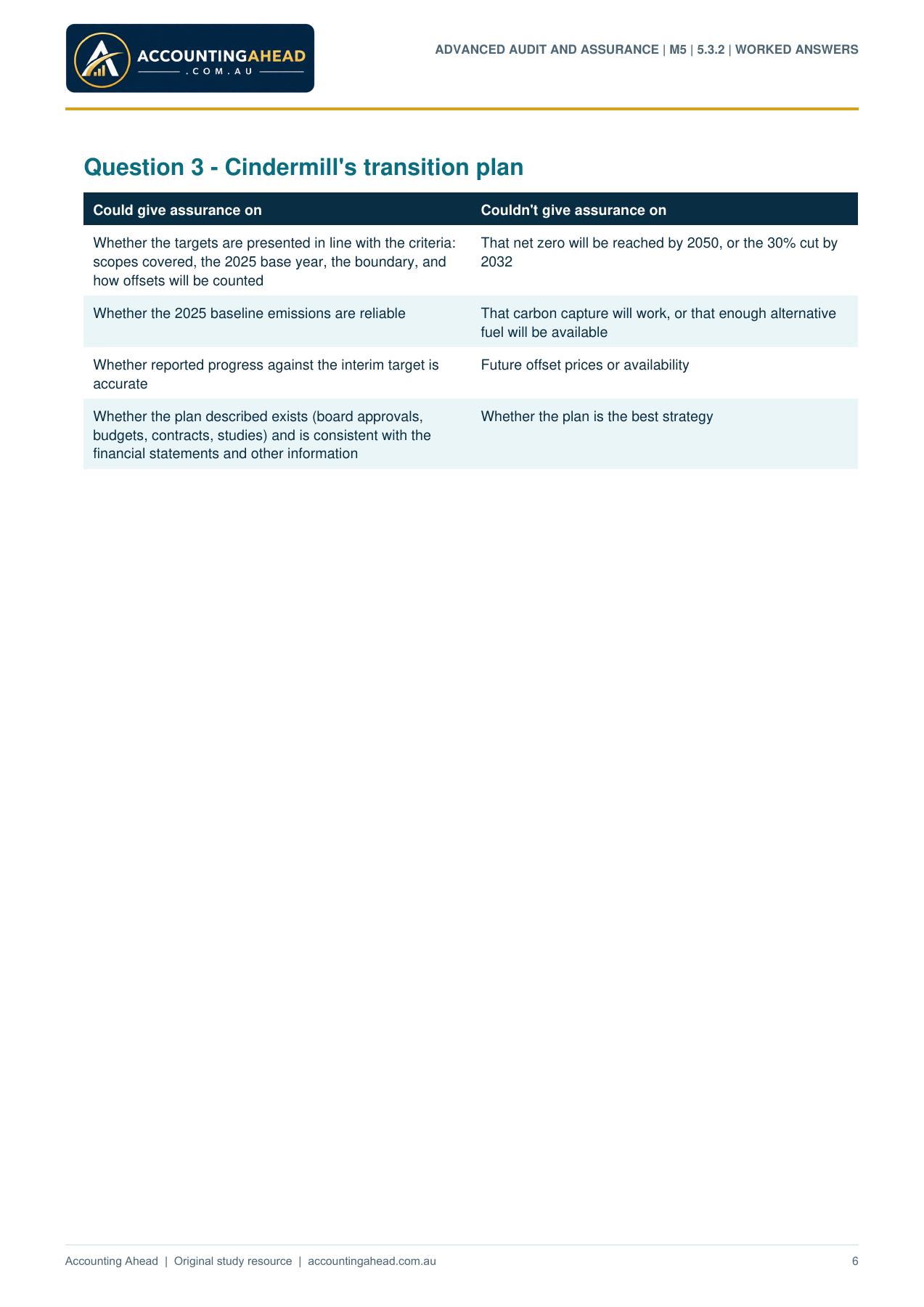
Question 3 - Cindermill's transition plan
Could give assurance on Couldn't give assurance on
Whether the targets are presented in line with the criteria:
scopes covered, the 2025 base year, the boundary, and
how offsets will be counted
That net zero will be reached by 2050, or the 30% cut by
2032
Whether the 2025 baseline emissions are reliable That carbon capture will work, or that enough alternative
fuel will be available
Whether reported progress against the interim target is
accurate
Future offset prices or availability
Whether the plan described exists (board approvals,
budgets, contracts, studies) and is consistent with the
financial statements and other information
Whether the plan is the best strategy
ADVANCED AUDIT AND ASSURANCE | M5 | 5.3.2 | WORKED ANSWERS
6