
Controls assurance and continuous assurance
Printable study notes, diagrams and practice support for Part 5.4.2.
Read the handout text
Accounting Ahead | Original study resource | accountingahead.com.au
Controls assurance and continuous
assurance
MODULE 5 | 5.4.2 | STUDENT COMPANION
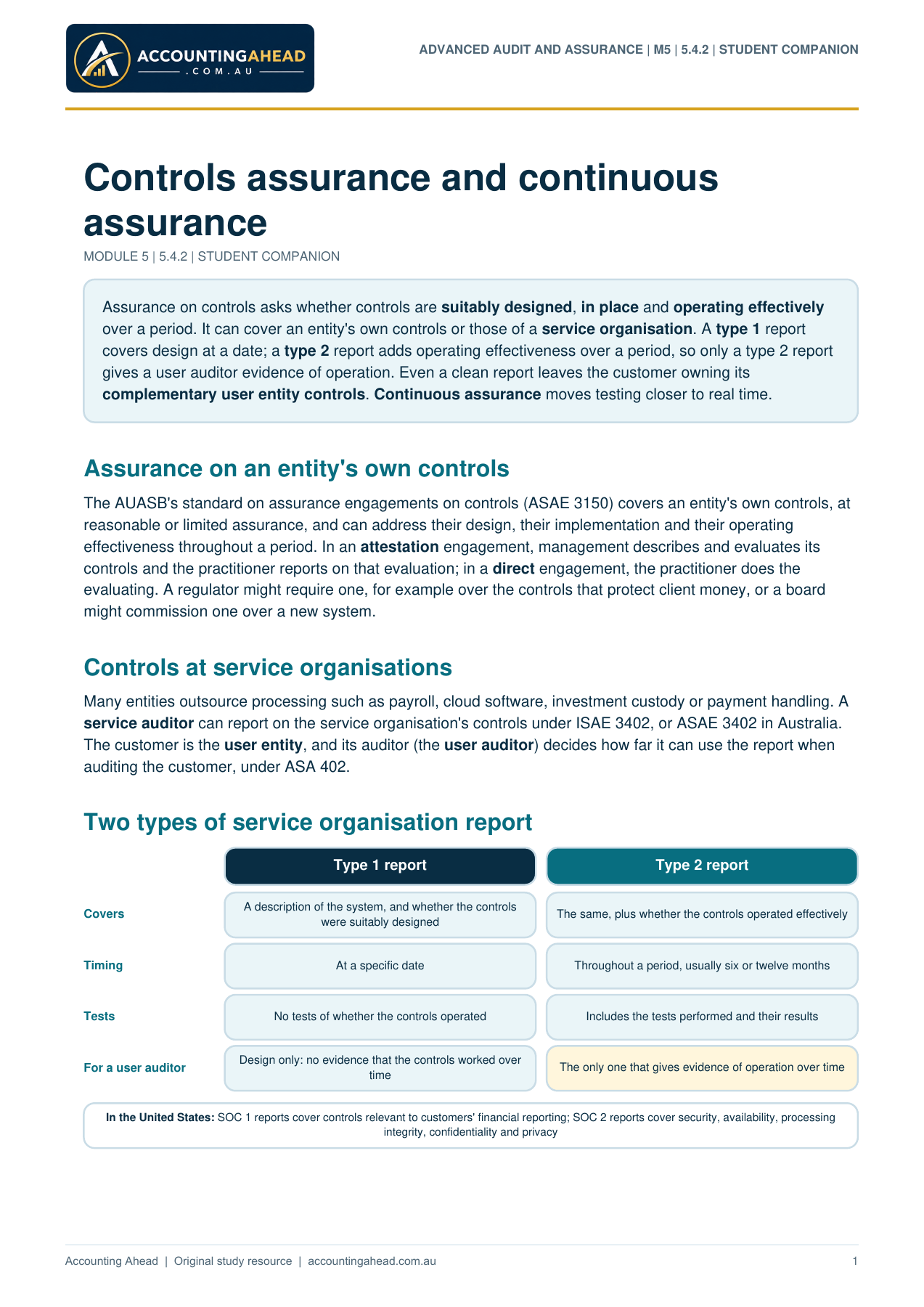
Assurance on controls asks whether controls are suitably designed, in place and operating effectively
over a period. It can cover an entity's own controls or those of a service organisation. A type 1 report
covers design at a date; a type 2 report adds operating effectiveness over a period, so only a type 2 report
gives a user auditor evidence of operation. Even a clean report leaves the customer owning its
complementary user entity controls. Continuous assurance moves testing closer to real time.
Assurance on an entity's own controls
The AUASB's standard on assurance engagements on controls (ASAE 3150) covers an entity's own controls, at
reasonable or limited assurance, and can address their design, their implementation and their operating
effectiveness throughout a period. In an attestation engagement, management describes and evaluates its
controls and the practitioner reports on that evaluation; in a direct engagement, the practitioner does the
evaluating. A regulator might require one, for example over the controls that protect client money, or a board
might commission one over a new system.
Controls at service organisations
Many entities outsource processing such as payroll, cloud software, investment custody or payment handling. A
service auditor can report on the service organisation's controls under ISAE 3402, or ASAE 3402 in Australia.
The customer is the user entity, and its auditor (the user auditor) decides how far it can use the report when
auditing the customer, under ASA 402.
Two types of service organisation report
Type 1 report Type 2 report
Covers A description of the system, and whether the controls
were suitably designed The same, plus whether the controls operated effectively
Timing At a specific date Throughout a period, usually six or twelve months
Tests No tests of whether the controls operated Includes the tests performed and their results
For a user auditor Design only: no evidence that the controls worked over
time The only one that gives evidence of operation over time
In the United States: SOC 1 reports cover controls relevant to customers' financial reporting; SOC 2 reports cover security, availability, processing
integrity, confidentiality and privacy
ADVANCED AUDIT AND ASSURANCE | M5 | 5.4.2 | STUDENT COMPANION
1
Accounting Ahead | Original study resource | accountingahead.com.au
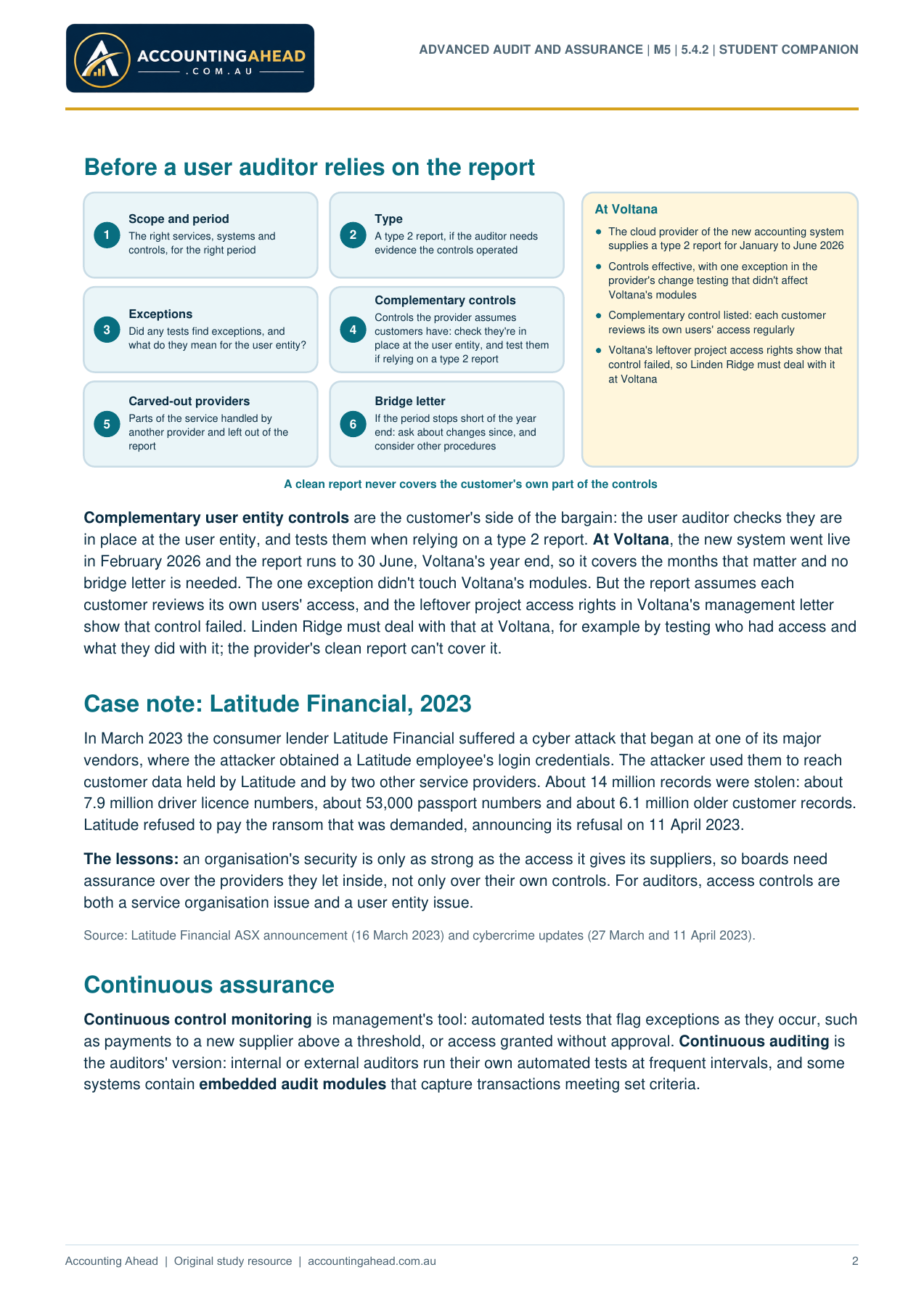
Before a user auditor relies on the report
1
Scope and period
The right services, systems and
controls, for the right period
2
Type
A type 2 report, if the auditor needs
evidence the controls operated
3
Exceptions
Did any tests find exceptions, and
what do they mean for the user entity?
4
Complementary controls
Controls the provider assumes
customers have: check they're in
place at the user entity, and test them
if relying on a type 2 report
5
Carved-out providers
Parts of the service handled by
another provider and left out of the
report
6
Bridge letter
If the period stops short of the year
end: ask about changes since, and
consider other procedures
At Voltana
The cloud provider of the new accounting system
supplies a type 2 report for January to June 2026
Controls effective, with one exception in the
provider's change testing that didn't affect
Voltana's modules
Complementary control listed: each customer
reviews its own users' access regularly
Voltana's leftover project access rights show that
control failed, so Linden Ridge must deal with it
at Voltana
A clean report never covers the customer's own part of the controls
Complementary user entity controls are the customer's side of the bargain: the user auditor checks they are
in place at the user entity, and tests them when relying on a type 2 report. At Voltana, the new system went live
in February 2026 and the report runs to 30 June, Voltana's year end, so it covers the months that matter and no
bridge letter is needed. The one exception didn't touch Voltana's modules. But the report assumes each
customer reviews its own users' access, and the leftover project access rights in Voltana's management letter
show that control failed. Linden Ridge must deal with that at Voltana, for example by testing who had access and
what they did with it; the provider's clean report can't cover it.
Case note: Latitude Financial, 2023
In March 2023 the consumer lender Latitude Financial suffered a cyber attack that began at one of its major
vendors, where the attacker obtained a Latitude employee's login credentials. The attacker used them to reach
customer data held by Latitude and by two other service providers. About 14 million records were stolen: about
7.9 million driver licence numbers, about 53,000 passport numbers and about 6.1 million older customer records.
Latitude refused to pay the ransom that was demanded, announcing its refusal on 11 April 2023.
The lessons: an organisation's security is only as strong as the access it gives its suppliers, so boards need
assurance over the providers they let inside, not only over their own controls. For auditors, access controls are
both a service organisation issue and a user entity issue.
Source: Latitude Financial ASX announcement (16 March 2023) and cybercrime updates (27 March and 11 April 2023).
Continuous assurance
Continuous control monitoring is management's tool: automated tests that flag exceptions as they occur, such
as payments to a new supplier above a threshold, or access granted without approval. Continuous auditing is
the auditors' version: internal or external auditors run their own automated tests at frequent intervals, and some
systems contain embedded audit modules that capture transactions meeting set criteria.
ADVANCED AUDIT AND ASSURANCE | M5 | 5.4.2 | STUDENT COMPANION
2
Accounting Ahead | Original study resource | accountingahead.com.au
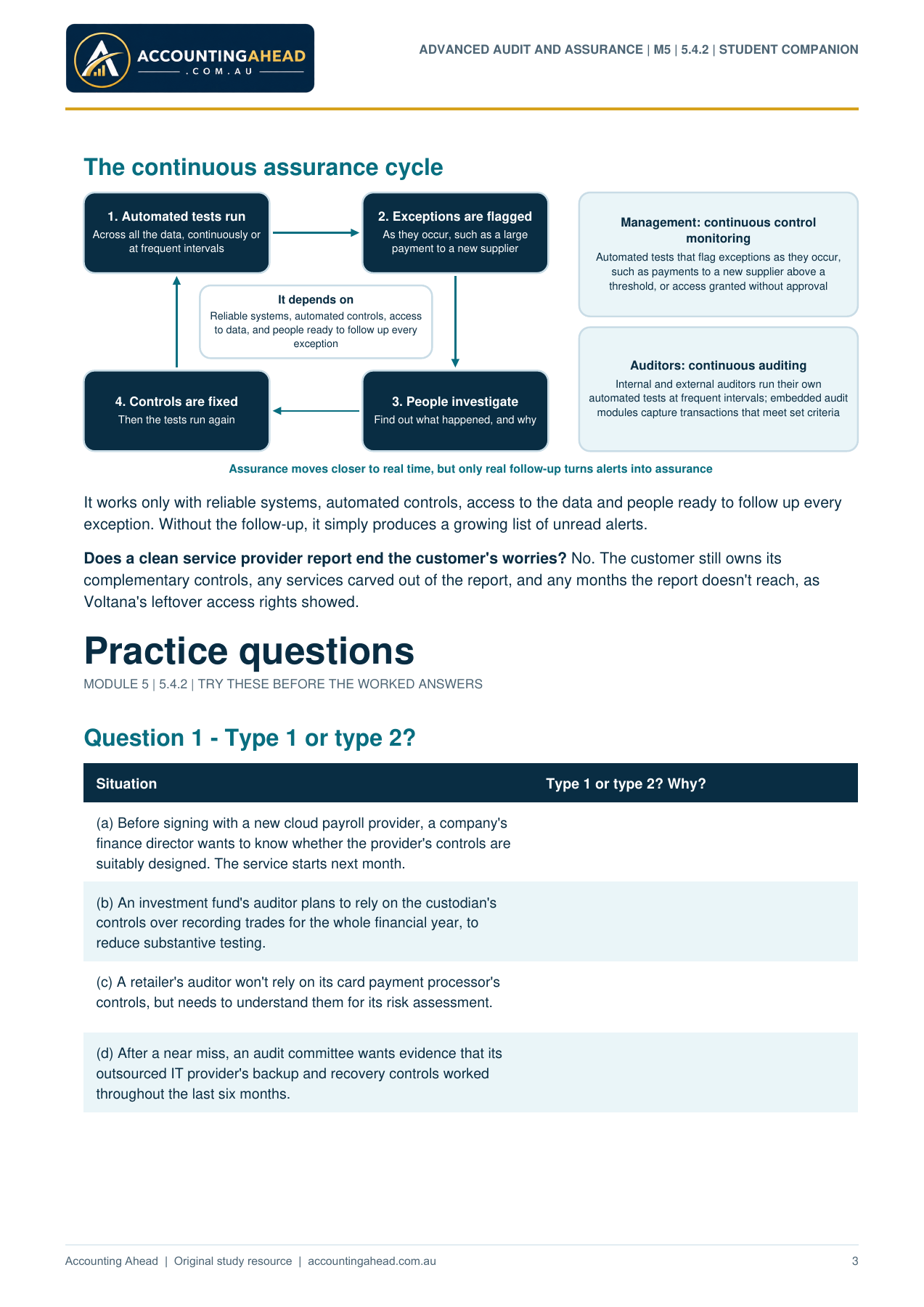
The continuous assurance cycle
1. Automated tests run
Across all the data, continuously or
at frequent intervals
2. Exceptions are flagged
As they occur, such as a large
payment to a new supplier
3. People investigate
Find out what happened, and why
4. Controls are fixed
Then the tests run again
It depends on
Reliable systems, automated controls, access
to data, and people ready to follow up every
exception
Management: continuous control
monitoring
Automated tests that flag exceptions as they occur,
such as payments to a new supplier above a
threshold, or access granted without approval
Auditors: continuous auditing
Internal and external auditors run their own
automated tests at frequent intervals; embedded audit
modules capture transactions that meet set criteria
Assurance moves closer to real time, but only real follow-up turns alerts into assurance
It works only with reliable systems, automated controls, access to the data and people ready to follow up every
exception. Without the follow-up, it simply produces a growing list of unread alerts.
Does a clean service provider report end the customer's worries? No. The customer still owns its
complementary controls, any services carved out of the report, and any months the report doesn't reach, as
Voltana's leftover access rights showed.
Practice questions
MODULE 5 | 5.4.2 | TRY THESE BEFORE THE WORKED ANSWERS
Question 1 - Type 1 or type 2?
Situation Type 1 or type 2? Why?
(a) Before signing with a new cloud payroll provider, a company's
finance director wants to know whether the provider's controls are
suitably designed. The service starts next month.
(b) An investment fund's auditor plans to rely on the custodian's
controls over recording trades for the whole financial year, to
reduce substantive testing.
(c) A retailer's auditor won't rely on its card payment processor's
controls, but needs to understand them for its risk assessment.
(d) After a near miss, an audit committee wants evidence that its
outsourced IT provider's backup and recovery controls worked
throughout the last six months.
ADVANCED AUDIT AND ASSURANCE | M5 | 5.4.2 | STUDENT COMPANION
3
Accounting Ahead | Original study resource | accountingahead.com.au
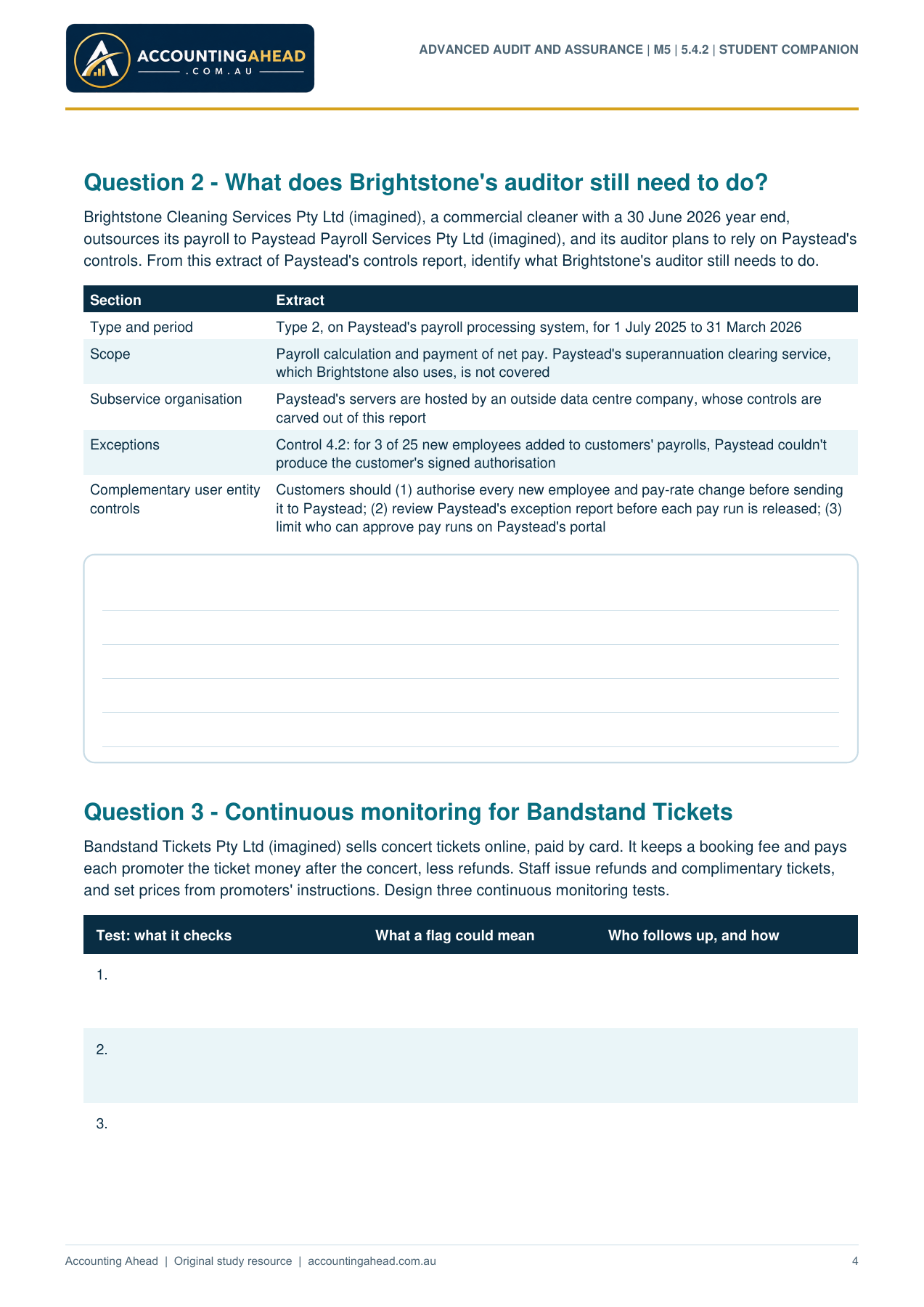
Question 2 - What does Brightstone's auditor still need to do?
Brightstone Cleaning Services Pty Ltd (imagined), a commercial cleaner with a 30 June 2026 year end,
outsources its payroll to Paystead Payroll Services Pty Ltd (imagined), and its auditor plans to rely on Paystead's
controls. From this extract of Paystead's controls report, identify what Brightstone's auditor still needs to do.
Section Extract
Type and period Type 2, on Paystead's payroll processing system, for 1 July 2025 to 31 March 2026
Scope Payroll calculation and payment of net pay. Paystead's superannuation clearing service,
which Brightstone also uses, is not covered
Subservice organisation Paystead's servers are hosted by an outside data centre company, whose controls are
carved out of this report
Exceptions Control 4.2: for 3 of 25 new employees added to customers' payrolls, Paystead couldn't
produce the customer's signed authorisation
Complementary user entity
controls
Customers should (1) authorise every new employee and pay-rate change before sending
it to Paystead; (2) review Paystead's exception report before each pay run is released; (3)
limit who can approve pay runs on Paystead's portal
Question 3 - Continuous monitoring for Bandstand Tickets
Bandstand Tickets Pty Ltd (imagined) sells concert tickets online, paid by card. It keeps a booking fee and pays
each promoter the ticket money after the concert, less refunds. Staff issue refunds and complimentary tickets,
and set prices from promoters' instructions. Design three continuous monitoring tests.
Test: what it checks What a flag could mean Who follows up, and how
1.
2.
3.
ADVANCED AUDIT AND ASSURANCE | M5 | 5.4.2 | STUDENT COMPANION
4
Accounting Ahead | Original study resource | accountingahead.com.au
Worked answers
MODULE 5 | 5.4.2 | WORKED ANSWERS - ATTEMPT THE QUESTIONS FIRST
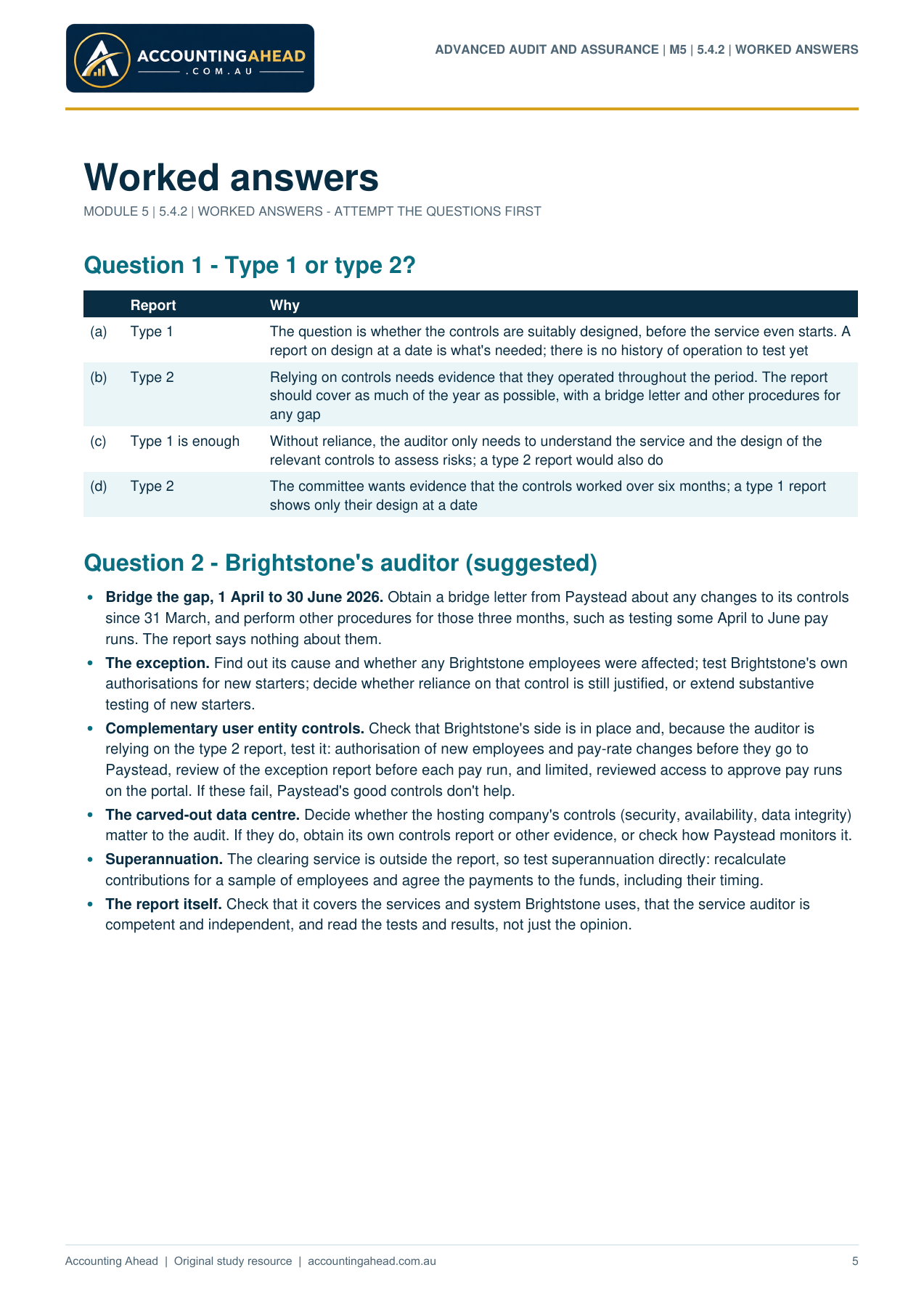
Question 1 - Type 1 or type 2?
Report Why
(a) Type 1 The question is whether the controls are suitably designed, before the service even starts. A
report on design at a date is what's needed; there is no history of operation to test yet
(b) Type 2 Relying on controls needs evidence that they operated throughout the period. The report
should cover as much of the year as possible, with a bridge letter and other procedures for
any gap
(c) Type 1 is enough Without reliance, the auditor only needs to understand the service and the design of the
relevant controls to assess risks; a type 2 report would also do
(d) Type 2 The committee wants evidence that the controls worked over six months; a type 1 report
shows only their design at a date
Question 2 - Brightstone's auditor (suggested)
Bridge the gap, 1 April to 30 June 2026. Obtain a bridge letter from Paystead about any changes to its controls
since 31 March, and perform other procedures for those three months, such as testing some April to June pay
runs. The report says nothing about them.
The exception. Find out its cause and whether any Brightstone employees were affected; test Brightstone's own
authorisations for new starters; decide whether reliance on that control is still justified, or extend substantive
testing of new starters.
Complementary user entity controls. Check that Brightstone's side is in place and, because the auditor is
relying on the type 2 report, test it: authorisation of new employees and pay-rate changes before they go to
Paystead, review of the exception report before each pay run, and limited, reviewed access to approve pay runs
on the portal. If these fail, Paystead's good controls don't help.
The carved-out data centre. Decide whether the hosting company's controls (security, availability, data integrity)
matter to the audit. If they do, obtain its own controls report or other evidence, or check how Paystead monitors it.
Superannuation. The clearing service is outside the report, so test superannuation directly: recalculate
contributions for a sample of employees and agree the payments to the funds, including their timing.
The report itself. Check that it covers the services and system Brightstone uses, that the service auditor is
competent and independent, and read the tests and results, not just the opinion.
ADVANCED AUDIT AND ASSURANCE | M5 | 5.4.2 | WORKED ANSWERS
5
Accounting Ahead | Original study resource | accountingahead.com.au
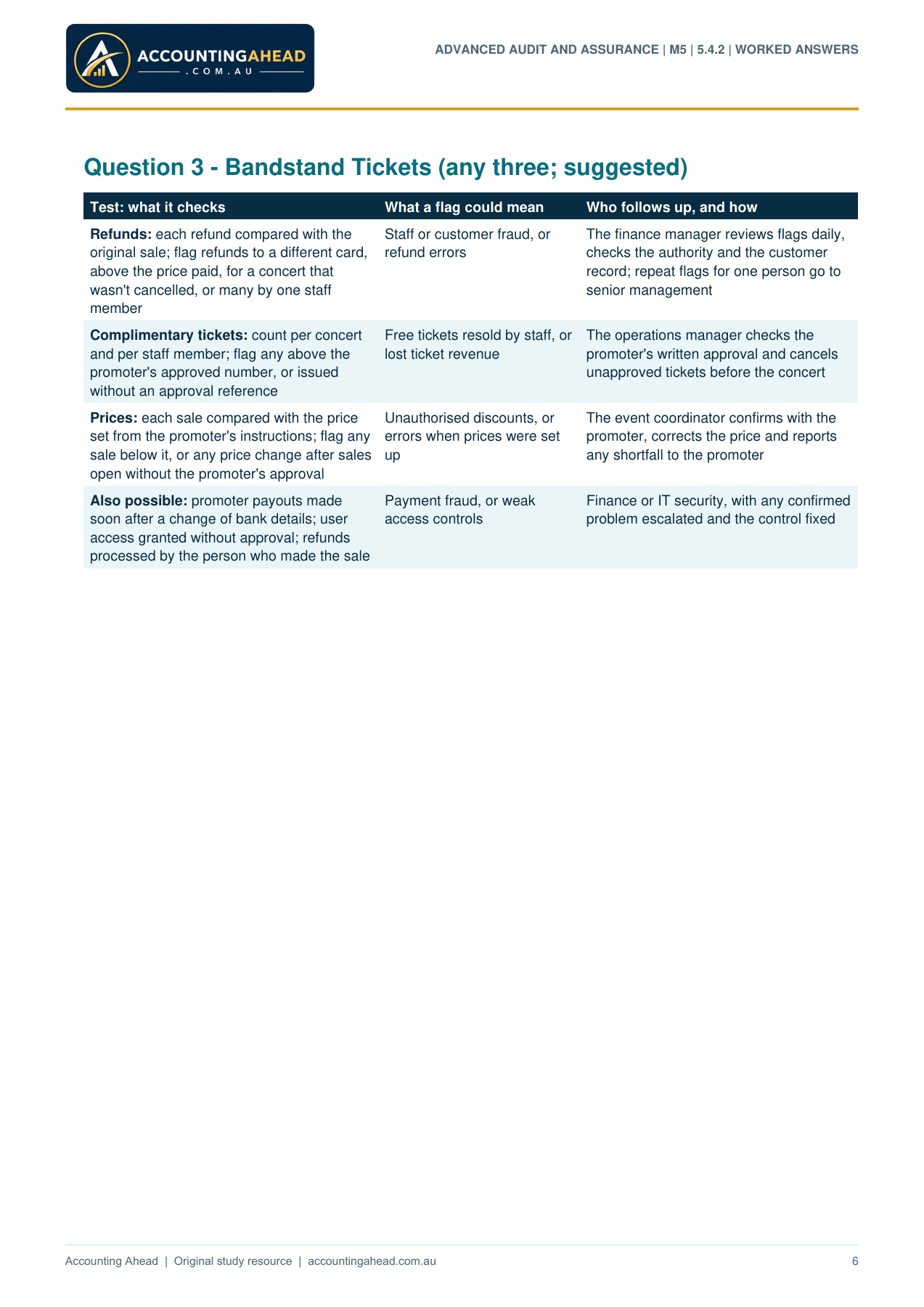
Question 3 - Bandstand Tickets (any three; suggested)
Test: what it checks What a flag could mean Who follows up, and how
Refunds: each refund compared with the
original sale; flag refunds to a different card,
above the price paid, for a concert that
wasn't cancelled, or many by one staff
member
Staff or customer fraud, or
refund errors
The finance manager reviews flags daily,
checks the authority and the customer
record; repeat flags for one person go to
senior management
Complimentary tickets: count per concert
and per staff member; flag any above the
promoter's approved number, or issued
without an approval reference
Free tickets resold by staff, or
lost ticket revenue
The operations manager checks the
promoter's written approval and cancels
unapproved tickets before the concert
Prices: each sale compared with the price
set from the promoter's instructions; flag any
sale below it, or any price change after sales
open without the promoter's approval
Unauthorised discounts, or
errors when prices were set
up
The event coordinator confirms with the
promoter, corrects the price and reports
any shortfall to the promoter
Also possible: promoter payouts made
soon after a change of bank details; user
access granted without approval; refunds
processed by the person who made the sale
Payment fraud, or weak
access controls
Finance or IT security, with any confirmed
problem escalated and the control fixed
ADVANCED AUDIT AND ASSURANCE | M5 | 5.4.2 | WORKED ANSWERS
6