
Performance audits and the three Es
Printable study notes, diagrams and practice support for Part 5.5.1.
Read the handout text
Accounting Ahead | Original study resource | accountingahead.com.au
Performance audits and the three Es
MODULE 5 | 5.5.1 | STUDENT COMPANION
A performance audit asks whether public money is being well spent. In Australia it is carried out mainly by
auditors-general, who report to parliament and never judge the merits of a policy. Economy concerns the
cost of inputs, efficiency the link between inputs and outputs, and effectiveness whether outputs achieve
the intended outcomes. Indicators measure each, but only mean something against a reference point.
Performance audits differ from financial statement audits in their subject matter, criteria, evidence and
reports.
Who carries out performance audits
Parliaments give governments money to carry out their policies, and departments and agencies do the work, so
parliament needs independent assurance about how well it is done. In Australia that comes from the
Auditor-General of each jurisdiction: the Auditor-General for Australia, supported by the Australian National Audit
Office under the Auditor-General Act 1997, and an Auditor-General in each state and territory, each reporting to
its own parliament. In the private sector, internal auditors and consulting firms do similar work, sometimes called
an operational audit.
The boundary. The auditor never judges whether a policy is the right one; that is for parliament and voters. It
examines how well the policy is being put into practice.
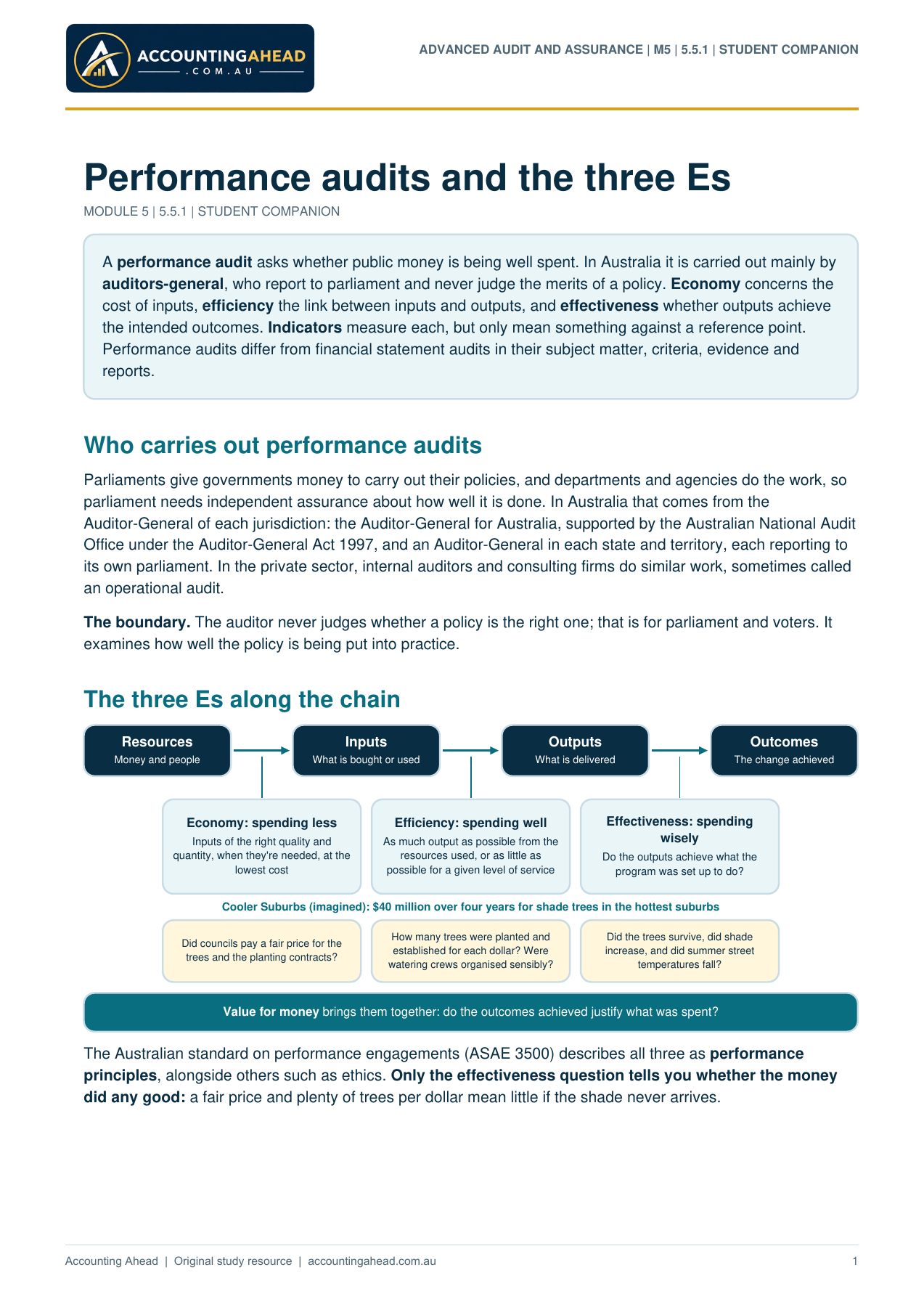
The three Es along the chain
Resources
Money and people
Inputs
What is bought or used
Outputs
What is delivered
Outcomes
The change achieved
Economy: spending less
Inputs of the right quality and
quantity, when they're needed, at the
lowest cost
Did councils pay a fair price for the
trees and the planting contracts?
Efficiency: spending well
As much output as possible from the
resources used, or as little as
possible for a given level of service
How many trees were planted and
established for each dollar? Were
watering crews organised sensibly?
Effectiveness: spending
wisely
Do the outputs achieve what the
program was set up to do?
Did the trees survive, did shade
increase, and did summer street
temperatures fall?
Cooler Suburbs (imagined): $40 million over four years for shade trees in the hottest suburbs
Value for money brings them together: do the outcomes achieved justify what was spent?
The Australian standard on performance engagements (ASAE 3500) describes all three as performance
principles, alongside others such as ethics. Only the effectiveness question tells you whether the money
did any good: a fair price and plenty of trees per dollar mean little if the shade never arrives.
ADVANCED AUDIT AND ASSURANCE | M5 | 5.5.1 | STUDENT COMPANION
1
Accounting Ahead | Original study resource | accountingahead.com.au
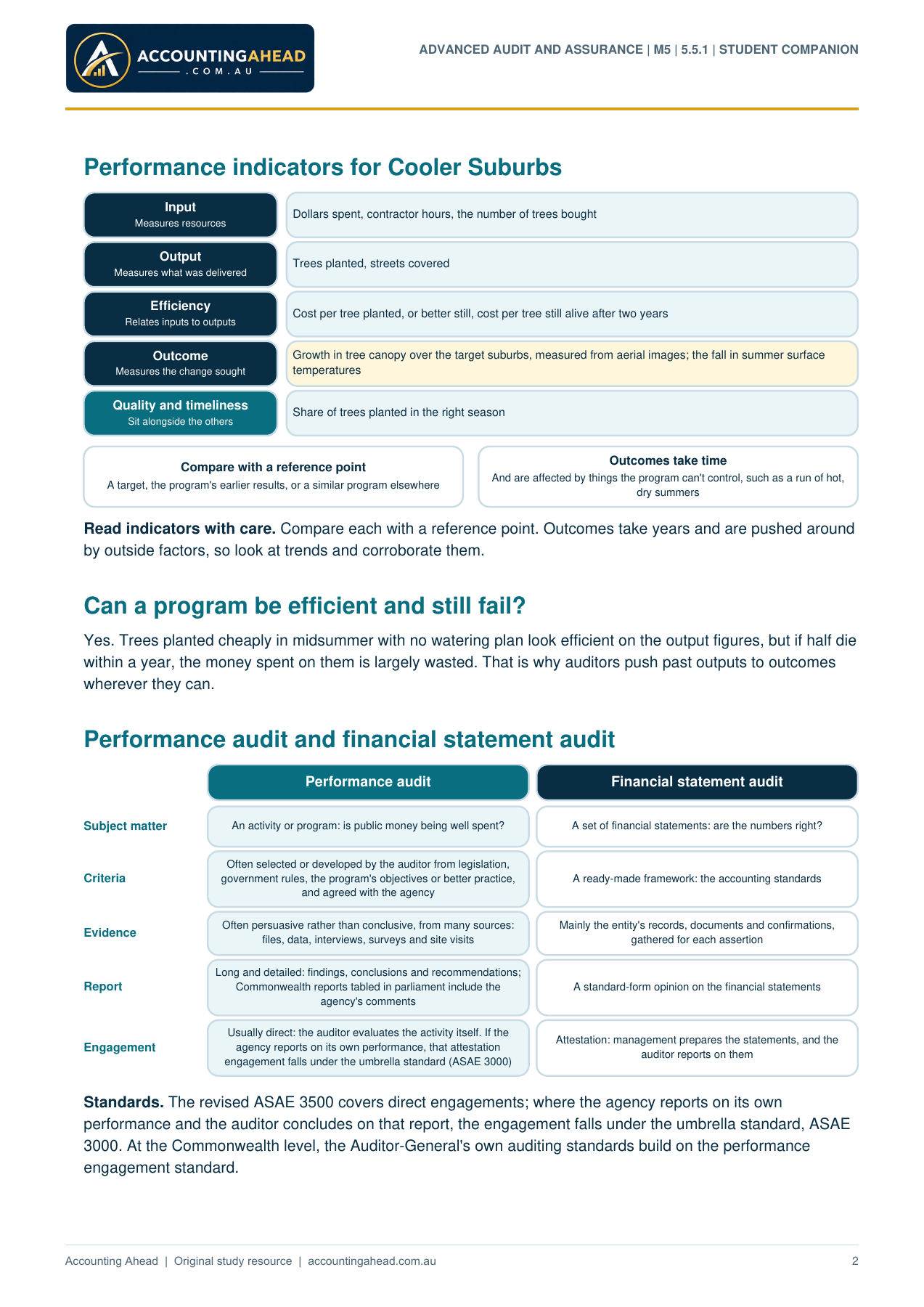
Performance indicators for Cooler Suburbs
Input
Measures resources
Dollars spent, contractor hours, the number of trees bought
Output
Measures what was delivered
Trees planted, streets covered
Efficiency
Relates inputs to outputs
Cost per tree planted, or better still, cost per tree still alive after two years
Outcome
Measures the change sought
Growth in tree canopy over the target suburbs, measured from aerial images; the fall in summer surface
temperatures
Quality and timeliness
Sit alongside the others
Share of trees planted in the right season
Compare with a reference point
A target, the program's earlier results, or a similar program elsewhere
Outcomes take time
And are affected by things the program can't control, such as a run of hot,
dry summers
Read indicators with care. Compare each with a reference point. Outcomes take years and are pushed around
by outside factors, so look at trends and corroborate them.
Can a program be efficient and still fail?
Yes. Trees planted cheaply in midsummer with no watering plan look efficient on the output figures, but if half die
within a year, the money spent on them is largely wasted. That is why auditors push past outputs to outcomes
wherever they can.
Performance audit and financial statement audit
Performance audit Financial statement audit
Subject matter An activity or program: is public money being well spent? A set of financial statements: are the numbers right?
Criteria
Often selected or developed by the auditor from legislation,
government rules, the program's objectives or better practice,
and agreed with the agency
A ready-made framework: the accounting standards
Evidence Often persuasive rather than conclusive, from many sources:
files, data, interviews, surveys and site visits
Mainly the entity's records, documents and confirmations,
gathered for each assertion
Report
Long and detailed: findings, conclusions and recommendations;
Commonwealth reports tabled in parliament include the
agency's comments
A standard-form opinion on the financial statements
Engagement
Usually direct: the auditor evaluates the activity itself. If the
agency reports on its own performance, that attestation
engagement falls under the umbrella standard (ASAE 3000)
Attestation: management prepares the statements, and the
auditor reports on them
Standards. The revised ASAE 3500 covers direct engagements; where the agency reports on its own
performance and the auditor concludes on that report, the engagement falls under the umbrella standard, ASAE
3000. At the Commonwealth level, the Auditor-General's own auditing standards build on the performance
engagement standard.
ADVANCED AUDIT AND ASSURANCE | M5 | 5.5.1 | STUDENT COMPANION
2
Accounting Ahead | Original study resource | accountingahead.com.au
Case note: the Community Sport Infrastructure audit
On 15 January 2020 the Australian National Audit Office tabled its audit of a $100 million Commonwealth
program of grants for community sport facilities, covering 684 projects, run by Sport Australia, with the Minister
for Sport approving the grants. It found that the funding decisions were not informed by an appropriate
assessment process and sound advice. The minister's office had run its own separate assessment; 61% of the
approved projects had scored below the agency's merit cut-off; and there was evidence that grants had favoured
electorates the government had targeted before the 2019 election. The legal authority the minister relied on to
approve the grants was not evident. After weeks of public debate, the minister resigned from the ministry on 2
February 2020, following a separate review that found a breach of ministerial standards, and on 5 February the
Senate set up a select committee to inquire into the grants. The lesson: how public money is allocated, not just
how much is spent, is a central question of effectiveness and accountability.
Source: ANAO Report No. 23 2019-20 (January 2020); Senate Select Committee on Administration of Sports Grants (2020).
Practice questions
MODULE 5 | 5.5.1 | TRY THESE BEFORE THE WORKED ANSWERS
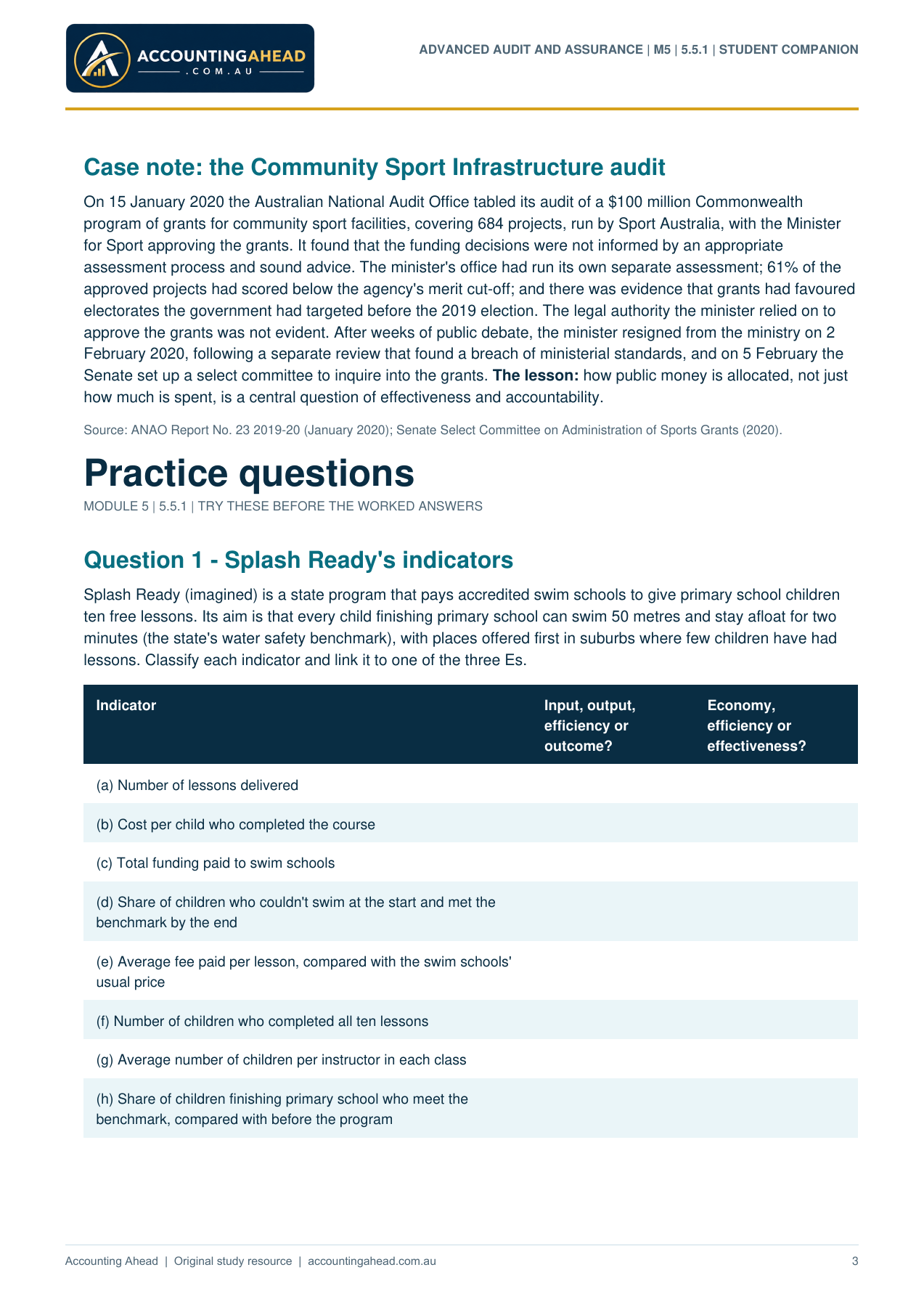
Question 1 - Splash Ready's indicators
Splash Ready (imagined) is a state program that pays accredited swim schools to give primary school children
ten free lessons. Its aim is that every child finishing primary school can swim 50 metres and stay afloat for two
minutes (the state's water safety benchmark), with places offered first in suburbs where few children have had
lessons. Classify each indicator and link it to one of the three Es.
Indicator Input, output,
efficiency or
outcome?
Economy,
efficiency or
effectiveness?
(a) Number of lessons delivered
(b) Cost per child who completed the course
(c) Total funding paid to swim schools
(d) Share of children who couldn't swim at the start and met the
benchmark by the end
(e) Average fee paid per lesson, compared with the swim schools'
usual price
(f) Number of children who completed all ten lessons
(g) Average number of children per instructor in each class
(h) Share of children finishing primary school who meet the
benchmark, compared with before the program
ADVANCED AUDIT AND ASSURANCE | M5 | 5.5.1 | STUDENT COMPANION
3
Accounting Ahead | Original study resource | accountingahead.com.au
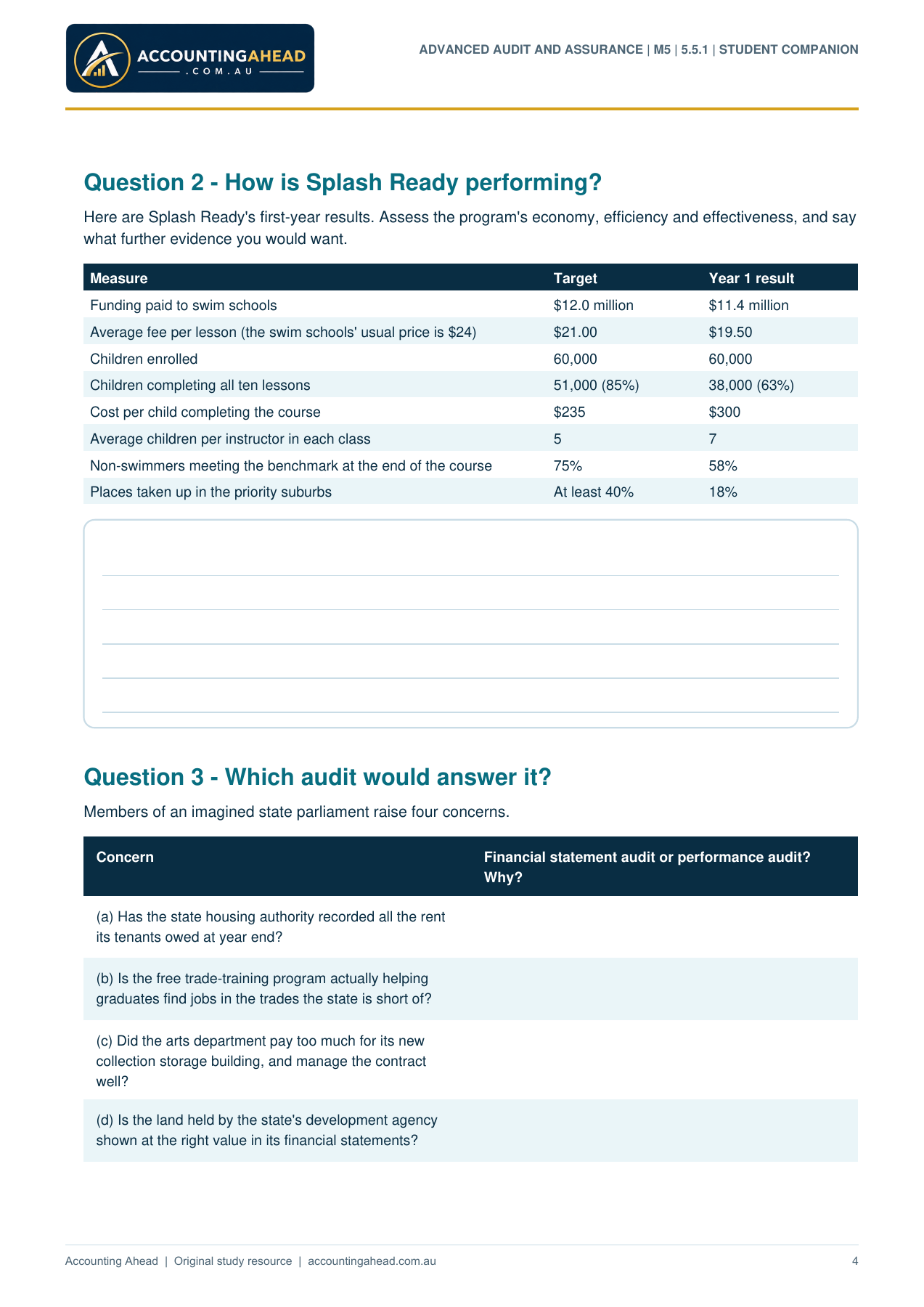
Question 2 - How is Splash Ready performing?
Here are Splash Ready's first-year results. Assess the program's economy, efficiency and effectiveness, and say
what further evidence you would want.
Measure Target Year 1 result
Funding paid to swim schools $12.0 million $11.4 million
Average fee per lesson (the swim schools' usual price is $24) $21.00 $19.50
Children enrolled 60,000 60,000
Children completing all ten lessons 51,000 (85%) 38,000 (63%)
Cost per child completing the course $235 $300
Average children per instructor in each class 5 7
Non-swimmers meeting the benchmark at the end of the course 75% 58%
Places taken up in the priority suburbs At least 40% 18%
Question 3 - Which audit would answer it?
Members of an imagined state parliament raise four concerns.
Concern Financial statement audit or performance audit?
Why?
(a) Has the state housing authority recorded all the rent
its tenants owed at year end?
(b) Is the free trade-training program actually helping
graduates find jobs in the trades the state is short of?
(c) Did the arts department pay too much for its new
collection storage building, and manage the contract
well?
(d) Is the land held by the state's development agency
shown at the right value in its financial statements?
ADVANCED AUDIT AND ASSURANCE | M5 | 5.5.1 | STUDENT COMPANION
4
Accounting Ahead | Original study resource | accountingahead.com.au
Worked answers
MODULE 5 | 5.5.1 | WORKED ANSWERS - ATTEMPT THE QUESTIONS FIRST
Question 1 - Splash Ready's indicators
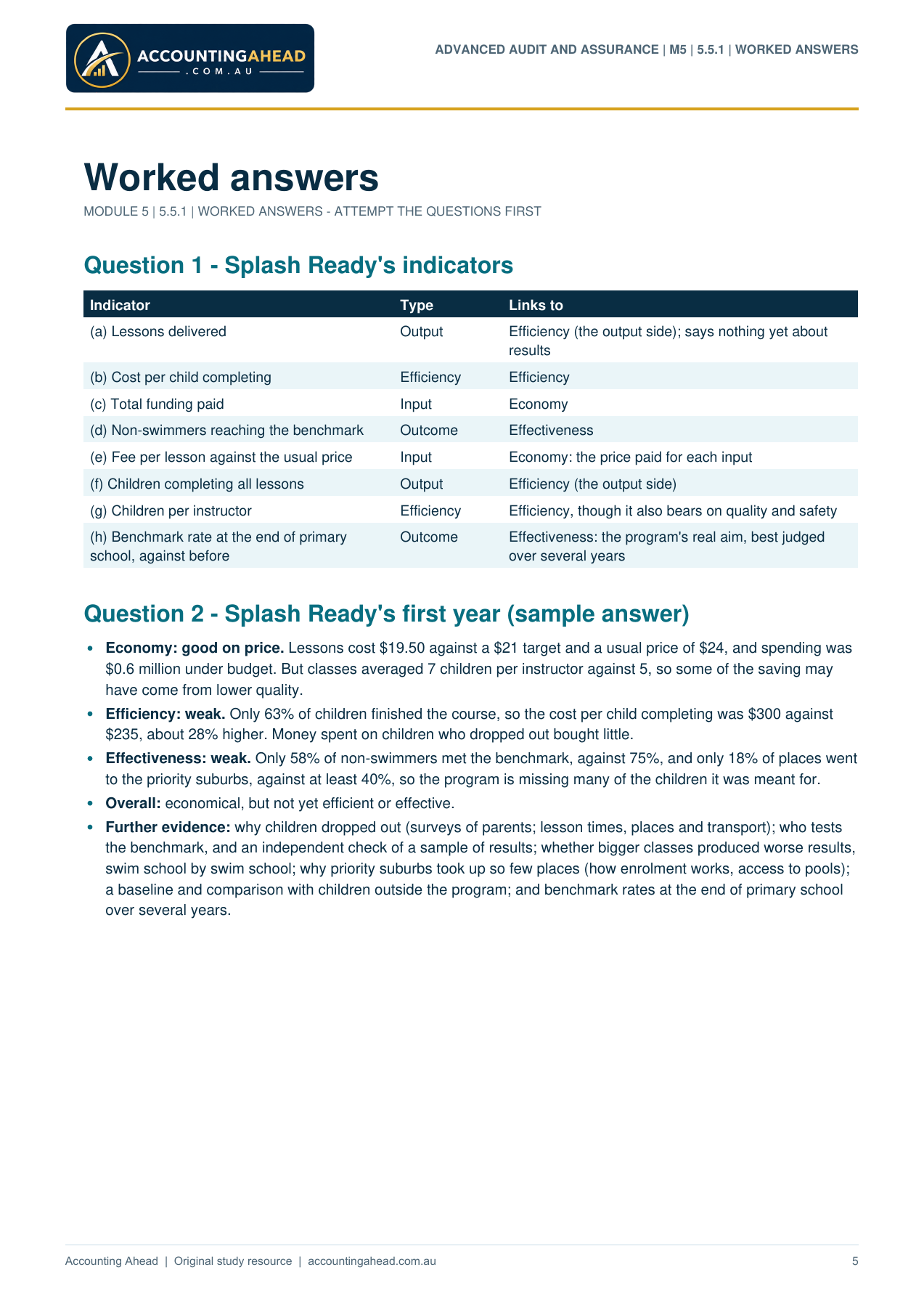
Indicator Type Links to
(a) Lessons delivered Output Efficiency (the output side); says nothing yet about
results
(b) Cost per child completing Efficiency Efficiency
(c) Total funding paid Input Economy
(d) Non-swimmers reaching the benchmark Outcome Effectiveness
(e) Fee per lesson against the usual price Input Economy: the price paid for each input
(f) Children completing all lessons Output Efficiency (the output side)
(g) Children per instructor Efficiency Efficiency, though it also bears on quality and safety
(h) Benchmark rate at the end of primary
school, against before
Outcome Effectiveness: the program's real aim, best judged
over several years
Question 2 - Splash Ready's first year (sample answer)
Economy: good on price. Lessons cost $19.50 against a $21 target and a usual price of $24, and spending was
$0.6 million under budget. But classes averaged 7 children per instructor against 5, so some of the saving may
have come from lower quality.
Efficiency: weak. Only 63% of children finished the course, so the cost per child completing was $300 against
$235, about 28% higher. Money spent on children who dropped out bought little.
Effectiveness: weak. Only 58% of non-swimmers met the benchmark, against 75%, and only 18% of places went
to the priority suburbs, against at least 40%, so the program is missing many of the children it was meant for.
Overall: economical, but not yet efficient or effective.
Further evidence: why children dropped out (surveys of parents; lesson times, places and transport); who tests
the benchmark, and an independent check of a sample of results; whether bigger classes produced worse results,
swim school by swim school; why priority suburbs took up so few places (how enrolment works, access to pools);
a baseline and comparison with children outside the program; and benchmark rates at the end of primary school
over several years.
ADVANCED AUDIT AND ASSURANCE | M5 | 5.5.1 | WORKED ANSWERS
5
Accounting Ahead | Original study resource | accountingahead.com.au
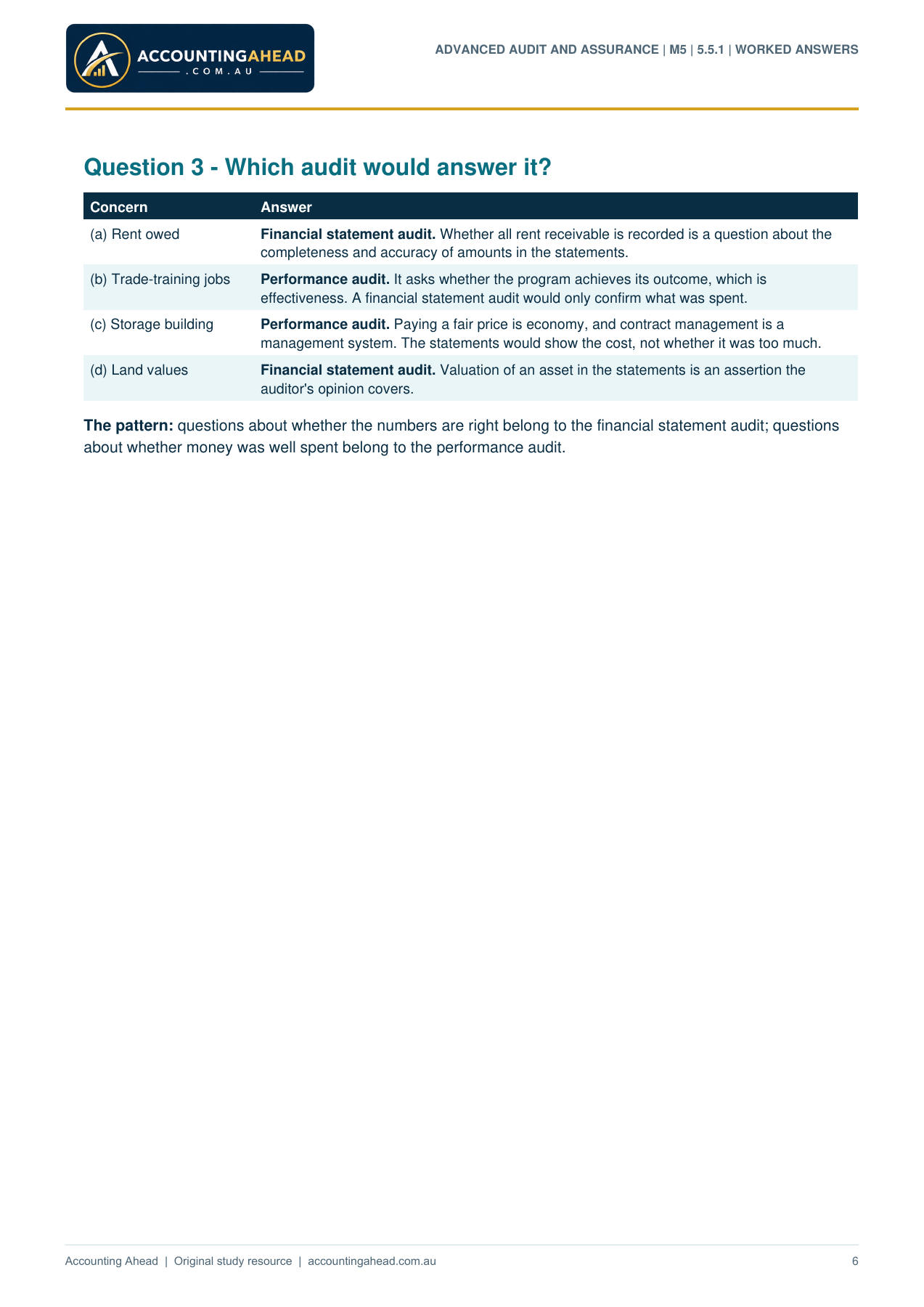
Question 3 - Which audit would answer it?
Concern Answer
(a) Rent owed Financial statement audit. Whether all rent receivable is recorded is a question about the
completeness and accuracy of amounts in the statements.
(b) Trade-training jobs Performance audit. It asks whether the program achieves its outcome, which is
effectiveness. A financial statement audit would only confirm what was spent.
(c) Storage building Performance audit. Paying a fair price is economy, and contract management is a
management system. The statements would show the cost, not whether it was too much.
(d) Land values Financial statement audit. Valuation of an asset in the statements is an assertion the
auditor's opinion covers.
The pattern: questions about whether the numbers are right belong to the financial statement audit; questions
about whether money was well spent belong to the performance audit.
ADVANCED AUDIT AND ASSURANCE | M5 | 5.5.1 | WORKED ANSWERS
6