
Conducting a performance audit
Printable study notes, diagrams and practice support for Part 5.5.2.
Read the handout text
Accounting Ahead | Original study resource | accountingahead.com.au
Conducting a performance audit
MODULE 5 | 5.5.2 | STUDENT COMPANION
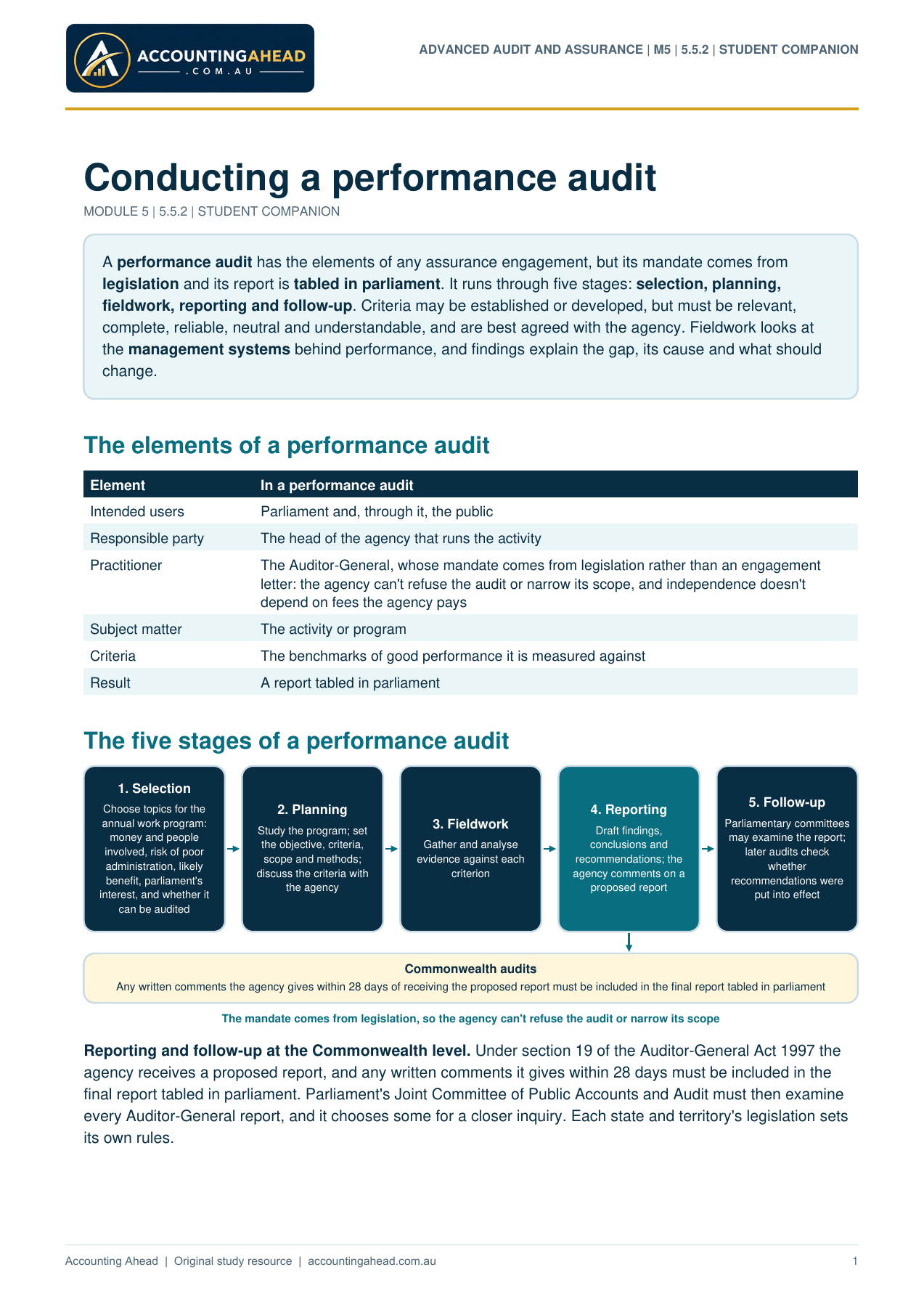
A performance audit has the elements of any assurance engagement, but its mandate comes from
legislation and its report is tabled in parliament. It runs through five stages: selection, planning,
fieldwork, reporting and follow-up. Criteria may be established or developed, but must be relevant,
complete, reliable, neutral and understandable, and are best agreed with the agency. Fieldwork looks at
the management systems behind performance, and findings explain the gap, its cause and what should
change.
The elements of a performance audit
Element In a performance audit
Intended users Parliament and, through it, the public
Responsible party The head of the agency that runs the activity
Practitioner The Auditor-General, whose mandate comes from legislation rather than an engagement
letter: the agency can't refuse the audit or narrow its scope, and independence doesn't
depend on fees the agency pays
Subject matter The activity or program
Criteria The benchmarks of good performance it is measured against
Result A report tabled in parliament
The five stages of a performance audit
1. Selection
Choose topics for the
annual work program:
money and people
involved, risk of poor
administration, likely
benefit, parliament's
interest, and whether it
can be audited
2. Planning
Study the program; set
the objective, criteria,
scope and methods;
discuss the criteria with
the agency
3. Fieldwork
Gather and analyse
evidence against each
criterion
4. Reporting
Draft findings,
conclusions and
recommendations; the
agency comments on a
proposed report
5. Follow-up
Parliamentary committees
may examine the report;
later audits check
whether
recommendations were
put into effect
Commonwealth audits
Any written comments the agency gives within 28 days of receiving the proposed report must be included in the final report tabled in parliament
The mandate comes from legislation, so the agency can't refuse the audit or narrow its scope
Reporting and follow-up at the Commonwealth level. Under section 19 of the Auditor-General Act 1997 the
agency receives a proposed report, and any written comments it gives within 28 days must be included in the
final report tabled in parliament. Parliament's Joint Committee of Public Accounts and Audit must then examine
every Auditor-General report, and it chooses some for a closer inquiry. Each state and territory's legislation sets
its own rules.
ADVANCED AUDIT AND ASSURANCE | M5 | 5.5.2 | STUDENT COMPANION
1
Accounting Ahead | Original study resource | accountingahead.com.au
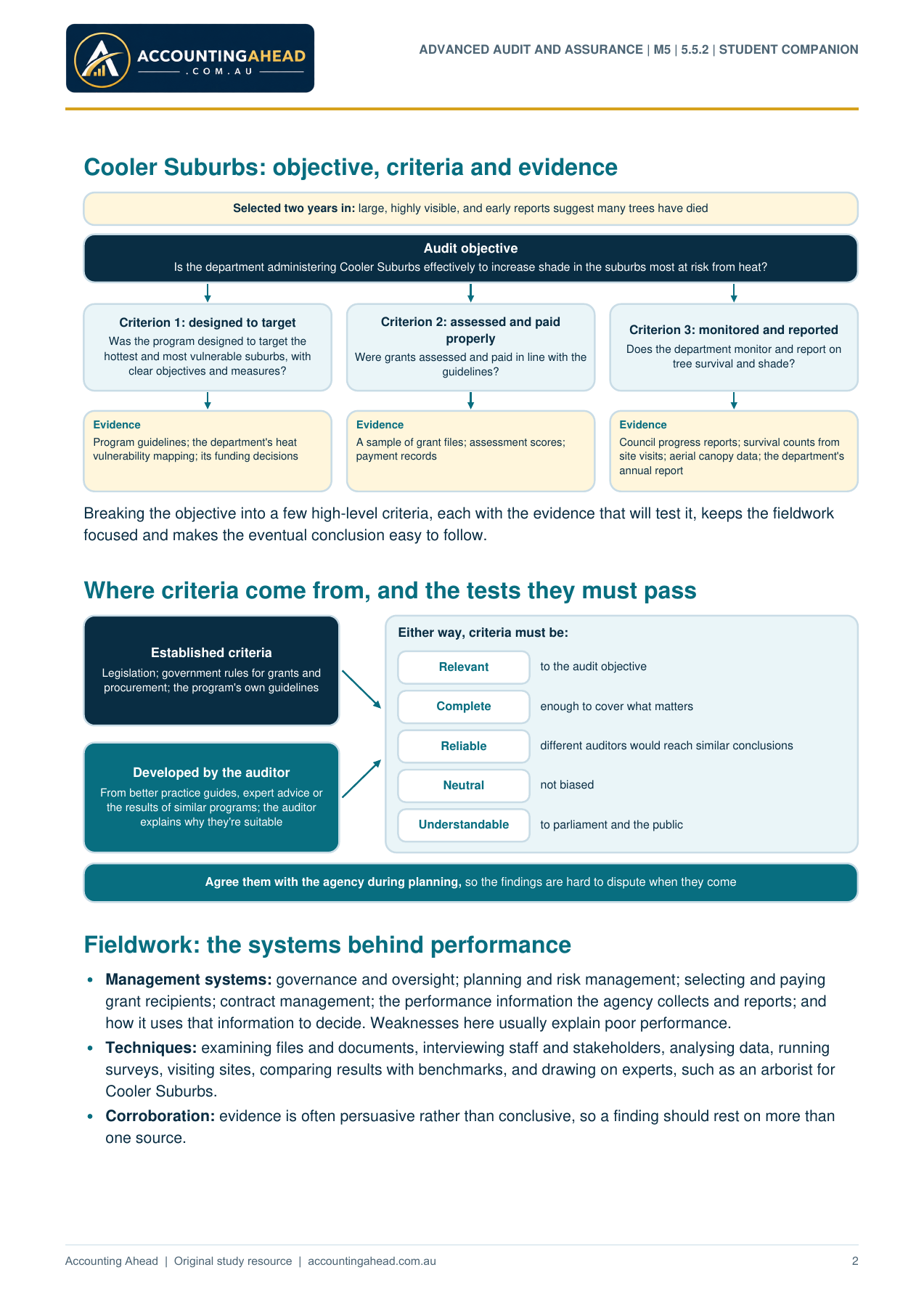
Cooler Suburbs: objective, criteria and evidence
Selected two years in: large, highly visible, and early reports suggest many trees have died
Audit objective
Is the department administering Cooler Suburbs effectively to increase shade in the suburbs most at risk from heat?
Criterion 1: designed to target
Was the program designed to target the
hottest and most vulnerable suburbs, with
clear objectives and measures?
Evidence
Program guidelines; the department's heat
vulnerability mapping; its funding decisions
Criterion 2: assessed and paid
properly
Were grants assessed and paid in line with the
guidelines?
Evidence
A sample of grant files; assessment scores;
payment records
Criterion 3: monitored and reported
Does the department monitor and report on
tree survival and shade?
Evidence
Council progress reports; survival counts from
site visits; aerial canopy data; the department's
annual report
Breaking the objective into a few high-level criteria, each with the evidence that will test it, keeps the fieldwork
focused and makes the eventual conclusion easy to follow.
Where criteria come from, and the tests they must pass
Established criteria
Legislation; government rules for grants and
procurement; the program's own guidelines
Developed by the auditor
From better practice guides, expert advice or
the results of similar programs; the auditor
explains why they're suitable
Either way, criteria must be:
Relevant to the audit objective
Complete enough to cover what matters
Reliable different auditors would reach similar conclusions
Neutral not biased
Understandable to parliament and the public
Agree them with the agency during planning, so the findings are hard to dispute when they come
Fieldwork: the systems behind performance
Management systems: governance and oversight; planning and risk management; selecting and paying
grant recipients; contract management; the performance information the agency collects and reports; and
how it uses that information to decide. Weaknesses here usually explain poor performance.
Techniques: examining files and documents, interviewing staff and stakeholders, analysing data, running
surveys, visiting sites, comparing results with benchmarks, and drawing on experts, such as an arborist for
Cooler Suburbs.
Corroboration: evidence is often persuasive rather than conclusive, so a finding should rest on more than
one source.
ADVANCED AUDIT AND ASSURANCE | M5 | 5.5.2 | STUDENT COMPANION
2
Accounting Ahead | Original study resource | accountingahead.com.au
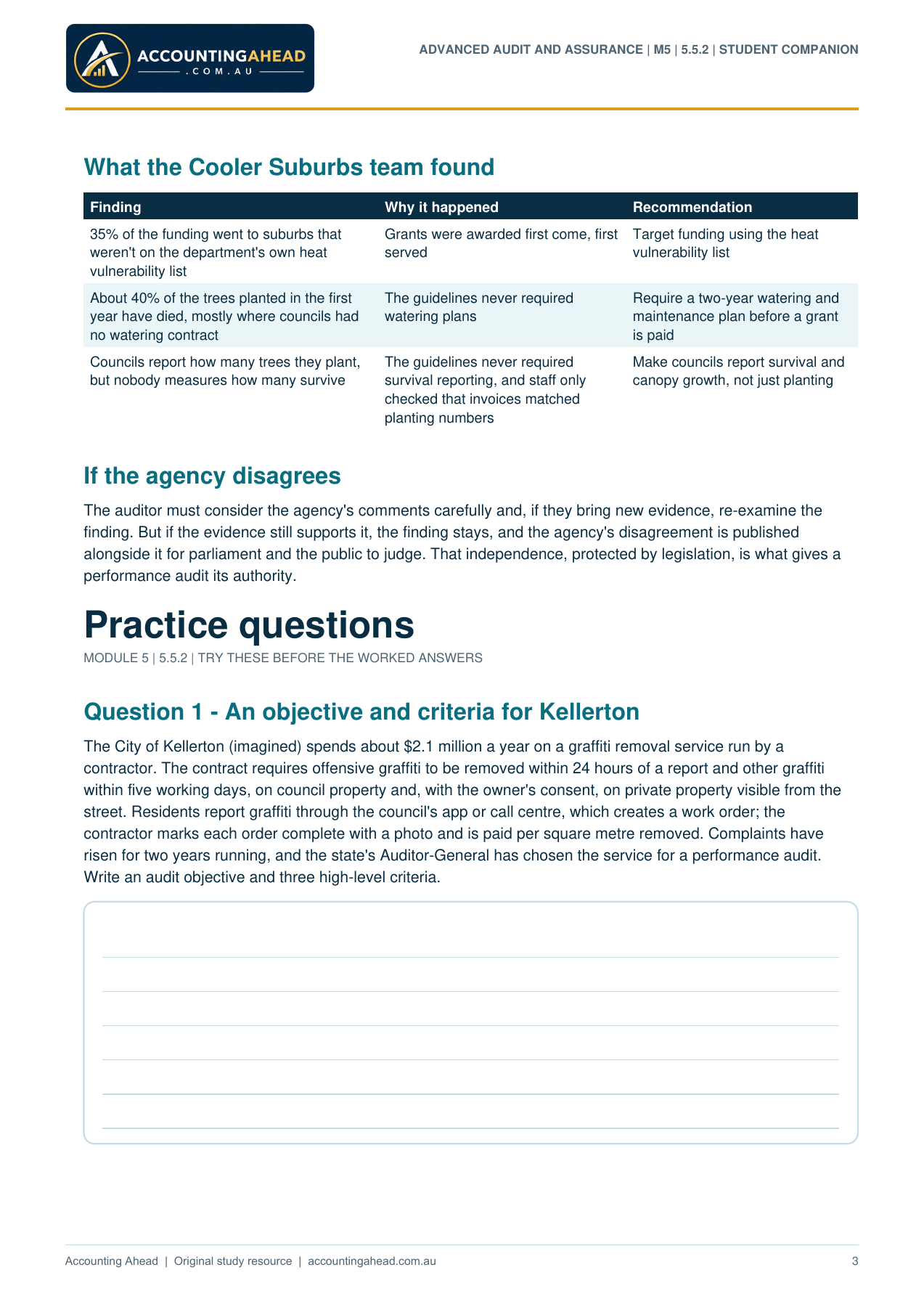
What the Cooler Suburbs team found
Finding Why it happened Recommendation
35% of the funding went to suburbs that
weren't on the department's own heat
vulnerability list
Grants were awarded first come, first
served
Target funding using the heat
vulnerability list
About 40% of the trees planted in the first
year have died, mostly where councils had
no watering contract
The guidelines never required
watering plans
Require a two-year watering and
maintenance plan before a grant
is paid
Councils report how many trees they plant,
but nobody measures how many survive
The guidelines never required
survival reporting, and staff only
checked that invoices matched
planting numbers
Make councils report survival and
canopy growth, not just planting
If the agency disagrees
The auditor must consider the agency's comments carefully and, if they bring new evidence, re-examine the
finding. But if the evidence still supports it, the finding stays, and the agency's disagreement is published
alongside it for parliament and the public to judge. That independence, protected by legislation, is what gives a
performance audit its authority.
Practice questions
MODULE 5 | 5.5.2 | TRY THESE BEFORE THE WORKED ANSWERS
Question 1 - An objective and criteria for Kellerton
The City of Kellerton (imagined) spends about $2.1 million a year on a graffiti removal service run by a
contractor. The contract requires offensive graffiti to be removed within 24 hours of a report and other graffiti
within five working days, on council property and, with the owner's consent, on private property visible from the
street. Residents report graffiti through the council's app or call centre, which creates a work order; the
contractor marks each order complete with a photo and is paid per square metre removed. Complaints have
risen for two years running, and the state's Auditor-General has chosen the service for a performance audit.
Write an audit objective and three high-level criteria.
ADVANCED AUDIT AND ASSURANCE | M5 | 5.5.2 | STUDENT COMPANION
3
Accounting Ahead | Original study resource | accountingahead.com.au
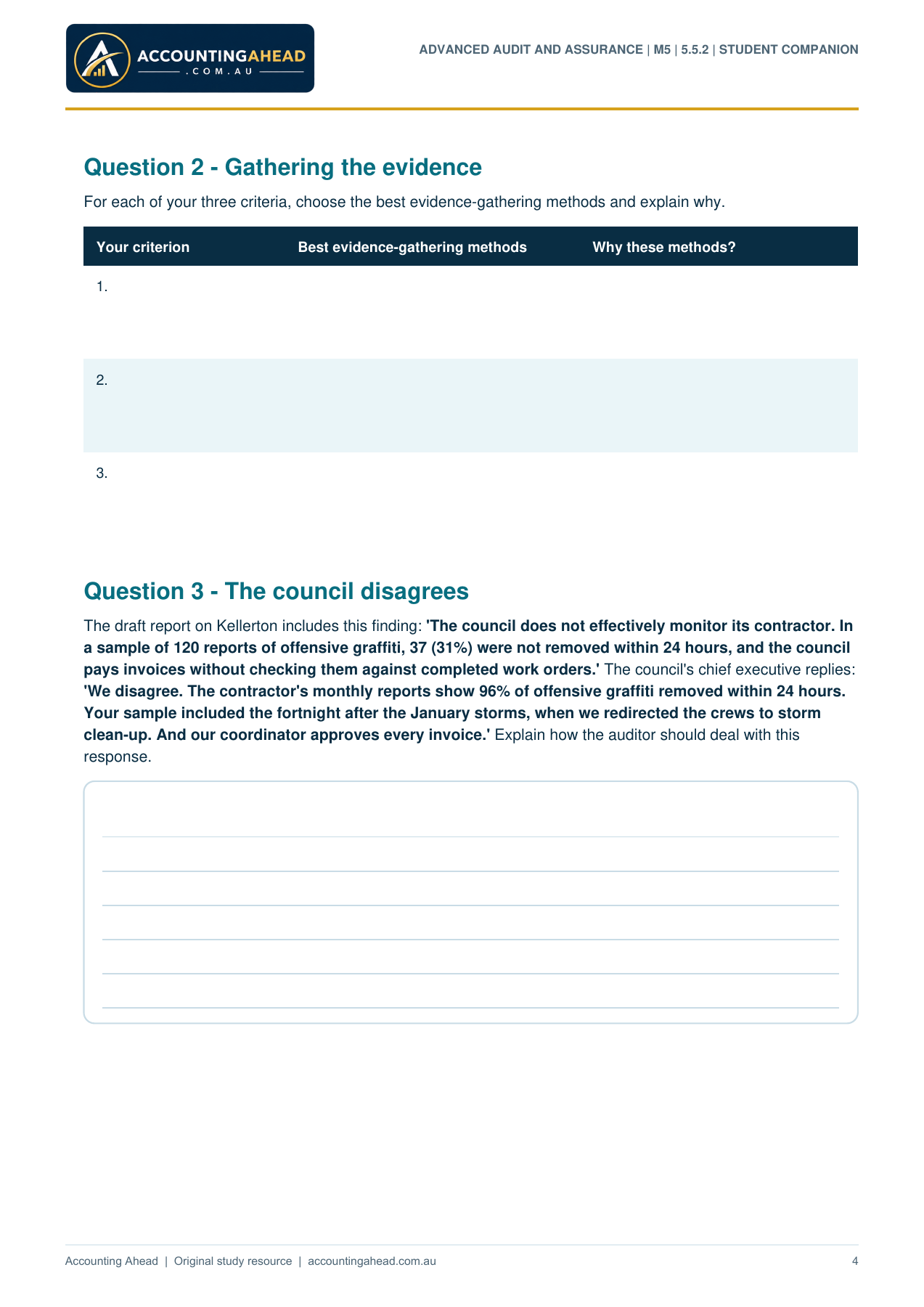
Question 2 - Gathering the evidence
For each of your three criteria, choose the best evidence-gathering methods and explain why.
Your criterion Best evidence-gathering methods Why these methods?
1.
2.
3.
Question 3 - The council disagrees
The draft report on Kellerton includes this finding: 'The council does not effectively monitor its contractor. In
a sample of 120 reports of offensive graffiti, 37 (31%) were not removed within 24 hours, and the council
pays invoices without checking them against completed work orders.' The council's chief executive replies:
'We disagree. The contractor's monthly reports show 96% of offensive graffiti removed within 24 hours.
Your sample included the fortnight after the January storms, when we redirected the crews to storm
clean-up. And our coordinator approves every invoice.' Explain how the auditor should deal with this
response.
ADVANCED AUDIT AND ASSURANCE | M5 | 5.5.2 | STUDENT COMPANION
4
Accounting Ahead | Original study resource | accountingahead.com.au
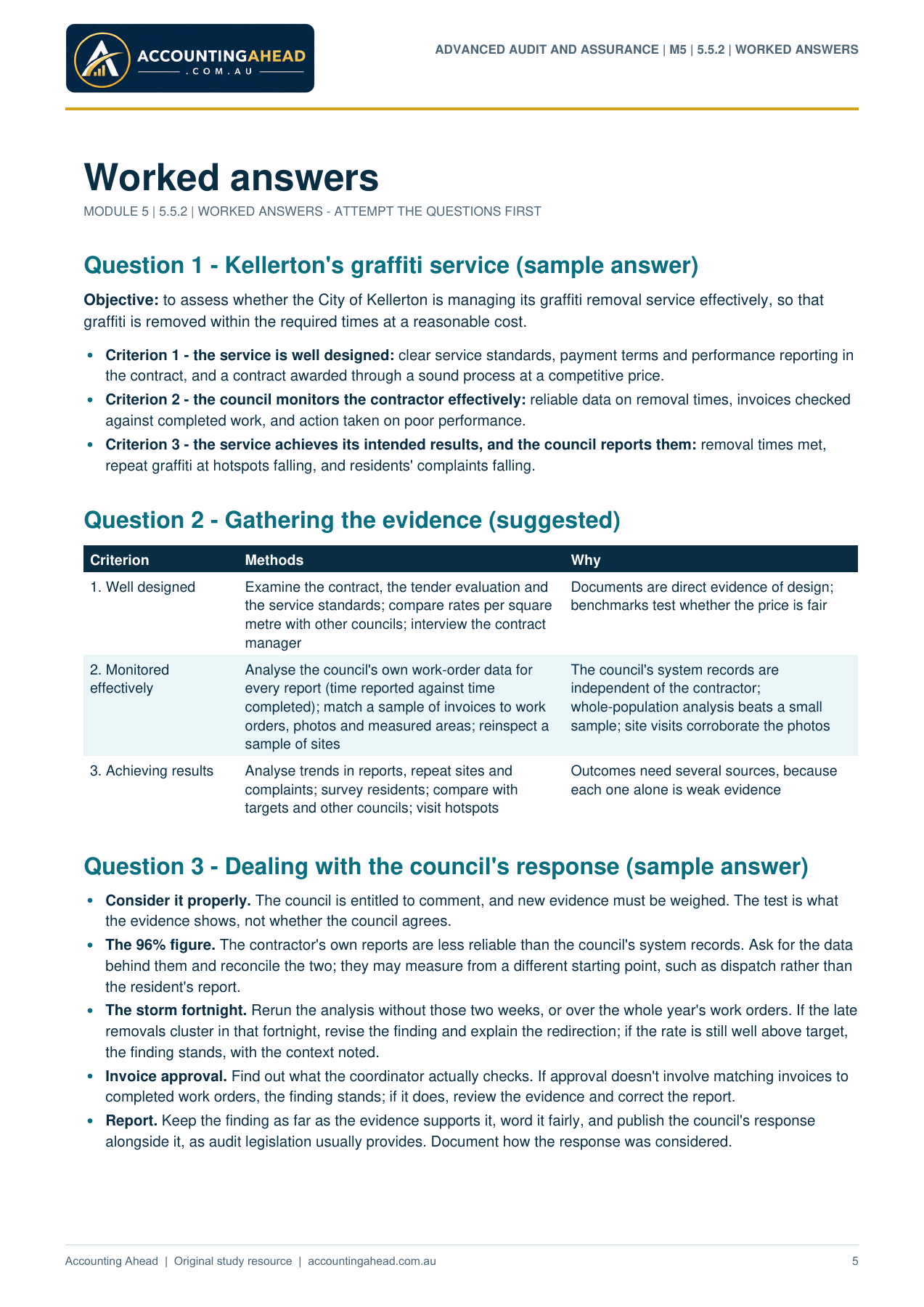
Worked answers
MODULE 5 | 5.5.2 | WORKED ANSWERS - ATTEMPT THE QUESTIONS FIRST
Question 1 - Kellerton's graffiti service (sample answer)
Objective: to assess whether the City of Kellerton is managing its graffiti removal service effectively, so that
graffiti is removed within the required times at a reasonable cost.
Criterion 1 - the service is well designed: clear service standards, payment terms and performance reporting in
the contract, and a contract awarded through a sound process at a competitive price.
Criterion 2 - the council monitors the contractor effectively: reliable data on removal times, invoices checked
against completed work, and action taken on poor performance.
Criterion 3 - the service achieves its intended results, and the council reports them: removal times met,
repeat graffiti at hotspots falling, and residents' complaints falling.
Question 2 - Gathering the evidence (suggested)
Criterion Methods Why
1. Well designed Examine the contract, the tender evaluation and
the service standards; compare rates per square
metre with other councils; interview the contract
manager
Documents are direct evidence of design;
benchmarks test whether the price is fair
2. Monitored
effectively
Analyse the council's own work-order data for
every report (time reported against time
completed); match a sample of invoices to work
orders, photos and measured areas; reinspect a
sample of sites
The council's system records are
independent of the contractor;
whole-population analysis beats a small
sample; site visits corroborate the photos
3. Achieving results Analyse trends in reports, repeat sites and
complaints; survey residents; compare with
targets and other councils; visit hotspots
Outcomes need several sources, because
each one alone is weak evidence
Question 3 - Dealing with the council's response (sample answer)
Consider it properly. The council is entitled to comment, and new evidence must be weighed. The test is what
the evidence shows, not whether the council agrees.
The 96% figure. The contractor's own reports are less reliable than the council's system records. Ask for the data
behind them and reconcile the two; they may measure from a different starting point, such as dispatch rather than
the resident's report.
The storm fortnight. Rerun the analysis without those two weeks, or over the whole year's work orders. If the late
removals cluster in that fortnight, revise the finding and explain the redirection; if the rate is still well above target,
the finding stands, with the context noted.
Invoice approval. Find out what the coordinator actually checks. If approval doesn't involve matching invoices to
completed work orders, the finding stands; if it does, review the evidence and correct the report.
Report. Keep the finding as far as the evidence supports it, word it fairly, and publish the council's response
alongside it, as audit legislation usually provides. Document how the response was considered.
ADVANCED AUDIT AND ASSURANCE | M5 | 5.5.2 | WORKED ANSWERS
5