
Agreed-upon procedures and compilations
Printable study notes, diagrams and practice support for Part 5.6.
Read the handout text
Accounting Ahead | Original study resource | accountingahead.com.au
Agreed-upon procedures and compilations
MODULE 5 | 5.6 | STUDENT COMPANION
Agreed-upon procedures report factual findings, with no opinion and no assurance, so every finding
must be worded objectively; comfort letters work the same way. Compilations use accounting expertise
to help management prepare information, also without assurance, and the practitioner considers
withdrawing if wrong information isn't fixed. Across audits, reviews and these services, assurance falls from
reasonable, to limited, to none.
Agreed-upon procedures
The practitioner performs procedures agreed with the engaging party and reports what it found. Users draw their
own conclusions, so the engaging party must acknowledge that the procedures suit its purpose. Lenders, grant
agencies and franchisors all use them. The international standard, ISRS 4400 (Revised), applies to
engagements agreed from 1 January 2022; Australia's ASRS 4400, issued on 11 December 2020, applies from
the same date.
Key requirements. Judgement still matters when agreeing the terms and procedures, but each procedure must
be capable of objective description, so different practitioners would reach the same findings. Under the
international standard the practitioner needn't be independent unless the terms or the law require it (the report
says whether it is), and the report needn't be restricted. Australia goes further: ASRS 4400 restricts the
report's use to the intended users it identifies, and the report states that the practitioner complied with the
principle of objectivity.
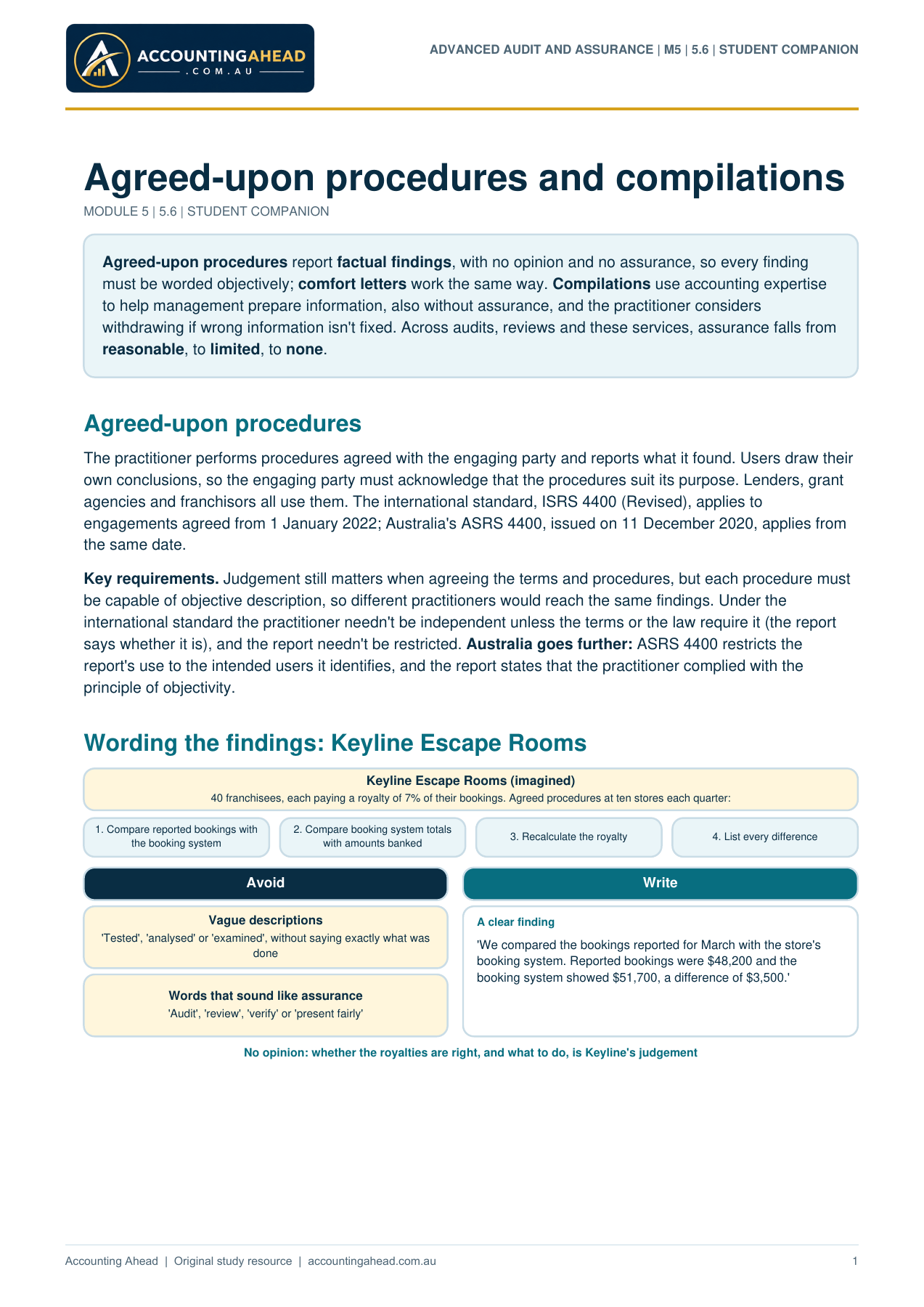
Wording the findings: Keyline Escape Rooms
Keyline Escape Rooms (imagined)
40 franchisees, each paying a royalty of 7% of their bookings. Agreed procedures at ten stores each quarter:
1. Compare reported bookings with
the booking system
2. Compare booking system totals
with amounts banked 3. Recalculate the royalty 4. List every difference
Avoid Write
Vague descriptions
'Tested', 'analysed' or 'examined', without saying exactly what was
done
Words that sound like assurance
'Audit', 'review', 'verify' or 'present fairly'
A clear finding
'We compared the bookings reported for March with the store's
booking system. Reported bookings were $48,200 and the
booking system showed $51,700, a difference of $3,500.'
No opinion: whether the royalties are right, and what to do, is Keyline's judgement
ADVANCED AUDIT AND ASSURANCE | M5 | 5.6 | STUDENT COMPANION
1
Accounting Ahead | Original study resource | accountingahead.com.au
Comfort letters
When a company issues shares or debt to the public, the lead managers and underwriters must show they made
reasonable inquiries about the offer document, so they often ask the company's auditor for a comfort letter.
Under ASRS 4450 Comfort Letter Engagements (issued 30 May 2012, effective 1 July 2013), the auditor reports
factual findings, not assurance, from procedures such as agreeing figures in the offer document with the
accounting records and recalculating ratios. The letter goes only to the board and the requesting parties, such as
underwriters, who sign the engagement letter, and its wording is negotiated so it never implies more comfort
than the work supports.
Compilation engagements
Accounting, not auditing, expertise: helping management prepare and present financial information, such
as a small business's annual statements, under the framework it has chosen. APES 315 governs the work in
Australia, alongside ISRS 4410 (Revised).
No verification, no assurance, but not just a typist: the practitioner understands the business and the
framework, reads the information for obvious errors, and asks management to correct records it finds
incomplete, inaccurate or misleading.
If management refuses: the international standard requires the practitioner to withdraw; APES 315 requires
it to decide, under its firm's policies, whether it can keep acting.
Has anyone checked compiled statements? Not in the assurance sense: management stays responsible,
and the report says no audit or review was performed and no opinion is expressed. A reader who needs
assurance needs a review or an audit.
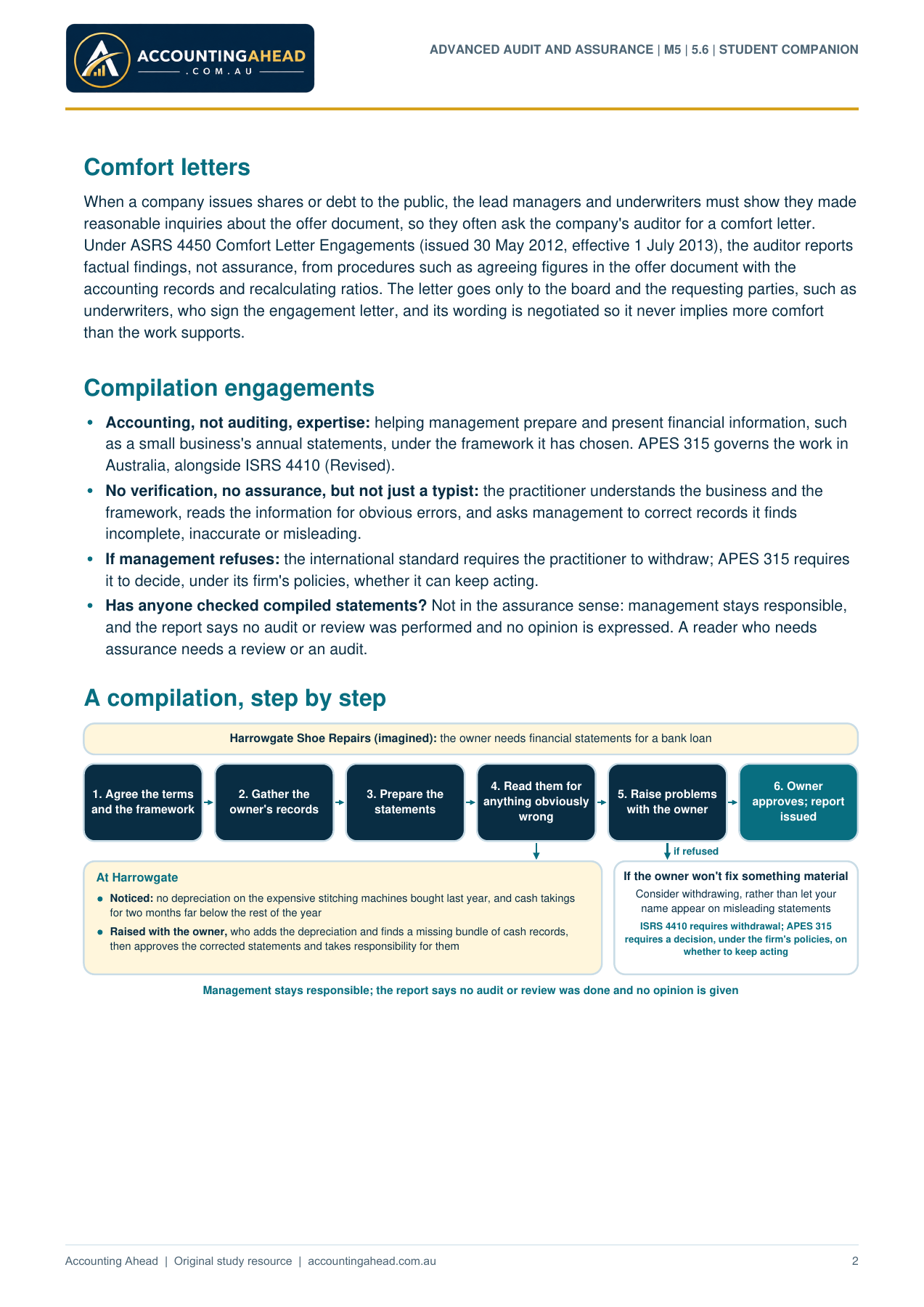
A compilation, step by step
Harrowgate Shoe Repairs (imagined): the owner needs financial statements for a bank loan
1. Agree the terms
and the framework
2. Gather the
owner's records
3. Prepare the
statements
4. Read them for
anything obviously
wrong
5. Raise problems
with the owner
6. Owner
approves; report
issued
if refused
At Harrowgate
Noticed: no depreciation on the expensive stitching machines bought last year, and cash takings
for two months far below the rest of the year
Raised with the owner, who adds the depreciation and finds a missing bundle of cash records,
then approves the corrected statements and takes responsibility for them
If the owner won't fix something material
Consider withdrawing, rather than let your
name appear on misleading statements
ISRS 4410 requires withdrawal; APES 315
requires a decision, under the firm's policies, on
whether to keep acting
Management stays responsible; the report says no audit or review was done and no opinion is given
ADVANCED AUDIT AND ASSURANCE | M5 | 5.6 | STUDENT COMPANION
2
Accounting Ahead | Original study resource | accountingahead.com.au
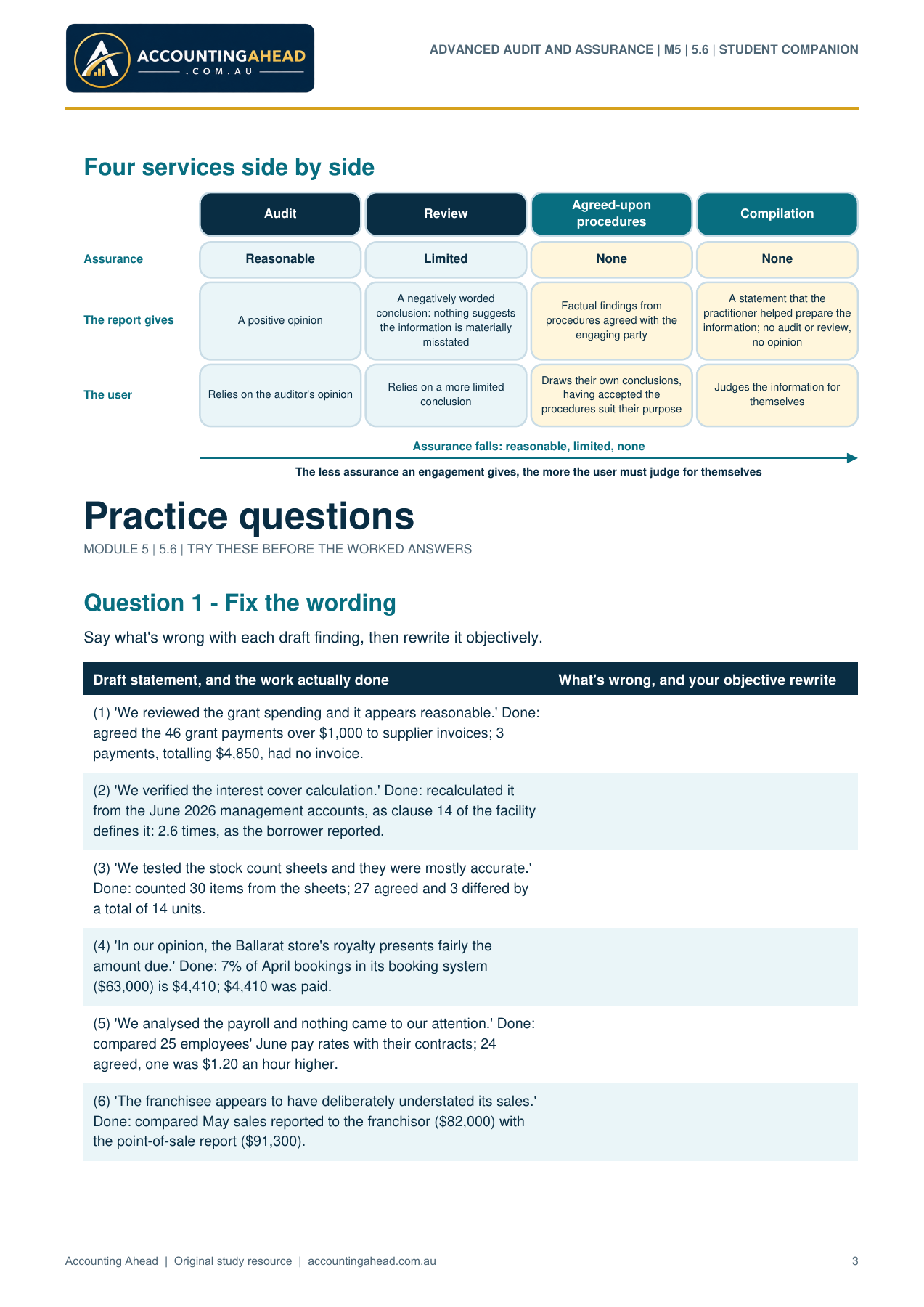
Four services side by side
Audit Review Agreed-upon
procedures Compilation
Assurance Reasonable Limited None None
The report gives A positive opinion
A negatively worded
conclusion: nothing suggests
the information is materially
misstated
Factual findings from
procedures agreed with the
engaging party
A statement that the
practitioner helped prepare the
information; no audit or review,
no opinion
The user Relies on the auditor's opinion Relies on a more limited
conclusion
Draws their own conclusions,
having accepted the
procedures suit their purpose
Judges the information for
themselves
Assurance falls: reasonable, limited, none
The less assurance an engagement gives, the more the user must judge for themselves
Practice questions
MODULE 5 | 5.6 | TRY THESE BEFORE THE WORKED ANSWERS
Question 1 - Fix the wording
Say what's wrong with each draft finding, then rewrite it objectively.
Draft statement, and the work actually done What's wrong, and your objective rewrite
(1) 'We reviewed the grant spending and it appears reasonable.' Done:
agreed the 46 grant payments over $1,000 to supplier invoices; 3
payments, totalling $4,850, had no invoice.
(2) 'We verified the interest cover calculation.' Done: recalculated it
from the June 2026 management accounts, as clause 14 of the facility
defines it: 2.6 times, as the borrower reported.
(3) 'We tested the stock count sheets and they were mostly accurate.'
Done: counted 30 items from the sheets; 27 agreed and 3 differed by
a total of 14 units.
(4) 'In our opinion, the Ballarat store's royalty presents fairly the
amount due.' Done: 7% of April bookings in its booking system
($63,000) is $4,410; $4,410 was paid.
(5) 'We analysed the payroll and nothing came to our attention.' Done:
compared 25 employees' June pay rates with their contracts; 24
agreed, one was $1.20 an hour higher.
(6) 'The franchisee appears to have deliberately understated its sales.'
Done: compared May sales reported to the franchisor ($82,000) with
the point-of-sale report ($91,300).
ADVANCED AUDIT AND ASSURANCE | M5 | 5.6 | STUDENT COMPANION
3
Accounting Ahead | Original study resource | accountingahead.com.au
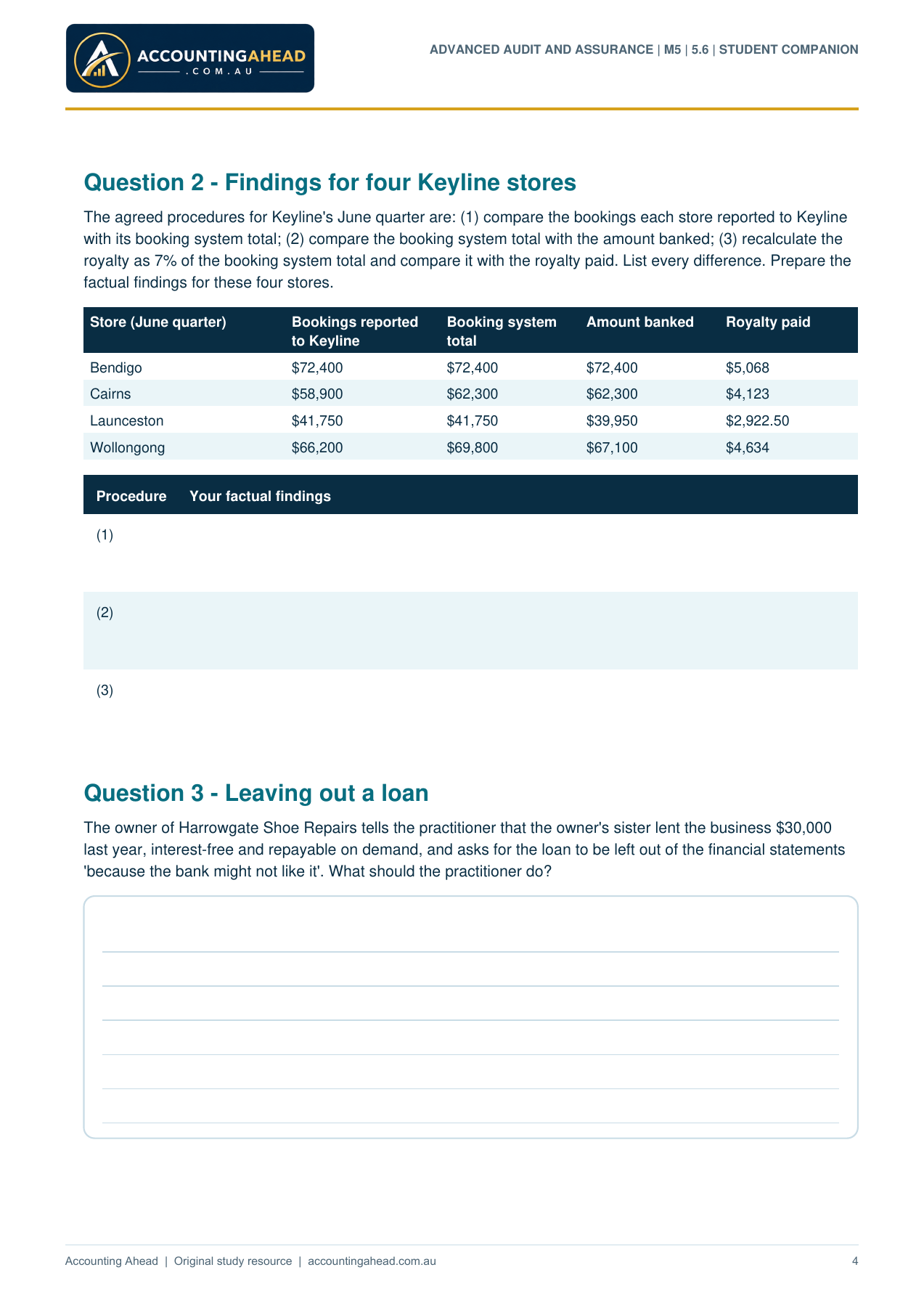
Question 2 - Findings for four Keyline stores
The agreed procedures for Keyline's June quarter are: (1) compare the bookings each store reported to Keyline
with its booking system total; (2) compare the booking system total with the amount banked; (3) recalculate the
royalty as 7% of the booking system total and compare it with the royalty paid. List every difference. Prepare the
factual findings for these four stores.
Store (June quarter) Bookings reported
to Keyline
Booking system
total
Amount banked Royalty paid
Bendigo $72,400 $72,400 $72,400 $5,068
Cairns $58,900 $62,300 $62,300 $4,123
Launceston $41,750 $41,750 $39,950 $2,922.50
Wollongong $66,200 $69,800 $67,100 $4,634
Procedure Your factual findings
(1)
(2)
(3)
Question 3 - Leaving out a loan
The owner of Harrowgate Shoe Repairs tells the practitioner that the owner's sister lent the business $30,000
last year, interest-free and repayable on demand, and asks for the loan to be left out of the financial statements
'because the bank might not like it'. What should the practitioner do?
ADVANCED AUDIT AND ASSURANCE | M5 | 5.6 | STUDENT COMPANION
4
Accounting Ahead | Original study resource | accountingahead.com.au
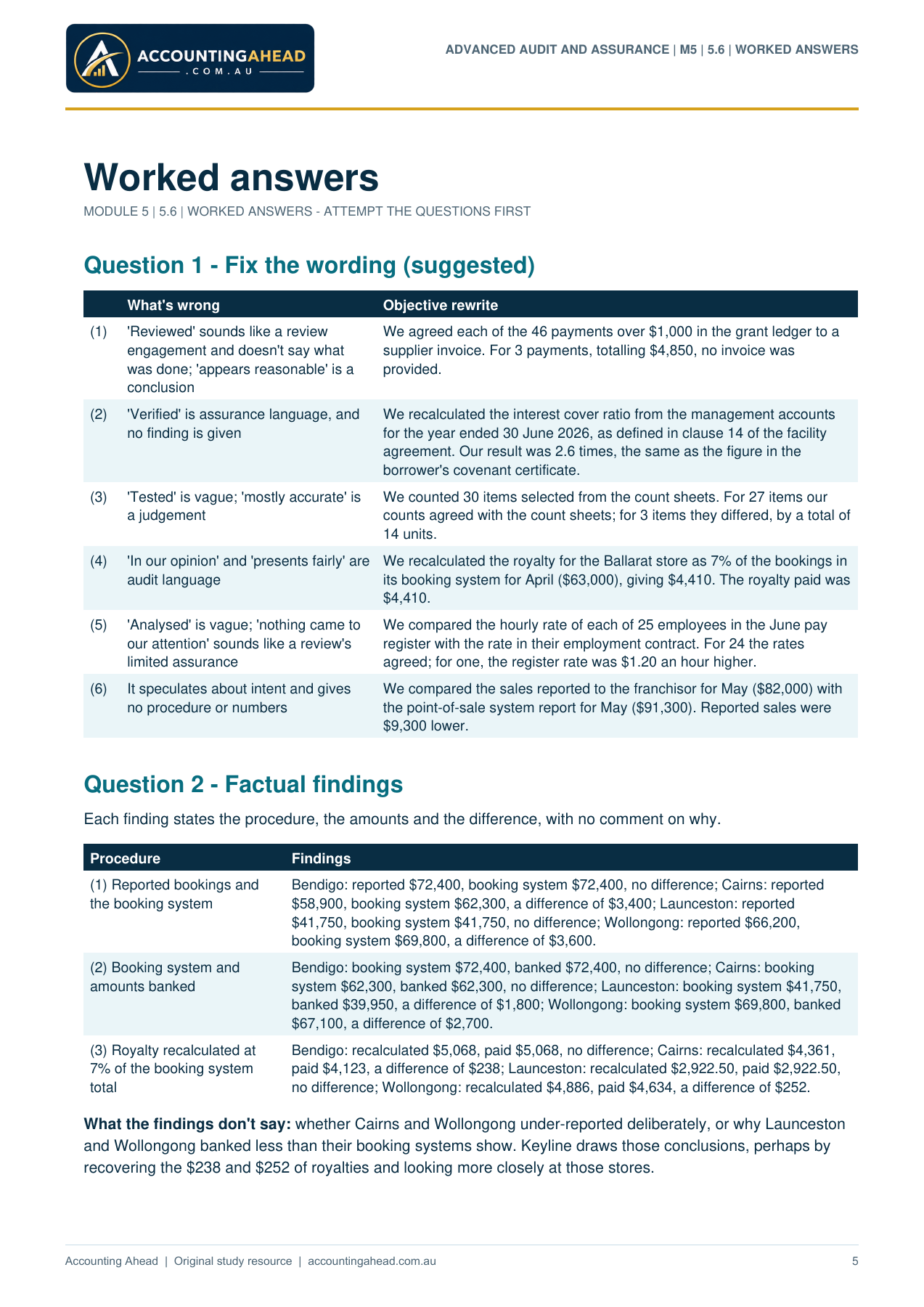
Worked answers
MODULE 5 | 5.6 | WORKED ANSWERS - ATTEMPT THE QUESTIONS FIRST
Question 1 - Fix the wording (suggested)
What's wrong Objective rewrite
(1) 'Reviewed' sounds like a review
engagement and doesn't say what
was done; 'appears reasonable' is a
conclusion
We agreed each of the 46 payments over $1,000 in the grant ledger to a
supplier invoice. For 3 payments, totalling $4,850, no invoice was
provided.
(2) 'Verified' is assurance language, and
no finding is given
We recalculated the interest cover ratio from the management accounts
for the year ended 30 June 2026, as defined in clause 14 of the facility
agreement. Our result was 2.6 times, the same as the figure in the
borrower's covenant certificate.
(3) 'Tested' is vague; 'mostly accurate' is
a judgement
We counted 30 items selected from the count sheets. For 27 items our
counts agreed with the count sheets; for 3 items they differed, by a total of
14 units.
(4) 'In our opinion' and 'presents fairly' are
audit language
We recalculated the royalty for the Ballarat store as 7% of the bookings in
its booking system for April ($63,000), giving $4,410. The royalty paid was
$4,410.
(5) 'Analysed' is vague; 'nothing came to
our attention' sounds like a review's
limited assurance
We compared the hourly rate of each of 25 employees in the June pay
register with the rate in their employment contract. For 24 the rates
agreed; for one, the register rate was $1.20 an hour higher.
(6) It speculates about intent and gives
no procedure or numbers
We compared the sales reported to the franchisor for May ($82,000) with
the point-of-sale system report for May ($91,300). Reported sales were
$9,300 lower.
Question 2 - Factual findings
Each finding states the procedure, the amounts and the difference, with no comment on why.
Procedure Findings
(1) Reported bookings and
the booking system
Bendigo: reported $72,400, booking system $72,400, no difference; Cairns: reported
$58,900, booking system $62,300, a difference of $3,400; Launceston: reported
$41,750, booking system $41,750, no difference; Wollongong: reported $66,200,
booking system $69,800, a difference of $3,600.
(2) Booking system and
amounts banked
Bendigo: booking system $72,400, banked $72,400, no difference; Cairns: booking
system $62,300, banked $62,300, no difference; Launceston: booking system $41,750,
banked $39,950, a difference of $1,800; Wollongong: booking system $69,800, banked
$67,100, a difference of $2,700.
(3) Royalty recalculated at
7% of the booking system
total
Bendigo: recalculated $5,068, paid $5,068, no difference; Cairns: recalculated $4,361,
paid $4,123, a difference of $238; Launceston: recalculated $2,922.50, paid $2,922.50,
no difference; Wollongong: recalculated $4,886, paid $4,634, a difference of $252.
What the findings don't say: whether Cairns and Wollongong under-reported deliberately, or why Launceston
and Wollongong banked less than their booking systems show. Keyline draws those conclusions, perhaps by
recovering the $238 and $252 of royalties and looking more closely at those stores.
ADVANCED AUDIT AND ASSURANCE | M5 | 5.6 | WORKED ANSWERS
5
Accounting Ahead | Original study resource | accountingahead.com.au
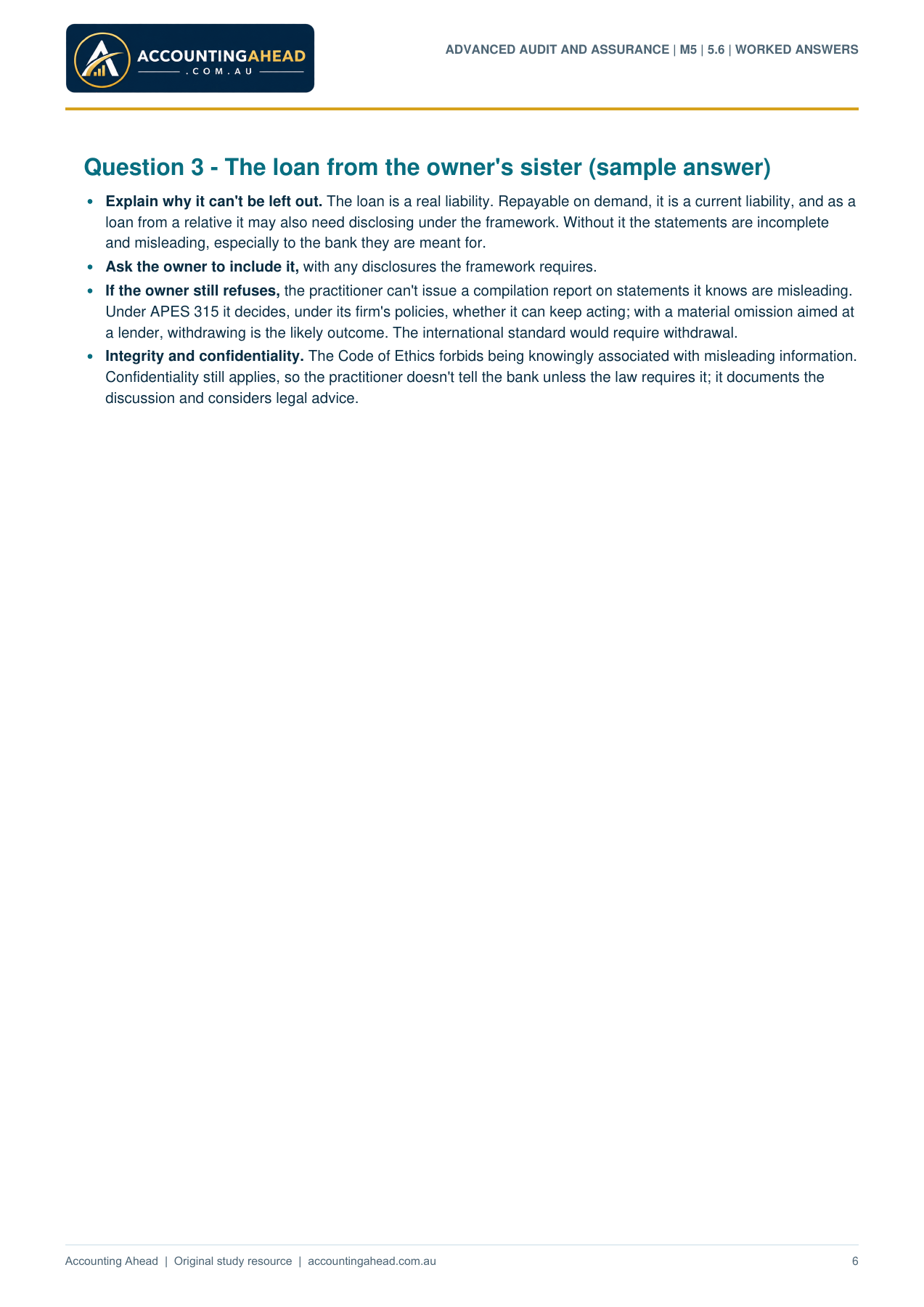
Question 3 - The loan from the owner's sister (sample answer)
Explain why it can't be left out. The loan is a real liability. Repayable on demand, it is a current liability, and as a
loan from a relative it may also need disclosing under the framework. Without it the statements are incomplete
and misleading, especially to the bank they are meant for.
Ask the owner to include it, with any disclosures the framework requires.
If the owner still refuses, the practitioner can't issue a compilation report on statements it knows are misleading.
Under APES 315 it decides, under its firm's policies, whether it can keep acting; with a material omission aimed at
a lender, withdrawing is the likely outcome. The international standard would require withdrawal.
Integrity and confidentiality. The Code of Ethics forbids being knowingly associated with misleading information.
Confidentiality still applies, so the practitioner doesn't tell the bank unless the law requires it; it documents the
discussion and considers legal advice.
ADVANCED AUDIT AND ASSURANCE | M5 | 5.6 | WORKED ANSWERS
6