
ASX governance principles in practice — study companion
Apply the eight ASX principles and distinguish a reasoned departure from a breach of law. Includes structured notes, practice questions and worked answers.
Read the handout text
Accounting Ahead | Original study resource | accountingahead.com.au
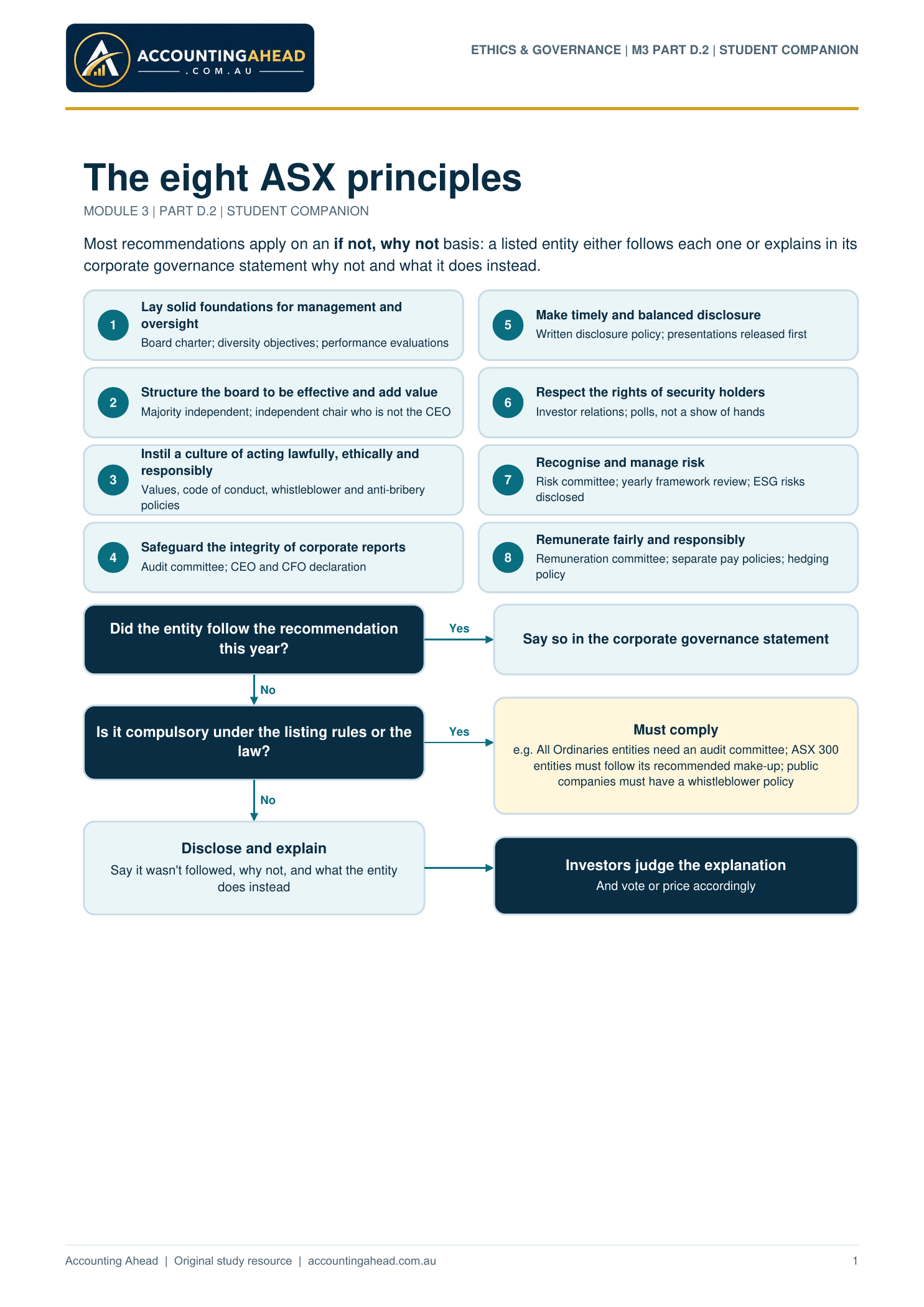
The eight ASX principles
MODULE 3 | PART D.2 | STUDENT COMPANION
Most recommendations apply on an if not, why not basis: a listed entity either follows each one or explains in its
corporate governance statement why not and what it does instead.
1
Lay solid foundations for management and
oversight
Board charter; diversity objectives; performance evaluations
2 Structure the board to be effective and add value
Majority independent; independent chair who is not the CEO
3
Instil a culture of acting lawfully, ethically and
responsibly
Values, code of conduct, whistleblower and anti-bribery
policies
4 Safeguard the integrity of corporate reports
Audit committee; CEO and CFO declaration
5 Make timely and balanced disclosure
Written disclosure policy; presentations released first
6 Respect the rights of security holders
Investor relations; polls, not a show of hands
7
Recognise and manage risk
Risk committee; yearly framework review; ESG risks
disclosed
8
Remunerate fairly and responsibly
Remuneration committee; separate pay policies; hedging
policy
Did the entity follow the recommendation
this year?
Yes
Say so in the corporate governance statement
No
Is it compulsory under the listing rules or the
law?
Yes Must comply
e.g. All Ordinaries entities need an audit committee; ASX 300
entities must follow its recommended make-up; public
companies must have a whistleblower policy
No
Disclose and explain
Say it wasn't followed, why not, and what the entity
does instead
Investors judge the explanation
And vote or price accordingly
ETHICS & GOVERNANCE | M3 PART D.2 | STUDENT COMPANION
1
Accounting Ahead | Original study resource | accountingahead.com.au
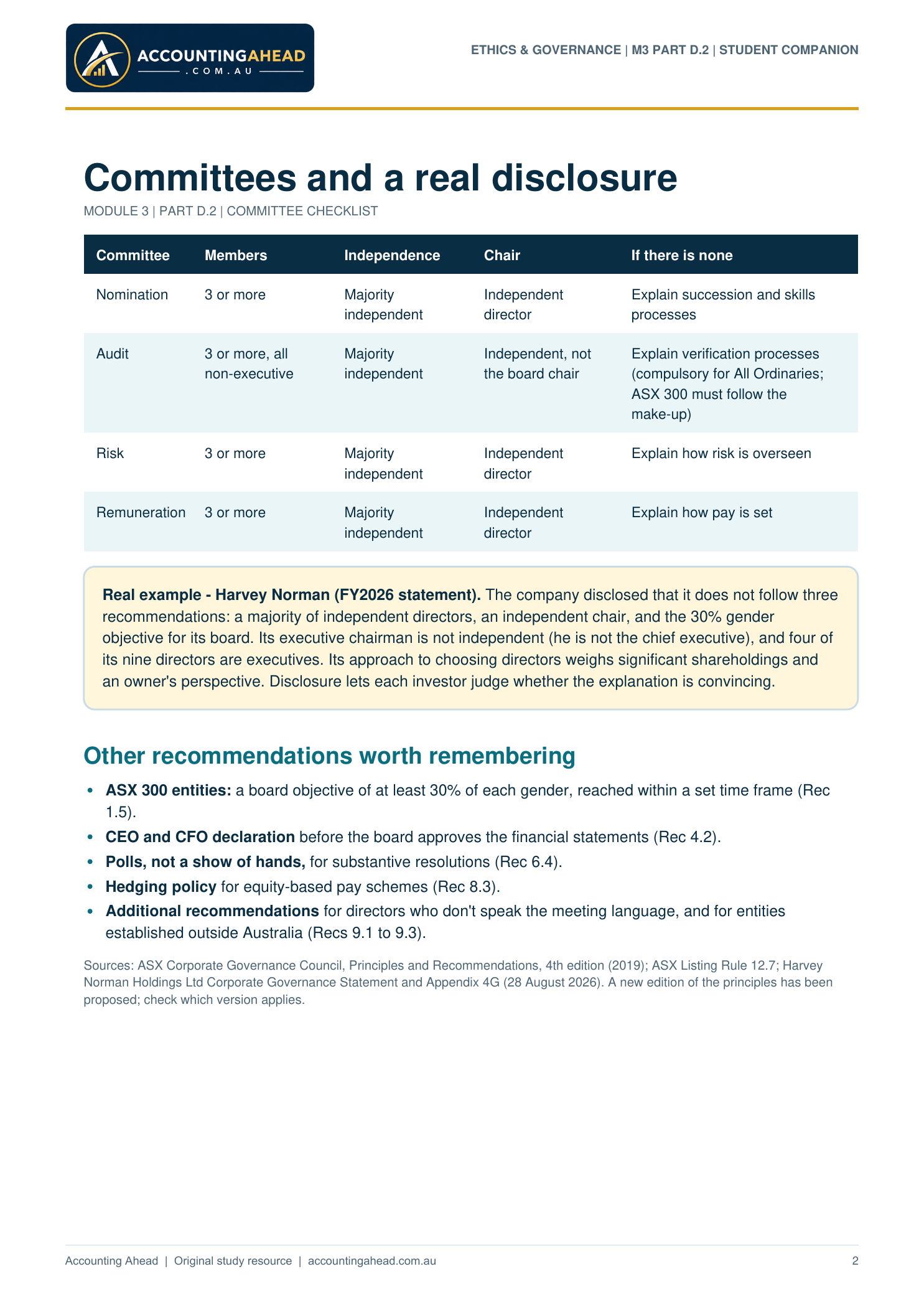
Committees and a real disclosure
MODULE 3 | PART D.2 | COMMITTEE CHECKLIST
Committee Members Independence Chair If there is none
Nomination 3 or more Majority
independent
Independent
director
Explain succession and skills
processes
Audit 3 or more, all
non-executive
Majority
independent
Independent, not
the board chair
Explain verification processes
(compulsory for All Ordinaries;
ASX 300 must follow the
make-up)
Risk 3 or more Majority
independent
Independent
director
Explain how risk is overseen
Remuneration 3 or more Majority
independent
Independent
director
Explain how pay is set
Real example - Harvey Norman (FY2026 statement). The company disclosed that it does not follow three
recommendations: a majority of independent directors, an independent chair, and the 30% gender
objective for its board. Its executive chairman is not independent (he is not the chief executive), and four of
its nine directors are executives. Its approach to choosing directors weighs significant shareholdings and
an owner's perspective. Disclosure lets each investor judge whether the explanation is convincing.
Other recommendations worth remembering
ASX 300 entities: a board objective of at least 30% of each gender, reached within a set time frame (Rec
1.5).
CEO and CFO declaration before the board approves the financial statements (Rec 4.2).
Polls, not a show of hands, for substantive resolutions (Rec 6.4).
Hedging policy for equity-based pay schemes (Rec 8.3).
Additional recommendations for directors who don't speak the meeting language, and for entities
established outside Australia (Recs 9.1 to 9.3).
Sources: ASX Corporate Governance Council, Principles and Recommendations, 4th edition (2019); ASX Listing Rule 12.7; Harvey
Norman Holdings Ltd Corporate Governance Statement and Appendix 4G (28 August 2026). A new edition of the principles has been
proposed; check which version applies.
ETHICS & GOVERNANCE | M3 PART D.2 | STUDENT COMPANION
2
Accounting Ahead | Original study resource | accountingahead.com.au
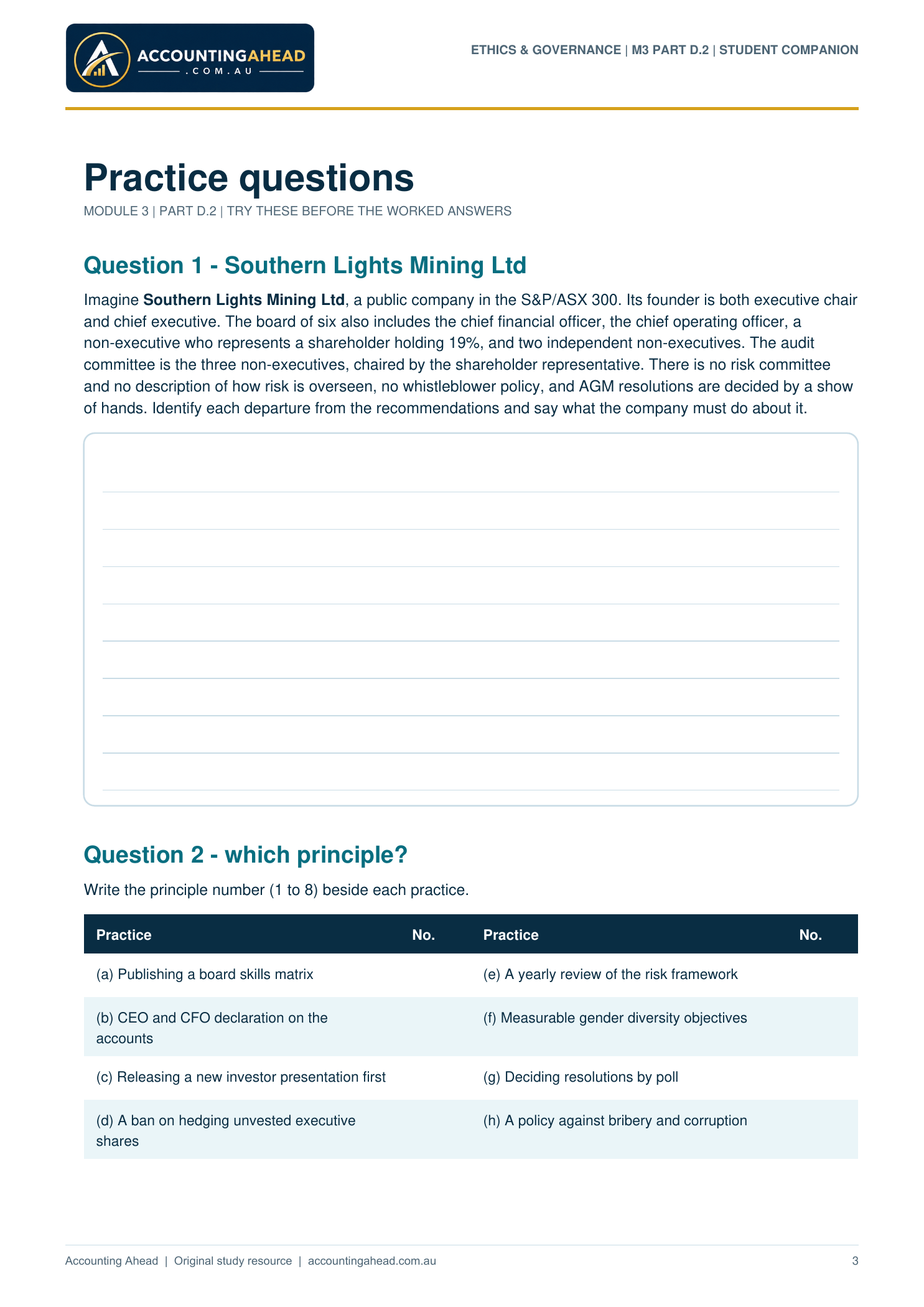
Practice questions
MODULE 3 | PART D.2 | TRY THESE BEFORE THE WORKED ANSWERS
Question 1 - Southern Lights Mining Ltd
Imagine Southern Lights Mining Ltd, a public company in the S&P/ASX 300. Its founder is both executive chair
and chief executive. The board of six also includes the chief financial officer, the chief operating officer, a
non-executive who represents a shareholder holding 19%, and two independent non-executives. The audit
committee is the three non-executives, chaired by the shareholder representative. There is no risk committee
and no description of how risk is overseen, no whistleblower policy, and AGM resolutions are decided by a show
of hands. Identify each departure from the recommendations and say what the company must do about it.
Question 2 - which principle?
Write the principle number (1 to 8) beside each practice.
Practice No. Practice No.
(a) Publishing a board skills matrix (e) A yearly review of the risk framework
(b) CEO and CFO declaration on the
accounts
(f) Measurable gender diversity objectives
(c) Releasing a new investor presentation first (g) Deciding resolutions by poll
(d) A ban on hedging unvested executive
shares
(h) A policy against bribery and corruption
ETHICS & GOVERNANCE | M3 PART D.2 | STUDENT COMPANION
3
Accounting Ahead | Original study resource | accountingahead.com.au
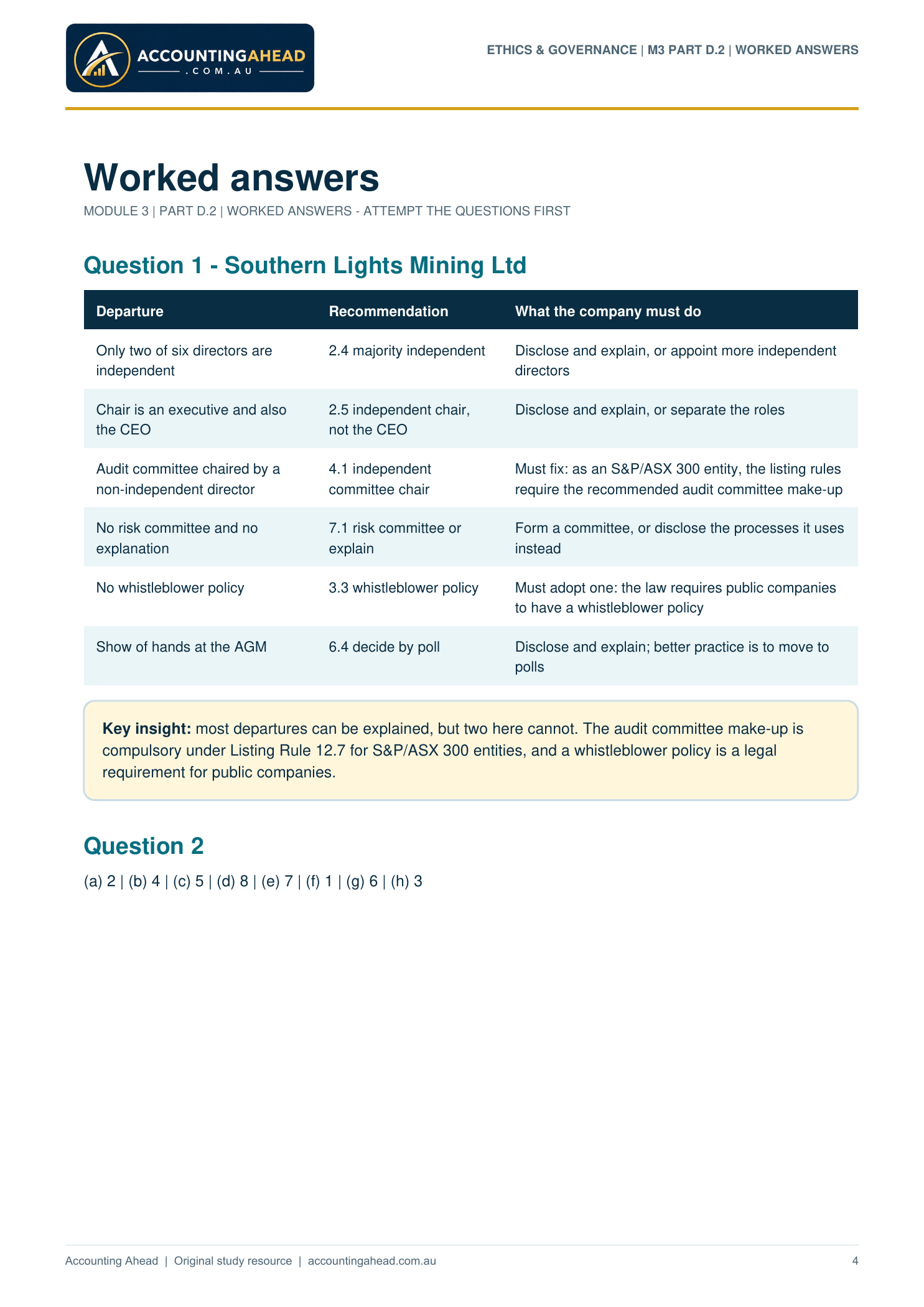
Worked answers
MODULE 3 | PART D.2 | WORKED ANSWERS - ATTEMPT THE QUESTIONS FIRST
Question 1 - Southern Lights Mining Ltd
Departure Recommendation What the company must do
Only two of six directors are
independent
2.4 majority independent Disclose and explain, or appoint more independent
directors
Chair is an executive and also
the CEO
2.5 independent chair,
not the CEO
Disclose and explain, or separate the roles
Audit committee chaired by a
non-independent director
4.1 independent
committee chair
Must fix: as an S&P/ASX 300 entity, the listing rules
require the recommended audit committee make-up
No risk committee and no
explanation
7.1 risk committee or
explain
Form a committee, or disclose the processes it uses
instead
No whistleblower policy 3.3 whistleblower policy Must adopt one: the law requires public companies
to have a whistleblower policy
Show of hands at the AGM 6.4 decide by poll Disclose and explain; better practice is to move to
polls
Key insight: most departures can be explained, but two here cannot. The audit committee make-up is
compulsory under Listing Rule 12.7 for S&P/ASX 300 entities, and a whistleblower policy is a legal
requirement for public companies.
Question 2
(a) 2 | (b) 4 | (c) 5 | (d) 8 | (e) 7 | (f) 1 | (g) 6 | (h) 3
ETHICS & GOVERNANCE | M3 PART D.2 | WORKED ANSWERS
4