
Corporations and company types — study companion
Compare company features, liability types and the distinctions between proprietary, public and listed companies. Includes structured notes, practice questions and worked answers.
Read the handout text
Accounting Ahead | Original study resource | accountingahead.com.au
What makes a company different
MODULE 3 | PART A.1 | STUDENT COMPANION
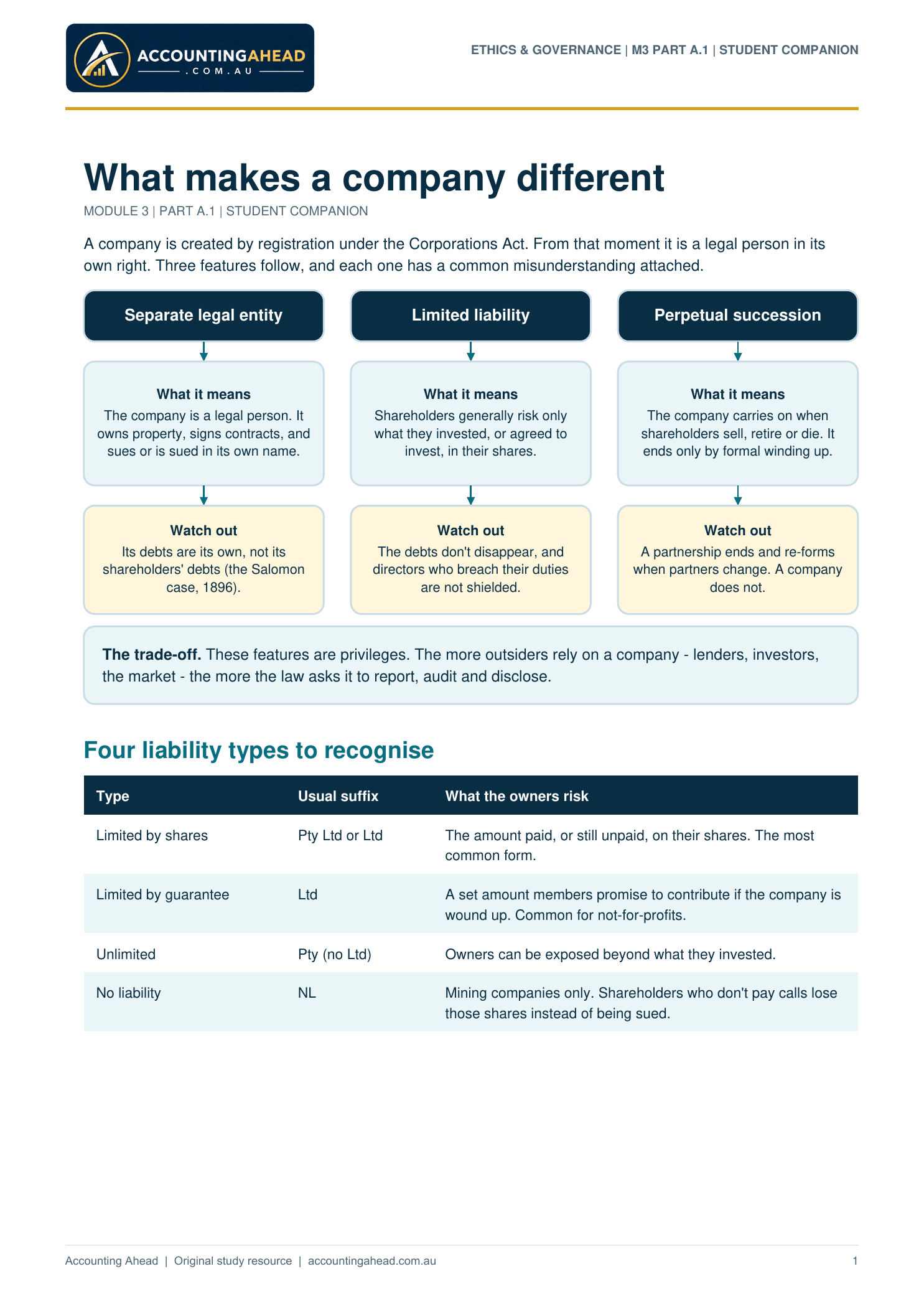
A company is created by registration under the Corporations Act. From that moment it is a legal person in its
own right. Three features follow, and each one has a common misunderstanding attached.
Separate legal entity
What it means
The company is a legal person. It
owns property, signs contracts, and
sues or is sued in its own name.
Watch out
Its debts are its own, not its
shareholders' debts (the Salomon
case, 1896).
Limited liability
What it means
Shareholders generally risk only
what they invested, or agreed to
invest, in their shares.
Watch out
The debts don't disappear, and
directors who breach their duties
are not shielded.
Perpetual succession
What it means
The company carries on when
shareholders sell, retire or die. It
ends only by formal winding up.
Watch out
A partnership ends and re-forms
when partners change. A company
does not.
The trade-off. These features are privileges. The more outsiders rely on a company - lenders, investors,
the market - the more the law asks it to report, audit and disclose.
Four liability types to recognise
Type Usual suffix What the owners risk
Limited by shares Pty Ltd or Ltd The amount paid, or still unpaid, on their shares. The most
common form.
Limited by guarantee Ltd A set amount members promise to contribute if the company is
wound up. Common for not-for-profits.
Unlimited Pty (no Ltd) Owners can be exposed beyond what they invested.
No liability NL Mining companies only. Shareholders who don't pay calls lose
those shares instead of being sued.
ETHICS & GOVERNANCE | M3 PART A.1 | STUDENT COMPANION
1
Accounting Ahead | Original study resource | accountingahead.com.au
Which kind of company?
MODULE 3 | PART A.1 | DECISION FLOWCHART
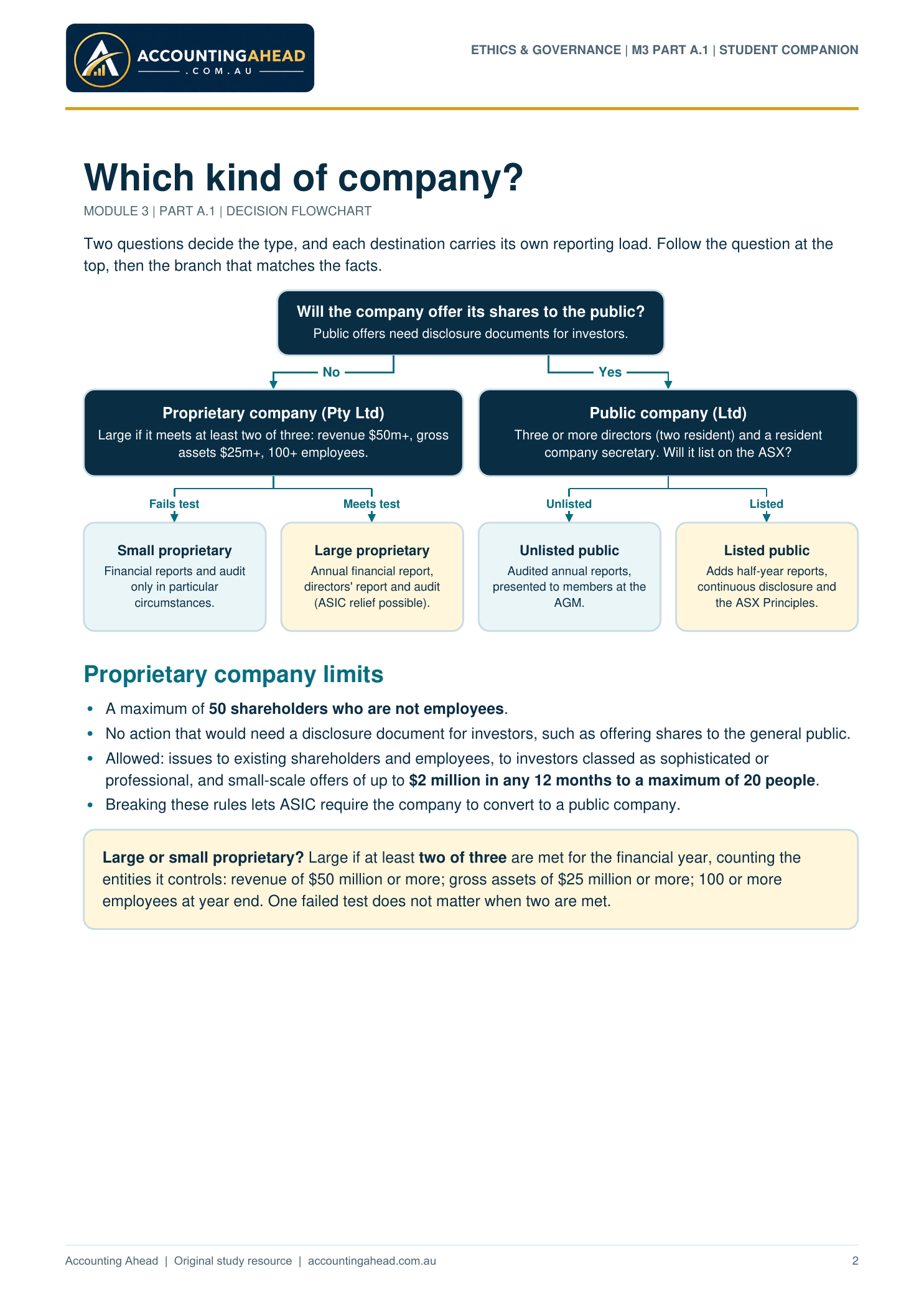
Two questions decide the type, and each destination carries its own reporting load. Follow the question at the
top, then the branch that matches the facts.
Will the company offer its shares to the public?
Public offers need disclosure documents for investors.
No Yes
Proprietary company (Pty Ltd)
Large if it meets at least two of three: revenue $50m+, gross
assets $25m+, 100+ employees.
Public company (Ltd)
Three or more directors (two resident) and a resident
company secretary. Will it list on the ASX?
Fails test Meets test Unlisted Listed
Small proprietary
Financial reports and audit
only in particular
circumstances.
Large proprietary
Annual financial report,
directors' report and audit
(ASIC relief possible).
Unlisted public
Audited annual reports,
presented to members at the
AGM.
Listed public
Adds half-year reports,
continuous disclosure and
the ASX Principles.
Proprietary company limits
A maximum of 50 shareholders who are not employees.
No action that would need a disclosure document for investors, such as offering shares to the general public.
Allowed: issues to existing shareholders and employees, to investors classed as sophisticated or
professional, and small-scale offers of up to $2 million in any 12 months to a maximum of 20 people.
Breaking these rules lets ASIC require the company to convert to a public company.
Large or small proprietary? Large if at least two of three are met for the financial year, counting the
entities it controls: revenue of $50 million or more; gross assets of $25 million or more; 100 or more
employees at year end. One failed test does not matter when two are met.
ETHICS & GOVERNANCE | M3 PART A.1 | STUDENT COMPANION
2
Accounting Ahead | Original study resource | accountingahead.com.au
Practice questions
MODULE 3 | PART A.1 | TRY THESE BEFORE THE WORKED ANSWERS
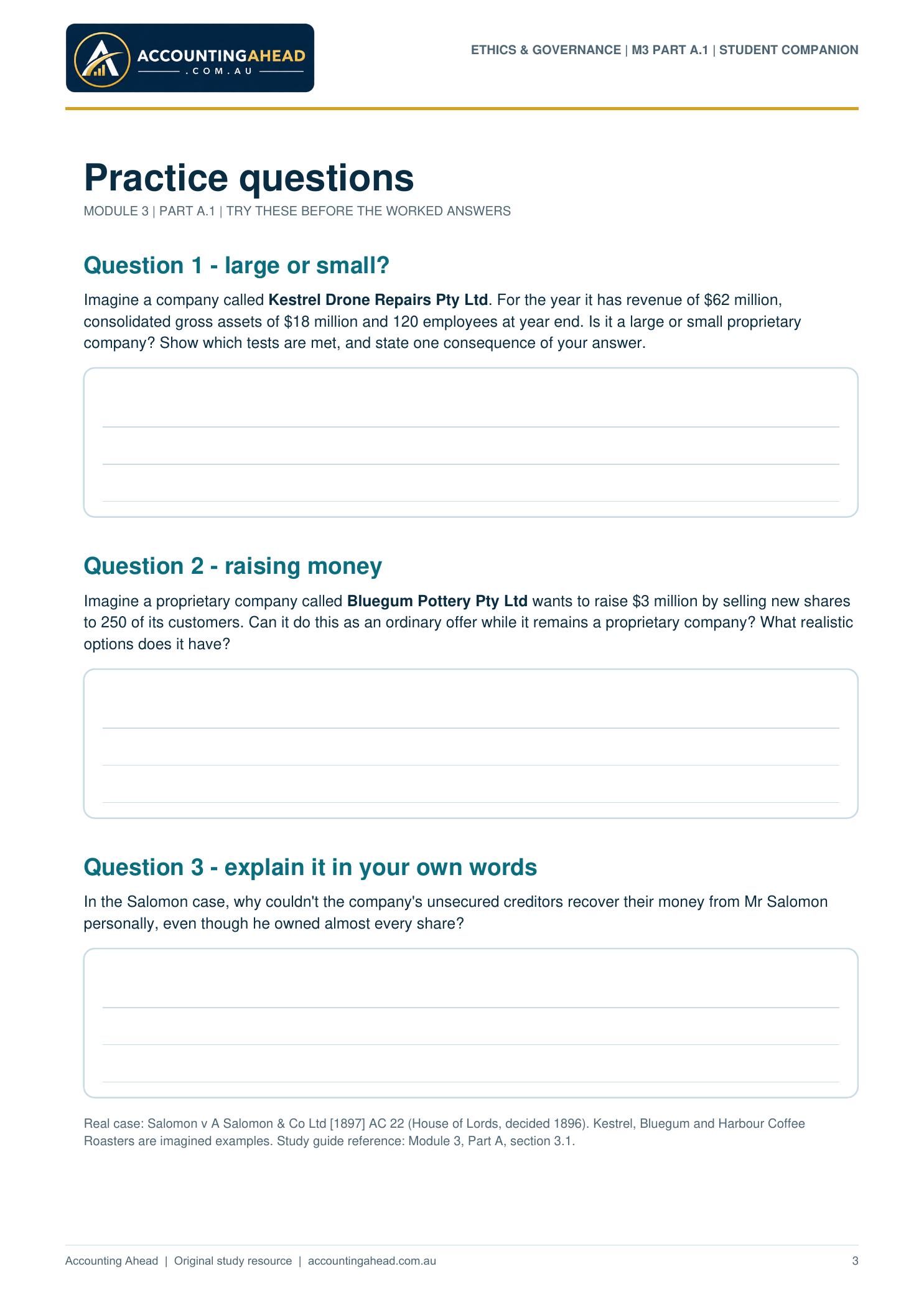
Question 1 - large or small?
Imagine a company called Kestrel Drone Repairs Pty Ltd. For the year it has revenue of $62 million,
consolidated gross assets of $18 million and 120 employees at year end. Is it a large or small proprietary
company? Show which tests are met, and state one consequence of your answer.
Question 2 - raising money
Imagine a proprietary company called Bluegum Pottery Pty Ltd wants to raise $3 million by selling new shares
to 250 of its customers. Can it do this as an ordinary offer while it remains a proprietary company? What realistic
options does it have?
Question 3 - explain it in your own words
In the Salomon case, why couldn't the company's unsecured creditors recover their money from Mr Salomon
personally, even though he owned almost every share?
Real case: Salomon v A Salomon & Co Ltd [1897] AC 22 (House of Lords, decided 1896). Kestrel, Bluegum and Harbour Coffee
Roasters are imagined examples. Study guide reference: Module 3, Part A, section 3.1.
ETHICS & GOVERNANCE | M3 PART A.1 | STUDENT COMPANION
3
Accounting Ahead | Original study resource | accountingahead.com.au
Worked answers
MODULE 3 | PART A.1 | WORKED ANSWERS - ATTEMPT THE QUESTIONS FIRST
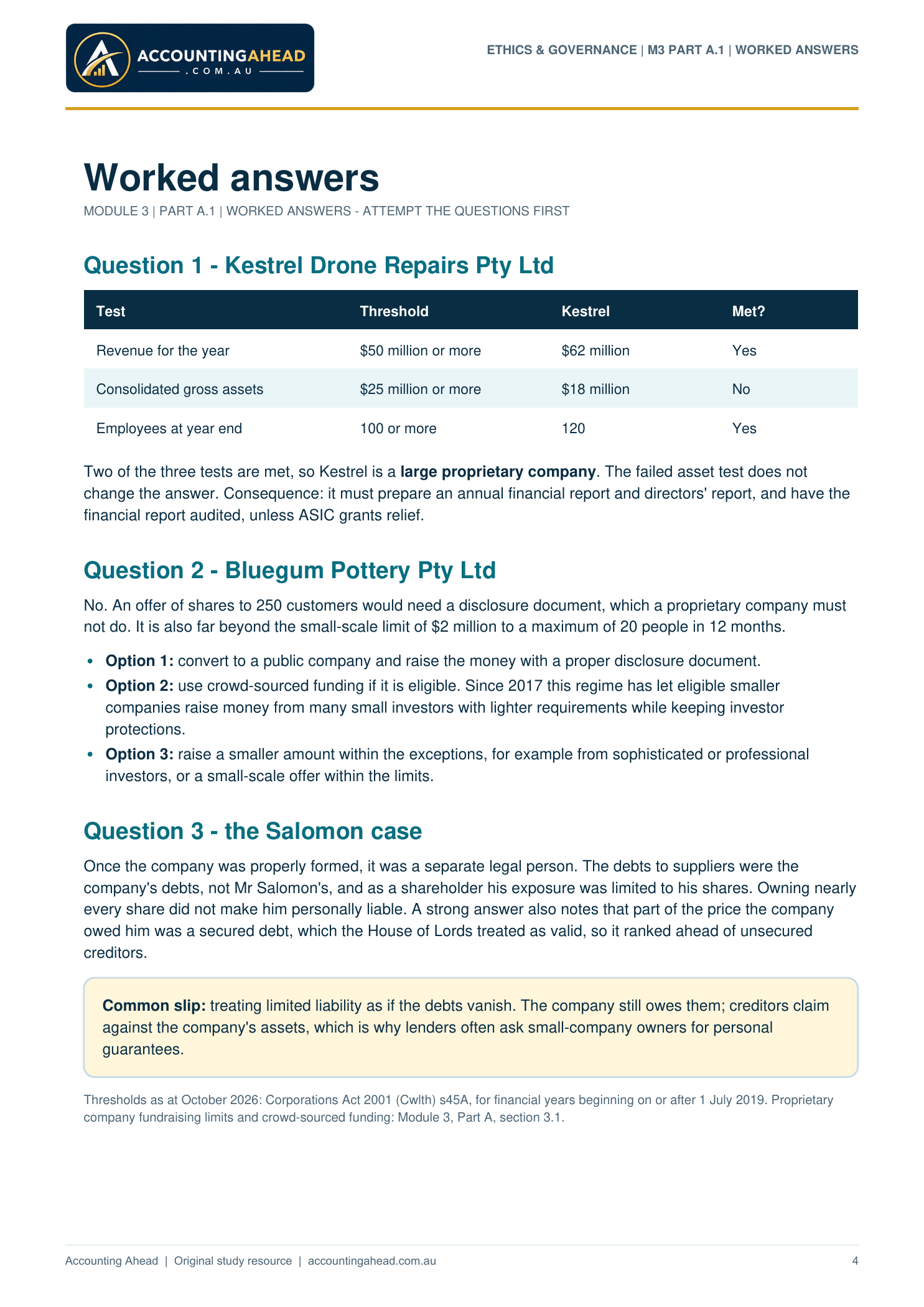
Question 1 - Kestrel Drone Repairs Pty Ltd
Test Threshold Kestrel Met?
Revenue for the year $50 million or more $62 million Yes
Consolidated gross assets $25 million or more $18 million No
Employees at year end 100 or more 120 Yes
Two of the three tests are met, so Kestrel is a large proprietary company. The failed asset test does not
change the answer. Consequence: it must prepare an annual financial report and directors' report, and have the
financial report audited, unless ASIC grants relief.
Question 2 - Bluegum Pottery Pty Ltd
No. An offer of shares to 250 customers would need a disclosure document, which a proprietary company must
not do. It is also far beyond the small-scale limit of $2 million to a maximum of 20 people in 12 months.
Option 1: convert to a public company and raise the money with a proper disclosure document.
Option 2: use crowd-sourced funding if it is eligible. Since 2017 this regime has let eligible smaller
companies raise money from many small investors with lighter requirements while keeping investor
protections.
Option 3: raise a smaller amount within the exceptions, for example from sophisticated or professional
investors, or a small-scale offer within the limits.
Question 3 - the Salomon case
Once the company was properly formed, it was a separate legal person. The debts to suppliers were the
company's debts, not Mr Salomon's, and as a shareholder his exposure was limited to his shares. Owning nearly
every share did not make him personally liable. A strong answer also notes that part of the price the company
owed him was a secured debt, which the House of Lords treated as valid, so it ranked ahead of unsecured
creditors.
Common slip: treating limited liability as if the debts vanish. The company still owes them; creditors claim
against the company's assets, which is why lenders often ask small-company owners for personal
guarantees.
Thresholds as at October 2026: Corporations Act 2001 (Cwlth) s45A, for financial years beginning on or after 1 July 2019. Proprietary
company fundraising limits and crowd-sourced funding: Module 3, Part A, section 3.1.
ETHICS & GOVERNANCE | M3 PART A.1 | WORKED ANSWERS
4