
Ethics comparison companion
Compare professional responsibilities, competing values and the main ethical lenses in a two-page study sheet.
Read the handout text
Accounting Ahead | Original study resource | accountingahead.com.au
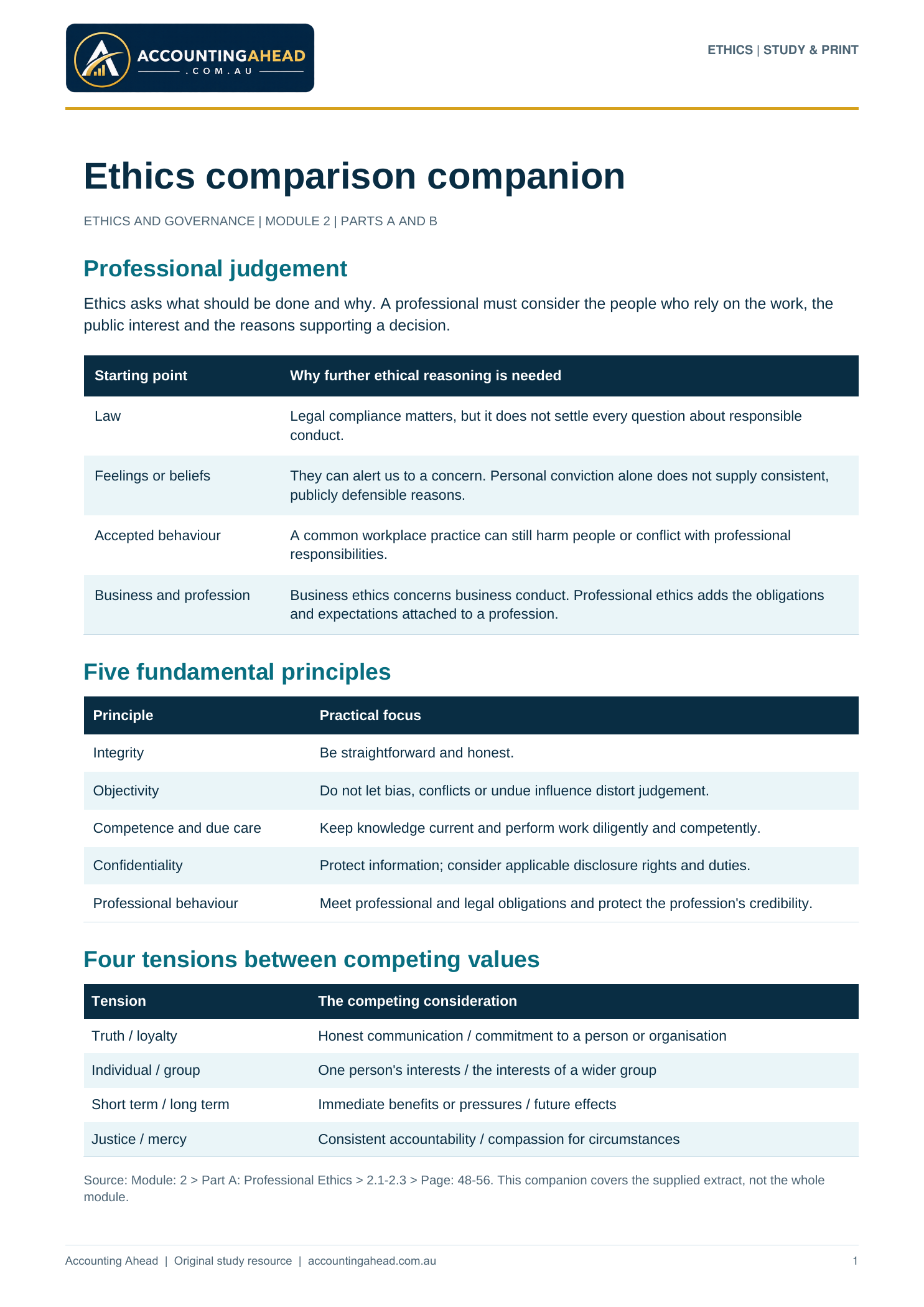
Ethics comparison companion
ETHICS AND GOVERNANCE | MODULE 2 | PARTS A AND B
Professional judgement
Ethics asks what should be done and why. A professional must consider the people who rely on the work, the
public interest and the reasons supporting a decision.
Starting point
Why further ethical reasoning is needed
Law
Legal compliance matters, but it does not settle every question about responsible
conduct.
Feelings or beliefs
They can alert us to a concern. Personal conviction alone does not supply consistent,
publicly defensible reasons.
Accepted behaviour
A common workplace practice can still harm people or conflict with professional
responsibilities.
Business and profession
Business ethics concerns business conduct. Professional ethics adds the obligations
and expectations attached to a profession.
Five fundamental principles
Principle
Practical focus
Integrity
Be straightforward and honest.
Objectivity
Do not let bias, conflicts or undue influence distort judgement.
Competence and due care
Keep knowledge current and perform work diligently and competently.
Confidentiality
Protect information; consider applicable disclosure rights and duties.
Professional behaviour
Meet professional and legal obligations and protect the profession's credibility.
Four tensions between competing values
Tension
The competing consideration
Truth / loyalty
Honest communication / commitment to a person or organisation
Individual / group
One person's interests / the interests of a wider group
Short term / long term
Immediate benefits or pressures / future effects
Justice / mercy
Consistent accountability / compassion for circumstances
Source: Module: 2 > Part A: Professional Ethics > 2.1-2.3 > Page: 48-56. This companion covers the supplied extract, not the whole
module.
ETHICS | STUDY & PRINT
1
Accounting Ahead | Original study resource | accountingahead.com.au
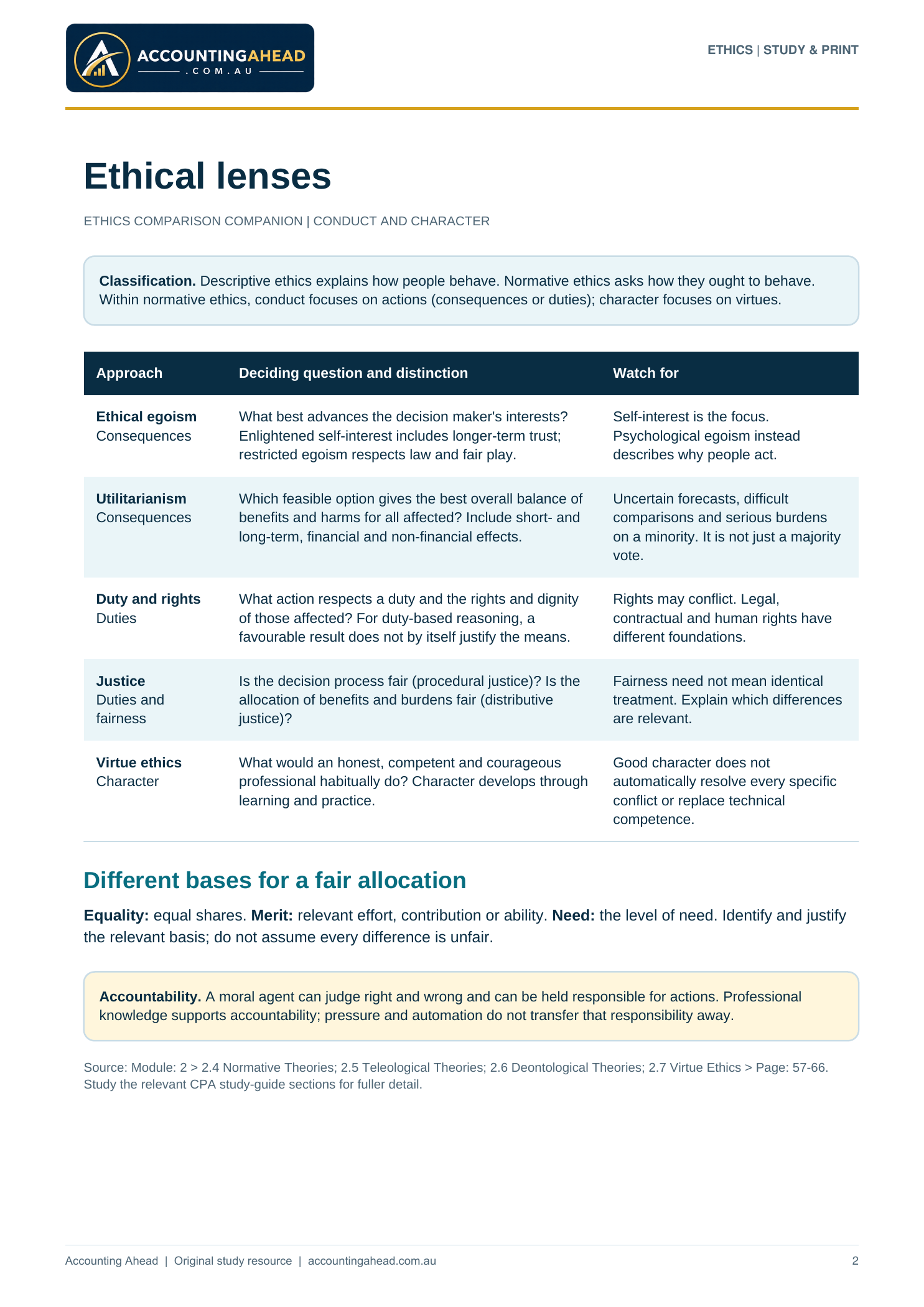
Ethical lenses
ETHICS COMPARISON COMPANION | CONDUCT AND CHARACTER
Classification. Descriptive ethics explains how people behave. Normative ethics asks how they ought to behave.
Within normative ethics, conduct focuses on actions (consequences or duties); character focuses on virtues.
Approach
Deciding question and distinction
Watch for
Ethical egoism
Consequences
What best advances the decision maker's interests?
Enlightened self-interest includes longer-term trust;
restricted egoism respects law and fair play.
Self-interest is the focus.
Psychological egoism instead
describes why people act.
Utilitarianism
Consequences
Which feasible option gives the best overall balance of
benefits and harms for all affected? Include short- and
long-term, financial and non-financial effects.
Uncertain forecasts, difficult
comparisons and serious burdens
on a minority. It is not just a majority
vote.
Duty and rights
Duties
What action respects a duty and the rights and dignity
of those affected? For duty-based reasoning, a
favourable result does not by itself justify the means.
Rights may conflict. Legal,
contractual and human rights have
different foundations.
Justice
Duties and
fairness
Is the decision process fair (procedural justice)? Is the
allocation of benefits and burdens fair (distributive
justice)?
Fairness need not mean identical
treatment. Explain which differences
are relevant.
Virtue ethics
Character
What would an honest, competent and courageous
professional habitually do? Character develops through
learning and practice.
Good character does not
automatically resolve every specific
conflict or replace technical
competence.
Different bases for a fair allocation
Equality: equal shares. Merit: relevant effort, contribution or ability. Need: the level of need. Identify and justify
the relevant basis; do not assume every difference is unfair.
Accountability. A moral agent can judge right and wrong and can be held responsible for actions. Professional
knowledge supports accountability; pressure and automation do not transfer that responsibility away.
Source: Module: 2 > 2.4 Normative Theories; 2.5 Teleological Theories; 2.6 Deontological Theories; 2.7 Virtue Ethics > Page: 57-66.
Study the relevant CPA study-guide sections for fuller detail.
ETHICS | STUDY & PRINT
2