
Four theories of corporate governance — study companion
Compare agency, stewardship, stakeholder and social-responsibility explanations of governance. Includes structured notes, practice questions and worked answers.
Read the handout text
Accounting Ahead | Original study resource | accountingahead.com.au
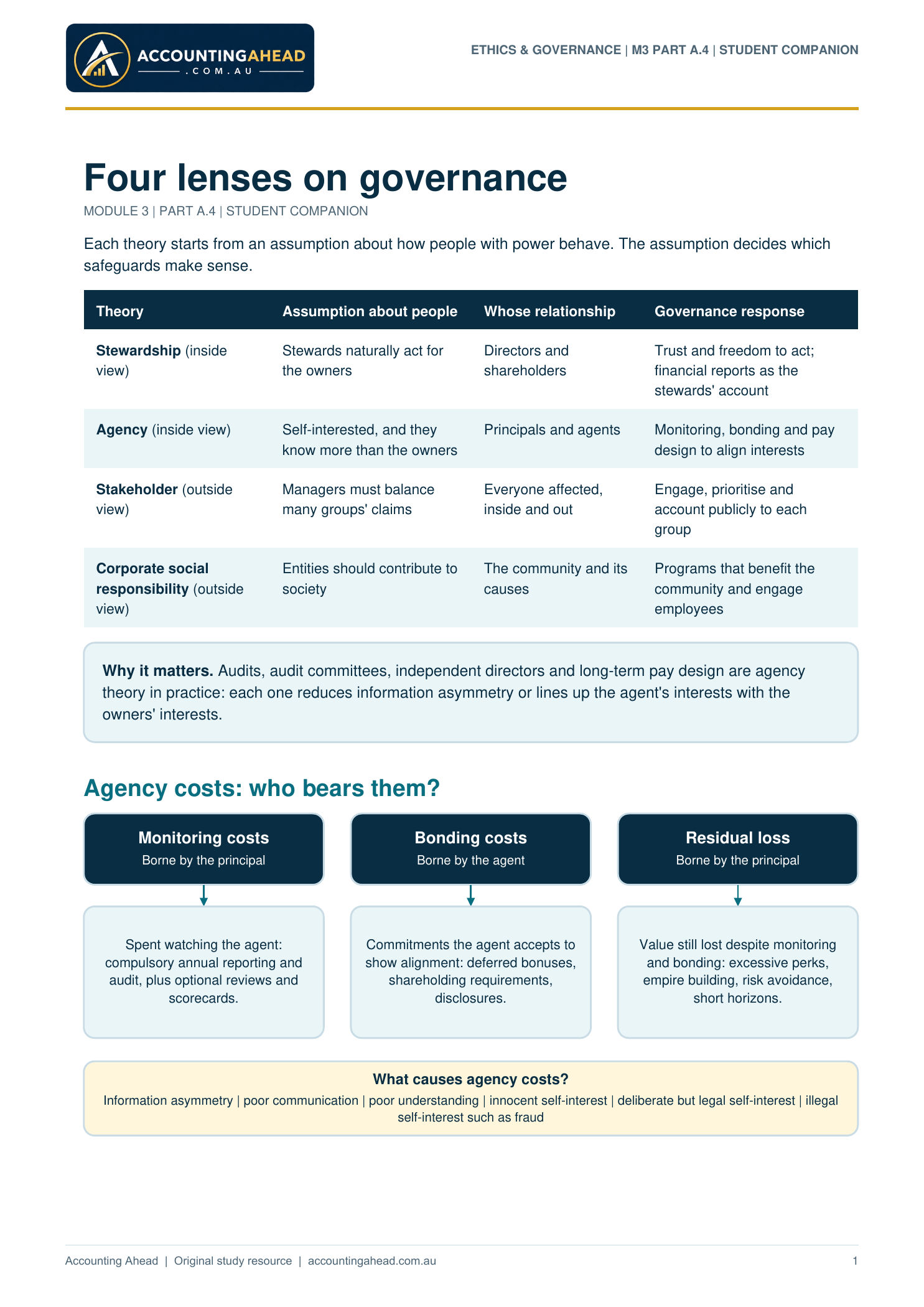
Four lenses on governance
MODULE 3 | PART A.4 | STUDENT COMPANION
Each theory starts from an assumption about how people with power behave. The assumption decides which
safeguards make sense.
Theory Assumption about people Whose relationship Governance response
Stewardship (inside
view)
Stewards naturally act for
the owners
Directors and
shareholders
Trust and freedom to act;
financial reports as the
stewards' account
Agency (inside view) Self-interested, and they
know more than the owners
Principals and agents Monitoring, bonding and pay
design to align interests
Stakeholder (outside
view)
Managers must balance
many groups' claims
Everyone affected,
inside and out
Engage, prioritise and
account publicly to each
group
Corporate social
responsibility (outside
view)
Entities should contribute to
society
The community and its
causes
Programs that benefit the
community and engage
employees
Why it matters. Audits, audit committees, independent directors and long-term pay design are agency
theory in practice: each one reduces information asymmetry or lines up the agent's interests with the
owners' interests.
Agency costs: who bears them?
Monitoring costs
Borne by the principal
Spent watching the agent:
compulsory annual reporting and
audit, plus optional reviews and
scorecards.
Bonding costs
Borne by the agent
Commitments the agent accepts to
show alignment: deferred bonuses,
shareholding requirements,
disclosures.
Residual loss
Borne by the principal
Value still lost despite monitoring
and bonding: excessive perks,
empire building, risk avoidance,
short horizons.
What causes agency costs?
Information asymmetry | poor communication | poor understanding | innocent self-interest | deliberate but legal self-interest | illegal
self-interest such as fraud
ETHICS & GOVERNANCE | M3 PART A.4 | STUDENT COMPANION
1
Accounting Ahead | Original study resource | accountingahead.com.au
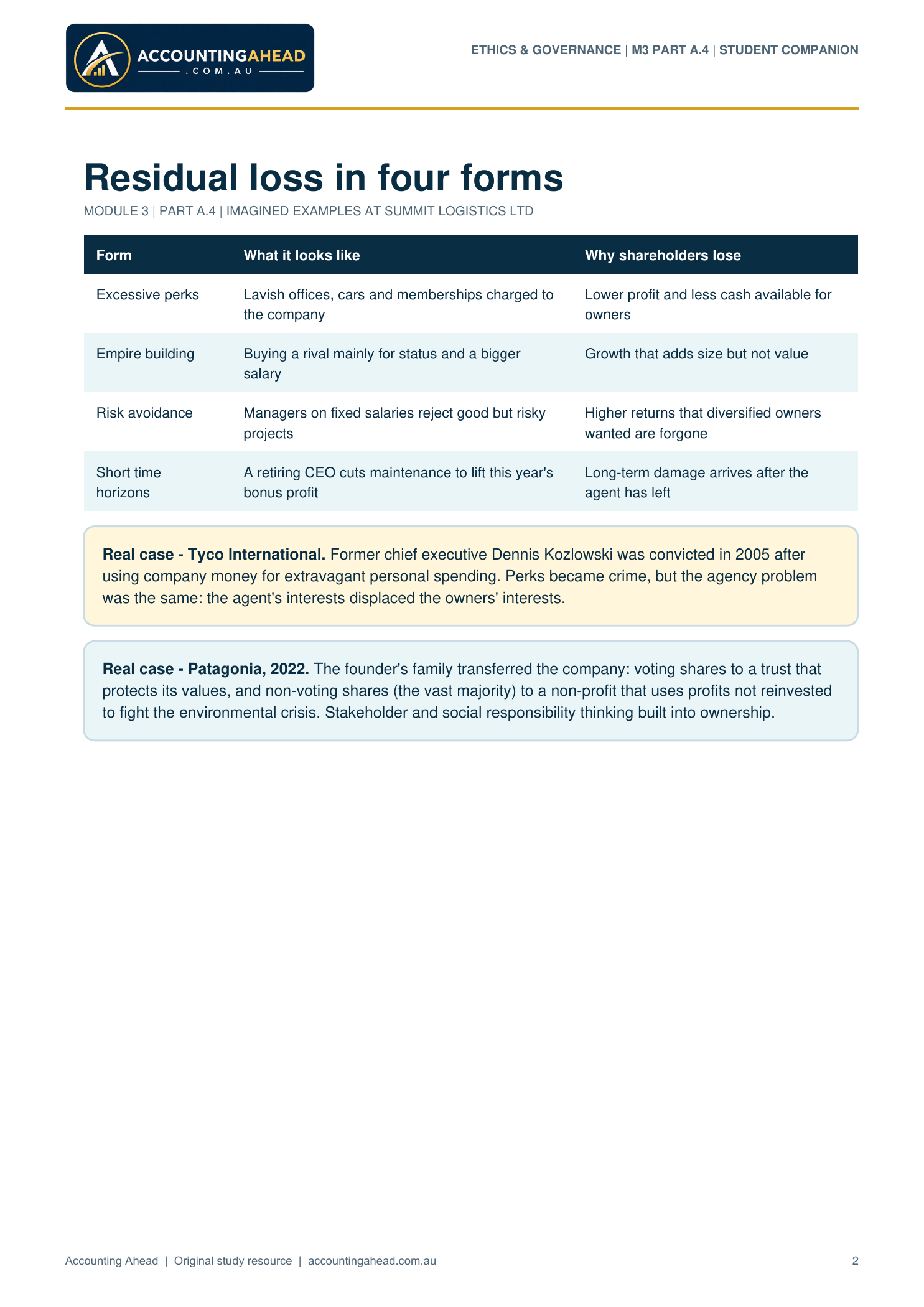
Residual loss in four forms
MODULE 3 | PART A.4 | IMAGINED EXAMPLES AT SUMMIT LOGISTICS LTD
Form What it looks like Why shareholders lose
Excessive perks Lavish offices, cars and memberships charged to
the company
Lower profit and less cash available for
owners
Empire building Buying a rival mainly for status and a bigger
salary
Growth that adds size but not value
Risk avoidance Managers on fixed salaries reject good but risky
projects
Higher returns that diversified owners
wanted are forgone
Short time
horizons
A retiring CEO cuts maintenance to lift this year's
bonus profit
Long-term damage arrives after the
agent has left
Real case - Tyco International. Former chief executive Dennis Kozlowski was convicted in 2005 after
using company money for extravagant personal spending. Perks became crime, but the agency problem
was the same: the agent's interests displaced the owners' interests.
Real case - Patagonia, 2022. The founder's family transferred the company: voting shares to a trust that
protects its values, and non-voting shares (the vast majority) to a non-profit that uses profits not reinvested
to fight the environmental crisis. Stakeholder and social responsibility thinking built into ownership.
ETHICS & GOVERNANCE | M3 PART A.4 | STUDENT COMPANION
2
Accounting Ahead | Original study resource | accountingahead.com.au
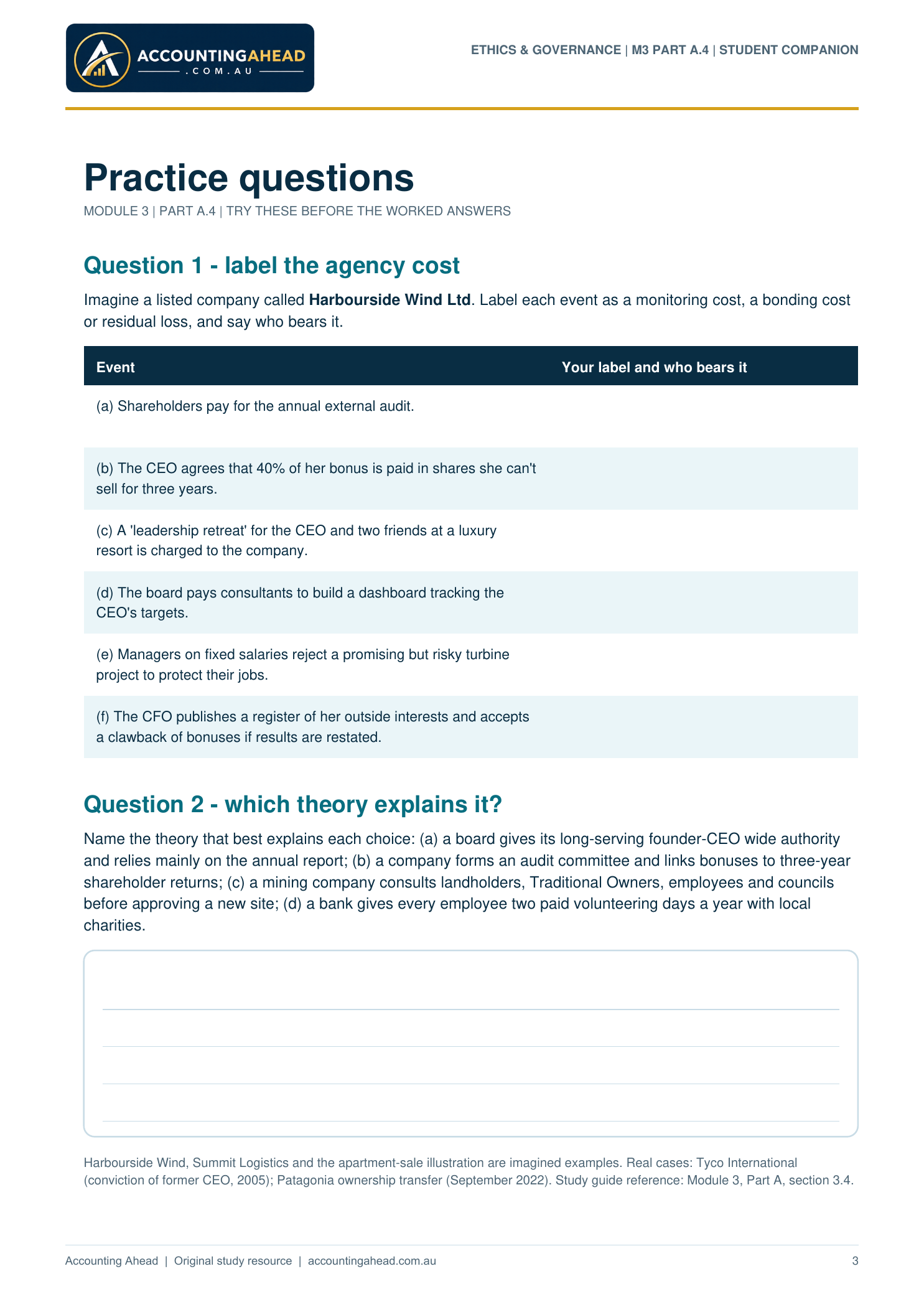
Practice questions
MODULE 3 | PART A.4 | TRY THESE BEFORE THE WORKED ANSWERS
Question 1 - label the agency cost
Imagine a listed company called Harbourside Wind Ltd. Label each event as a monitoring cost, a bonding cost
or residual loss, and say who bears it.
Event Your label and who bears it
(a) Shareholders pay for the annual external audit.
(b) The CEO agrees that 40% of her bonus is paid in shares she can't
sell for three years.
(c) A 'leadership retreat' for the CEO and two friends at a luxury
resort is charged to the company.
(d) The board pays consultants to build a dashboard tracking the
CEO's targets.
(e) Managers on fixed salaries reject a promising but risky turbine
project to protect their jobs.
(f) The CFO publishes a register of her outside interests and accepts
a clawback of bonuses if results are restated.
Question 2 - which theory explains it?
Name the theory that best explains each choice: (a) a board gives its long-serving founder-CEO wide authority
and relies mainly on the annual report; (b) a company forms an audit committee and links bonuses to three-year
shareholder returns; (c) a mining company consults landholders, Traditional Owners, employees and councils
before approving a new site; (d) a bank gives every employee two paid volunteering days a year with local
charities.
Harbourside Wind, Summit Logistics and the apartment-sale illustration are imagined examples. Real cases: Tyco International
(conviction of former CEO, 2005); Patagonia ownership transfer (September 2022). Study guide reference: Module 3, Part A, section 3.4.
ETHICS & GOVERNANCE | M3 PART A.4 | STUDENT COMPANION
3
Accounting Ahead | Original study resource | accountingahead.com.au
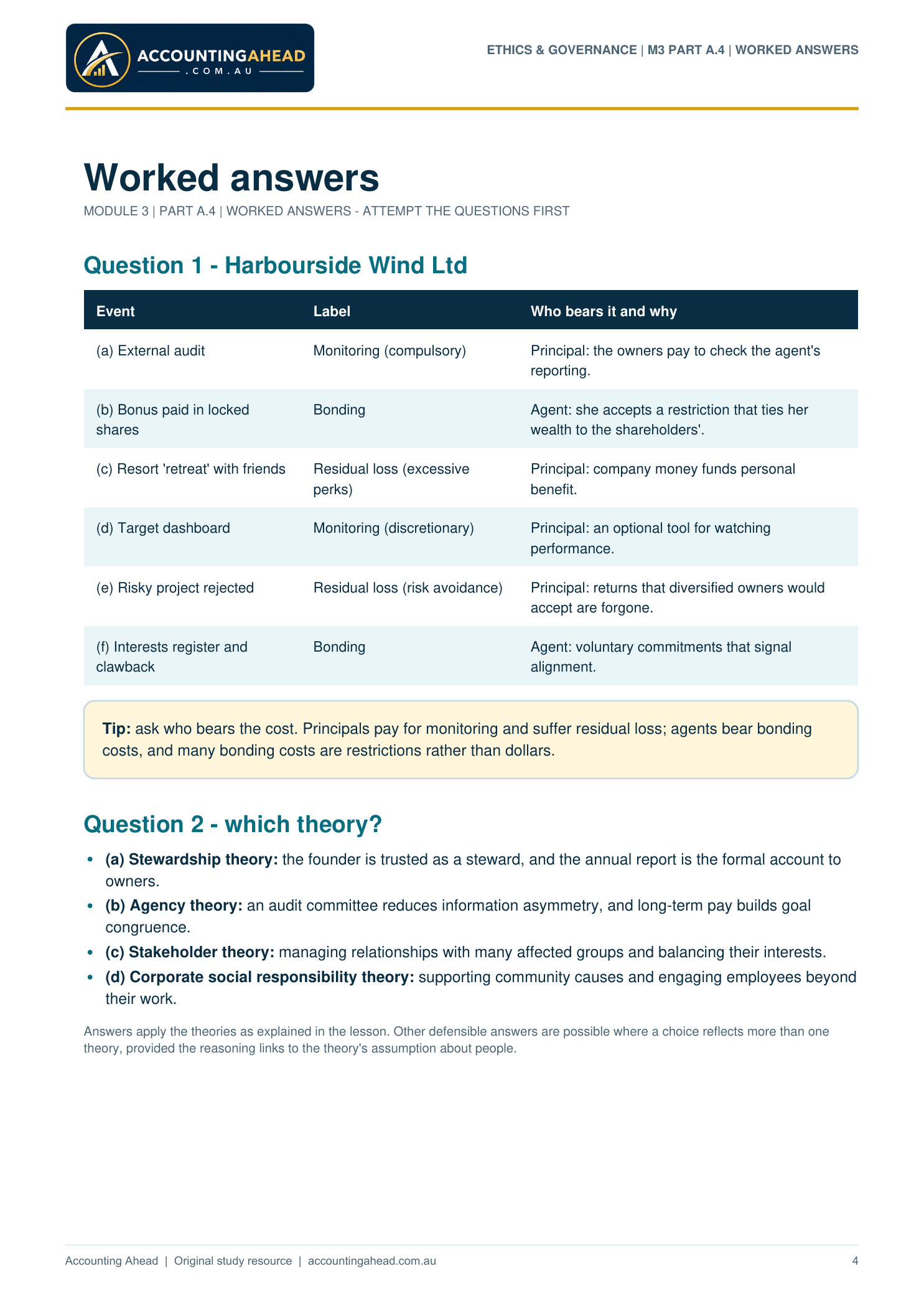
Worked answers
MODULE 3 | PART A.4 | WORKED ANSWERS - ATTEMPT THE QUESTIONS FIRST
Question 1 - Harbourside Wind Ltd
Event Label Who bears it and why
(a) External audit Monitoring (compulsory) Principal: the owners pay to check the agent's
reporting.
(b) Bonus paid in locked
shares
Bonding Agent: she accepts a restriction that ties her
wealth to the shareholders'.
(c) Resort 'retreat' with friends Residual loss (excessive
perks)
Principal: company money funds personal
benefit.
(d) Target dashboard Monitoring (discretionary) Principal: an optional tool for watching
performance.
(e) Risky project rejected Residual loss (risk avoidance) Principal: returns that diversified owners would
accept are forgone.
(f) Interests register and
clawback
Bonding Agent: voluntary commitments that signal
alignment.
Tip: ask who bears the cost. Principals pay for monitoring and suffer residual loss; agents bear bonding
costs, and many bonding costs are restrictions rather than dollars.
Question 2 - which theory?
(a) Stewardship theory: the founder is trusted as a steward, and the annual report is the formal account to
owners.
(b) Agency theory: an audit committee reduces information asymmetry, and long-term pay builds goal
congruence.
(c) Stakeholder theory: managing relationships with many affected groups and balancing their interests.
(d) Corporate social responsibility theory: supporting community causes and engaging employees beyond
their work.
Answers apply the theories as explained in the lesson. Other defensible answers are possible where a choice reflects more than one
theory, provided the reasoning links to the theory's assumption about people.
ETHICS & GOVERNANCE | M3 PART A.4 | WORKED ANSWERS
4