
Governance beyond listed companies — study companion
Adapt governance to family businesses, charities and public-sector accountability. Includes structured notes, practice questions and worked answers.
Read the handout text
Accounting Ahead | Original study resource | accountingahead.com.au
Governance beyond listed companies
MODULE 3 | PART E.1 | STUDENT COMPANION
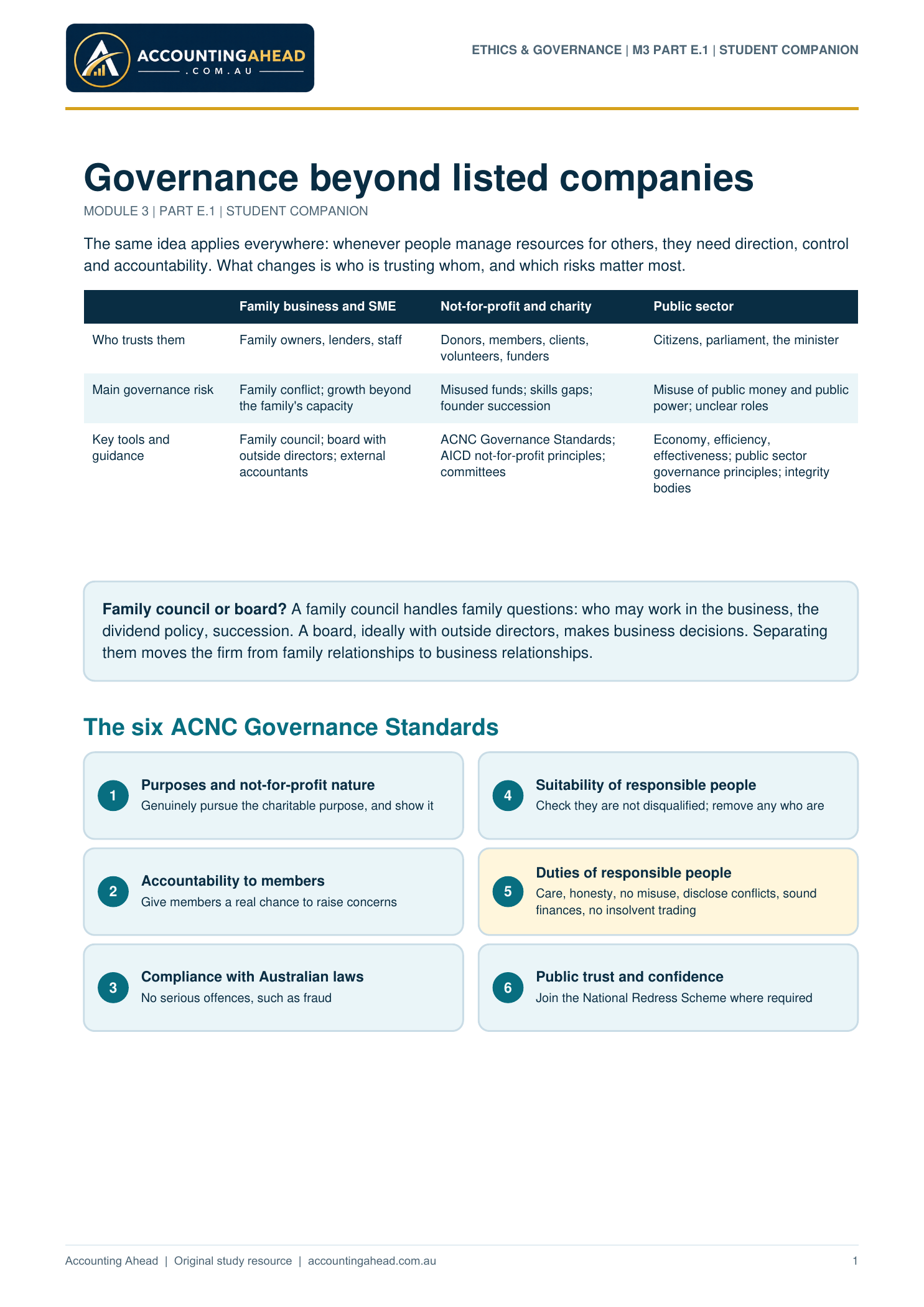
The same idea applies everywhere: whenever people manage resources for others, they need direction, control
and accountability. What changes is who is trusting whom, and which risks matter most.
Family business and SME Not-for-profit and charity Public sector
Who trusts them Family owners, lenders, staff Donors, members, clients,
volunteers, funders
Citizens, parliament, the minister
Main governance risk Family conflict; growth beyond
the family's capacity
Misused funds; skills gaps;
founder succession
Misuse of public money and public
power; unclear roles
Key tools and
guidance
Family council; board with
outside directors; external
accountants
ACNC Governance Standards;
AICD not-for-profit principles;
committees
Economy, efficiency,
effectiveness; public sector
governance principles; integrity
bodies
Family council or board? A family council handles family questions: who may work in the business, the
dividend policy, succession. A board, ideally with outside directors, makes business decisions. Separating
them moves the firm from family relationships to business relationships.
The six ACNC Governance Standards
1 Purposes and not-for-profit nature
Genuinely pursue the charitable purpose, and show it
2 Accountability to members
Give members a real chance to raise concerns
3 Compliance with Australian laws
No serious offences, such as fraud
4 Suitability of responsible people
Check they are not disqualified; remove any who are
5
Duties of responsible people
Care, honesty, no misuse, disclose conflicts, sound
finances, no insolvent trading
6 Public trust and confidence
Join the National Redress Scheme where required
ETHICS & GOVERNANCE | M3 PART E.1 | STUDENT COMPANION
1
Accounting Ahead | Original study resource | accountingahead.com.au
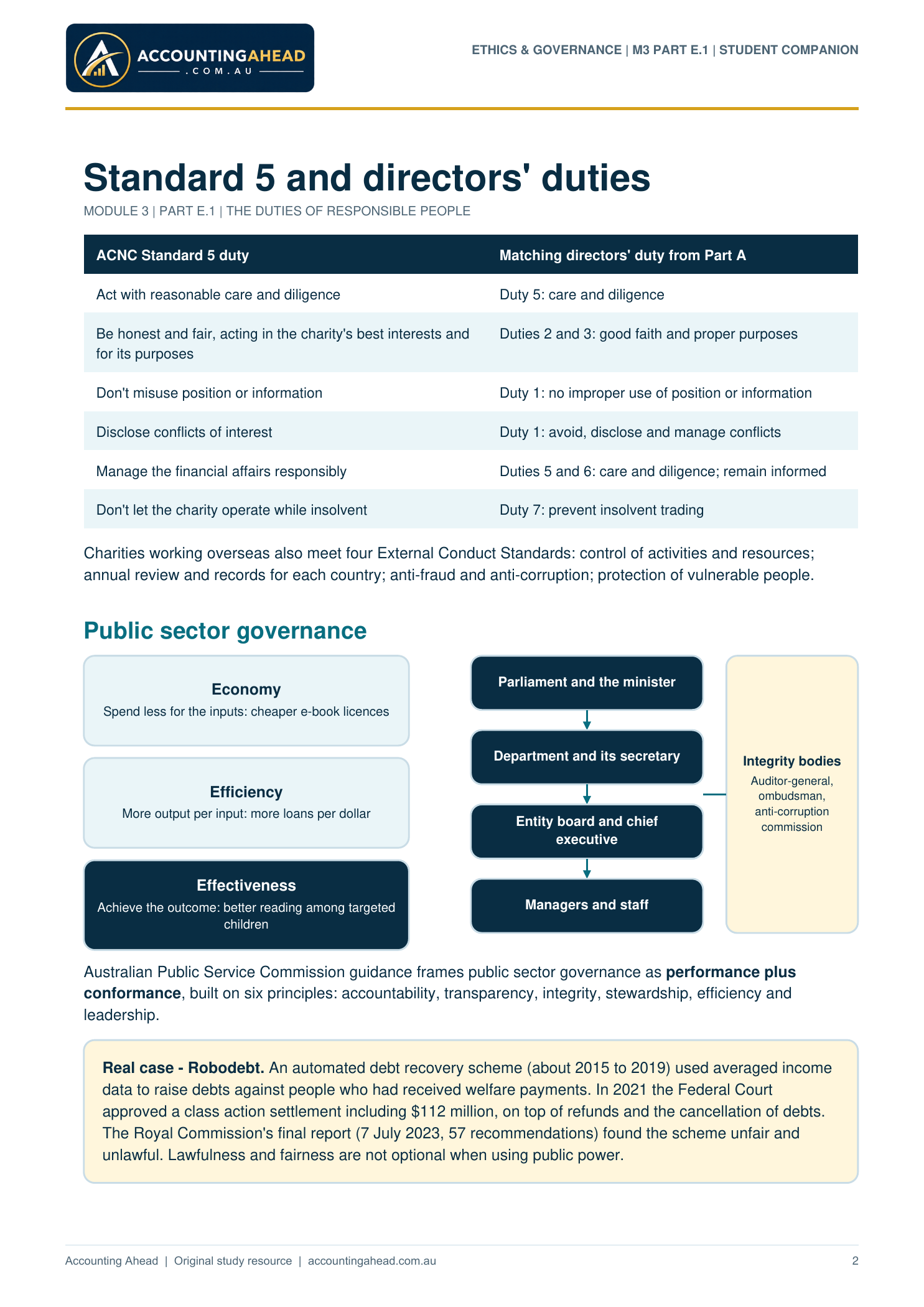
Standard 5 and directors' duties
MODULE 3 | PART E.1 | THE DUTIES OF RESPONSIBLE PEOPLE
ACNC Standard 5 duty Matching directors' duty from Part A
Act with reasonable care and diligence Duty 5: care and diligence
Be honest and fair, acting in the charity's best interests and
for its purposes
Duties 2 and 3: good faith and proper purposes
Don't misuse position or information Duty 1: no improper use of position or information
Disclose conflicts of interest Duty 1: avoid, disclose and manage conflicts
Manage the financial affairs responsibly Duties 5 and 6: care and diligence; remain informed
Don't let the charity operate while insolvent Duty 7: prevent insolvent trading
Charities working overseas also meet four External Conduct Standards: control of activities and resources;
annual review and records for each country; anti-fraud and anti-corruption; protection of vulnerable people.
Public sector governance
Economy
Spend less for the inputs: cheaper e-book licences
Efficiency
More output per input: more loans per dollar
Effectiveness
Achieve the outcome: better reading among targeted
children
Parliament and the minister
Department and its secretary
Entity board and chief
executive
Managers and staff
Integrity bodies
Auditor-general,
ombudsman,
anti-corruption
commission
Australian Public Service Commission guidance frames public sector governance as performance plus
conformance, built on six principles: accountability, transparency, integrity, stewardship, efficiency and
leadership.
Real case - Robodebt. An automated debt recovery scheme (about 2015 to 2019) used averaged income
data to raise debts against people who had received welfare payments. In 2021 the Federal Court
approved a class action settlement including $112 million, on top of refunds and the cancellation of debts.
The Royal Commission's final report (7 July 2023, 57 recommendations) found the scheme unfair and
unlawful. Lawfulness and fairness are not optional when using public power.
ETHICS & GOVERNANCE | M3 PART E.1 | STUDENT COMPANION
2
Accounting Ahead | Original study resource | accountingahead.com.au
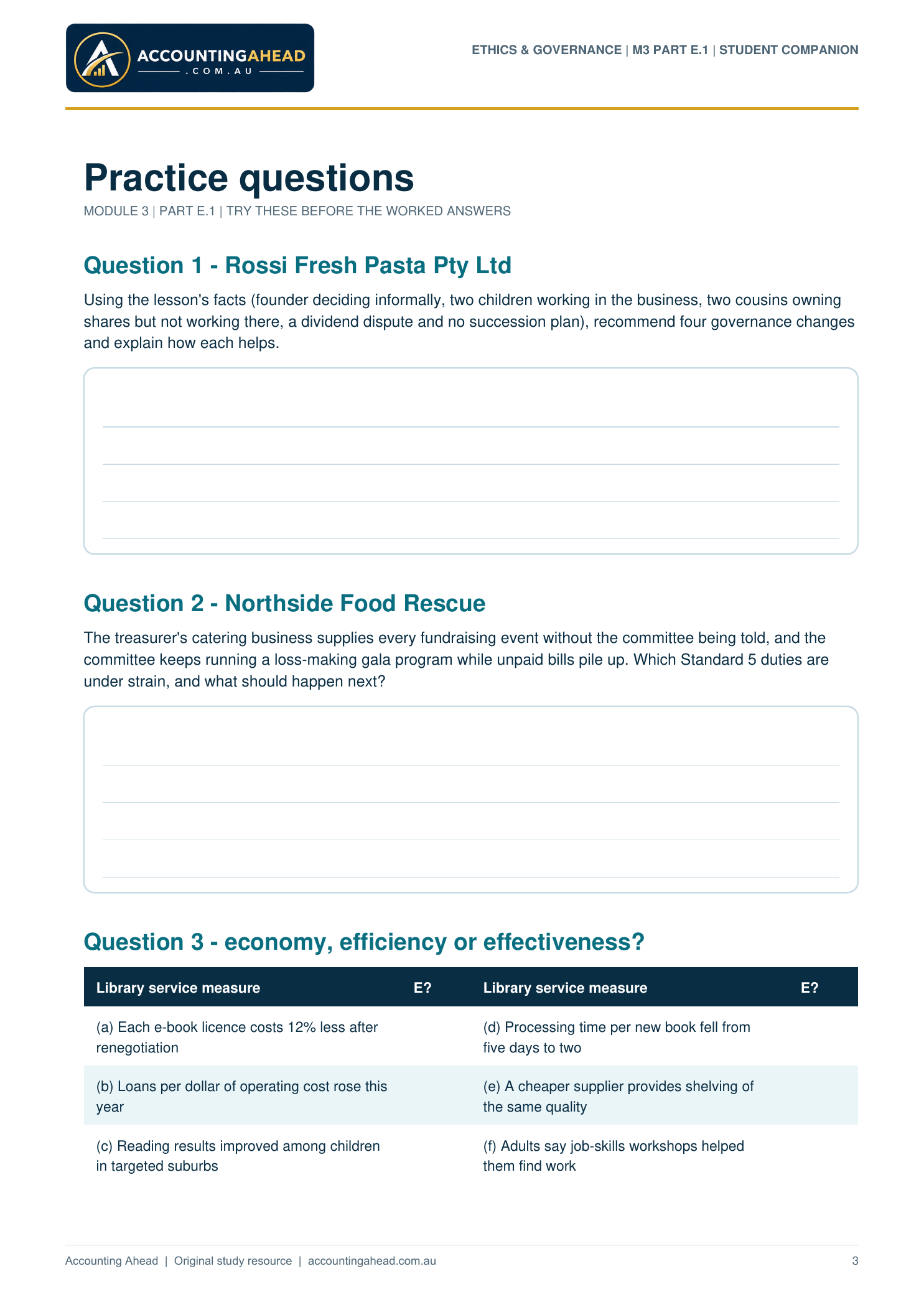
Practice questions
MODULE 3 | PART E.1 | TRY THESE BEFORE THE WORKED ANSWERS
Question 1 - Rossi Fresh Pasta Pty Ltd
Using the lesson's facts (founder deciding informally, two children working in the business, two cousins owning
shares but not working there, a dividend dispute and no succession plan), recommend four governance changes
and explain how each helps.
Question 2 - Northside Food Rescue
The treasurer's catering business supplies every fundraising event without the committee being told, and the
committee keeps running a loss-making gala program while unpaid bills pile up. Which Standard 5 duties are
under strain, and what should happen next?
Question 3 - economy, efficiency or effectiveness?
Library service measure E? Library service measure E?
(a) Each e-book licence costs 12% less after
renegotiation
(d) Processing time per new book fell from
five days to two
(b) Loans per dollar of operating cost rose this
year
(e) A cheaper supplier provides shelving of
the same quality
(c) Reading results improved among children
in targeted suburbs
(f) Adults say job-skills workshops helped
them find work
ETHICS & GOVERNANCE | M3 PART E.1 | STUDENT COMPANION
3
Accounting Ahead | Original study resource | accountingahead.com.au
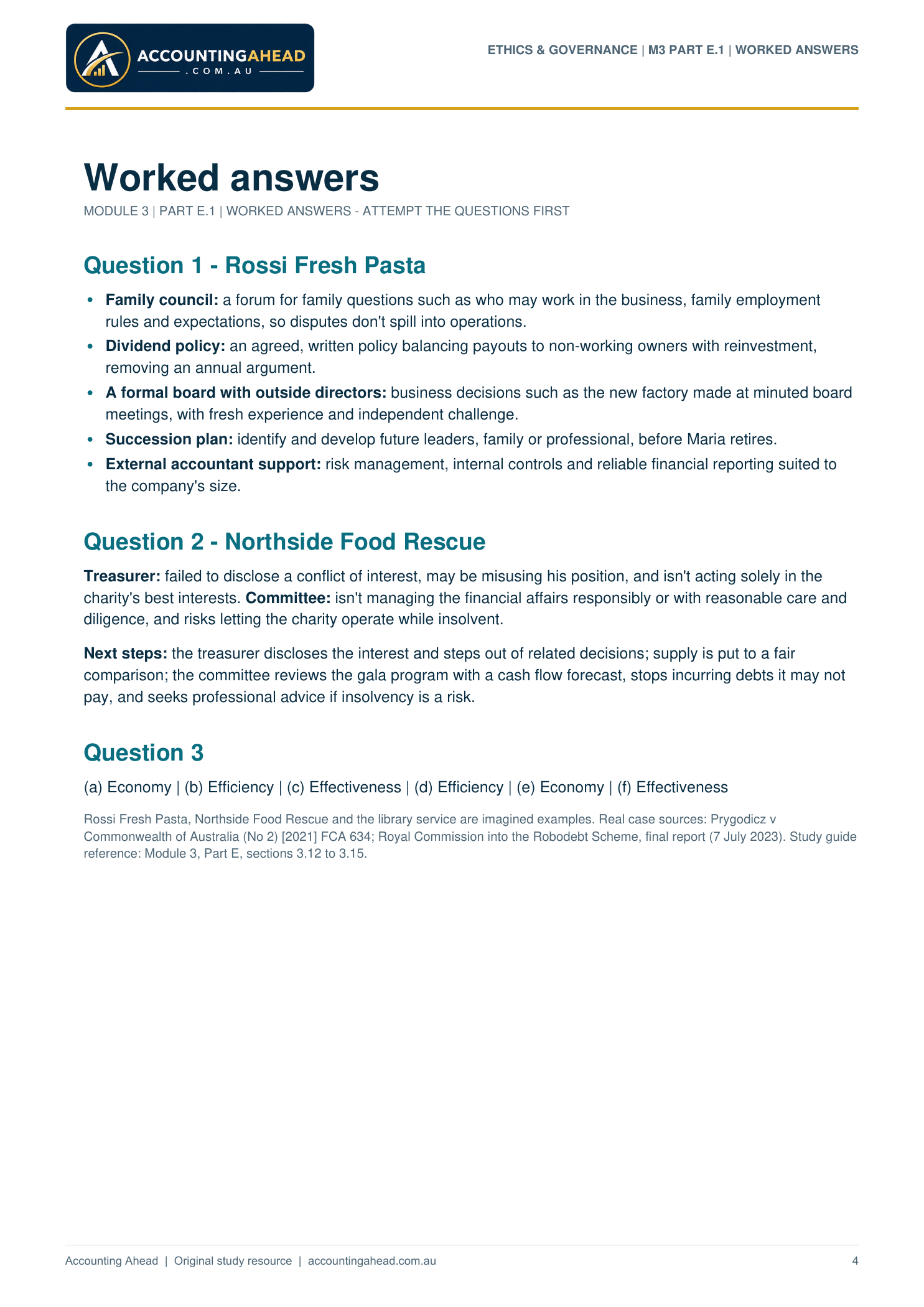
Worked answers
MODULE 3 | PART E.1 | WORKED ANSWERS - ATTEMPT THE QUESTIONS FIRST
Question 1 - Rossi Fresh Pasta
Family council: a forum for family questions such as who may work in the business, family employment
rules and expectations, so disputes don't spill into operations.
Dividend policy: an agreed, written policy balancing payouts to non-working owners with reinvestment,
removing an annual argument.
A formal board with outside directors: business decisions such as the new factory made at minuted board
meetings, with fresh experience and independent challenge.
Succession plan: identify and develop future leaders, family or professional, before Maria retires.
External accountant support: risk management, internal controls and reliable financial reporting suited to
the company's size.
Question 2 - Northside Food Rescue
Treasurer: failed to disclose a conflict of interest, may be misusing his position, and isn't acting solely in the
charity's best interests. Committee: isn't managing the financial affairs responsibly or with reasonable care and
diligence, and risks letting the charity operate while insolvent.
Next steps: the treasurer discloses the interest and steps out of related decisions; supply is put to a fair
comparison; the committee reviews the gala program with a cash flow forecast, stops incurring debts it may not
pay, and seeks professional advice if insolvency is a risk.
Question 3
(a) Economy | (b) Efficiency | (c) Effectiveness | (d) Efficiency | (e) Economy | (f) Effectiveness
Rossi Fresh Pasta, Northside Food Rescue and the library service are imagined examples. Real case sources: Prygodicz v
Commonwealth of Australia (No 2) [2021] FCA 634; Royal Commission into the Robodebt Scheme, final report (7 July 2023). Study guide
reference: Module 3, Part E, sections 3.12 to 3.15.
ETHICS & GOVERNANCE | M3 PART E.1 | WORKED ANSWERS
4