
International approaches to governance — study companion
Compare market-based and relationship-based systems, board structures and the role of reform. Includes structured notes, practice questions and worked answers.
Read the handout text
Accounting Ahead | Original study resource | accountingahead.com.au
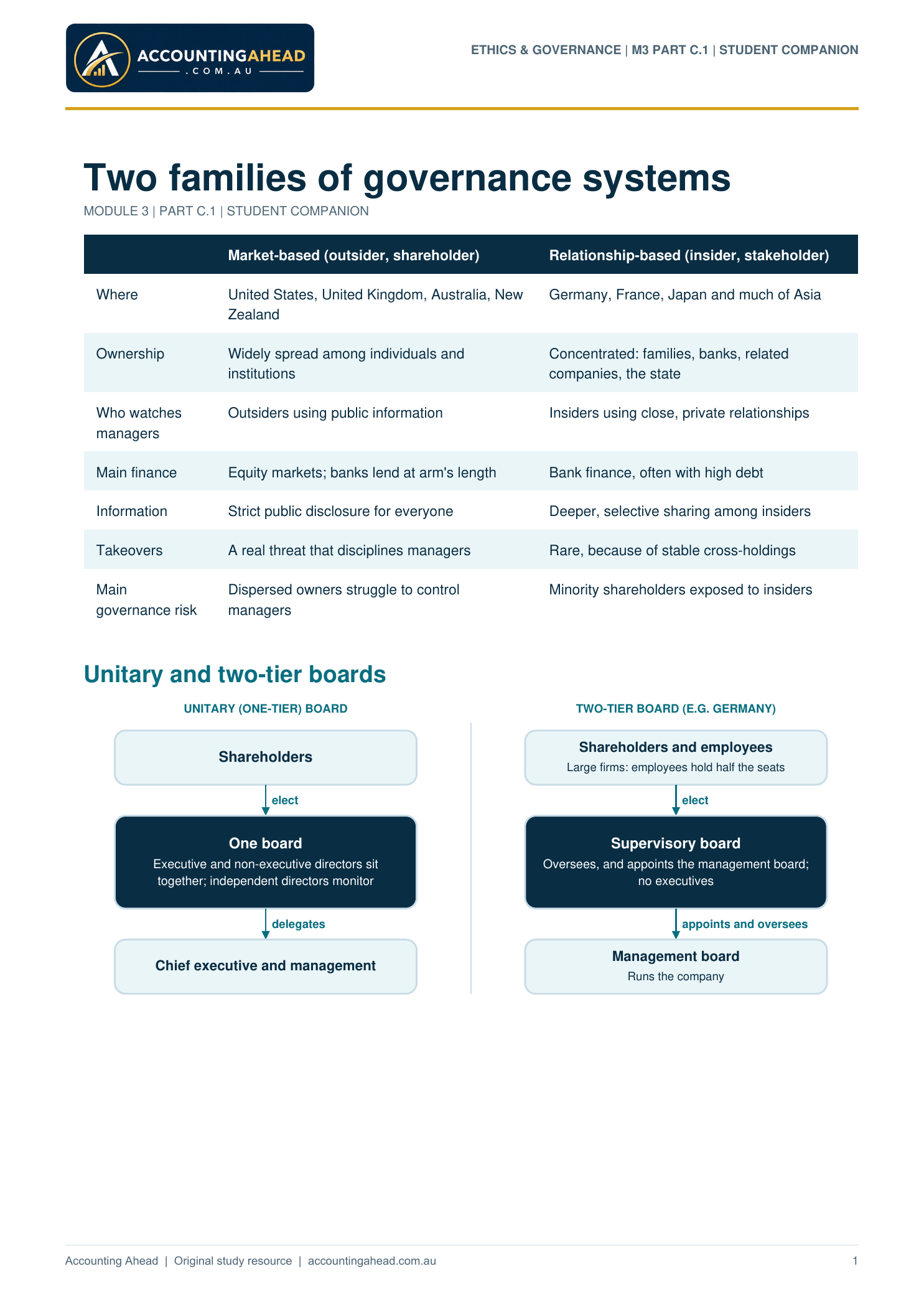
Two families of governance systems
MODULE 3 | PART C.1 | STUDENT COMPANION
Market-based (outsider, shareholder) Relationship-based (insider, stakeholder)
Where United States, United Kingdom, Australia, New
Zealand
Germany, France, Japan and much of Asia
Ownership Widely spread among individuals and
institutions
Concentrated: families, banks, related
companies, the state
Who watches
managers
Outsiders using public information Insiders using close, private relationships
Main finance Equity markets; banks lend at arm's length Bank finance, often with high debt
Information Strict public disclosure for everyone Deeper, selective sharing among insiders
Takeovers A real threat that disciplines managers Rare, because of stable cross-holdings
Main
governance risk
Dispersed owners struggle to control
managers
Minority shareholders exposed to insiders
Unitary and two-tier boards
UNITARY (ONE-TIER) BOARD TWO-TIER BOARD (E.G. GERMANY)
Shareholders
elect
One board
Executive and non-executive directors sit
together; independent directors monitor
delegates
Chief executive and management
Shareholders and employees
Large firms: employees hold half the seats
elect
Supervisory board
Oversees, and appoints the management board;
no executives
appoints and oversees
Management board
Runs the company
ETHICS & GOVERNANCE | M3 PART C.1 | STUDENT COMPANION
1
Accounting Ahead | Original study resource | accountingahead.com.au
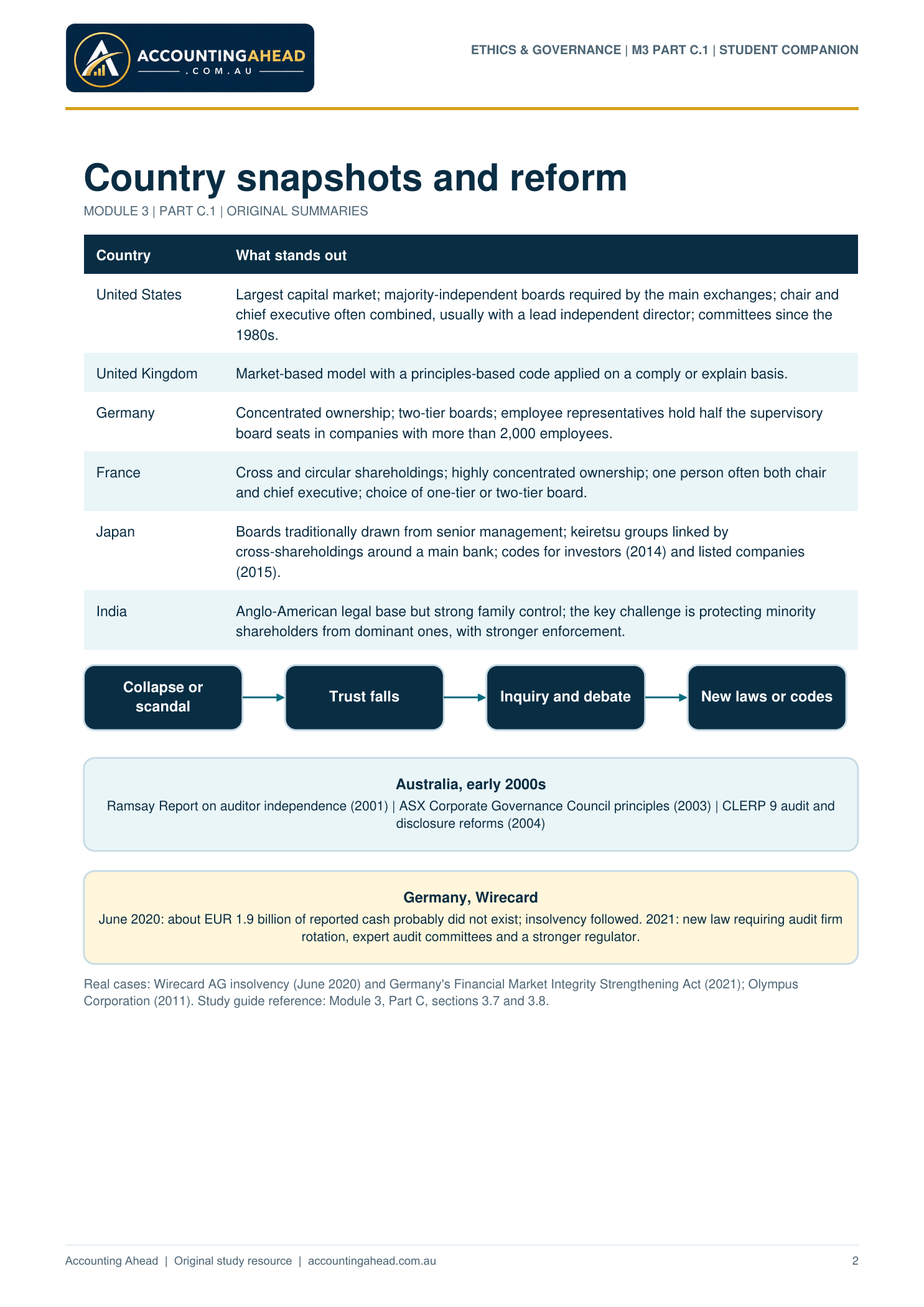
Country snapshots and reform
MODULE 3 | PART C.1 | ORIGINAL SUMMARIES
Country What stands out
United States Largest capital market; majority-independent boards required by the main exchanges; chair and
chief executive often combined, usually with a lead independent director; committees since the
1980s.
United Kingdom Market-based model with a principles-based code applied on a comply or explain basis.
Germany Concentrated ownership; two-tier boards; employee representatives hold half the supervisory
board seats in companies with more than 2,000 employees.
France Cross and circular shareholdings; highly concentrated ownership; one person often both chair
and chief executive; choice of one-tier or two-tier board.
Japan Boards traditionally drawn from senior management; keiretsu groups linked by
cross-shareholdings around a main bank; codes for investors (2014) and listed companies
(2015).
India Anglo-American legal base but strong family control; the key challenge is protecting minority
shareholders from dominant ones, with stronger enforcement.
Collapse or
scandal Trust falls Inquiry and debate New laws or codes
Australia, early 2000s
Ramsay Report on auditor independence (2001) | ASX Corporate Governance Council principles (2003) | CLERP 9 audit and
disclosure reforms (2004)
Germany, Wirecard
June 2020: about EUR 1.9 billion of reported cash probably did not exist; insolvency followed. 2021: new law requiring audit firm
rotation, expert audit committees and a stronger regulator.
Real cases: Wirecard AG insolvency (June 2020) and Germany's Financial Market Integrity Strengthening Act (2021); Olympus
Corporation (2011). Study guide reference: Module 3, Part C, sections 3.7 and 3.8.
ETHICS & GOVERNANCE | M3 PART C.1 | STUDENT COMPANION
2
Accounting Ahead | Original study resource | accountingahead.com.au
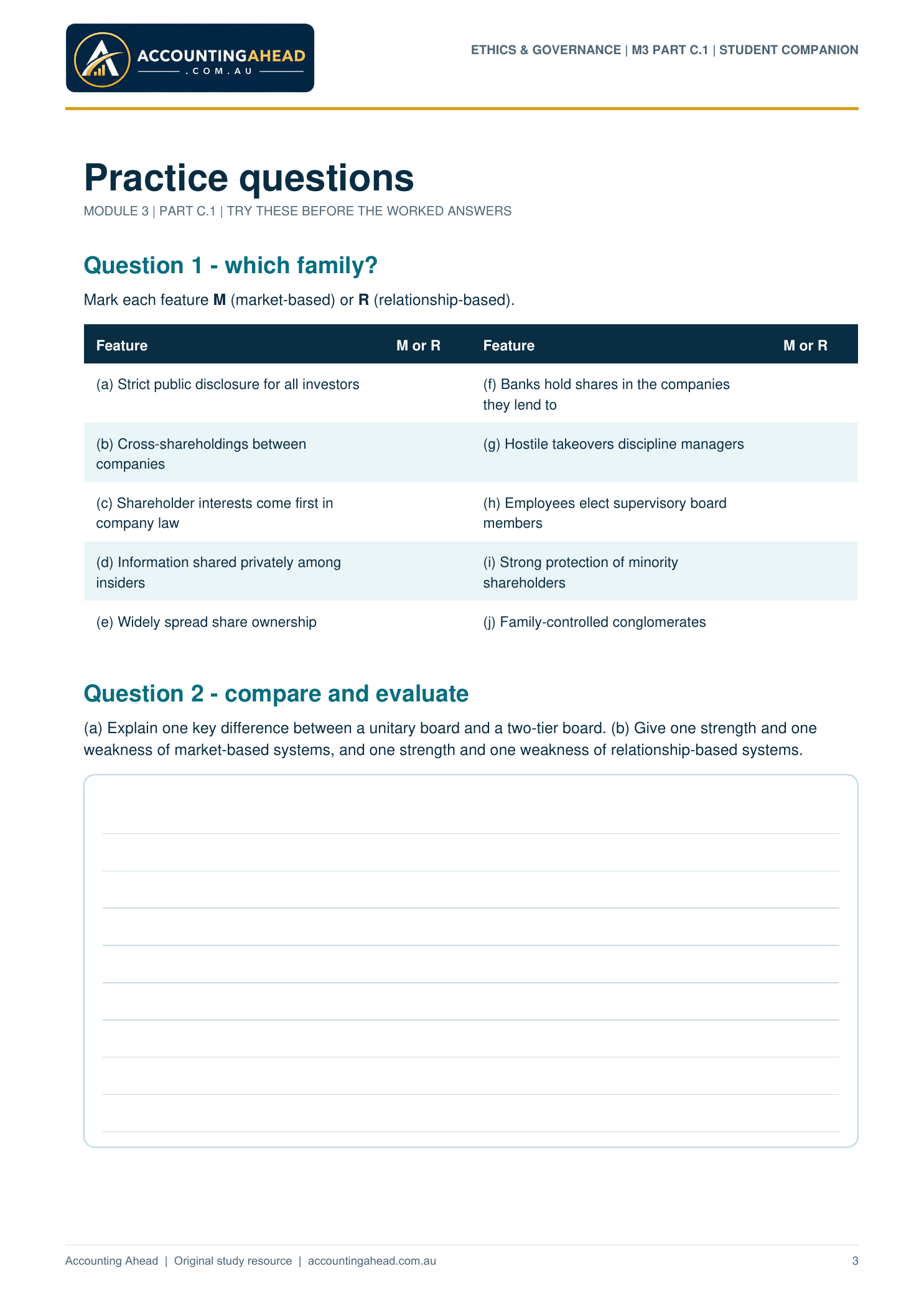
Practice questions
MODULE 3 | PART C.1 | TRY THESE BEFORE THE WORKED ANSWERS
Question 1 - which family?
Mark each feature M (market-based) or R (relationship-based).
Feature M or R Feature M or R
(a) Strict public disclosure for all investors (f) Banks hold shares in the companies
they lend to
(b) Cross-shareholdings between
companies
(g) Hostile takeovers discipline managers
(c) Shareholder interests come first in
company law
(h) Employees elect supervisory board
members
(d) Information shared privately among
insiders
(i) Strong protection of minority
shareholders
(e) Widely spread share ownership (j) Family-controlled conglomerates
Question 2 - compare and evaluate
(a) Explain one key difference between a unitary board and a two-tier board. (b) Give one strength and one
weakness of market-based systems, and one strength and one weakness of relationship-based systems.
ETHICS & GOVERNANCE | M3 PART C.1 | STUDENT COMPANION
3
Accounting Ahead | Original study resource | accountingahead.com.au
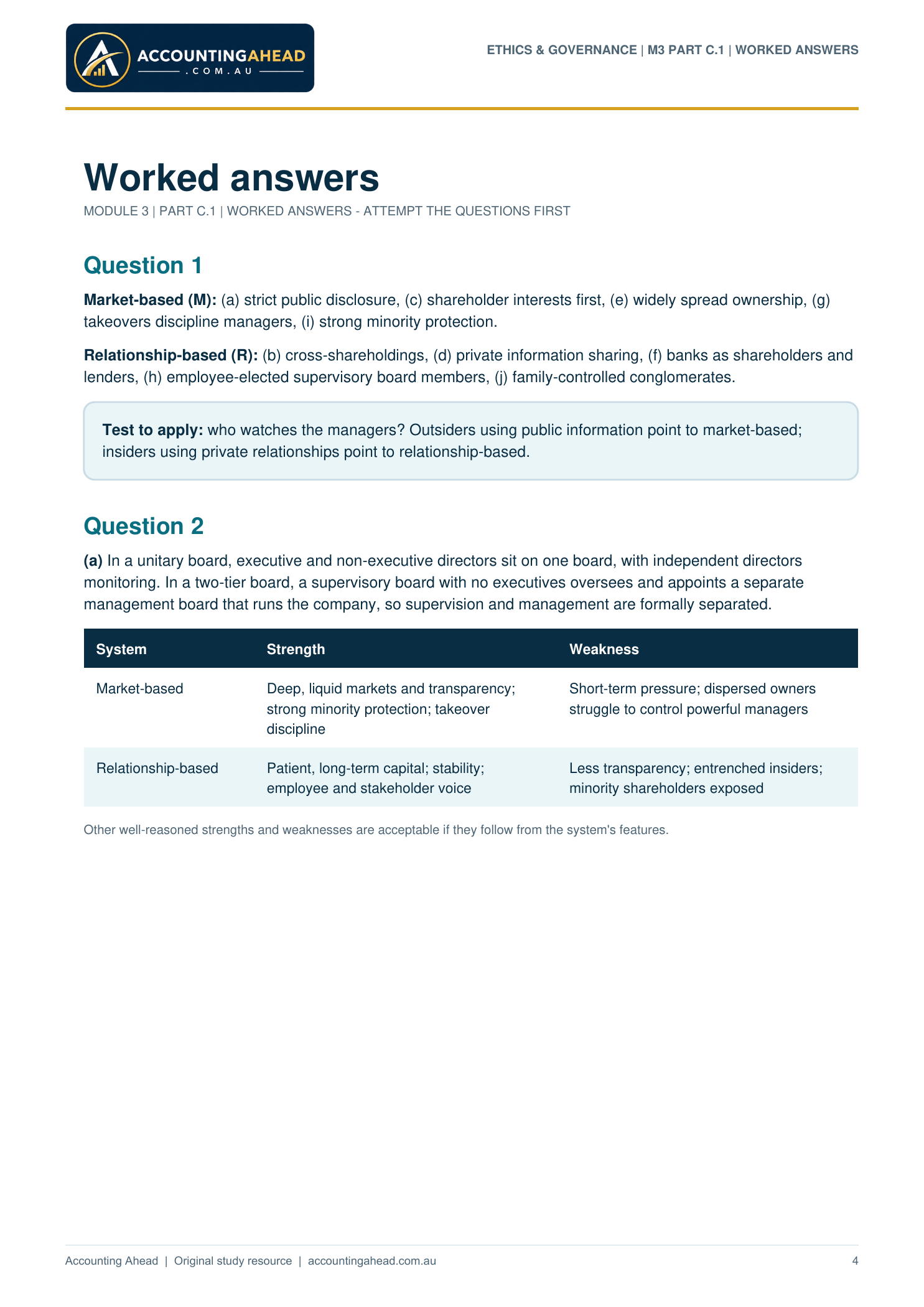
Worked answers
MODULE 3 | PART C.1 | WORKED ANSWERS - ATTEMPT THE QUESTIONS FIRST
Question 1
Market-based (M): (a) strict public disclosure, (c) shareholder interests first, (e) widely spread ownership, (g)
takeovers discipline managers, (i) strong minority protection.
Relationship-based (R): (b) cross-shareholdings, (d) private information sharing, (f) banks as shareholders and
lenders, (h) employee-elected supervisory board members, (j) family-controlled conglomerates.
Test to apply: who watches the managers? Outsiders using public information point to market-based;
insiders using private relationships point to relationship-based.
Question 2
(a) In a unitary board, executive and non-executive directors sit on one board, with independent directors
monitoring. In a two-tier board, a supervisory board with no executives oversees and appoints a separate
management board that runs the company, so supervision and management are formally separated.
System Strength Weakness
Market-based Deep, liquid markets and transparency;
strong minority protection; takeover
discipline
Short-term pressure; dispersed owners
struggle to control powerful managers
Relationship-based Patient, long-term capital; stability;
employee and stakeholder voice
Less transparency; entrenched insiders;
minority shareholders exposed
Other well-reasoned strengths and weaknesses are acceptable if they follow from the system's features.
ETHICS & GOVERNANCE | M3 PART C.1 | WORKED ANSWERS
4