
Board diversity and executive remuneration — student companion
Original branded notes, diagrams and practice with worked answers for Part A.3: compare diversity approaches, executive and non-executive pay, incentive horizons, malus and clawback.
Read the handout text
Accounting Ahead | Original study resource | accountingahead.com.au
Board diversity and executive
remuneration
MODULE 4 | PART A.3 | STUDENT COMPANION
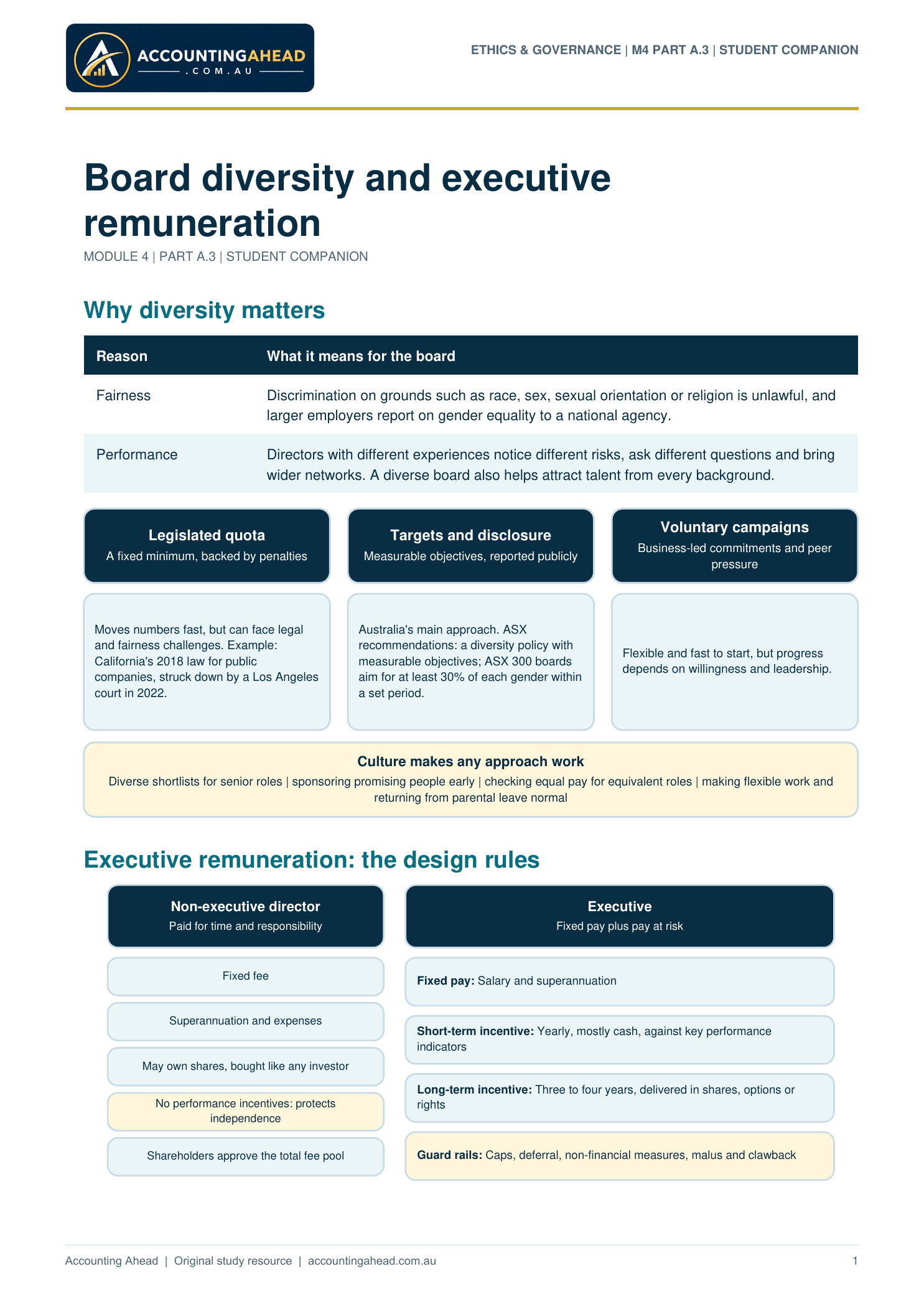
Why diversity matters
Reason What it means for the board
Fairness Discrimination on grounds such as race, sex, sexual orientation or religion is unlawful, and
larger employers report on gender equality to a national agency.
Performance Directors with different experiences notice different risks, ask different questions and bring
wider networks. A diverse board also helps attract talent from every background.
Legislated quota
A fixed minimum, backed by penalties
Moves numbers fast, but can face legal
and fairness challenges. Example:
California's 2018 law for public
companies, struck down by a Los Angeles
court in 2022.
Targets and disclosure
Measurable objectives, reported publicly
Australia's main approach. ASX
recommendations: a diversity policy with
measurable objectives; ASX 300 boards
aim for at least 30% of each gender within
a set period.
Voluntary campaigns
Business-led commitments and peer
pressure
Flexible and fast to start, but progress
depends on willingness and leadership.
Culture makes any approach work
Diverse shortlists for senior roles | sponsoring promising people early | checking equal pay for equivalent roles | making flexible work and
returning from parental leave normal
Executive remuneration: the design rules
Non-executive director
Paid for time and responsibility
Fixed fee
Superannuation and expenses
May own shares, bought like any investor
No performance incentives: protects
independence
Shareholders approve the total fee pool
Executive
Fixed pay plus pay at risk
Fixed pay: Salary and superannuation
Short-term incentive: Yearly, mostly cash, against key performance
indicators
Long-term incentive: Three to four years, delivered in shares, options or
rights
Guard rails: Caps, deferral, non-financial measures, malus and clawback
ETHICS & GOVERNANCE | M4 PART A.3 | STUDENT COMPANION
1
Accounting Ahead | Original study resource | accountingahead.com.au
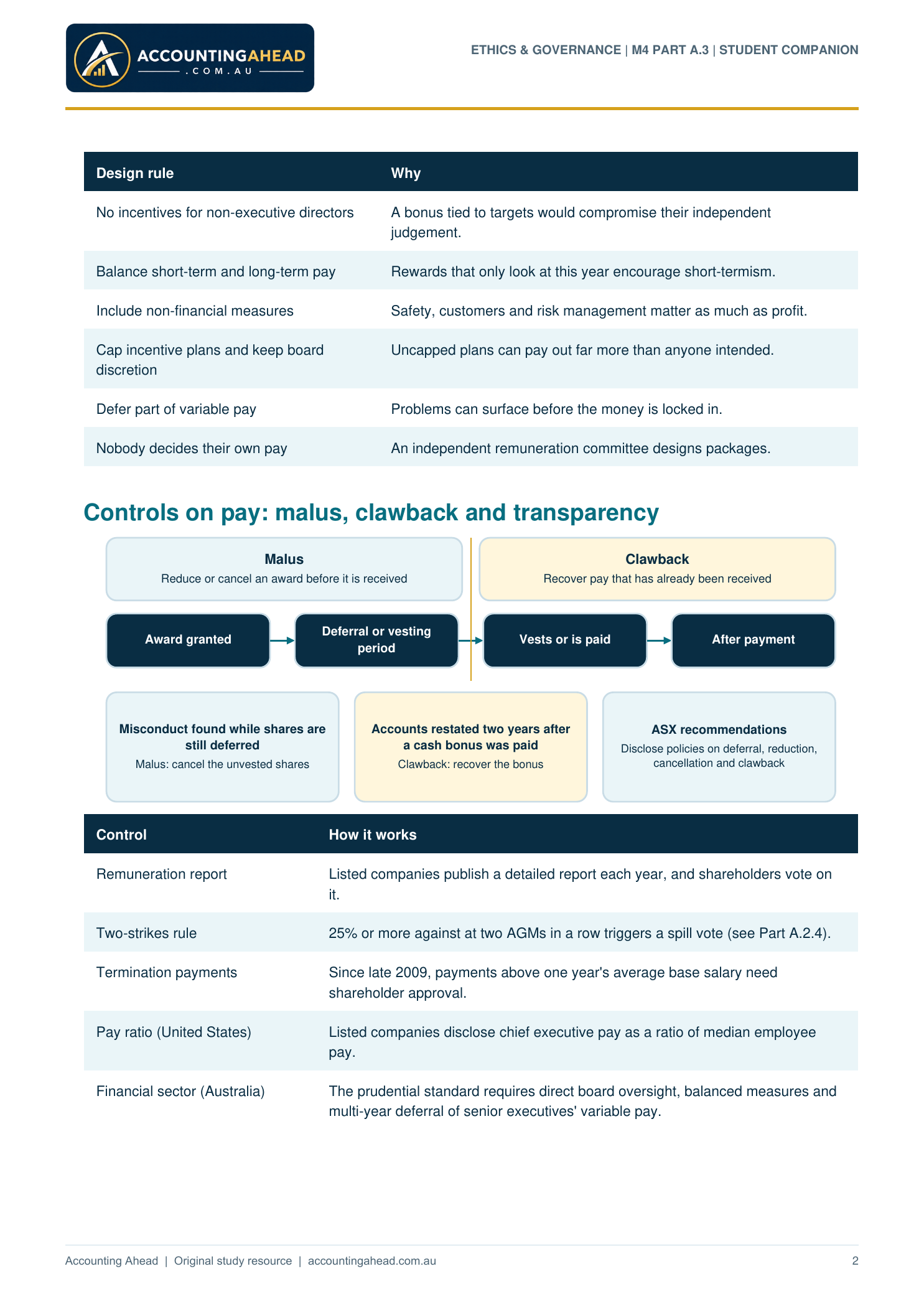
Design rule Why
No incentives for non-executive directors A bonus tied to targets would compromise their independent
judgement.
Balance short-term and long-term pay Rewards that only look at this year encourage short-termism.
Include non-financial measures Safety, customers and risk management matter as much as profit.
Cap incentive plans and keep board
discretion
Uncapped plans can pay out far more than anyone intended.
Defer part of variable pay Problems can surface before the money is locked in.
Nobody decides their own pay An independent remuneration committee designs packages.
Controls on pay: malus, clawback and transparency
Award granted Deferral or vesting
period Vests or is paid After payment
Malus
Reduce or cancel an award before it is received
Clawback
Recover pay that has already been received
Misconduct found while shares are
still deferred
Malus: cancel the unvested shares
Accounts restated two years after
a cash bonus was paid
Clawback: recover the bonus
ASX recommendations
Disclose policies on deferral, reduction,
cancellation and clawback
Control How it works
Remuneration report Listed companies publish a detailed report each year, and shareholders vote on
it.
Two-strikes rule 25% or more against at two AGMs in a row triggers a spill vote (see Part A.2.4).
Termination payments Since late 2009, payments above one year's average base salary need
shareholder approval.
Pay ratio (United States) Listed companies disclose chief executive pay as a ratio of median employee
pay.
Financial sector (Australia) The prudential standard requires direct board oversight, balanced measures and
multi-year deferral of senior executives' variable pay.
ETHICS & GOVERNANCE | M4 PART A.3 | STUDENT COMPANION
2
Accounting Ahead | Original study resource | accountingahead.com.au
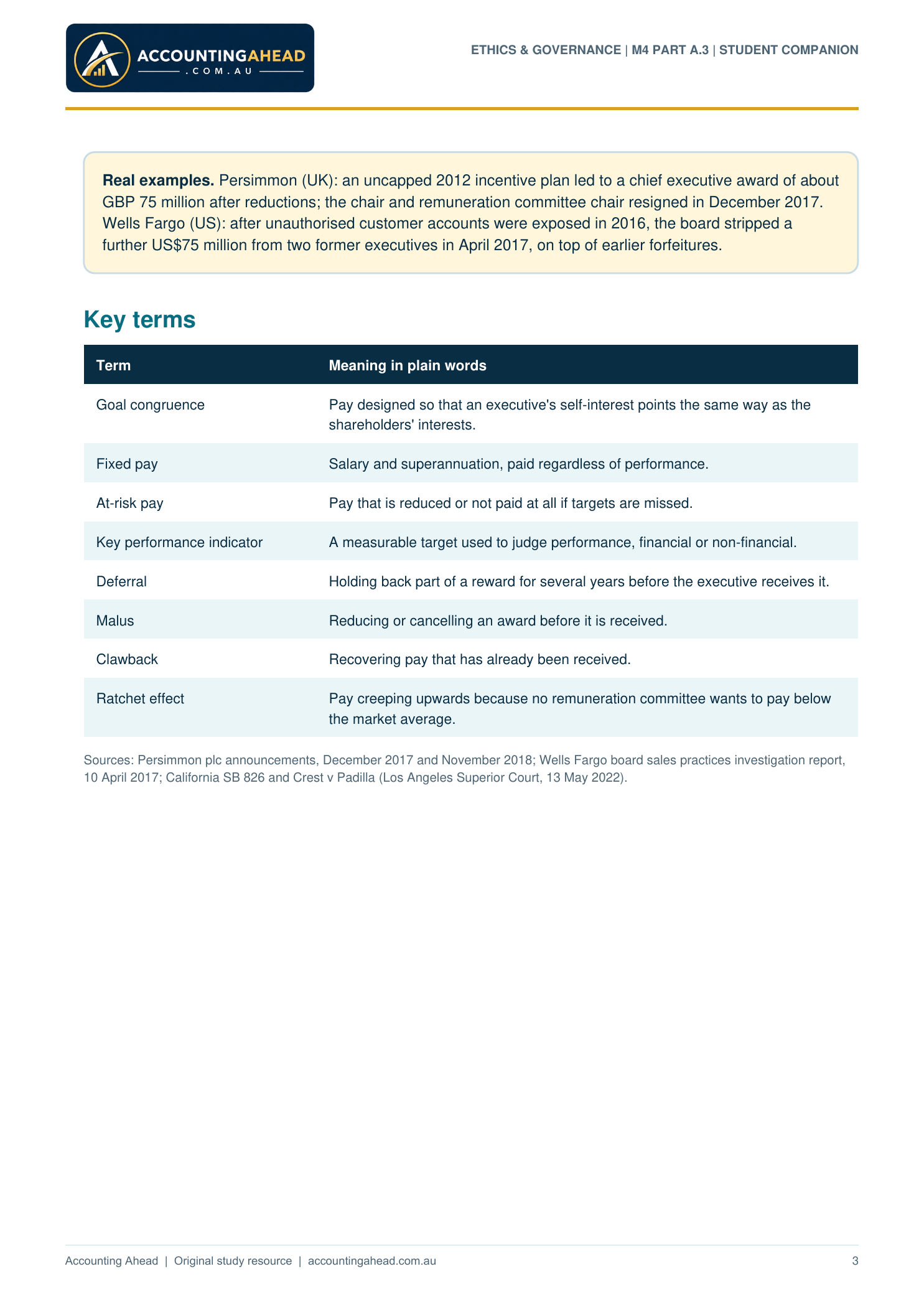
Real examples. Persimmon (UK): an uncapped 2012 incentive plan led to a chief executive award of about
GBP 75 million after reductions; the chair and remuneration committee chair resigned in December 2017.
Wells Fargo (US): after unauthorised customer accounts were exposed in 2016, the board stripped a
further US$75 million from two former executives in April 2017, on top of earlier forfeitures.
Key terms
Term Meaning in plain words
Goal congruence Pay designed so that an executive's self-interest points the same way as the
shareholders' interests.
Fixed pay Salary and superannuation, paid regardless of performance.
At-risk pay Pay that is reduced or not paid at all if targets are missed.
Key performance indicator A measurable target used to judge performance, financial or non-financial.
Deferral Holding back part of a reward for several years before the executive receives it.
Malus Reducing or cancelling an award before it is received.
Clawback Recovering pay that has already been received.
Ratchet effect Pay creeping upwards because no remuneration committee wants to pay below
the market average.
Sources: Persimmon plc announcements, December 2017 and November 2018; Wells Fargo board sales practices investigation report,
10 April 2017; California SB 826 and Crest v Padilla (Los Angeles Superior Court, 13 May 2022).
ETHICS & GOVERNANCE | M4 PART A.3 | STUDENT COMPANION
3
Accounting Ahead | Original study resource | accountingahead.com.au
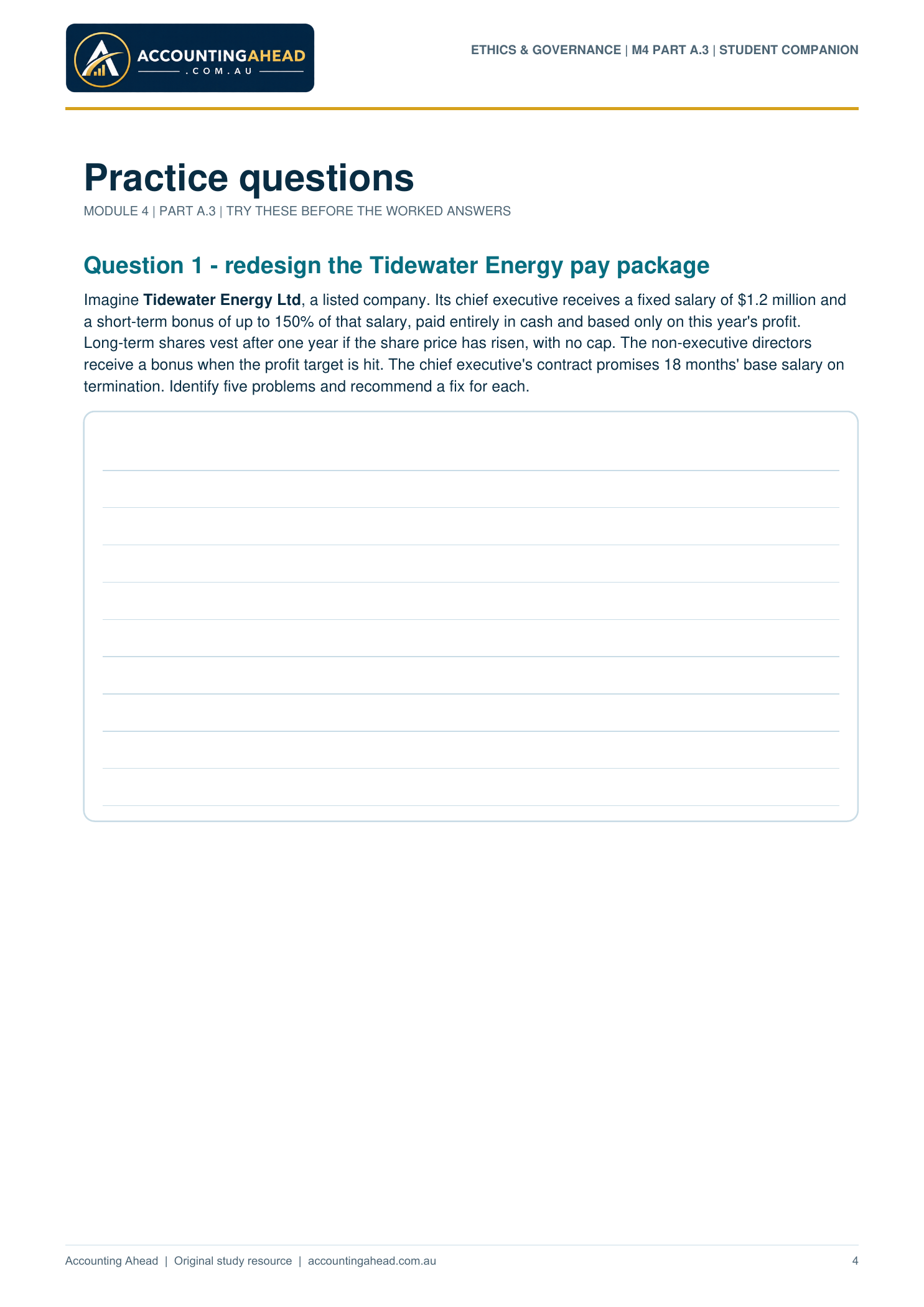
Practice questions
MODULE 4 | PART A.3 | TRY THESE BEFORE THE WORKED ANSWERS
Question 1 - redesign the Tidewater Energy pay package
Imagine Tidewater Energy Ltd, a listed company. Its chief executive receives a fixed salary of $1.2 million and
a short-term bonus of up to 150% of that salary, paid entirely in cash and based only on this year's profit.
Long-term shares vest after one year if the share price has risen, with no cap. The non-executive directors
receive a bonus when the profit target is hit. The chief executive's contract promises 18 months' base salary on
termination. Identify five problems and recommend a fix for each.
ETHICS & GOVERNANCE | M4 PART A.3 | STUDENT COMPANION
4
Accounting Ahead | Original study resource | accountingahead.com.au
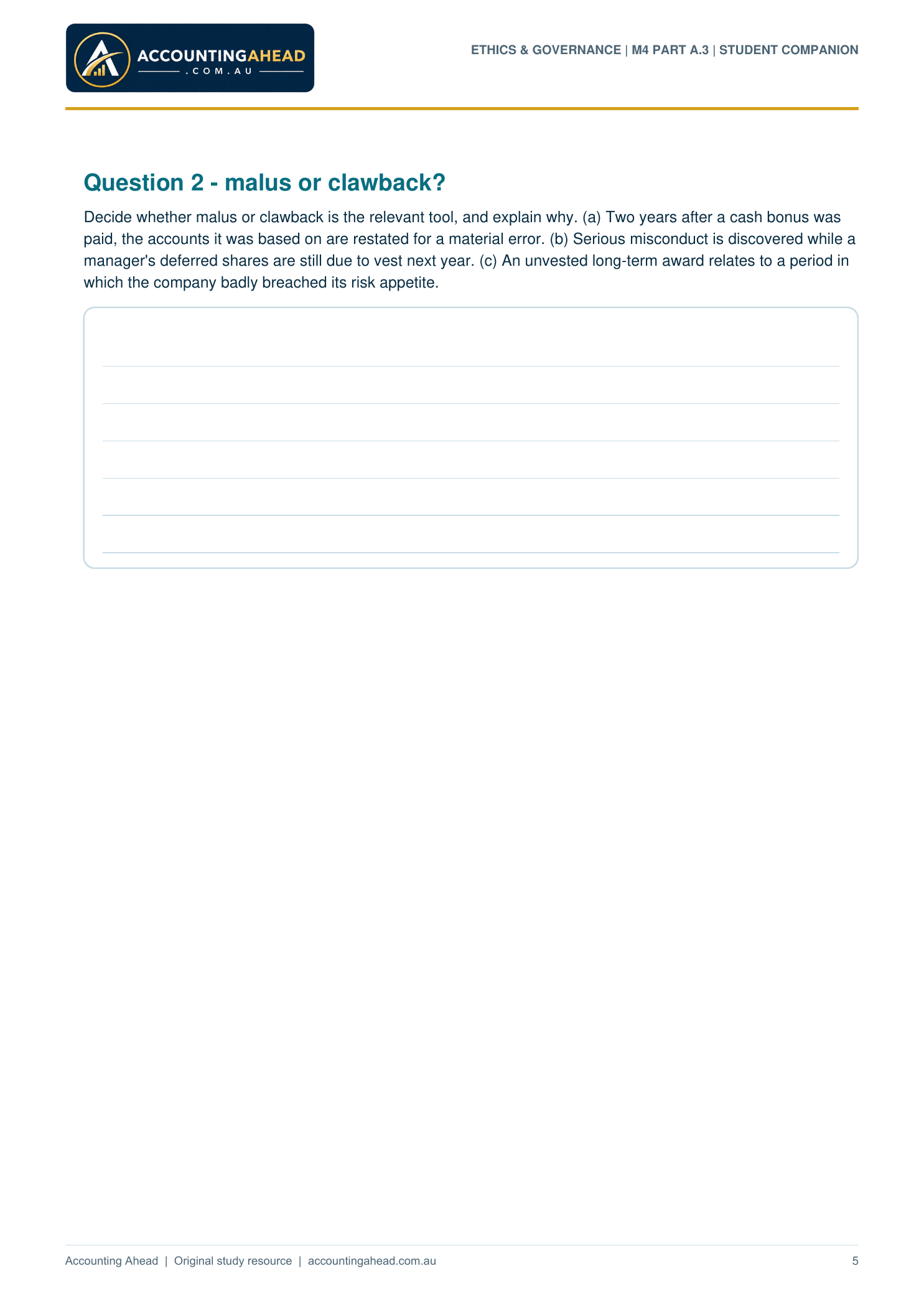
Question 2 - malus or clawback?
Decide whether malus or clawback is the relevant tool, and explain why. (a) Two years after a cash bonus was
paid, the accounts it was based on are restated for a material error. (b) Serious misconduct is discovered while a
manager's deferred shares are still due to vest next year. (c) An unvested long-term award relates to a period in
which the company badly breached its risk appetite.
ETHICS & GOVERNANCE | M4 PART A.3 | STUDENT COMPANION
5
Accounting Ahead | Original study resource | accountingahead.com.au
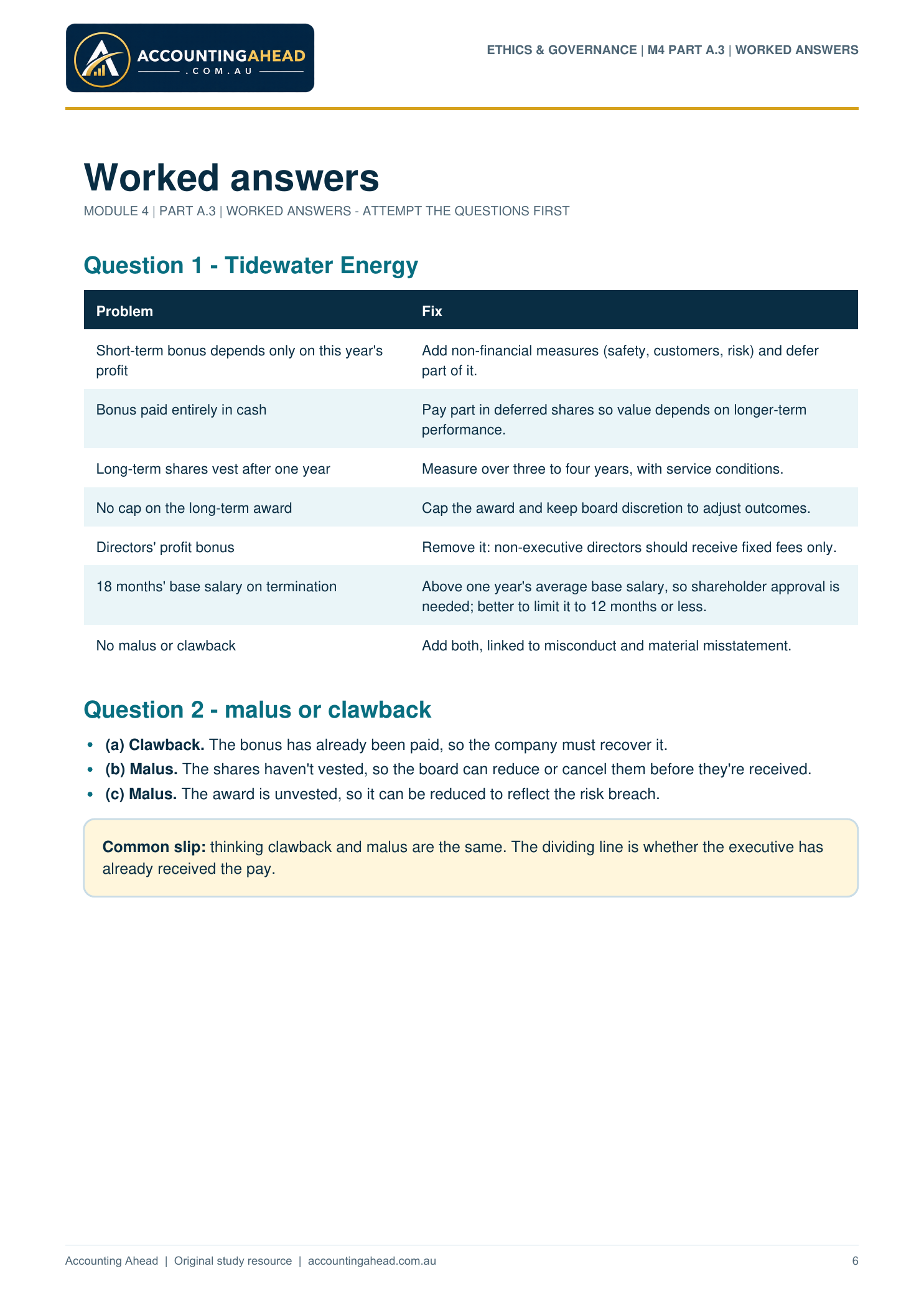
Worked answers
MODULE 4 | PART A.3 | WORKED ANSWERS - ATTEMPT THE QUESTIONS FIRST
Question 1 - Tidewater Energy
Problem Fix
Short-term bonus depends only on this year's
profit
Add non-financial measures (safety, customers, risk) and defer
part of it.
Bonus paid entirely in cash Pay part in deferred shares so value depends on longer-term
performance.
Long-term shares vest after one year Measure over three to four years, with service conditions.
No cap on the long-term award Cap the award and keep board discretion to adjust outcomes.
Directors' profit bonus Remove it: non-executive directors should receive fixed fees only.
18 months' base salary on termination Above one year's average base salary, so shareholder approval is
needed; better to limit it to 12 months or less.
No malus or clawback Add both, linked to misconduct and material misstatement.
Question 2 - malus or clawback
(a) Clawback. The bonus has already been paid, so the company must recover it.
(b) Malus. The shares haven't vested, so the board can reduce or cancel them before they're received.
(c) Malus. The award is unvested, so it can be reduced to reflect the risk breach.
Common slip: thinking clawback and malus are the same. The dividing line is whether the executive has
already received the pay.
ETHICS & GOVERNANCE | M4 PART A.3 | WORKED ANSWERS
6