
Employee obligations and board oversight — student companion
Original branded notes, diagrams and practice with worked answers for Part B.2: connect safety, officer due diligence, wages, superannuation, leave, discrimination and fair workplace conduct.
Read the handout text
Accounting Ahead | Original study resource | accountingahead.com.au
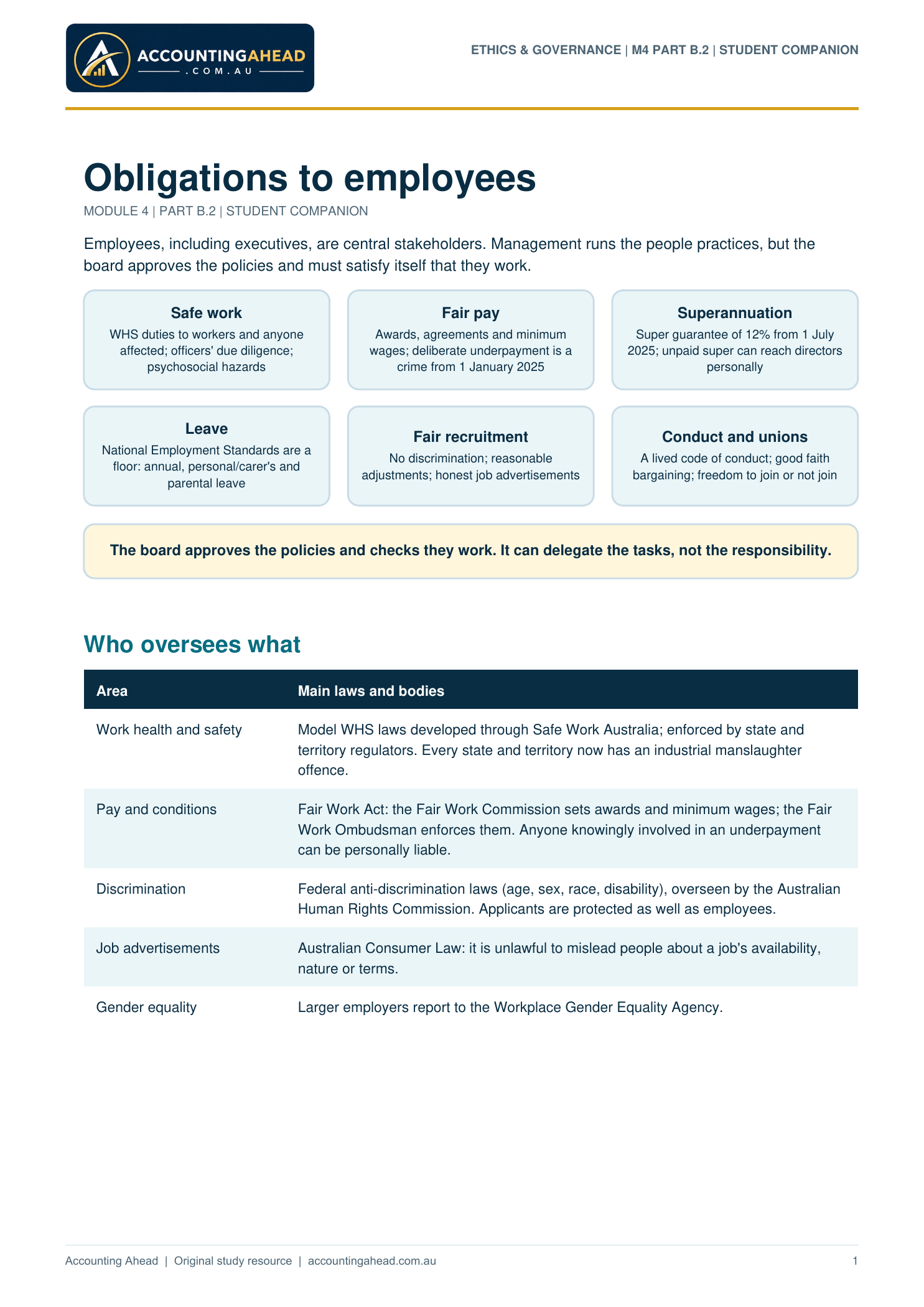
Obligations to employees
MODULE 4 | PART B.2 | STUDENT COMPANION
Employees, including executives, are central stakeholders. Management runs the people practices, but the
board approves the policies and must satisfy itself that they work.
Safe work
WHS duties to workers and anyone
affected; officers' due diligence;
psychosocial hazards
Fair pay
Awards, agreements and minimum
wages; deliberate underpayment is a
crime from 1 January 2025
Superannuation
Super guarantee of 12% from 1 July
2025; unpaid super can reach directors
personally
Leave
National Employment Standards are a
floor: annual, personal/carer's and
parental leave
Fair recruitment
No discrimination; reasonable
adjustments; honest job advertisements
Conduct and unions
A lived code of conduct; good faith
bargaining; freedom to join or not join
The board approves the policies and checks they work. It can delegate the tasks, not the responsibility.
Who oversees what
Area Main laws and bodies
Work health and safety Model WHS laws developed through Safe Work Australia; enforced by state and
territory regulators. Every state and territory now has an industrial manslaughter
offence.
Pay and conditions Fair Work Act: the Fair Work Commission sets awards and minimum wages; the Fair
Work Ombudsman enforces them. Anyone knowingly involved in an underpayment
can be personally liable.
Discrimination Federal anti-discrimination laws (age, sex, race, disability), overseen by the Australian
Human Rights Commission. Applicants are protected as well as employees.
Job advertisements Australian Consumer Law: it is unlawful to mislead people about a job's availability,
nature or terms.
Gender equality Larger employers report to the Workplace Gender Equality Agency.
ETHICS & GOVERNANCE | M4 PART B.2 | STUDENT COMPANION
1
Accounting Ahead | Original study resource | accountingahead.com.au
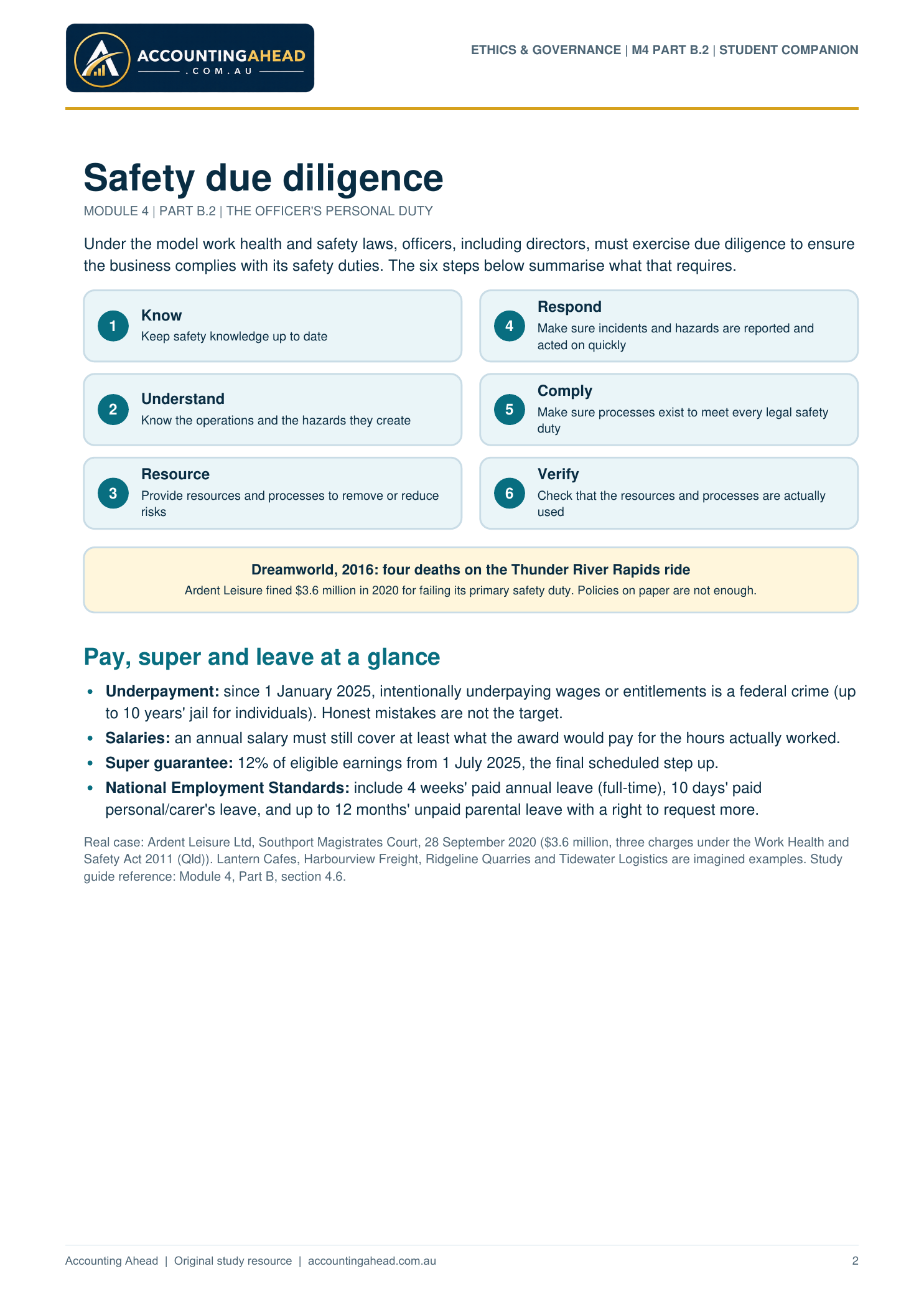
Safety due diligence
MODULE 4 | PART B.2 | THE OFFICER'S PERSONAL DUTY
Under the model work health and safety laws, officers, including directors, must exercise due diligence to ensure
the business complies with its safety duties. The six steps below summarise what that requires.
1 Know
Keep safety knowledge up to date
2 Understand
Know the operations and the hazards they create
3
Resource
Provide resources and processes to remove or reduce
risks
4
Respond
Make sure incidents and hazards are reported and
acted on quickly
5
Comply
Make sure processes exist to meet every legal safety
duty
6
Verify
Check that the resources and processes are actually
used
Dreamworld, 2016: four deaths on the Thunder River Rapids ride
Ardent Leisure fined $3.6 million in 2020 for failing its primary safety duty. Policies on paper are not enough.
Pay, super and leave at a glance
Underpayment: since 1 January 2025, intentionally underpaying wages or entitlements is a federal crime (up
to 10 years' jail for individuals). Honest mistakes are not the target.
Salaries: an annual salary must still cover at least what the award would pay for the hours actually worked.
Super guarantee: 12% of eligible earnings from 1 July 2025, the final scheduled step up.
National Employment Standards: include 4 weeks' paid annual leave (full-time), 10 days' paid
personal/carer's leave, and up to 12 months' unpaid parental leave with a right to request more.
Real case: Ardent Leisure Ltd, Southport Magistrates Court, 28 September 2020 ($3.6 million, three charges under the Work Health and
Safety Act 2011 (Qld)). Lantern Cafes, Harbourview Freight, Ridgeline Quarries and Tidewater Logistics are imagined examples. Study
guide reference: Module 4, Part B, section 4.6.
ETHICS & GOVERNANCE | M4 PART B.2 | STUDENT COMPANION
2
Accounting Ahead | Original study resource | accountingahead.com.au
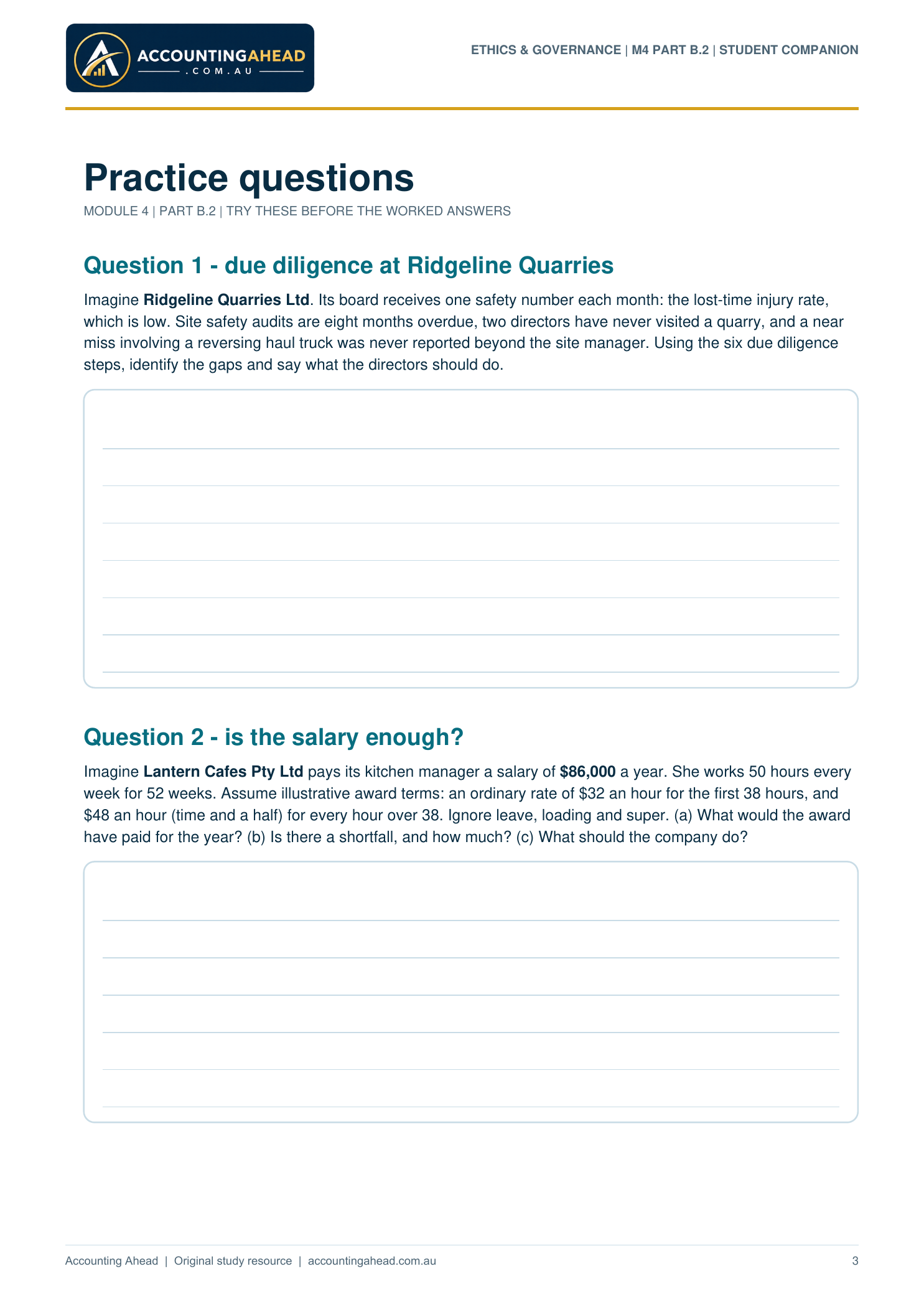
Practice questions
MODULE 4 | PART B.2 | TRY THESE BEFORE THE WORKED ANSWERS
Question 1 - due diligence at Ridgeline Quarries
Imagine Ridgeline Quarries Ltd. Its board receives one safety number each month: the lost-time injury rate,
which is low. Site safety audits are eight months overdue, two directors have never visited a quarry, and a near
miss involving a reversing haul truck was never reported beyond the site manager. Using the six due diligence
steps, identify the gaps and say what the directors should do.
Question 2 - is the salary enough?
Imagine Lantern Cafes Pty Ltd pays its kitchen manager a salary of $86,000 a year. She works 50 hours every
week for 52 weeks. Assume illustrative award terms: an ordinary rate of $32 an hour for the first 38 hours, and
$48 an hour (time and a half) for every hour over 38. Ignore leave, loading and super. (a) What would the award
have paid for the year? (b) Is there a shortfall, and how much? (c) What should the company do?
ETHICS & GOVERNANCE | M4 PART B.2 | STUDENT COMPANION
3
Accounting Ahead | Original study resource | accountingahead.com.au
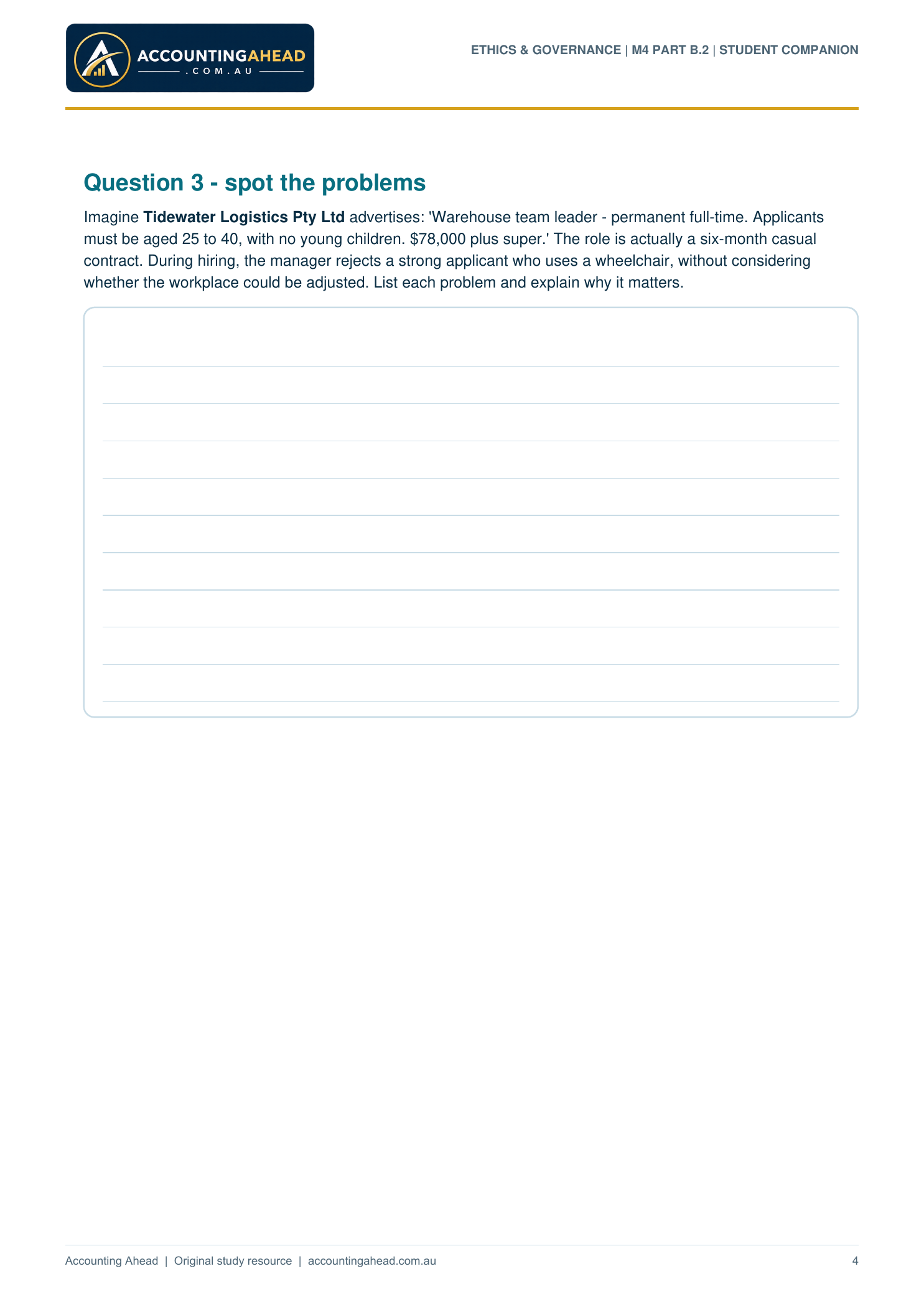
Question 3 - spot the problems
Imagine Tidewater Logistics Pty Ltd advertises: 'Warehouse team leader - permanent full-time. Applicants
must be aged 25 to 40, with no young children. $78,000 plus super.' The role is actually a six-month casual
contract. During hiring, the manager rejects a strong applicant who uses a wheelchair, without considering
whether the workplace could be adjusted. List each problem and explain why it matters.
ETHICS & GOVERNANCE | M4 PART B.2 | STUDENT COMPANION
4
Accounting Ahead | Original study resource | accountingahead.com.au
Worked answers
MODULE 4 | PART B.2 | WORKED ANSWERS - ATTEMPT THE QUESTIONS FIRST
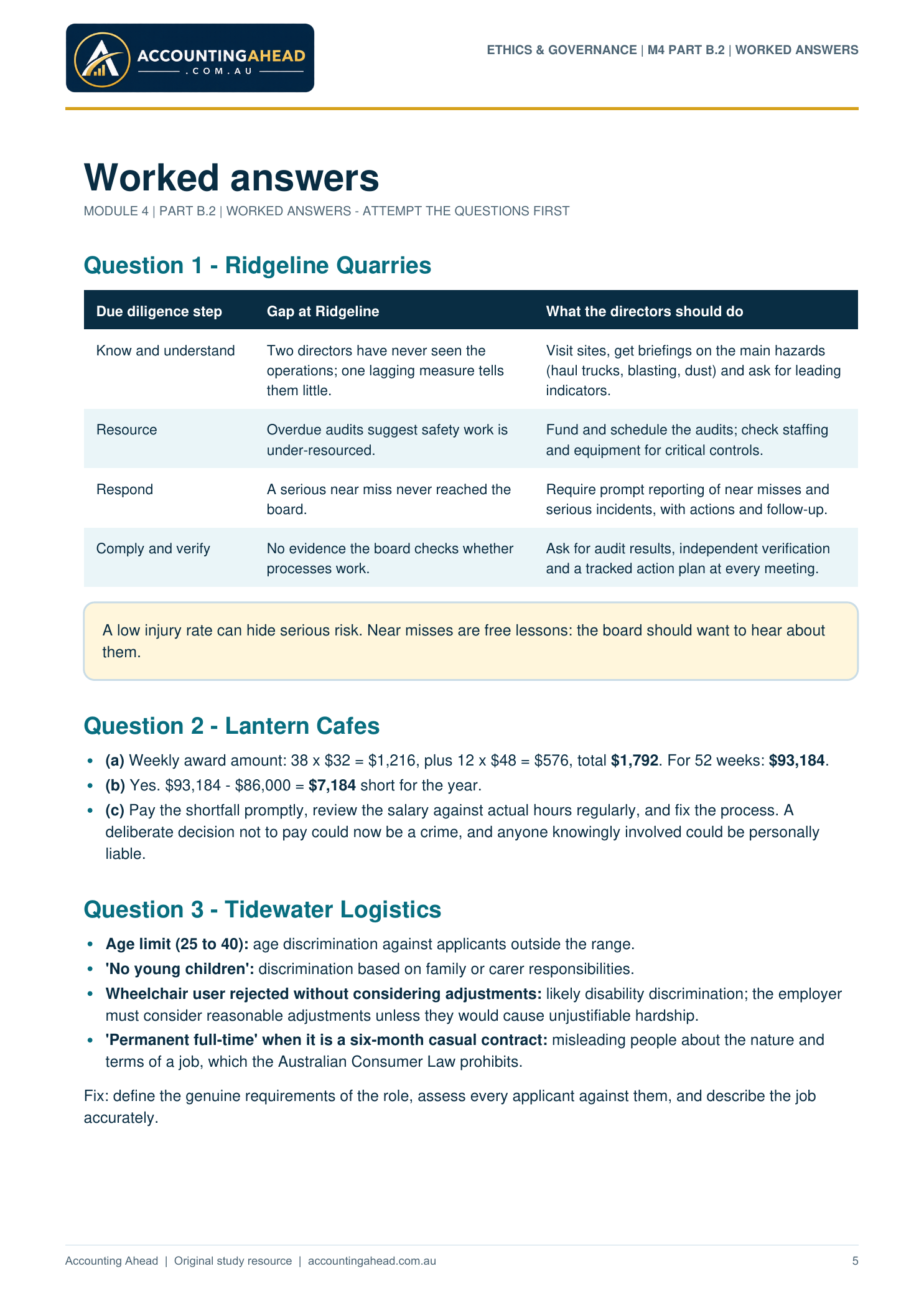
Question 1 - Ridgeline Quarries
Due diligence step Gap at Ridgeline What the directors should do
Know and understand Two directors have never seen the
operations; one lagging measure tells
them little.
Visit sites, get briefings on the main hazards
(haul trucks, blasting, dust) and ask for leading
indicators.
Resource Overdue audits suggest safety work is
under-resourced.
Fund and schedule the audits; check staffing
and equipment for critical controls.
Respond A serious near miss never reached the
board.
Require prompt reporting of near misses and
serious incidents, with actions and follow-up.
Comply and verify No evidence the board checks whether
processes work.
Ask for audit results, independent verification
and a tracked action plan at every meeting.
A low injury rate can hide serious risk. Near misses are free lessons: the board should want to hear about
them.
Question 2 - Lantern Cafes
(a) Weekly award amount: 38 x $32 = $1,216, plus 12 x $48 = $576, total $1,792. For 52 weeks: $93,184.
(b) Yes. $93,184 - $86,000 = $7,184 short for the year.
(c) Pay the shortfall promptly, review the salary against actual hours regularly, and fix the process. A
deliberate decision not to pay could now be a crime, and anyone knowingly involved could be personally
liable.
Question 3 - Tidewater Logistics
Age limit (25 to 40): age discrimination against applicants outside the range.
'No young children': discrimination based on family or carer responsibilities.
Wheelchair user rejected without considering adjustments: likely disability discrimination; the employer
must consider reasonable adjustments unless they would cause unjustifiable hardship.
'Permanent full-time' when it is a six-month casual contract: misleading people about the nature and
terms of a job, which the Australian Consumer Law prohibits.
Fix: define the genuine requirements of the role, assess every applicant against them, and describe the job
accurately.
ETHICS & GOVERNANCE | M4 PART B.2 | WORKED ANSWERS
5