
Representation, speaking up and honest disclosure — student companion
Original branded notes, diagrams and practice with worked answers for Part C.2: link shareholder representation and stewardship with protected whistleblowing, supply-chain responsibility and credible sustainability claims.
Read the handout text
Accounting Ahead | Original study resource | accountingahead.com.au
Representation, whistleblowers and
sustainability disclosure
MODULE 4 | PART C.2 | STUDENT COMPANION
Use the three diagrams to organise your notes, then try the practice questions before you look at the worked
answers. Each answer space is for handwriting or annotation.
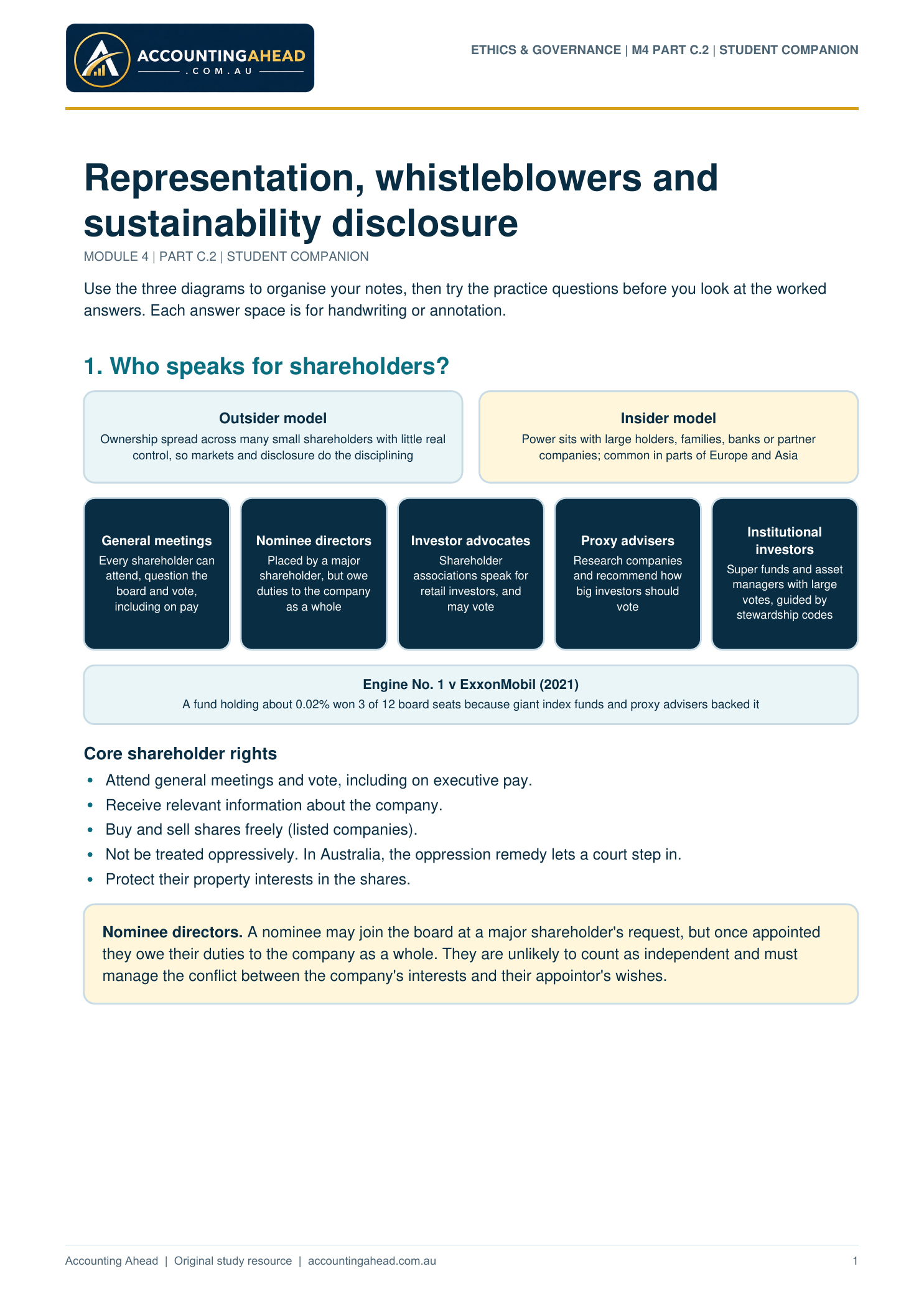
1. Who speaks for shareholders?
Outsider model
Ownership spread across many small shareholders with little real
control, so markets and disclosure do the disciplining
Insider model
Power sits with large holders, families, banks or partner
companies; common in parts of Europe and Asia
General meetings
Every shareholder can
attend, question the
board and vote,
including on pay
Nominee directors
Placed by a major
shareholder, but owe
duties to the company
as a whole
Investor advocates
Shareholder
associations speak for
retail investors, and
may vote
Proxy advisers
Research companies
and recommend how
big investors should
vote
Institutional
investors
Super funds and asset
managers with large
votes, guided by
stewardship codes
Engine No. 1 v ExxonMobil (2021)
A fund holding about 0.02% won 3 of 12 board seats because giant index funds and proxy advisers backed it
Core shareholder rights
Attend general meetings and vote, including on executive pay.
Receive relevant information about the company.
Buy and sell shares freely (listed companies).
Not be treated oppressively. In Australia, the oppression remedy lets a court step in.
Protect their property interests in the shares.
Nominee directors. A nominee may join the board at a major shareholder's request, but once appointed
they owe their duties to the company as a whole. They are unlikely to count as independent and must
manage the conflict between the company's interests and their appointor's wishes.
ETHICS & GOVERNANCE | M4 PART C.2 | STUDENT COMPANION
1
Accounting Ahead | Original study resource | accountingahead.com.au
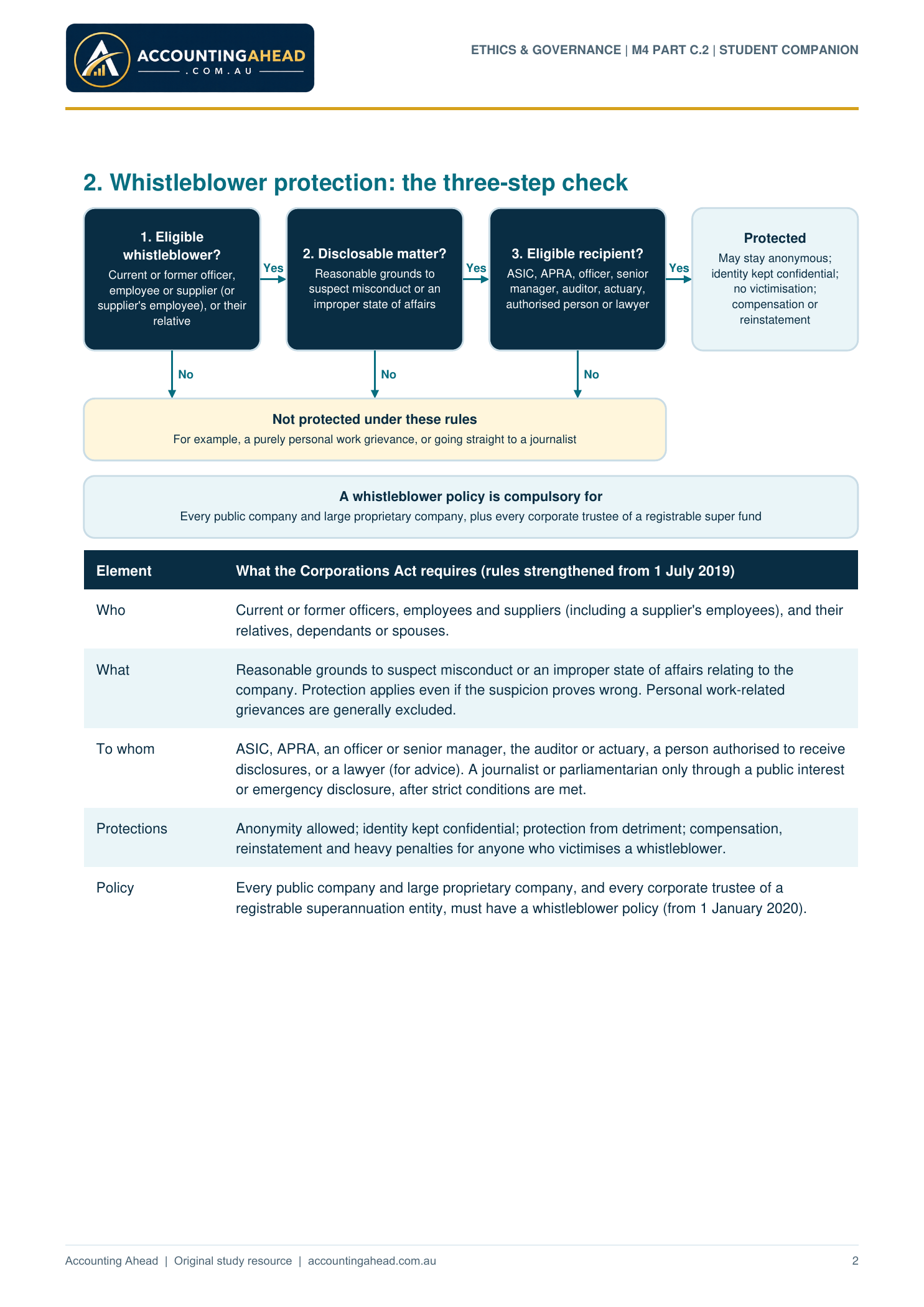
2. Whistleblower protection: the three-step check
1. Eligible
whistleblower?
Current or former officer,
employee or supplier (or
supplier's employee), or their
relative
Yes
No
2. Disclosable matter?
Reasonable grounds to
suspect misconduct or an
improper state of affairs
Yes
No
3. Eligible recipient?
ASIC, APRA, officer, senior
manager, auditor, actuary,
authorised person or lawyer
Yes
No
Protected
May stay anonymous;
identity kept confidential;
no victimisation;
compensation or
reinstatement
Not protected under these rules
For example, a purely personal work grievance, or going straight to a journalist
A whistleblower policy is compulsory for
Every public company and large proprietary company, plus every corporate trustee of a registrable super fund
Element What the Corporations Act requires (rules strengthened from 1 July 2019)
Who Current or former officers, employees and suppliers (including a supplier's employees), and their
relatives, dependants or spouses.
What Reasonable grounds to suspect misconduct or an improper state of affairs relating to the
company. Protection applies even if the suspicion proves wrong. Personal work-related
grievances are generally excluded.
To whom ASIC, APRA, an officer or senior manager, the auditor or actuary, a person authorised to receive
disclosures, or a lawyer (for advice). A journalist or parliamentarian only through a public interest
or emergency disclosure, after strict conditions are met.
Protections Anonymity allowed; identity kept confidential; protection from detriment; compensation,
reinstatement and heavy penalties for anyone who victimises a whistleblower.
Policy Every public company and large proprietary company, and every corporate trustee of a
registrable superannuation entity, must have a whistleblower policy (from 1 January 2020).
ETHICS & GOVERNANCE | M4 PART C.2 | STUDENT COMPANION
2
Accounting Ahead | Original study resource | accountingahead.com.au
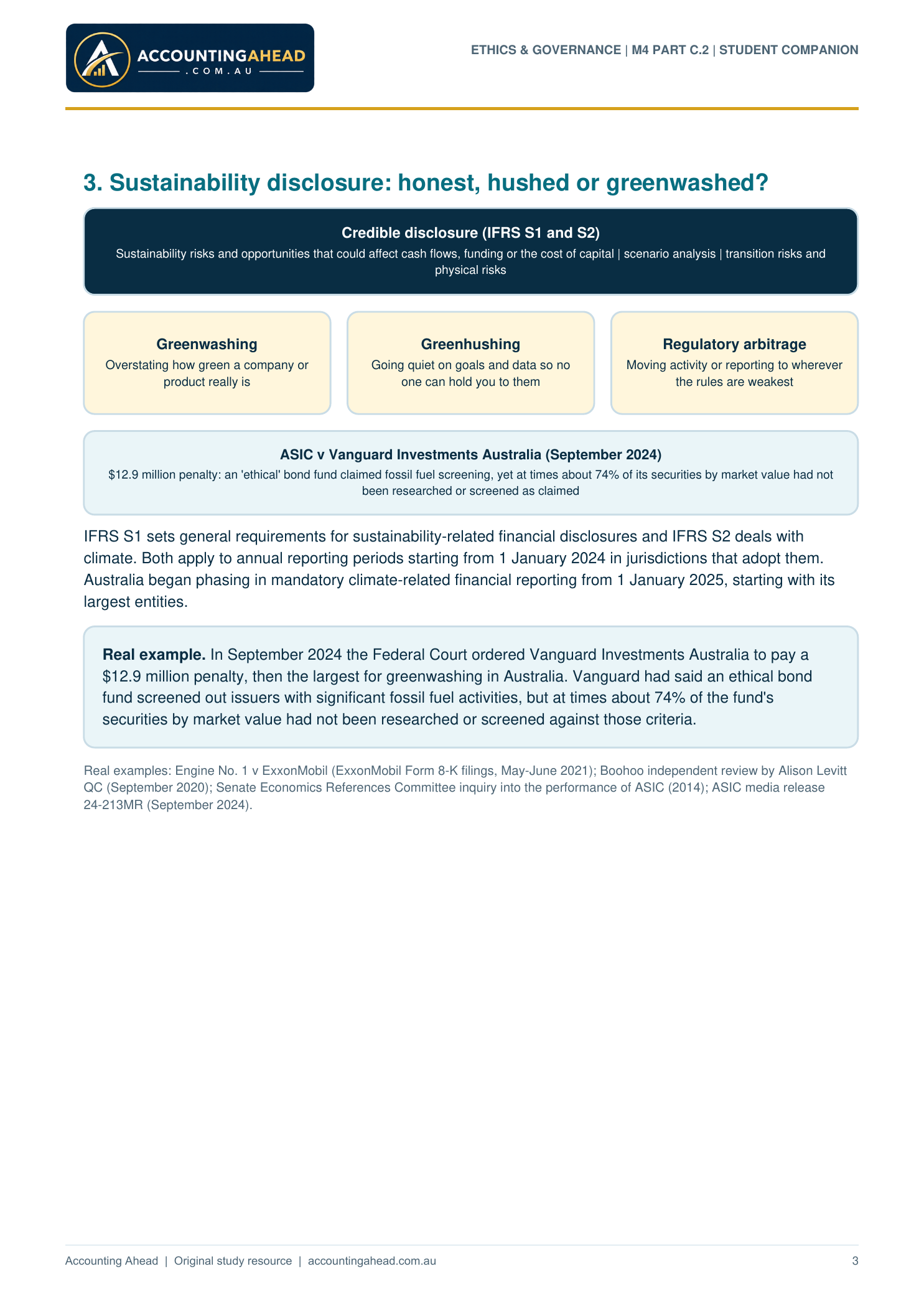
3. Sustainability disclosure: honest, hushed or greenwashed?
Credible disclosure (IFRS S1 and S2)
Sustainability risks and opportunities that could affect cash flows, funding or the cost of capital | scenario analysis | transition risks and
physical risks
Greenwashing
Overstating how green a company or
product really is
Greenhushing
Going quiet on goals and data so no
one can hold you to them
Regulatory arbitrage
Moving activity or reporting to wherever
the rules are weakest
ASIC v Vanguard Investments Australia (September 2024)
$12.9 million penalty: an 'ethical' bond fund claimed fossil fuel screening, yet at times about 74% of its securities by market value had not
been researched or screened as claimed
IFRS S1 sets general requirements for sustainability-related financial disclosures and IFRS S2 deals with
climate. Both apply to annual reporting periods starting from 1 January 2024 in jurisdictions that adopt them.
Australia began phasing in mandatory climate-related financial reporting from 1 January 2025, starting with its
largest entities.
Real example. In September 2024 the Federal Court ordered Vanguard Investments Australia to pay a
$12.9 million penalty, then the largest for greenwashing in Australia. Vanguard had said an ethical bond
fund screened out issuers with significant fossil fuel activities, but at times about 74% of the fund's
securities by market value had not been researched or screened against those criteria.
Real examples: Engine No. 1 v ExxonMobil (ExxonMobil Form 8-K filings, May-June 2021); Boohoo independent review by Alison Levitt
QC (September 2020); Senate Economics References Committee inquiry into the performance of ASIC (2014); ASIC media release
24-213MR (September 2024).
ETHICS & GOVERNANCE | M4 PART C.2 | STUDENT COMPANION
3
Accounting Ahead | Original study resource | accountingahead.com.au
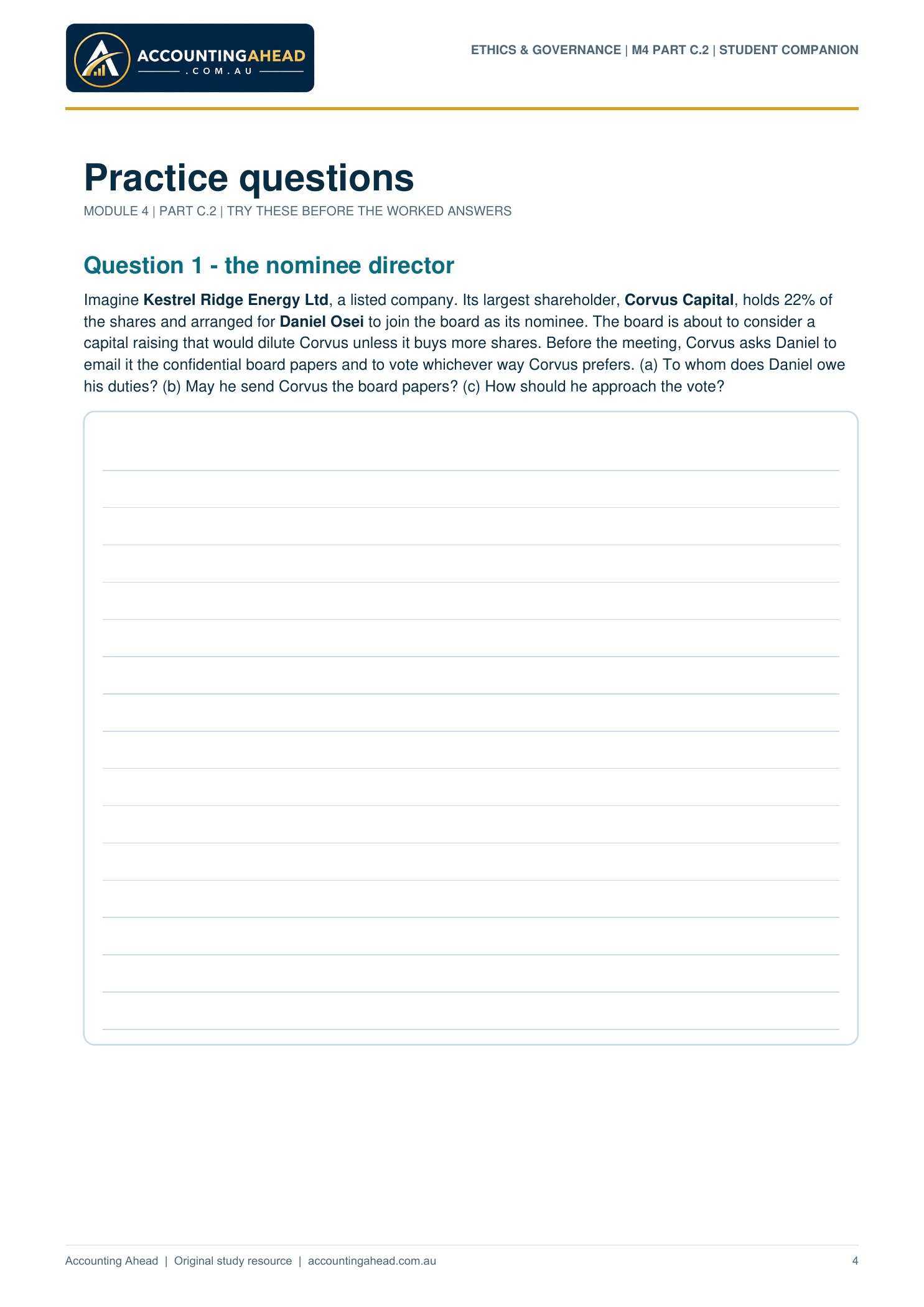
Practice questions
MODULE 4 | PART C.2 | TRY THESE BEFORE THE WORKED ANSWERS
Question 1 - the nominee director
Imagine Kestrel Ridge Energy Ltd, a listed company. Its largest shareholder, Corvus Capital, holds 22% of
the shares and arranged for Daniel Osei to join the board as its nominee. The board is about to consider a
capital raising that would dilute Corvus unless it buys more shares. Before the meeting, Corvus asks Daniel to
email it the confidential board papers and to vote whichever way Corvus prefers. (a) To whom does Daniel owe
his duties? (b) May he send Corvus the board papers? (c) How should he approach the vote?
ETHICS & GOVERNANCE | M4 PART C.2 | STUDENT COMPANION
4
Accounting Ahead | Original study resource | accountingahead.com.au
Question 2 - who is a protected whistleblower?
Imagine Bellweather Freight Pty Ltd, a large proprietary company. Three people want to raise concerns. Mai,
who left the finance team last year, contacts ASIC because she suspects the chief financial officer of inflating
revenue figures. Tom, a current warehouse supervisor, believes safety inspection records are being falsified and
goes straight to a journalist without telling anyone else first. Luca, a driver, tells the human resources manager
that his own roster change was unfair to him. For each person, decide whether the Corporations Act
whistleblower protections are likely to apply, and explain why.
ETHICS & GOVERNANCE | M4 PART C.2 | STUDENT COMPANION
5
Accounting Ahead | Original study resource | accountingahead.com.au
Question 3 - honest, hushed or greenwashed?
Imagine the Kowari Ethical Growth Fund, run by Kowari Investments Ltd. Its website says: 'Fossil-fuel free -
every holding screened by our ESG team.' Its disclosure document says it excludes companies earning more
than 10% of revenue from fossil fuels. An internal review finds that 18% of the fund's holdings by value were
never screened, and that two holdings earn most of their revenue from gas pipelines. Last year Kowari also
deleted its net zero target from its annual report without explanation and stopped publishing emissions data. (a)
Is the website claim likely to be misleading? (b) What does the deleted target suggest? (c) What should Kowari's
board do now?
ETHICS & GOVERNANCE | M4 PART C.2 | STUDENT COMPANION
6
Accounting Ahead | Original study resource | accountingahead.com.au
Worked answers
MODULE 4 | PART C.2 | WORKED ANSWERS - ATTEMPT THE QUESTIONS FIRST
Question 1 - Kestrel Ridge Energy Ltd
(a) To Kestrel Ridge as a whole. Being a nominee does not change a director's duties: Daniel must act
honestly, in the company's interests and for proper purposes, using his own judgement. He may weigh
Corvus's views only where they line up with the company's interests.
(b) Not without the board's approval. Board papers are confidential company information, and a director must
not misuse information gained as a director. Papers about a capital raising are also likely to be price-sensitive
inside information, so passing them on could amount to tipping. Any information-sharing arrangement with an
appointing shareholder should be authorised by the board and protected by confidentiality and insider trading
safeguards.
(c) He must decide what is best for the company, not take instructions. He should disclose the conflict
between his link to Corvus and his duty to the company, follow the board's conflict procedures, and step out
of the discussion and vote if the conflict is significant. The board should not treat him as independent.
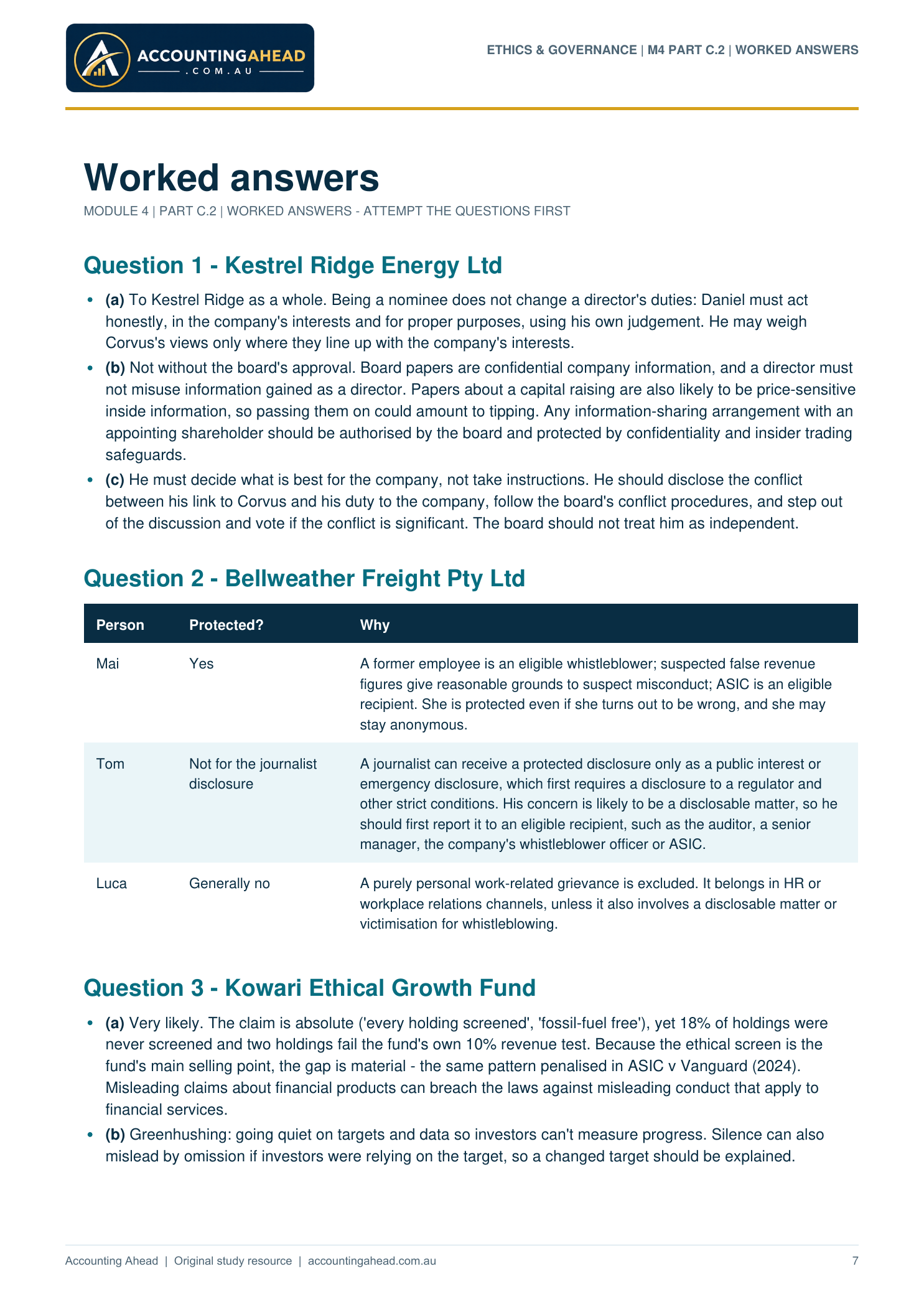
Question 2 - Bellweather Freight Pty Ltd
Person Protected? Why
Mai Yes A former employee is an eligible whistleblower; suspected false revenue
figures give reasonable grounds to suspect misconduct; ASIC is an eligible
recipient. She is protected even if she turns out to be wrong, and she may
stay anonymous.
Tom Not for the journalist
disclosure
A journalist can receive a protected disclosure only as a public interest or
emergency disclosure, which first requires a disclosure to a regulator and
other strict conditions. His concern is likely to be a disclosable matter, so he
should first report it to an eligible recipient, such as the auditor, a senior
manager, the company's whistleblower officer or ASIC.
Luca Generally no A purely personal work-related grievance is excluded. It belongs in HR or
workplace relations channels, unless it also involves a disclosable matter or
victimisation for whistleblowing.
Question 3 - Kowari Ethical Growth Fund
(a) Very likely. The claim is absolute ('every holding screened', 'fossil-fuel free'), yet 18% of holdings were
never screened and two holdings fail the fund's own 10% revenue test. Because the ethical screen is the
fund's main selling point, the gap is material - the same pattern penalised in ASIC v Vanguard (2024).
Misleading claims about financial products can breach the laws against misleading conduct that apply to
financial services.
(b) Greenhushing: going quiet on targets and data so investors can't measure progress. Silence can also
mislead by omission if investors were relying on the target, so a changed target should be explained.
ETHICS & GOVERNANCE | M4 PART C.2 | WORKED ANSWERS
7
Accounting Ahead | Original study resource | accountingahead.com.au
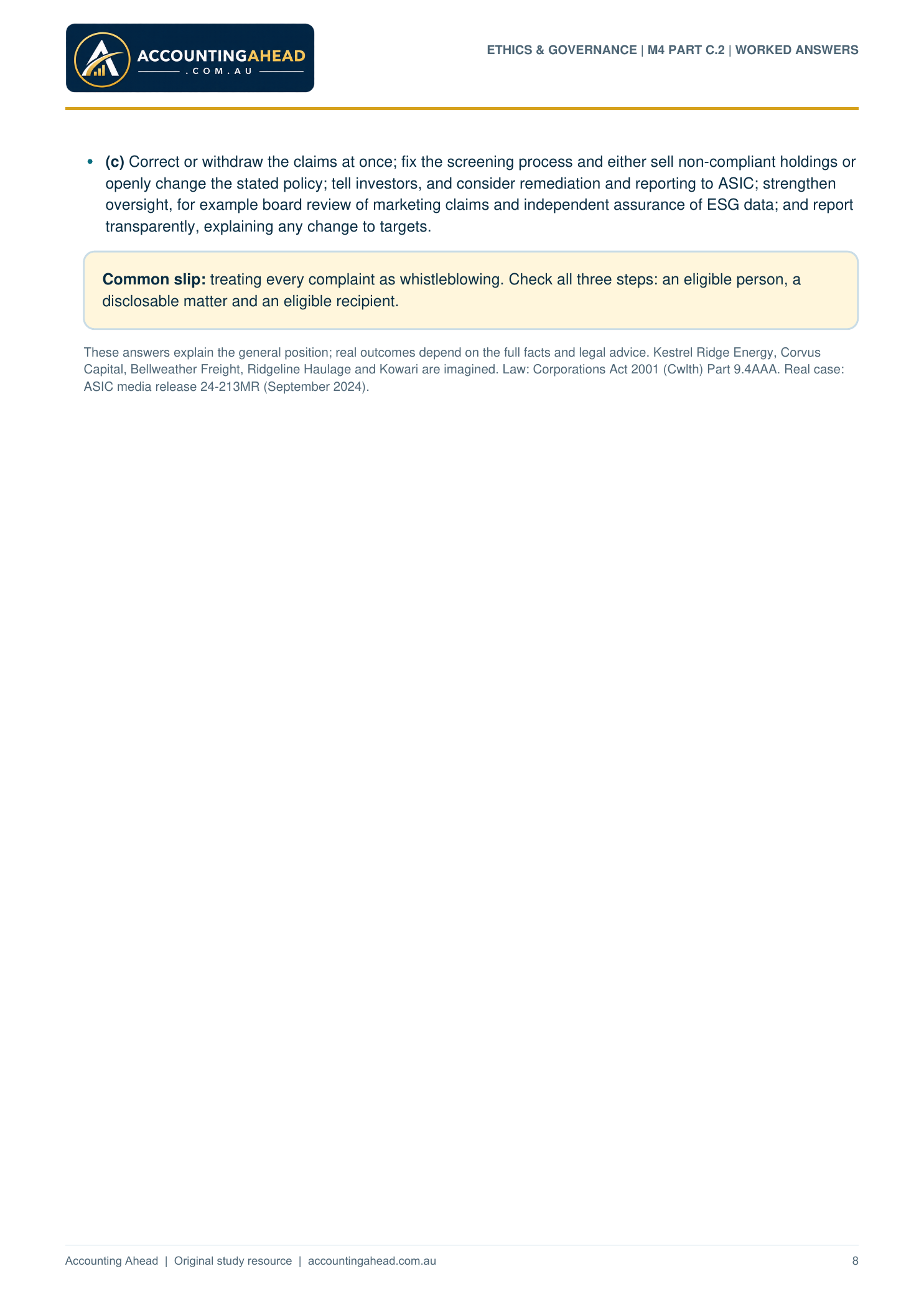
(c) Correct or withdraw the claims at once; fix the screening process and either sell non-compliant holdings or
openly change the stated policy; tell investors, and consider remediation and reporting to ASIC; strengthen
oversight, for example board review of marketing claims and independent assurance of ESG data; and report
transparently, explaining any change to targets.
Common slip: treating every complaint as whistleblowing. Check all three steps: an eligible person, a
disclosable matter and an eligible recipient.
These answers explain the general position; real outcomes depend on the full facts and legal advice. Kestrel Ridge Energy, Corvus
Capital, Bellweather Freight, Ridgeline Haulage and Kowari are imagined. Law: Corporations Act 2001 (Cwlth) Part 9.4AAA. Real case:
ASIC media release 24-213MR (September 2024).
ETHICS & GOVERNANCE | M4 PART C.2 | WORKED ANSWERS
8