
Why companies fail and how boards respond — student companion
Original branded notes, diagrams and practice with worked answers for Part A.1: trace common causes of corporate failure, the risk-management cycle, internal controls and the separation of chair and chief executive responsibilities.
Read the handout text
Accounting Ahead | Original study resource | accountingahead.com.au
Why companies fail and how boards
defend against it
MODULE 4 | PART A.1 | STUDENT COMPANION
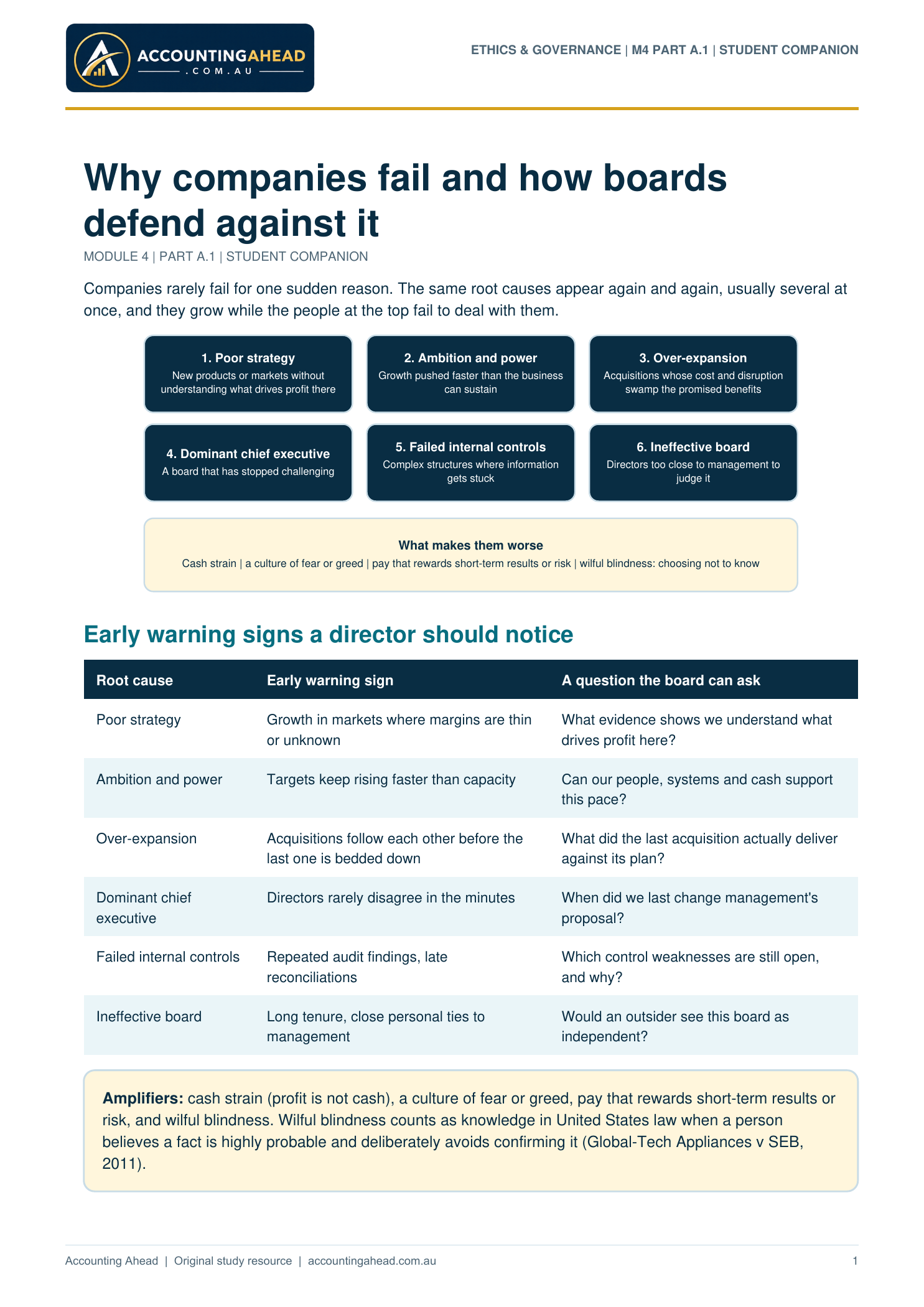
Companies rarely fail for one sudden reason. The same root causes appear again and again, usually several at
once, and they grow while the people at the top fail to deal with them.
1. Poor strategy
New products or markets without
understanding what drives profit there
2. Ambition and power
Growth pushed faster than the business
can sustain
3. Over-expansion
Acquisitions whose cost and disruption
swamp the promised benefits
4. Dominant chief executive
A board that has stopped challenging
5. Failed internal controls
Complex structures where information
gets stuck
6. Ineffective board
Directors too close to management to
judge it
What makes them worse
Cash strain | a culture of fear or greed | pay that rewards short-term results or risk | wilful blindness: choosing not to know
Early warning signs a director should notice
Root cause Early warning sign A question the board can ask
Poor strategy Growth in markets where margins are thin
or unknown
What evidence shows we understand what
drives profit here?
Ambition and power Targets keep rising faster than capacity Can our people, systems and cash support
this pace?
Over-expansion Acquisitions follow each other before the
last one is bedded down
What did the last acquisition actually deliver
against its plan?
Dominant chief
executive
Directors rarely disagree in the minutes When did we last change management's
proposal?
Failed internal controls Repeated audit findings, late
reconciliations
Which control weaknesses are still open,
and why?
Ineffective board Long tenure, close personal ties to
management
Would an outsider see this board as
independent?
Amplifiers: cash strain (profit is not cash), a culture of fear or greed, pay that rewards short-term results or
risk, and wilful blindness. Wilful blindness counts as knowledge in United States law when a person
believes a fact is highly probable and deliberately avoids confirming it (Global-Tech Appliances v SEB,
2011).
ETHICS & GOVERNANCE | M4 PART A.1 | STUDENT COMPANION
1
Accounting Ahead | Original study resource | accountingahead.com.au
The defences
MODULE 4 | PART A.1 | RISK MANAGEMENT AND INTERNAL CONTROL
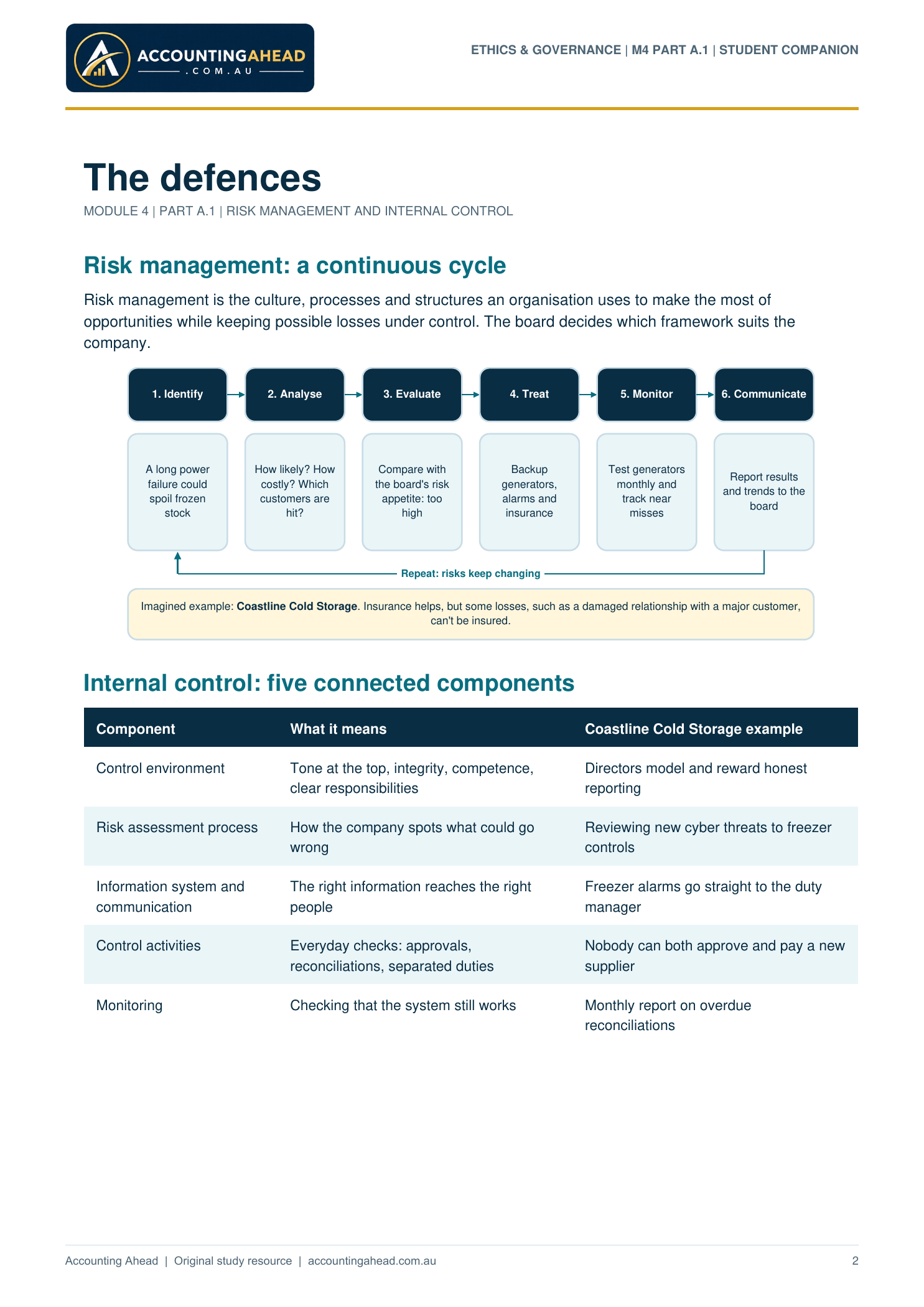
Risk management: a continuous cycle
Risk management is the culture, processes and structures an organisation uses to make the most of
opportunities while keeping possible losses under control. The board decides which framework suits the
company.
1. Identify
A long power
failure could
spoil frozen
stock
2. Analyse
How likely? How
costly? Which
customers are
hit?
3. Evaluate
Compare with
the board's risk
appetite: too
high
4. Treat
Backup
generators,
alarms and
insurance
5. Monitor
Test generators
monthly and
track near
misses
6. Communicate
Report results
and trends to the
board
Repeat: risks keep changing
Imagined example: Coastline Cold Storage. Insurance helps, but some losses, such as a damaged relationship with a major customer,
can't be insured.
Internal control: five connected components
Component What it means Coastline Cold Storage example
Control environment Tone at the top, integrity, competence,
clear responsibilities
Directors model and reward honest
reporting
Risk assessment process How the company spots what could go
wrong
Reviewing new cyber threats to freezer
controls
Information system and
communication
The right information reaches the right
people
Freezer alarms go straight to the duty
manager
Control activities Everyday checks: approvals,
reconciliations, separated duties
Nobody can both approve and pay a new
supplier
Monitoring Checking that the system still works Monthly report on overdue
reconciliations
ETHICS & GOVERNANCE | M4 PART A.1 | STUDENT COMPANION
2
Accounting Ahead | Original study resource | accountingahead.com.au
An independent chair
MODULE 4 | PART A.1 | WHO LEADS THE BOARD'S CHALLENGE?
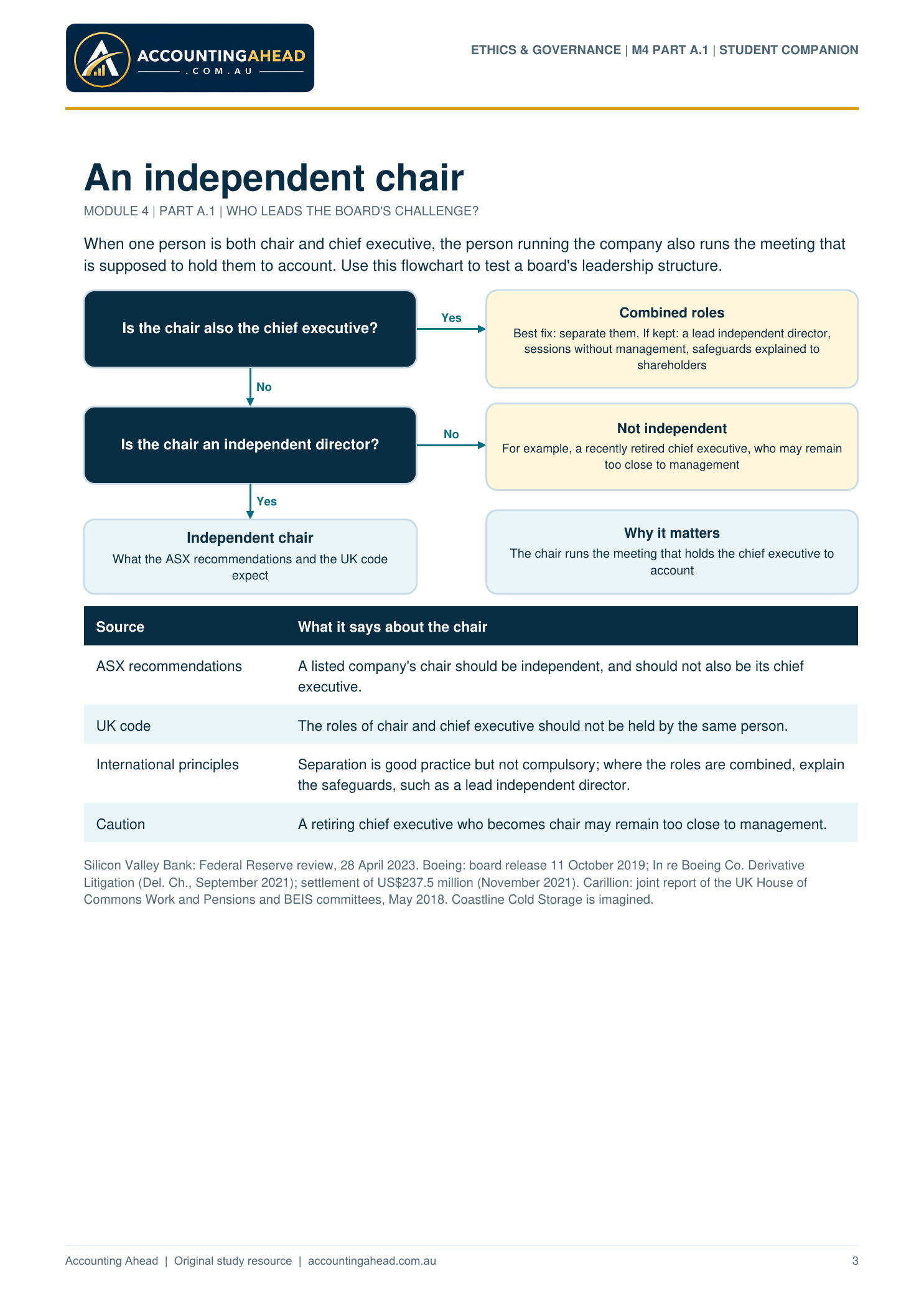
When one person is both chair and chief executive, the person running the company also runs the meeting that
is supposed to hold them to account. Use this flowchart to test a board's leadership structure.
Is the chair also the chief executive? Yes Combined roles
Best fix: separate them. If kept: a lead independent director,
sessions without management, safeguards explained to
shareholders
No
Is the chair an independent director? No Not independent
For example, a recently retired chief executive, who may remain
too close to management
Yes
Independent chair
What the ASX recommendations and the UK code
expect
Why it matters
The chair runs the meeting that holds the chief executive to
account
Source What it says about the chair
ASX recommendations A listed company's chair should be independent, and should not also be its chief
executive.
UK code The roles of chair and chief executive should not be held by the same person.
International principles Separation is good practice but not compulsory; where the roles are combined, explain
the safeguards, such as a lead independent director.
Caution A retiring chief executive who becomes chair may remain too close to management.
Silicon Valley Bank: Federal Reserve review, 28 April 2023. Boeing: board release 11 October 2019; In re Boeing Co. Derivative
Litigation (Del. Ch., September 2021); settlement of US$237.5 million (November 2021). Carillion: joint report of the UK House of
Commons Work and Pensions and BEIS committees, May 2018. Coastline Cold Storage is imagined.
ETHICS & GOVERNANCE | M4 PART A.1 | STUDENT COMPANION
3
Accounting Ahead | Original study resource | accountingahead.com.au
Practice questions
MODULE 4 | PART A.1 | TRY THESE BEFORE THE WORKED ANSWERS
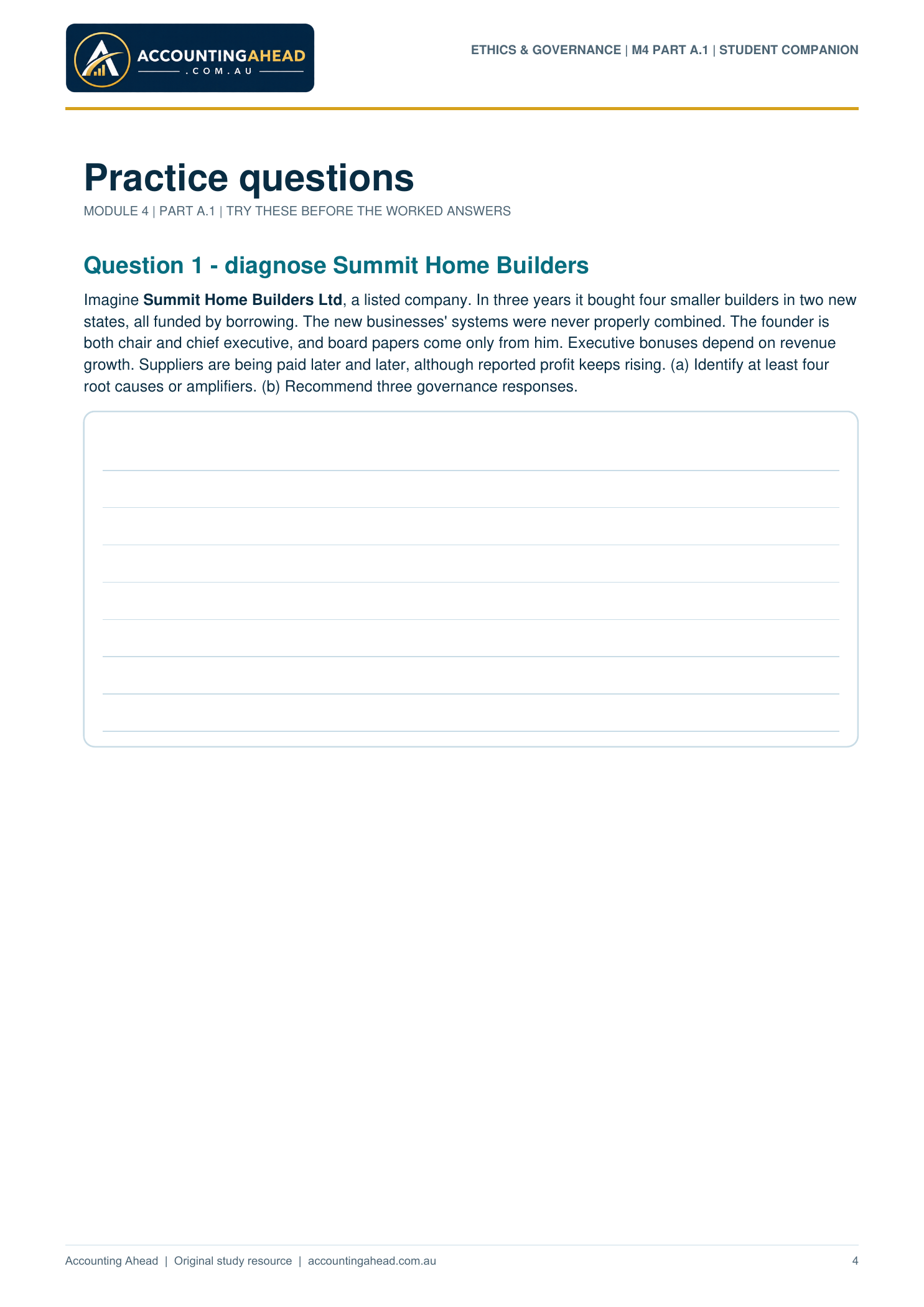
Question 1 - diagnose Summit Home Builders
Imagine Summit Home Builders Ltd, a listed company. In three years it bought four smaller builders in two new
states, all funded by borrowing. The new businesses' systems were never properly combined. The founder is
both chair and chief executive, and board papers come only from him. Executive bonuses depend on revenue
growth. Suppliers are being paid later and later, although reported profit keeps rising. (a) Identify at least four
root causes or amplifiers. (b) Recommend three governance responses.
ETHICS & GOVERNANCE | M4 PART A.1 | STUDENT COMPANION
4
Accounting Ahead | Original study resource | accountingahead.com.au
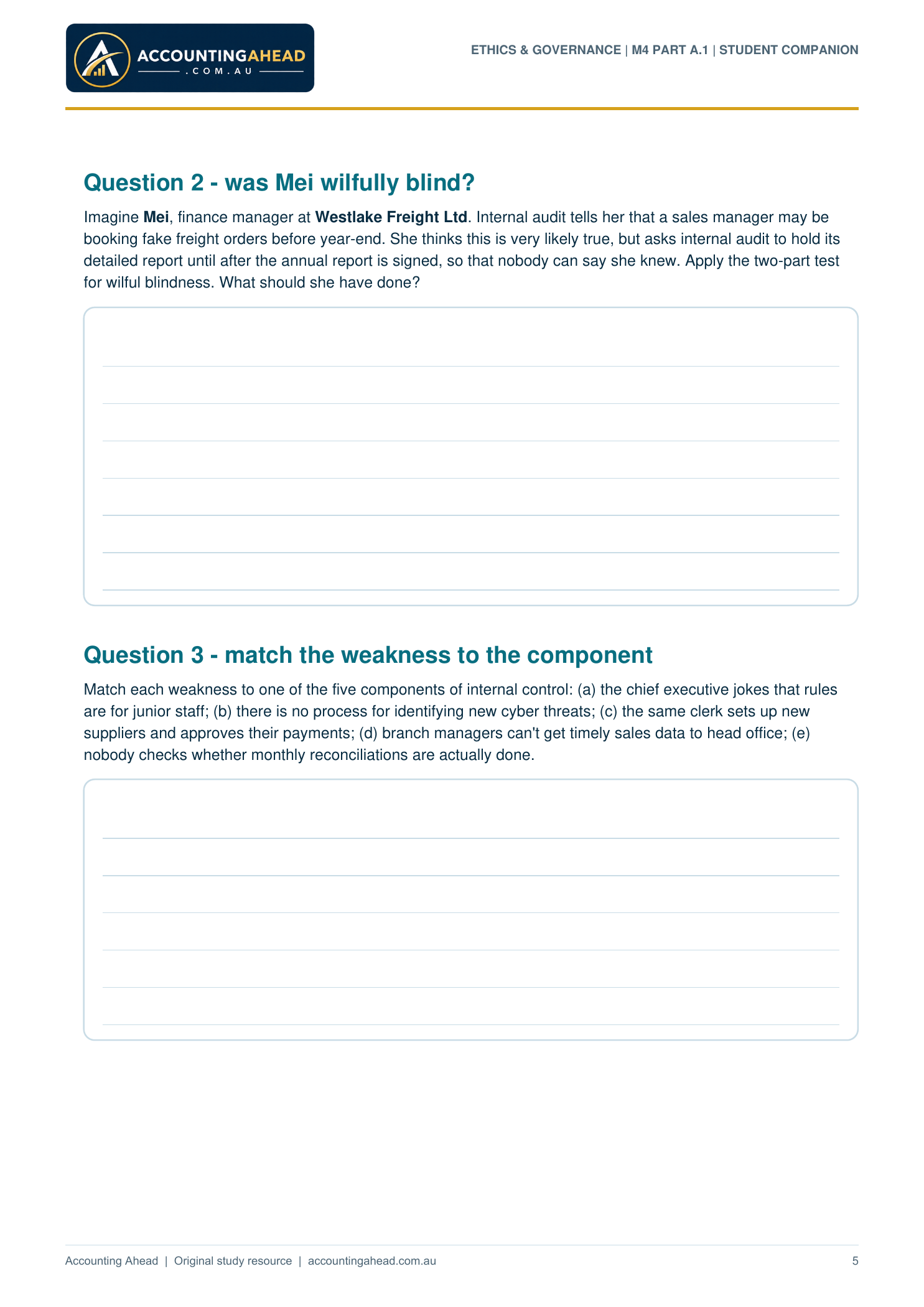
Question 2 - was Mei wilfully blind?
Imagine Mei, finance manager at Westlake Freight Ltd. Internal audit tells her that a sales manager may be
booking fake freight orders before year-end. She thinks this is very likely true, but asks internal audit to hold its
detailed report until after the annual report is signed, so that nobody can say she knew. Apply the two-part test
for wilful blindness. What should she have done?
Question 3 - match the weakness to the component
Match each weakness to one of the five components of internal control: (a) the chief executive jokes that rules
are for junior staff; (b) there is no process for identifying new cyber threats; (c) the same clerk sets up new
suppliers and approves their payments; (d) branch managers can't get timely sales data to head office; (e)
nobody checks whether monthly reconciliations are actually done.
ETHICS & GOVERNANCE | M4 PART A.1 | STUDENT COMPANION
5
Accounting Ahead | Original study resource | accountingahead.com.au
Worked answers
MODULE 4 | PART A.1 | WORKED ANSWERS - ATTEMPT THE QUESTIONS FIRST
Question 1 - Summit Home Builders
Over-expansion: four acquisitions in three years in new states, with systems never combined.
Dominant chief executive and ineffective board: the founder chairs the board and controls its information.
Pay that rewards the wrong thing: bonuses tied to revenue growth encourage growth at any cost.
Cash strain: suppliers paid later and later even though profit is rising - profit is not cash.
Debt: borrowing to fund expansion raises the stakes if the integration fails.
Possible responses: appoint an independent chair (or at least a lead independent director); require independent
board papers, including cash flow and integration reports; pause acquisitions until systems are combined;
rebalance bonuses towards long-term, cash and risk measures; ask the audit committee and internal audit to
test controls in the acquired businesses.
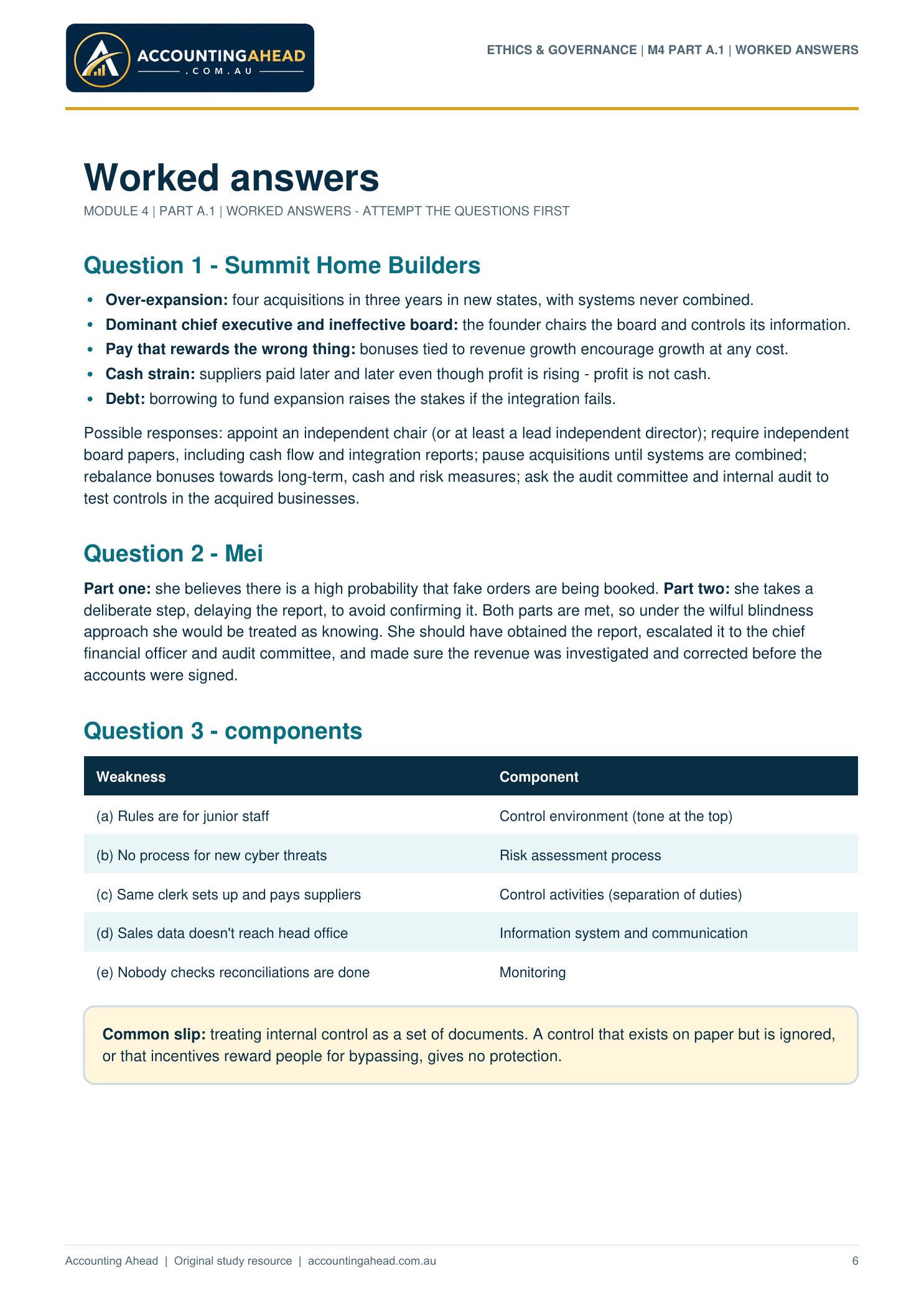
Question 2 - Mei
Part one: she believes there is a high probability that fake orders are being booked. Part two: she takes a
deliberate step, delaying the report, to avoid confirming it. Both parts are met, so under the wilful blindness
approach she would be treated as knowing. She should have obtained the report, escalated it to the chief
financial officer and audit committee, and made sure the revenue was investigated and corrected before the
accounts were signed.
Question 3 - components
Weakness Component
(a) Rules are for junior staff Control environment (tone at the top)
(b) No process for new cyber threats Risk assessment process
(c) Same clerk sets up and pays suppliers Control activities (separation of duties)
(d) Sales data doesn't reach head office Information system and communication
(e) Nobody checks reconciliations are done Monitoring
Common slip: treating internal control as a set of documents. A control that exists on paper but is ignored,
or that incentives reward people for bypassing, gives no protection.
ETHICS & GOVERNANCE | M4 PART A.1 | WORKED ANSWERS
6