
Climate reporting, carbon pricing and greenwashing — student companion
Original branded notes, diagrams and practice with worked answers for Part F.1: follow the international climate response, calculate cap-and-trade choices and test environmental claims against scope, evidence and governance.
Read the handout text
Accounting Ahead | Original study resource | accountingahead.com.au
Climate change reporting
MODULE 5 | PART F.1 | STUDENT COMPANION
Greenhouse gases let the sun's energy warm the Earth and trap some of the heat. Human activity, mainly
burning fossil fuels and clearing land, is increasing their concentration, and the climate is changing. Climate
change is an externality that conventional accounting leaves out, because of how the elements are defined and
the entity assumption.
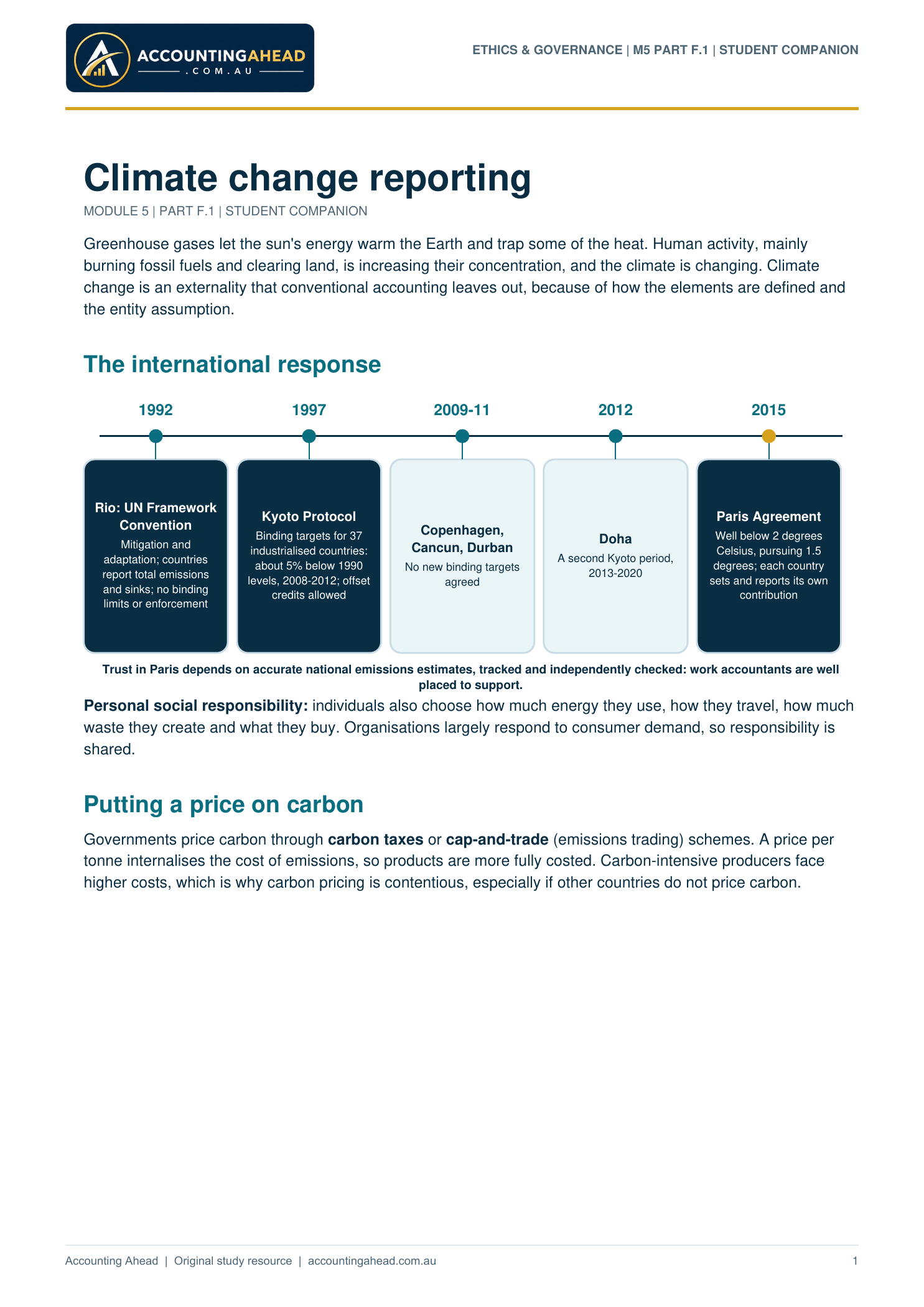
The international response
1992
Rio: UN Framework
Convention
Mitigation and
adaptation; countries
report total emissions
and sinks; no binding
limits or enforcement
1997
Kyoto Protocol
Binding targets for 37
industrialised countries:
about 5% below 1990
levels, 2008-2012; offset
credits allowed
2009-11
Copenhagen,
Cancun, Durban
No new binding targets
agreed
2012
Doha
A second Kyoto period,
2013-2020
2015
Paris Agreement
Well below 2 degrees
Celsius, pursuing 1.5
degrees; each country
sets and reports its own
contribution
Trust in Paris depends on accurate national emissions estimates, tracked and independently checked: work accountants are well
placed to support.
Personal social responsibility: individuals also choose how much energy they use, how they travel, how much
waste they create and what they buy. Organisations largely respond to consumer demand, so responsibility is
shared.
Putting a price on carbon
Governments price carbon through carbon taxes or cap-and-trade (emissions trading) schemes. A price per
tonne internalises the cost of emissions, so products are more fully costed. Carbon-intensive producers face
higher costs, which is why carbon pricing is contentious, especially if other countries do not price carbon.
ETHICS & GOVERNANCE | M5 PART F.1 | STUDENT COMPANION
1
Accounting Ahead | Original study resource | accountingahead.com.au
Cap-and-trade and accounting for
emissions
MODULE 5 | PART F.1 | MECHANICS AND RULES
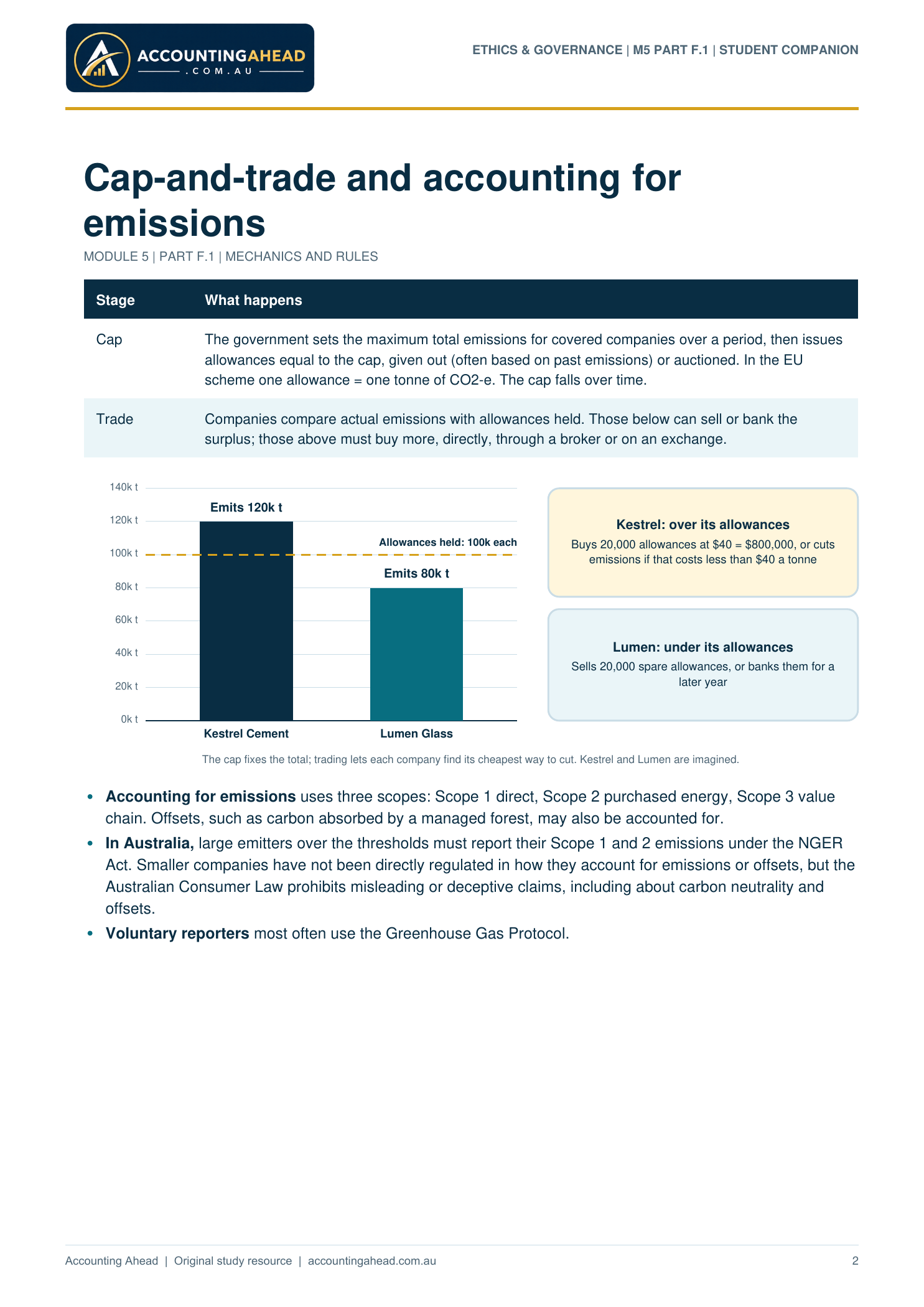
Stage What happens
Cap The government sets the maximum total emissions for covered companies over a period, then issues
allowances equal to the cap, given out (often based on past emissions) or auctioned. In the EU
scheme one allowance = one tonne of CO2-e. The cap falls over time.
Trade Companies compare actual emissions with allowances held. Those below can sell or bank the
surplus; those above must buy more, directly, through a broker or on an exchange.
0k t
20k t
40k t
60k t
80k t
100k t
120k t
140k t
Emits 120k t
Kestrel Cement
Emits 80k t
Lumen Glass
Allowances held: 100k each
Kestrel: over its allowances
Buys 20,000 allowances at $40 = $800,000, or cuts
emissions if that costs less than $40 a tonne
Lumen: under its allowances
Sells 20,000 spare allowances, or banks them for a
later year
The cap fixes the total; trading lets each company find its cheapest way to cut. Kestrel and Lumen are imagined.
Accounting for emissions uses three scopes: Scope 1 direct, Scope 2 purchased energy, Scope 3 value
chain. Offsets, such as carbon absorbed by a managed forest, may also be accounted for.
In Australia, large emitters over the thresholds must report their Scope 1 and 2 emissions under the NGER
Act. Smaller companies have not been directly regulated in how they account for emissions or offsets, but the
Australian Consumer Law prohibits misleading or deceptive claims, including about carbon neutrality and
offsets.
Voluntary reporters most often use the Greenhouse Gas Protocol.
ETHICS & GOVERNANCE | M5 PART F.1 | STUDENT COMPANION
2
Accounting Ahead | Original study resource | accountingahead.com.au
Regulators, standards and greenwashing
MODULE 5 | PART F.1 | GOVERNANCE AND CASE NOTES
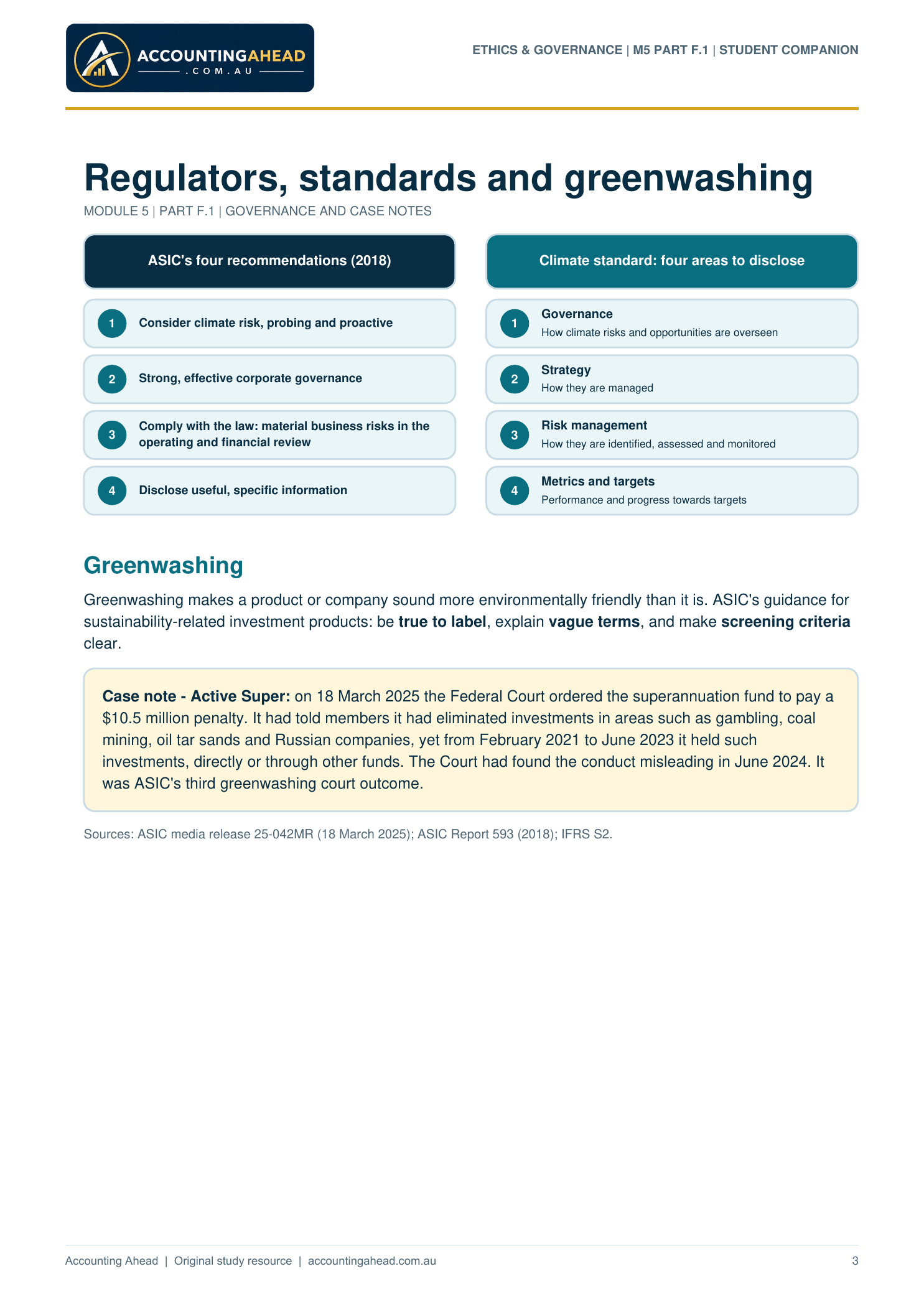
ASIC's four recommendations (2018)
1 Consider climate risk, probing and proactive
2 Strong, effective corporate governance
3 Comply with the law: material business risks in the
operating and financial review
4 Disclose useful, specific information
Climate standard: four areas to disclose
1 Governance
How climate risks and opportunities are overseen
2 Strategy
How they are managed
3 Risk management
How they are identified, assessed and monitored
4 Metrics and targets
Performance and progress towards targets
Greenwashing
Greenwashing makes a product or company sound more environmentally friendly than it is. ASIC's guidance for
sustainability-related investment products: be true to label, explain vague terms, and make screening criteria
clear.
Case note - Active Super: on 18 March 2025 the Federal Court ordered the superannuation fund to pay a
$10.5 million penalty. It had told members it had eliminated investments in areas such as gambling, coal
mining, oil tar sands and Russian companies, yet from February 2021 to June 2023 it held such
investments, directly or through other funds. The Court had found the conduct misleading in June 2024. It
was ASIC's third greenwashing court outcome.
Sources: ASIC media release 25-042MR (18 March 2025); ASIC Report 593 (2018); IFRS S2.
ETHICS & GOVERNANCE | M5 PART F.1 | STUDENT COMPANION
3
Accounting Ahead | Original study resource | accountingahead.com.au
Practice questions
MODULE 5 | PART F.1 | TRY THESE BEFORE THE WORKED ANSWERS
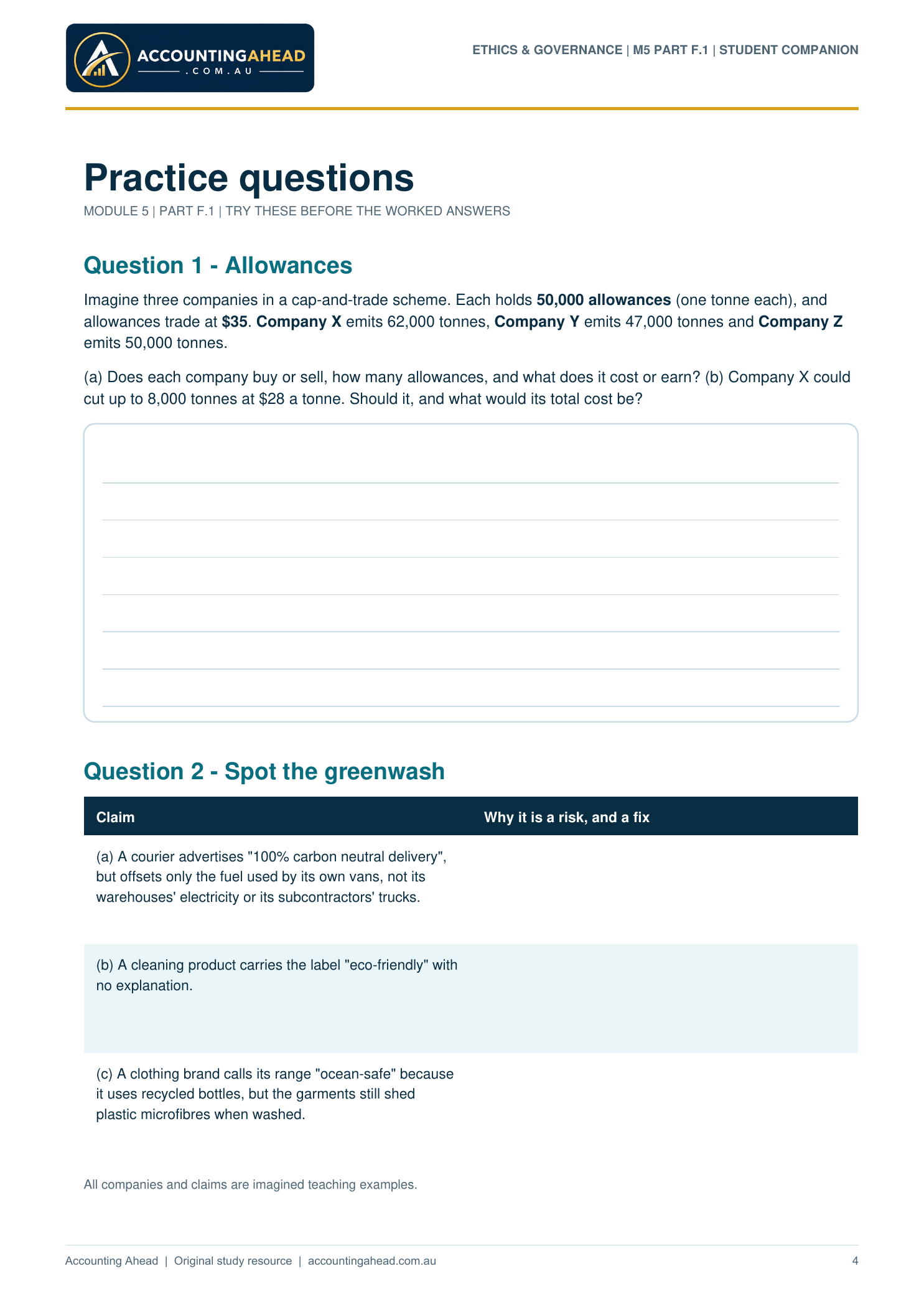
Question 1 - Allowances
Imagine three companies in a cap-and-trade scheme. Each holds 50,000 allowances (one tonne each), and
allowances trade at $35. Company X emits 62,000 tonnes, Company Y emits 47,000 tonnes and Company Z
emits 50,000 tonnes.
(a) Does each company buy or sell, how many allowances, and what does it cost or earn? (b) Company X could
cut up to 8,000 tonnes at $28 a tonne. Should it, and what would its total cost be?
Question 2 - Spot the greenwash
Claim Why it is a risk, and a fix
(a) A courier advertises "100% carbon neutral delivery",
but offsets only the fuel used by its own vans, not its
warehouses' electricity or its subcontractors' trucks.
(b) A cleaning product carries the label "eco-friendly" with
no explanation.
(c) A clothing brand calls its range "ocean-safe" because
it uses recycled bottles, but the garments still shed
plastic microfibres when washed.
All companies and claims are imagined teaching examples.
ETHICS & GOVERNANCE | M5 PART F.1 | STUDENT COMPANION
4
Accounting Ahead | Original study resource | accountingahead.com.au
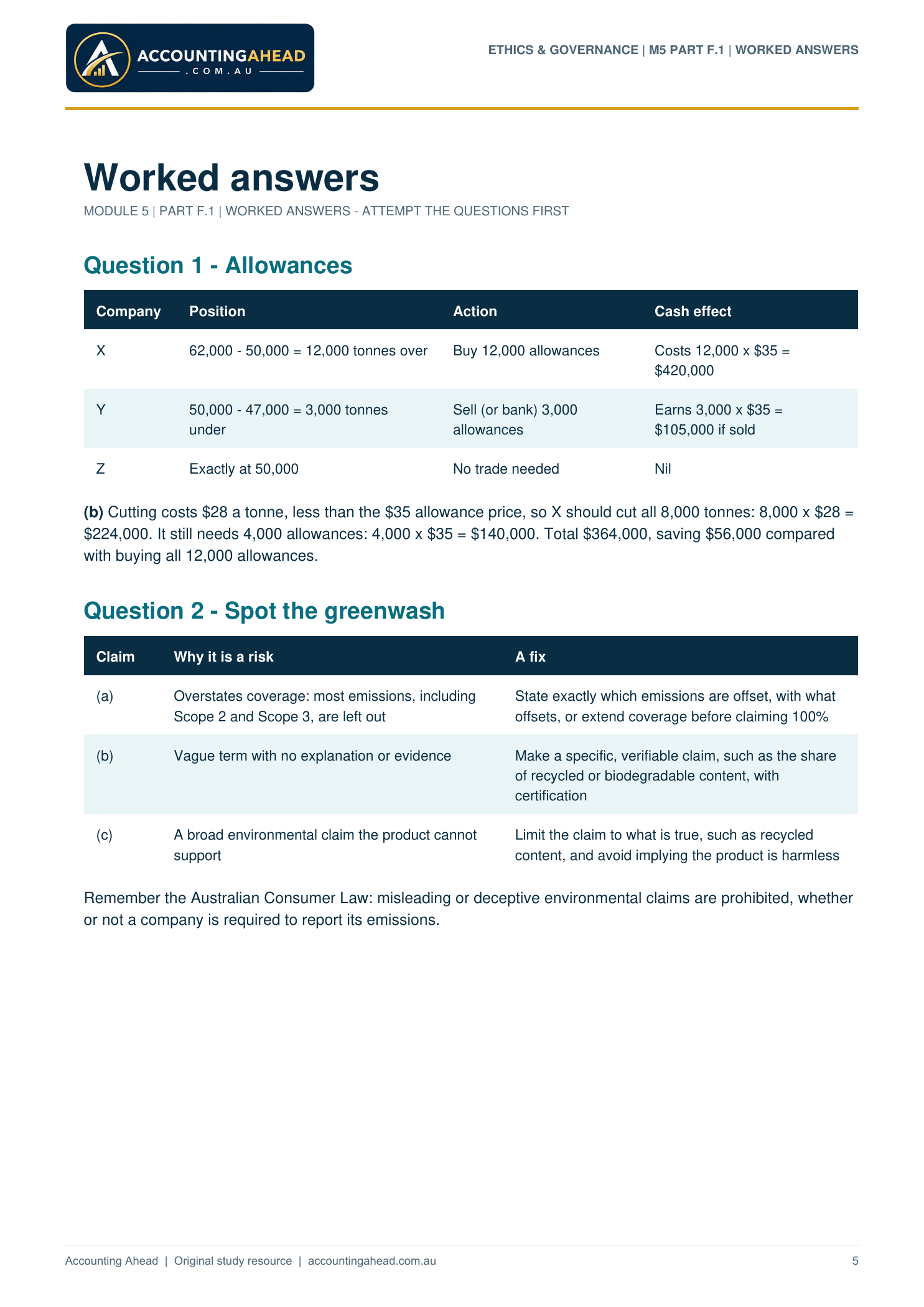
Worked answers
MODULE 5 | PART F.1 | WORKED ANSWERS - ATTEMPT THE QUESTIONS FIRST
Question 1 - Allowances
Company Position Action Cash effect
X 62,000 - 50,000 = 12,000 tonnes over Buy 12,000 allowances Costs 12,000 x $35 =
$420,000
Y 50,000 - 47,000 = 3,000 tonnes
under
Sell (or bank) 3,000
allowances
Earns 3,000 x $35 =
$105,000 if sold
Z Exactly at 50,000 No trade needed Nil
(b) Cutting costs $28 a tonne, less than the $35 allowance price, so X should cut all 8,000 tonnes: 8,000 x $28 =
$224,000. It still needs 4,000 allowances: 4,000 x $35 = $140,000. Total $364,000, saving $56,000 compared
with buying all 12,000 allowances.
Question 2 - Spot the greenwash
Claim Why it is a risk A fix
(a) Overstates coverage: most emissions, including
Scope 2 and Scope 3, are left out
State exactly which emissions are offset, with what
offsets, or extend coverage before claiming 100%
(b) Vague term with no explanation or evidence Make a specific, verifiable claim, such as the share
of recycled or biodegradable content, with
certification
(c) A broad environmental claim the product cannot
support
Limit the claim to what is true, such as recycled
content, and avoid implying the product is harmless
Remember the Australian Consumer Law: misleading or deceptive environmental claims are prohibited, whether
or not a company is required to report its emissions.
ETHICS & GOVERNANCE | M5 PART F.1 | WORKED ANSWERS
5